Search results
Search for "solid state" in Full Text gives 481 result(s) in Beilstein Journal of Organic Chemistry. Showing first 200.
Discovery of sugarnitriles A and B, and structural reassignment of SF-2140, from a sugarcane endophytic actinomycete Amycolatopsis sp. JS-O27
Beilstein J. Org. Chem. 2026, 22, 1114–1121, doi:10.3762/bjoc.22.90
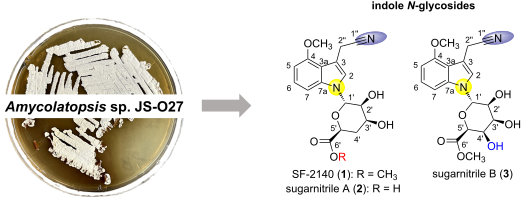
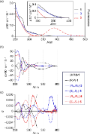
- File 1, and Figure 2a). Since the 13C and 2D NMR data of SF-2140 were lacking in previous papers [19][28], the current research supplemented the missing information. The sugar moiety of SF-2140 has been determined to adopt a 1C4 conformation in the solid state and was suggested to adopt a possible


The trans-influence in gold chemistry from a catalytic perspective
Beilstein J. Org. Chem. 2026, 22, 838–856, doi:10.3762/bjoc.22.66
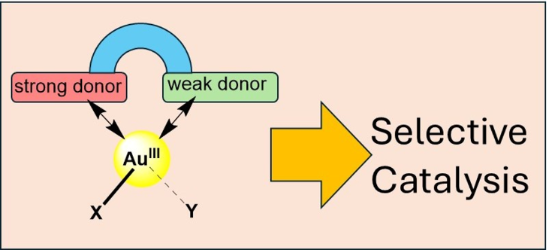
- other respects, notably in their π-acceptor capacity. This leads to interesting photoluminescence effects. For example, while (C^Npy^C)AuCl shows poor photoemissions in the solid state, this changes if Cl is replaced by strong donors, notably aryl, alkynyl or thiolate anions [39][40]. These raise the


Unsymmetrical sulfoxides with sterically hindered catechol fragment: synthesis, structure, electrochemical properties, and antiradical activity
Beilstein J. Org. Chem. 2026, 22, 828–837, doi:10.3762/bjoc.22.65
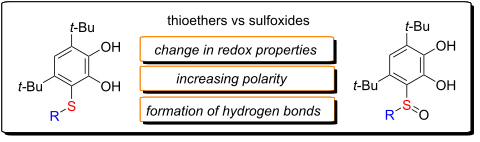
- in the solid state and in solution, highlighting the structural role of the sulfinyl group. Cyclic voltammetry demonstrated that the oxidation potential of the catechol fragment is systematically modulated by the oxidation state of the sulfur atom. The introduction of the S=O group shifts the first


Synthesis and structural elucidation of a novel bis-spirooxindole from isatin and ethylenediamine
Beilstein J. Org. Chem. 2026, 22, 813–820, doi:10.3762/bjoc.22.63
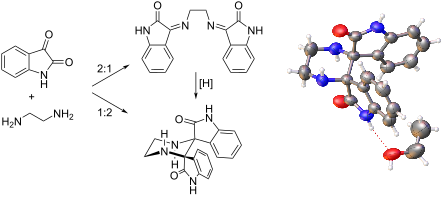
- molecule displays C2 symmetry, consistent with the simplified NMR spectra, and the solid-state metrics support the proposed pentacyclic structure. Compound 25 (C18H17N4O2 u.d. = 13) has one degree less of unsaturation than the diimine 24 (C18H14N4O2 u.d. = 14) suggesting that a reduction is required for


Knoevenagel condensation of 4,5- and 1,8-diazafluorenes
Beilstein J. Org. Chem. 2026, 22, 803–812, doi:10.3762/bjoc.22.62
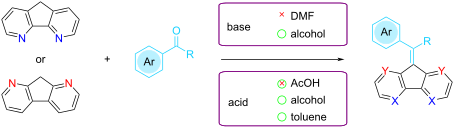
- materials [14]. Furthermore, diazafluorenylidenes may exhibit polymorphism, high solid-state emission, and decent charge carrier mobility which makes these molecules promising for use in organic optoelectronics [5][15][16]. Current synthetic approaches to diazafluorenylidenes are limited. The typical method




Halogenated azobenzene acrylates: from efficient solution photoswitching to stable solid-state photochromic materials
Beilstein J. Org. Chem. 2026, 22, 782–794, doi:10.3762/bjoc.22.60
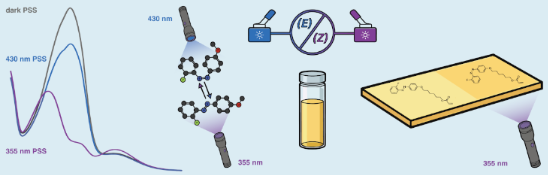
- similar photoswitching in the solid-state is much less explored. Since Hartley’s first report on a spatial rearrangement along the N=N double bond of azobenzene [5], a plethora of related molecular photoswitches has been developed and it has also been demonstrated that azobenzene can be covalently bound
- solid-state E/Z isomerization [8][9]. Azobenzene was also incorporated into the structure of liquid crystal elastomers (LCEs) [10][11], where UV-light curing increases thermally induced LCE film actuation or even locks the film in a specific shape during flipping [10]. The phenomenon of photoactuation
- pattern is known to provide a very long half-life of the Z-isomer ranging from tens of days to months [23][24]. Photoswitching properties both in solution and in the solid state were investigated along with a potential use of 1a–f as thermal-sensing labels. For these purposes, differential scanning


Hydrogen production from formic acid catalyzed by NHC–Cu complexes
Beilstein J. Org. Chem. 2026, 22, 620–627, doi:10.3762/bjoc.22.48
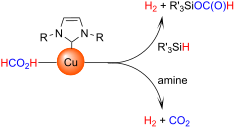
- ), almost 2 equivalents of gas were produced from 1 equivalent of formic acid within 3 hours. It has to be noted that, since all reactions were conducted in solution, all copper complexes must be considered as monomeric. In fact, dimeric Cu–H and Cu–formato are generally observed only in the solid state [53



Synthesis and stereochemical analysis of dynamic planar chiral oxa[7]orthocyclophene
Beilstein J. Org. Chem. 2026, 22, 436–442, doi:10.3762/bjoc.22.30

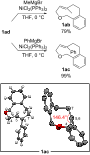
- X-ray crystallographic analysis was performed (CCDC 2513894). The solid-state structure of 1ac shows that the phenyl group on the E-alkene is directed antiparallel to the fused benzene ring. The dihedral angle of the alkene moiety (∠C4–C5–C6–C7) of 1ac is 146.4°, which is distorted by 33.6° from an




Synthesis and anti-cancer activity of naphthalimide–organylselanyl conjugates
Beilstein J. Org. Chem. 2026, 22, 416–435, doi:10.3762/bjoc.22.29
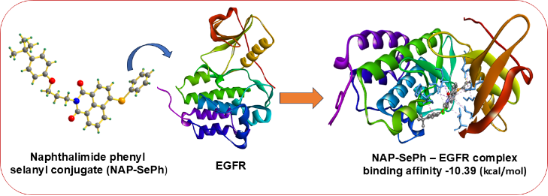
- solid state structure of the compound 7. All the above-mentioned non-bonded interaction distances are shorter than the sum of the van der Waals radii of the respective elements in contact [55]. Computational analysis To further evaluate the energy-minimised structures useful for molecular
- -crystal XRD coordinate file, while the structure of compound 8 was constructed using Gaussian tools. The C–Se–C bond angle computed from the gas phase optimised structure of 7 is 97.8°. It is in good agreement with the bond angle (102.5°) observed from the solid-state structure of 7. Due to steric reasons
- selenium center. The second important feature is the torsional motion in the propylene linker attached to the imide nitrogen of the naphthalimide core. The calculated O–C–C–C torsional angle from the gas-phase structure of 7 is −61.5°. The observed torsional angle from the solid-state structure of 7 is




Arene activation via π-bond localization: concepts and opportunities
Beilstein J. Org. Chem. 2026, 22, 257–273, doi:10.3762/bjoc.22.19
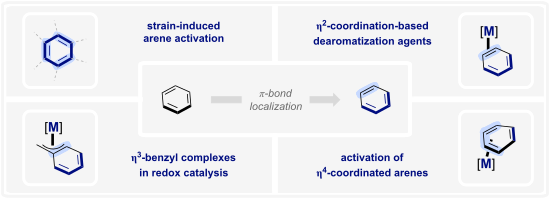
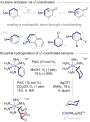
- metal fragment localizes a subset of the π-system, effectively unmasking the latent double-bond character of the aromatic ring. This is strikingly captured in the solid-state structure of the complex. One ring retains near-planarity, with a mean C–C distance of 1.41 Å, which is slightly elongated




Configuration–packing synergy enabling integrated crystalline-state RTP and amorphous-state TADF
Beilstein J. Org. Chem. 2026, 22, 224–236, doi:10.3762/bjoc.22.16
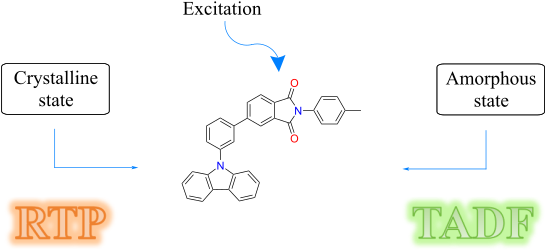
- analysis indicate that the HOMO and LUMO are localized on the carbazole and phthalimide fragments, respectively, affording a small singlet–triplet energy gap. In the solid state, compound 1 exhibits pronounced phase dependence: powder samples display room-temperature delayed emission with principal bands
- exciton recovery and enhancing device performance in both solution and solid states. Although significant progress has been made in developing systematic molecular and solid-state engineering strategies for RTP and TADF, examples of simultaneous “phosphorescence-delayed fluorescence” switching within a
- single molecule under different environments or phases are still relatively rare [33]. The underlying challenge lies in the different demands that RTP and TADF place on the microscopic configuration and solid-state environment. RTP typically favors molecular rigidity, confinement, and specific


Improved synthesis and physicochemical characterization of the selective serotonin 2A receptor agonist 25CN-NBOH
Beilstein J. Org. Chem. 2026, 22, 175–184, doi:10.3762/bjoc.22.11
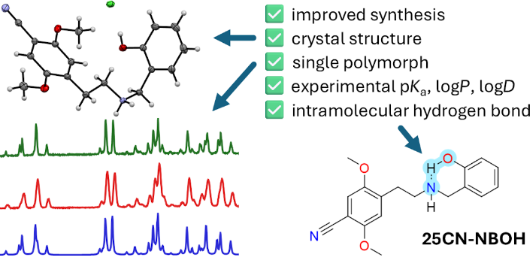
- characterization of 25CN-NBOH and report key physicochemical properties in the solid state as well as in the solution state, namely stability, ionization, solubility, partition coefficient, and membrane permeability. We show that the hydrochloride salt is a stable and well-defined crystalline compound that is also


Symmetrical D–π–A–π–D indanone dyes: a new design for nonlinear optics and cyanide detection
Beilstein J. Org. Chem. 2026, 22, 131–142, doi:10.3762/bjoc.22.6
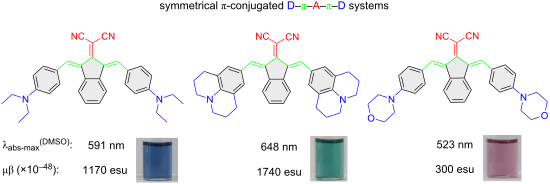
- at the B3LYP/6-31+G(d,p) level. Frontier molecular orbitals of a) 2a, b) 2a+CN−. TGA curves of dyes. Synthetic pathway of compounds. Proposed interaction mechanism with CN−. Summary of reaction conditions, yields, and solid state color of dyes 2a–c. Photophysical properties of dyes 2a–c in various


Recent advances in Norrish–Yang cyclization and dicarbonyl photoredox reactions for natural product synthesis
Beilstein J. Org. Chem. 2025, 21, 2315–2333, doi:10.3762/bjoc.21.177
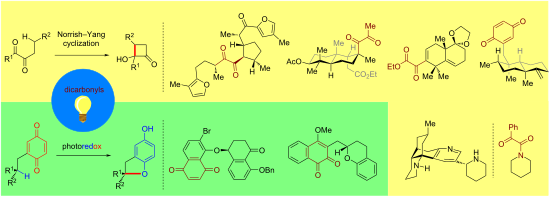
- stereoretentive coupling at C2 with aryl bromide 86, yielding 88 as a single diastereomer. Manipulation of the protecting group of 88 arrived at lycoplatyrine A (89). Notably, 87 and related α-hydroxy-β-lactams were obtained via Norrish–Yang cyclization of the corresponding neat α-keto amides in the solid state
- under blue LED irradiation. Solid-state reactions differ from solution-phase processes due to restraints on molecular motions imposed by the crystal lattice, thereby avoiding side reactions caused by unrestricted molecular motions in solution [41]. It has also been demonstrated that for crystalline 1,2
- undergoes SET to form a zwitterion as an intermediate step prior to cyclization [35][43][44]. It is noted that such molecular motions (rotations) are possible in solution but prevented by crystal-lattice restraints in the solid state [37]. In this synthesis, Sarpong et al. utilized the Norrish–Yang reaction




Insoluble methylene-bridged glycoluril dimers as sequestrants for dyes
Beilstein J. Org. Chem. 2025, 21, 2302–2314, doi:10.3762/bjoc.21.176
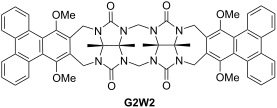
- along with comparator H2 as solid-state sequestrants for a panel of five dyes (methylene blue, methylene violet, acridine orange, rhodamine 6G, and methyl violet 6B). We find that catechol-walled H2 (OH substituents) is a superior sequestrant compared to G2W1–G2W4 (OMe substituents). X-ray crystal
- violet removal efficiency using triphenylene-walled G2W1. Design, synthesis and characterization of G2W1–G2W4 The sequestration of large planar aromatic dyes from aqueous solution into the solid state requires water-insoluble hosts that possess complementary molecular recognition surfaces. Previously, we
- larger aromatic walls in the form of triphenylene walls. To ensure that the targeted hosts display low aqueous solubility required for solid state sequestrants, we exchanged the O(CH2)3SO3Na groups for OMe groups. Accordingly, we targeted the preparation of W1 and W2 (Scheme 1) which contain large π



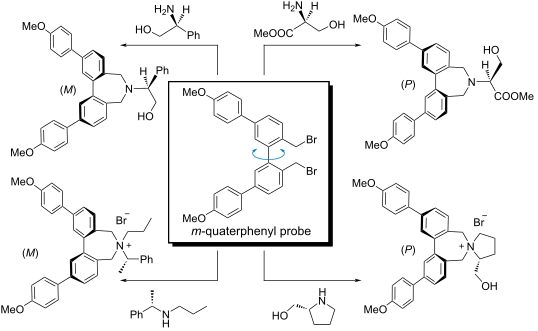
A m-quaterphenyl probe for absolute configurational assignments of primary and secondary amines
Beilstein J. Org. Chem. 2025, 21, 2211–2219, doi:10.3762/bjoc.21.168
- described above, the C6–C1–C1'–C6' dihedral angles in all conformers of (S)-3a–g and (R)-3h were approximately constant (plus or minus ca. 42 degree). The range of distribution of the angles was also small, ranging from +39.8 to +43.9 degrees, or −40.2 to −45.8 degrees (Figure 5). In the solid state of (S


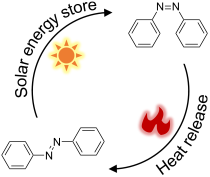
Solar thermal fuels: azobenzene as a cyclic photon–heat transduction platform
Beilstein J. Org. Chem. 2025, 21, 2036–2047, doi:10.3762/bjoc.21.159
- monomer to 103 min for the polymer. Linear azobenzene polymer solar thermal fuels Linear azobenzene polymers possess excellent processability and serve as ideal solid-state matrices for photoisomerization [49][50][51][52][53][54][55][56][57], making them suitable candidates for solar thermal fuels
- visible light under sunlight irradiation [59], achieving a solar efficiency of 0.4% and a solid-state isomerization efficiency of 72.7% (Figure 5b). Feng and co-workers reported the synthesis of three azopyridine polymers (ortho-, meta-, and para-) [60], with the m-azopyridine polymer exhibiting a
- azobenzene derivatives [82][83][84][85][86][87][88]. From an energy charging perspective, some solvent-free systems store energy in the solid state [89] or via photoinduced solid–liquid phase transitions [61][69][74], which occur because the melting temperature (Tm) of trans-azobenzene is above room




Understanding the origin of stereoselectivity in the photochemical denitrogenation of 2,3-diazabicyclo[2.2.1]heptene and its derivatives with non-adiabatic molecular dynamics
Beilstein J. Org. Chem. 2025, 21, 2007–2020, doi:10.3762/bjoc.21.156
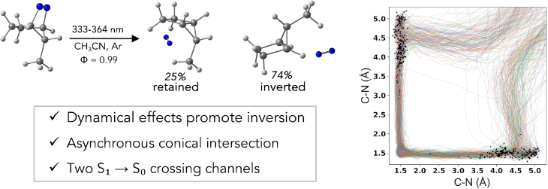
- ][68][69][70][71][72][73][74][75][76][77][78] mechanisms of cyclic azoalkenes have been studied with experimental and computational techniques for more than six decades, in solution [51][55][59][60][61][64][67][69][70][73][74][75][76][78][79], gas phase [50][55][62][64][65], and solid state [60][63


Systematic pore lipophilization to enhance the efficiency of an amine-based MOF catalyst in the solvent-free Knoevenagel reaction
Beilstein J. Org. Chem. 2025, 21, 1854–1863, doi:10.3762/bjoc.21.144
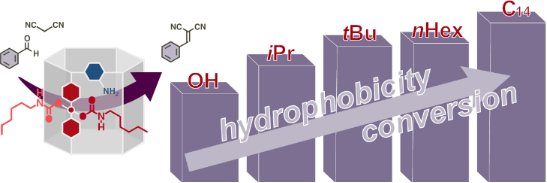
- functional groups are isolated together in confined space [7][8][9]. In the solid state, the generation of such multifunctional cavities has been pursued upon nanoporous scaffolds that include polymers of intrinsic microporosity (PIMs) [10][11][12][13], mesoporous silica materials (MSMs) [14][15][16][17


Photoswitches beyond azobenzene: a beginner’s guide
Beilstein J. Org. Chem. 2025, 21, 1808–1853, doi:10.3762/bjoc.21.143
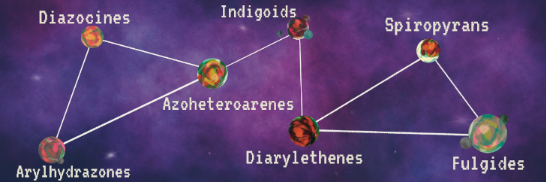
- ) [112]. Examples The Aprahamian group reported hydrazone 121, which is emissive in its Z-isomer. The fluorescence can be switched on and off by irradiation with 442 nm and 340 nm, respectively (Scheme 37) [114]. The photophysical and emissive properties were also maintained in bovine serum, in the solid
- state, and in the presence of glutathione, opening the possibility for applications in a biological environment. Some interesting isatin-based arylhydrazones were reported [115][116][117]. Compound 122H is a P-type hydrazone photoswitch. The addition of tetrabutylammonium fluoride (TBAF) deprotonates




3,3'-Linked BINOL macrocycles: optimized synthesis of crown ethers featuring one or two BINOL units
Beilstein J. Org. Chem. 2025, 21, 1719–1729, doi:10.3762/bjoc.21.134
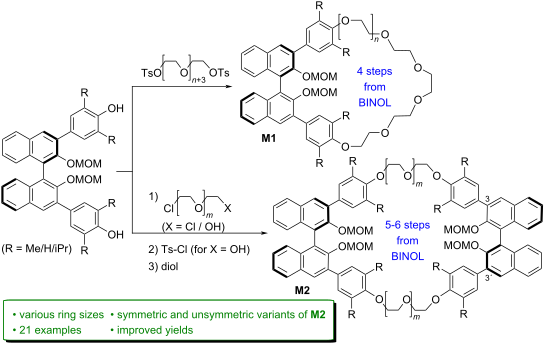
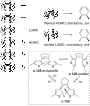
- bistosylates 85/6/7/8 (1.0 equiv), Cs2CO3 (2.0 equiv), CH3CN, 80 °C. Molecular structure of macrocycle (R)-Me-M16 in the solid state (hydrogen atoms are omitted for clarity and thermal ellipsoids are set at the 60% probability level). The ethylene glycol chain is partially disordered, only one component is
- : Experimental procedures and characterization data of new compounds. Supporting Information File 4: Crystallographic Information File (CIF) for the solid-state structure of (R)-Me-M16. Funding J.N. would like to thank the Deutsche Forschungsgemeinschaft DFG (project NI1273/2-2, project NI1273/5-1 and


Continuous-flow-enabled intensification in nitration processes: a review of technological developments and practical applications over the past decade
Beilstein J. Org. Chem. 2025, 21, 1678–1699, doi:10.3762/bjoc.21.132
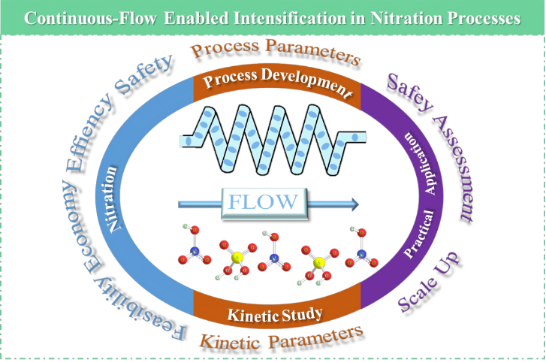
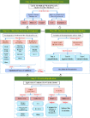
- nitration systems (Figure 4b). A significant proportion of nitration substrates are in the solid state, necessitating solvent-mediated dissolution to achieve practical operability in continuous-flow configurations. The common solvents used in nitration reactions include sulfuric acid (24%), dichloromethane



Synthesis of an aza[5]helicene-incorporated macrocyclic heteroarene via oxidation of an o-phenylene-pyrrole-thiophene icosamer
Beilstein J. Org. Chem. 2025, 21, 1561–1567, doi:10.3762/bjoc.21.119
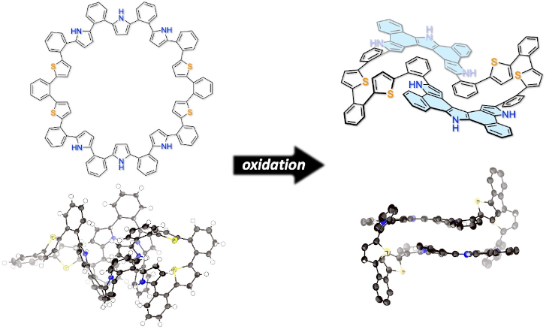
- and 8.98 ppm and five doublet signals due to the heterole β-protons in the range of 6.7–5.8 ppm, along with o-phenylene protons around 7 ppm. Single crystals suitable for X-ray diffraction analysis were obtained from a mixture of acetone/n-hexane and the solid-state structure was successfully
- aza[5]helicene-incorporated macrocyclic structure (Figure 4). In the solid-state, the distance between the two aza[5]helicene moieties was found to be 3.185 Å, closely consistent with the DFT-optimized value of 3.136 Å (see Supporting Information File 1). The average dihedral angles between the o


Highly distinguishable isomeric states of a tripodal arylazopyrazole derivative on graphite through electron/hole-induced switching at ambient conditions
Beilstein J. Org. Chem. 2025, 21, 1496–1507, doi:10.3762/bjoc.21.112
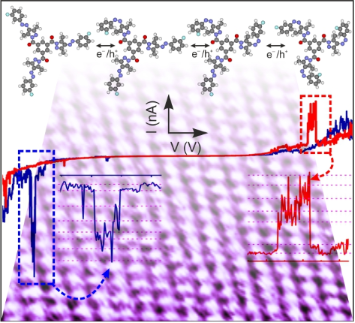
- hydrogelator [25], photoregulation of DNA nanosystems [26], in controlling surface wettability [27], and in solar energy conversion [28]. Considering these advantages, we synthesized C3 symmetric tripodal azopyrazole-based derivatives having a trimesoyl core and aroylazole connections as a solid-state
- switchable probe for light-driven reversible printing and erasing applications [29]. Besides exhibiting excellent photoswitching in solution phase, the tripodal photoswitches exhibit extended half-life of the ZZZ isomer in the solid-state as well [22][29]. The overall efficiency of the molecular switch could
- surface at ambient conditions. The fluorine substitution is chosen in FNAAP for its better photoisomerization efficiency (in solution as well as in solid state) and higher molecular stability [29]. Possible photoisomers of FNAAP, EEE, EEZ, EZZ and ZZZ are shown in Figure 1. FNAAP molecules assemble into



Wittig reaction of cyclobisbiphenylenecarbonyl
Beilstein J. Org. Chem. 2025, 21, 1454–1461, doi:10.3762/bjoc.21.107
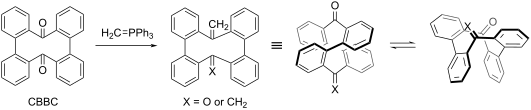
- reaction of CBBC 1 with methylenetriphenylphosphorane furnished two (exocyclic olefin)-containing macrocycles 3 and 5 as well as an internally functionalized DBC derivative 4. Compounds 3 and 5 adopt a bathtub-like conformation in the solid state. In solution, both figure-eight and bathtub conformations