


Search results
Search for "Young’s modulus" in Full Text gives 155 result(s) in Beilstein Journal of Nanotechnology.
Cellulose as a photocatalyst support material: extraction, structural features, and environmental applications
Beilstein J. Nanotechnol. 2026, 17, 635–652, doi:10.3762/bjnano.17.44
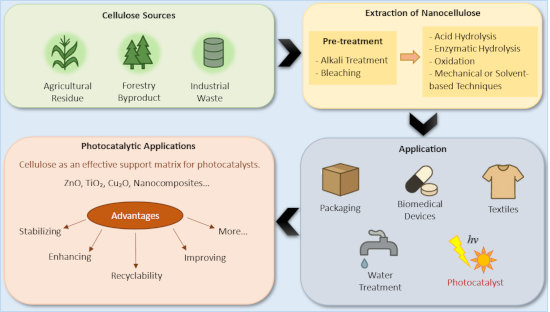
- mechanical strength, with a tensile capacity of about 10 GPa and a Young’s modulus of 140–150 GPa [11]. While CNFs can hold vast amounts of water, frequently exhibiting swelling ratios of 100 to 1,000 grams of water per gram of dry cellulose, which is 10,000% to 100,000% swelling capacity, while maintaining
- coverings. The nanocrystals extracted from tunicates have distinct advantages over other varieties, as they exhibit much higher aspect ratios than plant-derived cellulose nanocrystals and possess a Young’s modulus that even surpasses that of bacterial cellulose nanocrystals [38][39]. These exceptional


First-principles study on elastic properties of Cu, (Cu1−x,Nix)3Sn and interfacial mechanical properties of (Cu1−x,Nix)3Sn/Cu in the lead-free solder joint
Beilstein J. Nanotechnol. 2026, 17, 428–439, doi:10.3762/bjnano.17.29
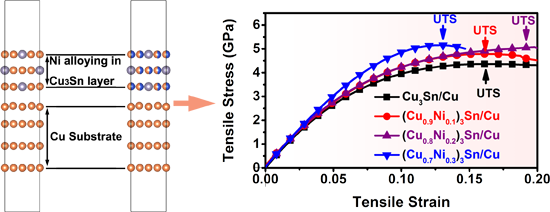
- mechanism can be attributed to the simultaneous improvements of oriented Young’s modulus and ductility of (CuxNi1−x)3Sn, achieved by Ni alloying. But higher Ni content beyond the thermodynamically stable domain of (CuxNi1−x)3Sn will deteriorate the interfacial mechanical properties by mechanical or
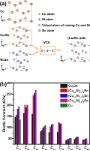
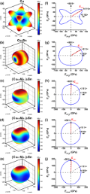
- constants, bulk modulus, shear modulus, Young’s modulus, anisotropy, and Poisson’s ratio of Cu and (CuxNi1−x)3Sn were calculated according to Voight–Reuss–Hill bounds [24][25]. Furthermore, from the calculated elastic constants, the orientation-dependent Young’s moduli of Cu and (CuxNi1−x)3Sn were
- (CuxNi1−x)3Sn, the average bulk modulus, shear modulus, Young’s modulus, universal anisotropy, and Poisson’s ratio were calculated according to the Voigt–Reuss–Hill approximations [25]. For FCC Cu, the Voigt-type bulk modulus BV and shear modulus GV, and the Reuss-type bulk modulus BR and shear modulus GR


Quantitative estimation of nanoparticle/substrate adhesion by atomic force microscopy
Beilstein J. Nanotechnol. 2026, 17, 1–14, doi:10.3762/bjnano.17.1

- parameters were used for the model: γ was taken as 2.3 J·m−2 [54], the Young’s modulus E of copper as 150 MPa [4], and the yield strength Y of Cu NPs with a diameter of ≈20 nm as 11 GPa [55]. While E and Y are not explicitly included in Equation 5, both parameters are essential for the model. Y affects the
- insightful characteristics for NP adhesion. The proposed method highlights the interplay between NP landing conditions governed by deposition parameters and NP-specific values like their diameter, surface energy, Young’s modulus, yield strength, as well as their crystallography-related anisotropies. Higher



Multifrequency AFM integrating PeakForce tapping and higher eigenmodes for heterogeneous surface characterization
Beilstein J. Nanotechnol. 2025, 16, 2077–2085, doi:10.3762/bjnano.16.142
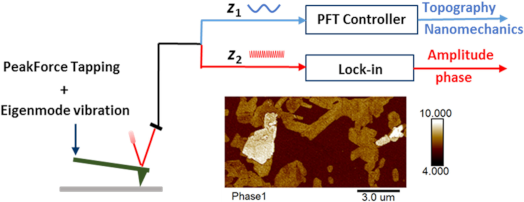
- environments such as liquids [18][19]. As demonstrated by force–distance curve analyses [19], PFT enables direct extraction of quantitative mechanical properties (e.g., Young’s modulus and adhesion) for material discrimination. However, this capability is constrained by the requirement for precise probe
- stiffness, insufficient sample deformation led to significant variability in modulus measurements (Figure 3b), indicating the ScanAsyst-Air probe was unsuitable for reliable Young’s modulus quantification. Comparative analysis revealed a high degree of similarity in the topography, modulus, and adhesion
- thicker nanosheet regions used for the reported histograms, and Ashman’s D values were computed for both Young’s modulus and phase signals using the method described in [25] (Table 3). D > 2 indicates clear separation of distributions. Modulus maps reveal probe-dependence; the soft probe fails to provide


Molecular and mechanical insights into gecko seta adhesion: multiscale simulations combining molecular dynamics and the finite element method
Beilstein J. Nanotechnol. 2025, 16, 2055–2076, doi:10.3762/bjnano.16.141
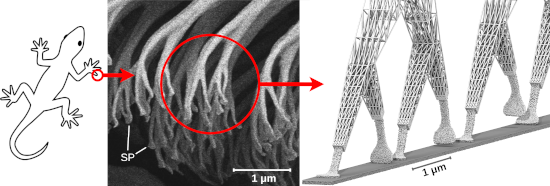
- given by Hooke’s law [36][37]: where σ is the Cauchy stress tensor, ε is the infinitesimal strain tensor, tr(ε) denotes the trace of the strain tensor, I is the second-order identity tensor, and λ and μ are the Lamé parameters defined as: with E being Young’s modulus and ν Poisson’s ratio. The real seta
- modulus and Poisson’s ratio, as derived from atomistic simulations and experimental data [11]. We generated ten such spatula models with differing bead positions and bond constants, yielding a Young’s modulus of 4.518 ± 0.036 GPa and a Poisson’s ratio of 0.401 ± 0.002. Details can be found in our previous
- the substrate. To ensure statistical robustness, we conducted five simulation runs using independently generated multiscale seta models. The same seta FE mesh, with slightly perturbed Young’s modulus and Poisson’s ratio (see subsection “Seta: finite elements”), was attached to 16 spatulae. Each






Further insights into the thermodynamics of linear carbon chains for temperatures ranging from 13 to 300 K
Beilstein J. Nanotechnol. 2025, 16, 1818–1825, doi:10.3762/bjnano.16.125
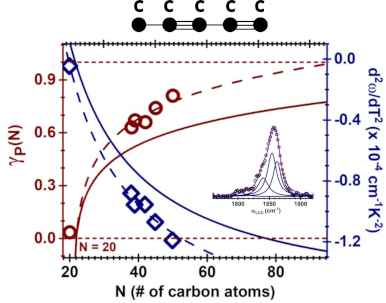
- allows thermal and mechanical properties of materials to be described by semi-classical theories (such as the Debye’s theory that describes the behavior of materials with T), and their phonon frequencies might be directly connected with relevant parameters such as the Young’s modulus, the Grüneisen


![[Graphic 23]](/bjnano/content/inline/2190-4286-16-125-i25.svg?max-width=637&scale=1.18182)
Beyond the bilayer: multilayered hygroscopic actuation in pine cone scales
Beilstein J. Nanotechnol. 2025, 16, 1695–1710, doi:10.3762/bjnano.16.119
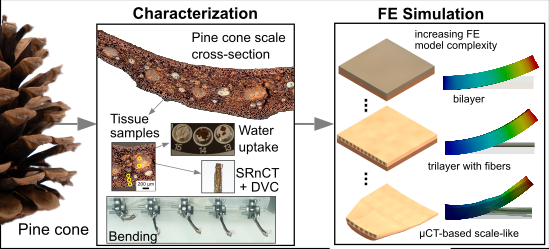
- scale-like geometry (5.57 mm). In the fiberless trilayer, a medium bending magnitude was achieved (4.11 mm), and the standard bilayer geometry bent the least (2.90 mm). By reducing the Young’s modulus of the sclerenchyma fiber layer in the bilayer, the maximum total displacement was increased to 5.10 mm
- . A similar trend was found for the scale-like geometry in which the Young’s modulus of the brown tissue was reduced, with an increased maximum displacement of 5.33 mm, and thus the highest value measured in any of the simulations. Looking at the change in curvature of the lateral axis of the
- multiple fibers. Thus, the sclerenchyma fiber layer contributes more to the structural Young’s modulus of the cone scale model, and the resulting bending is less than that observed in nature. Since previous simulations of the pine cone scale have used the bilayer model as a simplified geometry [23][30


Bioinspired polypropylene-based functionally graded materials and metamaterials modeling the mistletoe–host interface
Beilstein J. Nanotechnol. 2025, 16, 1592–1606, doi:10.3762/bjnano.16.113
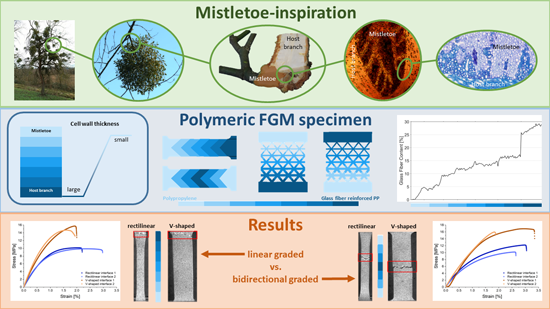
- showed that both Young’s modulus (by 38%) and ultimate tensile strength (by 62%) could be increased by introducing V-shaped interfaces. Digital image correlation analysis and the fracture images showed that the positioning of the area with the highest glass fiber content can lead to spatial control over
- − l0)/l0 = Δl/l0) values were calculated from the resulting force and displacement data and specimen geometries. The Young’s modulus (E = σ/ε) of the specimens was calculated within the linear region of the stress–strain curves, and the ultimate tensile strength (UTS) was calculated as the highest
- transitions. Mechanical properties and failure behavior The homogeneous PPGF specimens (1499.8 ± 123.7 MPa) revealed a 9.3% higher Young’s modulus than the non-reinforced PP specimens (1372.5 ± 156.2 MPa) (Figure 5A). A pronounced influence on the Young’s modulus was observed for the interface structuring of


Mechanical stability of individual bacterial cells under different osmotic pressure conditions: a nanoindentation study of Pseudomonas aeruginosa
Beilstein J. Nanotechnol. 2025, 16, 1171–1183, doi:10.3762/bjnano.16.86
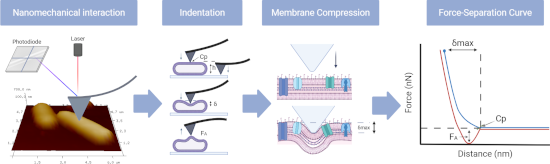
- conditions. Of particular interest was the extraction and comparison of nanomechanical maps obtained in the low range of loading forces to quantify its morphology, membrane stiffness, Young’s modulus of elasticity and adhesion when PA was tested in hypotonic (Milli-Q water), isotonic (0.1 M phosphate
- volume when the adhered bacteria are abruptly exposed to different osmotic pressures. In Figure 3, maps for three of the main physical parameters, height (h), stiffness (k), and Young’s modulus (Y) obtained in FV, are shown as columns, while the measuring conditions are given as rows. For the height
- background for stiffness and Young’s modulus. In these cases, the offset in the color-coded scales has been set to 0–35 mN/m and 0–5 MPa, respectively, for an easier and more direct interpretation of the obtained values. The stiffness is obtained from the slope of the curve during compression by the AFM tip


Soft materials nanoarchitectonics: liquid crystals, polymers, gels, biomaterials, and others
Beilstein J. Nanotechnol. 2025, 16, 1025–1067, doi:10.3762/bjnano.16.77







Multifunctional properties of bio-poly(butylene succinate) reinforced with multiwalled carbon nanotubes
Beilstein J. Nanotechnol. 2025, 16, 1014–1024, doi:10.3762/bjnano.16.76
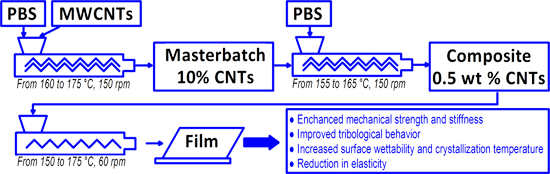
- packaging, which typically require elongation at break in the range of 100–600% and Young’s modulus between 200 and 700 MPa [25]. Potential applications include stretch sleeves, flexible lids, and barrier films, where controlled deformation and improved wear resistance are desired. Rheological analysis



Polyurethane/silk fibroin-based electrospun membranes for wound healing and skin substitute applications
Beilstein J. Nanotechnol. 2025, 16, 591–612, doi:10.3762/bjnano.16.46
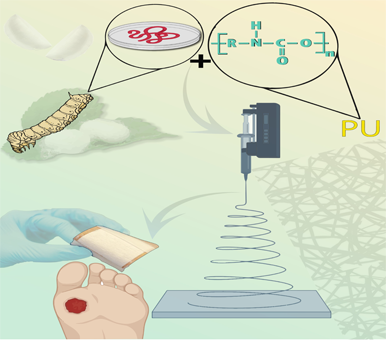
- the body [67]. Yildiz et al. used polycaprolactone (PCL)/SF to develop nanofibers as an improved skin substitute for treating chronic wounds or burns. The addition of SF increased tensile strength and Young’s modulus through intermolecular interactions. Results showed that the PCL/SF nanofibers had



N2+-implantation-induced tailoring of structural, morphological, optical, and electrical characteristics of sputtered molybdenum thin films
Beilstein J. Nanotechnol. 2025, 16, 495–509, doi:10.3762/bjnano.16.38
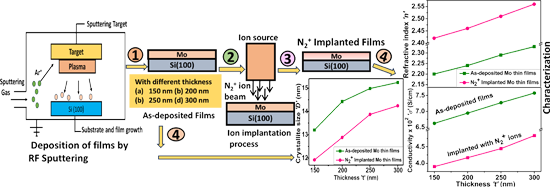
- residual stress in the Mo film. The stress induced in the films is calculated using the formula [13][33][37] where Ef is the Young’s modulus, νf represents the Poisson's ratio, d0 corresponds to the bulk interplanar spacing, and d is the calculated interplanar spacing. The material parameters for Mo are Ef


Enhancing mechanical properties of chitosan/PVA electrospun nanofibers: a comprehensive review
Beilstein J. Nanotechnol. 2025, 16, 286–307, doi:10.3762/bjnano.16.22

- place for better handling and positioning on the machine, as shown in Figure 9. Tensile properties measured by UTM include ultimate tensile strength, Young’s modulus, and elongation at break [134]. Ultimate tensile strength is the maximum stress the specimen can withstand before rupturing. Young's
- ratio on tensile properties of the material. Koosha et al. [59] observed a reduction in ultimate tensile strength, Young’s modulus, elongation at break, and toughness with the incorporation of chitosan as opposed to pure PVA membranes. As the chitosan content increases, the tensile strength decreases
- chitosan-to-PVA ratios in cross-linked chitosan/PVA nanofibers investigated by Zhou et al. [135] shows improvement in tensile strength, elongation at break, and Young’s modulus with increasing PVA content from 10% (w/w) to 50% (w/w). Choo et al. [136] measured the tensile strength and elongation at break


Hymenoptera and biomimetic surfaces: insights and innovations
Beilstein J. Nanotechnol. 2024, 15, 1333–1352, doi:10.3762/bjnano.15.107

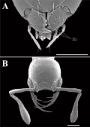
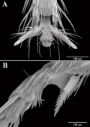
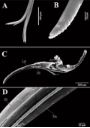
- these castes, the mandibles play a critical role, with different sizes and functions correlating to specific tasks within the colony [60]. Studies found that larger leafcutter ants (Atta laevigata, Attini) have higher Zn content in their mandible cutting edges, leading to greater hardness and Young’s
- modulus [61]. Understanding the mechanical properties and composition of leafcutter ant mandibles could offer valuable insights into biomimetic design principles, potentially inspiring the development of innovative tools and instruments with enhanced performance and adaptability for various applications





Interface properties of nanostructured carbon-coated biological implants: an overview
Beilstein J. Nanotechnol. 2024, 15, 1041–1053, doi:10.3762/bjnano.15.85
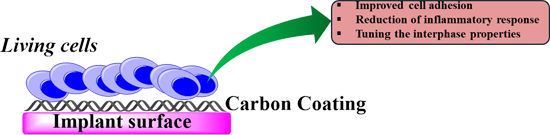
- materials In 2008, Lee and co-workers [32] stated that neat graphene was the strongest material ever tested with a tensile strength of 131 GPa and a Young’s modulus close to 1 TPa. The reason for these properties of graphene is the stability of the π-bond network around the hexagonal structures of carbon
- Young’s modulus of 100% and 156%, reaching 60 MPa and 0.52 GPa, respectively, after coating. CNTs are generally used to reinforce the bulk of composite-based implants [136] or added to polymeric films [135]. Interestingly, they can be mixed with hydroxyapatite in order to magnify the compatibility with



Electrospun polysuccinimide scaffolds containing different salts as potential wound dressing material
Beilstein J. Nanotechnol. 2024, 15, 781–796, doi:10.3762/bjnano.15.65
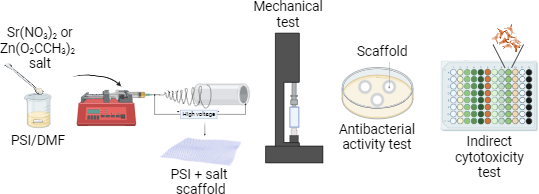
- the load and extension values by using the following equations: The cross-sectional area of the scaffolds was calculated from the product of the thickness and the width. The thickness of the scaffolds was measured by a digital micrometer (IP65, Mitutoyo, Japan). The Young’s modulus was calculated from
- the linear part of the stress–strain curve [45]. The slope of the linear function gives the Young’s modulus. Antibacterial activity The Kirby–Bauer disc diffusion method was applied to test the antibacterial activity of the scaffolds containing different salts [46][47]. The experiment was performed
- , including strength and elasticity of the fibrous scaffold, are crucial parameters. Medical gauze has a storage modulus of 1 MPa to 1 GPa [58], while the Young’s modulus of the skin is between 0.1 and 10 kPa, depending on the body parts, layer, and skin age [59]. In our research, we aimed to investigate the



Elastic modulus of β-Ga2O3 nanowires measured by resonance and three-point bending techniques
Beilstein J. Nanotechnol. 2024, 15, 704–712, doi:10.3762/bjnano.15.58
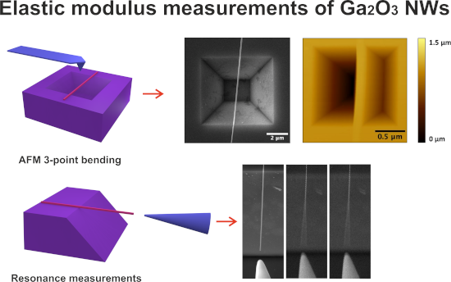
- , studies by Luan et al. [23] have revealed the elastic anisotropy in β-Ga2O3, highlighting the strong directional dependence of Young’s modulus. Available studies hint that various factors could strongly influence the mechanical properties of Ga2O3 one-dimensional nanostructures, which merits to be
- the average bond length and thus result in a reduction in the elastic modulus [31][32][33]. For example, Wang et al. [34] showed that ZnO NWs with a higher density of oxygen vacancies, inferred from photoluminescence measurements, exhibited significantly (up to 20%) lower Young’s modulus. Wang et al
- are showing that stacking faults can either decrease or increase Young’s modulus [31][37]. The decrease of Young’s modulus of NWs in comparison to that of bulk has been reported to be even as high as three times in WO3 NWs [25], four to five times in boron NBs [38], and up to 10 times in ZnO NBs [22


Stiffness calibration of qPlus sensors at low temperature through thermal noise measurements
Beilstein J. Nanotechnol. 2024, 15, 580–602, doi:10.3762/bjnano.15.50
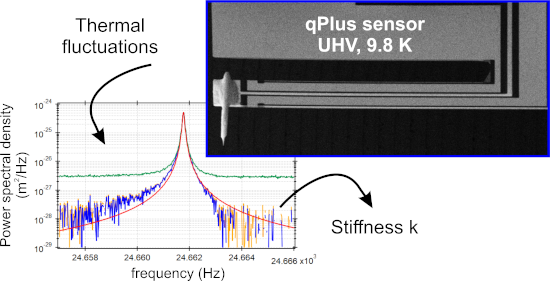
- of the probe from its dimensions and the mechanical properties of its constitutive material. When the load is applied at the free end of the probe, its static stiffness is given by: where E, w, t, and l are Young’s modulus, width, thickness, and length of the probe, respectively. Cleveland et al
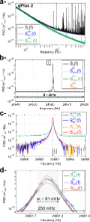
- geometric quantities, the estimated static stiffness of the probe (cf. Equation 2) is ks = (3322 ± 1270) N/m. To get this value, we have considered Young’s modulus and density of quartz, E = (78.7 ± 1.6) GPa and ρ = (2.65 ± 0.06) × 103 kg·m−3, respectively. It is also reminded that Equation 2 does not

Design, fabrication, and characterization of kinetic-inductive force sensors for scanning probe applications
Beilstein J. Nanotechnol. 2024, 15, 242–255, doi:10.3762/bjnano.15.23
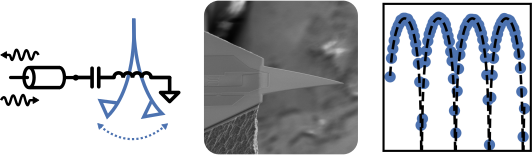
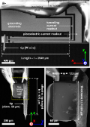
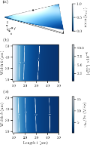
- etching conditions across the wafer. To some extent, one could change the mask design and adjust the dimensions of the cantilever to compensate for this effect. Using the mean value of 641 ± 42 kHz and adjusting the Young’s modulus of our Si-N plate to 208 GPa, we find good agreement between mechanical



Determination of the radii of coated and uncoated silicon AFM sharp tips using a height calibration standard grating and a nonlinear regression function
Beilstein J. Nanotechnol. 2023, 14, 1200–1207, doi:10.3762/bjnano.14.99
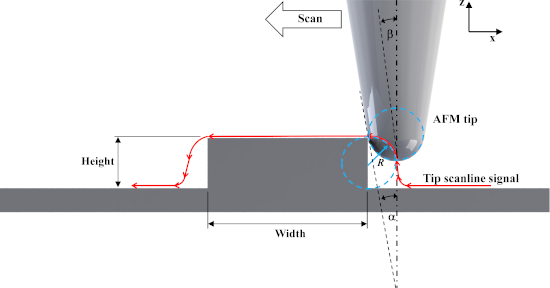
- AFM tip and the sample, which depends on the tip radius, defines how accurately the AFM tip determines those properties and the shape of fabricated micro- and nanostructures. The contact radius of the tip is a key variable for calculating the stiffness and Young’s modulus of the material by fitting


Elasticity, an often-overseen parameter in the development of nanoscale drug delivery systems
Beilstein J. Nanotechnol. 2023, 14, 1149–1156, doi:10.3762/bjnano.14.95

- determined by the Young’s modulus, bulk modulus or shear modulus, viscoelastic properties or deformability) as well as the measurement method to quantify these properties. Anselmo et al. as well as Nie et al. gave comprehensive overviews and definitions of different measurements of mechanical properties [16
- -loaded gelatin nanoparticles imaged in the quantitative imaging mode with a JPK NanoWizard III in Milli-Q® water at 37 °C, as well as the extracted Young’s modulus map as previously described [22] (Figure 1). Takechi-Haraya et al. showed that for liposomes both methods deliver the same results [21]. The
- most popular method is the evaluation of nanoindentation data resulting in Young’s moduli. The determination of the Young’s modulus is based on different theories. The adapted Hertz’ model, according to Sneddon [23], is most often used requiring a maximum indentation of 10% of the particle height


Transferability of interatomic potentials for silicene
Beilstein J. Nanotechnol. 2023, 14, 574–585, doi:10.3762/bjnano.14.48
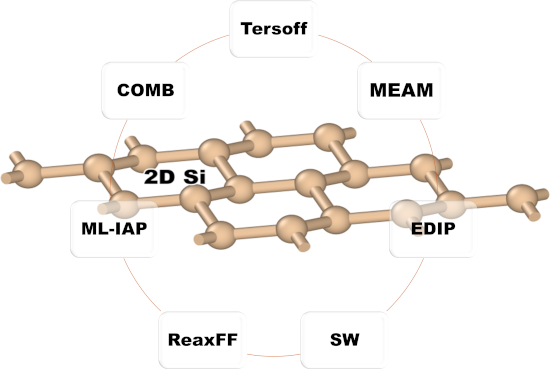
- quantify the potentials under examination. For 2D materials, directional 2D Young’s moduli, 2D Poisson’s ratios, and the 2D shear modulus, are often used instead of elastic constants Cij. Because of the symmetry of hexagonal lattices, these reduce to one 2D Young’s modulus E and one 2D Poisson’s ratio ν
- , average cohesive energy, average bond length, average height, 2D elastic constants, 2D Young’s modulus, Poisson’s ratio, and 2D Kelvin moduli, of the five silicene polymorphs analyzed are gathered in Table 1. Since we are analyzing free-standing silicene here, which has not yet been observed in
- for the LBS phase and are limited to 2D Young’s modulus and Poisson’s ratio only. These quantities are also in reasonable agreement with the present results. It is worth noting that all calculated 2D Kelvin moduli for all silicene phases are positive, which results in mechanical stability [25]. The
![[Graphic 3]](/bjnano/content/inline/2190-4286-14-48-i7.svg?max-width=637&scale=1.18182)

Gap-directed chemical lift-off lithographic nanoarchitectonics for arbitrary sub-micrometer patterning
Beilstein J. Nanotechnol. 2023, 14, 34–44, doi:10.3762/bjnano.14.4
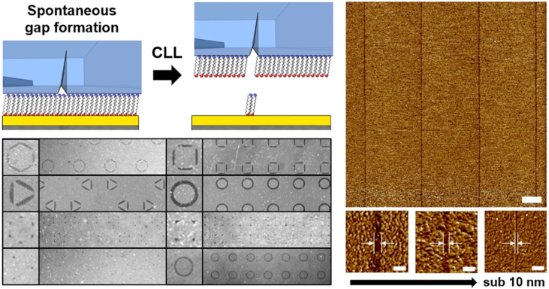
- parameters, D, H, W, and the elastomer’s Young’s modulus [40][46]. In current experimental setups, D and H are used to tune the formation of self-collapse-induced structural gaps, but it is reasonable to assume that both W and the elastomer stamp’s physical properties would have impacted the result as well
- . Increasing W or utilizing stamps with greater Young’s modulus (stiffer) while fixing other parameters would decrease the tendency for roof to collapse, thus increasing line width and decreasing gap size. In addition to acting as the matrix for biorecognition arrays, the molecular pattern created on a post


Frequency-dependent nanomechanical profiling for medical diagnosis
Beilstein J. Nanotechnol. 2022, 13, 1483–1489, doi:10.3762/bjnano.13.122
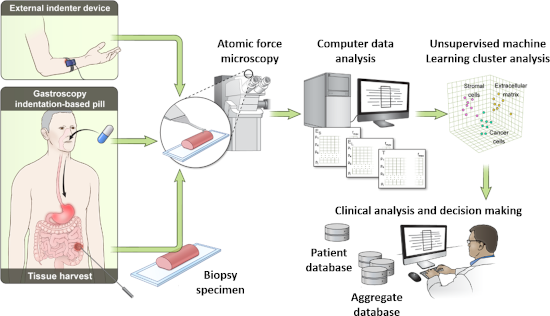
- from those of the material below it. Second, the results are not always transferrable, since they are often not expressed in rigorous physical units. Specifically, for mechanobiological AFM measurements, it is quite common to only estimate the Young’s modulus of the material. However, this quantity is
- cells as well as healthy human melanocytes and fibroblasts, showing that clear cell differentiation is possible when a wide frequency range is considered instead of a single number such as a pseudo-Young’s modulus. Furthermore, such representations would be extremely useful to evaluate the gradual
- others. Small changes in the shape of the curve could signal or confirm the onset of disease, perhaps even before clinically detectable symptoms emerge. This type of evaluation is difficult (or nearly impossible) to perform when a pseudo-Young’s modulus is used, since the latter is a single quantity that





