


Search results
Search for "alloy" in Full Text gives 216 result(s) in Beilstein Journal of Nanotechnology. Showing first 200.
Nanoglasses: a trail towards uncharted regions of vitreous materials and their properties?
Beilstein J. Nanotechnol. 2026, 17, 1047–1062, doi:10.3762/bjnano.17.72

- ) metastable state. Therefore, alloy compositions in the glass grains and in the GGI phase are necessarily expected to be different, as also experimentally confirmed. This situation stabilizes the two-phase state additionally concerning both thermodynamic and kinetic stability, similar to grain boundary
- material in shorter times at reduced cost, when compared to deposition from the gas phase, inherent limitations concerning composition selection and purity exist. Often, suitable electrolytes for co-depositing glass-forming alloy compositions are lacking and/or the electrochemical potentials for co
- -depositing the different elements do not sufficiently overlap to generate the desired alloy composition. A versatile alternative is presented by depositing columnar thin-film nanoglasses from the gas phase onto substrates. Recently, the validity of this approach has been demonstrated for a Cu–Zr nanoglass


Tailoring Ag–Pt nanoalloys through solid-state dewetting: structural and optical insights
Beilstein J. Nanotechnol. 2026, 17, 748–759, doi:10.3762/bjnano.17.52

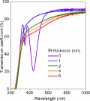
- the bulk Ag–Pt system, and provide insight into their structure–property relationships relevant for catalytic and plasmonic applications. Keywords: Ag–Pt alloy; dewetting; nanoalloys; plasmon resonance; thin films; Introduction Nanoalloys in the form of nanostructures exhibit novel and intriguing
- macroscopic alloy systems (e.g., Ag–Pt nanoalloys [3][4] or Ni–Au [5][6]). Furthermore, they enable the formation of various crystalline arrangements and structures. There are various methods for synthesizing metallic nanoalloys, both on solid substrates and in solution [7][8][9]. An auspicious method seems
- to its high gas-absorption capacity, making it highly relevant for catalytic applications. According to phase diagrams, bulk Ag–Pt bimetallic systems exhibit a large miscibility gap at temperatures below approximately 1190 °C, allowing alloy formation only at very high atomic concentrations of either




First-principles study on elastic properties of Cu, (Cu1−x,Nix)3Sn and interfacial mechanical properties of (Cu1−x,Nix)3Sn/Cu in the lead-free solder joint
Beilstein J. Nanotechnol. 2026, 17, 428–439, doi:10.3762/bjnano.17.29
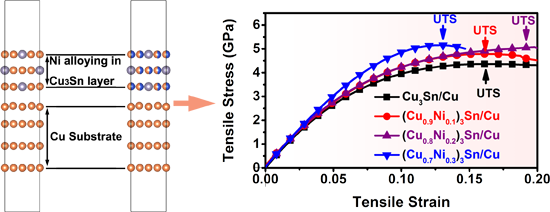
- , wettability, melting point, corrosion resistance, and mechanical and electrical properties [1][2]. A series of binary alloy solders, like Sn-Zn alloys [3], Sn-Cu alloys [4], Sn-Ag alloys [5], and Sn-Bi alloys [6], have been extensively investigated. Moreover, ternary and quaternary alloys have recently
- received considerable attention, and the Sn-Ag-Cu ternary alloy is considered as a promising candidate to substitute conventional lead-containing solder alloys [7]. Driven by the miniaturization of electronic devices and their widespread application in harsh environments such as high temperature and high
- efficiency without losing the accuracy by reducing the model size of the alloy systems. Considering the phase stability of (CuxNi1−x)3Sn [22], the content of Ni was set within the range from 0 to 30 atom %. As far as the calculations of the structure optimizations and elastic properties are concerned, a


Polycatecholamine nanocoatings on stainless steel: the effect on attachment of human fibroblasts and platelets
Beilstein J. Nanotechnol. 2026, 17, 365–380, doi:10.3762/bjnano.17.25
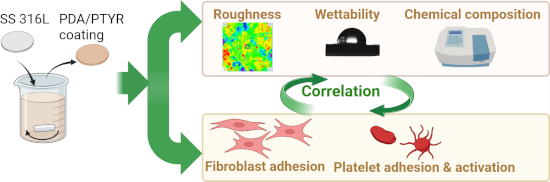
- : cell–material interactions; Fenton oxidation; hemocompatibility; nanocoatings; polycatechols; Introduction Stainless steel 316L (SS 316L) is an iron-based alloy containing chromium and molybdenum, which promote passivation and corrosion resistance [1]. Owing to its mechanical robustness





Beam shaping techniques for pulsed laser ablation in liquids: Unlocking tunable control of nanoparticle synthesis in liquids
Beilstein J. Nanotechnol. 2026, 17, 309–342, doi:10.3762/bjnano.17.22
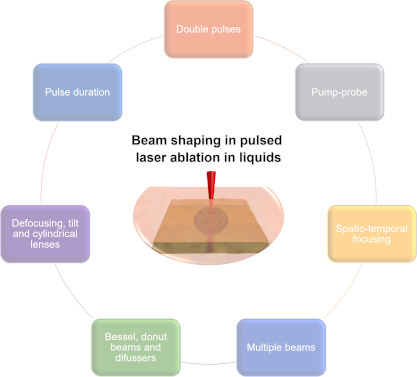
- advantages of DS beams in various laser applications, their use in PLAL for NP synthesis has only recently been explored by modifying the distribution size of metal NPs [158]. Studies comparing picosecond Gaussian and DS beams on different targets (metal, metal oxide, and alloy) showed that DS pulses







Fast vortex dynamics and relaxation times in NbRe-based heterostructures
Beilstein J. Nanotechnol. 2026, 17, 292–302, doi:10.3762/bjnano.17.20
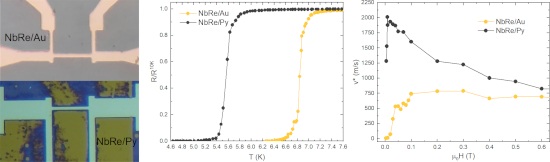
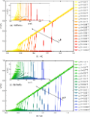
- mechanisms of the system [26]. In contrast, in an S/F system with a strong ferromagnet such as Py, the superconducting order parameter is strongly depressed over a very short distance (ξPy = 2 nm [33]) due to the large exchange field. Moreover, since Py is a disordered alloy, quasiparticles experience an


Advancing nanolithography: a comprehensive review of materials for local anodic oxidation with AFM
Beilstein J. Nanotechnol. 2026, 17, 275–291, doi:10.3762/bjnano.17.19
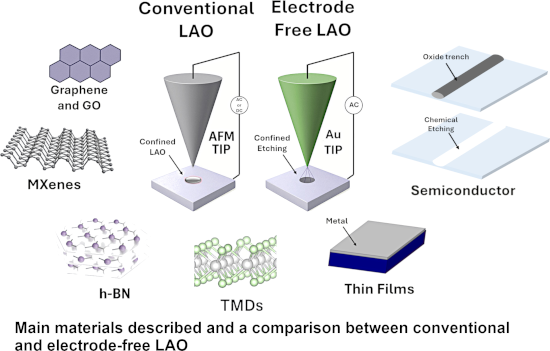
- morphologically and chemically degrades; therefore, the choice of tip material (e.g., n+-doped silicon, metal coating, or solid alloy) affects oxidation efficiency, with solid tips performing better than coated tips in terms of durability. Tip shape and sharpness play also a crucial role as a main regulator of


Optical bio/chemical sensors for vitamin B12 analysis in food and pharmaceuticals: state of the art, challenges, and future outlooks
Beilstein J. Nanotechnol. 2025, 16, 2207–2244, doi:10.3762/bjnano.16.153


Hartree–Fock interaction in superconducting condensate fractals
Beilstein J. Nanotechnol. 2025, 16, 2177–2182, doi:10.3762/bjnano.16.150
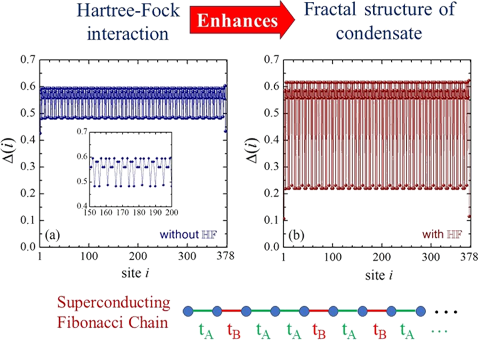
- [9][10][11]. Quasicrystals exhibit long-range orientational order, such as the fivefold symmetry in Al86Mn14 alloys [9][10], but lack the translational invariance [11]. The superconductivity of quasicrystals was established in 2018 with the discovery of superconducting signatures in an Al–Zn–Mg alloy


Laser ablation in liquids for shape-tailored synthesis of nanomaterials: status and challenges
Beilstein J. Nanotechnol. 2025, 16, 1963–1997, doi:10.3762/bjnano.16.137
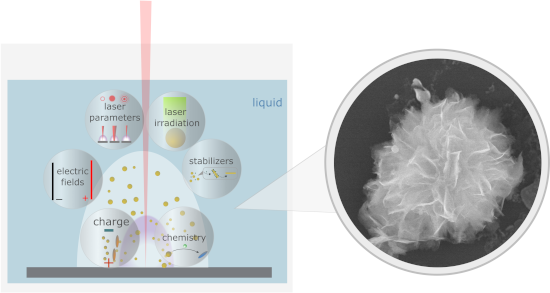
- into account. [73]. The presence of the gaseous bubble around the heated particles influences the kinetics of the relaxation processes as well as the absorption of the laser beam by the NPs. In [67], the conditions required for melting silver and copper NPs with the formation of a metastable AgCu alloy






Ambient pressure XPS at MAX IV
Beilstein J. Nanotechnol. 2025, 16, 1677–1694, doi:10.3762/bjnano.16.118
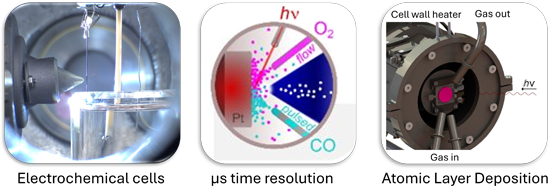
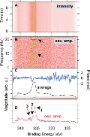
- beneath the native oxide layer, as reported in Figure 13. The Ni-Cr-Mo alloy exhibited activity towards the oxygen evolution reaction (OER), which is responsible for initiating passivity breakdown due to the dissolution of Mo in its Mo6+ state. This mechanism contrasts with the typical transpassive





Transient electronics for sustainability: Emerging technologies and future directions
Beilstein J. Nanotechnol. 2025, 16, 1545–1556, doi:10.3762/bjnano.16.109
- electronic systems. Traditionally studied bioresorbable metals include magnesium, zinc, and their alloy AZ31B [51][52]. Mg has been utilized as a transient conductive material in implantable pressure and temperature sensors, where it served as the interconnects and electrodes and underwent complete
- but also of electrical and mechanical performance. For instance, Mg-3Zn, which suffers from phase separation in bulk form, can be synthesized as a uniform alloy in thin films, offering improved corrosion resistance [61]. Moreover, bioresorbable amorphous metal (metallic glass) films have demonstrated


Influence of laser beam profile on morphology and optical properties of silicon nanoparticles formed by laser ablation in liquid
Beilstein J. Nanotechnol. 2025, 16, 1533–1544, doi:10.3762/bjnano.16.108
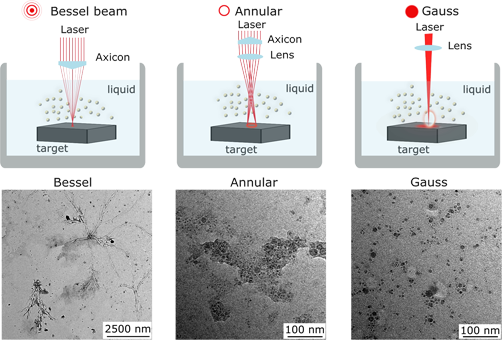
- laser pulses. For example, laser beams with a donut shape were used for ablating gold, yttrium oxide, and high-entropy alloy targets in water. The donut beam enabled NP size reduction and narrower size distributions [28]. Application of femtosecond Bessel beams for the ablation of silver in a liquid was


Laser processing in liquids: insights into nanocolloid generation and thin film integration for energy, photonic, and sensing applications
Beilstein J. Nanotechnol. 2025, 16, 1428–1498, doi:10.3762/bjnano.16.104






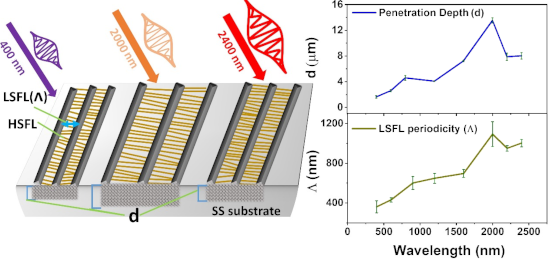
Wavelength-dependent correlation of LIPSS periodicity and laser penetration depth in stainless steel
Beilstein J. Nanotechnol. 2025, 16, 1302–1315, doi:10.3762/bjnano.16.95
- is the effective mass of the electron. Stainless steel has a more complex electron density than pure metals because it is composed of a mix of iron, chromium, nickel, and other elements. Stainless steel’s electron density varies depending on the composition and microstructure of the alloy, typically





Crystalline and amorphous structure selectivity of ignoble high-entropy alloy nanoparticles during laser ablation in organic liquids is set by pulse duration
Beilstein J. Nanotechnol. 2025, 16, 1141–1159, doi:10.3762/bjnano.16.84
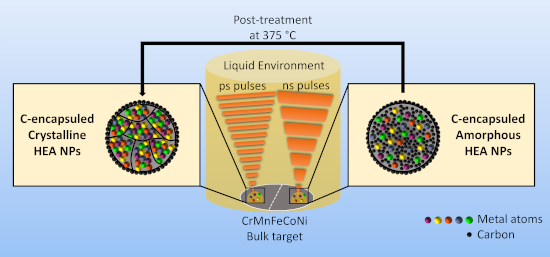
- Interface Science (KiNSIS), Christian-Albrechts University of Kiel, Christian-Albrechts-Platz 4, 24118 Kiel, Germany 10.3762/bjnano.16.84 Abstract High-entropy alloy nanoparticles (HEA NPs) represent a promising material class with significant potential in various applications, such as heterogeneous
- heterogeneous catalysts or magnets. In that context, the outstanding temperature stability up to 375 °C (differential scanning calorimetry) or 500 °C (transmission electron microscopy) may motivate future application-relevant work. Keywords: amorphous; cantor alloy; compositionally complex alloy; complex solid
- solution; EELS; electron energy loss spectroscopy; laser processing in liquids; multicomponent alloy; STEM-EDX; selected area electron diffraction; X-ray diffraction; Introduction High-entropy alloys (HEAs), also referred to as compositionally complex solid solutions (CCSS) [1], are of great interest in




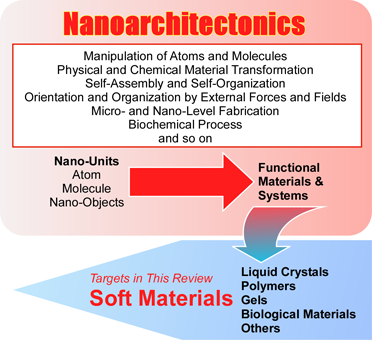
Soft materials nanoarchitectonics: liquid crystals, polymers, gels, biomaterials, and others
Beilstein J. Nanotechnol. 2025, 16, 1025–1067, doi:10.3762/bjnano.16.77
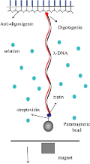
- colleagues have reported the rapid and reversible microactuation of liquid crystals based on the surface catalysis of H₂ and O₂ at room temperature on a late transition metal alloy film (Figure 7) [242]. The reaction of gaseous hydrogen and oxygen, catalyzed by a Pd/Au surface, is employed to rapidly and






Heat-induced transformation of nickel-coated polycrystalline diamond film studied in situ by XPS and NEXAFS
Beilstein J. Nanotechnol. 2025, 16, 887–898, doi:10.3762/bjnano.16.67
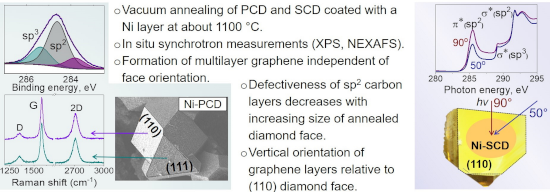
- ]. The obtained films were about 500 μm thick. Synthetic SCD were produced using high-pressure high-temperature (HPHT) method on a BARS apparatus [54]. The starting materials included a graphite rod (99.99% purity), a Ni0.7Fe0.3 alloy as a solvent catalyst, and a synthetic diamond (≈0.5 mm) as a seed


Synthesis and magnetic transitions of rare-earth-free Fe–Mn–Ni–Si-based compositionally complex alloys at bulk and nanoscale
Beilstein J. Nanotechnol. 2025, 16, 823–836, doi:10.3762/bjnano.16.62
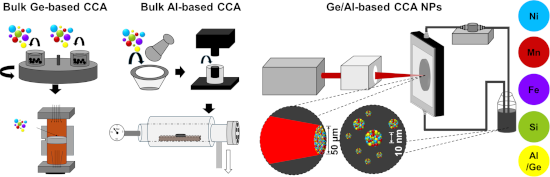
- -type structure [22]. For instance, a ternary MnNiSi alloy transitions from the hexagonal Ni2In structure to the orthorhombic TiNiSi structure at 1200 K [23], which is far from ideal for magnetocaloric, electronic, and spintronic-based applications. When these alloys are doped with elements such as Fe
- irradiation of the target material submerged in a liquid environment. This makes PLAL a safe, scalable and environmentally friendly approach [46][47][48]. Research on the synthesis of CoCrFeMnNi Cantor alloy NPs by PLAL demonstrated that this method consistently produces NPs with near-equiatomic compositions
- reliable alloy production method, we aim to create sustainable magnetic materials. Additionally, we compare the composition and magnetic transitions of the CCAs at the nanoscale to assess how these factors influence material magnetic performance. This research addresses the economic challenges associated


Colloidal few layered graphene–tannic acid preserves the biocompatibility of periodontal ligament cells
Beilstein J. Nanotechnol. 2025, 16, 664–677, doi:10.3762/bjnano.16.51
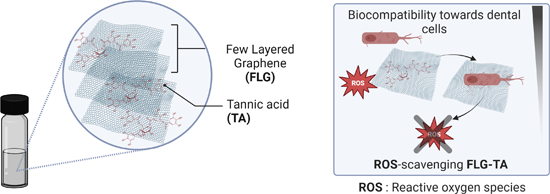
- absolute ethanol. Finally, samples were dehydrated with hexamethylenedisilazane for 15 min and air-dried in a fume hood for 24 h and coated with a gold–palladium alloy using a Hummer JR sputtering device (Technics, CA, USA), creating a 12.5 nm thick gold layer (50 s at 20 mA sputter current). SEM





Retrieval of B1 phase from high-pressure B2 phase for CdO nanoparticles by electronic excitations in CdxZn1−xO composite thin films
Beilstein J. Nanotechnol. 2025, 16, 551–560, doi:10.3762/bjnano.16.43

- interdiffusion at the interface between the CdxZn1−xO (x = 0.4) alloy film and the Si wafer substrate [24]. This process initiates significant diffusion of Si atoms, starting at the film–substrate interface and extending into the thin film layer, leading to the formation of Si–O bonds. At an annealing


Impact of adsorbate–substrate interaction on nanostructured thin films growth during low-pressure condensation
Beilstein J. Nanotechnol. 2025, 16, 473–483, doi:10.3762/bjnano.16.36

- types of atoms in the high-entropy alloy and z(m) = −2,…,2. In the two-dimensional lattice presentation, the interaction strength δ(r) with the randomly distributed z(m) = z(r) represents the δ-correlated quenched spatial disorder with ⟨δ(r)⟩ = δ0; Δ is the strength of the spatial disorder. Next, we


Effect of additives on the synthesis efficiency of nanoparticles by laser-induced reduction
Beilstein J. Nanotechnol. 2025, 16, 464–472, doi:10.3762/bjnano.16.35
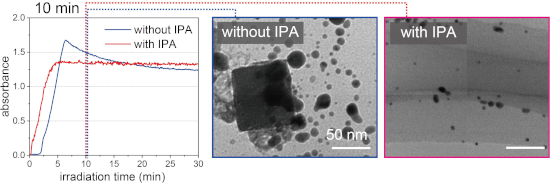
- produced by the breakdown of solvent molecules in a high-intensity reaction field near the focus of the laser. This unique reaction has the characteristic of being able to synthesize non-equilibrium solid–solution alloy nanoparticles. On the other hand, it is necessary to improve the synthesis efficiency
- synthesize 160 mg/h of Au nanoparticles in the current system. It was also shown that non-equilibrium solid–solution alloy nanoparticles could be synthesized even when a radical scavenger was added. Furthermore, the addition of a radical scavenger also made it possible to synthesize base metal nanoparticles
- metal ions in the solution to form nanoparticles [25][26]. It has been reported that, due to the short reduction reaction of solvated electrons [29][30], it is possible to form solid–solution alloy nanoparticles with controlled compositions that do not exist in the equilibrium phase diagram [20]. It has


Size control of nanoparticles synthesized by pulsed laser ablation in liquids using donut-shaped beams
Beilstein J. Nanotechnol. 2025, 16, 407–417, doi:10.3762/bjnano.16.31
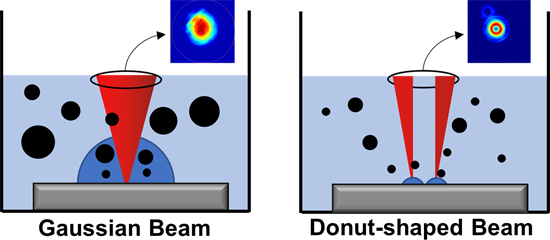
- laser beam. In experiments on pulsed laser ablation in water of gold, yttrium oxide, and high-entropy alloy targets with both Gaussian and donut-shaped beams, we observed a significant reduction in particle size, narrowing of the size distribution width, and an improvement in sphericity when utilizing
- this pioneering study, further investigation with higher temporal and spatial resolution are warranted. Keywords: beam shaping; cavitation bubble; donut beam; gold nanoparticles; high-entropy alloy nanoparticles; nanoparticle size analysis; yttrium oxide nanoparticles; Introduction The demand for
- precise compositional control such as metastable binary core–shell NPs [16] and quinary Cantor high-entropy alloy NPs [17][18]. Such high-entropy nanomaterials are recently being discussed as game changers, providing disruptive design opportunities in multifunctional catalysts or magnetic materials [19


Recent advances in photothermal nanomaterials for ophthalmic applications
Beilstein J. Nanotechnol. 2025, 16, 195–215, doi:10.3762/bjnano.16.16
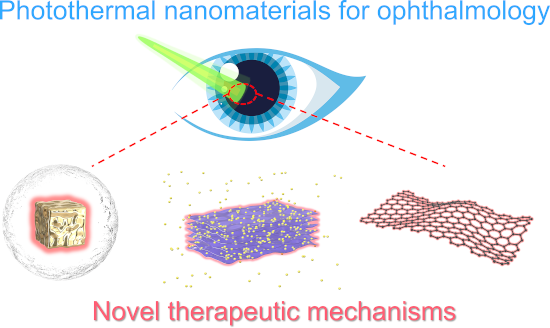
- photothermal therapy agent, AuAgCu2O-NS, which consists of a core of AuAg alloy nanospheres and a Cu2O shell, specifically designed for treating non-healing keratitis caused by drug-resistant bacterial infections [152]. This agent’s controllable photothermal effects, coupled with the release of Ag+ ions from





