


Search results
Search for "colloids" in Full Text gives 130 result(s) in Beilstein Journal of Nanotechnology.
Light-driven ammonia electrooxidation via carbon nitride–ruthenium molecular interfaces
Beilstein J. Nanotechnol. 2026, 17, 854–862, doi:10.3762/bjnano.17.61
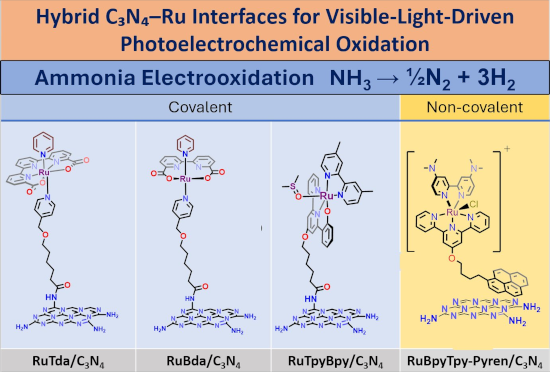
- Erlangen-Nürnberg, Cauerstraße 3, IZNF, Erlangen 91058, Germany Friedrich-Alexander-Universität Erlangen-Nürnberg, Profile Center Solar (FAU Solar), Freyeslebenstraße 1, 91058 Erlangen, Germany Department of Colloid Chemistry, Max-Planck-Institute of Colloids and Interfaces, Am Mühlenberg 1, 14476 Potsdam


Towards targeted drugs and next generation of nanomedicines
Beilstein J. Nanotechnol. 2026, 17, 598–601, doi:10.3762/bjnano.17.41

- for colloids, which were investigated also long before they were called "nanoparticles". On the other hand, such argument leaves out the fact that lipid-based drug carriers and colloids used today in nanomedicine are quite distinct from the ones from the past. For instance, the lipid nanoparticles
Laser–material interactions in liquids for the synthesis of nanomaterials: current status and perspectives
Beilstein J. Nanotechnol. 2026, 17, 571–575, doi:10.3762/bjnano.17.38
- –matter interactions; laser processing in liquids; In the ever-evolving landscape of materials science and nanotechnology, laser synthesis and processing of colloids (LSPC) has emerged [1] as a powerful and versatile technique for producing high-purity, surfactant-free nanoparticles from a wide range of
Beam shaping techniques for pulsed laser ablation in liquids: Unlocking tunable control of nanoparticle synthesis in liquids
Beilstein J. Nanotechnol. 2026, 17, 309–342, doi:10.3762/bjnano.17.22
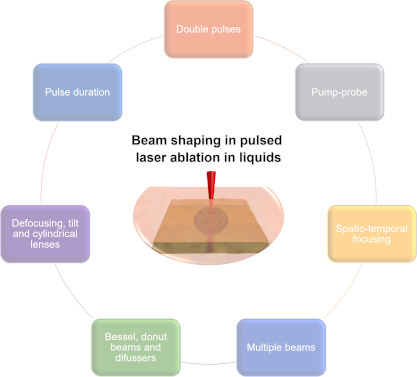
- 10.3762/bjnano.17.22 Abstract Nanoparticle synthesis via pulsed laser ablation in liquids has gained prominence as a versatile and environmentally friendly approach for producing ligand-free colloids with controlled composition, size, and morphology. While pulsed laser ablation in liquids offers
- gas aggregation are highly scalable and productive, though they typically require high temperatures or vacuum systems and may offer limited control over surface chemistry. Compared with these approaches, PLAL provides high-purity colloids with reduced impurities and byproducts, even allowing for
- ablation area is irradiated, which increases NP production. The higher colloidal concentration enhances aggregation, often resulting in larger mean particle sizes [143]. Furthermore, the precision of the focusing can play a crucial role in the physicochemical properties of the colloids. Ryabchikov et al







Stereodiscrimination of guests in chiral organosilica aerogels studied by ESR spectroscopy
Beilstein J. Nanotechnol. 2025, 16, 2034–2054, doi:10.3762/bjnano.16.140
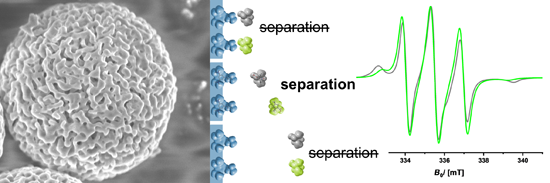
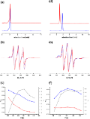
- ). A further increase of the chiral selector was not possible as AlaNH25SIL is no longer an aerogel material but is composed of large agglomerated colloids (see Supporting Information File 1, Figure S6). SerNH10oSil was prepared analogously using a serine-modified sol–gel precursor; the data is given




Laser ablation in liquids for shape-tailored synthesis of nanomaterials: status and challenges
Beilstein J. Nanotechnol. 2025, 16, 1963–1997, doi:10.3762/bjnano.16.137
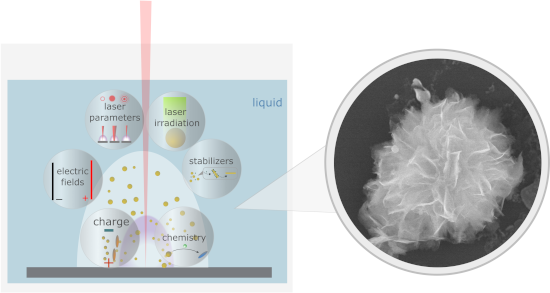
- -induced modification of pre-formed NPs for shape change Another strategy for shape manipulation can be based on utilization of laser-assisted processes in multistep synthesis approaches. In these methods, the laser ablation of a solid target is used to prepare initial colloids which are further processed
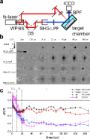
- and reshaping of NPs using ns, ms, and CW lasers has been applied in a number of works. Among the first, ns laser-induced shape modification of spherical silver NPs to nanowires in colloids has been demonstrated by Tsuji et al. [74] and Tarasenko et al. [65] (Figure 7e,f). The diameter of the formed
- of one-dimensional nanostructures during laser processing of colloids can occur via linear growth. This mechanism was described in a number of works for various materials. In [85][86] the transformation of copper nanoflakes into nanowires dispersed in ethanol or methanol has been achieved by using




Mechanical property measurements enabled by short-term Fourier-transform of atomic force microscopy thermal deflection analysis
Beilstein J. Nanotechnol. 2025, 16, 1952–1962, doi:10.3762/bjnano.16.136
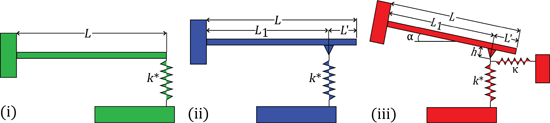
- (Nanosensors PtSi-CONT), and borosilicate glass colloids (Sigma-Aldrich 440345-100G) attached to the tipless cantilevers (Nanosensors TL-CONT). The borosilicate glass colloids had a diameter of 8–11 μm and an elastic modulus of 60 GPa. Data analysis Following completion of experiments, post processing of the




Influence of laser beam profile on morphology and optical properties of silicon nanoparticles formed by laser ablation in liquid
Beilstein J. Nanotechnol. 2025, 16, 1533–1544, doi:10.3762/bjnano.16.108
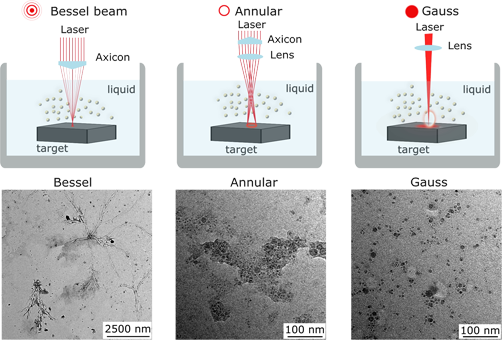
- absorption spectra of the prepared colloids were measured using a Cary 500 Scan spectrophotometer (Varian, USA) in the spectral range of 200–2000 nm in a 10 mm quartz cuvette. The measurements of the PL spectra were carried out at room temperature using a Fluorolog-3 spectrofluorometer (HORIBA Scientific
- produced using Bessel and annular profiles. It should be noted that the fractions of amorphous and crystalline phases can be determined by deconvolution of the Raman peaks profiles to estimate the crystallinity of Si NPs (Supporting Information File 1, Figure S6). The colloids synthesized using different
- laser beams also showed different optical properties, which were characterized using UV–vis absorption and PL spectroscopies. The absorption spectra of the Si colloids prepared using Gauss, Bessel, and annular profiles are shown in Figure 6. In all the spectra, absorption in the visible and near


Laser processing in liquids: insights into nanocolloid generation and thin film integration for energy, photonic, and sensing applications
Beilstein J. Nanotechnol. 2025, 16, 1428–1498, doi:10.3762/bjnano.16.104
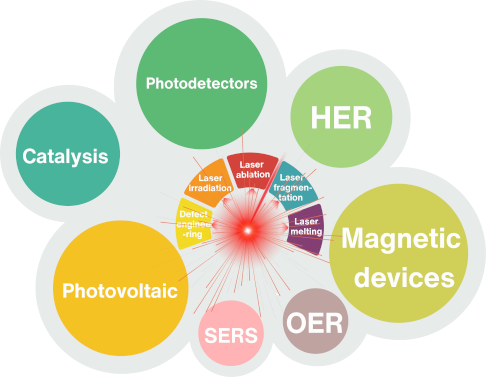
- , involving soft laser treatment of the final product or intermediate colloids. They defined “soft laser fluence” as the maximum laser intensity that could heat and melt the particles without causing evaporation, thus preserving their size. This approach was based on a particle heating–melting–evaporation
- factors such as size, surface-to-volume ratio, crystalline structure, composition, oxidation state, shape, and defects [68]. To synthesize NPs, colloids suspended in transparent liquids are irradiated with short or ultra-short laser pulses, which result in selective absorption by the NPs. This occurs
- different liquid media by changing the laser parameters were reported. The colloids were drop-cast onto Si wafers for various studies [117]. NiO and ZnO nanostructured films were obtained on silicon and quartz substrates to examine their optical properties as well as their structural, topographical, and






Crystalline and amorphous structure selectivity of ignoble high-entropy alloy nanoparticles during laser ablation in organic liquids is set by pulse duration
Beilstein J. Nanotechnol. 2025, 16, 1141–1159, doi:10.3762/bjnano.16.84
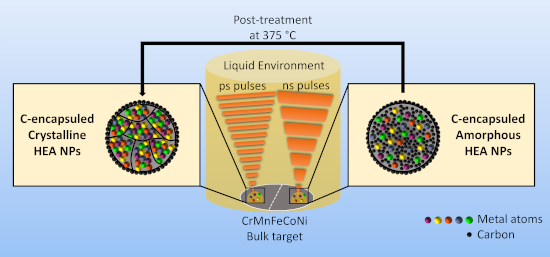
- heterogeneous catalysts, colloids are more flexible as the support material is not predefined by the synthesis route but can be freely chosen. This may be highly relevant as previous studies report on the facile supporting of laser-generated NPs onto multiple carrier materials such as carbon [33][34][35], metal
- colloids (LSPC) [41][42][43][44] provides nanoparticles dispersed in liquids without the addition of common additives (e.g., citrate [45], tensides [46], polymers [47]) or support material to stabilize the particles with high variability on the used solvent, yielding colloidal nanoparticles with
- example in magnetron sputtering techniques. Colloidal HEA NPs by LSPC were first reported in 2019 by Waag et al. [35], where CrMnFeCoNi NPs were produced in ethanol, using a picosecond-pulsed laser for ablation (ps-LAL), yielding colloids of HEA NPs with a mean diameter below 10 nm and productivities of 3




Fabrication of metal complex phthalocyanine and porphyrin nanoparticle aqueous colloids by pulsed laser fragmentation in liquid and their potential application to a photosensitizer for photodynamic therapy
Beilstein J. Nanotechnol. 2025, 16, 1088–1096, doi:10.3762/bjnano.16.80
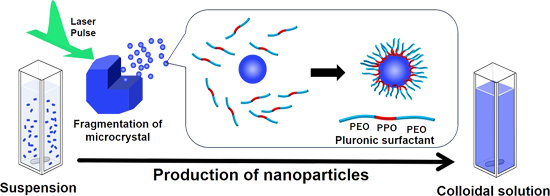
- against cancer cells was reported. However, conventional methods of producing nanoparticle colloids require organic solvents and excessive amounts of organic adjuvants, which may have other implications for research in pharmacological, photochemical, and medical applications, and also may interfere with
- the activity of the target substance in general. An alternative and promising method for dispersing hydrophobic organic compounds as colloids is pulsed laser fragmentation in liquids (PLFL) [9][10]. This relatively new fabrication method has advantages because a microcrystalline sample powder
- acetate [23], paclitaxel [24], naproxen and fenofibrate [25], curcumin [26], and cinnamon [27]. This work aims to fabricate aqueous colloids of MPc (M = AlCl, Fe, Co, Zn) and Pt complex octaethylporphyrin (PtOEP) (Figure 1) nanoparticles with a high dispersion stability and to demonstrate the potential


Time-resolved probing of laser-induced nanostructuring processes in liquids
Beilstein J. Nanotechnol. 2025, 16, 968–1002, doi:10.3762/bjnano.16.74
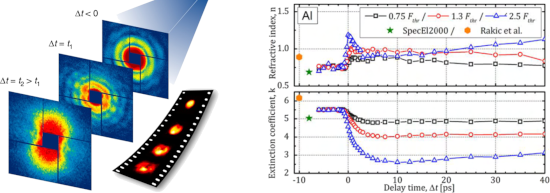
- Institute of Technology (KIT), Postfach 3640, D-76021 Karlsruhe, Germany 10.3762/bjnano.16.74 Abstract Laser synthesis and processing of colloids (LSPC) in liquids has gained widespread applications in producing nanomaterials of different classes of solids. While the technical processes in different cases
- within the particle. It was proposed that the solvent molecules directly interact with non-thermal electrons at the particle surface, particularly in very small particles. In fact, the relatively well-defined geometry of NP colloids that leads to excitation localization and uniformity as well as the
- formation threshold as well as bubble sizes [125][128]. Figure 8F shows that bubble size growth with laser fluence can be extracted with good correlation to X-ray results (Figure 8G). Structure formation, such as LAL or LFL in NP colloids and on surfaces, involves all steps of particle heating, melting


Morphology and properties of pyrite nanoparticles obtained by pulsed laser ablation in liquid and thin films for photodetection
Beilstein J. Nanotechnol. 2025, 16, 785–805, doi:10.3762/bjnano.16.60
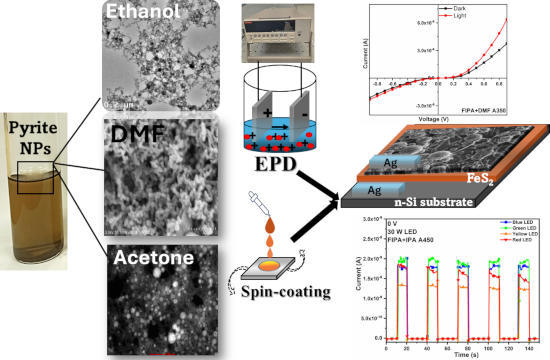
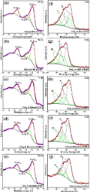
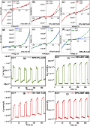
- further excite the plasma plume, which is believed to promote homogenization of the ablated material. This effect often results in narrower nanoparticle size distributions rather than larger particles [37]. In the reported work also, no significant agglomeration was observed in the colloids, except for






Efficiency of single-pulse laser fragmentation of organic nutraceutical dispersions in a circular jet flow-through reactor
Beilstein J. Nanotechnol. 2025, 16, 711–727, doi:10.3762/bjnano.16.55
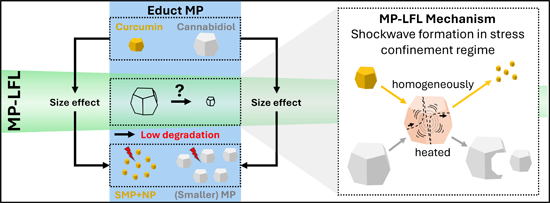
- viability even at high curcumin concentrations. Keywords: antioxidant; cannabidiol; curcumin; drug; food additive; low degradation; nanoparticle; pulsed laser ablation in liquids; solubilization; Introduction Laser synthesis and processing of colloids (LSPC) has become increasingly popular over the last
- few decades, as this relatively new fabrication method can be used to produce stable, additive-free colloids of different material classes under high-purity conditions, which are suitable for a wide range of technical applications [1][2][3][4][5]. Pulsed laser ablation (LAL), laser fragmentation (LFL
- colloids, for example, to increase their defect density in favor of electrocatalytic or optical properties without changing their size [6][7][8]. In addition, the acronym PUDEL has recently been used for pulsed laser diffusion enhancement in liquids, which refers to an increase in diffusion without


Size control of nanoparticles synthesized by pulsed laser ablation in liquids using donut-shaped beams
Beilstein J. Nanotechnol. 2025, 16, 407–417, doi:10.3762/bjnano.16.31
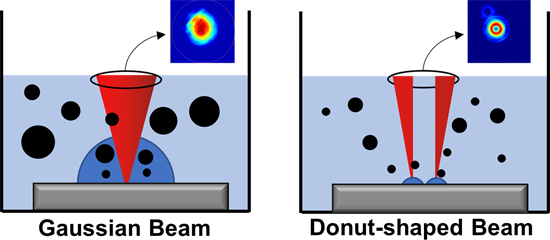
- 400 kHz repetition rate for 2 min along a spiral path with an outer diameter of 10 mm and a scanning speed of 20 m·s−1. The pulse energy was varied in the 50–250 µJ range by a laser attenuator to produce colloids with NP concentrations in the range of several tens of milligrams per liter. HEA NPs were


Pulsed laser in liquid grafting of gold nanoparticle–carbon support composites
Beilstein J. Nanotechnol. 2025, 16, 349–361, doi:10.3762/bjnano.16.26
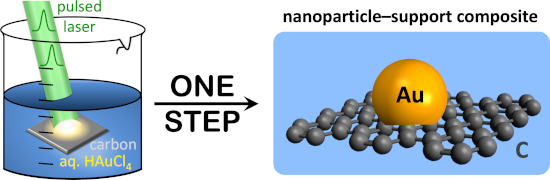
- that our laser fluence did not enable carbon sublimation. Stable gold colloids have been produced by reactive nanosecond laser irradiation of aqueous [AuCl4]– solutions [29][30]. Colloidal gold nanoparticle formation occurred by nucleation of reduced (metallic) gold atoms [25][31][32]. As in pulsed


Preferential enrichment and extraction of laser-synthesized nanoparticles in organic phases
Beilstein J. Nanotechnol. 2025, 16, 254–263, doi:10.3762/bjnano.16.20
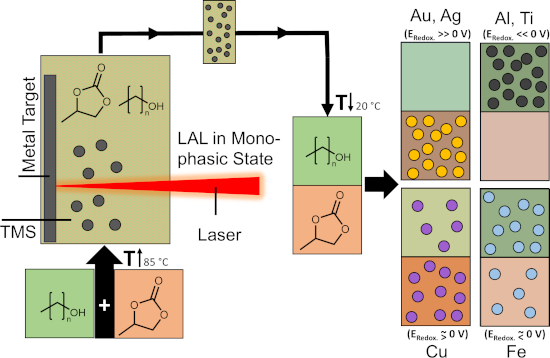
- in liquid; laser synthesis and processing of colloids; phase transfer; size separation; thermomorphic multiphase system; Introduction Laser ablation in liquids (LAL) provides nanoparticles without the need of external surfactants while retaining the initial composition of the educt material in the
- properties and surface chemistry of the gained colloids. The use of organic solvents as liquid may result in reactive LAL processes [1][10] that cause elements from the solvent molecules (and solutes) to be part of the final nanoparticle’s composition. The solvent decomposition induced by laser-based
- states at around 80 °C. While laser-synthesized nanoparticles have been characterized regarding their (surface) oxidation [4][5][7] and carbon shells [7][24] previously, the phase preference of nanoparticles from laser synthesis and processing of colloids in liquid–liquid TMSs is unknown. However, to




Biomimetic nanocarriers: integrating natural functions for advanced therapeutic applications
Beilstein J. Nanotechnol. 2024, 15, 1619–1626, doi:10.3762/bjnano.15.127

- nanotechnology, introduced by Richard Feynman in 1959 during an American Physical Society meeting [1][2], involves the manipulation of matter at the atomic level. The term "nanometer" was initially proposed by Richard Zsigmondy in the context of measuring gold colloids. Nanotechnology is generally defined as the


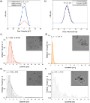
Effect of wavelength and liquid on formation of Ag, Au, Ag/Au nanoparticles via picosecond laser ablation and SERS-based detection of DMMP
Beilstein J. Nanotechnol. 2024, 15, 1054–1069, doi:10.3762/bjnano.15.86

- was meticulously evaluated by analyzing the ablation rates, surface plasmon resonance peak positions, and particle size distributions of the obtained colloids. The nanoparticles (NPs) were characterized using the techniques of UV–visible absorption, transmission electron microscopy, and energy
- while the laser wavelength was increased. Size reduction was observed when the aqueous NaCl solution was used as a surrounding medium instead of other liquids (DW). In this case, the size increases with an increasing wavelength. The diameters of colloids prepared at a laser wavelength of 1064 nm in DW
- wavelengths (355, 532, and 1064 nm) on the variation of morphological features and yields of colloids obtained through the ablation of Ag, Au, and Ag50Au50 targets conducted in a medium of DW and aqueous NaCl solution using a picosecond laser. Our findings demonstrated that the irradiation laser wavelengths


Synthesis of silver–palladium Janus nanoparticles using co-sputtering of independent sources: experimental and theorical study
Beilstein J. Nanotechnol. 2024, 15, 808–816, doi:10.3762/bjnano.15.67
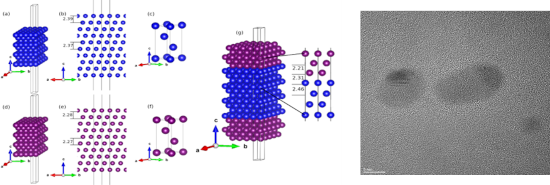
- nanoparticles, by the wet reduction method using palladium and silver hydroxide colloids as precursors, to study hydrogen absorption; the size of these BNPs was 6–7 nm. However, inhomogeneous nanoparticles were obtained because Ag fractions were found on the surface, which were increased by heating the samples




Laser synthesis of nanoparticles in organic solvents – products, reactions, and perspectives
Beilstein J. Nanotechnol. 2024, 15, 638–663, doi:10.3762/bjnano.15.54
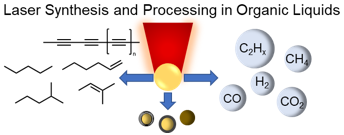
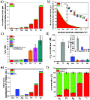
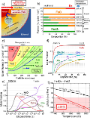
- 23284, USA 10.3762/bjnano.15.54 Abstract Laser synthesis and processing of colloids (LSPC) is an established method for producing functional and durable nanomaterials and catalysts in virtually any liquid of choice. While the redox reactions during laser synthesis in water are fairly well understood
- reports from Fojtik and Henglein on nanoparticle synthesis [1] and Patil et al. on reactive target modification [2], pulsed laser synthesis and processing of colloids (LSPC) has been shown to be a scalable [3][4][5][6] and versatile technique for nanoparticle synthesis, comprehensively reviewed regarding
- fundamentals and applications [7]. The colloids reported in the literature contain mainly inorganic particles (hence, they are the focus of this review), although the literature on organic particle synthesis has been reported as well, ranging from dyes [8][9] to natural substances [10][11] and drugs [12]. LSPC





Nanoarchitectonics of photothermal materials to enhance the sensitivity of lateral flow assays
Beilstein J. Nanotechnol. 2023, 14, 988–1003, doi:10.3762/bjnano.14.82
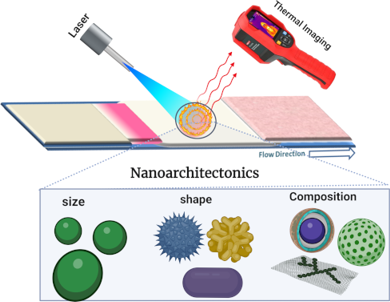
- ], Colloids and Surfaces B: Biointerfaces, vol. 186, by V. Shirshahi; S. N. Tabatabaei; S. Hatamie; R. Saber, “Photothermal enhancement in sensitivity of lateral flow assays for detection of E-coli O157:H7”, article no. 110721, Copyright (2019), with permission from Elsevier. (This content is not subject to


Carboxylic acids and light interact to affect nanoceria stability and dissolution in acidic aqueous environments
Beilstein J. Nanotechnol. 2023, 14, 762–780, doi:10.3762/bjnano.14.63
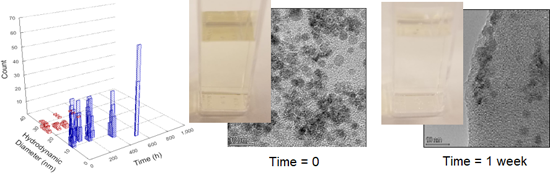
- stress within biological systems [11]. Nanoceria in plant systems Nanoceria acts as colloids in aqueous environments, in the soil near plant root systems, and within bodily fluids. Acetic, citric, lactic, succinic, and tartaric acid secreted from plant roots are known to complex with metals/metal oxides
Polymer nanoparticles from low-energy nanoemulsions for biomedical applications
Beilstein J. Nanotechnol. 2023, 14, 339–350, doi:10.3762/bjnano.14.29
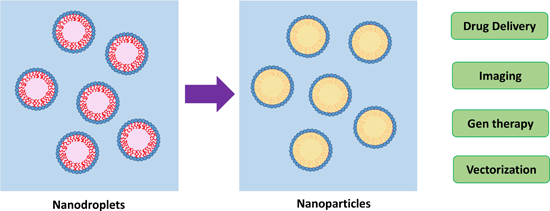
- cellulose nanoparticles obtained from nanoemulsions with an O/S (ethyl acetate/poly(oxyethylene)(10) oleyl ether) ratio of 70/30 and 90 wt % of water. The ethyl acetate phase contained 4 wt % of ethyl cellulose. Figure 2 was reprinted from [43], Colloids and Surfaces B: Biointerfaces, vol. 145, by G




Solvent-induced assembly of mono- and divalent silica nanoparticles
Beilstein J. Nanotechnol. 2023, 14, 52–60, doi:10.3762/bjnano.14.6
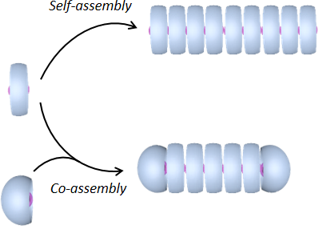
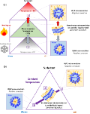
- previous work on the assembly of 1-PSN with larger PPSR ranging from 0.69 to 1.54 in a THF/ethanol mixture has shown that colloids with a low aggregation number (e.g., dimers, trimers, tetramers, and spherical micelles) could be obtained at a low incubation time. Also, the higher the PPSR value, the more





