Search results
Search for "nanosheets" in Full Text gives 161 result(s) in Beilstein Journal of Nanotechnology.
Room-temperature NO2 sensing performance of ZnO/Ti3C2Tx heterojunctions
Beilstein J. Nanotechnol. 2026, 17, 1159–1169, doi:10.3762/bjnano.17.79
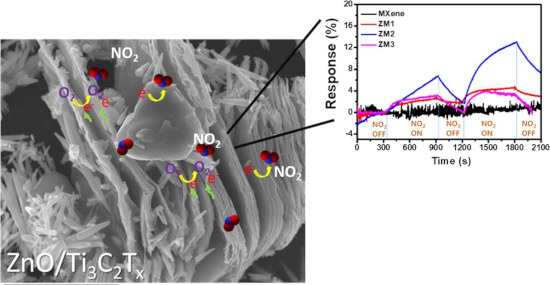
- MXene-derived TiO2, demonstrating robust NO2 sensing performance [23]. Similarly, Sun et al. employed Co3O4 nanoparticle-based polyethyleneimine-functionalized Ti3C2Tx nanosheets, showcasing exemplary sensing response characteristics and rapid response/recovery times towards NO2 gas [24]. Furthermore, n
- toward a lower diffraction angle corresponds to an increase in the interlayer spacing, suggesting that ZnO nanostructures are effectively intercalated between adjacent MXene nanosheets. The enlarged interlayer distance suppresses the restacking of Ti3C2Tx layers, exposes more accessible active sites, and
- composites. The pure MXene shows a characteristic accordion-like morphology, in which both few-layered nanosheets and multilayered stacked lamellae with enlarged interlayer spacing were observed, which is typical of etched MXene materials (Figure 2a). ZnO prepared by the chemical bath deposition method





Electrochemical sensing of sildenafil in pharmaceutical formulations using an (S,N)-doped reduced graphene oxide-modified electrode
Beilstein J. Nanotechnol. 2026, 17, 1087–1102, doi:10.3762/bjnano.17.74
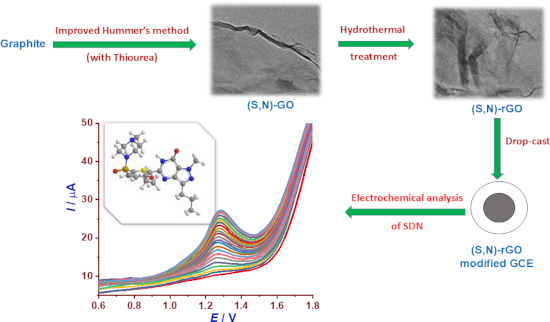
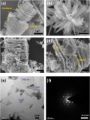
- , FTIR, BET, and Raman analyses. High-resolution transmission electron microscopy (HRTEM) images of (S,N)-GO and (S,N)-rGO are presented in Figure 2a and Figure 2b, respectively. The (S,N)-GO sample exhibits thin, transparent, and relatively smooth layered nanosheets with a typical wrinkled morphology



Materials challenges in solid-state sensors for continuous monitoring of ions in water
Beilstein J. Nanotechnol. 2026, 17, 935–973, doi:10.3762/bjnano.17.66
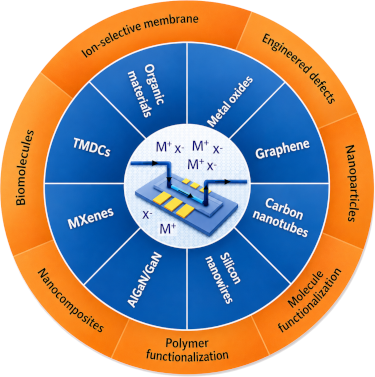
- device employs rGO nanosheets as the conductive channel, functionalized with benzyltriethylammonium chloride (TEBAC), whose quaternary ammonium groups exhibit strong electrostatic affinity for nitrate ions. The TEBAC molecules are immobilized on rGO via π–π interactions, forming a stable hybrid sensing
- probe, they interact with the electron cloud of the rGO nanosheets), leading to a modulation of carrier density and a measurable decrease in channel conductance (due to the fact that rGO material is p-doped). This transduction process enables the device to rapidly (2–7 s) achieve an ultralow limit of


Environmental applications of silver nanoparticles: state-of-the-art review and emerging trends
Beilstein J. Nanotechnol. 2026, 17, 697–736, doi:10.3762/bjnano.17.49


Recent progress in enhancing built-in electric fields of perovskite solar cells via junction engineering
Beilstein J. Nanotechnol. 2026, 17, 602–621, doi:10.3762/bjnano.17.42
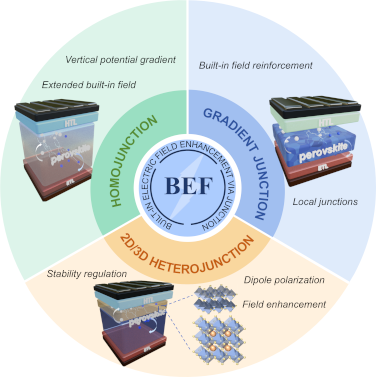
- absorber layer, while recombination losses and improving stability are suppressed. A modification strategy based on two-dimensional black phosphorus nanosheets (BP NSs) proposed by Fan et al. [38] exemplifies this combination of interface-induced and bulk modulation. During perovskite crystallization, BP
- recombination and ion migration. To address this issue, Zhang et al. [45] proposed a bottom-up gradient construction strategy based on alkali-intercalated vermiculite nanosheets, abbreviated as “AIV”. At the bottom interface, AIV and the perovskite form Pb–O bonds that facilitate lattice matching and reduce



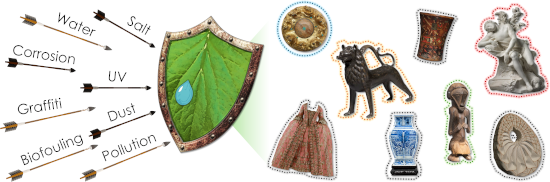
Functional surface engineering for cultural heritage protection: the role of superhydrophobic and superoleophobic coatings – a comprehensive review
Beilstein J. Nanotechnol. 2026, 17, 63–96, doi:10.3762/bjnano.17.6




Missing links in nanomaterials research impacting productivity and perceptions
Beilstein J. Nanotechnol. 2025, 16, 2168–2176, doi:10.3762/bjnano.16.149
- , other 2D nanomaterials, such as elemental 2D materials (e.g., borophene, phosphorene, and silicene), transition metal dichalcogenides (e.g., MoS2, WS2, and NbSe2), transition metal oxides (e.g., MnO2, Fe2O3, and Ni(OH)2 nanosheets), MXenes (e.g., Ti3C2, Ti2C, and Ta4C3), 2D halides (e.g., CrI3, NiI2
Toward clinical translation of carbon nanomaterials in anticancer drug delivery: the need for standardisation
Beilstein J. Nanotechnol. 2025, 16, 2092–2104, doi:10.3762/bjnano.16.144

- responses [37]. In contrast, a recent first-in-human investigation of thin, highly purified graphene oxide nanosheets reported that acute inhalation was well tolerated, showing no adverse effects on lung function, cardiovascular health, or systemic inflammatory markers [28]. Even within the same material




Multifrequency AFM integrating PeakForce tapping and higher eigenmodes for heterogeneous surface characterization
Beilstein J. Nanotechnol. 2025, 16, 2077–2085, doi:10.3762/bjnano.16.142
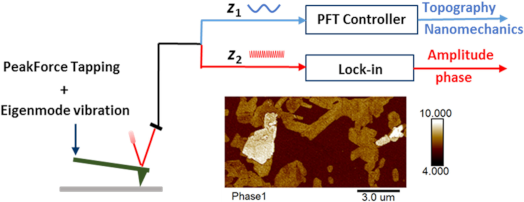
- montmorillonite (MMT) nanosheets, demonstrating its potential to improve material property contrast and characterization. Experimental Experimental setup Our experiments were conducted using a commercial AFM system (Bruker Dimension Icon) equipped with a cantilever holder that incorporates a piezoelectric
- procedure described above. Sample preparation The MMT nanosheets in the form of a purified powder were provided by the research group of Prof. Yinan Hao at Inner Mongolia Agricultural University. The powder was synthesized through an ultrasonic exfoliation process (240 W, 90 min) detailed in their patent
- and electronic signal separation enables simultaneous, effective acquisition of quasi-static force maps and eigenmode-derived material contrast. Dual-probe comparative analysis of MMT nanosheets The effectiveness of the method was evaluated using the soft (ScanAsyst-Air, 0.48 N·m−1) and stiff (NSC15


Laser ablation in liquids for shape-tailored synthesis of nanomaterials: status and challenges
Beilstein J. Nanotechnol. 2025, 16, 1963–1997, doi:10.3762/bjnano.16.137
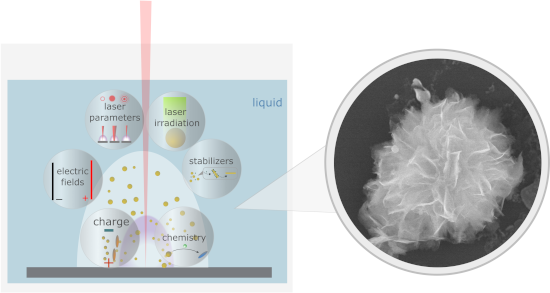
- the anisotropic growth and self-assembly of nanostructures with the formation of nanorods and nanosheets. It is currently agreed that media surrounding the particles also influence the surface energy dependence on nanoparticle size. If ions or surfactants are present in the solution, their absorption
- plasma is nonuniform as compared to the anode case. As a result, during cathode ablation, spherical nanostructures appear only as a minor component, while ZnO nanosheets dominate in the colloid. The surface charges can be considered among the key parameters influencing NP shape. The charge of the NPs is
- modification. The presence of the active ionic species has been shown to guide the formation of Ni(OH)2 nanosheets in [30]. After NP formation, the shape transformation can occur during the stages of growth, self-organization, and ageing of the NPs. In this case, laser ablation, which is performed for





Piezoelectricity of layered double hydroxides: perspectives regarding piezocatalysis and nanogenerators
Beilstein J. Nanotechnol. 2025, 16, 1812–1817, doi:10.3762/bjnano.16.124

- range, allowing for the adjustment of key characteristics. Another specific feature of LDHs is their ability to delaminate in water and organic solvents after pretreatment to separate nanosheets. The latter is important in connection with the discovery of piezoelectric properties in two-dimensional
- current output. The piezoelectric potential generated in the ZnO nanosheets functions as an applied voltage, facilitating charge storage within the LDH layers, which act as capacitors. This mechanism leads to enhanced voltage and current pulses under mechanical stimulation. LDHs can also enhance the
- organically modified Ni/Co-LDH nanosheets. However, some concerns arise regarding whether the synthesized material reported by the authors can indeed be classified as a Ni/Co-LDH. First, the synthesis was carried out using salts of divalent nickel and divalent cobalt at a Ni/Co ratio of 1:2. In the absence of

Nanotechnology-based approaches for the removal of microplastics from wastewater: a comprehensive review
Beilstein J. Nanotechnol. 2025, 16, 1607–1632, doi:10.3762/bjnano.16.114
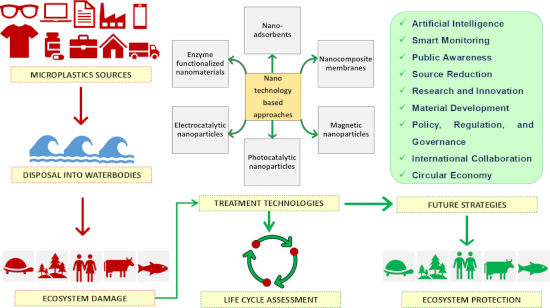
- explored for applications such as water treatment and purification [114]. Yang et al. [120] introduced for the first time a membrane with an enhanced water permeability. This membrane was obtained by selectively etching Co3O4 nanoparticles embedded within Ti3C2Tx nanosheets, followed by vacuum filtration
- . The resulting h-Ti3C2Tx nanosheets possess a porous, flat structure with 25 nm diameter holes ideal for MP separation. When tested with fluorescent polystyrene (FP) microspheres of varying sizes as MPs models, the membranes demonstrated exceptional removal efficiency of up to 99.3%. Additionally, a


Influence of laser beam profile on morphology and optical properties of silicon nanoparticles formed by laser ablation in liquid
Beilstein J. Nanotechnol. 2025, 16, 1533–1544, doi:10.3762/bjnano.16.108
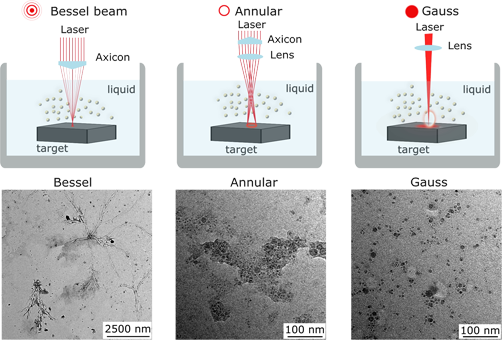
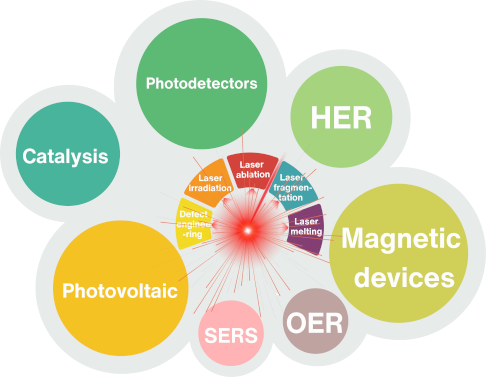
- number of approaches have been adopted to the formation of semiconducting nanowires and hybrid nanostructures by PLAL, including one-dimensional nanowires, nanotubes, and nanoribbons, as well as two-dimensional nanosheets and nanobelts [13][20][21]. Exemplary applications of laser ablation techniques for


Laser processing in liquids: insights into nanocolloid generation and thin film integration for energy, photonic, and sensing applications
Beilstein J. Nanotechnol. 2025, 16, 1428–1498, doi:10.3762/bjnano.16.104






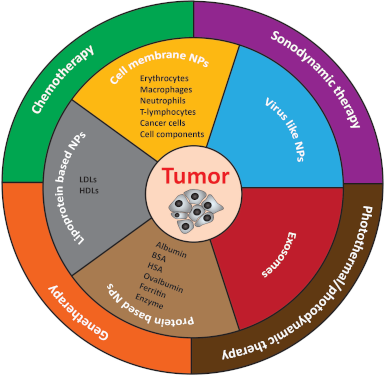
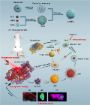
Better together: biomimetic nanomedicines for high performance tumor therapy
Beilstein J. Nanotechnol. 2025, 16, 1246–1276, doi:10.3762/bjnano.16.92







Electronic and optical properties of chloropicrin adsorbed ZnS nanotubes: first principle analysis
Beilstein J. Nanotechnol. 2025, 16, 1184–1196, doi:10.3762/bjnano.16.87
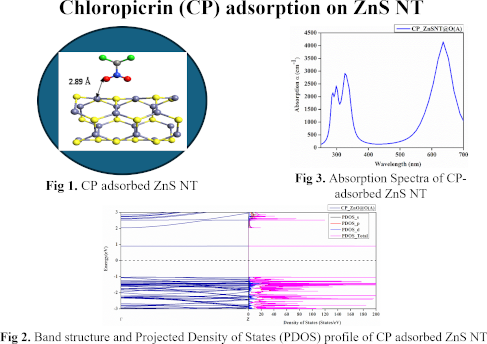
- their bulk counterparts [9][10][11][12][13][14]. Zinc sulfide (ZnS) attracts considerable attention among various nanomaterials due to its unique properties. Nanostructured ZnS with different morphologies, including nanotubes, nanowires, nanoparticles, and nanosheets has been extensively investigated


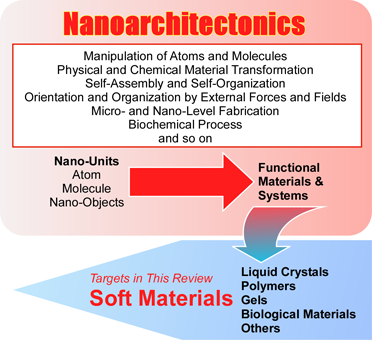
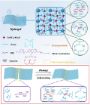
Soft materials nanoarchitectonics: liquid crystals, polymers, gels, biomaterials, and others
Beilstein J. Nanotechnol. 2025, 16, 1025–1067, doi:10.3762/bjnano.16.77






Structural and magnetic properties of microwave-synthesized reduced graphene oxide/VO2/Fe2O3 nanocomposite
Beilstein J. Nanotechnol. 2025, 16, 921–932, doi:10.3762/bjnano.16.70
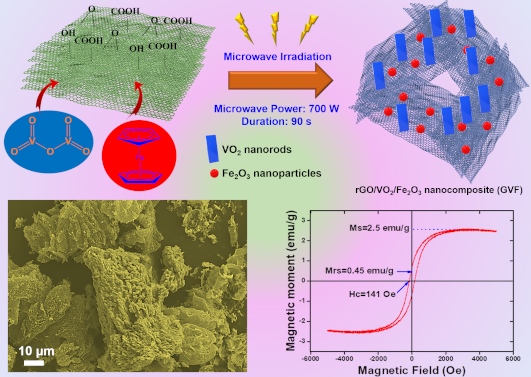
- expected to display enhanced magnetic characteristics owing to the induction of higher defects and the presence of α-Fe2O3. Figure 4a,b represents FESEM images of rGO at low and high magnifications. As shown, the morphological analyses represent the wavy-like networks of rGO nanosheets, demonstrating the
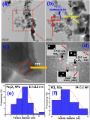
- . The detailed structure of the GVF was monitored by HRTEM analysis. The corresponding images are shown in Figure 8a–f. As shown in Figure 8a, the rGO nanosheets are found to be transparent and thin in nature. In the magnified HRTEM image, an agglomerated dispersion of Fe2O3 NPs and VO2 nanospheres (NSs
- ) was visible on the thin rGO surfaces. Notably, a clear difference between the size of Fe2O3 NPs (average particle diameter – 8.1 ± 2.2 nm) and VO2 NSs (average particle diameter – 34 ± 5.2 nm) indicates the formation of these two different types of metal oxides on top of the rGO nanosheets (Figure 8e



Synchrotron X-ray photoelectron spectroscopy study of sodium adsorption on vertically arranged MoS2 layers coated with pyrolytic carbon
Beilstein J. Nanotechnol. 2025, 16, 847–859, doi:10.3762/bjnano.16.64
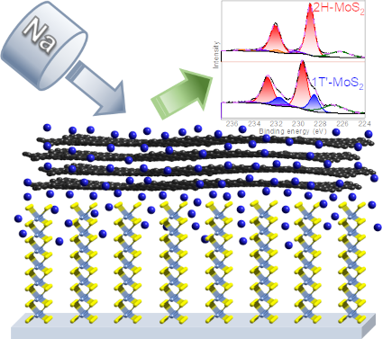
- sandwiched between MoS2 layers, the MoS2 component was not converted to Mo and Na2S even at a high degree of sodiation [18]. An ex situ study of a fully sodiated anode composed of MoS2 nanosheets coupled with few-layered graphene revealed a partial transformation of 2H-MoS2 into a distorted tetragonal
- structural stability of the material [22][23][24]. The orientation of the carbon component in the hybrid can also affect the electrochemical processes. For example, interlayer-expanded MoS2 nanosheets vertically anchored on graphene film and carbon fibers showed a good rate performance in SIBs [25][26]. It


Facile one-step radio frequency magnetron sputtering of Ni/NiO on stainless steel for an efficient electrode for hydrogen evolution reaction
Beilstein J. Nanotechnol. 2025, 16, 837–846, doi:10.3762/bjnano.16.63
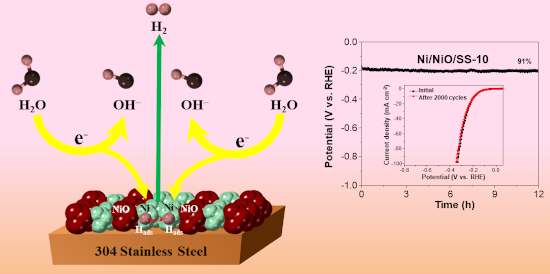
- and coworkers prepared Ni/NiO nanosheets via a hydrothermal process and annealing, which gave a high HER efficiency [18]. Wang et al. found that Ni metal plays a crucial role in NiOx-based material for water electrolysis [19]. However, using chemical methods to fabricate Ni/NiO-based nanomaterials is


Supramolecular hydration structure of graphene-based hydrogels: density functional theory, green chemistry and interface application
Beilstein J. Nanotechnol. 2025, 16, 806–822, doi:10.3762/bjnano.16.61
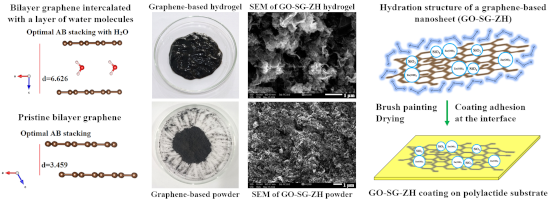
- supramolecular hydration structures that preserve graphene nanosheets from the restacking through hydrophobic force, van der Waals force, and π–π interaction. In this manuscript, density functional theory and high-performance computing (HPC) are used for modeling and calculating van der Waals force between
- graphene nanosheets in water-intercalated AB bilayer graphene structures. A layer of water molecules significantly decreases the intersheet van der Waals force. A novel hydrogel of graphene oxide–silica gel–zinc hydroxide (GO-SG-ZH) is experimentally synthesized to demonstrate the advantages of hydrated
- structures, elemental compositions, aqueous dispersibility, and antibacterial activities. Hydration shells on graphene-based nanosheets in the hydrogel increase intersheet distances to prevent the stacking of the nanostructures. Hydration layers in the GO-SG-ZH hydrogel was also lubricative for direct brush


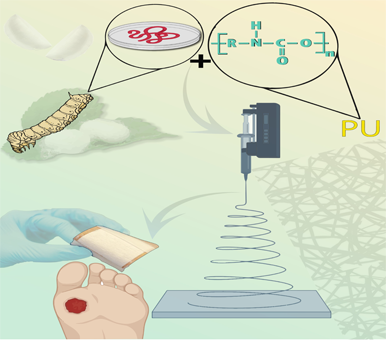
Polyurethane/silk fibroin-based electrospun membranes for wound healing and skin substitute applications
Beilstein J. Nanotechnol. 2025, 16, 591–612, doi:10.3762/bjnano.16.46
- growth [175]. Zhou et al. focused on the fabrication of a novel composite membrane suitable for photothermal cancer therapy based on black phosphorus (BP) nanosheets because of their high biocompatibility and photothermal efficacy. SF was used as an exfoliating agent in stable liquid exfoliation with
- ultrasound to incorporate BP nanosheets for improved stability and processability. As a result, silk fibroin-doped black phosphorus nanosheets (BP@SF) were produced, which possess good water dispersity and long-term stability. BP@SF nanosheets were consolidated into fibrous membranes based on SF and PLGA by



Retrieval of B1 phase from high-pressure B2 phase for CdO nanoparticles by electronic excitations in CdxZn1−xO composite thin films
Beilstein J. Nanotechnol. 2025, 16, 551–560, doi:10.3762/bjnano.16.43

- may indicate areas enriched in cadmium. Our earlier investigation into CdO thin film noted similar Cd-rich whitish regions and the formation of nanosheets [18]. In the CZ900_313O thin film, no significant surface alterations were detected. However, the CZ900_313Ag thin film exhibits visible damage on


Water in nanoporous hexagonal boron nitride nanosheets: a first-principles study
Beilstein J. Nanotechnol. 2025, 16, 510–519, doi:10.3762/bjnano.16.39
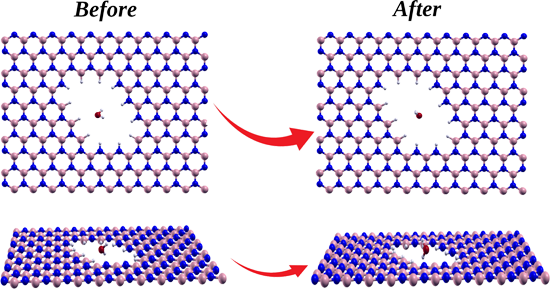
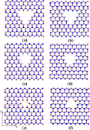
- calculated through Equation 3: where Etotal is the total energy of system, Eporous is the energy of the porous monolayer, and is the energy of an isolated water molecule. Results and Discussion Energetic stability of h-BN nanopore Figure 2 and Figure 3 display the h-BN nanosheets with rhombic and triangular
- stability, whereas an additional N–H pair does not provide the same effect. In fact, Pham et al. observed that N-terminated pores are less stable in air than B-terminated ones [34]. Water molecule in h-BN nanosheets We studied the adsorption process of a water molecule on a porous h-BN nanosheet. Initially
- interaction between water and pores is the ability of a single water molecule to induce wrinkles in h-BN nanosheets with triangular pores, even when the pore is stabilized with B–H pairs at its vertices (see Figure 7). This deformation disappears upon removal of the water molecule. The observed deformation




Graphene oxide–chloroquine conjugate induces DNA damage in A549 lung cancer cells through autophagy modulation
Beilstein J. Nanotechnol. 2025, 16, 316–332, doi:10.3762/bjnano.16.24
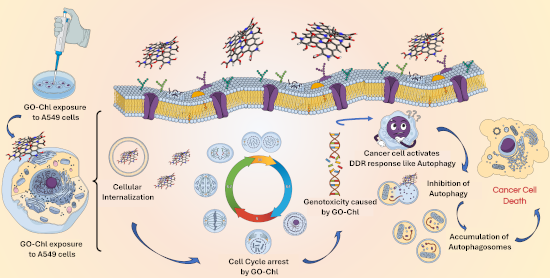
- , including WNT, Notch, STAT 1/3, and NRF-2, respectively [20]. Graphene oxide nanosheets have been shown to selectively disrupt the cell membrane and cytoskeleton of cancer cells through activation of FAK-Rho-ROCK pathway and suppressed expression of integrin [21]. It has also been found that nuclear
- from Thermo Scientific Nunc (Rochester, New York). Synthesis of graphene oxide Highly exfoliated GO nanosheets were chemically synthesized using slight modifications to the method documented by Dimiev et al. [26][27]. Briefly, 0.5 g of graphite powder was treated with a mixture of 0.5 g of NaNO3 and 40
- were collected using successive centrifugation steps at 13,000 rpm for 30 min and washing with deionized (DI) water several times, until the hydrolysis of covalent sulfates formed during oxidation [26][27]. The final product of exfoliated GO nanosheets were extracted through freeze-drying. Binding of