Search results
Search for "penetration depth" in Full Text gives 130 result(s) in Beilstein Journal of Nanotechnology.
Recent progress in enhancing built-in electric fields of perovskite solar cells via junction engineering
Beilstein J. Nanotechnol. 2026, 17, 602–621, doi:10.3762/bjnano.17.42
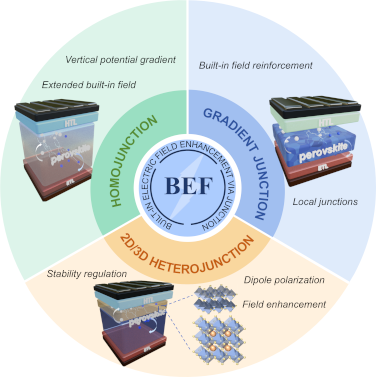
- unified framework of BEF descriptors, magnitude, penetration depth, directionality, and spatial continuity. Special emphasis is placed on the potential for synergistic integration of multiple junction architectures and on the development of mild, process-compatible fabrication routes. Ultimately
- aligning energy levels [16]. These advantages have established heterojunctions as a major research hotspot, with current efforts shifting from simple passivation to deliberate interfacial potential design [17]. Nevertheless, the impact of phase penetration depth, residual strain, and bulk inhomogeneity on
- , energy level or dimensionality, has recently emerged as a key strategy for strengthening the BEF. Such graded junctions establish sustained band bending aligned with the BEF through the film thickness and across interfaces, thereby markedly increasing the field strength and effective penetration depth



Beam shaping techniques for pulsed laser ablation in liquids: Unlocking tunable control of nanoparticle synthesis in liquids
Beilstein J. Nanotechnol. 2026, 17, 309–342, doi:10.3762/bjnano.17.22
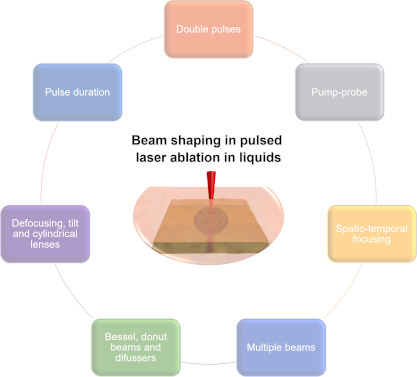
- threshold characterises the “gentle” ablation phase [177]. The ablation rate is low and determined by the optical penetration depth [178]. The rapid ionisation of the material leads to the ejection of charged particles due to electrostatic repulsion, named Coulomb explosion. This process occurs within a few
- penetration depth δ and the electron-thermal penetration depth, l, related to electron heat conduction. Considering that the Gaussian beam fluence distribution follows Φ = Φ0exp(−r2/ω2), with ω being the radius of the beam and Φ0 = E0/πω2 the peak fluence, ΔV is given by: where Φth is the threshold fluence
- enough to limit significant thermal effects, yet there is still thermal diffusion [176]. For pulses longer than 1 ps, the ablation regime determined by the optical penetration depth is not observed [178]. In the nanosecond regime, the energy is deposited over an extended period, and heat has time to







Fast vortex dynamics and relaxation times in NbRe-based heterostructures
Beilstein J. Nanotechnol. 2026, 17, 292–302, doi:10.3762/bjnano.17.20
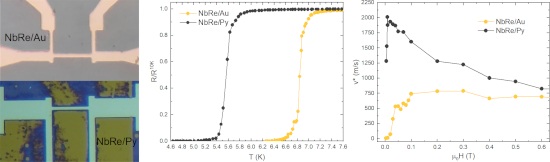
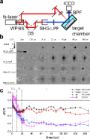
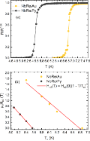
- are characterized by significantly different electrical resistivities, with Au being an excellent electrical conductor even at small thicknesses and Py films showing high resistivity in the ultrathin film regime [40][41]. To calculate the London penetration depth at T = 0 K, the formula λ(0) = 1.05


Capabilities of the 3D-MLSI software tool in superconducting neuron design
Beilstein J. Nanotechnol. 2026, 17, 122–138, doi:10.3762/bjnano.17.8

- parameter here is the London penetration depth [5], which was taken as 85 nm according to manufacturer data. Details of 3D-MLSI numerical technique can be found in [49][50]. An input data file, specified in text format, must contain the geometry of the device in the plane of the substrate, the parameters of
- manufacturer’s design rules. So ah can hardly be chosen larger then 2 μm since the minimal width was 4 μm for all samples studied here. In principle, the lower grid scale ahb < ah should be related to the London penetration depth λ = 85 nm for all superconducting layers. However, ahb, and ah as well, must not be
- and ahb = 0.5 μm was used, which provides a reasonable estimate, as was stated above. Summarizing, 3D-MLSI evaluates two-terminal partial inductances of thin multilayer structures, with the only free parameter being the London penetration depth. A fairly good performance rate is achieved due to the



Microscopic study of the intermediate mixed state in intertype superconductors
Beilstein J. Nanotechnol. 2026, 17, 57–62, doi:10.3762/bjnano.17.5
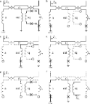
- quantized vortices forming a mixed state [1][2][3]. Within the Ginzburg–Landau (GL) framework, the boundary between these regimes is determined by the GL parameter κ = λL/ξGL, where λL is the magnetic London penetration depth and ξGL is Ginsburg–Landau coherence length, with the critical value separating
- T. The variation of g and T modifies both the coherence length ξ and the magnetic penetration depth λ, and hence their ratio κ = λ/ξ, which determines the superconductivity type. Within the GL theory, ξ and λ share the same temperature dependence, ξ,λ ∝ (1 − T/Tc)−1/2, making the superconductivity


Internal 3D temperature mapping in biological systems using ratiometric light-sheet imaging and lipid-coated upconversion nanothermometers
Beilstein J. Nanotechnol. 2025, 16, 2306–2316, doi:10.3762/bjnano.16.159
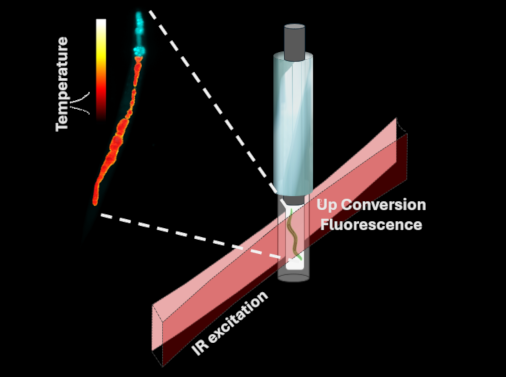
- volumetric temperature sensing through fluorescence-lifetime or UC nanothermometry. However, these approaches remain limited by point-by-point scanning, shallow penetration depth, and narrow fields of view (typically below 100 µm), restricting their applicability to intact organisms. Beyond these


Terahertz-range on-chip local oscillator based on Josephson junction arrays for superconducting quantum-limited receivers
Beilstein J. Nanotechnol. 2025, 16, 2296–2305, doi:10.3762/bjnano.16.158
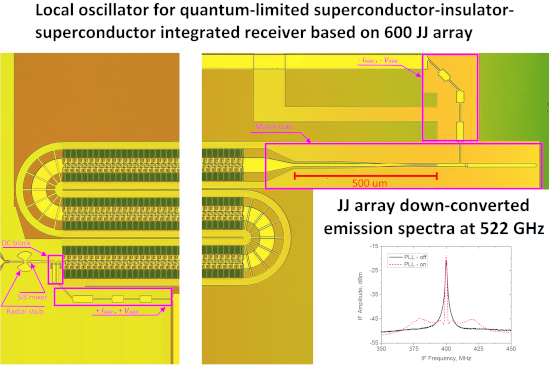
- London penetration depth [18][53]. The experimental results for the S21 coefficient of the 300–550 GHz and 500–700 GHz matching circuits and the calculations are shown in Figure 6a and Figure 6b, respectively. The experimental values of Ipump are normalized to Ig. However, the experiment shows a


Laser ablation in liquids for shape-tailored synthesis of nanomaterials: status and challenges
Beilstein J. Nanotechnol. 2025, 16, 1963–1997, doi:10.3762/bjnano.16.137





Wavelength-dependent correlation of LIPSS periodicity and laser penetration depth in stainless steel
Beilstein J. Nanotechnol. 2025, 16, 1302–1315, doi:10.3762/bjnano.16.95
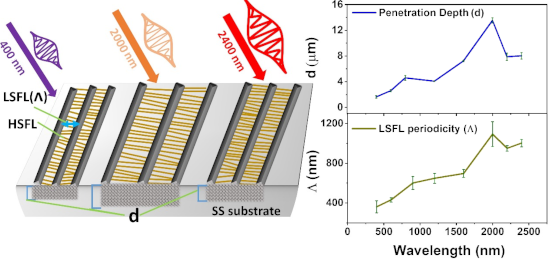
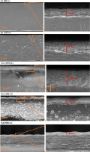
- observed. By employing cross-sectional electron microscopy, we scrutinize the penetration depth of laser radiation or laser-affected zone, in the LIPSS-formed SS sheets, revealing a parallel trend with LSFL and HSFL spatial periodicity. Specifically, the penetration depth increases with wavelength up to
- ); maximum LIPSS; penetration depth; Introduction Nanostructuring on surfaces plays a pivotal role in governing surface properties, and laser-induced periodic surface structures (LIPSS) have emerged as a potent method for achieving nanoscale surface modifications. Over the past decade, LIPSS and laser
- 400 to 2400 nm laser irradiation. This enabled the examination of the cross-sectional zone where the cumulative effect of the laser irradiation occurs. We analyzed how these effects correlate with the incident laser wavelength. The manuscript delves into the critical parameter of penetration depth, or




Mechanical stability of individual bacterial cells under different osmotic pressure conditions: a nanoindentation study of Pseudomonas aeruginosa
Beilstein J. Nanotechnol. 2025, 16, 1171–1183, doi:10.3762/bjnano.16.86
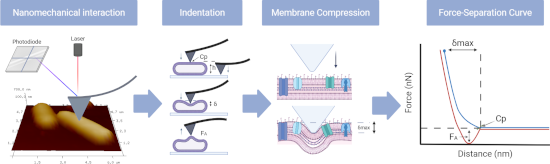
- stiffness remain almost unchanged for the tested conditions. However, mean values obtained for Young’s modulus show a shallow trend to decrease with higher osmolarities, particularly when point nanoindentations were used. On the other hand, a clear increase in the penetration depth δmax is observed for


Crystalline and amorphous structure selectivity of ignoble high-entropy alloy nanoparticles during laser ablation in organic liquids is set by pulse duration
Beilstein J. Nanotechnol. 2025, 16, 1141–1159, doi:10.3762/bjnano.16.84
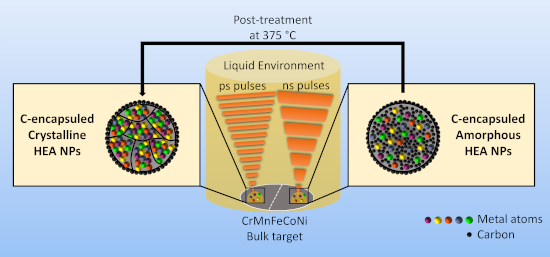
- pulses is that ns-LAL goes along with a more pronounced melting of the target surface (higher thermal penetration depth and lateral heating), compared to that of ps-LAL, a process that Waag et al. experimentally described by comparing target surfaces after both ps- and ns-LAL [87]. This is because in ns




Time-resolved probing of laser-induced nanostructuring processes in liquids
Beilstein J. Nanotechnol. 2025, 16, 968–1002, doi:10.3762/bjnano.16.74
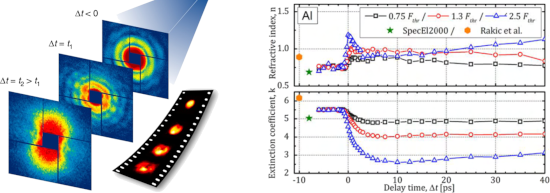
- scattering studies with the use of electrons have been hindered by their shallow penetration depth (<1 μm) compared to that of hard X-rays (>100 μm). Recently, the development of free-flowing liquid sheet jets has overcome this limitation by providing flat liquid sheets with thicknesses down to tens of
- to liquid) should lead to restructuring. In a simple model, the laser energy is converted into heat that will be localized in the absorbing part within the laser penetration depth. Absorption is linear as expressed by the (known) absorption cross section. In the model by Takami et al. [46], which is


Insights into the electronic and atomic structures of cerium oxide-based ultrathin films and nanostructures using high-brilliance light sources
Beilstein J. Nanotechnol. 2025, 16, 860–871, doi:10.3762/bjnano.16.65

- addition of water facilitating the production of ethanol [57]. Given the high penetration depth of hard X-rays in materials, XAS in the hard X-ray range is much easier than XPS to be carried out under ambient pressure conditions; it provided valuable insight into the working principles of ceria-based


Efficiency of single-pulse laser fragmentation of organic nutraceutical dispersions in a circular jet flow-through reactor
Beilstein J. Nanotechnol. 2025, 16, 711–727, doi:10.3762/bjnano.16.55
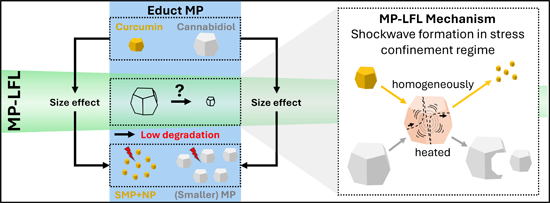
- pulse duration of 10 ps (as the acoustic relaxation time is higher, tac, 1 µm ≥ 500 ps, Equations S11 and S12, Supporting Information File 1). Depending on the optical penetration depth, the particle size influences whether homogeneous or inhomogeneous heating takes place. The heated volume leads to the
- formation of thermoelastic stress and finally to the formation of shock waves, promoting mechanical fragmentation. For curcumin, the mean optical penetration depth is 32 µm (dopt, 1 µm = 39 µm, dopt, 10 µm = 27 µm), and for CBD, the mean optical penetration depth is 170 µm. The mean absorption coefficients
- sphere. For both material systems, the mean optical penetration depth is well above the average educt particle size and therefore leads to homogeneous heating of the educt by the laser. Overall, the nutraceutical particles are homogeneously heated during picosecond-LFL, and the criterion for


Performance optimization of a microwave-coupled plasma-based ultralow-energy ECR ion source for silicon nanostructuring
Beilstein J. Nanotechnol. 2025, 16, 484–494, doi:10.3762/bjnano.16.37

- of the Ar-ion bombardment. The thickness of the amorphous layer is around 1.5 nm, which is consistent with the penetration depth of the Ar ions (1.2 nm) estimated by Monte Carlo simulations (Figure 5f) [31]. Therefore, the topographical image is consistent with the cross-sectional image, indicating a
- , rendering it valuable for both implantation and deposition processes. Our meticulous investigation of the ECR ion source lays the groundwork for ion beam-induced nanostructuring and layer-wise material modification, affording precise control over ion penetration depth and fluence. The manuscript emphasizes


Vortex lattices of layered HTSCs at different vortex–vortex interaction potentials
Beilstein J. Nanotechnol. 2025, 16, 362–370, doi:10.3762/bjnano.16.27
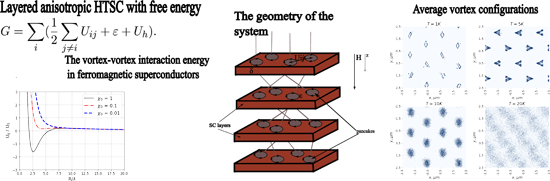
- length λJ = γs, where s is the distance between the superconducting planes, γ is the anisotropy parameter, and λ is the London penetration depth of the magnetic field. When the ratio λ/λJ < 0.46, crossed lattices of Abrikosov and Josephson vortices (vortex chains) are observed; at λ/λJ > 0.46, the
- artificial pinning centers, or in samples with columnar defects perpendicular to the superconducting planes, the average deviation of pancakes from the axis of the vortex filament due to thermal motion is much less than λ, that is, the London penetration depth of the magnetic field into the superconductor
- magnetic field penetration depth and the coherence length [28]. In this paper, the following forms of this dependence are used: and These relations fairly accurately reflect the temperature dependence of the characteristic lengths in bismuth HTSC [29]. In this work, in addition to the classical potential


Recent advances in photothermal nanomaterials for ophthalmic applications
Beilstein J. Nanotechnol. 2025, 16, 195–215, doi:10.3762/bjnano.16.16
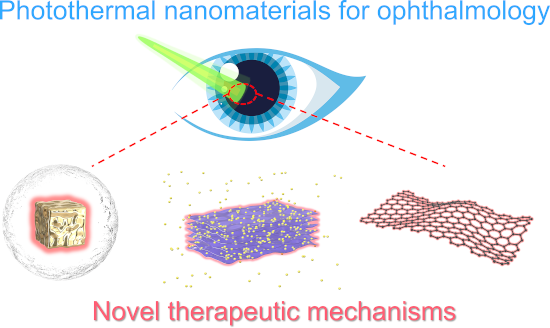
- endogenous chromophores (i.e., blood, water, and melanin) and biomolecules in the human body have a low absorption rate of NIR light. Hence, NIR has a high tissue penetration depth, which can avoid photothermal damage to healthy tissues [35][36][37]. Activation of photothermal nanomaterials with NIR light
- penetration depth is only a few millimeters, which does not provide clear imaging of deeper ocular structures [177][178]. Fluorescence imaging is hindered by contrast agent photobleaching and phototoxicity, resulting in low image quality and biological side effects [179][180]. Photoacoustic imaging has deep


Ion-induced surface reactions and deposition from Pt(CO)2Cl2 and Pt(CO)2Br2
Beilstein J. Nanotechnol. 2024, 15, 1427–1439, doi:10.3762/bjnano.15.115

- -energy electrons produced by ion–substrate interactions. In this respect, the increased importance of this reaction pathway is a consequence of the extremely inefficient momentum transfer for H2+/Pt(CO)2X2 collisions, coupled with the greater penetration depth of the lighter ions within the tantalum



Direct electron beam writing of silver using a β-diketonate precursor: first insights
Beilstein J. Nanotechnol. 2024, 15, 1117–1124, doi:10.3762/bjnano.15.90

- functionality [23][24]. Here, skin depth refers to the penetration depth of an electromagnetic field into a (non-transparent) metallic material. While pure metal deposition by direct electron beam writing was demonstrated for gold precursors with inorganic ligands [25][26], high purity comes often at the


Functional fibrillar interfaces: Biological hair as inspiration across scales
Beilstein J. Nanotechnol. 2024, 15, 664–677, doi:10.3762/bjnano.15.55
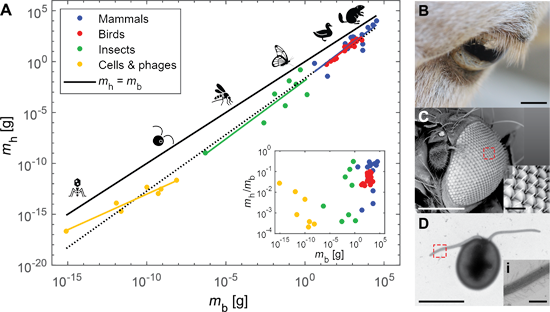
- , also known as a peg-in-pit sensillum [154]. The protruding hair-like receptors help to absorb thermal radiation, since the penetration depth of infrared radiation into insect cuticle is quite shallow [155]. Additionally, the hair-like sensillum possesses electron-dense filaments that may improve


Investigating ripple pattern formation and damage profiles in Si and Ge induced by 100 keV Ar+ ion beam: a comparative study
Beilstein J. Nanotechnol. 2024, 15, 367–375, doi:10.3762/bjnano.15.33
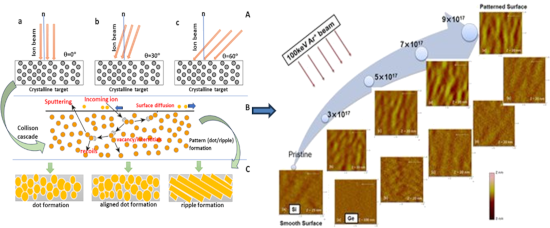
- × 1017 ions/cm2. Due to a higher mass difference between Si and Ge, Ge being a heavier target, there was not too much damage as a result of Ar ion irradiation. Therefore, most of the region remained unaltered beyond the ion penetration depths for both cases. This may be due to the high penetration depth


Design, fabrication, and characterization of kinetic-inductive force sensors for scanning probe applications
Beilstein J. Nanotechnol. 2024, 15, 242–255, doi:10.3762/bjnano.15.23
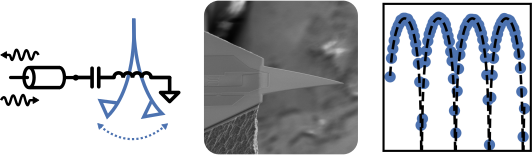
- less than the London penetration depth to the normal-state sheet resistance R□ and the superconducting energy gap Δ0. For a conductor of length ℓ and width w, the kinetic inductance is where Lk,□ is the kinetic inductance per square. From Equation 4, we require a superconducting film with large normal



Measurements of dichroic bow-tie antenna arrays with integrated cold-electron bolometers using YBCO oscillators
Beilstein J. Nanotechnol. 2024, 15, 26–36, doi:10.3762/bjnano.15.3
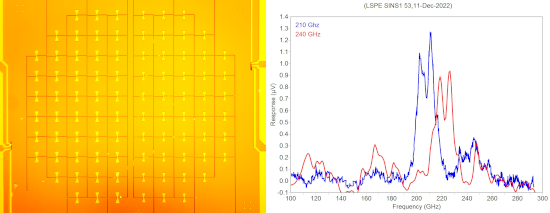
- were rather long since their lengths were much larger than the Josephson penetration depth λJ < 1 µm (T = 2.7 K). The oscillator chip contains six JJ structures integrated into modified dipole antennas [29]. When the DC bias current is passed through the junction, the AC voltage arises, the frequency


Nanoarchitectonics of photothermal materials to enhance the sensitivity of lateral flow assays
Beilstein J. Nanotechnol. 2023, 14, 988–1003, doi:10.3762/bjnano.14.82
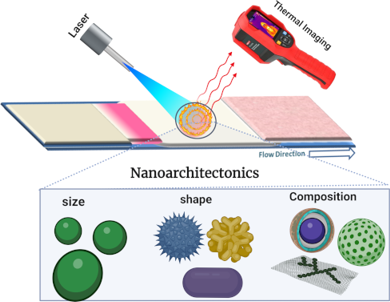
- the photothermal material; the material should exhibit strong light-to-heat conversion and good photostability. The structural and morphological properties of the selected material should ensure strong absorption in the NIR region to attain better penetration depth in the LFA nitrocellulose membrane


Ultralow-energy amorphization of contaminated silicon samples investigated by molecular dynamics
Beilstein J. Nanotechnol. 2023, 14, 834–849, doi:10.3762/bjnano.14.68
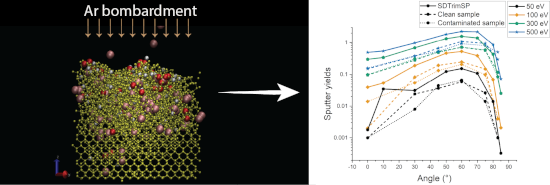
- molecules are deposited at the surface, even higher energy collisions will only transmit a fraction of the energy to the water molecules, which will be either sputtered or fragmented and implanted. Hence, the resulting penetration depth of hydrogen and oxygen should be shallower than for argon. It is