


Search results
Search for "piezoelectric" in Full Text gives 155 result(s) in Beilstein Journal of Nanotechnology.
Vibration-induced dynamic structural superlubricity on MoS2/Au(111) under ultrahigh vacuum
Beilstein J. Nanotechnol. 2026, 17, 1039–1046, doi:10.3762/bjnano.17.71
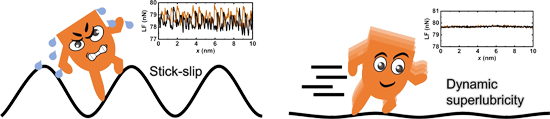
- . Monolayer MoS2 flakes were synthesized following established protocols [15][26][27]. The mechanical actuation was implemented by applying a vertical sinusoidal excitation to the cantilever base through a piezoelectric actuator, introducing out-of-plane vibrations to the tip–sample contact. The friction


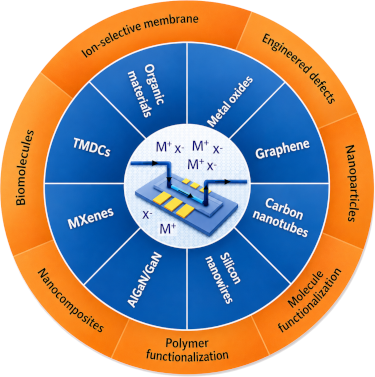
Materials challenges in solid-state sensors for continuous monitoring of ions in water
Beilstein J. Nanotechnol. 2026, 17, 935–973, doi:10.3762/bjnano.17.66


Molecular engineering of individual dye-based nanoparticle photostability for ultrabright two-photon fluorescence
Beilstein J. Nanotechnol. 2026, 17, 688–696, doi:10.3762/bjnano.17.48
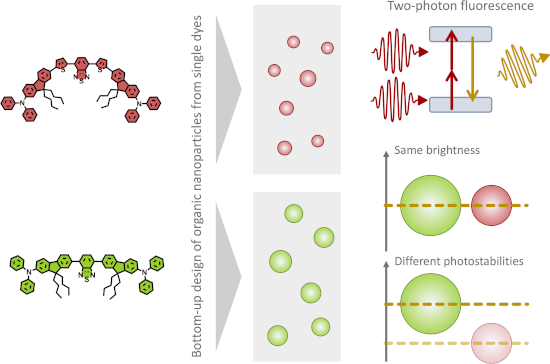
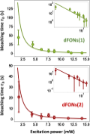
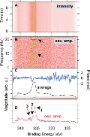
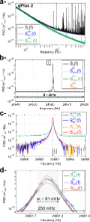
- the piezoelectric stage with 100 nm steps and a 10 ms integration time per pixel. Laser excitation powers were maintained at 1.7 mW and 1.6 mW for dFONs(1) and dFONs(2), respectively. A typical scan is shown in Figure 2a, where several point spread functions (PSFs) are displayed corresponding to
- at 40 °C on a hotplate for 15 min to evaporate the solvent. 2P fluorescence signals from individual nanoparticles were observed using a custom-made inverted 2P microscope setup [22] with a water-immersion objective (NA 1.2, ×60, Nikon) and a piezoelectric nanopositioning stage (Piezoconcept) for


Impacts of annealing on structural and photophysical properties of zinc phthalocyanine adsorbed on graphene
Beilstein J. Nanotechnol. 2026, 17, 576–585, doi:10.3762/bjnano.17.39
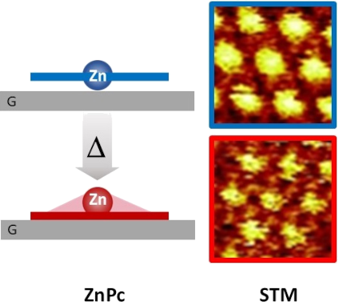
- wire (90/10, Goodfellow). The scanning piezoelectric ceramic was calibrated in the xy directions with the help of atomically resolved pictures obtained on HOPG. In order to ensure a correct statistical representation of our measurements concerning the structural organization of the monolayers, several


Calibration of piezo actuators and systems by dynamic interferometry
Beilstein J. Nanotechnol. 2025, 16, 2086–2091, doi:10.3762/bjnano.16.143
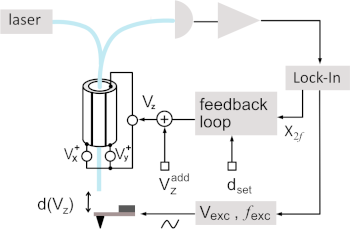
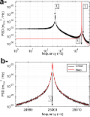
- . Experiments are performed with laser light of wavelength λ = λvac = 780.41 nm and the excitation frequency is kept at the cantilever eigenfrequency fexc = 169.667 kHz determined at the beginning of the measurements. The piezoelectric tube (PZT-8, EBL Products Inc., East Hartford, CT, USA) used for fiber
- positioning is specified with a piezoelectric constant d31 = −0.95 Å/V [22] at 293 K, according to the manufacturer’s data sheet [23]. The extension or contraction of the fiber tube piezo ΔL depends on Vz,f and the dimensions of the tube [24]. where L and h are the length of the piezo tube and the wall


Multifrequency AFM integrating PeakForce tapping and higher eigenmodes for heterogeneous surface characterization
Beilstein J. Nanotechnol. 2025, 16, 2077–2085, doi:10.3762/bjnano.16.142
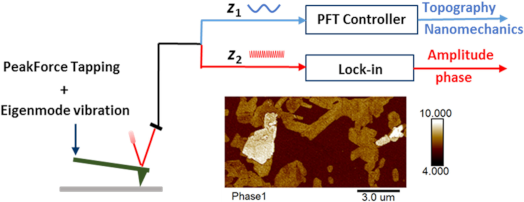
- montmorillonite (MMT) nanosheets, demonstrating its potential to improve material property contrast and characterization. Experimental Experimental setup Our experiments were conducted using a commercial AFM system (Bruker Dimension Icon) equipped with a cantilever holder that incorporates a piezoelectric
- Figure 1, the probe is exposed to two excitation mechanisms: (i) The piezoelectric driver PD-I induces sinusoidal vibrations at a frequency significantly below the cantilever’s first eigenmode frequency, typically in the range of 0.5–2 kHz on our instrument. This action propels the probe to engage and
- the measurement points can be calculated using the contact mechanics models [18][22]. (ii) Concurrently, the piezoelectric actuator PD-II excites the probe at its higher eigenmode, inducing a minor vibration with an amplitude generally beneath 1 nm. This high-eigenmode oscillation amplitude remains


Low-temperature AFM with a microwave cavity optomechanical transducer
Beilstein J. Nanotechnol. 2025, 16, 1873–1882, doi:10.3762/bjnano.16.130
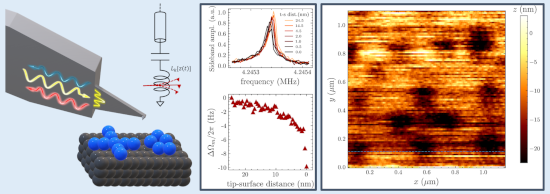
- force-sensor design is a significant improvement over piezoelectric force sensors commonly used in low-temperature AFM. We discuss the potential for further improvement of the sensor design to achieve optimal detection at the standard quantum limit. We demonstrate AFM operation with surface-tracking
- -circuit board to which the sensor is mounted. This custom board also hosts a piezoelectric inertial actuator (shaker), which drives the cantilever oscillation. A test surface is mounted on top of the open-loop scanner stack consisting of a z-positioner for coarse approach and an open-loop xyz-scanner for
- by mechanical displacement noise and the force measurement is at the thermal limit. When T < T*, the measurement is dominated by detector noise and improvements to displacement detection will improve force sensitivity. Piezoelectric sensors with transimpedance amplifier detectors as reported by


Piezoelectricity of layered double hydroxides: perspectives regarding piezocatalysis and nanogenerators
Beilstein J. Nanotechnol. 2025, 16, 1812–1817, doi:10.3762/bjnano.16.124

- Evgeniy S. Seliverstov Evgeniya A. Tarasenko Olga E. Lebedeva Department of General Chemistry, Belgorod State National Research University, Pobedy 85, 308015 Belgorod, Russian Federation 10.3762/bjnano.16.124 Abstract Recent research in alternate sources of energy such as piezoelectric energy
- is still in its infancy and this review explores its recent advances. The discussion encompasses LDH-based piezoelectric nanogenerators, piezocatalytic and piezo-photocatalytic properties of LDHs, and composite material synergies that enhance the overall electroactive performance. Looking to the
- future, systematic research into the effects of LDHs’ composition and structure on piezoelectric properties will be crucial to unlock their full potential. This mini-review aims to inspire the audience with valuable ideas for the development of new LDH-based piezoelectric materials, thereby contributing

Ambient pressure XPS at MAX IV
Beilstein J. Nanotechnol. 2025, 16, 1677–1694, doi:10.3762/bjnano.16.118
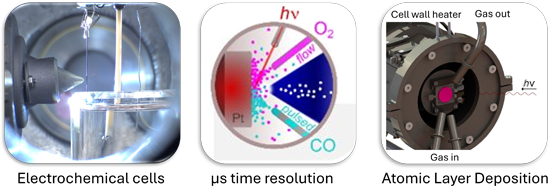
- repetition rate of 5 Hz to control O2 gas injection (piezoelectric valve) in a background of NH3 (15 sccm) and O2 (10 sccm) achieving 3.8 mbar (the local pressure at the sample surface is much higher) total pressure at 460 °C on a PtRh(100) catalyst. Spectra were acquired at 200 kHz (5 µs time resolution





Mechanical stability of individual bacterial cells under different osmotic pressure conditions: a nanoindentation study of Pseudomonas aeruginosa
Beilstein J. Nanotechnol. 2025, 16, 1171–1183, doi:10.3762/bjnano.16.86
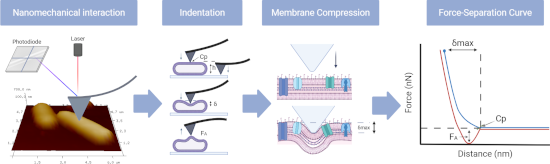
- displacement by the piezoelectric element are gathered in order to maintain a constant cantilever deflection or amplitude while a surface is scanned line by line Conversely, in FV quantitative information is extracted after analysis of a force–separation curve obtained from a performed nanoindentation


Piezoelectricity of hexagonal boron nitrides improves bone tissue generation as tested on osteoblasts
Beilstein J. Nanotechnol. 2025, 16, 1068–1081, doi:10.3762/bjnano.16.78
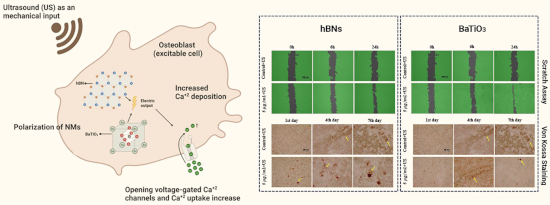
- 10.3762/bjnano.16.78 Abstract Bone tissue, also known as bone, is a hard and specialized connective tissue consisting of various bone cells. Internally, it has a honeycomb-like matrix providing rigidity to the bone and a piezoelectric feature contributing to bone remodeling. Bone remodeling is a crucial
- be sufficient to repair the damage. To address this, the use of piezoelectric nanomaterials (NMs) in bone tissue engineering was investigated. In this study, the influence of the piezoelectric hexagonal boron nitrides (hBNs) and barium titanate (BaTiO3) on human osteoblasts (HOb) was comparatively
- evaluated. The synthesized hBNs and purchased BaTiO3 were used after their full characterization by imaging and spectroscopic techniques. The piezoelectric behavior of both NMs was evaluated using piezoresponse force microscopy (PRFM). During in vitro studies, the piezoelectricity of the NMs was stimulated


Thickness dependent oxidation in CrCl3: a scanning X-ray photoemission and Kelvin probe microscopies study
Beilstein J. Nanotechnol. 2025, 16, 749–761, doi:10.3762/bjnano.16.58
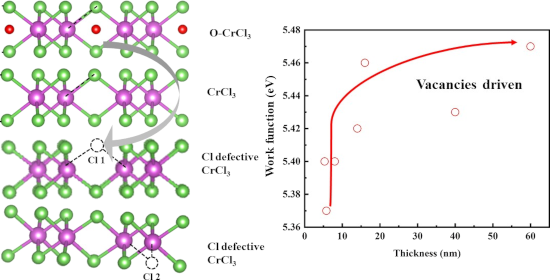
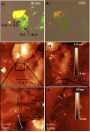
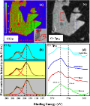
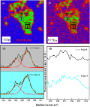
- with an unfocused beam (≈2.0 μm diameter), while the high-resolution SPEM maps of 128 × 128 μm2 size using a piezoelectric driven stage were obtained with a focused beam (pixel size of 130 nm) by means of a Fresnel zone and a relatively broad energy resolution mode [23]. The SPEM maps were captured





Quantification of lead through rod-shaped silver-doped zinc oxide nanoparticles using an electrochemical approach
Beilstein J. Nanotechnol. 2025, 16, 422–434, doi:10.3762/bjnano.16.33
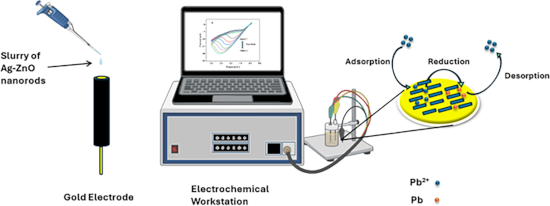
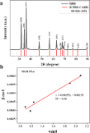
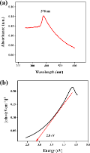
- employed as effective electron mediators [9]. Zinc oxide nanoparticles have gained a lot of attention due to their unique features, such as wide bandgap (approximately 3.37 eV), excellent electron transportation, piezoelectric behavior, semiconductor nature, low toxicity, and enhanced electrochemical





Advanced atomic force microscopy techniques V
Beilstein J. Nanotechnol. 2025, 16, 54–56, doi:10.3762/bjnano.16.6

- calculations. Eftekari et al. measure the local surface photovoltage generated in a silicon photodiode integrated with a piezoelectric membrane [8]. The design of such a device allows for the laterally resolved simultaneous quantification of the photovoltage generated by the photodiode as well as the
- mechanical oscillation of the piezoelectric membrane with highest resolution in real time. In addition to the measurement of surface potentials or photovoltages, Navarro-Rodriguez et al. investigate the dynamics of surface charges and how they couple to the detection system [9]. They describe in detail how
Strain-induced bandgap engineering in 2D ψ-graphene materials: a first-principles study
Beilstein J. Nanotechnol. 2024, 15, 1440–1452, doi:10.3762/bjnano.15.116
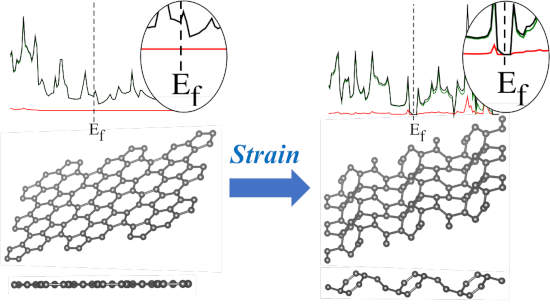
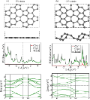
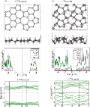
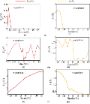
- graphene to a piezoelectric substrate, by shrinking or elongating the substrate by applying a bias voltage, or by using the tip of an atomic force microscope (AFM) to push graphene over a hole created in the substrate [29]. A wealth of literature on strain engineering of graphene and other 2D materials


Out-of-plane polarization induces a picosecond photoresponse in rhombohedral stacked bilayer WSe2
Beilstein J. Nanotechnol. 2024, 15, 1362–1368, doi:10.3762/bjnano.15.109
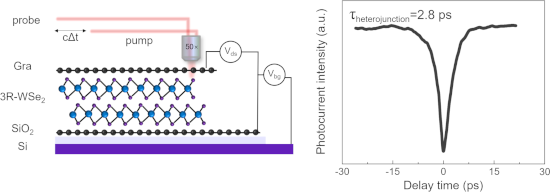
- approximately 0.2 pA. Photocurrent maps were generated by scanning the desired area using a piezoelectric displacement stage equipped with a fixed laser spot. The scanning range covered a maximum square area of 100 µm. Using time-resolved photocurrent measurements (TRPC), we explored the intrinsic photoresponse


Mn-doped ZnO nanopowders prepared by sol–gel and microwave-assisted sol–gel methods and their photocatalytic properties
Beilstein J. Nanotechnol. 2024, 15, 1283–1296, doi:10.3762/bjnano.15.104
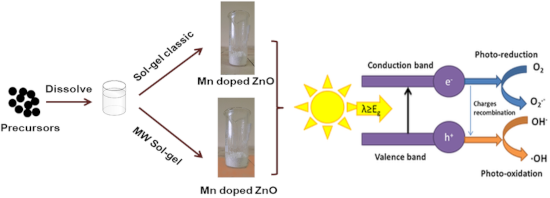
- previous studies, the authors demonstrated that Mn-doped ZnO films exhibit superior optical and piezoelectric properties compared to undoped ZnO, with a more compact microstructure and reduced surface roughness [41]. Building on this foundation, the current article aims to focus on the methods of


Signal generation in dynamic interferometric displacement detection
Beilstein J. Nanotechnol. 2024, 15, 1070–1076, doi:10.3762/bjnano.15.87
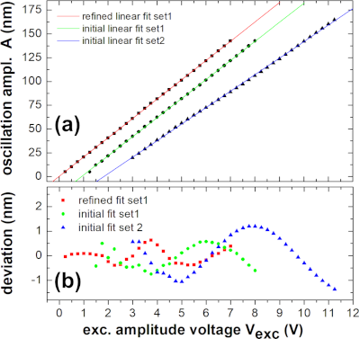
- and a quality factor of Q = 9000. After transfer of the cantilever, which is glued to a cantilever holder, the cantilever is mechanically firmly attached to the AFM scan head, while the optical fiber and the sample are approached to the cantilever and the tip by piezoelectric motors for coarse motion


Enhancing higher-order modal response in multifrequency atomic force microscopy with a coupled cantilever system
Beilstein J. Nanotechnol. 2024, 15, 694–703, doi:10.3762/bjnano.15.57

- , the piezoelectric transducer (PZT-5H) was driven by a signal generator (DG1022, Rigol Technologies Co., Ltd.) to apply the excitation force to different positions of the cantilever. 2 cm and 5 cm face excitations were applied with a piezoelectric transducer size of 20 × 14 × 0.2 mm and 50 × 14 × 0.2
- piezoelectric transducers used during the frequency sweep are all 14 × 2.5 × 0.2 mm, which means less mass and less effect on the cantilever modes. The peak-to-peak voltages during the two sweeps are different, and the sweep function of the signal generator is continuously varying. Hence, the amplitude is
- adjustment of the bottom support device. The latter has a greater effect on the modal frequency. Next, the first two orders of modes of the traditional cantilever beam and coupled system were excited by using piezoelectric transducers (50 × 14 × 0.2 mm and 20 × 14 × 0.2 mm, respectively). The peak-to-peak


Stiffness calibration of qPlus sensors at low temperature through thermal noise measurements
Beilstein J. Nanotechnol. 2024, 15, 580–602, doi:10.3762/bjnano.15.50
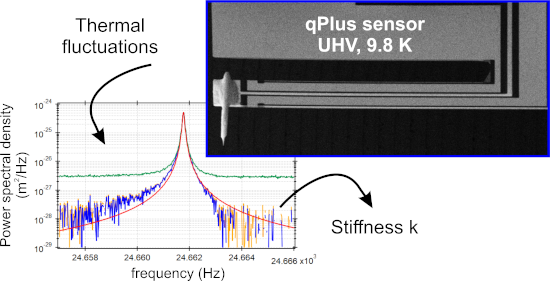
- piezoelectric nature, which facilitates the readout of the tip deflection, based on the piezoelectric charge induced by the quartz upon oscillation through a simple I/V, or charge, preamplifier [27][28], as compared to the heavy optical detection setup required for silicon cantilevers. Nowadays, the qPlus
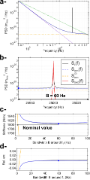
- stiffness. But this is not feasible in practice because of measurement noise, which usually exceeds thermal noise. There are several origins to measurement noise. For qPlus sensors, two main noise sources may be considered: the preamplifier, which converts the piezoelectric current of the QTF into a
- to the calibration of the modal stiffness of QTFs used below 4.2 K and at 5 mbar [62][63]. The method is based on the measurement of the admittance of the piezoelectric current produced by the fork upon oscillation. The authors fitted that quantity with a Butterworth–Van Dyke-type electrical

Unveiling the nature of atomic defects in graphene on a metal surface
Beilstein J. Nanotechnol. 2024, 15, 416–425, doi:10.3762/bjnano.15.37
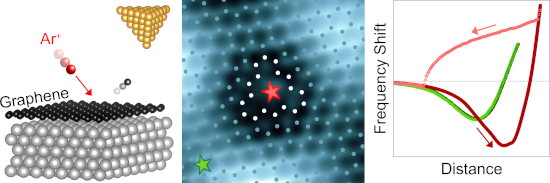
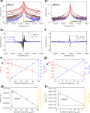
- of an oscillating piezoelectric tuning fork sensor [37][38] (resonance frequency: 30.5 kHz, quality factor: 45000, amplitude: 50 pm) were mapped at constant height for topographic images. The vertical force between tip and sample was extracted from distance-dependent measurements of the resonance


Determining by Raman spectroscopy the average thickness and N-layer-specific surface coverages of MoS2 thin films with domains much smaller than the laser spot size
Beilstein J. Nanotechnol. 2024, 15, 279–296, doi:10.3762/bjnano.15.26


Design, fabrication, and characterization of kinetic-inductive force sensors for scanning probe applications
Beilstein J. Nanotechnol. 2024, 15, 242–255, doi:10.3762/bjnano.15.23
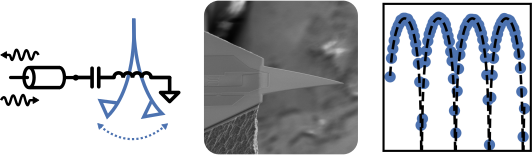
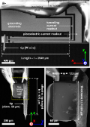
- passed to the sample. A directional coupler separates incoming and reflected signal. The reflected signal is amplified with a cryogenic low-noise amplifier and additionally amplified at room temperature. A separate port on the microwave platform generates the low-frequency drive to a piezoelectric shaker
- . (b) Photograph of the sample, the custom-made launcher, and the directional coupler integrated at the bottom of the microwave inset. The piezoelectric shaker used to inertially actuate the cantilever of the sample (held by three prongs at the front end of the launcher) is visible as the white disk



Spatial mapping of photovoltage and light-induced displacement of on-chip coupled piezo/photodiodes by Kelvin probe force microscopy under modulated illumination
Beilstein J. Nanotechnol. 2023, 14, 1059–1067, doi:10.3762/bjnano.14.87
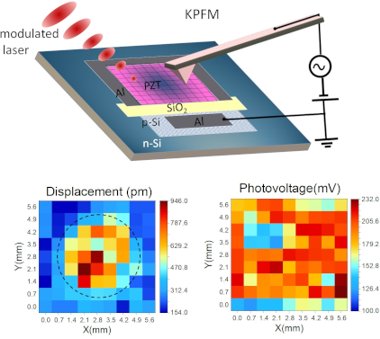
- In this work, a silicon photodiode integrated with a piezoelectric membrane is studied by Kelvin probe force microscopy (KPFM) under modulated illumination. Time-dependent KPFM enables simultaneous quantification of the surface photovoltage generated by the photodiode as well as the resulting
- mechanical oscillation of the piezoelectric membrane with vertical atomic resolution in real-time. This technique offers the opportunity to measure concurrently the optoelectronic and mechanical response of the device at the nanoscale. Furthermore, time-dependent atomic force microscopy (AFM) was employed to
- spatially map voltage-induced oscillation of various sizes of piezoelectric membranes without the photodiode to investigate their position- and size-dependent displacement. Keywords: Kelvin probe force microscopy (KPFM); light-driven micro/nano systems; piezoelectric membrane; surface photovoltage (SPV


Industrial perspectives for personalized microneedles
Beilstein J. Nanotechnol. 2023, 14, 857–864, doi:10.3762/bjnano.14.70
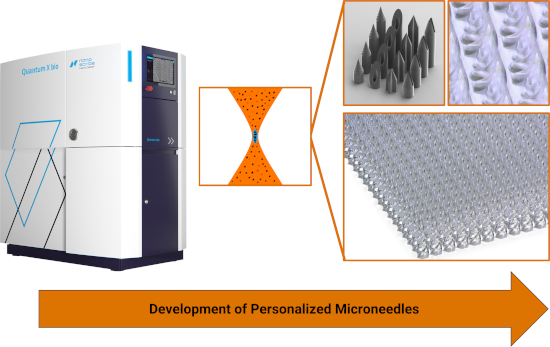
- printers (e.g., Nanoscribe Quantum X platforms) producing polymer masters. The increased scan speed and throughput are the result of new supporting technologies coming to market, such as replacing piezoelectric stages with galvanometric mirrors. These new technologies continue to decrease the gap in





