Search results
Search for "SiO2/Si substrate" in Full Text gives 37 result(s) in Beilstein Journal of Nanotechnology.
The integration of graphene into microelectronic devices
Beilstein J. Nanotechnol. 2017, 8, 1056–1064, doi:10.3762/bjnano.8.107
- Society. Schematic illustration of the basic approach for the method of direct growth of graphene on a SiO2 surface. (a) A thin Ni film is deposited on a SiO2/Si substrate. (b) Plasma CVD is performed. (c) Carbon atoms diffuse into the Ni film, and graphene is preferentially grown along the interface
- between the Ni and SiO2 layers. (d) Graphene on a SiO2/Si substrate is realized by removing the Ni film using a chemical etching technique. Reprinted with permission from [29], copyright 2012 American Chemical Society. Schematic illustration of the mobility (experiment) as a function of the ratio between


CVD transfer-free graphene for sensing applications
Beilstein J. Nanotechnol. 2017, 8, 1015–1022, doi:10.3762/bjnano.8.102
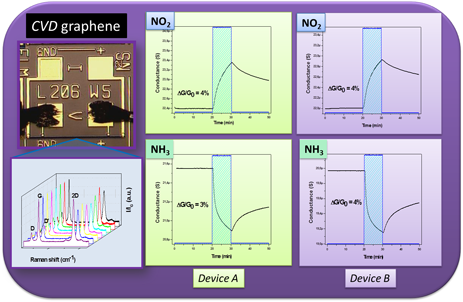
- of graphene down to micrometre-size dimensions. A photo-lithographic process, combined with SF6 dry etching, has been used to shape the Mo in the desired form. Graphene layers have then been grown on pre-patterned Mo/SiO2/Si substrate by means of AIXTRON BlackMagic Pro equipment, setting the


Nitrogen-doped twisted graphene grown on copper by atmospheric pressure CVD from a decane precursor
Beilstein J. Nanotechnol. 2017, 8, 145–158, doi:10.3762/bjnano.8.15
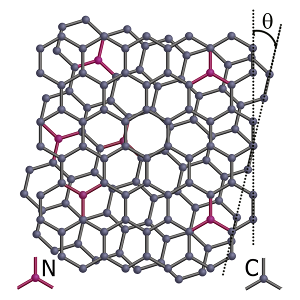
- the insets to Figures Figure 2a and Figure 2b the 2D peaks are shown revealing the symmetry of the 2D band. The latter indicates the weak interlayer interaction, which will be discussed later. In Figure 3a we demonstrate the Rayleigh image of sample A transferred to a SiO2/Si substrate. Raman mapping
- 1588 cm−1 against 1580 cm−1 for SLG [25]. Figure 5a–d shows Raman maps (400 points) of sample B transferred onto a SiO2/Si substrate. The corresponding histograms are presented in Figure 6a–d. A single Raman spectrum was accumulated for 10 s with a laser wavelength of 473 nm and a beam diameter of
- partitioning procedure following different parameters (this result is not shown here). The obtained results are in reasonable agreement with each other. Therefore, in order to demonstrate the universality of the elaborated method, for sample B on a SiO2/Si substrate, the Raman data set splitting was based on


Sub-nanosecond light-pulse generation with waveguide-coupled carbon nanotube transducers
Beilstein J. Nanotechnol. 2017, 8, 38–44, doi:10.3762/bjnano.8.5
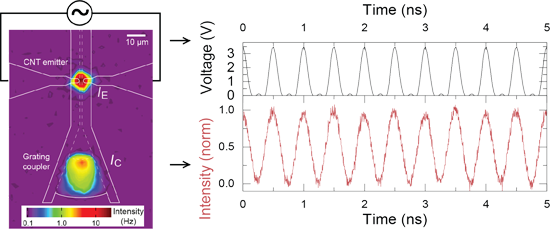
- electron beam lithography on top of Si3N4/SiO2/Si substrate. Au/Cr contacts were produced by physical vapor deposition, and 600 nm wide, half-etched Si3N4-waveguides were formed with reactive ion etching. A typical sample contains tens of contact pairs and CNTs that were placed in between using


Orientation of FePt nanoparticles on top of a-SiO2/Si(001), MgO(001) and sapphire(0001): effect of thermal treatments and influence of substrate and particle size
Beilstein J. Nanotechnol. 2016, 7, 591–604, doi:10.3762/bjnano.7.52
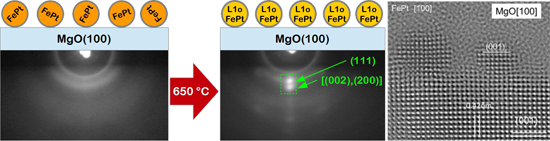
- Figure 2a the RHEED pattern for a 3 nm Fe48Pt52 film on a SiO2/Si substrate is presented after post annealing at 650 °C for 30 min. A diffuse intensity distribution is observed without any superposed streaks or spots. The bright ring around the direct beam is a halo feature due to the RHEED arrangement


Formation of pure Cu nanocrystals upon post-growth annealing of Cu–C material obtained from focused electron beam induced deposition: comparison of different methods
Beilstein J. Nanotechnol. 2015, 6, 1508–1517, doi:10.3762/bjnano.6.156
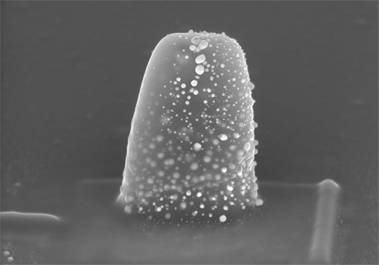
- conventionally or with a laser the flat morphology of square, line, or tip deposits on the pre-patterned SiO2/Si substrate changes (Figure 3 and Figure 4). While the laser allows for local heating, the conventional hotplate approach allows for more accurate temperature measurements. The visible onset of Cu
- nanocrystal precipitation on the deposit surface starts at around 150 °C for the Cu(hfac)2 deposits on the pre-patterned SiO2/Si substrate. Further heating to about 200 °C for 30 min did not visibly change the appearance of the Cu nanocrystal precipitation. EDX analysis after conventional heating to 200 °C




Analytical development and optimization of a graphene–solution interface capacitance model
Beilstein J. Nanotechnol. 2014, 5, 603–609, doi:10.3762/bjnano.5.71
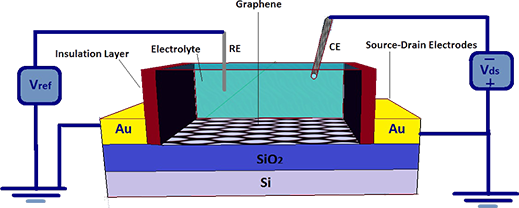
- -based devices, graphene with its outstanding properties such as consuming less energy and faster heat dissipating show a great promise in electrolyte-gated graphene field-effect transistors (EGFETs) [20]. An EGFET fabricated on a SiO2/Si substrate with gold source and drain electrodes and a graphene




Effect of contaminations and surface preparation on the work function of single layer MoS2
Beilstein J. Nanotechnol. 2014, 5, 291–297, doi:10.3762/bjnano.5.32
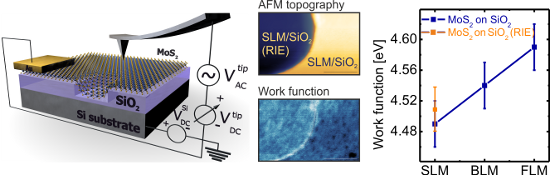
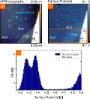
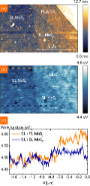
- measurements were performed under ambient conditions using amplitude modulated KPFM, both having a great impact on the results. In this work we study the work function of SLM on a standard SiO2/Si substrate using non-contact atomic force microscopy (NC-AFM) and Kelvin probe force microscopy in situ. In our



Fabrication of carbon nanomembranes by helium ion beam lithography
Beilstein J. Nanotechnol. 2014, 5, 188–194, doi:10.3762/bjnano.5.20
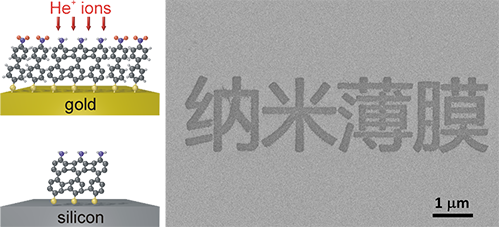
- cross-linked SAM is transferred onto another substrate, e.g., SiO2/Si. Figure 1e demonstrates a successful transfer of structured CNMs in Chinese characters which means nanomembranes: the grey background is SiO2/Si substrate and the darker features are transferred CNMs. For the fabrication of
- been transferred onto a SiO2/Si substrate. Interestingly, the first step is the formation of circular shaped nuclei, which is analogous to the nucleation for thin films or polymer crystallization [23]. After a dose of 176 µC/cm2 (Figure 3a), the average diameter of the nuclei is 9.0 ± 1.7 nm, which
- were transferred onto another substrate for further investigations again with the HIM. For the transfer of NBPT CNMs onto a SiO2/Si substrate the samples were spin-coated with a layer of poly(methyl methacrylate) (PMMA) for stabilization and baked on a hotplate at 90 °C for 5 min. The separation of the


Ordered arrays of nanoporous gold nanoparticles
Beilstein J. Nanotechnol. 2012, 3, 651–657, doi:10.3762/bjnano.3.74
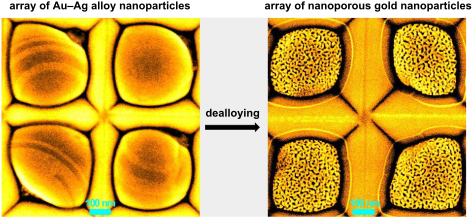
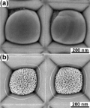
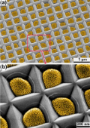
- samples in a 65 wt % HNO3 solution at 21 °C for 5 min. A reference sample (15 nm Au/20 nm Ag bilayers on a flat SiO2/Si substrate) was processed by annealing at 900 °C in Ar for 15 min and then submerging in a 65 wt % HNO3 solution at 21 °C for 5 min. The SiO2 thickness of the reference sample is 100 nm



Imaging ultra thin layers with helium ion microscopy: Utilizing the channeling contrast mechanism
Beilstein J. Nanotechnol. 2012, 3, 507–512, doi:10.3762/bjnano.3.58
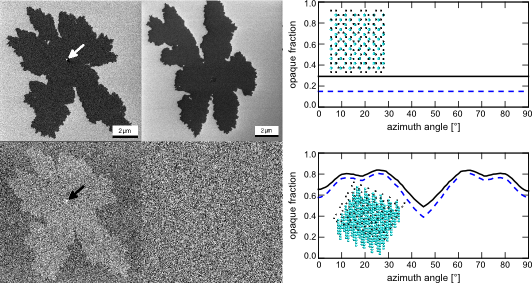
- surface layer of the relevant material (SiO2, PFS, or MS). As a consequence of the identical strip width for PFS and MS strips, we do not know a priori which stripe is which. However, we assign the bright structureless areas to the uncovered SiO2/Si substrate. It is understood that because of the


Formation of precise 2D Au particle arrays via thermally induced dewetting on pre-patterned substrates
Beilstein J. Nanotechnol. 2011, 2, 318–326, doi:10.3762/bjnano.2.37
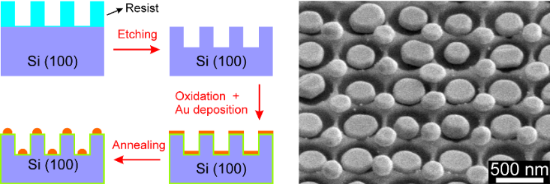
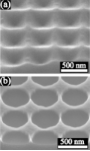
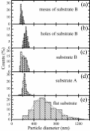
- symmetry (substrate B). SEM images of induced particles on the flat SiO2/Si substrate after dewetting of the 5 nm (a) and 60 nm (b) thick Au films. (c) Histograms of particle size distributions produced by the dewetting of the 5 nm, 10 nm, 20 nm, 30 nm, 40 nm, and 60 nm thick Au films on the flat SiO2/Si
- substrate A have a spatial period of 513 nm and a depth of 150 nm. The holes in the substrate B have the same spatial period of 513 nm, a diameter of about 490 nm, and a depth of 120 nm. Figure 2 shows the SEM images of the Au particles formed from the 5 nm and 60 nm thick Au films on a flat SiO2/Si
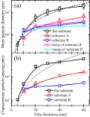
- substrate. Usually, flat substrates lead to a broad distribution of particle size and spacing of the dewetted particles. Figure 2c shows the particle size distributions produced by dewetting of Au films with thicknesses from 5 nm to 60 nm on the flat substrates. Both, mean particle size
and the width