


Search results
Search for "artificial intelligence" in Full Text gives 34 result(s) in Beilstein Journal of Nanotechnology.
Nanogenerator-based self-powered sensors for data collection
Beilstein J. Nanotechnol. 2021, 12, 680–693, doi:10.3762/bjnano.12.54
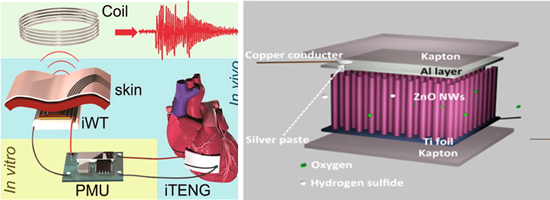
- , Swansea University, Swansea, SA1 8EN, UK 10.3762/bjnano.12.54 Abstract Self-powered sensors can provide energy and environmental data for applications regarding the Internet of Things, big data, and artificial intelligence. Nanogenerators provide excellent material compatibility, which also leads to a
- ][44][45][46], waste milk carton [15], and skin [47][48][49]. Thus, low-cost self-powered sensors can be deployed on a large scale and are a good candidate for data sources for the Internet of things (IoT), big data, and artificial intelligence (AI). NGs can be used as both pressure sensors and as
- increases with pressure. The output voltage reaches a saturation value after a certain number of sensor actuations, as shown in Figure 2e. This intelligent neuromorphic sensor that mimics synaptic enhancement and memory can be used as a human skin tactile sensing solution, providing rich data for artificial



A review on the green and sustainable synthesis of silver nanoparticles and one-dimensional silver nanostructures
Beilstein J. Nanotechnol. 2021, 12, 102–136, doi:10.3762/bjnano.12.9
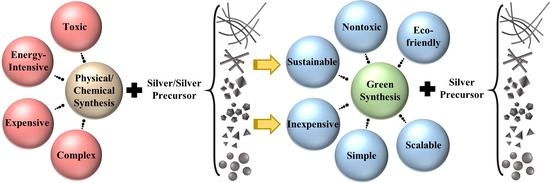
- , continuous green and sustainable synthesis of silver nanostructures adaptable for in situ characterization, and incorporation of artificial intelligence (AI) in green silver nanostructures synthesis are discussed. 2 Physical and chemical synthesis methodologies of silver nanoparticles In this section


Piezotronic effect in AlGaN/AlN/GaN heterojunction nanowires used as a flexible strain sensor
Beilstein J. Nanotechnol. 2020, 11, 1847–1853, doi:10.3762/bjnano.11.166
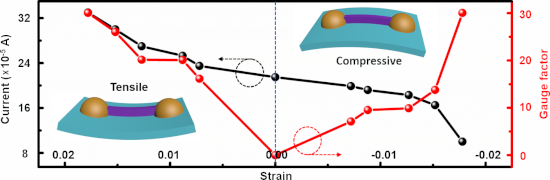
- investigated and systematically analyzed under compressive and tensile strain. Here, we describe a strain sensor that shows a great application potential in wearable integrated circuits, in health-monitoring devices, and in artificial intelligence. Keywords: AlGaN/AlN/GaN nanowires; flexible; piezotronic
- into electrical signals. They exhibit a potential for application in health-monitoring and motion-monitoring devices, and in artificial intelligence, for example [20][21][22]. However, high sensitivity (gauge factor ≥20) is key to detect a very small deformation of a given material [23][24]. Therefore
- describes the fabrication of a highly sensitive and a highly stable strain sensor based on a new AlGaN/AlN/GaN NW structure, which has a great potential to be applied in wearable integrated circuits, health-monitoring devices, artificial intelligence, among other fields. Results and Discussion The epitaxial


Detecting stable adsorbates of (1S)-camphor on Cu(111) with Bayesian optimization
Beilstein J. Nanotechnol. 2020, 11, 1577–1589, doi:10.3762/bjnano.11.140
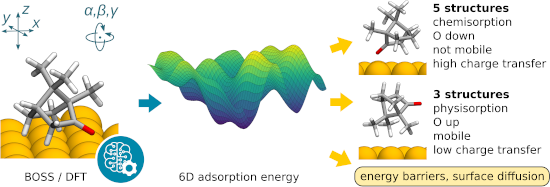
- -06CH11357. Funding This work has received funding from the Academy of Finland via the Artificial Intelligence for Microscopic Structure Search (AIMSS) project No. 316601 and the Flagship programme: Finnish Center for Artificial Intelligence FCAI, and from the Emil Aaltonen Foundation.


Multiwalled carbon nanotube based aromatic volatile organic compound sensor: sensitivity enhancement through 1-hexadecanethiol functionalisation
Beilstein J. Nanotechnol. 2019, 10, 2364–2373, doi:10.3762/bjnano.10.227
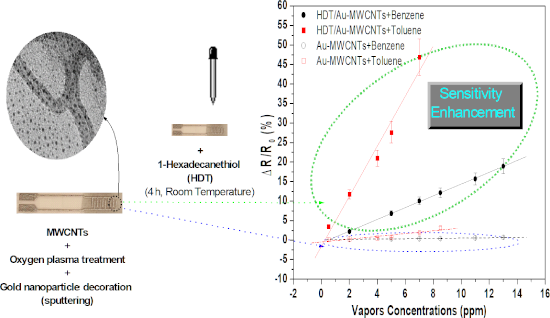
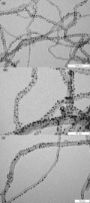
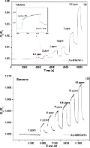
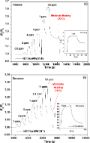
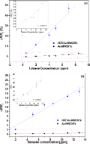
- selectivity. It was also shown to improve the sensor response dynamics. These results combined with previous results [22][32] could be interesting for the development of functionalised multisensor arrays combined with an artificial intelligence algorithm for selectivity enhancement. Synoptic structure of the




Wearable, stable, highly sensitive hydrogel–graphene strain sensors
Beilstein J. Nanotechnol. 2019, 10, 475–480, doi:10.3762/bjnano.10.47
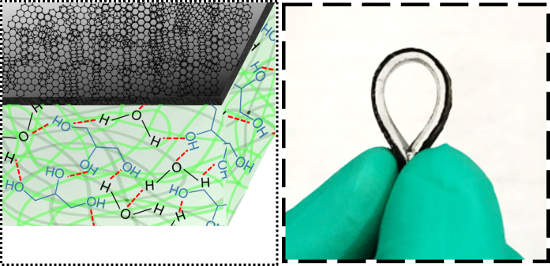
- the field of bioelectronics, artificial intelligence, and soft robotics [1][2]. Among these sensors, strain sensors can translate an external applied tensile force into electrical signal, hence attracting numerous research efforts for health monitoring, biomechanics studies and artificial skin for


Adiabatic superconducting cells for ultra-low-power artificial neural networks
Beilstein J. Nanotechnol. 2016, 7, 1397–1403, doi:10.3762/bjnano.7.130
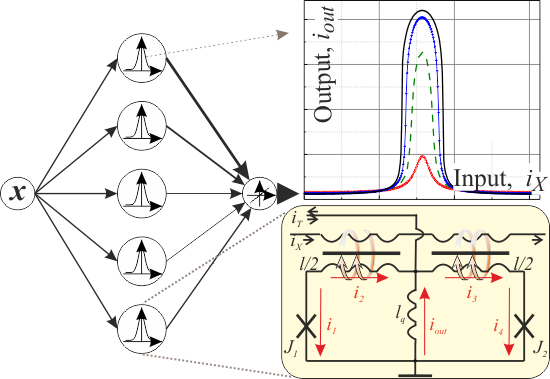
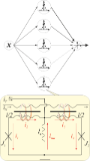
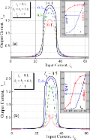
- application in the fields of artificial intelligence and machine learning [1]. The future of cellular and satellite communications, radar systems, deep sea and space exploration will likely be closely related to the capability of ANNs to provide effective solutions to problems such as classification and


An analytical approach to evaluate the performance of graphene and carbon nanotubes for NH3 gas sensor applications
Beilstein J. Nanotechnol. 2014, 5, 726–734, doi:10.3762/bjnano.5.85
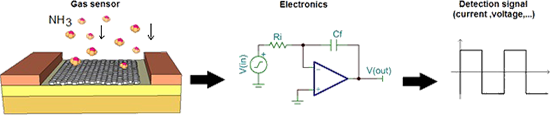
- Elnaz Akbari Vijay K. Arora Aria Enzevaee Mohamad. T. Ahmadi Mehdi Saeidmanesh Mohsen Khaledian Hediyeh Karimi Rubiyah Yusof Centre for Artificial Intelligence and Robotics (CAIRO), Universiti Teknologi Malaysia, Kuala Lumpur, Malaysia Faculty of Electrical Engineering, Universiti Teknologi


Analytical development and optimization of a graphene–solution interface capacitance model
Beilstein J. Nanotechnol. 2014, 5, 603–609, doi:10.3762/bjnano.5.71
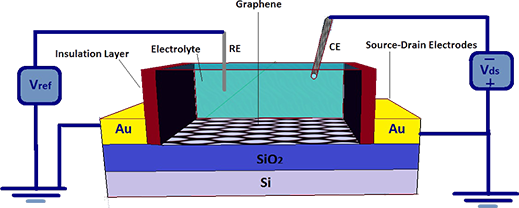
- Hediyeh Karimi Rasoul Rahmani Reza Mashayekhi Leyla Ranjbari Amir H. Shirdel Niloofar Haghighian Parisa Movahedi Moein Hadiyan Razali Ismail Centre for Artificial Intelligence and Robotics, Universiti Teknologi Malaysia, 54100 Kuala Lumpur, Malaysia Malaysia Japan International Ins. Of Technology




Other Beilstein-Institut Open Science Activities



