


Search results
Search for "environmental monitoring" in Full Text gives 41 result(s) in Beilstein Journal of Nanotechnology.
Walking energy harvesting and self-powered tracking system based on triboelectric nanogenerators
Beilstein J. Nanotechnol. 2020, 11, 1590–1595, doi:10.3762/bjnano.11.141
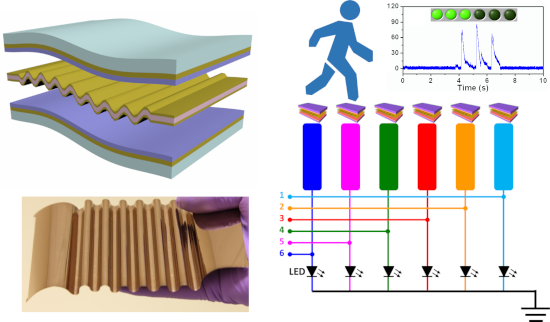
- transportation control, and for environmental monitoring. Experimental Surface modification of a PTFE film The surface modification of a PTFE film was performed in a similar manner as described previously [34]. Deep reactive ion etching was employed to construct PTFE nanowires aligned on the surface. Isopropyl





Triboelectric nanogenerator based on Teflon/vitamin B1 powder for self-powered humidity sensing
Beilstein J. Nanotechnol. 2020, 11, 1394–1401, doi:10.3762/bjnano.11.123
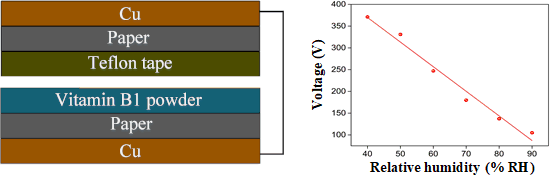
- ; Introduction Recently, there has been unprecedented advancement in the internet of things (IoT) technology, which includes environmental monitoring and intelligent community applications. Particularly, humidity sensing has been investigated in environmental monitoring, and in other sectors, such as agriculture
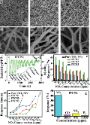
- environmental monitoring. The manufacturing process of the TVB-TENG structure. The working mechanism of the TVB-TENG structure. (a) The output voltage (matched load of 100 MΩ) and (b) short-circuit current (matched load of 100 kΩ) in a TENG. (c) The behavior of the output voltage and short-circuit current upon





Preparation, characterization and photocatalytic performance of heterostructured CuO–ZnO-loaded composite nanofiber membranes
Beilstein J. Nanotechnol. 2020, 11, 631–650, doi:10.3762/bjnano.11.50
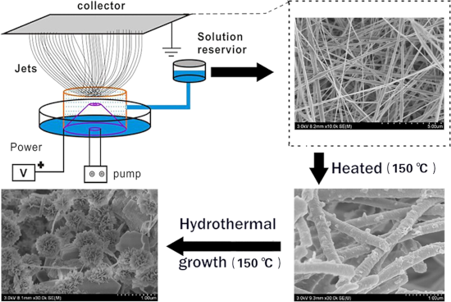
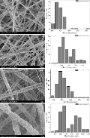
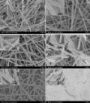
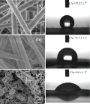
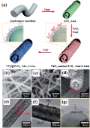
- environmental monitoring, industry, aviation, and transportation. In this paper, heterostructured CuO–ZnO-loaded CNF membranes (CNFMs) were prepared successfully by a combination of electrospinning, heat treatment, and hydrothermal synthesis. The influence of the synthesis parameters on morphology, structure












Experimental study of an evanescent-field biosensor based on 1D photonic bandgap structures
Beilstein J. Nanotechnol. 2019, 10, 967–974, doi:10.3762/bjnano.10.97

- been demonstrated for several applications such as medical diagnosis, environmental monitoring or security control [4]. Most typical configurations of integrated photonic biosensors are based on the use of resonant or interferometric configurations, as it is the case of ring resonators or disks and


Hydrophilicity and carbon chain length effects on the gas sensing properties of chemoresistive, self-assembled monolayer carbon nanotube sensors
Beilstein J. Nanotechnol. 2019, 10, 565–577, doi:10.3762/bjnano.10.58

- to exposure for humans [18]. In environmental monitoring applications, nitrogen dioxide should be detected in the 20 to 200 ppb range. Some authors have reported the detection of NO2 at such low concentrations using sensors employing carbon nanotubes [31][32]. In addition, sensors can be employed as


Electrospun one-dimensional nanostructures: a new horizon for gas sensing materials
Beilstein J. Nanotechnol. 2018, 9, 2128–2170, doi:10.3762/bjnano.9.202
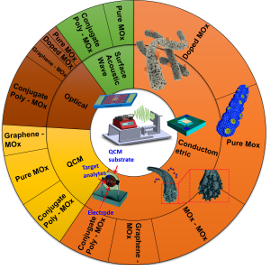
- applications in numerous areas, including healthcare, energy storage, biotechnology, environmental monitoring, and defence/security. Their enhanced specific surface area, superior mechanical properties, nanoporosity and improved surface characteristics (in particular, uniformity and stability) have made them






Metal oxide nanostructures: preparation, characterization and functional applications as chemical sensors
Beilstein J. Nanotechnol. 2017, 8, 1205–1217, doi:10.3762/bjnano.8.122
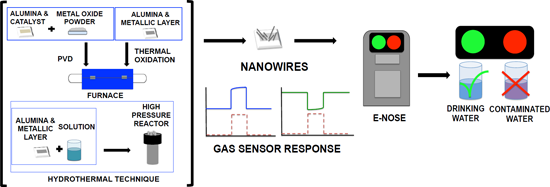
- oxidizing and a reducing gas interesting for environmental monitoring). Moreover, we have integrated metal oxide nanowires into an electronic nose and proved its ability in a real case study, more specifically the detection of water contamination. Results and Discussion Preparation of metal oxide
- dioxide, according to the raw estimation from the power-law fitting. However, such high concentrations are not interesting for environmental monitoring, being far above the air quality requirements [25]. Considering both target gases, Nb2O5-based sensors exhibit the lowest performance. One explanation


Gas sensing properties of MWCNT layers electrochemically decorated with Au and Pd nanoparticles
Beilstein J. Nanotechnol. 2017, 8, 592–603, doi:10.3762/bjnano.8.64
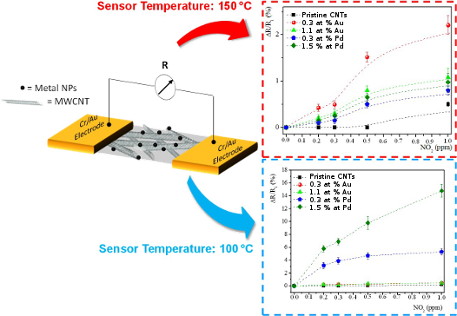
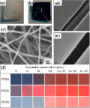
- detection in environmental monitoring. TEM images of electrochemically synthesized core–shell A) Au NPs and B) Pd NPs. Schematic view of the two-pole chemiresistor based on a MWCNT network functionalized with metal NPs. XPS core level spectrum of A) Au 4f and B) Pd 3d on functionalized MWCNTs. SEM images of


Sensitive detection of hydrocarbon gases using electrochemically Pd-modified ZnO chemiresistors
Beilstein J. Nanotechnol. 2017, 8, 82–90, doi:10.3762/bjnano.8.9
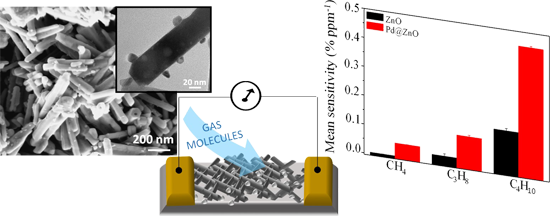
- detection for environmental monitoring. In the last years, various techniques have been used for HC gas detection [6][7][8][9]. However, they still have some limitations such as the need for expensive instruments, time-consuming procedures, complicated pre-treatments and periodical maintenance [10][11][12


Hydrophilic silver nanoparticles with tunable optical properties: application for the detection of heavy metals in water
Beilstein J. Nanotechnol. 2016, 7, 1654–1661, doi:10.3762/bjnano.7.157
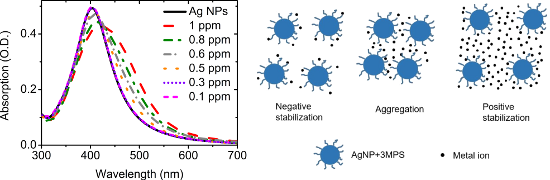
- devices, nanobiotechnology and nanomedicine. In particular, from the environmental monitoring perspective, sensors based on silver nanoparticles are in great demand because of their antibacterial and inexpensive synthetic method. In the present study, we synthesized AgNPs in water phase using silver
- ][12], energy [13][14][15], optoelectronics [16][17] and biomedicine [18] to sensors [19][20]. A very promising field of application is chemical sensing, which includes gas detection, safety and environmental monitoring [21][22][23][24][25]. Moreover, the need for developing highly sensitive and


Graphene-enhanced plasmonic nanohole arrays for environmental sensing in aqueous samples
Beilstein J. Nanotechnol. 2016, 7, 1564–1573, doi:10.3762/bjnano.7.150
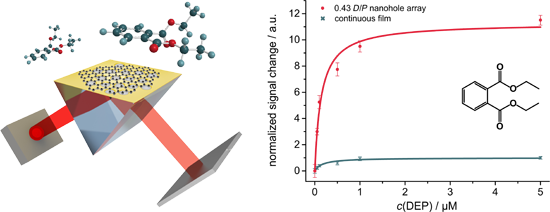
- environmental monitoring providing important features such as real time measurements, high sensitivity and label-free assay [8]. The detection of highly diluted concentrations and small molecules (<200 Da) remains challenging within SPR sensing [9]. For (bio)analytical applications the sensitivity needs to be




NO gas sensing at room temperature using single titanium oxide nanodot sensors created by atomic force microscopy nanolithography
Beilstein J. Nanotechnol. 2016, 7, 1044–1051, doi:10.3762/bjnano.7.97
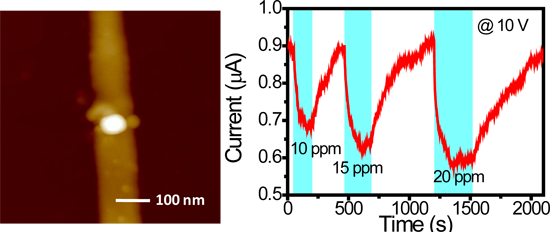
- recent years, gas sensors have been widely used in a variety of fields, such as medical diagnosis [1][2], environmental monitoring [3] and combustion emission control [4]. Among all types of gas sensors, resistor-type gas sensors based on semiconducting metal oxide nanomaterials [5][6][7][8] are more
- fabrication of titanium oxide nanowire (NW) gas sensors [25][26]. NO gas sensing at low concentrations is beneficial for human health [1][2] and environmental monitoring [3]. Various types of metal oxide nanomaterials have been utilized for NO or NO2 gas sensing, e.g., SnO2 [12][15][16][17], ZnO [13][14][17


Chemiresistive/SERS dual sensor based on densely packed gold nanoparticles
Beilstein J. Nanotechnol. 2015, 6, 2498–2503, doi:10.3762/bjnano.6.259

- sensors are chemiresistors, which are sensitive electrical devices capable of detecting (bio)chemicals by simply monitoring electrical resistance. They require simple DC circuitry, and are therefore ideal for developing wearable/portable devices for protection from chemical exposure, or for environmental
- monitoring. Assemblies of gold NPs were recently proposed as chemiresistor sensors, exhibiting reliable responses to the analyzed compounds [4]. In most cases very small particles were used (3–7 nm), functionalized with specific ligands that facilitate their assembly into thin nanoparticle films through


Simulation tool for assessing the release and environmental distribution of nanomaterials
Beilstein J. Nanotechnol. 2015, 6, 938–951, doi:10.3762/bjnano.6.97
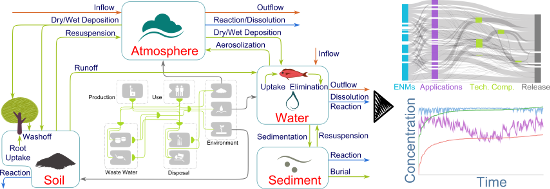
- . In this regard, various environmental impact assessment (EIA) frameworks have been proposed [6], which all require knowledge of the potential environmental distribution of ENMs in addition to their potential toxicological effects. However, reported ENM source release rates, environmental monitoring
- organics. These organics adsorb onto ambient particles [20][21] and thus their transport behavior is governed by the particle phase as is the case with ENMs [9][12]. Simulation results have demonstrated excellent agreement with environmental monitoring data to within a factor of 2 or better [9], which is


Highly NO2 sensitive caesium doped graphene oxide conductometric sensors
Beilstein J. Nanotechnol. 2014, 5, 1073–1081, doi:10.3762/bjnano.5.120
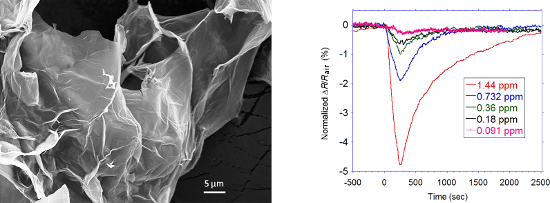
- and environmental monitoring [12]. Theoretical [13][14] and experimental [15][16][17][18][19] studies have revealed that functionalization of graphene can improve significantly its gas sensing performance [20]. The presence of dopants or defects in the graphene lattice can increase the adsorption




Functionalised zinc oxide nanowire gas sensors: Enhanced NO2 gas sensor response by chemical modification of nanowire surfaces
Beilstein J. Nanotechnol. 2012, 3, 368–377, doi:10.3762/bjnano.3.43
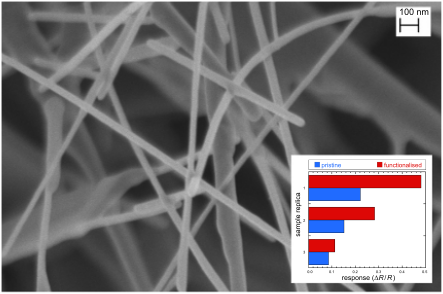
- investigated for practical applications such as the detection of gas leaks and the environmental monitoring of gaseous pollutants. Since the earliest reports in this field, research efforts were focussed on improving gas response, selectivity, and sensor stability, and on their practical use, yet further





