Search results
Search for "micelles" in Full Text gives 117 result(s) in Beilstein Journal of Nanotechnology.
Nanotechnology – a robust tool for fighting the challenges of drug resistance in non-small cell lung cancer
Beilstein J. Nanotechnol. 2023, 14, 240–261, doi:10.3762/bjnano.14.23
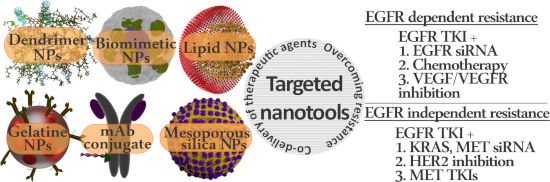
- )-functionalized nanoporous silica particles loaded with a poly(ʟ-glutamic acid) pH-cleavable linker–doxorubicin conjugate, which self-assembles into NPs after its release from the iNPG [114]. Li et al. designed a multistage nanocarrier for NSCLC targeting, composed of icotinib-loaded amphiphilic chitosan micelles


Cyclodextrins as eminent constituents in nanoarchitectonics for drug delivery systems
Beilstein J. Nanotechnol. 2023, 14, 218–232, doi:10.3762/bjnano.14.21
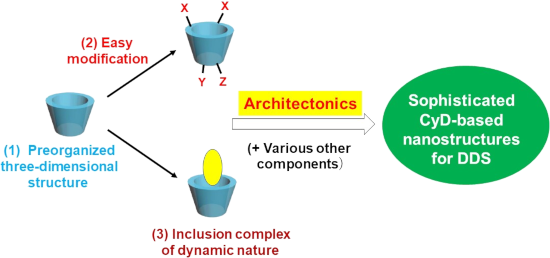
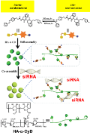
- enhances the hydrophobic interactions of the poly(N-isopropylacrylamide) segments, stabilizing the hydrogel. The anticancer drug DOX encapsulated in the hydrophobic core is slowly released through the dissolution of the hydrogel to micelles. By modifying β-CyD with both N-acetyl-ʟ-cysteine and arginine




Solvent-induced assembly of mono- and divalent silica nanoparticles
Beilstein J. Nanotechnol. 2023, 14, 52–60, doi:10.3762/bjnano.14.6
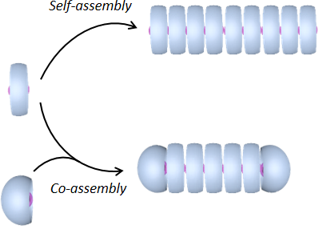
- with two patches functionalized with metal-coordination-based recognition units [20], and by co-assembly of block copolymer micelles and hard nanoparticles [21]. Particles with two patches located at opposite poles have been assembled into a Kagome lattice by hydrophobic interactions [22], into chains
- -controlled patch-to-particle size ratio (PPSR) into dimers, trimers, tetramers, and spherical micelles at a low incubation time in mixtures of tetrahydrofuran (THF) and ethanol [32]. Here, we extend the study to 1-PSN with smaller PPSR values and to the use of another poor solvent for the PS patch (i.e
- previous work on the assembly of 1-PSN with larger PPSR ranging from 0.69 to 1.54 in a THF/ethanol mixture has shown that colloids with a low aggregation number (e.g., dimers, trimers, tetramers, and spherical micelles) could be obtained at a low incubation time. Also, the higher the PPSR value, the more


Microneedle-based ocular drug delivery systems – recent advances and challenges
Beilstein J. Nanotechnol. 2022, 13, 1167–1184, doi:10.3762/bjnano.13.98
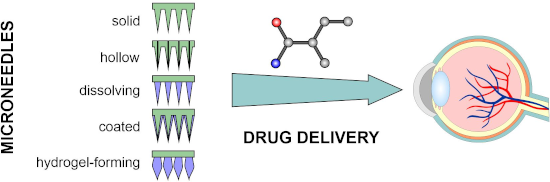
- introduced into systems whose purpose is to provide the expected concentration in the treated tissue for the desired time period. The most frequently studied and described are liposomes [60][61], micelles [60][62], microparticles [63][64][65], nanoparticles [66][67], micro- [68][69], and nanoemulsions [70


Antibacterial activity of a berberine nanoformulation
Beilstein J. Nanotechnol. 2022, 13, 641–652, doi:10.3762/bjnano.13.56
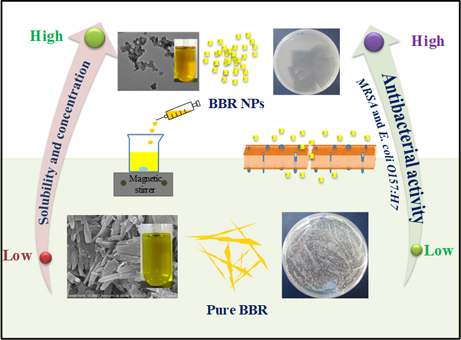
- ), and it remains a challenge to increase drug loading. Besides, the high cost and the complexity of nanoformulation production narrow the accessibility [32]. Regarding dendrimers, micelles, and polymeric nanoparticles, there are also issues with long-term stability, low drug loading efficiency, and



Micro- and nanotechnology in biomedical engineering for cartilage tissue regeneration in osteoarthritis
Beilstein J. Nanotechnol. 2022, 13, 363–389, doi:10.3762/bjnano.13.31
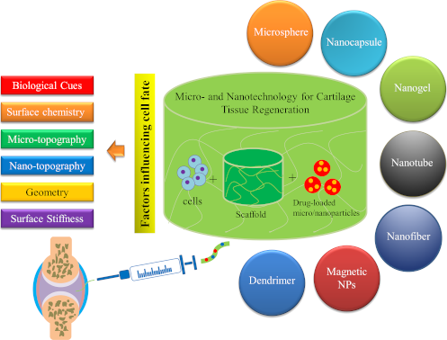
- delivery [50], in vitro diagnosis [51], in vivo imaging [52], and TE purposes. Various NPs can be prepared in the form of liposomes, nanocapsules, micelles, dendrimers, and nanospheres based on their composition and method of preparation. Basically, NPs are designed to function as carriers for bioactive


Coordination-assembled myricetin nanoarchitectonics for sustainably scavenging free radicals
Beilstein J. Nanotechnol. 2022, 13, 284–291, doi:10.3762/bjnano.13.23
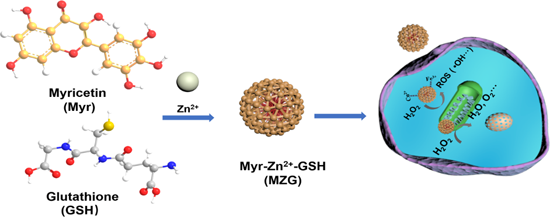
- antioxidant peptides by proteases. The combination of liposomes or polymers with different payload materials has been reported, for example, PEG-modified liposomes loaded with resveratrol, layer-by-layer-coated gelatin nanoparticles, or Gelucire-based solid lipid and polymeric micelles [14][15][16][17][18][19


Photothermal ablation of murine melanomas by Fe3O4 nanoparticle clusters
Beilstein J. Nanotechnol. 2022, 13, 255–264, doi:10.3762/bjnano.13.20
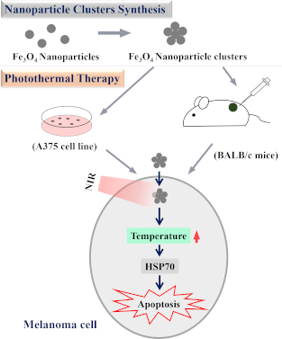
- micelles and the formation of Fe3O4 nanoparticle clusters, which were then coated with polyvinylpyrrolidone (PVP) to improve stability, biocompatibility and chemical features of the nanoparticles. Further SEM measurements revealed the as-formed Fe3O4 NPCs to be spherical and uniformly sized with an average


Use of nanosystems to improve the anticancer effects of curcumin
Beilstein J. Nanotechnol. 2021, 12, 1047–1062, doi:10.3762/bjnano.12.78
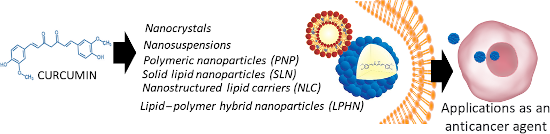
- nanosystems. According to previous evidence, the use of nanosystems is highly flexible since it can be tailored for numerous applications with highly specific goals. Polymeric micelles and theranostics (a strategy that combines treatment and diagnostics) are two examples of such applications that are based on


Comprehensive review on ultrasound-responsive theranostic nanomaterials: mechanisms, structures and medical applications
Beilstein J. Nanotechnol. 2021, 12, 808–862, doi:10.3762/bjnano.12.64
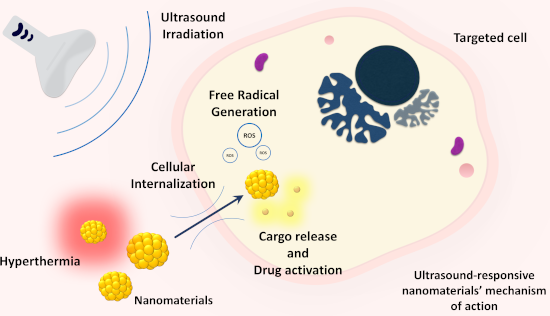
- , and sonoporation. These effects can result in the release of encapsulated drugs or genes at the site of interest as well as cell death and considerable image enhancement. The present review discusses US-responsive theranostic nanomaterials under the following categories: MBs, micelles, liposomes
- carrier. The imaging applications of these materials will also be discussed. These materials include nanocarrier formulations and nanostructured contrast agents, such as microbubbles (MBs), surfactant-based carriers (including micelles, NEs, and niosomes), polymer-based carriers (including gels
- less-discussed US-responsive nanomaterials in addition to the conventional nanomaterials (i.e., microbubbles, micelles, liposomes, and nanoemulsions) is another distinguishable feature of this review. Ultrasound-responsive nanomaterials are discussed in terms of their background, structure, preparation


Rapid controlled synthesis of gold–platinum nanorods with excellent photothermal properties under 808 nm excitation
Beilstein J. Nanotechnol. 2021, 12, 462–472, doi:10.3762/bjnano.12.37
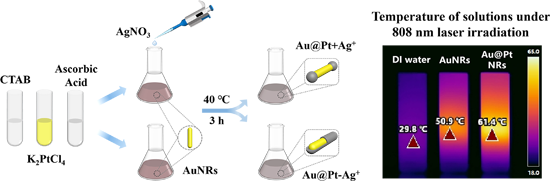
- micelles were formed in the solution. PtCl42− is complexed with CTAB micelles and then gets reduced at the surface of AuNRs by ascorbic acid. During the reaction, a relatively obvious Pt shell formed gradually. In sharp contrast, in the presence of Ag+, it is apparent that Pt grows mainly at the tip of the
- , as shown in curve Au@Pt-3 and Au@Pt-4 in Figure 3a. We hypothesize that with the increase of K2PtCl4 content, the collision frequency between PtCl42−-CTAB micelles and AuNRs also increased, and eventually, Pt smoothly covers the surface of AuNRs and forms a thicker Pt coating. The absorption spectra


A review on nanostructured silver as a basic ingredient in medicine: physicochemical parameters and characterization
Beilstein J. Nanotechnol. 2021, 12, 440–461, doi:10.3762/bjnano.12.36
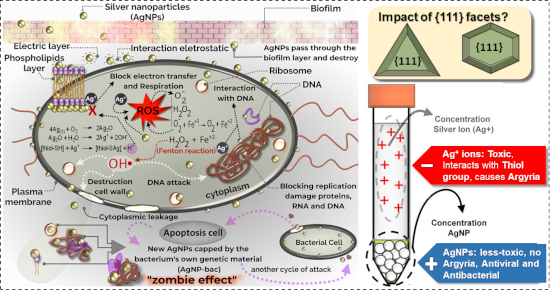
- ]. Separation of AgNPs from Ag+: The cloud point extraction (CPE) technique was initiated by Goto et al. and it is based on the solubilization capacity and on the cloud point of nonionic surfactants [148]. At the cloud point, the instability observed in the micelles is promoted by the dehydration of the
- hydrophilic groups with consequent formation of giant micelles (cages) providing reduced water solubility (which defines the cloud point transition). It is exactly at this point that the AgNPs get surrounded by these non-ionic micelles and separated from the ionic silver (hydrophilic character) [149]. The


The impact of molecular tumor profiling on the design strategies for targeting myeloid leukemia and EGFR/CD44-positive solid tumors
Beilstein J. Nanotechnol. 2021, 12, 375–401, doi:10.3762/bjnano.12.31
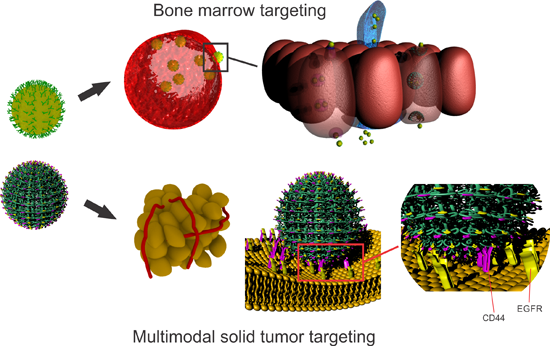
- the improvement of the overall therapeutic efficacy. A targeted NDDS for the co-delivery of ponatinib and SAR302503 (selective JAK2 inhibitor) for efficient CML treatment was developed by Mu and co-workers [47]. The authors employed alendronate-decorated PLA–PEG micelles for BM targeting. Both
- ponatinib and SAR302503 are hydrophobic drugs and were co-encapsulated inside the hydrophobic core of PEG–PLA micelles by solvent displacement nanoprecipitation. The results demonstrated that the targeted NDDS enabled a high availability of the drugs inside the BM, which is a prerequisite for overcoming the


A review on the green and sustainable synthesis of silver nanoparticles and one-dimensional silver nanostructures
Beilstein J. Nanotechnol. 2021, 12, 102–136, doi:10.3762/bjnano.12.9
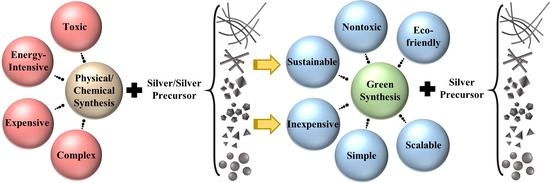
- humidity [233]. The sol–gel process is associated with costly precursors, process longevity, and difficulties regarding reproducibility [234]. 2.2.2 Reverse-micelle process. The reverse micelle is another approach for the synthesis of AgNPs. Reverse micelles are produced from surfactants such as sucrose
- AgNPs in sodium dioctyl sulfosuccinate (AOT) reverse micelles using ascorbic acid as the reductant and obtained particles with an average size of 6 nm. Yang et al. [154] used sodium borohydride as the reductant and octadecylamine (ODA) as the solvent and produced AgNPs with an average size of 3.38 nm
- concentration inside the reverse micelles [235]. AOT-microemulsions have been the most common microemulsions for the preparation of micelles [152]. However, this method may result in the synthesis of AgNPs with weak surface plasmon characteristics due to a broad surface plasmon band [152]. 2.2.3 Chemical vapor


Antimicrobial metal-based nanoparticles: a review on their synthesis, types and antimicrobial action
Beilstein J. Nanotechnol. 2020, 11, 1450–1469, doi:10.3762/bjnano.11.129
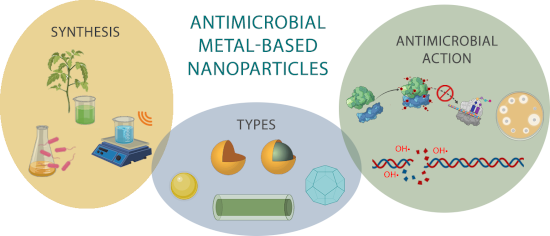
- Cu NPs. The bioavailability of these antimicrobial NPs had lower MIC values against E. coli and B. subtilis than copper hydroxide particles in suspension [143]. Silver carbon complexes with different formulations, including micelles and NPs, have also shown an antimicrobial effect since they inhibit


Poly(1-vinylimidazole) polyplexes as novel therapeutic gene carriers for lung cancer therapy
Beilstein J. Nanotechnol. 2020, 11, 354–369, doi:10.3762/bjnano.11.26
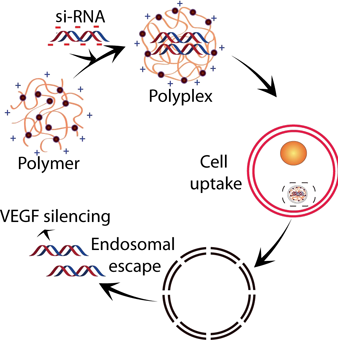
- applications [18]. A folic acid-conjugated amine containing poly(1-vinylimidazole) was found to effectively complex DNA and transfect cancer cells [19]. PVI linked with the dipeptide Cys–Trp was demonstrated to self-assemble to micelles that could also complex RNA effectively. Very few studies have also


Phase inversion-based nanoemulsions of medium chain triglyceride as potential drug delivery system for parenteral applications
Beilstein J. Nanotechnol. 2020, 11, 213–224, doi:10.3762/bjnano.11.16
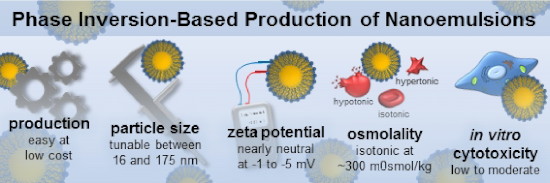
- drug delivery systems such as solid lipid or polymeric nanoparticles, nanocapsules, liquid nanoemulsions, liposomes and micelles can be used to carry poorly water soluble ingredients of pharmaceuticals for parenteral applications [1][2][3]. Thereby, the physical entrapment of the active ingredients




Rational design of block copolymer self-assemblies in photodynamic therapy
Beilstein J. Nanotechnol. 2020, 11, 180–212, doi:10.3762/bjnano.11.15
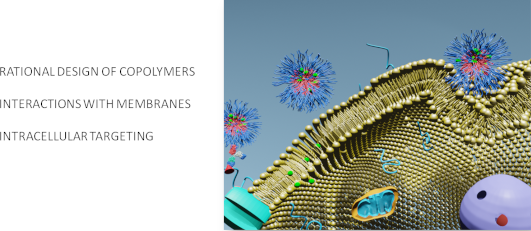
- the importance of intracellular targeting has been addressed. Keywords: intracellular targeting; micelles; photodynamic therapy (PDT); photochemistry; polymer; self-assembly; Review Introduction After Paul Ehrlich, in 1900, had the very first notion of a drug being delivered at will to a specific
- micelles or vesicles. The driving forces of this assembly are a loss of entropy during the self-assembly and different interactions acting on the monomer units of the polymer. Whereas polymer/polymer interactions are favored for the hydrophobic block, interactions between the hydrophobic block and water
- ). This strategy also revealed not to be always appropriate for ROS production and in the case of vinylpyridinium-based block copolymers (with both the pH-insensitive 4-vinilpyridinium and the positively charged N-methyl-2-vinylpyridinium iodide), the PIC micelles are even proposed as antioxidants due to






Molecular architectonics of DNA for functional nanoarchitectures
Beilstein J. Nanotechnol. 2020, 11, 124–140, doi:10.3762/bjnano.11.11
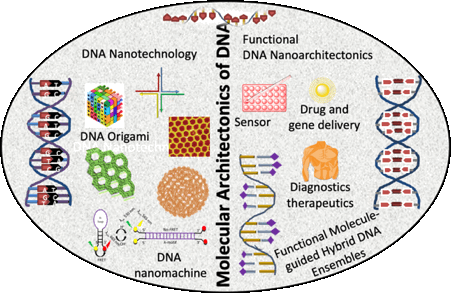
- from DNA block copolymer micelles [100]. The block copolymer micelles were synthesized through ring-opening polymerization, followed by the integration of DNA oligonucleotides in a postpolymerization modification process. The DNA acted as a polar head group, while the whole polymer system acted as a


Internalization mechanisms of cell-penetrating peptides
Beilstein J. Nanotechnol. 2020, 11, 101–123, doi:10.3762/bjnano.11.10
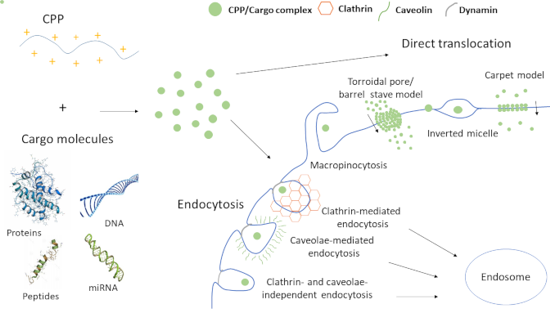
- , direct translocation is regarded as a single-step process including mechanisms involving the formation of inverted micelles, pores and the ‘carpet’ model [21]. This process can be tested under specific experimental conditions – low temperature, energy depletion and the use of endocytic inhibitors for
- inverted micelles was initially reported for penetratin as a mechanism involved at the early stages of cellular uptake [24]. Penetratin is a protein transduction domain derived from the homeoprotein Antennapeadia. It is one of the first peptides described that was able to successfully carry active
- membrane curvature [26]. Such membrane curvatures or invaginations can lead to the formation of inverted micelles that entrap the peptide. The hydrophilic environment inside the inverted micelle allows accumulation of the peptide and is favorable for the transport of hydrophilic compounds conjugated to the


Advanced hybrid nanomaterials
Beilstein J. Nanotechnol. 2019, 10, 2563–2567, doi:10.3762/bjnano.10.247

- synthesize clusters, so-called colloidal molecules [21]. Nanospherical satellites were covalently bonded via amide groups within the dimples of valence-endowed patchy nanoparticles, allowing the tuning of their topology and self-assembling ability. Polyion complex micelles formed by complexation between poly
- (ethylene oxide)-b-poly(acrylic acid) (PEO-b-PAA) and an oligo-chitosan-type polyamine was used as a structure-directing agent to prepare ordered mesoporous silica materials in the work “pH-mediated control over the mesostructure of ordered mesoporous materials templated by polyion complex micelles” [22
Coating of upconversion nanoparticles with silica nanoshells of 5–250 nm thickness
Beilstein J. Nanotechnol. 2019, 10, 2410–2421, doi:10.3762/bjnano.10.231
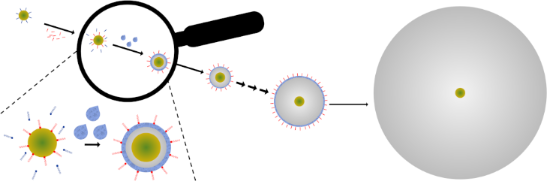
- remain constant. Hence, the number of micelles stays constant, and their size is increased to accommodate the growing core–shell particles. Consequently, the formation of core-free silica particles is suppressed. When the negative zeta potential of the particles, which continuously decreased during the
- , the size and the number of the aqueous domains, i.e., the water pools inside the micelles, are determined by the ratio of ammonia water to Igepal CO-520, often denoted as the R-value [30][36][51][52]. Several authors suggested that for an optimal growth process where particles with multiple cores as
- well as coreless particles are absent, the number of micelles has to ideally match the number of particles [36][47]. If in the course of this process the silica shell becomes thicker, ammonia water and surfactant must be added accordingly in order to balance the particle growth, while suppressing the


Design of a nanostructured mucoadhesive system containing curcumin for buccal application: from physicochemical to biological aspects
Beilstein J. Nanotechnol. 2019, 10, 2304–2328, doi:10.3762/bjnano.10.222
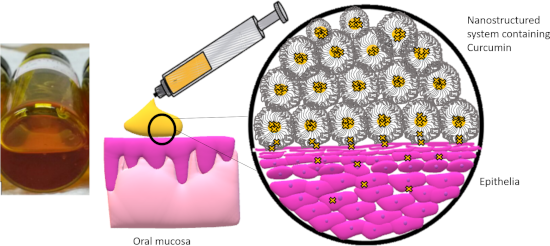
- elucidated by incorporation kinetics and location studies. They revealed that the drug was quickly incorporated and located in the hydrophobic portion of nanometer-sized polymeric micelles. Moreover, the systems displayed plastic behavior with rheopexy characteristics at 37 °C, viscoelastic properties and a
- characteristics beneficial for pharmaceutical and biomedical use [1]. P407 is a non-ionic block copolymer with polypropylene oxide (PPO) and polyethylene oxide (PEO) segments, which can display thermoresponsive properties forming nanometer-sized micelles, hydrogels and lyotropic liquid crystals [2][3]. The
- increase of temperature can promote the self-assembly from unimers to micelles, with large endothermic heat. In this sense, PPO-groups dehydrate in a hydrophobic core with a surrounding hydrated shell. Higher concentrations of P407 are used (15% to 20%, w/w) as colloidal gelling systems in a cubic


Mannosylated brush copolymers based on poly(ethylene glycol) and poly(ε-caprolactone) as multivalent lectin-binding nanomaterials
Beilstein J. Nanotechnol. 2019, 10, 2192–2206, doi:10.3762/bjnano.10.212
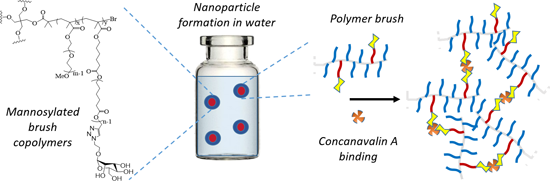
- aggregates (e.g., micelles and vesicles) above their critical aggregation concentration (CAC). The resulting self-assembled nanoparticles can act as drug carriers and delivery systems, being able to accommodate a hydrophobic drug within their hydrophobic core [22], or chemically bind bioactive agents [23][24



Incorporation of doxorubicin in different polymer nanoparticles and their anticancer activity
Beilstein J. Nanotechnol. 2019, 10, 2062–2072, doi:10.3762/bjnano.10.201
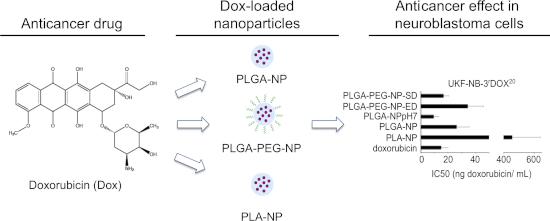
- 33.9 ± 0.5%, respectively). These loading efficiencies are in the range of those described for similar preparations, although higher drug loads have been described when using alternative PLGA-based formulations such as nanoparticles or micelles with doxorubicin covalently bound to the polymer
- , nanoparticles produced by nanoprecipitation, micelles based on multi-arm star-shaped PLGA–PEG block copolymers, or nanopolymersomes [14][15][16][17][18]. In addition, PLGA nanoparticles prepared at pH 7 displayed a more controlled and sustained doxorubicin release than PLGA nanoparticles prepared without pH
- such as nanoparticles or micelles with doxorubicin covalently bound to the polymer, nanoparticles produced by nanoprecipitation, micelles based on multi-arm star-shaped PLGA–PEG block copolymers, or nanopolymersomes [14][15][16][17][18]. Nanoparticle efficacy in cell culture Finally, the effects of