


Search results
Search for "mineralization" in Full Text gives 72 result(s) in Beilstein Journal of Nanotechnology.
Nanocasting synthesis of BiFeO3 nanoparticles with enhanced visible-light photocatalytic activity
Beilstein J. Nanotechnol. 2020, 11, 1822–1833, doi:10.3762/bjnano.11.164
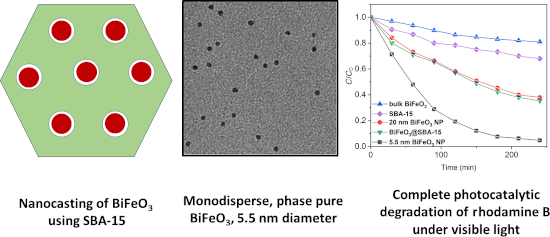
- the complete mineralization of dyes is achieved by the generation of hydroxyl and superoxide anion radicals [10][11]. Traditional photocatalysts, such as TiO2 or ZnO, provide chemical stability and facile preparation methods [12][13]. However, their environmental benefit in large-scale industrial




Multilayer capsules made of weak polyelectrolytes: a review on the preparation, functionalization and applications in drug delivery
Beilstein J. Nanotechnol. 2020, 11, 508–532, doi:10.3762/bjnano.11.41

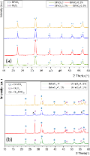
- [34]. Certain limitations such as low stability and low EE have been reported in organic and inorganic templates, respectively. Interestingly, the deposition of an additional silica layer through a biomimetic mineralization process onto a protamine/PSS microcapsule formed on a CaCO3 template improved



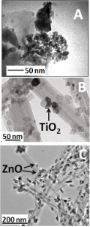
Photoactive nanoarchitectures based on clays incorporating TiO2 and ZnO nanoparticles
Beilstein J. Nanotechnol. 2019, 10, 1140–1156, doi:10.3762/bjnano.10.114
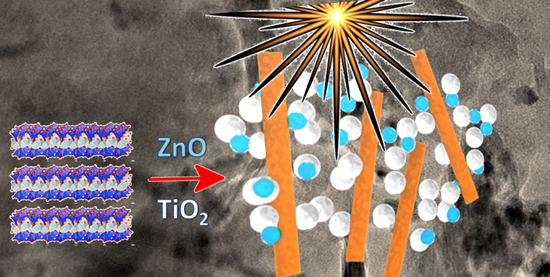
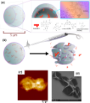
- often than ZnO NPs regarding their use as photocatalysts. One of the main applications of clay–semiconductor materials is the mineralization of organic pollutants, which represents an ideal solution for the remediation of wastewater contaminated with diverse organic species. This process consists in the
- other photocatalytic reactions assisted by semiconductor photocatalysts. The use of TiO2 and ZnO NPs, particularly the anatase and wurtzite phases, as heterogeneous photocatalysts attracted great attention over the last years. Atmospheric oxygen is used as oxidant to achieve complete mineralization of
- ]. Probably the first contribution was introduced by Bel Hadjltaief and co-workers [158], using a Tunisian Na+-smectite treated with titanium(IV) isopropoxide and zinc acetate. This ZnO–TiO2@clay material shows that a rapid and complete mineralization of methyl green dye in water can be achieved with the



Hierarchical heterostructures of Bi2MoO6 microflowers decorated with Ag2CO3 nanoparticles for efficient visible-light-driven photocatalytic removal of toxic pollutants
Beilstein J. Nanotechnol. 2018, 9, 2297–2305, doi:10.3762/bjnano.9.214
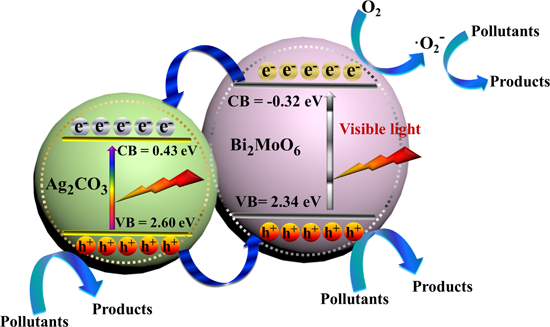
- established. However, the conventional wastewater treatments are usually accompanied by high cost, low efficiency and other insufficiencies [2]. The decomposition and mineralization of pollutants under sunlight through photocatalysis has been demonstrated to be an effective and green technology for
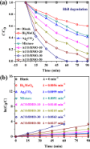
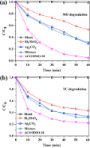
- /Bi2MoO6 [22]. As shown in Figure S3 (Supporting Information File 1), ACO/BMO-30 is much more active than Ag2MoO4/Bi2MoO6, but not as active as Ag/Ag2CO3/Bi2MoO6 due to the fact that Ag/Ag2CO3/Bi2MoO6 is a ternary composite. To examine the mineralization ability of ACO/BMO-30, the total organic carbon (TOC
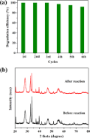
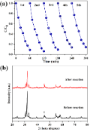
- -30 shows a decent mineralization ability. To test the durability of ACO/BMO-30, repeated runs were carried out under unchanging conditions. As depicted in Figure 8a, after six consecutive runs, the RhB degradation efficiency is still about 92.2%. Additionally, no apparent change of the crystalline




Synthesis of a MnO2/Fe3O4/diatomite nanocomposite as an efficient heterogeneous Fenton-like catalyst for methylene blue degradation
Beilstein J. Nanotechnol. 2018, 9, 1940–1950, doi:10.3762/bjnano.9.185
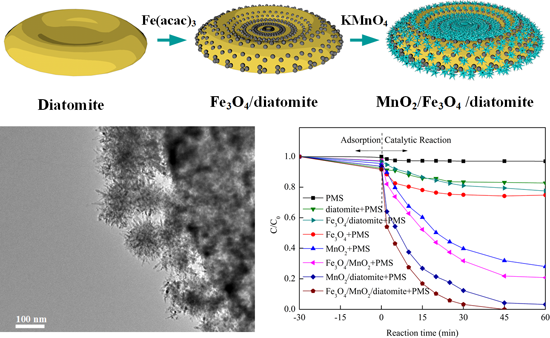
- mineralization rate of about 60% in 60 min and great recyclability with a recycle efficiency of 86.78% after five runs for MB. The probable mechanism of this catalytic system is also proposed as a synergistic effect between MnO2 and Fe3O4. Keywords: diatomite; Fenton-like oxidation; hybrid catalyst; iron(II,III


A visible-light-controlled platform for prolonged drug release based on Ag-doped TiO2 nanotubes with a hydrophobic layer
Beilstein J. Nanotechnol. 2018, 9, 1793–1801, doi:10.3762/bjnano.9.170
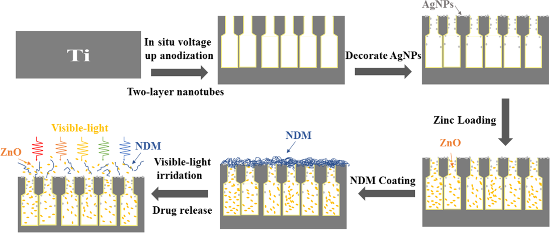
- essential to human being, previously published work [26] showed that Zn can greatly improve cell functionality by enhancing osteoblast proliferation and mineralization and promoting mesenchymal stem cell osteogenic differentiation. Meanwhile, its anti-inflammatory properties have also drawn wide attention





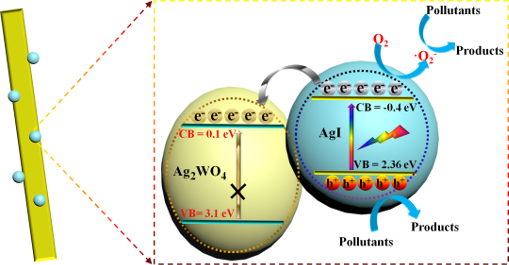
Ag2WO4 nanorods decorated with AgI nanoparticles: Novel and efficient visible-light-driven photocatalysts for the degradation of water pollutants
Beilstein J. Nanotechnol. 2018, 9, 1308–1316, doi:10.3762/bjnano.9.123
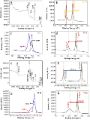
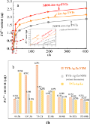
- still achieves the highest apparent rate constant (0.0292 min−1 for MO degradation and 0.0129 min−1 for 4-CP degradation) among all these samples. The mineralization of organic pollutants is crucial for pollutant treatment [46]. Thus, the total organic carbon (TOC) removal efficiency of RhB over 0.3AgI




Noble metal-modified titania with visible-light activity for the decomposition of microorganisms
Beilstein J. Nanotechnol. 2018, 9, 829–841, doi:10.3762/bjnano.9.77
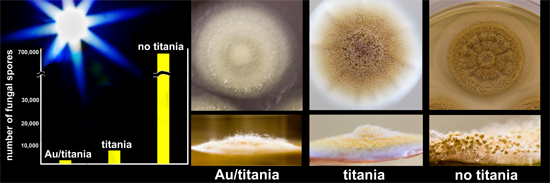
- samples (eight orders of decrease after three hours of vis irradiation and one order in the dark), only the silver-modified samples under vis irradiation caused continuous evolution of carbon dioxide suggesting a mineralization of bacterial cells [54]. To check if bacterial cells were really decomposed


Perovskite-structured CaTiO3 coupled with g-C3N4 as a heterojunction photocatalyst for organic pollutant degradation
Beilstein J. Nanotechnol. 2018, 9, 671–685, doi:10.3762/bjnano.9.62
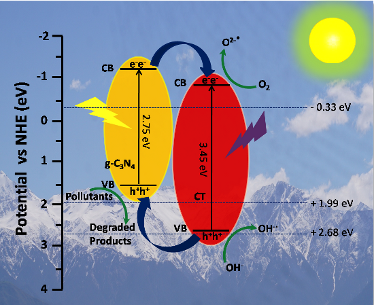
- interface to produce active species, which causes mineralization of pollutants. Therefore, our photocatalytic activity studies illustrate that the CTCN heterojunction formed by coupling CT with g-C3N4 performs well in comparison to its bare counterparts under all three irradiation conditions (i.e., UV


Photocatalytic and adsorption properties of TiO2-pillared montmorillonite obtained by hydrothermally activated intercalation of titanium polyhydroxo complexes
Beilstein J. Nanotechnol. 2018, 9, 364–378, doi:10.3762/bjnano.9.36
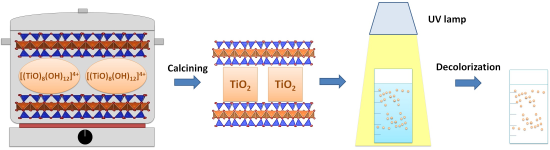
- to anionic ones. The pillared materials prepared using hydrothermal treatment combine sorptive and photocatalytic properties and can be recommended for mineralization and decomposition of organic contaminants, even in highly acidic media. Experimental Montmorillonite A fraction of MM particles with a






Two-dimensional carbon-based nanocomposites for photocatalytic energy generation and environmental remediation applications
Beilstein J. Nanotechnol. 2017, 8, 1571–1600, doi:10.3762/bjnano.8.159
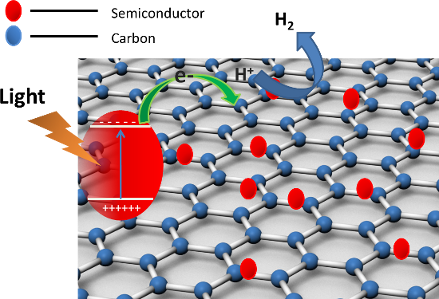
- aqueous solution to generate hydrogen, or it can produce a superoxide radical anion (O2−*) by reacting with the dissolved oxygen, hydroperoxide radical (*OOH) upon reaction with H+ ions [4]. These reactive radical species also have potential to accomplish complete mineralization of the pollutants into H2O


Preparation of thick silica coatings on carbon fibers with fine-structured silica nanotubes induced by a self-assembly process
Beilstein J. Nanotechnol. 2017, 8, 1145–1155, doi:10.3762/bjnano.8.116
- support or as a catalytic active material. The second possibility can be fulfilled for instance by introducing a titania precursor in the mineralization process. A silica/titania mixture is able to catalyze liquid phase epoxidation [35], the NOx abatement under UV irradiation [36] or the photocatalytic
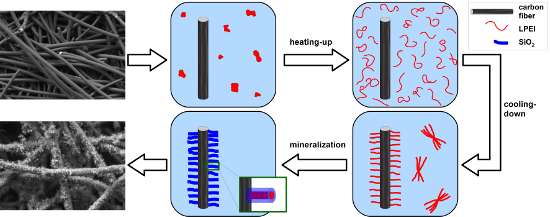
- of the fiber with LPEI aggregates can be obtained which serves as both catalyst and template in the following mineralization step. The nature of LPEI enables access to a nanostructured patterning of the resulting silica shell. LPEI/silica composite particles and their immobilization on carbon fibers
- highly branched. The fiber bundle morphology is preserved in the subsequent mineralization process initialized by addition of 3 vol % silica precursor tetramethyl orthosilicate (TMOS) in a mixture of ethanol and water (1:1, v/v). The polymer aggregates are encapsulated by a silica shell in a very short


High photocatalytic activity of Fe2O3/TiO2 nanocomposites prepared by photodeposition for degradation of 2,4-dichlorophenoxyacetic acid
Beilstein J. Nanotechnol. 2017, 8, 915–926, doi:10.3762/bjnano.8.93
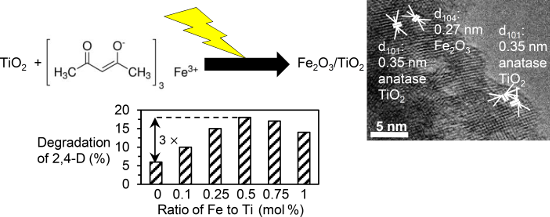
- nonahydrate precursor, which gave more than two times higher activity than the bare TiO2 [15]. The photocatalytic oxidation of 2,4-D by active species involves various steps, including formation of intermediates before its mineralization to CO2 and H2O. Decarboxylation has been reported as the initial step
- be suggested that 2,4-D was firstly oxidized by the active species (photogenerated holes and superoxide radicals) before decarboxylation and the formation of 2,4-DCP. The dechlorination of 2,4-DCP then took place, leading to ring opening, hydrocarbon chain breaking, and finally, the mineralization to
- photogenerated holes are left in the VB. The photogenerated electrons could reduce oxygen to form superoxide radicals, while holes could directly oxidize 2,4-D to 2,4-DCP before its mineralization. The presence of Fe2O3 reduces electron–hole recombination on the TiO2. Since the CB edge energy level of Fe2O3


Recombinant DNA technology and click chemistry: a powerful combination for generating a hybrid elastin-like-statherin hydrogel to control calcium phosphate mineralization
Beilstein J. Nanotechnol. 2017, 8, 772–783, doi:10.3762/bjnano.8.80
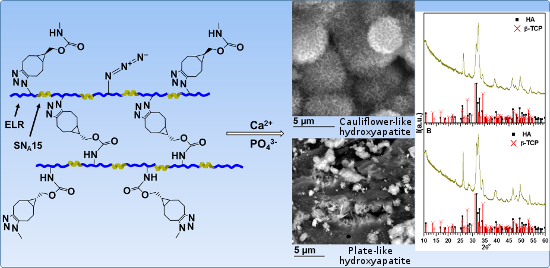
- bind to and nucleate calcium phosphate. The benefit of using click chemistry is that the hybrid elastin-like-statherin recombinamers cross-link without losing their fibrillar structure. Mineralization of the resulting hybrid elastin-like-statherin recombinamer hydrogels with calcium phosphate is
- biomaterials. Keywords: calcium phosphate; elastin-like recombinamers; hydroxyapatite; mineralization; SNA15; Introduction Combination of the specific properties of two materials is often a key to generating a new material, whose properties are superior to those of its individual components, with improved
- materials with a high application potential [14]. Although organic additives can be used to control the CP mineralization process in aqueous solution, their soluble nature restricts their use in potential applications. To overcome this problem, organic chains are introduced as insoluble additives, for



Nanostructured carbon materials decorated with organophosphorus moieties: synthesis and application
Beilstein J. Nanotechnol. 2017, 8, 485–493, doi:10.3762/bjnano.8.52
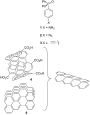
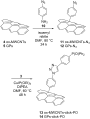
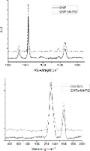
- Flash E1112 analyzer. ICP analysis were made using an Optima 2000 Perkin Elmer Inductively Coupled Plasma (ICP) Dual Vision instrument after acidic mineralization. TEM images were acquired at the electronic microscopic center CNR Florence (CE.M.E.) with a Philips CM12 with CRYO-GATAN UHRST 3500





Template-controlled piezoactivity of ZnO thin films grown via a bioinspired approach
Beilstein J. Nanotechnol. 2017, 8, 296–303, doi:10.3762/bjnano.8.32
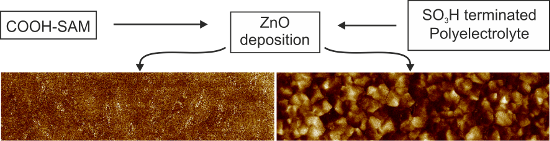
- applied. Another approach is bioinspired mineralization. Here, principles from nature are adapted to deposit inorganic materials under mild reaction conditions. The crystal growth is controlled by organic additives in the mineralization solution that act as structure directing agents [18][19][20][21][22
- this model system, we deposit ZnO via bioinspired mineralization onto templates with different functionalities. In our recent work [39] we have demonstrated that the piezoactivity of the grown ZnO film strongly depends on the template. In particular, the impact of a piezoactive template (i.e., a layer
- of tobacco mosaic viruses) on the mineralization processes of ZnO films has been investigated and an extraordinary high degree of orientation was observed. In this study, we elucidate the influence of the negative charge density of two non-piezoelectric templates on the deposition of ZnO films from


Photocatalysis applications of some hybrid polymeric composites incorporating TiO2 nanoparticles and their combinations with SiO2/Fe2O3
Beilstein J. Nanotechnol. 2017, 8, 272–286, doi:10.3762/bjnano.8.30
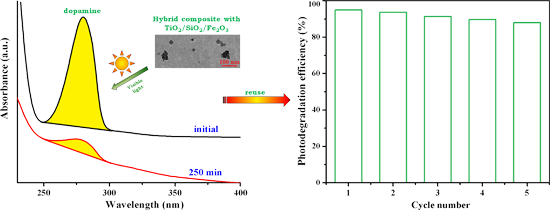
- constants were around 18 × 10−3 min−1 (Figure 7d) for the two photocatalysts S3 and S4. The mineralization of phenol, i.e., the complete degradation of phenol and its decomposition intermediates to CO2, was investigated by measuring the concentration of total organic carbon (TOC) in the solutions irradiated
- with visible light for 250 min in presence of the S4 polymeric film. The TOC analysis indicated a phenol mineralization of about 46%, the result suggesting that the speed of TOC removal is slower (approximately half) than the phenol degradation into intermediate species. A different photobehaviour was


Laser irradiation in water for the novel, scalable synthesis of black TiOx photocatalyst for environmental remediation
Beilstein J. Nanotechnol. 2017, 8, 196–202, doi:10.3762/bjnano.8.21
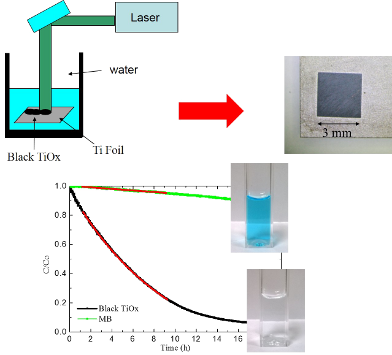
- widely used for both water splitting and mineralization of organic contaminants in solution [2]. The applications range from third generation solar cells [3] to material for air or water purification [4] to antifogging and self-cleaning surfaces [5][6]. The main advantage of this material is its high


3D printing of mineral–polymer bone substitutes based on sodium alginate and calcium phosphate
Beilstein J. Nanotechnol. 2016, 7, 1794–1799, doi:10.3762/bjnano.7.172
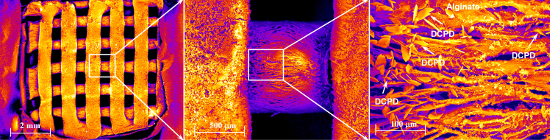
- the carboxylate group of alginate. This physical bonding translates to mixtures that are rich in electronic pairs leading to a higher reactivity and mineralization potential that can be transformed into composite materials [13]. According to X-ray diffraction data, synthesis in the presence of


Role of RGO support and irradiation source on the photocatalytic activity of CdS–ZnO semiconductor nanostructures
Beilstein J. Nanotechnol. 2016, 7, 1684–1697, doi:10.3762/bjnano.7.161
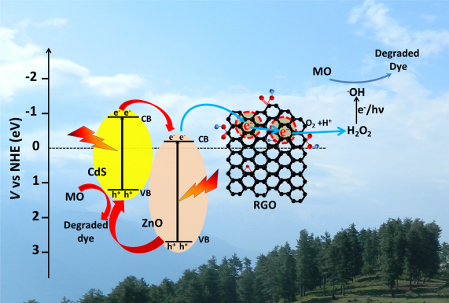
- photocatalytic decomposition of organic pollutants [4][5][6][7][8]. These semiconductor photocatalysts not only degrade the contaminants, but also cause their complete mineralization into CO2, H2O and mineral acids [9][10]. Thus, it is advantageous over physico-chemical methods such as flocculation–coagulation




Novel roles for well-known players: from tobacco mosaic virus pests to enzymatically active assemblies
Beilstein J. Nanotechnol. 2016, 7, 613–629, doi:10.3762/bjnano.7.54
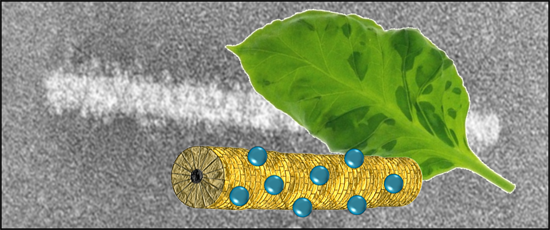
- play a leading role among the most promising viral backbones [5][7][91][92]. TMV and closely related tobamoviruses have been applied as versatile templates for the metallization or mineralization of their inner or outer surfaces, respectively, yielding nanosized components for, e.g., electronic devices


Chemical bath deposition of textured and compact zinc oxide thin films on vinyl-terminated polystyrene brushes
Beilstein J. Nanotechnol. 2016, 7, 102–110, doi:10.3762/bjnano.7.12
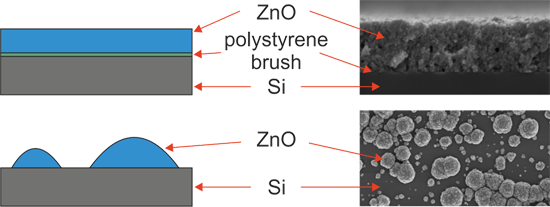
- polystyrene brush on the deposition of ZnO thin films under moderate conditions. On a non-modified SiOx surface, island growth is observed, whereas the polymer brush induces homogeneous film growth. A chemical modification of the polystyrene brushes during the mineralization process occurs, which enables
- deposition processes for ZnO nanostructures. For example, biopolymers can control the mineralization and the structure formation of inorganic materials in an aqueous environment. Biopolymeric templates and their structure-inducing properties are in the focus of many recent works and issued in a recent
- °. On the other hand, the surface decorated with a PS brush is hydrophobic with a WCA of 85°. Transesterification of polystyrene brushes During the ZnO mineralization, a modification of the PS brush was observed that leads to a hydrophilic surface, which can improve the interaction with the ZnO


Impact of ultrasonic dispersion on the photocatalytic activity of titania aggregates
Beilstein J. Nanotechnol. 2015, 6, 2423–2430, doi:10.3762/bjnano.6.250
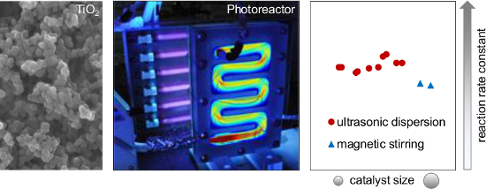
- oxidation, discoloration, mineralization, and degradation of organic pollutants [1][2]. Photocatalysis is an example of an AOP that has been effectively applied for the treatment of highly polluted water such as dye sewage [3][4]. Among the materials for this application, titanium dioxide (TiO2) is a very


Template-controlled mineralization: Determining film granularity and structure by surface functionality patterns
Beilstein J. Nanotechnol. 2015, 6, 1763–1768, doi:10.3762/bjnano.6.180
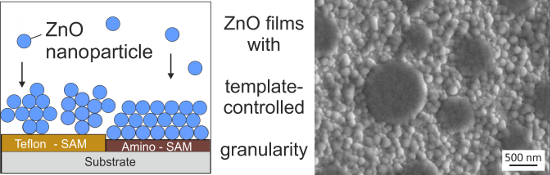
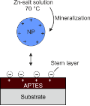
- the site-selective mineralization of a semiconductor material, zinc oxide (ZnO), on a chemically patterned surface [3]. ZnO thin films are of special interest since they can be used for different applications such as solar cells [16], biosensing devices [17] and others [18]. By using a nearly
- , as both surfaces exhibit an rms-roughness value of 0.1 nm. After mineralization, the APTES islands are covered by a homogenous, smooth film with an rms-roughness of 1 nm. AFM images show a granular structure that is not clearly visible in the corresponding SEM image. This might be due to the lower
- mineralization. Mineralization experiment All deposition solutions were freshly prepared prior to use to ensure clear starting solutions. Stock solutions of Zn(NO3)2∙6H2O (Sigma-Aldrich, ≥99.0%), hexamethylenetetramine (HMTA, Sigma-Aldrich, ≥99.5%) and L-histidine (Sigma-Aldrich, ≥99%) in Milli-Q water each at a

Towards multifunctional inorganic materials: biopolymeric templates
Beilstein J. Nanotechnol. 2015, 6, 1698–1699, doi:10.3762/bjnano.6.172

- aforementioned manufacturing methods, biomineralization leads to fascinating, complex-structured, inorganic materials under ambient conditions. The corresponding processes have been evolutionarily optimized over millions of years and involve biopolymeric templates, which control the mineralization and the



