Search results
Search for "particle size" in Full Text gives 593 result(s) in Beilstein Journal of Nanotechnology. Showing first 200.
PEGylated lipids in lipid nanoparticle delivery dynamics and therapeutic innovation
Beilstein J. Nanotechnol. 2025, 16, 1914–1930, doi:10.3762/bjnano.16.133
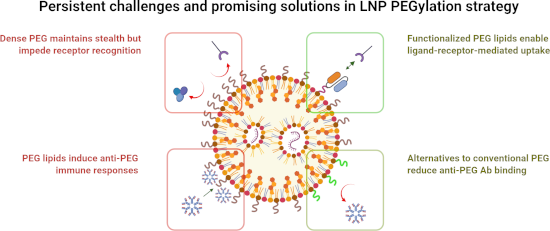
- properties of LNPs including particle size, surface charge, and encapsulation efficiency. Subsequent sections explore the roles of PEG lipids in modulating protein corona formation and cellular uptake. The latter parts highlight the potential of functionalized PEG lipids for targeted delivery and the
- particle size decreasing from 173.9 nm at 1 mol % to 109.1 nm at 5 mol %. Meanwhile, the PDI increased modestly from 0.060 to 0.146 with the increase of PEG density from 1 to 5 mol %, indicating a slight broadening in size distribution and less LNP homogeneity at higher PEG levels. The surface charge on
- fraction of PEG lipids can affect LNP characterizations. In DMPE-PEG5k LNPs, increasing the PEG lipid fraction from 1.5 mol % to 5 mol % resulted in no significant change in particle size but led to a substantial encapsulation efficiency drop from over 90% to below 80%. While in LNPs incorporating Chol-PEG



On the road to sustainability – application of metallic nanoparticles obtained by green synthesis in dentistry: a scoping review
Beilstein J. Nanotechnol. 2025, 16, 1851–1862, doi:10.3762/bjnano.16.128
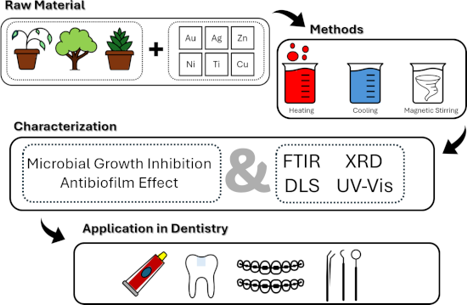
- between them and results in more uniform nucleation and better control over particle size and morphology. Moreover, continuous stirring prevents aggregation of the nanoparticles, contributing to their colloidal stability. Studies have shown that variations in stirring speed can significantly impact the
- nanoparticle formation in real time by detecting surface plasmon resonance bands, which provide insight into particle size and distribution [57]. XRD offers detailed information on the crystalline structure and phase composition of the nanoparticles, confirming successful synthesis and purity [53]. Together


Current status of using adsorbent nanomaterials for removing microplastics from water supply systems: a mini review
Beilstein J. Nanotechnol. 2025, 16, 1837–1850, doi:10.3762/bjnano.16.127
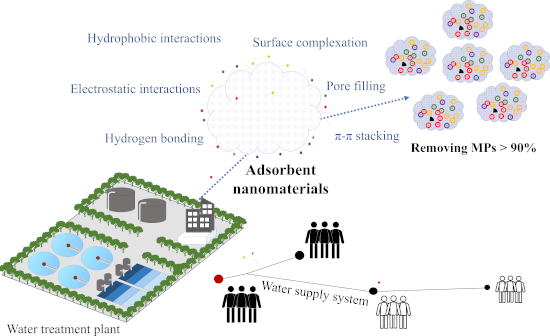
- depends on polymer type and particle size. In contrast, nanomaterials show higher and more significant removal efficiency, in some cases exceeding 99%. Particularly, multifunctional materials (e.g., Fe3O4@PDA-lipase nanoparticles or MOFs) combine adsorption, magnetic recovery, and even catalytic
- particles·L−1, in which the bulk of the data is approximately 569–751 particles·kg−1 [38][39]. In the study of Chu et al., MP concentrations in the water and pipe scale samples ranged from 13.2 to 134.7 particles·L−1 and from 569.9 to 751.7 particles·kg−1, respectively, with a significantly smaller particle
- size in the pipe scales (50–100 μm) than in the water samples (>200 μm) [40]. In Eastern China, the level of MPs in raw water was recorded at 4960 particles·L−1. After being treated by various processes, the MPs concentration significantly reduced from 4712 ± 95 particles·L−1 to 1012 ± 78 particles·L−1


Exploring the potential of polymers: advancements in oral nanocarrier technology
Beilstein J. Nanotechnol. 2025, 16, 1751–1793, doi:10.3762/bjnano.16.122
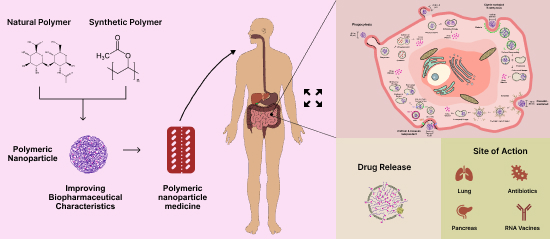
- , can occur in organic or aqueous continuous phases, with the latter offering a reduction of toxic solvent residues. Miniemulsion and microemulsion methods provide better control over particle size and distribution, although microemulsion polymerization often requires higher concentrations of


Multifunctional anionic nanoemulsion with linseed oil and lecithin: a preliminary approach for dry eye disease
Beilstein J. Nanotechnol. 2025, 16, 1711–1733, doi:10.3762/bjnano.16.120
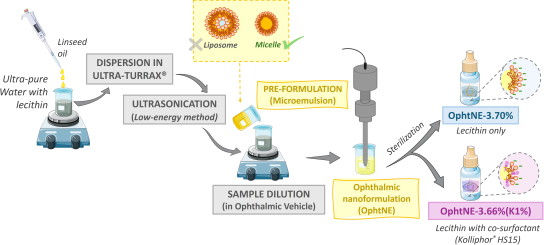
- required to produce nanoemulsions with a uniform particle size and incorporated a co-surfactant to enhance the stability of the nanoformulation. A straightforward method was proposed, involving the dilution of the preformulation in an ophthalmic vehicle, followed by homogenization through ultrasonication
- emulsion, if the component proportions in its formulation are adjusted to enhance stability. In this context, as an initial approach, different concentrations of lecithin were evaluated in pre-formulations (pre-emulsions). The results for particle size, polydispersity index, electrical conductivity, zeta



Prospects of nanotechnology and natural products for cancer and immunotherapy
Beilstein J. Nanotechnol. 2025, 16, 1644–1667, doi:10.3762/bjnano.16.116
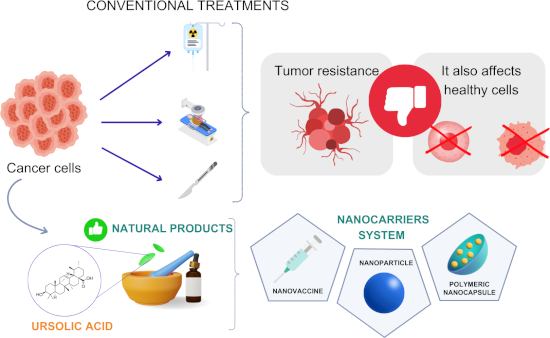
- compounds must have properties that contribute to a stable formulation, difficulty in controlling physicochemical characteristics, such as particle size, which can affect reproducibility and scalability, and problems related to rapid clearance and interaction with non-target tissues, mainly due to the
- CXCL9/10 expression in Schwann cells [114]. Particle size and stability of the formulation in the patent were characterized using scanning electron microscopy (SEM). The nanoparticles demonstrated enhanced uptake in HepG2 cells, as confirmed by flow cytometry and confocal microscopy, and achieved a
- particle size, along with improved interaction with cellular receptors, enables a significantly increase of the cell inhibitory effect (tumor cells were HepG2 and MCF-7), with the complex exhibiting an increased amount of cytokine secretion when used at a concentration of 10 mg·mL−1 [76]. Gold


Venom-loaded cationic-functionalized poly(lactic acid) nanoparticles for serum production against Tityus serrulatus scorpion
Beilstein J. Nanotechnol. 2025, 16, 1633–1643, doi:10.3762/bjnano.16.115
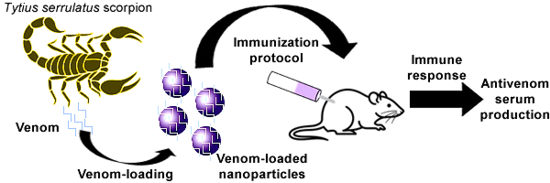
- 165 nm and a positive zeta potential of 7.0 mV. After the addition of venom, the PLA nanoparticles loaded with T. serrulatus venom proteins remained with a narrow particle size distribution. Moreover, an increase in size of the particles occurred after the addition of the venom for both concentrations
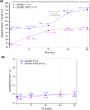
- as the mean diameters of nanoparticles (Figure 2). Physical stability assay Distinct NPs with venom-loaded formulations were analyzed for particle size and PDI (Figure 3). The tracking was accomplished for 42 days (six weeks) and the formulations do not show significant differences in particle size
- on the particle size; thus, small particles have a larger surface area for dissolution, providing faster release kinetics [39]. Uniformity of particle size is also important for the stability of the formulation, as well as for the choice of administration route. The intravenous and intramuscular


Nanotechnology-based approaches for the removal of microplastics from wastewater: a comprehensive review
Beilstein J. Nanotechnol. 2025, 16, 1607–1632, doi:10.3762/bjnano.16.114
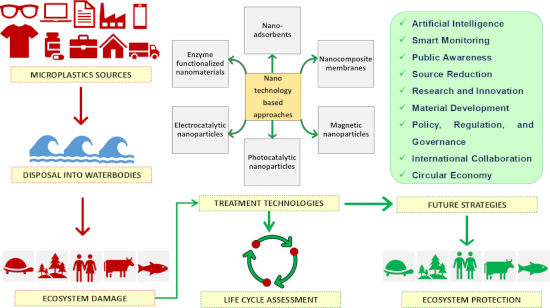
- processes [96]. The particle size of photocatalysts plays a very important role in the recombination of electrons and holes. Smaller particles exhibit higher photocatalytic activity due to their increased surface area, which allows for greater adsorption of pollutants and enhanced production of hydroxyl
- radicals. These benefits are particularly significant when the particle size is reduced to around 10 nm. Utilizing nanostructured semiconductors in photocatalytic applications proves to be more efficient, as a larger proportion of the photogenerated electron–hole pairs is available at the surface
- . Nanoparticles, owing to their high surface-to-volume ratio, demonstrate superior catalytic performance compared to bulk materials. Furthermore, the particle size of semiconductors influences their bandgap energy and crystalline structure, which in turn affects their redox potential and the spatial distribution


Influence of laser beam profile on morphology and optical properties of silicon nanoparticles formed by laser ablation in liquid
Beilstein J. Nanotechnol. 2025, 16, 1533–1544, doi:10.3762/bjnano.16.108
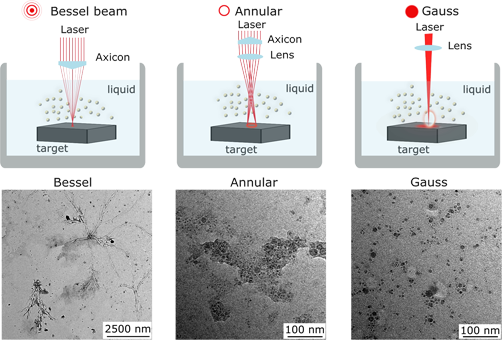
- structure of the formed NPs were analyzed by means of ultraviolet–visible (UV–vis) spectroscopy, high-resolution transmission electron microscopy (HRTEM), selected area electron diffraction (SAED), X-ray diffraction (XRD), and Raman and photoluminescence (PL) spectroscopies. Particle size and morphology


Cross-reactivities in conjugation reactions involving iron oxide nanoparticles
Beilstein J. Nanotechnol. 2025, 16, 1504–1521, doi:10.3762/bjnano.16.106
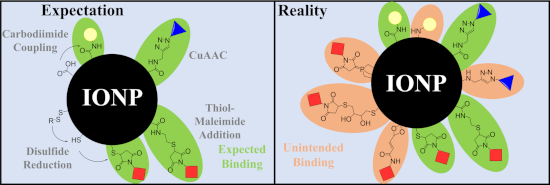
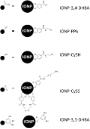
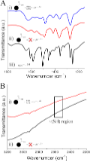
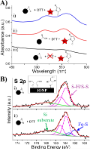
- advantage of the solution-exposed carboxylate group of 3,4-DHBA to produce IONPs that are amenable to further functionalization using EDC coupling, without sacrificing the small particle size, which is critical for maintaining their magnetic properties [50] and increasing their half-life in the bloodstream







Laser processing in liquids: insights into nanocolloid generation and thin film integration for energy, photonic, and sensing applications
Beilstein J. Nanotechnol. 2025, 16, 1428–1498, doi:10.3762/bjnano.16.104
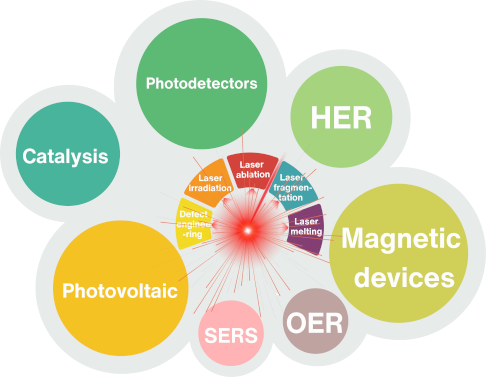
- demonstrates the capability of LML to transform smaller NPs into larger spherical structures, confirming the process’s potential for tuning particle size through laser irradiation. The productivity of SMSPs synthesized by PLML increases with high-power laser irradiation because the mass of melted particles is
- the particle size, inhomogeneous heating occurs, leading to nanoparticle formation as a byproduct [55][56]. Therefore, a method called burst mode has been explained to control particle heating and suppress byproduct formation through partial evaporation as shown in Figure 6 [54][57][58][59][60]. The
- influencing the particle size [61]. Figure 5b,c depicts this dependency studies of laser fluence required to melt a single particle of Au, Fe3O4, and Fe2O3 using different wavelengths of laser (355 and 532 nm). Longer laser irradiation times lead to larger particle sizes, with initially inhomogeneous






Photochemical synthesis of silver nanoprisms via green LED irradiation and evaluation of SERS activity
Beilstein J. Nanotechnol. 2025, 16, 1417–1427, doi:10.3762/bjnano.16.103
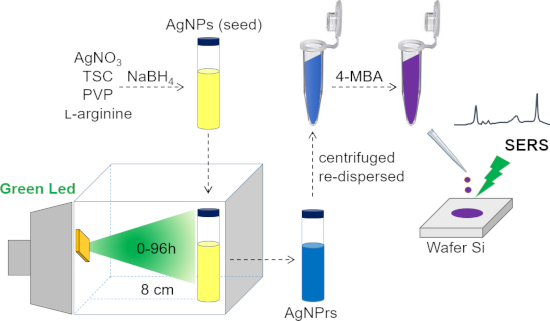
- these results, we conclude that 72 h represents the optimal irradiation time for the complete transformation of silver seeds into silver nanoplates in this study. From the FESEM images and particle size distribution graph after 12 h of LED irradiation in Figure 3, it is observed that the particle sizes
- the range of 25–35 nm, suggesting a greater presence of AgNPrs. However, the persistence of AgNPs and round silver nanoparticles implies that the conversion efficiency from AgNPs to AgNPrs remains relatively low. After 72 h of LED irradiation, the particle size increased significantly compared to the
- nm. Samples were diluted tenfold with deionized water prior to measurement. To determine the morphology, particle size of the synthesized nanostructures, the samples were analyzed using field-emission scanning electron microscopy (FESEM, Hitachi S-4800, Japan) and transmission electron microscopy


The role of biochar in combating microplastic pollution: a bibliometric analysis in environmental contexts
Beilstein J. Nanotechnol. 2025, 16, 1401–1416, doi:10.3762/bjnano.16.102
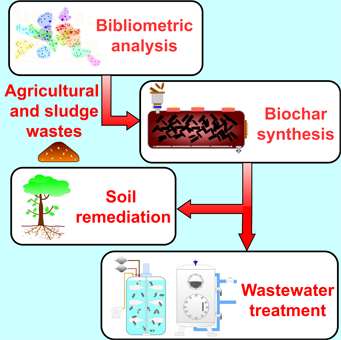
- highly dependent on biochar particle size and column dimensions [47]. Specifically, biochar sized 0.6–1.18 mm combined with a column diameter of 15 mm and a 20 cm bed depth achieved up to 96.65% removal efficiency. For 10 µm PE particles, retention was limited to segments 3–9 (out of 29 segments) with
- biochar, MP particle size and the aggregation potential of MPs [43][67]. These findings underscore the importance of optimizing biochar properties to enhance MP removal across different particle types and sizes. Despite advancements in biochar-based filtration and batch treatment, the removal efficiency



Enhancing the therapeutical potential of metalloantibiotics using nano-based delivery systems
Beilstein J. Nanotechnol. 2025, 16, 1350–1366, doi:10.3762/bjnano.16.98
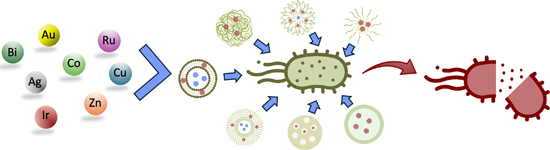
- (III) metalloantibiotic 12 (Figure 4) in liposomes [113]. The Au-loaded liposomes displayed high loading efficiency, high stability, and particle size and zeta potential values suitable for drug delivery. Even though the antibacterial activity against resistant strains of S. aureus was not improved, a


Ferroptosis induction by engineered liposomes for enhanced tumor therapy
Beilstein J. Nanotechnol. 2025, 16, 1325–1349, doi:10.3762/bjnano.16.97
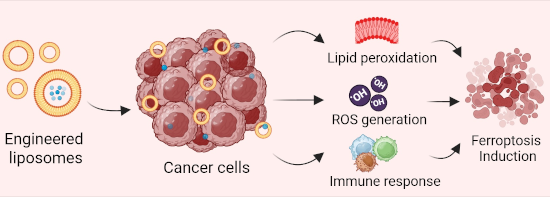
- traditional methods, such as thin film hydration, to produce liposomes and lipid nanoparticles [113][120]. Microfluidics offers exceptional control over particle size, lower variability, higher EE, and better scalability, making it the most advanced and practical approach for nanoparticle production [115][119
- ]. Different techniques are used to evaluate the characteristics of liposomes [122][123][124]. In the case of average particle size, DLS and microscopy techniques such as scanning electron microscopy (SEM), TEM, cryogenic TEM, and AFM are used to determine the size of liposomes [122]. The size of liposomes is
- liposomes (AGCL) using alkyl-N-octyl-β-ᴅ-glucopyranoside with the idea that incorporating Cel into alkyl-Glu-modified liposomes could improve its ability to target tumors and reduce potential side effects. The particle size and zeta potential of AGCL were reported to be approximately 83.41 nm and −19.1 mV


Enhancing the photoelectrochemical performance of BiOI-derived BiVO4 films by controlled-intensity current electrodeposition
Beilstein J. Nanotechnol. 2025, 16, 1289–1301, doi:10.3762/bjnano.16.94
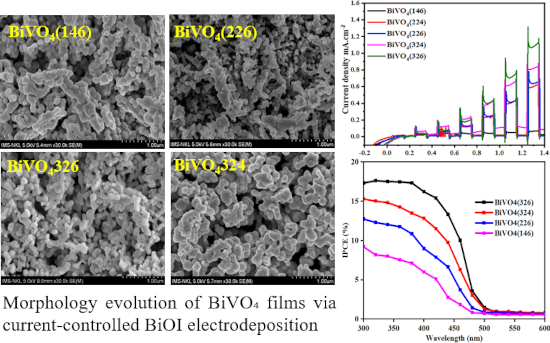
- , θ is the Bragg angle in radians, β is the full width at half maximum of the peak in radians, D is the particle size, and k is a constant with a value of 0.9. As shown in Table 1, an increase in the deposition current and VO(acac)2 concentration led to narrower peak widths and larger crystallite
- observed in the Raman spectra. These structural features are critical for improving the electronic and catalytic properties of BiVO4 photoanodes. To complement the XRD-derived crystallite sizes, the particle sizes were estimated from the FESEM images. As shown in Table 1, the particle size trends do not
- . This distinction suggests that while the crystallite size governs the internal crystalline quality and carrier mobility, the particle size affects the surface area and interface kinetics. Ideally, a material such as BiVO4(326) with both large crystallites and small, porous particles offers superior PEC



Better together: biomimetic nanomedicines for high performance tumor therapy
Beilstein J. Nanotechnol. 2025, 16, 1246–1276, doi:10.3762/bjnano.16.92
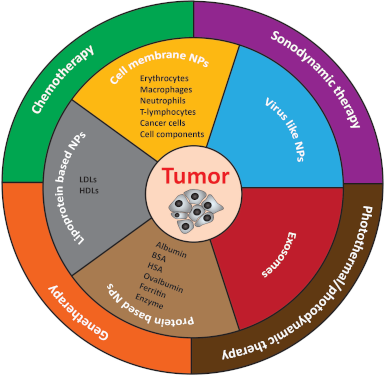
- applications. It forms crosslinked gels and responds to changes in pH and temperature [93]. To escape the RES, ovalbumin nanoparticles are conjugated with polyethylene glycol. Controlling the PEG/OVA ratio allows for fine-tuning of critical physical properties, such as particle size, elasticity, and mesh size







Functional bio-packaging enhanced with nanocellulose from rice straw and cinnamon essential oil Pickering emulsion for fruit preservation
Beilstein J. Nanotechnol. 2025, 16, 1234–1245, doi:10.3762/bjnano.16.91
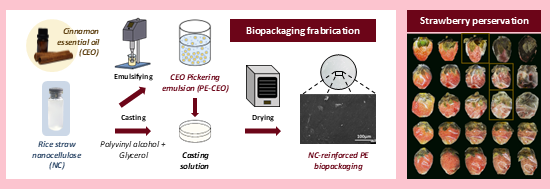
- seen for rBP compared to BP, which indicates a decrease in interplanar spacing, suggesting that NC has infiltrated the PVA lattice structure. For rCBP, with the addition of PE-CEO that has a larger particle size (≈700 nm [38]), the peaks were shifted towards lower angles and the peak intensity was



Hydrogels and nanogels: effectiveness in dermal applications
Beilstein J. Nanotechnol. 2025, 16, 1216–1233, doi:10.3762/bjnano.16.90
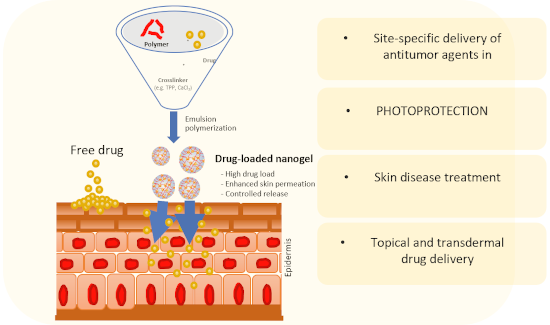
- antimetabolite used to treat rheumatoid arthritis, were obtained by Sadarani et al. (2019). First, methotrexate was encapsulated in deformable liposomes followed by incorporation in the hydroxyethylcellulose gel. The nanogel-MTX presented a small particle size of 110 ± 20 nm and a drug encapsulation rate of 42


Investigation of the solubility of protoporphyrin IX in aqueous and hydroalcoholic solvent systems
Beilstein J. Nanotechnol. 2025, 16, 1209–1215, doi:10.3762/bjnano.16.89
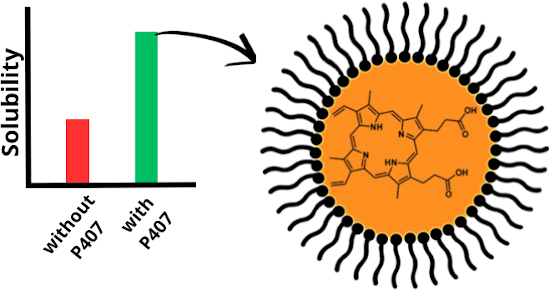
- of solubility were later contradicted by particle size distribution analysis. Figure 2 shows the solubility behavior of PpIX in water and EtOHabs, with mean concentrations of 0.497 ± 0.054 mg/mL in water, and 0.179 ± 0.004 mg/mL in EtOHabs. In contrast, the systems containing 0.4 mg/mL of PpIX in


Chitosan nanocomposite containing rotenoids: an alternative bioinsecticidal approach for the management of Aedes aegypti
Beilstein J. Nanotechnol. 2025, 16, 1197–1208, doi:10.3762/bjnano.16.88
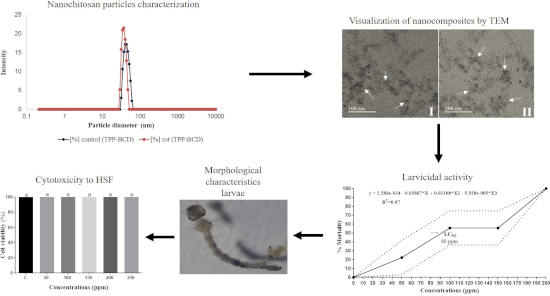
- efficiency, the size analysis of the produced nanochitosan particles confirmed that both ion gelation methods produced nanostructures smaller than 100 nm (Figure 1). However, in Figure 1B, the peak area is narrower, indicating a higher uniformity in particle size. Figure 2C and 2D also show that the



Crystalline and amorphous structure selectivity of ignoble high-entropy alloy nanoparticles during laser ablation in organic liquids is set by pulse duration
Beilstein J. Nanotechnol. 2025, 16, 1141–1159, doi:10.3762/bjnano.16.84
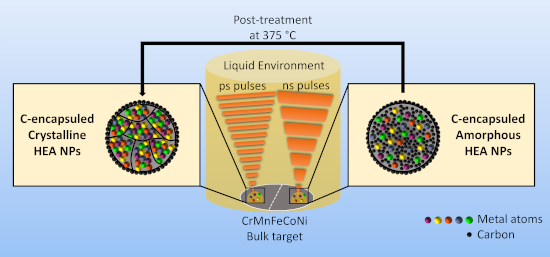
- structures while the influence of the other mentioned metalloids is less frequently observed [75]. Crystalline FeSiB NPs, synthesized by ns-LAL in water could be modified and an amorphous structure could be achieved by a follow-up LFL treatment. As a result, the particle size decreased and the beforehand
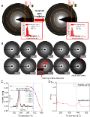
- ][81]. To test this hypothesis, we analyzed the particle size distributions within the circular areas used for SAED experiments for amorphous samples from ns-LAL and crystalline samples from ps-LAL. Figure 1B and Figure 1E show TEM images of analyzed HEA NPs with the corresponding particle size
- distributions directly associated with the diffraction patterns of the SAED analysis. In both selected areas (indicated as white circles in Figure 1B and Figure 1E, respectively) the determined particle size distributions show mean values of 21 ± 10 nm for crystalline ps-ablated particles and 21 ± 7 nm for




Fabrication of metal complex phthalocyanine and porphyrin nanoparticle aqueous colloids by pulsed laser fragmentation in liquid and their potential application to a photosensitizer for photodynamic therapy
Beilstein J. Nanotechnol. 2025, 16, 1088–1096, doi:10.3762/bjnano.16.80
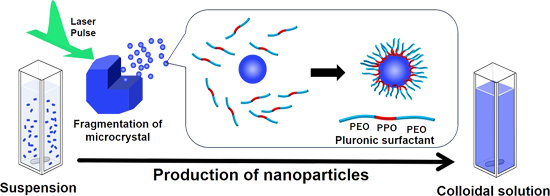
- . The nanoparticles having strong absorption in the NIR region (700 to 900 nm) were successfully prepared by PLFL, and the colloids remained stably dispersed over a period of at least one week. Particle size and size distribution determined by DLS measurements depended on the molecules. The compound
- microcrystalline powder into small nanoparticles with high efficiency. The particle size was determined by dynamic light scattering measurements (Zetasizer nanoS, Malvern Instruments). In this analysis, the prepared colloids were diluted more than tenfold with ion-exchanged water. Dispersion stability Dispersion


Piezoelectricity of hexagonal boron nitrides improves bone tissue generation as tested on osteoblasts
Beilstein J. Nanotechnol. 2025, 16, 1068–1081, doi:10.3762/bjnano.16.78
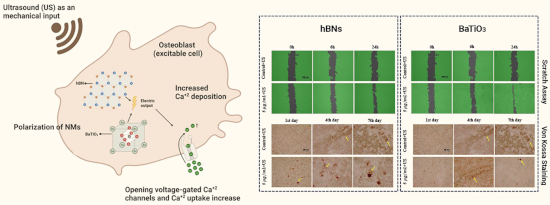
- SiC surface and stored at room temperature. The synthesized hBN and commercial BaTiO3 nanoparticles (Sigma-Aldrich, Germany) were characterized using several analytical techniques. Transmission electron microscopy (TEM, JEOL ARM 200 CF, 200 keV) was employed to examine morphology and particle size by


Soft materials nanoarchitectonics: liquid crystals, polymers, gels, biomaterials, and others
Beilstein J. Nanotechnol. 2025, 16, 1025–1067, doi:10.3762/bjnano.16.77