


Search results
Search for "siRNA" in Full Text gives 40 result(s) in Beilstein Journal of Nanotechnology.
Molecular architectonics of DNA for functional nanoarchitectures
Beilstein J. Nanotechnol. 2020, 11, 124–140, doi:10.3762/bjnano.11.11
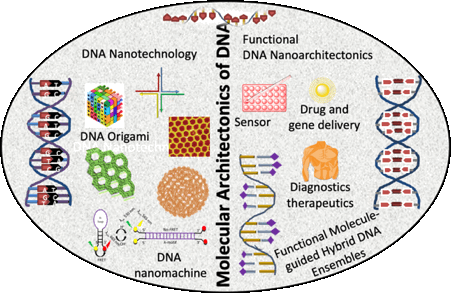
- -functionalized iron oxide nanoparticle system was capable of selectively targeting the cancer cells and, potentially, to act as an MRI contrast agent. The programmability of the DNA tetrahedrons provided an opportunity to conjugate other functional nucleic acid sequences, viz., DNA, siRNA, or DNAzymes, to serve
- co-workers showed that self-assembled DNA tetrahedron nanoarchitectures with narrow size distribution could deliver siRNA into tumor cells [71]. The programmable DNA strands were functionalized with tumor-targeting folate ligands. The nanoarchitecture consisted of six DNA strands having a total of
- was exactly complementary to the siRNA sequence, and, typically, six siRNAs could be annealed with the tetrahedron unit. To ascertain the in vivo transfection efficiency of the siRNA-loaded DNA tetrahedron nanoarchitecture, pharmacokinetic profiling and organ biodistribution assays were conducted in


Internalization mechanisms of cell-penetrating peptides
Beilstein J. Nanotechnol. 2020, 11, 101–123, doi:10.3762/bjnano.11.10
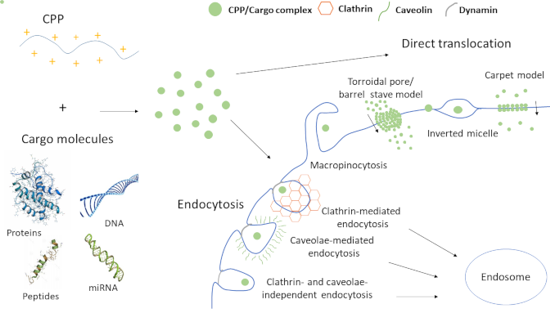
- peptide nucleic acids (PNAs) and phosphorodiamidate morpholino oligonucleotides (PMOs) [3][12]. Concerning charged molecules such as siRNA or miRNA, the covalent conjugation leads to restricted biological activity, most likely due to the steric hindrance caused by the covalently-linked CPP, which is an
- obstacle for the incorporation of siRNA/miRNA into the RISC complex. Because of this, the siRNA/miRNA molecule cannot be loaded into the complex and manifest its effect [13]. Regarding covalent strategies of cargo-attachment, there is a great promise in biorthogonal chemistry, which allows for the design
- -siRNA/miRNA delivery [17]. It has been reported that CPP-siRNA conjugates have reduced transient and stable expression of reporter transgenes in a number of mammalian cell lines [18]. In this case, thiol-containing siRNAs were synthesized and conjugated to penetratin or transportan by a reducible


The different ways to chitosan/hyaluronic acid nanoparticles: templated vs direct complexation. Influence of particle preparation on morphology, cell uptake and silencing efficiency
Beilstein J. Nanotechnol. 2019, 10, 2594–2608, doi:10.3762/bjnano.10.250
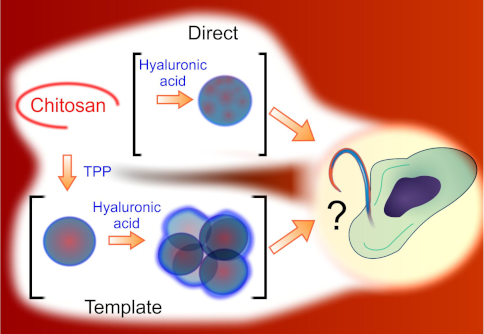
- all a higher aspect ratio (Rg/RH) and a lower fractal dimension. We then compared the kinetics of uptake and the (antiluciferase) siRNA delivery performance in murine RAW 264.7 macrophages and in human HCT-116 colorectal tumor cells. The preparative method (and therefore the internal particle
- at a 1:9 TPP/chitosan weight ratio. In the case of siRNA-loaded nanoparticles, TPP was dissolved in deionized nuclease-free water containing siRNA. The chitosan–TPP nanoparticle (template) dispersion was stirred for 30 min and then mixed with 1 mL of acetate buffer (200 mM, pH 5). After 5 min, 1 mL
- the water every 20 min. B) Direct complexation. 500 µL of a 0.069 wt % chitosan solution prepared as described above was mixed with an equal volume of deionized and nuclease-free water containing siRNA or simply with deionized water for 10 min at 25 °C. The resulting dispersion (with or without siRNA



Long-term stability and scale-up of noncovalently bound gold nanoparticle-siRNA suspensions
Beilstein J. Nanotechnol. 2019, 10, 2568–2578, doi:10.3762/bjnano.10.248
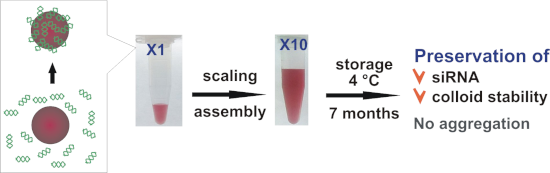
- nanoparticles (AuNPs) are a platform for the creation of nanoconstructions that can have a variety of functions, including the delivery of therapeutic nucleic acids. We previously designed a AuNP/small interfering RNA (siRNA) nanoconstruction consisting of siRNA noncovalently bound on the AuNP surface and
- showed that this construction, when coated with a lipid shell, was an efficient vehicle for the delivery of siRNA into cells. The goal of the present work was to study the possibility of scaling up the synthesis of AuNP-siRNA and its long-term storage without loss of physicochemical characteristics and
- siRNA duplex integrity as well as siRNA surface density. Dynamic light scattering, transmission electron microscopy, UV–vis spectroscopy, and electrophoresis were used to study the effect of scaling up the AuNP-siRNA synthesis and long term storage of its suspension on physicochemical properties of the


Targeting strategies for improving the efficacy of nanomedicine in oncology
Beilstein J. Nanotechnol. 2019, 10, 168–181, doi:10.3762/bjnano.10.16
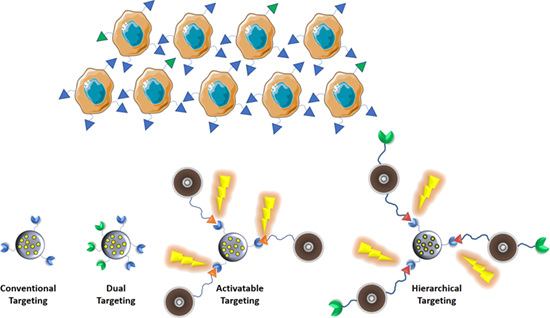
- selective delivery to these organelles [49]. The peptide Lys–Asp–Glu–Leu (KDEL) has been anchored on gold nanoparticles loaded with siRNA for the selective delivery of the genetic material into the endoplasmic reticulum [50]. The main mechanism for the internalization of nanoparticles within mammalian cells
- is endocytosis [51]. Usually, the nanocarriers enter into the cells into endosomes, which evolve into lysosomes, which can lead to the degradation of the transported cargo, especially in the case of sensitive agents such as genes or siRNA. Therefore, it is necessary to design mechanisms to induce the
- constitutes a formidable barrier for tissue targeting not only in nanomedicine but also in common drug delivery [63]. In this case, liposomes were modified with Angiopep-2 and tLyP-1 homing and penetrating peptides for the simultaneous delivery of siRNA and (docetaxel) DTX. Angiopep-2 showed affinity to the


Enhanced antineoplastic/therapeutic efficacy using 5-fluorouracil-loaded calcium phosphate nanoparticles
Beilstein J. Nanotechnol. 2018, 9, 2499–2515, doi:10.3762/bjnano.9.233
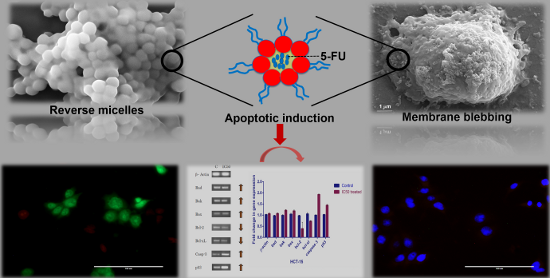
- nanoparticles in biomedical applications is extended to tissue engineering, gene/siRNA delivery, anticancer drug delivery, protein and antigen delivery, vaccine delivery, insulin as well as imaging probe or contrasting agent delivery for bio-imaging. 5-Fluorouracil (5-FU), a well-known anticancer agent


Cationic PEGylated polycaprolactone nanoparticles carrying post-operation docetaxel for glioma treatment
Beilstein J. Nanotechnol. 2017, 8, 1446–1456, doi:10.3762/bjnano.8.144
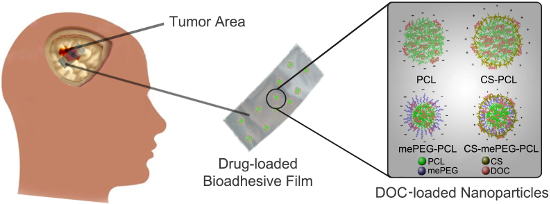
- increased the particle size and decreased the cellular uptake of nanoparticles [66]. Cationic core–shell nanoparticles are also quite suitable for the delivery of negatively charged gene and drug to tumor tissue. Wei et al. used cationic core–shell nanoparticles for the active targeted delivery of siRNA on


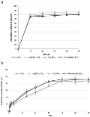


Uptake of the proteins HTRA1 and HTRA2 by cells mediated by calcium phosphate nanoparticles
Beilstein J. Nanotechnol. 2017, 8, 381–393, doi:10.3762/bjnano.8.40
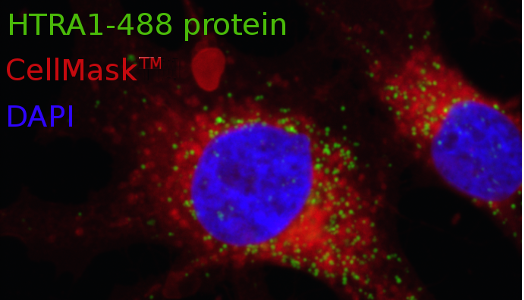
- ]. For instance, nucleic acids like DNA [10][11][12][13], siRNA [14][15][16][17] and µRNA [18] have been successfully introduced to perform transfection, gene silencing, prophylactic and therapeutic vaccination [19][20][21]. All kinds of synthetic molecules and biomolecules can be transported across the


High antiviral effect of TiO2·PL–DNA nanocomposites targeted to conservative regions of (−)RNA and (+)RNA of influenza A virus in cell culture
Beilstein J. Nanotechnol. 2016, 7, 1166–1173, doi:10.3762/bjnano.7.108
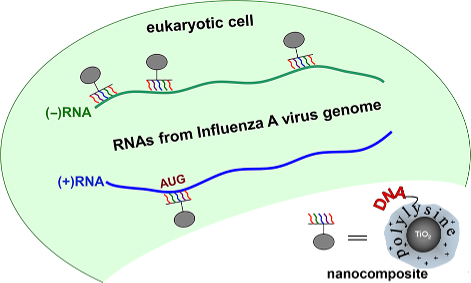
- ’-terminal region of (−)RNA [10][11] were the most chosen regions of IAV segment 5 to be affected by oligonucleotides and their analogs. The coding region close to the stop codon was often used as the target for the action of siRNA [9][12][15][16]. The other regions of the NP gene were also studied as


Hematopoietic and mesenchymal stem cells: polymeric nanoparticle uptake and lineage differentiation
Beilstein J. Nanotechnol. 2015, 6, 383–395, doi:10.3762/bjnano.6.38
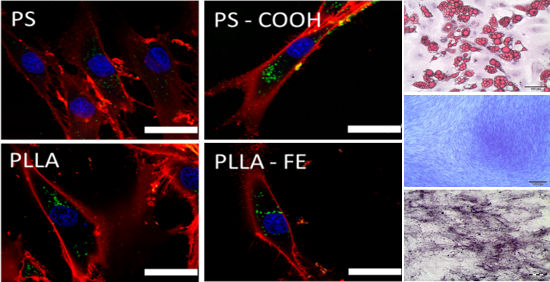
- granulopoetic markers was significantly suppressed. Discussion Although nanoparticles are proposed as useful drug and DNA or siRNA delivery vehicles (which could potentially change the fate of stem cells), they could also influence the cellular fate of stem cells with a potentially devastating effect. While


Comparative evaluation of the impact on endothelial cells induced by different nanoparticle structures and functionalization
Beilstein J. Nanotechnol. 2015, 6, 300–312, doi:10.3762/bjnano.6.28
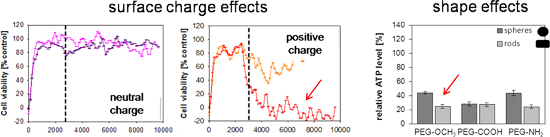
- ; Introduction To advance the field of nanomedicine, innovative nanoparticle formulations with suitable properties for diagnostic imaging, therapy (e.g., magnetic hyperthermia), delivery of drugs and siRNA have been developed. Apart from their feasibility for the respective application many of these


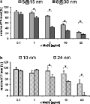


Caveolin-1 and CDC42 mediated endocytosis of silica-coated iron oxide nanoparticles in HeLa cells
Beilstein J. Nanotechnol. 2015, 6, 167–176, doi:10.3762/bjnano.6.16
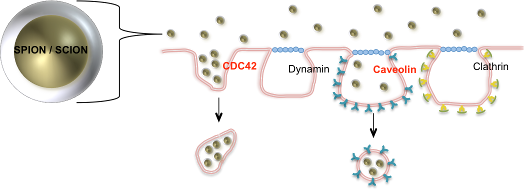
- and surface charge, were tested in HeLa cells as a model cell line. To elucidate, which molecular pathways are involved in their endocytosis, well-known endocytotic mechanisms [26][27][28] were inhibited by specific knockdown of key proteins via siRNA (Figure 1). Experimental Superparamagnetic iron
- Technologies. To achieve the optimal transfection efficiency, two transfection rounds on day 1 and 3 after cell plating were performed. In preliminary experiments the knockdown technique was optimized to cause no cell death by applying different ranges of transfection reagent with different amounts of siRNA
- were transfected according to the protocol “Thermo Scientific DharmaFECT Transfection Reagents - siRNA Transfection Protocol“ and DharmaFECT 1 siRNA Transfection Reagent (Thermo Fisher Scientific, Cat. No. T-2001-01) was used. Information about the siRNA-mix (SMARTpool®) used is shown in Table 3


Anticancer efficacy of a supramolecular complex of a 2-diethylaminoethyl–dextran–MMA graft copolymer and paclitaxel used as an artificial enzyme
Beilstein J. Nanotechnol. 2014, 5, 2293–2307, doi:10.3762/bjnano.5.238
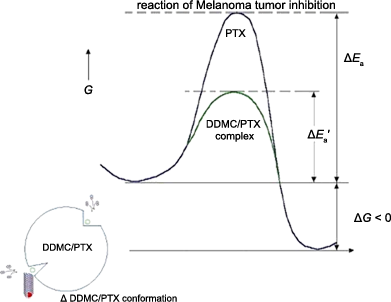
- structure is stabilized at less than the critical micelle concentration. It was reported recently that the administration of DDMC as an aerosol [25] and the use of DDMC/p53 in intratumoral gene therapy [26] were effective. DDMC is very suitable for experiments using targeted siRNA or miRNA transfection in


In vitro interaction of colloidal nanoparticles with mammalian cells: What have we learned thus far?
Beilstein J. Nanotechnol. 2014, 5, 1477–1490, doi:10.3762/bjnano.5.161
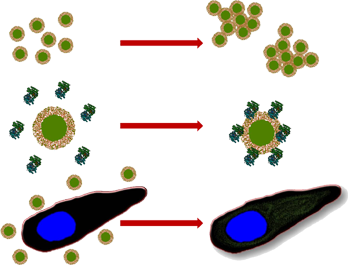
- case of positively charged NPs adsorb to the NPs. As a consequence of counter ion adsorption the local ion concentration around the NPs surface is different from the bulk [54][87][106][107]. ii) Also nucleic acids, such as mRNA or siRNA, which are negatively charged due to their phosphate groups attach


Molecular biology approaches in bioadhesion research
Beilstein J. Nanotechnol. 2014, 5, 983–993, doi:10.3762/bjnano.5.112
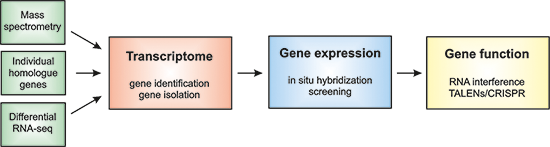
- fragments of 21–22 bp in length. These short fragments are known as siRNAs. Each siRNA is unwound into two single stranded components: The passenger strand, which is degraded, and the guide strand which is recruited by the RNAi-induced silencing complex (RISC). When the guide strand fits to a given





