Search results
Search for "sustainability" in Full Text gives 77 result(s) in Beilstein Journal of Nanotechnology.
Instance maps as an organising concept for complex experimental workflows as demonstrated for (nano)material safety research
Beilstein J. Nanotechnol. 2025, 16, 57–77, doi:10.3762/bjnano.16.7

- interoperability! While the focus of the cases presented here is nanosafety and sustainability, the general utility and applicability of the instance map concept to describe complex experimental and computational studies in other research areas and potentially in regulatory settings and industrial development and
- is demonstrated on a range of experimental workflows applied in nanosafety and sustainability assessment, representing the assessment of nanomaterials or advanced materials via different endpoints and workflows. Typically, the overall experimental workflow in nanosafety assessment consists of (but is
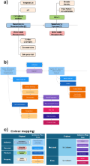
- satisfy the information requirements of downstream experiments; also, all data needs to be integrated to perform a safety and sustainability evaluation. The InstanceMaps tool was used to visually map all exposure points, the characterisation methods applied to these points, and the workflows needed to


Facile synthesis of size-tunable L-carnosine-capped silver nanoparticles and their role in metal ion sensing and catalytic degradation of p-nitrophenol
Beilstein J. Nanotechnol. 2024, 15, 1576–1592, doi:10.3762/bjnano.15.124
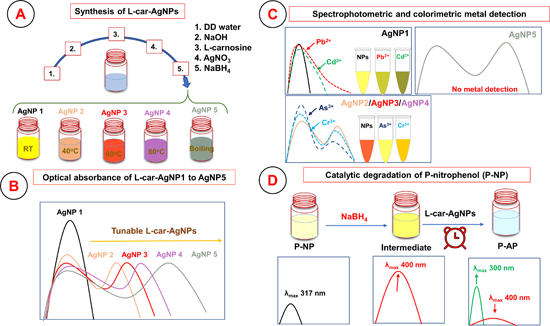
- sustainability and public health. Silver nanoparticles (AgNPs) have attracted the interest of researchers worldwide in recent years because of their promising use in environmental chemistry. The unique optochemical properties of AgNPs, including high surface area to volume ratio, optical absorbance, excellent


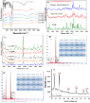


Hymenoptera and biomimetic surfaces: insights and innovations
Beilstein J. Nanotechnol. 2024, 15, 1333–1352, doi:10.3762/bjnano.15.107
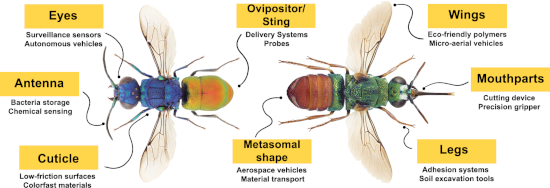
- ]. Understanding and mimicking these biological systems can lead to significant advancements in various fields, including materials science, fashion, and environmental sustainability [34]. In materials science, the principles of structural coloration can be applied to develop colorfast materials that do not fade







Effect of wavelength and liquid on formation of Ag, Au, Ag/Au nanoparticles via picosecond laser ablation and SERS-based detection of DMMP
Beilstein J. Nanotechnol. 2024, 15, 1054–1069, doi:10.3762/bjnano.15.86

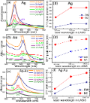
- , such as high cost, chemical instability, and sustainability issues [22][23]. Menéndez-Manjón et al. [24] reported the synthesis of Ag/Au alloy NPs via picosecond LASiS of solid targets in monomer MMA. Amendola et al. [25] demonstrated the fabrication of magneto-plasmonic alloy NPs, such as Fe–Au, by


Beyond biomimicry – next generation applications of bioinspired adhesives from microfluidics to composites
Beilstein J. Nanotechnol. 2024, 15, 965–976, doi:10.3762/bjnano.15.79
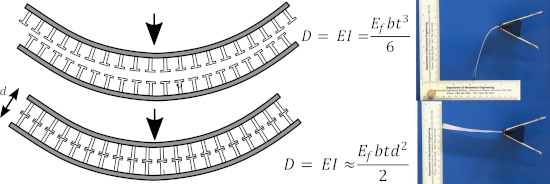
- stiffness. While soft robotics have shown a need for stiffness-tunable materials, the ability for composites in and of themselves to be reversibly bonded potentially opens up a far greater industrial impact and applications in adaptable, smart materials. Even improved sustainability could be achieved if
- form. Nature offers many examples of self-healing damage over time, yet human-engineered products have rarely achieved this capability in a cost-effective manner [37]. Materials that can absorb energy and deform without being permanently damaged would be highly attractive from a sustainability
- adaptability, sustainability, and product performance. The future of reversible adhesives will come from looking within, and going beyond, biomimicry. Chronological development of different gecko adhesive manufacturing processes that were developed by the author and then adapted by future students. Process (A


The effect of age on the attachment ability of stick insects (Phasmatodea)
Beilstein J. Nanotechnol. 2024, 15, 867–883, doi:10.3762/bjnano.15.72

- experiments could explore more ageing-related effects to gain insights into the processes of attachment ability decay in insects and, thus, potentially improve sustainability of artificial biologically inspired engineering gripping systems. Such studies could include the role of hemolymph pressure for



Assessing phytotoxicity and tolerance levels of ZnO nanoparticles on Raphanus sativus: implications for widespread adoptions
Beilstein J. Nanotechnol. 2024, 15, 115–125, doi:10.3762/bjnano.15.11
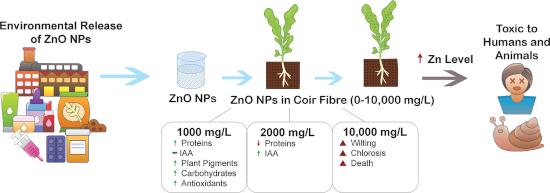
- a promising strategy to enhance soil fertility and crop productivity, and as a protective agent against phytopathogens [13][14]. On the other hand, even though ZnO NPs are employed in agriculture to maintain sustainability and increase the effectiveness of agricultural activities, the potential


Mixed oxides with corundum-type structure obtained from recycling can seals as paint pigments: color stability
Beilstein J. Nanotechnol. 2023, 14, 467–477, doi:10.3762/bjnano.14.37
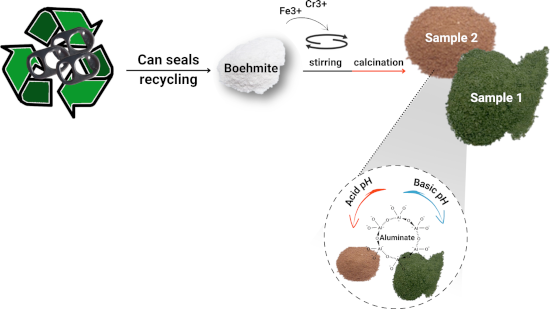
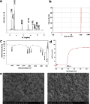
- . Keywords: circular economy; colorimetry; sustainability; Introduction The growing interest in industrial products that do not harm the environment triggered the development of diverse strategies to optimize recycling and green syntheses of materials. It is possible to combine economic and environmental




New trends in nanobiotechnology
Beilstein J. Nanotechnol. 2023, 14, 377–379, doi:10.3762/bjnano.14.32

- Pau-Loke Show Kit Wayne Chew Wee-Jun Ong Sunita Varjani Joon Ching Juan Department of Chemical Engineering, Khalifa University, P.O. Box 127788, Abu Dhabi, United Arab Emirates Centre for Energy and Environmental Sustainability, Lucknow, India Nanotechnology & Catalysis Research Centre (NanoCat
A nonenzymatic reduced graphene oxide-based nanosensor for parathion
Beilstein J. Nanotechnol. 2022, 13, 730–744, doi:10.3762/bjnano.13.65
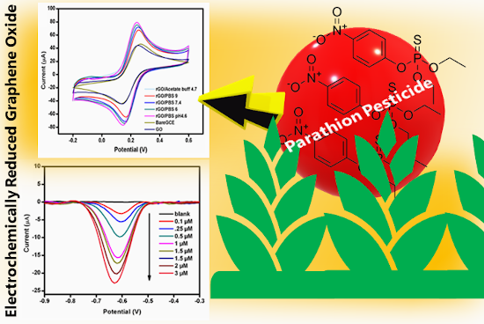
- , West Bengal 713209, India Environment and Sustainability Institute, University of Exeter, Penryn Campus, Cornwall TR10 9FE, United Kingdom Chemical Sciences and Technology Division, CSIR-National Institute of Interdisciplinary Science and Technology, Thiruvananthapuram, Kerala 695019, India 10.3762


Coordination-assembled myricetin nanoarchitectonics for sustainably scavenging free radicals
Beilstein J. Nanotechnol. 2022, 13, 284–291, doi:10.3762/bjnano.13.23
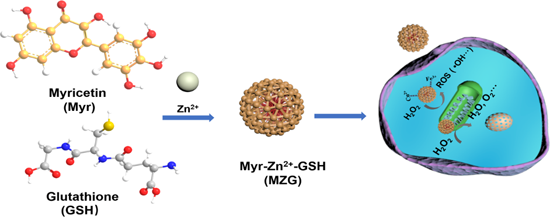
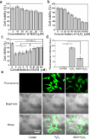
- sustainability of radical scavenging activity due to the co-assembly that might have enhanced the stability of Myr and GSH. As shown in Figure 3d, ABTS+ solution was persistently added to 1 mL of MZG nanoparticle suspension or water for 5 days. The result revealed that MZG nanoparticles exhibited prolonged


Self-assembly of amino acids toward functional biomaterials
Beilstein J. Nanotechnol. 2021, 12, 1140–1150, doi:10.3762/bjnano.12.85
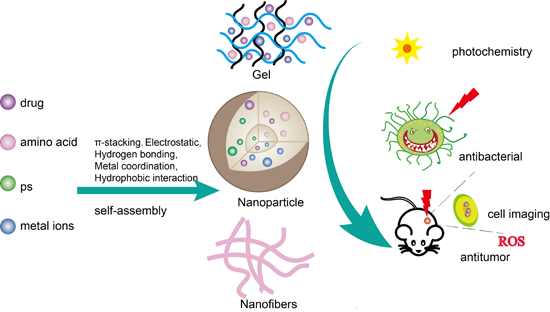
- adhesive fibers. Therefore, a simple and robust bionic cyanobacteria model with excellent catalytic activity and sustainability was obtained. In addition, amino acids were co-assembled with phthalocyanines to improve their functionality. Han et al. [89] used histidine derivatives, 9

Progress and innovation of nanostructured sulfur cathodes and metal-free anodes for room-temperature Na–S batteries
Beilstein J. Nanotechnol. 2021, 12, 995–1020, doi:10.3762/bjnano.12.75
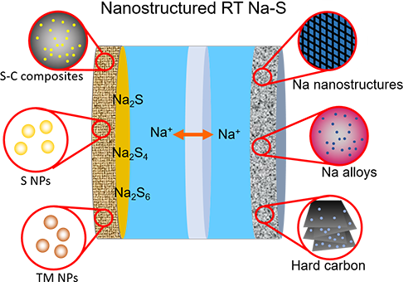
- The revival of Na–S batteries has triggered enormous research within this field. Important drivers are, besides the high theoretical capacity and energy density values, aspects of sustainability, environmental impact, and geo-economic concerns. Sodium and sulfur are amongst the most abundant elements





The role of deep eutectic solvents and carrageenan in synthesizing biocompatible anisotropic metal nanoparticles
Beilstein J. Nanotechnol. 2021, 12, 924–938, doi:10.3762/bjnano.12.69
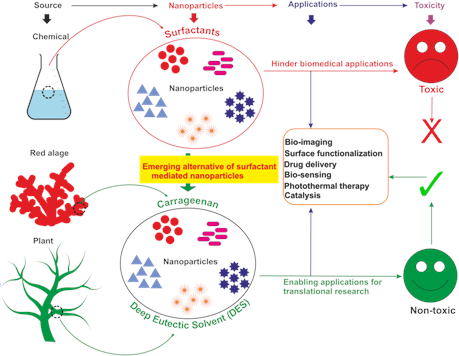
- , biocompatibility, sustainability, and low cost, achieving the real potential in nanobiotechnology is not far. Carrageenan as green/safe stabilizing agent in nanomaterial synthesis A stabilizing agent, often known as capping agent, is one of the vital components in the synthesis of nanomaterials. The colloidal


A review on the green and sustainable synthesis of silver nanoparticles and one-dimensional silver nanostructures
Beilstein J. Nanotechnol. 2021, 12, 102–136, doi:10.3762/bjnano.12.9
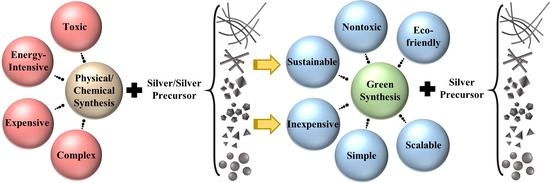
- [181], and are more economically feasible [104][181][219]. Sustainability, energy efficiency, renewability, and reduction of chemical derivatives, are among other advantages of green synthesis processes [266]. Furthermore, nature provides a high variety of reagents that can act as reducing agents


ZnO and MXenes as electrode materials for supercapacitor devices
Beilstein J. Nanotechnol. 2021, 12, 49–57, doi:10.3762/bjnano.12.4
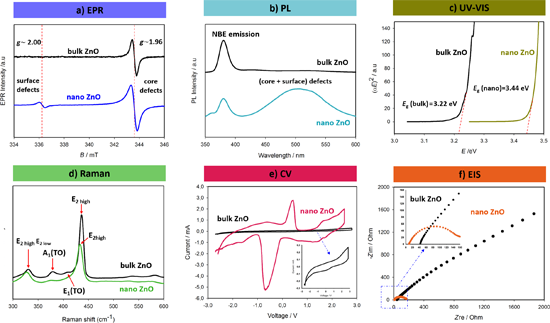
- alternatives to metal oxides are two-dimensional (2D) MXenes. Their properties include environmental sustainability, lamellar structure, high transformation efficiency, high surface hydrophilicity, and good electrical conductivity [14]. Therefore, in the following section we discuss the main properties of
- , long cycling stability, as well as environmental sustainability [15][16][17][18][21][22]. Unfortunately, supercapacitors are not fully in the market due to manufacturing cost, stability, and lifetime concerns [15]. Electrodes and electrolytes are two key parameters that affect the design of the
Triboelectric nanogenerator based on Teflon/vitamin B1 powder for self-powered humidity sensing
Beilstein J. Nanotechnol. 2020, 11, 1394–1401, doi:10.3762/bjnano.11.123
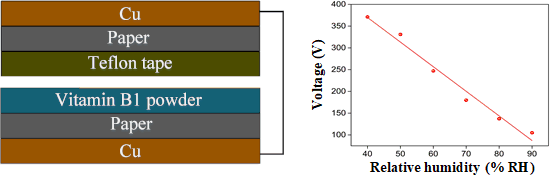
- lubricant to make a friction nanogenerator. Due to its sustainability and flexibility, paper can be used as a substrate and supporting structure. The conductive electrode is made of copper foil, while the triboelectric pair is comprised of Teflon tape and vitamin B1 powder. The approximate values of the




Gas sorption porosimetry for the evaluation of hard carbons as anodes for Li- and Na-ion batteries
Beilstein J. Nanotechnol. 2020, 11, 1217–1229, doi:10.3762/bjnano.11.106
- Chemistry, Technical University of Munich, Lichtenbergstr. 4, Garching bei München 85748, Germany Nanochemistry Department, Max Planck Institute for Solid State Research, Heisenbergstraße 1, Stuttgart 70569, Germany Institute of Materials and Systems for Sustainability, Nagoya University, Furo-cho, Chikusa


Synthesis and enhanced photocatalytic performance of 0D/2D CuO/tourmaline composite photocatalysts
Beilstein J. Nanotechnol. 2020, 11, 407–416, doi:10.3762/bjnano.11.31
- : Additional experimental data. Funding This work was supported by the China Scholarship Council (201908360233). D. D. Dionysiou also acknowledges support from the University of Cincinnati through a UNESCO co-Chair Professor position on “Water Access and Sustainability” and the Herman Schneider Professorship


Green and scalable synthesis of nanocrystalline kuramite
Beilstein J. Nanotechnol. 2019, 10, 2073–2083, doi:10.3762/bjnano.10.202
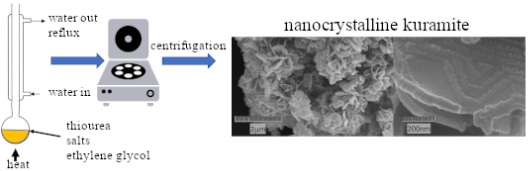
- on flexible surfaces. Most of the efforts in this research field aim at the optimal trade-off between the solar energy conversion performance, scalability and sustainability of these nanocrystalline multinary sulfides [34][35]. To this end, researchers have produced many different polymorphic and


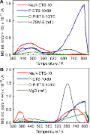
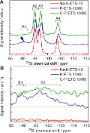
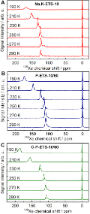
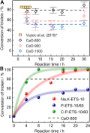
Synthesis of highly active ETS-10-based titanosilicate for heterogeneously catalyzed transesterification of triglycerides
Beilstein J. Nanotechnol. 2019, 10, 2039–2061, doi:10.3762/bjnano.10.200
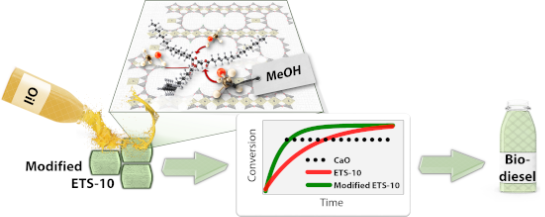
- , animal fats and tallows [1]. Keeping in mind the critical aspect of food security (i.e., minimizing the use of edible feedstock types for fuel production) and the need for sustainability in the long run, recent developments in the use of algae as the feedstock have given the concepts of biofuel








Processing nanoporous organic polymers in liquid amines
Beilstein J. Nanotechnol. 2019, 10, 1844–1850, doi:10.3762/bjnano.10.179
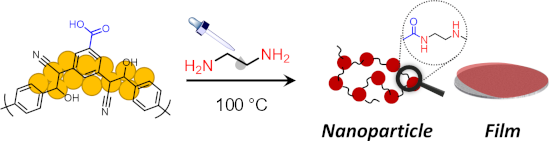
- Jeehye Byun Damien Thirion Cafer T. Yavuz Water Cycle Research Center, Korea Institute of Science and Technology (KIST), 5 Hwarang-ro 14, Seoul, 02792, Korea Graduate School of Energy, Environment, Water and Sustainability (EEWS), Korea Advanced Institute of Science and Technology (KAIST), 291
- and economic sustainability for gas capture [12] and water treatment applications [13]. Nanoporous polymers are classified as network polymers, and such network polymers do not dissolve in common organic solvents but rather swell. Despite the advantages of network structures, the nanoporous polymers



BiOCl/TiO2/diatomite composites with enhanced visible-light photocatalytic activity for the degradation of rhodamine B
Beilstein J. Nanotechnol. 2019, 10, 1412–1422, doi:10.3762/bjnano.10.139
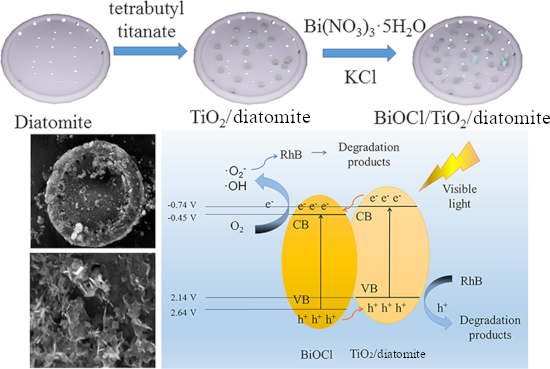
- nature as a whole. In recent years, advanced oxidation processes including Fenton [3], Fenton-like [4][5][6] and photocatalysis [7] reactions have been widely used in wastewater treatment. In addition, photocatalysis has attracted great attention due to advantages such as environmental sustainability


Electronic properties of several two dimensional halides from ab initio calculations
Beilstein J. Nanotechnol. 2019, 10, 823–832, doi:10.3762/bjnano.10.82
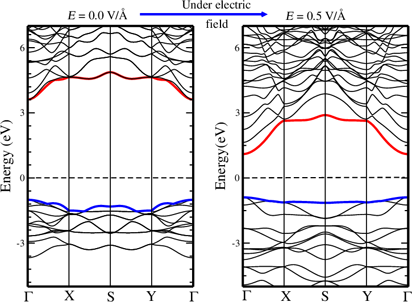
- , Tunisia Laboratoire de Physique et Chimie Théoriques (LPCT, UMR CNRS 7019) Institut Jean Barriol, Université de Lorraine, BP 239, Boulevard des Aiguillettes 54506 Vandoeuvre-lès-Nancy, France Graduate School of Energy, Environment, Water, and Sustainability (EEWS), Korea Advanced Institute of Science and


Reduced graphene oxide supported C3N4 nanoflakes and quantum dots as metal-free catalysts for visible light assisted CO2 reduction
Beilstein J. Nanotechnol. 2019, 10, 448–458, doi:10.3762/bjnano.10.44
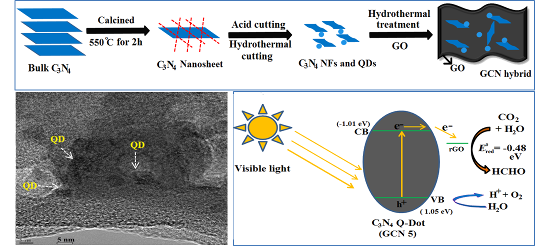
- promising for CO2 photoreduction because of their excellent activity and environmental sustainability. Keywords: CO2 reduction; metal-free hybrid; nanoflakes; photocatalyst; quantum dots; Introduction The solar-light-assisted photocatalytic reduction of CO2 into useful chemicals, such as HCOOH, HCHO, CH4
- better charge separation, which further enhances its photo-reductive capacity. Therefore, metal-free GCN hybrid materials could be a potential candidate for CO2 photoreduction and HCHO (fuel) generation because of their excellent activity, stability and environmental sustainability. Experimental