Search results
Search for "threshold" in Full Text gives 432 result(s) in Beilstein Journal of Nanotechnology. Showing first 200.
Bioinspired polypropylene-based functionally graded materials and metamaterials modeling the mistletoe–host interface
Beilstein J. Nanotechnol. 2025, 16, 1592–1606, doi:10.3762/bjnano.16.113
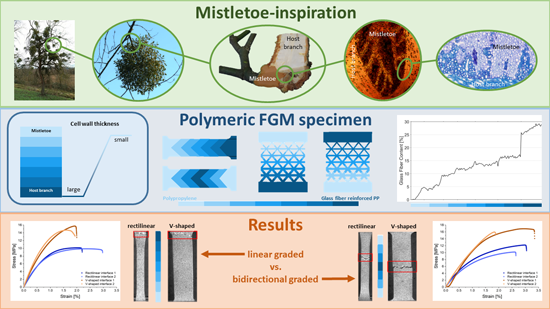
- segmentation based on a threshold that differentiated between the pixel brightness of the glass fibers and the PP resulted in the fiber pixel area (Af). The fiber content of each cross-sectional image was calculated as the ratio between Af and At, and the values of the cross sections of each cut specimen were
- applied. The small deviation may be due to the volume reduction of PP during hot pressing, the burnt glass fibers at the edges, and inaccuracies in the post-processing threshold algorithms. The good fusion of the individual compartments and the gradual increase in fiber concentration along the specimen


Laser processing in liquids: insights into nanocolloid generation and thin film integration for energy, photonic, and sensing applications
Beilstein J. Nanotechnol. 2025, 16, 1428–1498, doi:10.3762/bjnano.16.104
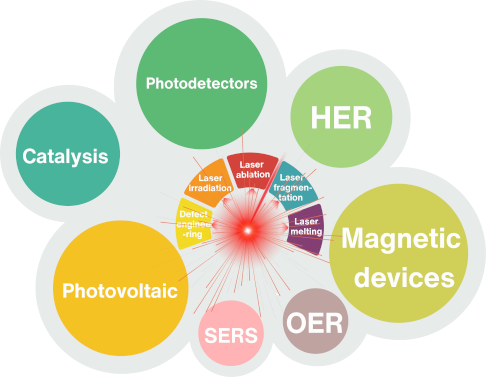
- significance of photon-assisted transitions in fragmentation processes, particularly when interacting with the second and third harmonics of a picosecond Nd:YAG laser. Although the temperature of the Au NPs exceeded the evaporation threshold, the results suggest that heating alone was not the primary cause of
- model, which was experimentally validated. In 2010, as research on pulsed laser irradiation progressed, Koshizaki’s group explored the potential of non-focused laser beams with moderate fluence, lower than the ablation threshold, to irradiate colloidal NPs [42][48][49][64][65][66][67]. Their findings






Synthesis and antibacterial properties of nanosilver-modified cellulose triacetate membranes for seawater desalination
Beilstein J. Nanotechnol. 2025, 16, 1380–1391, doi:10.3762/bjnano.16.100
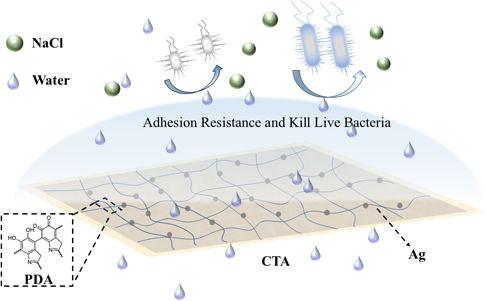
- . Although modern NMR instruments have improved sensitivity, there is still a practical detection threshold. If the concentration of PDA falls below this threshold, the signal may not be detectable or may be too weak to provide meaningful information. These factors make it challenging to detect and quantify


Automated collection and categorisation of STM images and STS spectra with and without machine learning
Beilstein J. Nanotechnol. 2025, 16, 1367–1379, doi:10.3762/bjnano.16.99
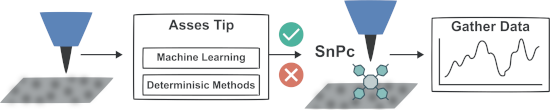
- threshold of >0.98, the model was able to reliably generate and identify sharp tips. Dataset summary Using the data generation method described above, we obtained a total of 2604 individual spectra on the bare Au(111) surface, 86 of which were used for our classification models. In order to use this data
- plotted, showing the spread of the RMS in each category. This histogram is shown in Figure 6. From this, the final threshold was chosen <0.25, with all spectra resulting in a value within this range classified as “good”. Using this method, the deterministic model was able to achieve an overall accuracy of
- move on to either an in situ tip preparation step, (j); if the number of shaping attempts without a “good” tip has exceeded a pre-determined threshold, (i), the tip is moved away macroscopically, (k), under the assumption that the area is not suitable for classification. Throughout the schematic, green




Wavelength-dependent correlation of LIPSS periodicity and laser penetration depth in stainless steel
Beilstein J. Nanotechnol. 2025, 16, 1302–1315, doi:10.3762/bjnano.16.95
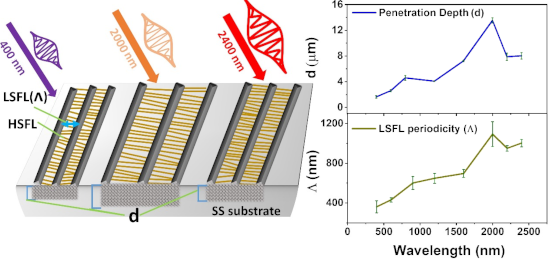
- structure with laser irradiation wavelengths ranging from 400 to 2200 nm. From this, a linear trend in LIPSS characteristics was observed up to 2000 nm, and the threshold of the LIPSS formation was determined [52]. In the present work, we extend the LIPSS over a large area, instead of a single line, using




Functional bio-packaging enhanced with nanocellulose from rice straw and cinnamon essential oil Pickering emulsion for fruit preservation
Beilstein J. Nanotechnol. 2025, 16, 1234–1245, doi:10.3762/bjnano.16.91
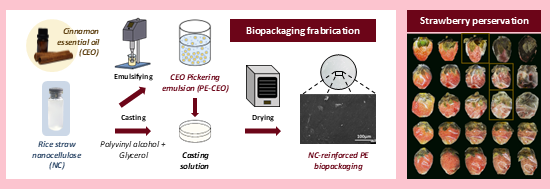
- microbial access [7]. PVA also exhibits superior biocompatibility as evidenced by its high safety threshold (LD50 of 15–20 g·kg−1), low systemic absorption, absence of mutagenic effects, and established medical applications, making it a reliable choice for biopackaging without concerns of harmful



Mechanical stability of individual bacterial cells under different osmotic pressure conditions: a nanoindentation study of Pseudomonas aeruginosa
Beilstein J. Nanotechnol. 2025, 16, 1171–1183, doi:10.3762/bjnano.16.86
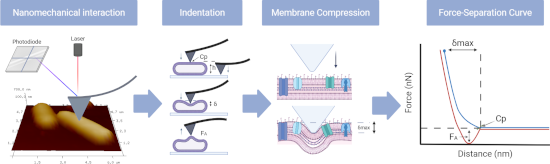
- . Therefore, the type and density of these MS channels triggered at different threshold values of membrane tension determine the survival capacity of the bacteria under drastic changes in osmotic pressure [16][17][18][19][20]. PA is also known to use other channel proteins to overcome the attack by
- changes before it reaches the force threshold of 500 pN. These results are interpreted as follows. For the three investigated osmolarity levels, bacteria do not seem to be disrupted or damaged, at least from a morphological point of view when imaged in the low regime of loading forces or from its
- prevented by the rapid reaction of the MS channels, which act as safety valves which open as soon as the internal Pt causes an increase in the tension of the envelope above a specific threshold value. Then, it rapidly releases contained osmolytes to deflate the internal pressure and avoid membrane rupture


Crystalline and amorphous structure selectivity of ignoble high-entropy alloy nanoparticles during laser ablation in organic liquids is set by pulse duration
Beilstein J. Nanotechnol. 2025, 16, 1141–1159, doi:10.3762/bjnano.16.84
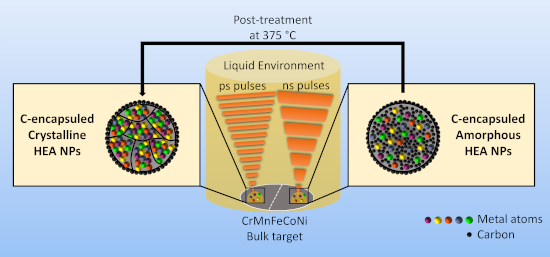
- pulse energies in the second control experiment (0.15 mJ) (corresponding parameters can be found in Supporting Information File 1, Table S5, Section S9), exceeding typical threshold values by far [50][88]. As depicted in Supporting Information File 1, Figure S7, amorphization tendencies were analogous




Fabrication of metal complex phthalocyanine and porphyrin nanoparticle aqueous colloids by pulsed laser fragmentation in liquid and their potential application to a photosensitizer for photodynamic therapy
Beilstein J. Nanotechnol. 2025, 16, 1088–1096, doi:10.3762/bjnano.16.80
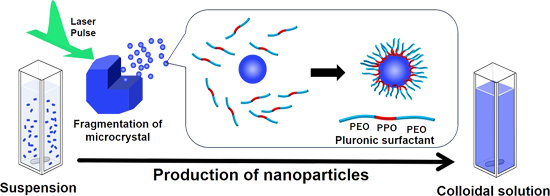
- experiments regarding the laser fluence dependence for AlClPc. The absorption spectra of the sample after laser irradiation at various fluences for 30 min were compared (Figure S9, Supporting Information File 1). The absorption of the nanoparticles increased with the fluence above a threshold (30 mJ·cm−2


Soft materials nanoarchitectonics: liquid crystals, polymers, gels, biomaterials, and others
Beilstein J. Nanotechnol. 2025, 16, 1025–1067, doi:10.3762/bjnano.16.77
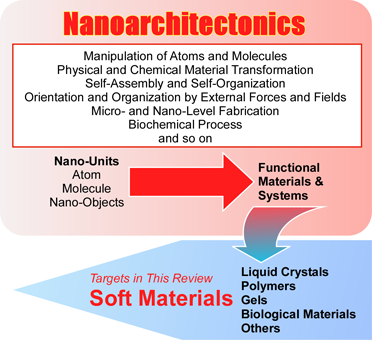
- [120], fulfils this role. Similarly as Richard Feynman established the foundations of nanotechnology in the mid-20th century [121][122], Masakazu Aono proposed the concept of nanoarchitectonics [123][124] at the threshold between the 20th and 21st centuries. Nanoarchitectonics can be defined as the
- conductivity. However, above the percolation threshold, the additive particles begin to overlap, resulting in the formation of isolated, disordered interfaces and an increase in the volume of less conductive material. Accordingly, the highest value of ionic conductivity is observed at moderate concentrations






Time-resolved probing of laser-induced nanostructuring processes in liquids
Beilstein J. Nanotechnol. 2025, 16, 968–1002, doi:10.3762/bjnano.16.74
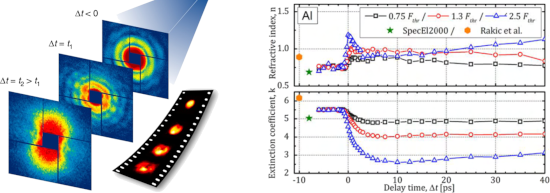
- further until the evaporation threshold is reached. Evaporation again requires additional energy to overcome heat of fusion. Only evaporation can lead to expulsion of material and formation of clusters in this context via condensation of the vapor. Further processes that will be described in the laser
- to both positive and negative transmission changes, as shown in Figure 8C. Therefore, TAS at this point is no longer an unambiguous probe for the resolution of such effects [131]. Nevertheless, the bubble formation as a threshold process can still be identified through the characteristic change in
- formation threshold as well as bubble sizes [125][128]. Figure 8F shows that bubble size growth with laser fluence can be extracted with good correlation to X-ray results (Figure 8G). Structure formation, such as LAL or LFL in NP colloids and on surfaces, involves all steps of particle heating, melting


Synthesis of a multicomponent cellulose-based adsorbent for tetracycline removal from aquaculture water
Beilstein J. Nanotechnol. 2025, 16, 728–739, doi:10.3762/bjnano.16.56
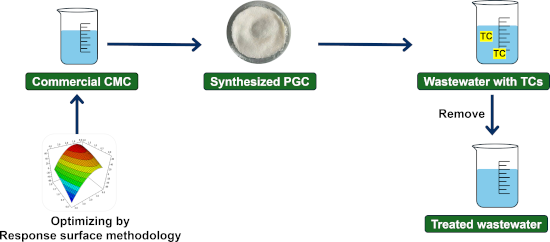
- concentration exceeds this threshold, TC adsorption efficiency declines. This is because higher PVA levels hinder dissolution and mixing, particularly as viscosity increases. Similarly, TC adsorption efficiency also declines as GA concentration increases. At high concentrations, GA can dissolve PVA


Efficiency of single-pulse laser fragmentation of organic nutraceutical dispersions in a circular jet flow-through reactor
Beilstein J. Nanotechnol. 2025, 16, 711–727, doi:10.3762/bjnano.16.55
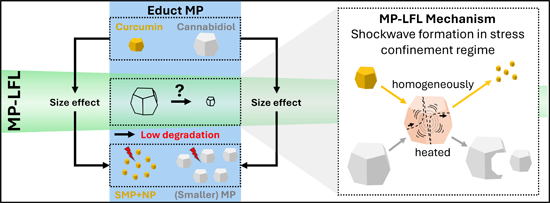
- fluences, which could be explained by NP formation [22][34]. However, this increase in extinction could only be observed once a certain threshold fluence was exceeded. If the laser fluence is further increased above a critical value, degradation can occur due to excessive energy input. Using fullerene C60
- production of ROS are also conceivable. Even though the laser intensities applied at the jet’s entrance (ca. 3·1010 W·cm−2) are one order of magnitude below the irradiance threshold range for the optical breakdown of water (i.e., 4.5·1011 W·cm−2 at 30 ps, 1064 nm [59]), it is difficult to pinpoint to which
- extent such nonlinear, free-electron-generating, radical-promoting effects need to be considered as a contribution to the degradation of the nutraceuticals in our specific setup. On the one hand, it is well-known that the threshold of the Kerr effect is considerably lower in the presence of (inorganic


Feasibility analysis of carbon nanofiber synthesis and morphology control using a LPG premixed flame
Beilstein J. Nanotechnol. 2025, 16, 581–590, doi:10.3762/bjnano.16.45
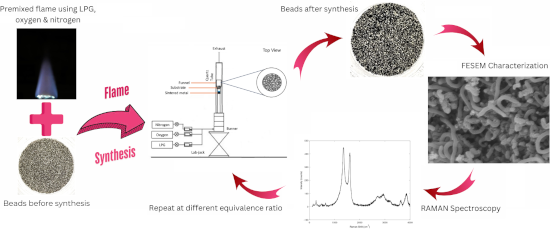
- also contributes to the percolation threshold, which is a fundamental parameter controlling electrical conductivity and crucial for certain applications such as sensors, where accurate modulation is required [9]. An initial work by Naha et al. developed a model to enhance the understanding and



Retrieval of B1 phase from high-pressure B2 phase for CdO nanoparticles by electronic excitations in CdxZn1−xO composite thin films
Beilstein J. Nanotechnol. 2025, 16, 551–560, doi:10.3762/bjnano.16.43

- -based optoelectronic applications [7]. High-energy ion irradiation can lead to latent track formation or phase transitions, either from crystalline to crystalline or crystalline to amorphous, depending on the threshold electronic energy loss (Seth) [8][9]. The formation of latent tracks has been


Performance optimization of a microwave-coupled plasma-based ultralow-energy ECR ion source for silicon nanostructuring
Beilstein J. Nanotechnol. 2025, 16, 484–494, doi:10.3762/bjnano.16.37

- further increases in extraction voltage, the beam current decreases rapidly. Beyond this threshold of 400 V, the increased extraction voltage induces significant defocusing of the ion beam. This highlights the critical role of the extraction voltage in maintaining beam coherence. Generally, the extraction


Size control of nanoparticles synthesized by pulsed laser ablation in liquids using donut-shaped beams
Beilstein J. Nanotechnol. 2025, 16, 407–417, doi:10.3762/bjnano.16.31
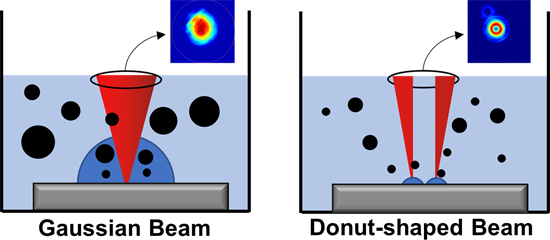
- top-view setup was applied to observe the bubble morphology evolution on a transparent yttrium aluminum garnet (YAG) target. The YAG crystal has a low thermal conductivity and a high laser-ablation threshold, minimizing the influence of the ablation products on cavitation bubble dynamics and, thus
- NPs per characterized sample were analyzed for every single experiment performed. The tendencies can be explained by the fact that a donut-shaped beam avoids overheating in the center of the laser spot and prevents underheating in the peripheral region with temperatures below the ablation threshold


Development of a mucoadhesive drug delivery system and its interaction with gastric cells
Beilstein J. Nanotechnol. 2025, 16, 371–384, doi:10.3762/bjnano.16.28

- onto the wells (input). Statistical analysis Statistical differences among the study groups in in situ mucoadhesion measurements, PAS stain assay, and internalization studies were assessed by Student’s t-tests. The significance threshold was p ≤ 0.05. The statistical differences among the groups of


Pulsed laser in liquid grafting of gold nanoparticle–carbon support composites
Beilstein J. Nanotechnol. 2025, 16, 349–361, doi:10.3762/bjnano.16.26
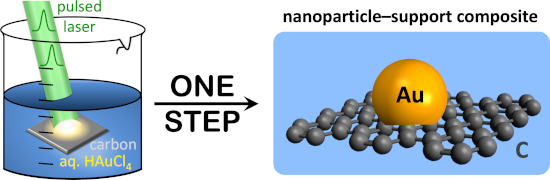
- nanosecond pulses, graphite has an effective absorption coefficient of 5 µm−1 [26], resulting in an ablation threshold fluence of 0.7 J·cm−2 [27]; thus, our chosen fluence was well below this ablation threshold. The critical melting fluence of graphite has been reported to be 0.13 J·cm−2 [28], suggesting


Tailoring of physical properties of RF-sputtered ZnTe films: role of substrate temperature
Beilstein J. Nanotechnol. 2025, 16, 333–348, doi:10.3762/bjnano.16.25
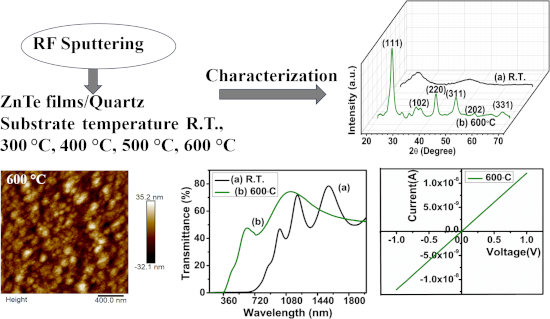
- leads to a reduction in microstrain and dislocation density. The optical studies using UV–vis–NIR spectroscopy reveal that the transmittance of films increases with substrate temperature. Further, the shift in transmittance threshold towards lower wavelengths with substrate temperature indicates that




Recent advances in photothermal nanomaterials for ophthalmic applications
Beilstein J. Nanotechnol. 2025, 16, 195–215, doi:10.3762/bjnano.16.16
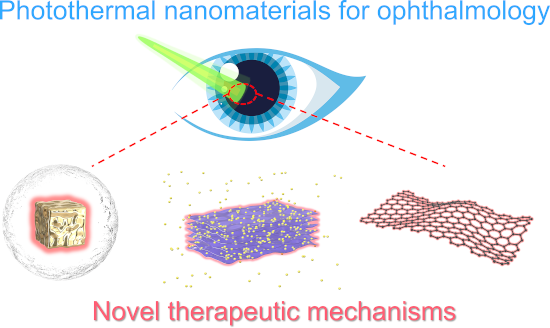
- circularly polarized laser pulses, drastically reducing cell viability to about 10%. This targeted approach ensures that the laser energy remains below the threshold that could damage healthy cells, and the thermal field is efficiently confined to a 10 nm range around the cancer cells, thereby sparing


Probing the potential of rare earth elements in the development of new anticancer drugs: single molecule studies
Beilstein J. Nanotechnol. 2025, 16, 187–194, doi:10.3762/bjnano.16.15
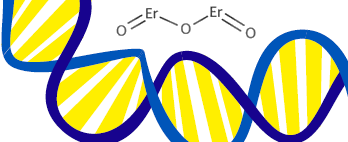
- certain threshold concentration (≈0.04 μM) and then decays abruptly, indicating that a strong DNA compaction process has occurred [25][26][27][28]. A similar DNA compaction was also found for neodymium at higher concentrations (>0.5 μM), but not for ytterbium. In Figure 2, we show the corresponding
- trivalent rare earth cations can interact with the double helix, promoting the well-known cation-induced DNA condensation process, just as other polycations such as, for example, spermidine and hexaammine cobalt [29][31]. Note that the threshold concentration for DNA condensation to occur depends strongly
- . For ytterbium and neodymium, this mechanical parameter remains constant. In the case of erbium, the behavior is different. The contour length remains initially constant until reaching a certain threshold concentration (≈0.04 μM) and then decays abruptly, indicating that a strong DNA compaction process


A review of metal-organic frameworks and polymers in mixed matrix membranes for CO2 capture
Beilstein J. Nanotechnol. 2025, 16, 155–186, doi:10.3762/bjnano.16.14




Mechanistic insights into endosomal escape by sodium oleate-modified liposomes
Beilstein J. Nanotechnol. 2024, 15, 1667–1685, doi:10.3762/bjnano.15.131
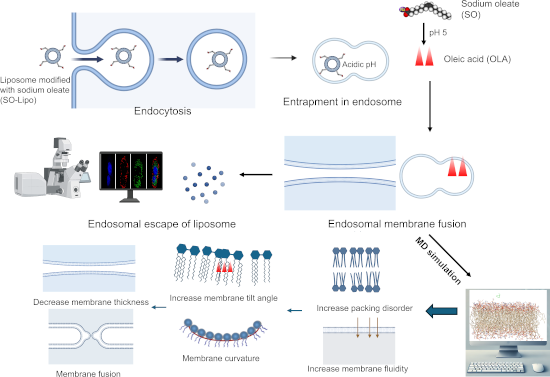
- of 500 µM, the cell viability slightly decreased, approaching significance (p = 0.051), indicating a potential threshold where lipid concentration may begin to impact cell viability. Significant cytotoxicity was observed at higher concentrations (1000 and 2000 µM) with p-values of 0.003 and <0.001




Facile synthesis of size-tunable L-carnosine-capped silver nanoparticles and their role in metal ion sensing and catalytic degradation of p-nitrophenol
Beilstein J. Nanotechnol. 2024, 15, 1576–1592, doi:10.3762/bjnano.15.124
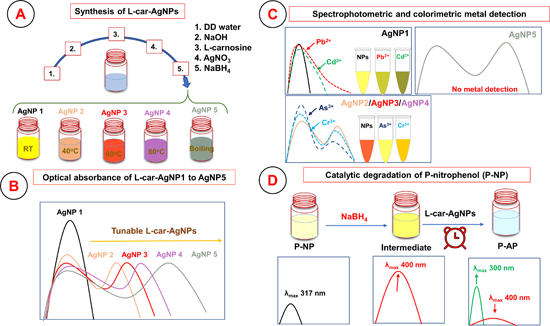
- the potential of gelatine-embedded silver nanoparticles in the degradation of P-NP, but it was not used for heavy metal ion sensing [17]. Similarly, citrate-stabilized silver nanospheres were used for the colorimetric detection of Ni2+ with a threshold limit of 0.75 mM without any catalytic activity