


Search results
Search for "electrodes" in Full Text gives 617 result(s) in Beilstein Journal of Nanotechnology. Showing first 200.
Out-of-plane polarization induces a picosecond photoresponse in rhombohedral stacked bilayer WSe2
Beilstein J. Nanotechnol. 2024, 15, 1362–1368, doi:10.3762/bjnano.15.109
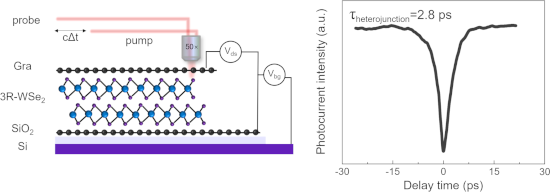
- monolayers of WSe2 were aligned at a 0° angle to form the 3R phase. The graphene/3R WSe2/graphene heterojunctions were aligned and assembled onto a SiO2/Si substrate by the all-dry transfer method. Au/Cr (50/10 nm) electrodes were patterned using standard electron-beam lithography (EBL, Raith 150 Two) and


New design of operational MEMS bridges for measurements of properties of FEBID-based nanostructures
Beilstein J. Nanotechnol. 2024, 15, 1273–1282, doi:10.3762/bjnano.15.103
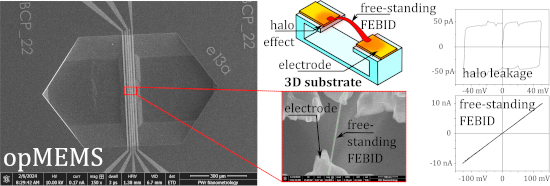
- floor for the smallest deflections. In addition to the above parameters, the resistances of the actuation and measurement lines were measured to be 340 and 450 Ω, respectively. The opMEMS bridge was then milled to obtain four coincident electrodes in the RoI (Figure 5) with the following FIB parameters
- importantly, our opMEMS already integrates four measurement lines, with the ability to expand to six or eight separate electrodes in the RoI. This encourages us to think of opMEMS as an experimental platform for more complex measurements than a simple two-line connection case. In the future, we will pursue


Quantum-to-classical modeling of monolayer Ge2Se2 and its application in photovoltaic devices
Beilstein J. Nanotechnol. 2024, 15, 1153–1169, doi:10.3762/bjnano.15.94
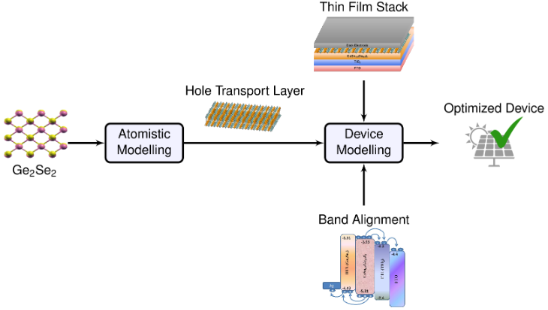
- , a large number of materials have been reported as ETLs/HTL materials, such as carbon [15], copper iodide [16], CuSbS2, NiO, CuSCN [17], ZnO, and CdS [18]. These materials promote efficient extraction of charge carriers and suppress recombination between the perovskite film and the electrodes. But in
- coating between the absorber and substrate/electrodes in the design of solar cells. Device Modeling The high carrier mobility, optimum bandgap, and suitable optical characteristics of monolayer Ge2Se2 as discussed in the previous section, further motivated us to design a photovoltaic solar cell using




Effect of wavelength and liquid on formation of Ag, Au, Ag/Au nanoparticles via picosecond laser ablation and SERS-based detection of DMMP
Beilstein J. Nanotechnol. 2024, 15, 1054–1069, doi:10.3762/bjnano.15.86

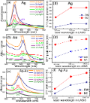
- laser ablating Au/Fe multilayers with varying thicknesses and deposition orders. Jakobi et al. [26] reported the synthesis of Pt–Ir alloy NPs by femtosecond laser ablation of a Pt9Ir target in acetone and further utilized as PtIr electrodes. In recent years, laser-ablated NPs/NSs have gained prominent


Bolometric IR photoresponse based on a 3D micro-nano integrated CNT architecture
Beilstein J. Nanotechnol. 2024, 15, 1030–1040, doi:10.3762/bjnano.15.84
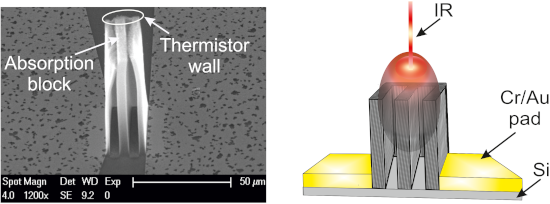
- CNT thermistor wall stabilized by complementary CNT block structures. Two strategically positioned metal electrodes on the Si substrate provide lateral contacts with the vertical CNT bolometer, facilitating effective resistance measurements. Importantly, this CNT structure exhibits remarkable thermal


Recent progress on field-effect transistor-based biosensors: device perspective
Beilstein J. Nanotechnol. 2024, 15, 977–994, doi:10.3762/bjnano.15.80
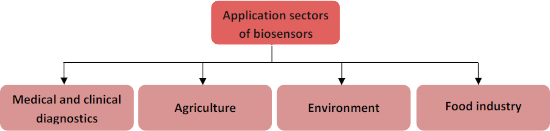
- increasing their use in daily life [38]. The first ion-sensitive field-effect transistor (IS FETs) biosensor combined the metal–oxide–semiconductor (MOS) structure with glass electrodes for measuring ion activities in electrochemical and biological environments [39]. Subsequently, hydrogen-sensitive MOSFET
- biorecognition layer, a transducer, and an amplifier (Figure 2). It typically consists of a semiconductor channel and three terminal electrodes named drain, source, and gate [37][49]. The biorecognition layer selectively binds the target biomolecule (analyte), such as enzymes, antibodies, and proteins in a
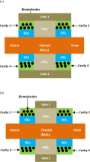
- real-time biosensing applications. Figure 13 shows the schematic view of a DC DG JL MOSFET-based biosensor. In this structure, double cavities were created in each side of the device between the gate electrodes and the dielectric SiO2 layer, and also separated with a Si3N4 dielectric region targeting




Synthesis of silver–palladium Janus nanoparticles using co-sputtering of independent sources: experimental and theorical study
Beilstein J. Nanotechnol. 2024, 15, 808–816, doi:10.3762/bjnano.15.67
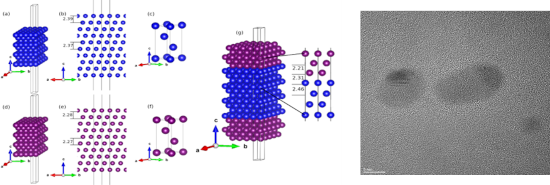
- –palladium alloyed nanocrystals are currently materials of high interest in electronics, specifically because they can be used in the building of electrodes for multilayer ceramic capacitors, exhibiting better thermal performance than silver nanocrystals, partly, because Pd has a relatively high critical




Simultaneous electrochemical determination of uric acid and hypoxanthine at a TiO2/graphene quantum dot-modified electrode
Beilstein J. Nanotechnol. 2024, 15, 719–732, doi:10.3762/bjnano.15.60
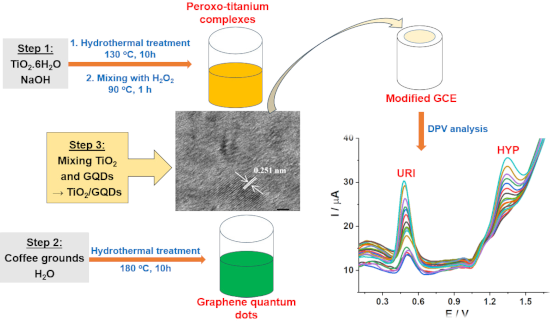
- , cost-effectiveness, and reliability. The use of modified electrodes has shown to improve significantly electrocatalytic activity and electrical conductivity of electrodes. Graphene, with sp2-hybridized carbon atoms in a single layer, has gained much attention because of its unique physicochemical
- electrodes used in electrochemical analysis. To the best of our knowledge, there are only few reports on TiO2/GQDs for electrochemical analysis. In the present work, TiO2/GQDs were prepared from coffee grounds and peroxo titanium complexes by a hydrothermal process. The simultaneous determination of URI and
- contain C (30.6%), O (55.3%), and Ti (14.1%), evenly distributed across the sample. This is in agreement with the XRD, Raman, and HRTEM observations. Simultaneous voltammetric determination of uric acid (URI) and hypoxanthine (HYP) Cyclic voltammetric behavior of different electrodes The cyclic


Reduced subthreshold swing in a vertical tunnel FET using a low-work-function live metal strip and a low-k material at the drain
Beilstein J. Nanotechnol. 2024, 15, 713–718, doi:10.3762/bjnano.15.59
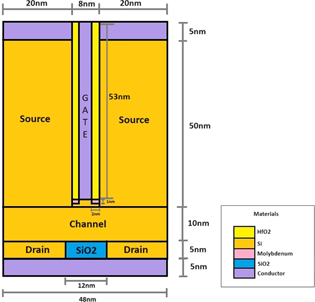
- Miller capacitance. Impact of dielectric materials on gate source and gate–drain capacitance The interelectrode capacitance is caused by the dielectric material of the gate. By applying a potential between the capacitor’s electrodes, the charges are polarized [9]. The capacitance of a parallel-plate


Stiffness calibration of qPlus sensors at low temperature through thermal noise measurements
Beilstein J. Nanotechnol. 2024, 15, 580–602, doi:10.3762/bjnano.15.50
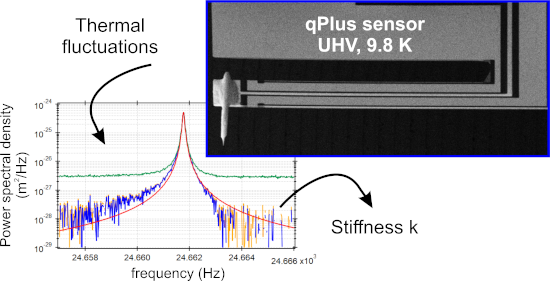
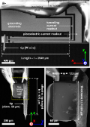
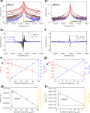
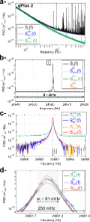
- , the technique mostly employs QTFs, based on the so-called qPlus design, which actually covers different types of sensors in terms of size and design of the electrodes. They all have in common a QTF featuring a metallic tip glued at the free end of one of its prongs. In this study, we report the
- ring electrode for mechanical excitation. The QTF surface features a set of three metallic electrodes evaporated on it. Their chemical composition has been characterized by EDS as consisting of a ≃200 nm thick layer of Au on a thinner chromium layer to favor the adhesion and wetting of Au. The massive

Heat-induced morphological changes in silver nanowires deposited on a patterned silicon substrate
Beilstein J. Nanotechnol. 2024, 15, 435–446, doi:10.3762/bjnano.15.39
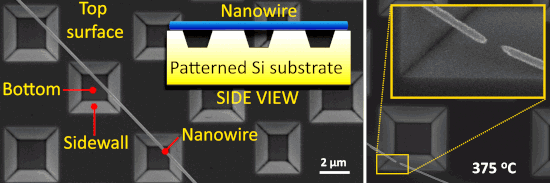
- , and characterization of such materials [9][10]. Silver NWs are among the most extensively studied materials for NW-based transparent electrodes. High-quality Ag NWs can be synthesized relatively easily in large quantities, with precise control over their length and diameter [11][12]. Compared to


Modulated critical currents of spin-transfer torque-induced resistance changes in NiCu/Cu multilayered nanowires
Beilstein J. Nanotechnol. 2024, 15, 360–366, doi:10.3762/bjnano.15.32
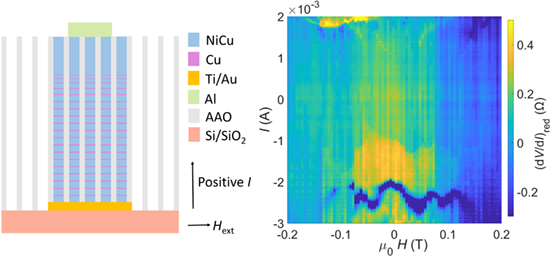
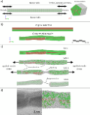
- Discussion The AAO template was fabricated by directly anodizing a ca. 1 µm thick aluminum (Al) film on a silicon (Si) substrate covered with 200 nm SiO2 and patterned Ti/Au (5/50 nm) bottom electrodes. It has pores with a diameter of around 35 nm, an interpore distance of around 50 nm, and a height of
- around 1 µm. The electrodeposition of multilayered nanowires was carried out in situ using a three-electrode potentiostat in the pulsed mode [20] at 25 °C. Note that the nanowires were selectively deposited in the pores on the top of the Ti/Au bottom electrodes as shown in Figure 1a. Therefore, most of
- the surface area of the AAO template (or Si substrate) is isolated from the bottom electrodes and the magnetic nanowires, thereby largely improving the flexibility for the design of the top electrodes. After removing the overgrowth by a thin blade or milling in argon plasma, a thick Al film of 180 nm


Controllable physicochemical properties of WOx thin films grown under glancing angle
Beilstein J. Nanotechnol. 2024, 15, 350–359, doi:10.3762/bjnano.15.31
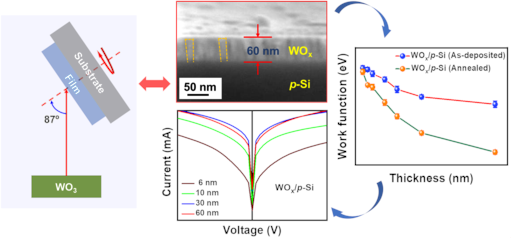
- heterostructures were performed by preparing Ag electrodes (1 mm diameter) on top of the WOx films and p-Si substrates. The I–V data were acquired by applying DC voltage sweeps (−1 V→0 V→+1 V) using a Keithley source meter (Model 2400, Tektronix, USA) in a sandwiched configuration. During the measurements, the


Ultrasensitive and ultrastretchable metal crack strain sensor based on helical polydimethylsiloxane
Beilstein J. Nanotechnol. 2024, 15, 270–278, doi:10.3762/bjnano.15.25
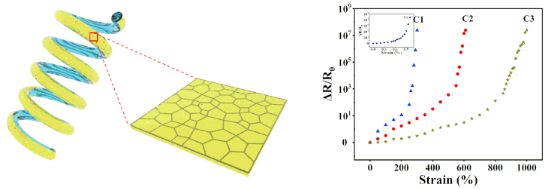
- wires as electrodes on both sides of the helical polydimethylsiloxane. Fabrication of the metal crack strain sensor The helical structure of PDMS was achieved by utilizing a screw as a mold, as depicted in Figure 5. To ensure the absence of bubbles within the grooves of the screw, a precisely fitting


CdSe/ZnS quantum dots as a booster in the active layer of distributed ternary organic photovoltaics
Beilstein J. Nanotechnol. 2024, 15, 144–156, doi:10.3762/bjnano.15.14
- CPE (CPE-T) is responsible for the polarization of the sample in various areas of the material structure and on the electrodes. The mechanisms of ionic or electronic conductivity are represented by the resistance R [54]. Substitute systems with nanodots QD520:P3HT:PC71BM, QD580:P3HT:PC71BM, and QD600
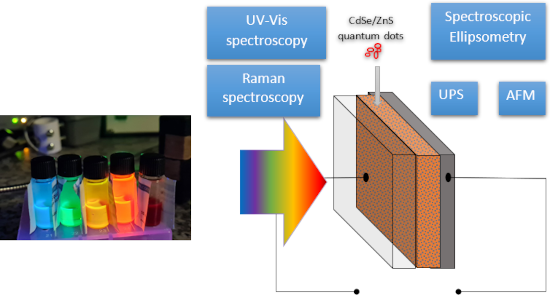
- diagram of a potential solar cell with aluminum and indium tin oxide (ITO) electrodes is presented in Figure 10. The HOMO was determined using the UPS spectrum of the valence bands for all samples. The lowest unoccupied molecular orbital (LUMO) was determined by subtracting the energy gap from the HOMO




In situ optical sub-wavelength thickness control of porous anodic aluminum oxide
Beilstein J. Nanotechnol. 2024, 15, 126–133, doi:10.3762/bjnano.15.12
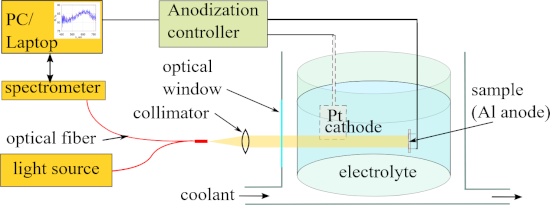
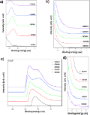
- heating, electrolyte flow [19], arrangement of the electrodes, and crystallographic orientation of the aluminum substrate [20]. In this work, we continuously recorded the reflectance spectra from a PAAO-coated aluminum surface during anodization. In a similar reflective interference spectroscopy (RIfS


Influence of conductive carbon and MnCo2O4 on morphological and electrical properties of hydrogels for electrochemical energy conversion
Beilstein J. Nanotechnol. 2024, 15, 57–70, doi:10.3762/bjnano.15.6
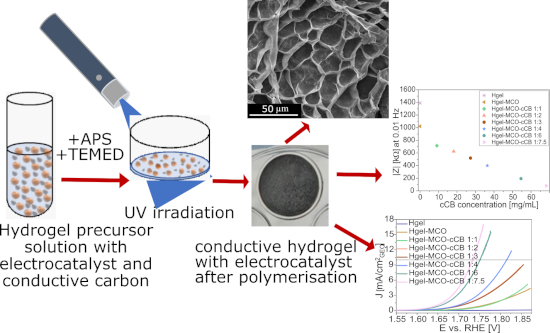
- hydrogel structure. The changes are within the range of 79.7–1390.5 kΩ at 0.01 Hz and 3.5–18.6 kΩ at 1 Hz. The trend of the electrochemical impedance spectroscopy (EIS) results shows the capacitive-dominant nature of the hydrogel for all analysed hydrogel-based electrodes. Three different regions were
- , 9.26 mF/cm2, and 4.38 mF/cm2, respectively, for , , and electrodes [56], but with four times higher catalyst loading. The catalytic kinetics of the hydrogel samples showed a much lower Tafel slope value for pure hydrogel (141 mV/dec) than those obtained for the hydrogel with catalyst and conductive
- . Table 2 compares the results obtained for the hydrogel samples investigated by us with the data of hydrogel-based electrodes obtained by other scientific groups. Comparing the overpotential values obtained by us and data obtained by other groups for hydrogel electrodes with various types of


Josephson dynamics and Shapiro steps at high transmissions: current bias regime
Beilstein J. Nanotechnol. 2024, 15, 51–56, doi:10.3762/bjnano.15.5
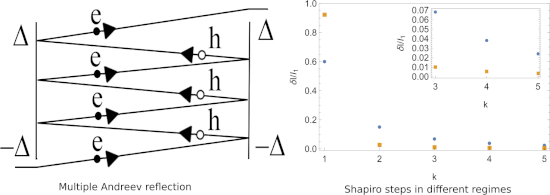
- ) electrodes is kept much shorter than the superconducting coherence length, that is, d ≪ ξ0 ∼ vF/Δ. Here, Δ is the absolute value of the order parameter in superconducting electrodes and vF denotes the Fermi velocity. For simplicity here and below, we set the Planck and Boltzmann constants equal to unity (ℏ


Spatial variations of conductivity of self-assembled monolayers of dodecanethiol on Au/mica and Au/Si substrates
Beilstein J. Nanotechnol. 2023, 14, 1169–1177, doi:10.3762/bjnano.14.97
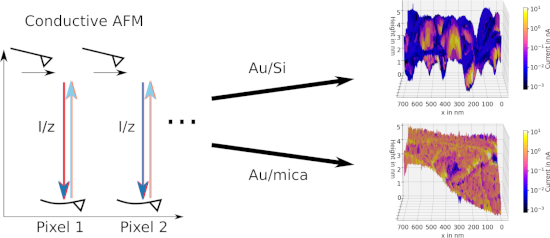
- ][3] has always held a central role, as the flexibility and control over the structure of molecules is unmatched. One of the fundamental parts of devices employing a bottom-up approach combined with molecular electronics is comprised of metal electrodes and molecular layers deposited onto them. For


A multi-resistance wide-range calibration sample for conductive probe atomic force microscopy measurements
Beilstein J. Nanotechnol. 2023, 14, 1141–1148, doi:10.3762/bjnano.14.94
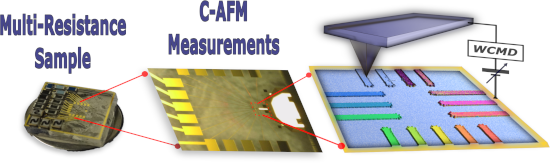
- voltage between −1 V and +1 V. This approach mitigates the difficulties related to surface contamination on the gold electrodes during scanning. Resistance values for each electrode arm were determined from the slopes of the I–V straights using a regression model. For each value, the coefficient of
- effect is currently under thorough investigations for a future publication. Accordingly, a new set of images was acquired for the electrodes i = 3 to i = 15 at two bias voltages of +1 V and −1 V, and the corresponding resistance value was determined by their mean value. For each electrode, this imaging


Spatial mapping of photovoltage and light-induced displacement of on-chip coupled piezo/photodiodes by Kelvin probe force microscopy under modulated illumination
Beilstein J. Nanotechnol. 2023, 14, 1059–1067, doi:10.3762/bjnano.14.87
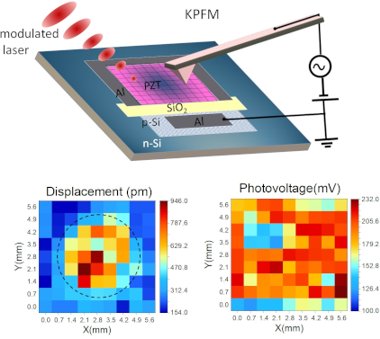
- zirconate titanate (PZT), was integrated onto a silicon photodiode. The PZT layer was sandwiched between two lanthanum nickelate (LNO) electrodes and ultimately the backside of the silicon substate was etched to enhance the motion of the membrane. More detailed information on the fabrication and cross
- with a diluted BHF:HNO3:H2O solution and a HCl solution, respectively. To avoid shunting of the device, a SiO2 insulating layer was deposited. Patterned aluminum (Al) contacts which connect to the top and bottom electrodes of the PBZT were fabricated through a lift-off process. The fabrication was
- waveform voltage at an adjustable frequency, operated through a function generator (GWInstek, SFG-1013). Here, the selected modulation frequency was 1 Hz. It should be noted that the active area of the device stack of piezoelectric layer (PZT) and LNO electrodes is transparent and thus the incoming light


A visible-light photodetector based on heterojunctions between CuO nanoparticles and ZnO nanorods
Beilstein J. Nanotechnol. 2023, 14, 1018–1027, doi:10.3762/bjnano.14.84
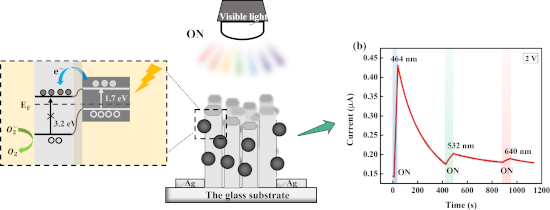
- relations under reverse and bias voltages, indicating a good ohmic contact between semiconductor materials and Ag electrodes [42]. It is worth noting that the current rise corresponds to the light intensity increase. The highest photocurrent reached 18 μA under a light illumination of 1.28 mW·cm−2. The low
- , increasing the visible-light intensity promotes more excited electrons in the conduction band (CB) of CuO NPs. These electrons transfer to the CB of ZnO NRs and increase the photocurrent collected by the Ag electrodes. Response time and recovery are essential when evaluating a photodetector’s performance
- the Ag electrodes and generate the photocurrent, while holes accumulate near the surface of ZnO NRs to desorb ionized oxygen and release gaseous oxygen: Conclusion In this report, a visible-light photodetector based on CuO NPs/ZnO NRs was fabricated by simple and time-saving methods. Spherical CuO


Ni, Co, Zn, and Cu metal-organic framework-based nanomaterials for electrochemical reduction of CO2: A review
Beilstein J. Nanotechnol. 2023, 14, 904–911, doi:10.3762/bjnano.14.74

- converting individual MOFs into MOF-derived carbon-support nanomaterials. Another issue is the durability of the working electrodes. Many studies have employed drop casting and the use of binders to affix MOFs onto the substrate for electrode fabrication. This approach presents drawbacks such as reduced
- accessibility to active sites and unstable MOFs/substrate interfaces. Therefore, further studies are required to develop binder-free electrodes by in situ synthesis of MOFs on conductive substrates, such as nickel foam, copper foil, and carbon cloth, to overcome the aforementioned limitations and advancing the


A wearable nanoscale heart sound sensor based on P(VDF-TrFE)/ZnO/GR and its application in cardiac disease detection
Beilstein J. Nanotechnol. 2023, 14, 819–833, doi:10.3762/bjnano.14.67
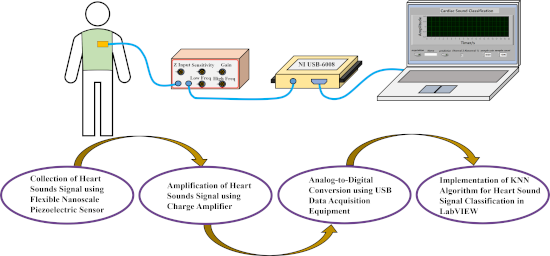
- signal, which is then amplified by the power amplifier and delivered to the speaker to convert the electrical signal into an acoustic signal. A flexible nanoscale heart sound sensor is placed 1 cm above the speaker, and its electrodes are connected to the charge amplifier and then to the oscilloscope


In situ magnesiothermic reduction synthesis of a Ge@C composite for high-performance lithium-ion batterie anodes
Beilstein J. Nanotechnol. 2023, 14, 751–761, doi:10.3762/bjnano.14.62
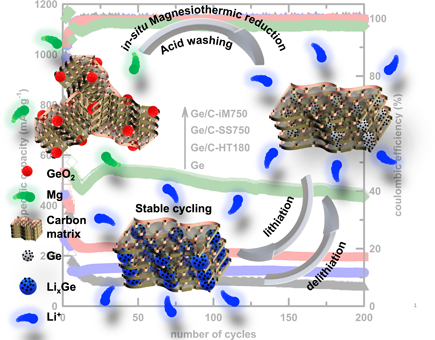
- , is a possible alternative for graphite electrodes due to its high theoretical capacity of 1623 mAh·g−1 (four times higher than that of graphite) and good rate performance due to high electronic (2.1 S·m−1, 1 × 10⁴ times higher than that of silicon) and ionic (6.51 × 10⁻¹² cm2·s−1, 400 times higher
- than Si at room temperature) conductivity [14]. However, electrodes based on alloying suffer from deterioration during repeated lithiation/delithiation because of the large variation in volume. Despite the lower volume change ratio compared to Si (370% for Ge and 400% for Si) and the structural
- nanoparticles and a carbon matrix using a hydrothermal route has been reported, and the enhancement in the electrochemical performance of Ge@C electrodes was demonstrated [33]. In this work, a one-pot synthesis route has been followed to prepare a Ge@C composite using an in situ magnesiothermic reduction of





