Search results
Search for "hybrid materials" in Full Text gives 108 result(s) in Beilstein Journal of Nanotechnology.
Size-selected Fe3O4–Au hybrid nanoparticles for improved magnetism-based theranostics
Beilstein J. Nanotechnol. 2018, 9, 2684–2699, doi:10.3762/bjnano.9.251
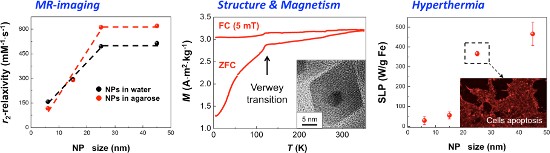
- MS values) is not reached, an additional stabilization by agarose seems to play a decisive role for significantly enhanced r2 values [57]. This means that the effectiveness of the hybrid materials as contrast agents increases under in vitro and in vivo operational conditions. Magnetic hyperthermia
- as compared to the hybrids in water or agarose in line with previous cell culture experiments [85]. Here, we focus on the hyperthermia function of the hybrid materials in the same cell line. For this purpose, polymer-coated MNP-25 NPs were dispersed in RPMI medium at 3.6 mg·mL−1 Fe concentration


Nanocellulose: Recent advances and its prospects in environmental remediation
Beilstein J. Nanotechnol. 2018, 9, 2479–2498, doi:10.3762/bjnano.9.232
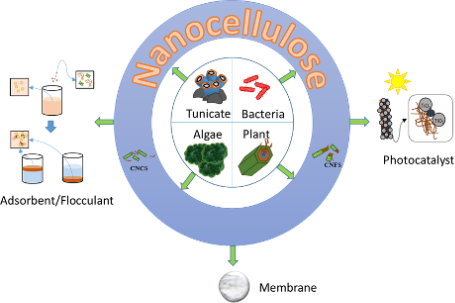
- nanostructures in the form of thin film, membrane, fibre and hybrid materials under UV and visible light irradiation. Nanocellulose–metal oxide (TiO2, ZnO, graphene oxide, and Fe2O3) composites have been used as photocatalysts to improve the degradation rate of organic pollutants as compared to individual


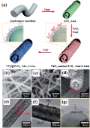
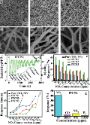
Electrospun one-dimensional nanostructures: a new horizon for gas sensing materials
Beilstein J. Nanotechnol. 2018, 9, 2128–2170, doi:10.3762/bjnano.9.202






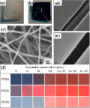
Facile phase transfer of gold nanorods and nanospheres stabilized with block copolymers
Beilstein J. Nanotechnol. 2018, 9, 616–627, doi:10.3762/bjnano.9.58
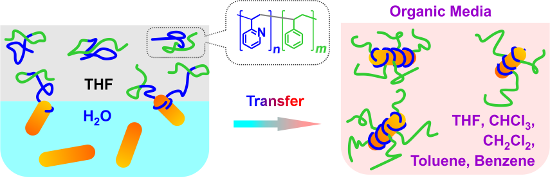
- copolymers doped with noble metal nanoparticles are considered as promising hybrid materials that combine the plasmonic, catalytic or other functionality of nanoparticles, their periodic spatial arrangement in the microphase separated copolymer domains and the general processability of polymer matrices [3][4



Liquid-crystalline nanoarchitectures for tissue engineering
Beilstein J. Nanotechnol. 2018, 9, 205–215, doi:10.3762/bjnano.9.22
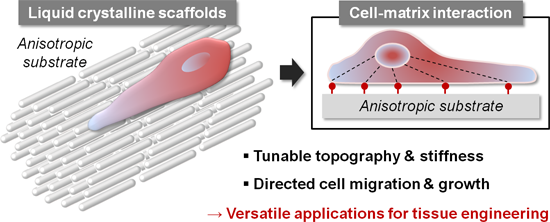
- local alignments, which resulted in directed and oriented growth of human mesenchymal stem cells and their osteogenic differentiation [105]. Additionally, biomineralization-mimicking hybrid materials, using chitin nanowhisker gel matrices in a nematic phase as templates for CaCO3 crystallization, have


Bombyx mori silk/titania/gold hybrid materials for photocatalytic water splitting: combining renewable raw materials with clean fuels
Beilstein J. Nanotechnol. 2018, 9, 187–204, doi:10.3762/bjnano.9.21
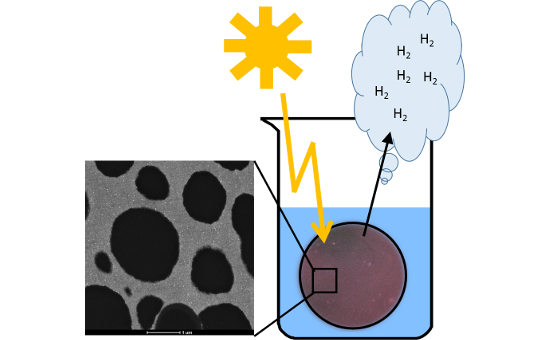
- Giessen, Germany Department of Chemistry and CQ-VR, University of Trás-os-Montes e Alto Douro, Pt-5001-801 Vila Real, Portugal 10.3762/bjnano.9.21 Abstract The synthesis, structure, and photocatalytic water splitting performance of two new titania (TiO2)/gold(Au)/Bombyx mori silk hybrid materials are
- resulting slightly yellow solid was purified via solvent exchange with EtOH/H2O (1:1 v/v), EtOH/H2O (3:7 v/v) each for at least 8 h at 60 °C, and finally with water for 24 h. Step 5: When a modification with AuNP was desired, the as-prepared wet silk/TiO2 hybrid materials obtained in step 4 were stored in
- washed three times with 50 mL of water at room temperature. Characterization Samples for all transmission electron microscopy (TEM) investigations were prepared as follows: small pieces (ca. 2 mm2) of the wet hybrid materials were immersed in a 3% glutaraldehyde solution in 0.1 M phosphate buffer (pH 7




One-step chemical vapor deposition synthesis and supercapacitor performance of nitrogen-doped porous carbon–carbon nanotube hybrids
Beilstein J. Nanotechnol. 2017, 8, 2669–2679, doi:10.3762/bjnano.8.267
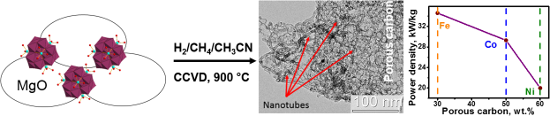
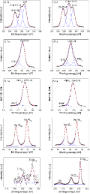
- , 630090 Novosibirsk, Russia, Institute of Coal Chemistry and Materials Science FRC CCC SB RAS, Kemerovo 650000, Russia 10.3762/bjnano.8.267 Abstract Novel nitrogen-doped carbon hybrid materials consisting of multiwalled nanotubes and porous graphitic layers have been produced by chemical vapor deposition
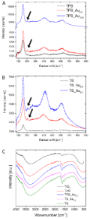
- concentration of incorporated nitrogen. The hybrid materials were tested as electrodes in a 1M H2SO4 electrolyte and the best performance was found for a nitrogen-enriched material produced using the Fe/Mo catalyst. From the electrochemical impedance spectroscopy data, it was concluded that the nitrogen doping
- (CNTs) or fibers in an electrode material [4][5]. A typical synthesis procedure for carbon–carbon hybrid materials includes the mechanical mixing of the components, previously synthesized separately by different methods (ex situ synthesis). The mixing is usually carried out in a solvent, but since


Patterning of supported gold monolayers via chemical lift-off lithography
Beilstein J. Nanotechnol. 2017, 8, 2648–2661, doi:10.3762/bjnano.8.265
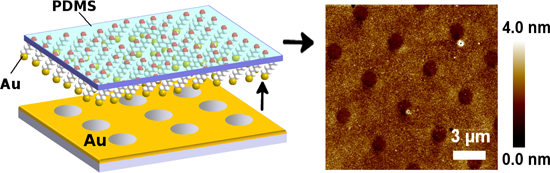
- variables on CLL and the structure and functionality of the resulting hybrid materials. Further development of CLL has significant potential for fabricating sensors, biocompatible platforms, and other applications that will benefit from flexible, transparent, bio-inert materials combined with the extensive


Synthesis of metal-fluoride nanoparticles supported on thermally reduced graphite oxide
Beilstein J. Nanotechnol. 2017, 8, 2474–2483, doi:10.3762/bjnano.8.247
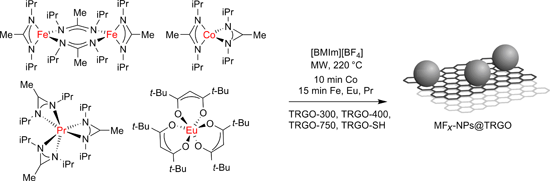
- good base material for obtaining highly loaded nanoparticle–graphene hybrid materials, because of its surface functionalization [80]. A distinct possibility is the formation of hydrogen bonds between the metal-fluoride nanoparticles and the hydroxyl groups at the TRGO surface. Batteries based on


Electronic structure, transport, and collective effects in molecular layered systems
Beilstein J. Nanotechnol. 2017, 8, 2094–2105, doi:10.3762/bjnano.8.209
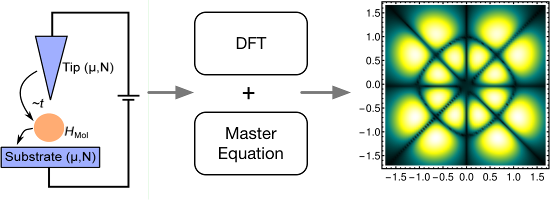
- combined with the strong acceptor molecule F4TCNQ. In general all of the fabricated heterostructures revealed new low-energy optical excitations originating from hybrid states. These states are of special importance for the transport characteristics of the hybrid materials. In contrast to other organic


![[Graphic 29]](/bjnano/content/inline/2190-4286-8-209-i41.png?max-width=637&scale=1.18182) between the occupations nA and nB of the two checkerboard sublattices for a) asy...
between the occupations nA and nB of the two checkerboard sublattices for a) asy...

![[Graphic 30]](/bjnano/content/inline/2190-4286-8-209-i42.png?max-width=637&scale=1.18182) per site for a) asymmetric tunneling, Γtop/Γbottom = 0.5, and b) symmetric tunneli...
per site for a) asymmetric tunneling, Γtop/Γbottom = 0.5, and b) symmetric tunneli...
Functional materials for environmental sensors and energy systems
Beilstein J. Nanotechnol. 2017, 8, 2015–2016, doi:10.3762/bjnano.8.201

- ., nanotubes, graphene-based materials), 2D nanostructures, hybrid materials and their related surface modifications in order to enhance the sensing properties. Particular emphasis was placed on rapidly emerging applications in the sector of air-quality monitoring and energy systems for environmental
- scientific community, policy makers and social networks. The topics of this Thematic Series, based on 23 peer-reviewed articles, includes works on advanced gas sensing semiconducting materials, hybrid materials and nanocomposites for chemical sensing, catalytic sensing materials, metal oxides for chemical
Hybrid nanomaterials: from the laboratory to the market
Beilstein J. Nanotechnol. 2017, 8, 861–862, doi:10.3762/bjnano.8.87
- components of different origin, composition, and individual chemical and physical properties. As a result, some of the most attractive materials for modern technology are materials composed of at least two (and often more) different components – these are known as hybrid materials. Indeed, biological high
- -performance materials such as bone or teeth are organic/inorganic hybrid materials of multiscale hierarchical structure and chemical composition perfectly matched to their respective task. As a result, hybrid materials have been explored for essentially all applications possible. Their chemical composition
- interesting and useful materials have been found. The recent past, however, has seen two developments that are key to the development and application of new, high-performance hybrid materials: (i) a new level of rational design has been reached − many molecular and supramolecular principles of hybrid material
Recombinant DNA technology and click chemistry: a powerful combination for generating a hybrid elastin-like-statherin hydrogel to control calcium phosphate mineralization
Beilstein J. Nanotechnol. 2017, 8, 772–783, doi:10.3762/bjnano.8.80
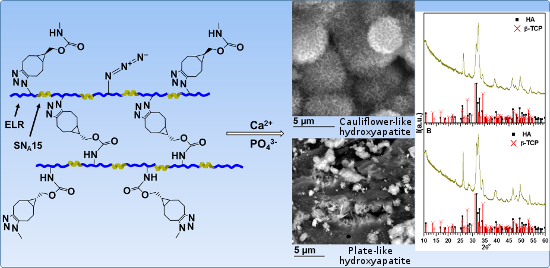
- advanced multifunctional materials. The generation of such multifunctional hybrid materials depends on the properties of their counterparts and the way in which they are assembled. The success of this assembly depends on the different approaches used, such as recombinant DNA technology and click chemistry
- functional performance that can be used for different applications, such as tissue engineering [1]. This perspective can be applied in one of the hottest current research fields, namely control of the formation of calcium phosphate (CP) nanostructures for the generation of biomimetic hybrid materials. Among
- high level of control over mineralization [18][19], including the potential to hierarchically generate structured hybrid materials that may, for example, resemble bone tissue [20]. Although extensive research has been conducted on the mineralization field, it is a challenge to integrate CP nanocrystals



Synthesis of graphene–transition metal oxide hybrid nanoparticles and their application in various fields
Beilstein J. Nanotechnol. 2017, 8, 688–714, doi:10.3762/bjnano.8.74
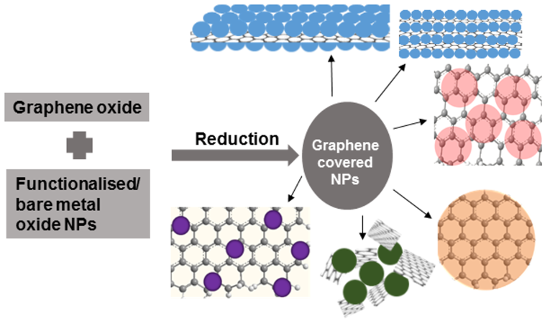
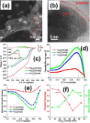
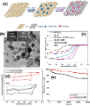
- ) and therefore offers the possibility to fabricate a large variety of graphene–transition metal oxide (TMO) NP hybrids. These hybrid materials are promising alternatives to reduce the drawbacks of using only TMO NPs in various applications, such as anode materials in lithium ion batteries (LIBs
- critical review, we discuss the development of graphene–TMO hybrids with the detailed account of their synthesis. In addition, attention is given to the wide range of applications. This review covers the details of graphene–TMO hybrid materials and ends with a summary where an outlook on future
- perspectives to improve the properties of the hybrid materials in view of applications are outlined. Keywords: graphene; hybrid; nanoparticle; reduced graphene oxide; transition metal oxide; Review Introduction Graphene consists of a single layer of carbon in a two-dimensional (2D) lattice. It is a densely






Methods for preparing polymer-decorated single exchange-biased magnetic nanoparticles for application in flexible polymer-based films
Beilstein J. Nanotechnol. 2017, 8, 408–417, doi:10.3762/bjnano.8.43
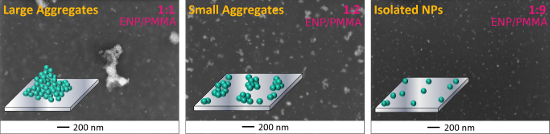
- Polymer-based hybrid materials are opening the way for engineering new, multifunctional, flexible materials exhibiting novel properties (e.g., mechanical, magnetic, electrical, optical) due to the synergy between the two components, polymer and inorganic nanoparticles (NPs) [1]. In the case of magnetic


Association of aescin with β- and γ-cyclodextrins studied by DFT calculations and spectroscopic methods
Beilstein J. Nanotechnol. 2017, 8, 348–357, doi:10.3762/bjnano.8.37
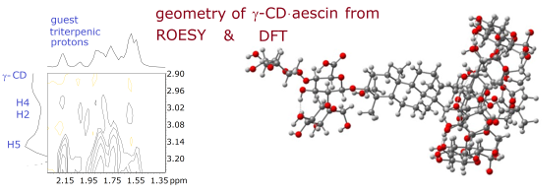
- -up Approaches of Hybrid Materials: Preparation and Design” (26–28 May 2015, Ljubljana, Slovenia) - poster communication “Inclusion of aescin into beta and gamma cyclodextrins”; HINT General Scientific Workshop and Review Meeting (12–14 October 2015, Milan, Italy) – oral communication “Nano


Photocatalysis applications of some hybrid polymeric composites incorporating TiO2 nanoparticles and their combinations with SiO2/Fe2O3
Beilstein J. Nanotechnol. 2017, 8, 272–286, doi:10.3762/bjnano.8.30
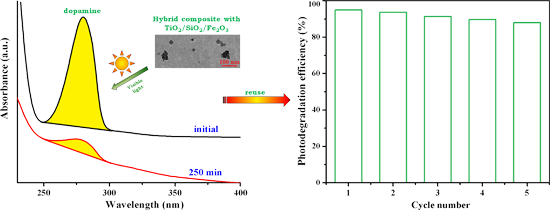
- represented by the characteristic C, O and N peaks, supporting thus the formation of hybrid materials. In addition, the elemental mapping images for titanium, silicon and iron atoms, registered on the SEM images of cross-section of the composite films suggested a relatively uniform distribution of the
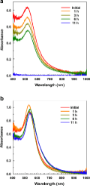
- photodecomposition process of an aqueous solution of phenol (1.06 × 10⁻³ M) in the presence of hybrid materials with TiO2 nanoparticles, pure or combined with SiO2 and/or Fe2O3, was investigated by monitoring the characteristic absorption band of phenol at λ = 270 nm. Figure 6a,b shows the UV–vis absorption spectra


Intercalation and structural aspects of macroRAFT agents into MgAl layered double hydroxides
Beilstein J. Nanotechnol. 2016, 7, 2000–2012, doi:10.3762/bjnano.7.191
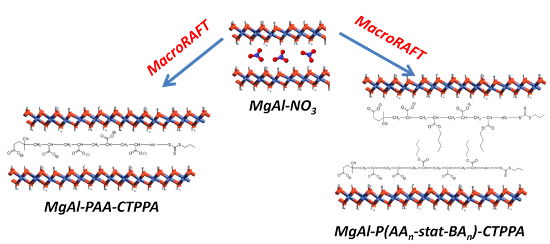
- , BP32229 44322 Nantes cedex 3, France 10.3762/bjnano.7.191 Abstract Increasing attention has been devoted to the design of layered double hydroxide (LDH)-based hybrid materials. In this work, we demonstrate the intercalation by anion exchange process of poly(acrylic acid) (PAA) and three different
- the hybrid phases were further characterized by Fourier transform infrared (FTIR) and solid-state 13C, 1H and 27Al nuclear magnetic resonance (NMR) spectroscopies to get a better description of the local structure. Keywords: hybrid materials; hydrophilic copolymers; intercalation; layered double
- hydroxides; RAFT; solid-state NMR; Introduction Within the emergence of a wide range of organic–inorganic hybrid materials with interesting physical and chemical properties [1], hybrid layered double hydroxides (LDH) have attracted considerable attention in the scientific community [2][3]. LDH matrices are


Organoclay hybrid materials as precursors of porous ZnO/silica-clay heterostructures for photocatalytic applications
Beilstein J. Nanotechnol. 2016, 7, 1971–1982, doi:10.3762/bjnano.7.188
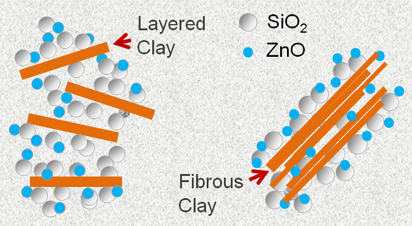
- other ZnO NP, which could be attributed to differences in the NP size [30]. Conclusion We introduced a new family of ZnO/SiO2 porous clay heterostructures synthesized from organoclay hybrid materials the interfaces of which turned out to be especially useful for the growing and assembling of silica and





Effective intercalation of zein into Na-montmorillonite: role of the protein components and use of the developed biointerfaces
Beilstein J. Nanotechnol. 2016, 7, 1772–1782, doi:10.3762/bjnano.7.170
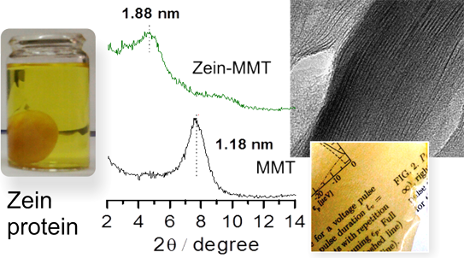
- (typically Na+ and Ca2+) located in the interlayer region [3]. These interlayer cations are exchangeable by treatment with diverse cationic species, being the reason of its extensive use in the development of hybrid materials by ion-exchange intercalation reactions. Since 1950 when Talibudeen reported on the




Graphene-enhanced plasmonic nanohole arrays for environmental sensing in aqueous samples
Beilstein J. Nanotechnol. 2016, 7, 1564–1573, doi:10.3762/bjnano.7.150
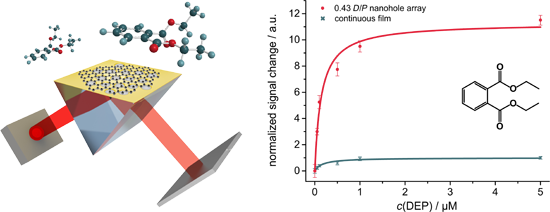
- artificial nose with chemometric analysis of a complex matrix will also offer a possible solution. Therefore, it is expected that hybrid materials consisting of nanostructured gold together with two-dimensional nanomaterials will be attractive in designing new sensor applications based on SPR transduction




A composite structure based on reduced graphene oxide and metal oxide nanomaterials for chemical sensors
Beilstein J. Nanotechnol. 2016, 7, 1421–1427, doi:10.3762/bjnano.7.133
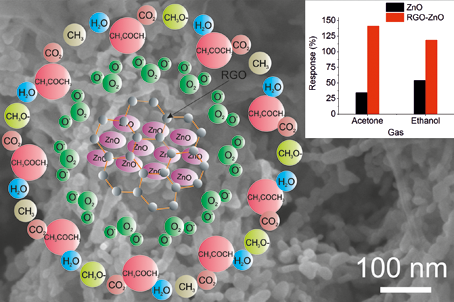
- that both pure ZnO and the hybrid materials exhibit enhanced response kinetics and response amplitudes when the operating temperature is increased. As a result, the best sensing results were obtained at the maximum sensor temperature (250 °C). Figure 4 shows the response and the recovery curves of the


Novel roles for well-known players: from tobacco mosaic virus pests to enzymatically active assemblies
Beilstein J. Nanotechnol. 2016, 7, 613–629, doi:10.3762/bjnano.7.54
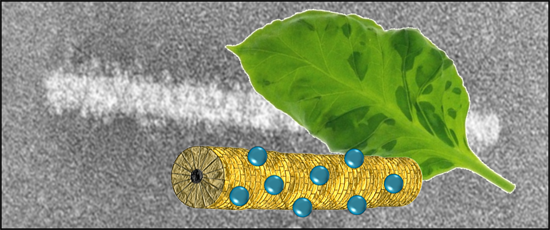
- scaffolding biotemplates in various applications, ranging from biosensing to tumor therapeutics. Hence, in the recent past, the number of reports on the successful construction of advantageous virus-derived hybrid materials and devices has been growing rapidly and reviewed extensively [5][7][8][65][66][67][68
- further examples described in overview articles [70][72][83][84][85][86], antibodies as virus-based tracers [65], immunoadsorbents [87] or molecular stickers [88], to name but a few examples. Much effort is also directed towards the fabrication of nanostructured hybrid materials with improved or novel
- blocks of extended hybrid materials. Reproduced with permission from [6], copyright 2014 Springer. TMV and related tobamoviruses: versatile templates for the construction of biohybrid nanoobjects and nanostructured materials for a wide range of applications exemplified schematically. Among numerous


Hemolysin coregulated protein 1 as a molecular gluing unit for the assembly of nanoparticle hybrid structures
Beilstein J. Nanotechnol. 2016, 7, 351–363, doi:10.3762/bjnano.7.32
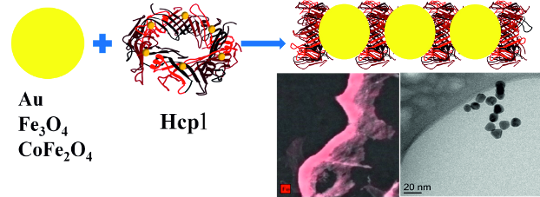
- to a higher squareness value of the hysteresis curve. Thus the Hcp1_cys3 unit is shown to be very versatile in the formation of new biohybrid materials with enhanced magnetic, catalytic and optical properties. Keywords: gold catalyst; hemolysin coregulated protein 1 (Hcp1); magnetic hybrid materials
- of magnetite NPs in the fiber-like structure. The results of the magnetic measurements exhibit similar MR and MS values at room temperature and low temperature for the hybrid material and NPs. The hybrid materials reveal a lower blocking temperature than the blank NPs due to protein incorporation




Nanostructured surfaces by supramolecular self-assembly of linear oligosilsesquioxanes with biocompatible side groups
Beilstein J. Nanotechnol. 2015, 6, 2377–2387, doi:10.3762/bjnano.6.244
- The authors thank the Polish National Science Centre for the financial support within grant DEC-2011/03/B/ST5/02672 ‘‘Studies on preparation and structurization of new hybrid materials’’. We also acknowledge the assistance of Adam Michalski in recording ATR-FTIR spectra.