


Search results
Search for "monodisperse" in Full Text gives 143 result(s) in Beilstein Journal of Nanotechnology.
Study of silica-based intrinsically emitting nanoparticles produced by an excimer laser
Beilstein J. Nanotechnol. 2019, 10, 211–221, doi:10.3762/bjnano.10.19
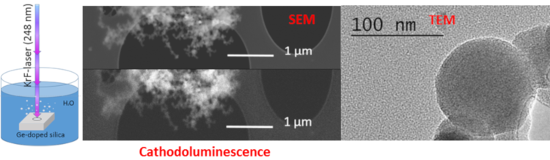
- irradiation. This experimental result indicates that it would be difficult to obtain monodisperse, regularly shape nanoparticles by increasing or decreasing the energy per pulse of a nanosecond pulsed laser with a spot size of millimeters. In the following we consider that the particles of irregular shape are



Mechanism of silica–lysozyme composite formation unravelled by in situ fast SAXS
Beilstein J. Nanotechnol. 2019, 10, 182–197, doi:10.3762/bjnano.10.17
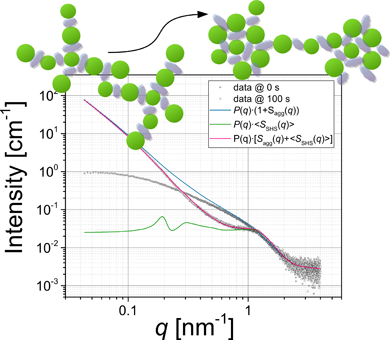
- valid only for a system of ideally monodisperse particles (i.e., the distribution is a delta function), which is actually not the case for the silica NPs used here (Figure 1B). This is an important consideration when including the interparticle interactions from the structure factor. There are several
- approaches to consider the polydispersity of particles together with a structure factor [33], but because the fitted size distribution (histogram in Figure 1B) is discrete with a finite number of n bins a local monodisperse approximation (LMA) [34] is used in our models: where Pp(q,ri) is the form factor of
- system characterized by a monodisperse particle distribution with only a single value of for a given RHS and the resulting Nagg. For a polydisperse distribution, as in our study, although a population of primary particles is described by D(ri) (Equation 2), the resulting distribution of aggregate sizes



Charged particle single nanometre manufacturing
Beilstein J. Nanotechnol. 2018, 9, 2855–2882, doi:10.3762/bjnano.9.266


Near-infrared light harvesting of upconverting NaYF4:Yb3+/Er3+-based amorphous silicon solar cells investigated by an optical filter
Beilstein J. Nanotechnol. 2018, 9, 2788–2793, doi:10.3762/bjnano.9.260
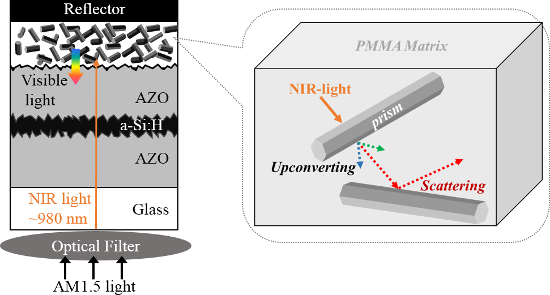
- smooth facets. No nanoparticles are observed and the UC nanorods exhibit a monodisperse size distribution. On average, they are ca. 200 nm in diameter and ca. 1.5 μm in length. According to the X-ray diffraction (XRD) patterns in Figure 1b, with increasing reaction time, reflections of the hexagonal β


Enhanced antineoplastic/therapeutic efficacy using 5-fluorouracil-loaded calcium phosphate nanoparticles
Beilstein J. Nanotechnol. 2018, 9, 2499–2515, doi:10.3762/bjnano.9.233
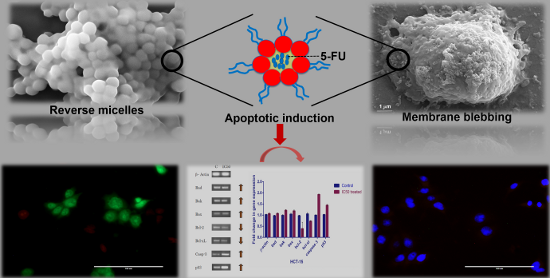
- uniformly dispersed in oil, forming a water-in-oil (W/O) microemulsion system [24]. Highly monodisperse, stable, size controllable and chemically reproducible nanoparticles can be formed by adopting the aforementioned method. The anionic surfactant (AOT) in the organic solvent forms the oil dispersion media
- were prepared by a reverse micelle microemulsion method. The highly monodisperse nanoparticles were synthesized and subsequently validated by the presence of phosphate ester bonds in FTIR analysis and again the presence of the hydroxyapatite peak in the XRD analysis confirmed their successful formation


Lead-free hybrid perovskites for photovoltaics
Beilstein J. Nanotechnol. 2018, 9, 2209–2235, doi:10.3762/bjnano.9.207
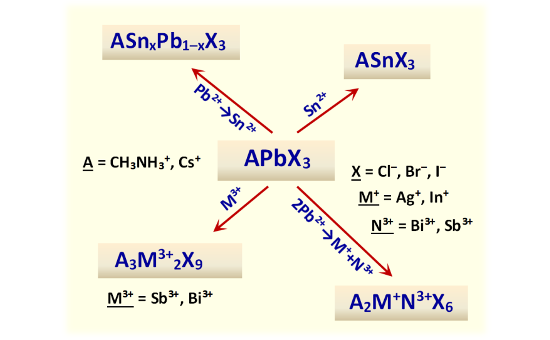
- possible size/shape effects to be investigated with respect to the optical, luminescent and photovoltaic properties of such materials. For example, reasonably monodisperse ≈10 nm NCs of a variety of CsSnX3 HPs (X = Cl, Br, I, Cl/Br, Br/I) can be produced (Figure 7a) by a general hot injection method using


Nanoconjugates of a calixresorcinarene derivative with methoxy poly(ethylene glycol) fragments for drug encapsulation
Beilstein J. Nanotechnol. 2018, 9, 2057–2070, doi:10.3762/bjnano.9.195
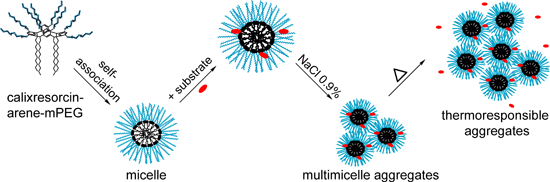
- interact with each other (Figure S5, Supporting Information File 1). Figure 2a presents the resulting scattering curve of the aqueous solution of 3 after the subtraction of water scattering. The character of scattering corresponds to a monodisperse particle system. Power-law slopes from the data in the
- radius of gyration Rg and the forward scattering I(0) were calculated by using the Guinier plot (Figure 2b) and are 53.5 ± 1.8 Å and 531 ± 18, respectively. Additionally, with the help of the PRIMUS software [26] the fitting of SAXS spectra in a globular model with a local monodisperse approximation was


Fabrication of photothermally active poly(vinyl alcohol) films with gold nanostars for antibacterial applications
Beilstein J. Nanotechnol. 2018, 9, 2040–2048, doi:10.3762/bjnano.9.193
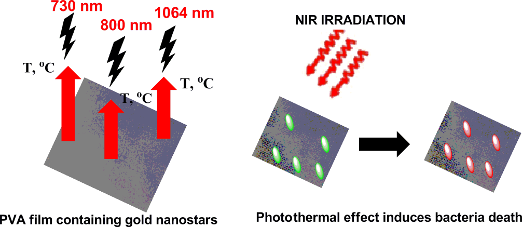
- that the detected spots in the confocal image were single nanoparticles. The distribution of the reflectivity of the spots on each layer did not change more than a few tens of percent units, indicating that if any aggregation is occurring it is very monodisperse. It is hardly conceivable that all of


Synthesis of a MnO2/Fe3O4/diatomite nanocomposite as an efficient heterogeneous Fenton-like catalyst for methylene blue degradation
Beilstein J. Nanotechnol. 2018, 9, 1940–1950, doi:10.3762/bjnano.9.185
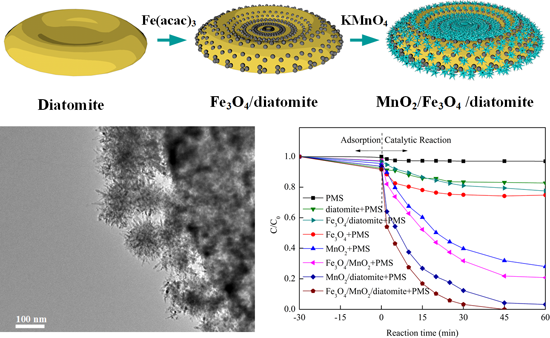
- , Supporting Information File 1), the SEM and TEM images show that the pure MnO2 agglomerates into large micrometer-sized particles, in contrast to the monodisperse nano-MnO2 in the MnO2/Fe3O4/diatomite composite. The TEM analysis confirms the successful synthesis of the core–shell structured MnO2/Fe3O4


Controllable one-pot synthesis of uniform colloidal TiO2 particles in a mixed solvent solution for photocatalysis
Beilstein J. Nanotechnol. 2018, 9, 1715–1727, doi:10.3762/bjnano.9.163
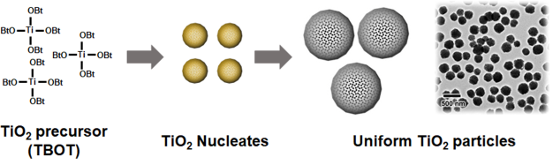
- influences of synthetic parameters such as a solvent composition, surfactant concentration, and concentration of the titanium butoxide. Under the optimum ratio of mixed solvent conditions (ethanol/acetonitrile 3:1), uniform and monodisperse colloidal TiO2 particles were obtained. As the concentration of




Closed polymer containers based on phenylboronic esters of resorcinarenes
Beilstein J. Nanotechnol. 2018, 9, 1594–1601, doi:10.3762/bjnano.9.151
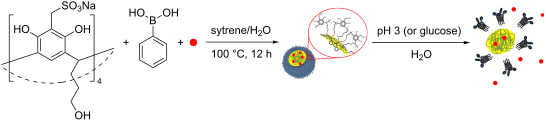
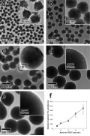
- bond SRA with BA and to form closed polymer particles. The size and dispersity of the particles depend on the volume of styrene used. Styrene and water in the ratio 1:40 (2.5 vol %) yields to the most monodisperse and uniform particles with a hydrodynamic diameter of about 200 nm and a polydispersity


Interaction-tailored organization of large-area colloidal assemblies
Beilstein J. Nanotechnol. 2018, 9, 1582–1593, doi:10.3762/bjnano.9.150
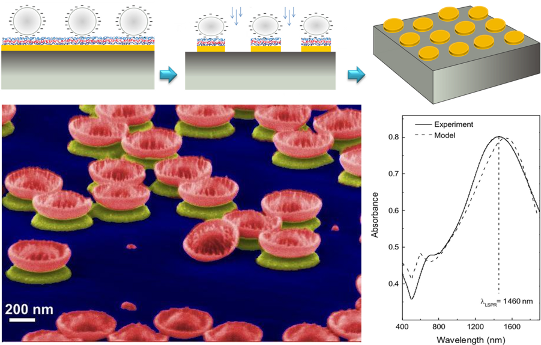
- of nanoscale patterns such as nanoscale holes (nanoholes), nanoscale disks (nanodisks), nanoscale dots (nanodots) and nanoscale rings (nanorings), combining the advantages of both top-down and bottom-up approaches [16][17][18]. In this technique, monodisperse, spherical, nanoscale materials (usually


Preparation and morphology-dependent wettability of porous alumina membranes
Beilstein J. Nanotechnol. 2018, 9, 1423–1436, doi:10.3762/bjnano.9.135
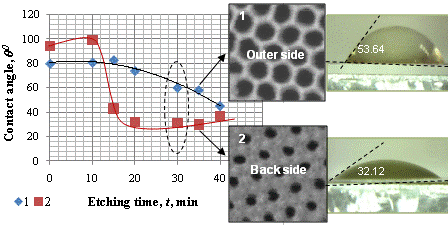
- -monodisperse cylindrical pores [23][24]. Membranes obtained by traditional methods have a three-dimensional pore structure that has a large pore size distribution, which does not allow high permeability values to be obtained [9][25][26]. Therefore, the optimization of parameters such as the diameter and length


Colorimetric detection of Cu2+ based on the formation of peptide–copper complexes on silver nanoparticle surfaces
Beilstein J. Nanotechnol. 2018, 9, 1414–1422, doi:10.3762/bjnano.9.134
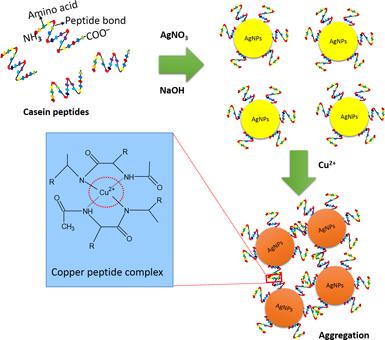
- monodisperse in nature with a narrow size distribution, as expected from the narrow absorbance peak centered at 410 nm. The UV–vis spectroscopic data were collected before and after centrifugation (10000 rpm for 12 min) to observe how the SPR peak width and shift changed with the removal of unbound/unreacted


Heterostuctures of 4-(chloromethyl)phenyltrichlorosilane and 5,10,15,20-tetra(4-pyridyl)-21H,23H-porphine prepared on Si(111) using particle lithography: Nanoscale characterization of the main steps of nanopatterning
Beilstein J. Nanotechnol. 2018, 9, 1211–1219, doi:10.3762/bjnano.9.112
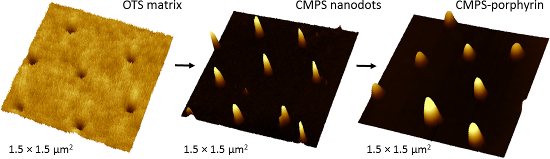
- drying, 10 µL of monodisperse silica microspheres in water was deposited on the clean silicon substrates and dried in air to produce a surface film of Si spheres. The substrate and dried microspheres were placed in an oven at 150 °C for 20 h. The annealing heating step was used to temporarily solder the
- ]. Steps for preparing nanopatterned CMPS-porphyrin heterostructures. (a) Monodisperse silica spheres were deposited on Si(111) to form a surface mask for particle lithography. (b) After immersion in OTS solution, the microspheres were rinsed away to reveal nanoholes of OTS. (c) With a second immersion


Material discrimination and mixture ratio estimation in nanocomposites via harmonic atomic force microscopy
Beilstein J. Nanotechnol. 2017, 8, 2771–2780, doi:10.3762/bjnano.8.276
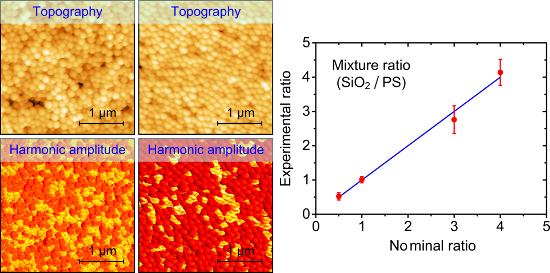
- should also be easily distinguishable from the topography, which is suitable for the verification of the capability of harmonic AFM in discriminating materials. The third kind of sample is a mixture of monodisperse PS NPs and SiO2 with the same diameter of about 100 nm. The mixture ratios (SiO2/PS) were




PTFE-based microreactor system for the continuous synthesis of full-visible-spectrum emitting cesium lead halide perovskite nanocrystals
Beilstein J. Nanotechnol. 2017, 8, 2521–2529, doi:10.3762/bjnano.8.252
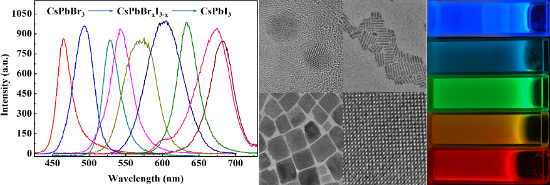
- , there is no report on the continuous synthesis of perovskite nanocrystals via microreactor systems, even though these systems have been successfully used to synthesize CdSe [25], CdSe/ZnS [26], CdSexTe1−x [27], and CdS [28] QDs, as well as monodisperse Au–Ag alloy nanoparticles [29]. In this work, we


Synthesis and characterization of noble metal–titania core–shell nanostructures with tunable shell thickness
Beilstein J. Nanotechnol. 2017, 8, 2083–2093, doi:10.3762/bjnano.8.208
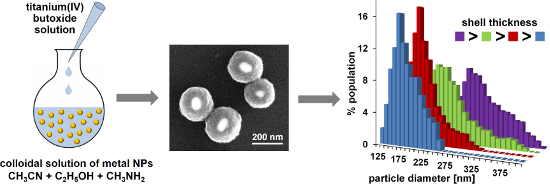
- the reduction of silver nitrate with hydroxylamine hydrochloride [50][51]. In both cases, relatively monodisperse spherical or quasi-spherical metal NPs with a mean particle diameter of around 100 nm were obtained (Table 1, Figure 1 and Figure S1, Supporting Information File 1). Initially, we also


Fabrication of carbon nanospheres by the pyrolysis of polyacrylonitrile–poly(methyl methacrylate) core–shell composite nanoparticles
Beilstein J. Nanotechnol. 2017, 8, 1897–1908, doi:10.3762/bjnano.8.190

- , the direct fabrication of discrete carbon nanospheres can be achieved. Although carbon nanospheres and microspheres have been fabricated by various methods, reports on the fabrication of monodisperse carbon nanospheres with a diameter less than 100 nm are still very few [21][27][37][38]. Also



Self-assembly of chiral fluorescent nanoparticles based on water-soluble L-tryptophan derivatives of p-tert-butylthiacalix[4]arene
Beilstein J. Nanotechnol. 2017, 8, 1825–1835, doi:10.3762/bjnano.8.184
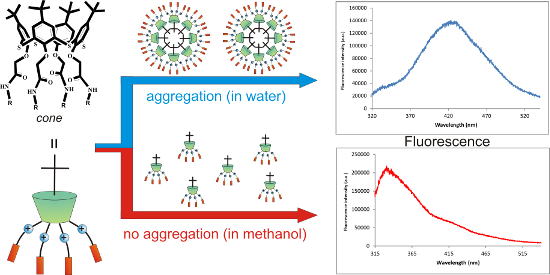
- ]. This is probably due to the changing form of the self-associates with the concentration of macrocycles. For the macrocycles 8–11, the most stable monodisperse systems are formed at the concentration of 1 × 10⁻⁴ М (Table 1, Supporting Information File 1, Figures S17–S20). It was shown that with time



Synthesis and functionalization of NaGdF4:Yb,Er@NaGdF4 core–shell nanoparticles for possible application as multimodal contrast agents
Beilstein J. Nanotechnol. 2017, 8, 1815–1824, doi:10.3762/bjnano.8.183
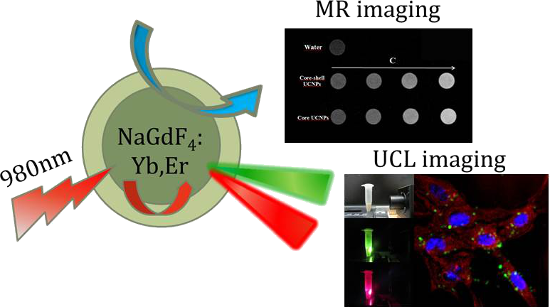
- Institute of Chemistry, Center for Physical Sciences and Technology, Sauletekio Ave. 3, Vilnius, LT-10222, Lithuania 10.3762/bjnano.8.183 Abstract Upconverting nanoparticles (UCNPs) are promising, new imaging probes capable of serving as multimodal contrast agents. In this study, monodisperse and
- . Our results showed that Tween 80-coated UCNPs exhibited low cytotoxicity even at a high-dose concentration. Results and Discussion The SEM images of the NaGdF4:Yb,Er core and NaGdF4:Yb,Er@NaGdF4 core–shell nanoparticles are shown in Figure 1. Core nanoparticles are monodisperse, and have a spherical
- In summary we have successfully synthesized ultrasmall, monodisperse, hexagonal phase core NaGdF4:Yb,Er nanoparticles and polydisperse, core–shell NaGdF4:Yb,Er@NaGdF4 nanoparticles. Oleate-capped core NaGdF4:Yb,Er nanoparticles and core–shell NaGdF4:Yb,Er@NaGdF4 nanoparticles were successfully


Development of polycationic amphiphilic cyclodextrin nanoparticles for anticancer drug delivery
Beilstein J. Nanotechnol. 2017, 8, 1457–1468, doi:10.3762/bjnano.8.145
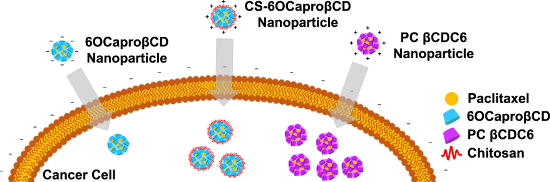
- optimized for selection of organic solvent, ratio of organic phase to aqueous phase and surfactant concentration to obtain monodisperse particles with a diameter range around 80 to 125 nm. Intended as chemotherapeutic nanocarriers, various PCX-loaded amphiphilic CD nanoparticles were also evaluated for
- nanoparticles, and acetone > methanol > ethanol for PC βCDC6 nanoparticles. It is worth noting that ethanol also gave the most monodisperse particles with an acceptable polydispersity index (<0.2) (Table 1). As expected, the core–shell nanoparticles CS-6OCaproβCD had the largest size due to the chitosan coating


Cationic PEGylated polycaprolactone nanoparticles carrying post-operation docetaxel for glioma treatment
Beilstein J. Nanotechnol. 2017, 8, 1446–1456, doi:10.3762/bjnano.8.144
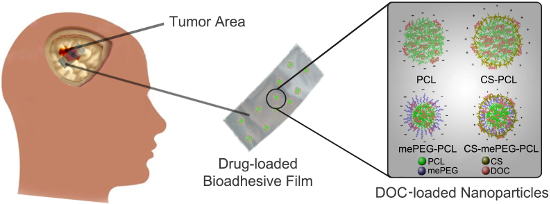
- obtain smaller, monodisperse nanoparticles with favorable stability. Three different preparation techniques, emulsion/solvent evaporation, double emulsion and nanoprecipitation, were used to prepare PCL or mePEG-PCL nanoparticles. As seen in Table 1, the mean diameter of PCL nanoparticles was found to be




Synthesis of [Fe(Leq)(Lax)]n coordination polymer nanoparticles using blockcopolymer micelles
Beilstein J. Nanotechnol. 2017, 8, 1318–1327, doi:10.3762/bjnano.8.133
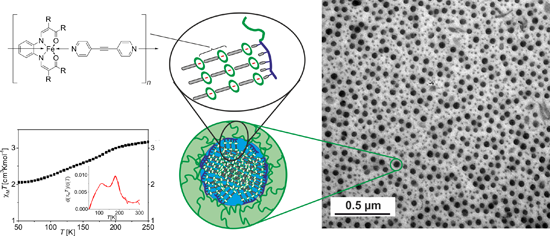
- networks are of great interest in current research because of their various applications as sensors, data-storage devices, catalysts or contrast agents [1][2][3][4][5]. For these applications the formation of stable, uniform and monodisperse particles with defined properties is necessary. Synthetic



Bright fluorescent silica-nanoparticle probes for high-resolution STED and confocal microscopy
Beilstein J. Nanotechnol. 2017, 8, 1283–1296, doi:10.3762/bjnano.8.130
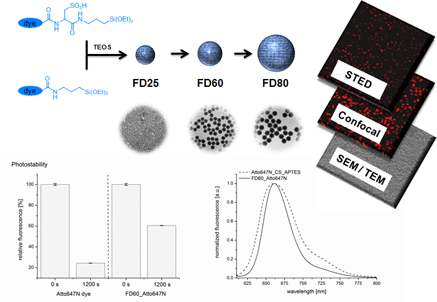
- agglomeration and stability) and the fluorescence properties of the obtained particles were compared to particles from commonly known synthesis methods. As a result, the spectroscopic characteristics of the presented monodisperse dye-doped silica nanoparticles were similar to those of the free uncoupled dyes
- synthesis of monodisperse silica nanoparticles in the size range of 15 to 80 nm and their modification with fluorescent NIR dyes to enable stimulated emission depletion (STED) and confocal imaging. For this purpose, we adopted a literature-known synthesis of silica nanoparticles using an L-arginine
- increased the hydrophilic character of the dye avoiding agglomeration and gel formation during the synthesis. By using the Atto647N–cysteic acid–APTES conjugate (Atto647N-CS-APTES) and a precise adjustment of the reaction parameters, monodisperse silica nanoparticles with a mean particle diameter of 15 nm





