Search results
Search for "photocatalytic properties" in Full Text gives 67 result(s) in Beilstein Journal of Nanotechnology.
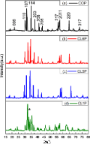
Manufacturing and investigation of physical properties of polyacrylonitrile nanofibre composites with SiO2, TiO2 and Bi2O3 nanoparticles
Beilstein J. Nanotechnol. 2016, 7, 1141–1155, doi:10.3762/bjnano.7.106
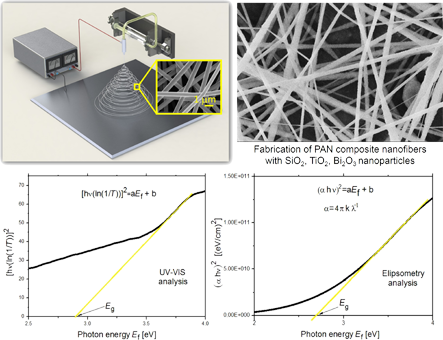
- mentioned that the authors made an attempt to manufacture and investigate the properties of the PAN nanofibres reinforced with bismuth oxide nanoparticles, about which there is no literature data. Because of the good photocatalytic properties of Bi2O3 nanoparticles, nanofibres of PAN/Bi2O3 may be a more



Impact of ultrasonic dispersion on the photocatalytic activity of titania aggregates
Beilstein J. Nanotechnol. 2015, 6, 2423–2430, doi:10.3762/bjnano.6.250
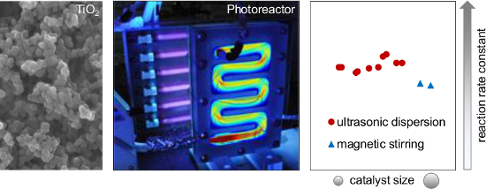
- discoloration of MB, in consequence, indicates the photocatalytic properties of P25 [19]. Experimental setup An industrial, photocatalytic implementation requires a photoreactor, which not only satisfies basic techniques of chemical engineering [10] but also ensures effective photon collecting [20]. An idea for
- methylene blue The photocatalytic properties of P25 were examined by characterizing the discoloration of MB. The desired MB concentration [6][7][29] of 0.01 mM was obtained by adding the MB stock solution into the dispersed P25 suspensions. To achieve an adsorption–desorption equilibrium, the suspensions


Electrochemical coating of dental implants with anodic porous titania for enhanced osteointegration
Beilstein J. Nanotechnol. 2015, 6, 2183–2192, doi:10.3762/bjnano.6.224
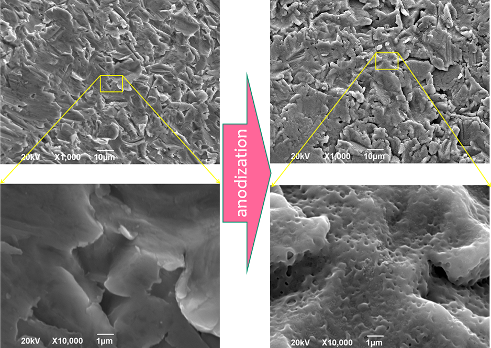
- , following the success of nanostructured anodic porous alumina, anodic porous titania has also attracted the interest of academic researchers. This material, investigated mainly for its photocatalytic properties and for applications in solar cells, is usually obtained from the anodization of ultrapure


Effect of SiNx diffusion barrier thickness on the structural properties and photocatalytic activity of TiO2 films obtained by sol–gel dip coating and reactive magnetron sputtering
Beilstein J. Nanotechnol. 2015, 6, 2039–2045, doi:10.3762/bjnano.6.207
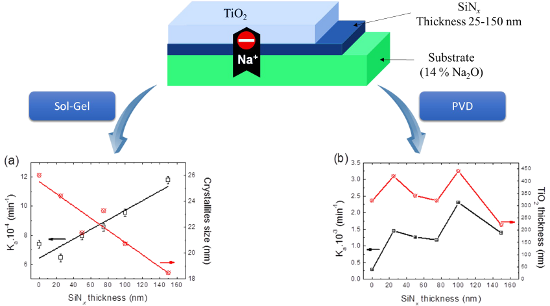
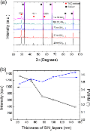
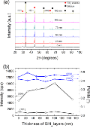
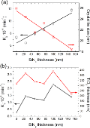
- species responsible for the degradation of OII. For an equivalent TiO2 thickness, the degradation rate of OII is relatively similar. Conclusion We investigated the structural and photocatalytic properties of titanium dioxide films obtained by low temperature sol–gel and reactive sputtering processes for
Radiation losses in the microwave Ku band in magneto-electric nanocomposites
Beilstein J. Nanotechnol. 2015, 6, 1700–1707, doi:10.3762/bjnano.6.173
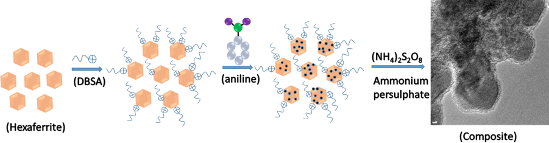
- interesting material with variable properties and a large anisotropy field having a magnetic resonance in the range of 2–52 GHz. Also, at the nano-scale, its optical properties [19], magnetic properties [20][21], piezo-electric properties [22], photocatalytic properties [23], gas-sensing properties [24


High photocatalytic activity of V-doped SrTiO3 porous nanofibers produced from a combined electrospinning and thermal diffusion process
Beilstein J. Nanotechnol. 2015, 6, 1281–1286, doi:10.3762/bjnano.6.132
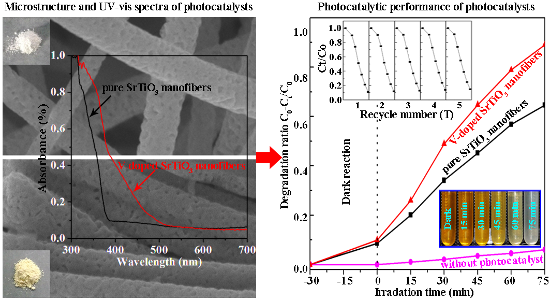
- excellent photocatalytic properties of Fe-doped SrTiO3, Nd-doped SrTiO3 and Ni/La co-doped SrTiO3 [18][19][20]. These new photocatalysts enable a good response to light or overcome light corrosion caused by the excessive accumulation of photogenerated carriers due to poor conductivity. However, there are
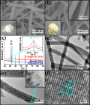


Effects of swift heavy ion irradiation on structural, optical and photocatalytic properties of ZnO–CuO nanocomposites prepared by carbothermal evaporation method
Beilstein J. Nanotechnol. 2015, 6, 928–937, doi:10.3762/bjnano.6.96
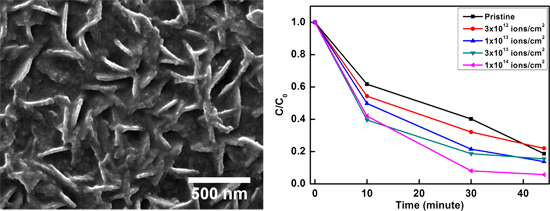
- of ZnO nanostructures, not much work has been done on the SHI-induced modifications in ZnO–CuO nanocomposites. In this paper, we report on the effects of 90 MeV Ni7+ ion irradiation on the structural, optical and photocatalytic properties of ZnO–CuO nanocomposites, which were prepared by a simple
- evaporation of ZnO and Cu, combined with annealing. FESEM studies showed the presence of ZnO nanosheets and nanorods, which are formed by Cu–Zn alloy nanodroplets assisted oriented attachment of ZnO nanoparticles. The effects of swift heavy ion irradiation on the structural, optical, and photocatalytic
- properties of the nanocomposite were studied. Swift heavy ion irradiation has been found to result in significant enhancement in the photocatalytic efficiency of ZnO–CuO nanocomposites, towards sun light driven degradation of methylene blue and methyl orange dyes in water. The possible mechanism for the




Transformation of hydrogen titanate nanoribbons to TiO2 nanoribbons and the influence of the transformation strategies on the photocatalytic performance
Beilstein J. Nanotechnol. 2015, 6, 831–844, doi:10.3762/bjnano.6.86
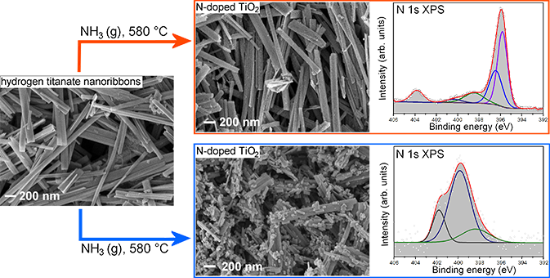
- particular, a great deal of attention has paid to the research and exploitation of its catalytic and photocatalytic properties in a variety of applications, ranging from the environmental to energy applications [3][4][5]. The key factors that determine the photocatalytic efficiency of TiO2 are its phase




Tm-doped TiO2 and Tm2Ti2O7 pyrochlore nanoparticles: enhancing the photocatalytic activity of rutile with a pyrochlore phase
Beilstein J. Nanotechnol. 2015, 6, 605–616, doi:10.3762/bjnano.6.62
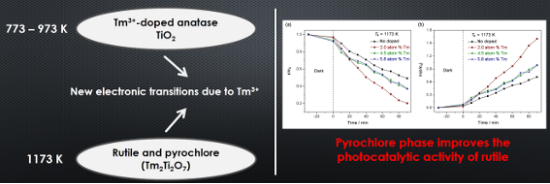
- that the photocatalytic properties of the semiconductor can be improved by adding a pyrochlore phase to the rutile phase as is shown for the 5.8 atom % Tm-doped sample results. The 2.0 atom % Tm-doped TiO2 sample presented the best photocatalytic activity. Furthermore, in accordance with the results


Influence of stabilising agents and pH on the size of SnO2 nanoparticles
Beilstein J. Nanotechnol. 2014, 5, 2192–2201, doi:10.3762/bjnano.5.228
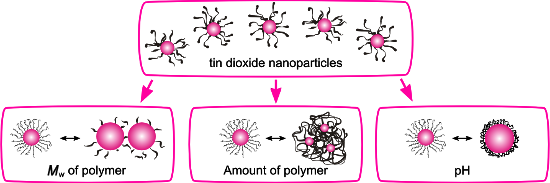
- dioxide; Introduction Tin dioxide is an n-type semiconductor with a band gap width of 3.6 eV. It is characterised by good photocatalytic properties and in its presence, decomposition of an organic dye in the visible range of the electromagnetic spectrum may takes place [1]. Moreover, SnO2 is widely used
- loss of the typical characteristic properties of nanomaterials, for example, the specific sensor or photocatalytic properties. For this reason, colloidal metal oxide nanoparticles (regardless of the synthesis method) require the use of a stabilising agent to fully maintain a high state of dispersion


Functionalized nanostructures for enhanced photocatalytic performance under solar light
Beilstein J. Nanotechnol. 2014, 5, 994–1004, doi:10.3762/bjnano.5.113
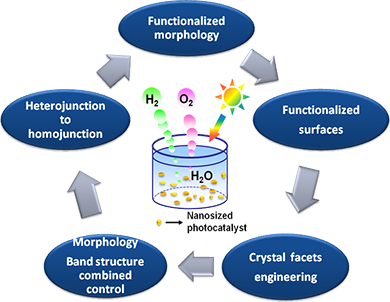
- photocatalysts can also facilitate the migration of photogenerated charges from bulk to surface [10]. It has been reported that porous semiconductor photocatalysts, such as TiO2 [11], Nb2O5 [12] and Ta2O5 [10], displayed much better photocatalytic properties than their bulk counterparts. Meanwhile, when
- semiconductor nanocrystals are dispersed in the mesoporous substrate, greatly enhanced photocatalytic properties can also be achieved. For example, dispersing TiO2 nanoclusters in MCM-41 [13] and MCM-48 [14] resulted in much higher photocatalytic activities than that of bulk TiO2 under UV light irradiation. Our
- ZnS, has received lots of attention in recent years, owing to the tunable band structure and excellent photocatalytic properties for hydrogen production under visible light without needing noble metal cocatalysts [54]. However, the band gap of Cd1−xZnxS is not narrow enough for an efficient


Nanostructure sensitization of transition metal oxides for visible-light photocatalysis
Beilstein J. Nanotechnol. 2014, 5, 696–710, doi:10.3762/bjnano.5.82
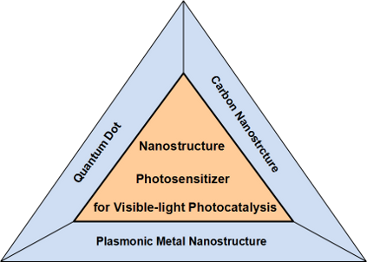
- dots [33]. Such superior photocatalytic properties could be attributable to a combination of a few factors including the depression of electron–hole recombination, bandgap narrowing, and increased surface area upon hybridization. Due to the rapid development of nanotechnology, a variety of quantum dots




Enhanced photocatalytic activity of Ag–ZnO hybrid plasmonic nanostructures prepared by a facile wet chemical method
Beilstein J. Nanotechnol. 2014, 5, 639–650, doi:10.3762/bjnano.5.75
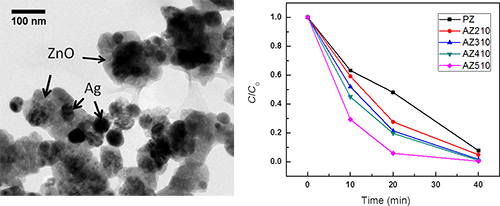
- the synthesis of Ag–ZnO hybrid plasmonic nanostructures with enhanced photocatalytic activity by a facile wet-chemical method. The structural, optical, plasmonic and photocatalytic properties of the Ag–ZnO hybrid nanostructures were studied by X-ray diffraction (XRD), field emission scanning electron
- method and studied their photocatalytic properties. They concluded that Ag nanoparticles improve the separation of electron and holes by acting as electron sinks. In our case, the photocatalytic efficiency is highest for sample AZ510, with nanodisk-like structures having higher surface area, and maximum


Mesoporous cerium oxide nanospheres for the visible-light driven photocatalytic degradation of dyes
Beilstein J. Nanotechnol. 2014, 5, 517–523, doi:10.3762/bjnano.5.60
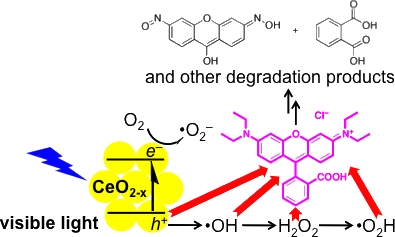
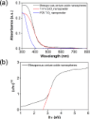
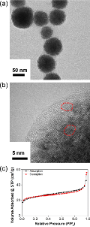
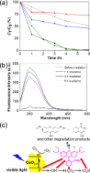
- been applied to transmit only wavelengths larger than 420 nm, to demonstrate photocatalytic properties under ambient conditions. The UV–vis spectral changes of the colloidal mixture illustrated in Figure 4 clearly shows the degradation of RhB over time, with the dye being completely decomposed within 6

Structural, optical and photocatalytic properties of flower-like ZnO nanostructures prepared by a facile wet chemical method
Beilstein J. Nanotechnol. 2013, 4, 763–770, doi:10.3762/bjnano.4.87
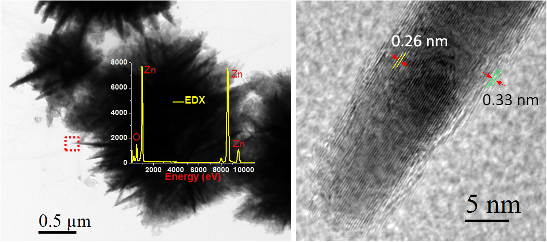
- Flower-like ZnO nanostructures were synthesized by a facile wet chemical method. Structural, optical and photocatalytic properties of these nanostructures have been studied by X-ray diffraction (XRD), scanning electron microscopy (SEM), transmission electron microscopy (TEM), photoluminescence (PL) and
- studied the effects of ageing on structural, optical and photocatalytic properties of flower-like ZnO nanostructures, which were prepared by a simple wet chemical method. We have demonstrated that the formation of a passivating layer of Zn(OH)2 on the ZnO nanostructures due to ageing leads to a drastic
- nanostructures by using a facile wet chemical method. The structural, optical and photocatalytic properties of ZnO nanostructures have been investigated. As compared to spherical ZnO nanoparticles, flower-like ZnO nanostructures exhibited an enhanced photocatalytic efficiency towards the degradation of methylene


Photocatalytic antibacterial performance of TiO2 and Ag-doped TiO2 against S. aureus. P. aeruginosa and E. coli
Beilstein J. Nanotechnol. 2013, 4, 345–351, doi:10.3762/bjnano.4.40
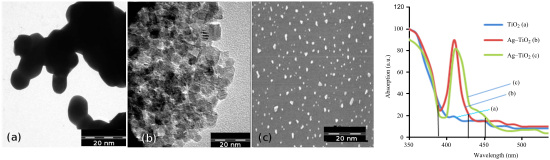
- , optical and photocatalytic properties of TiO2 and Ag-doped TiO2 synthesized by an acid-catalyzed sol–gel technique. The XRD pattern showed the coexistence of silver and anatase TiO2 phases. UV–vis spectroscopy revealed the shifting of the absorption edge of silver-doped TiO2 to the visible region (higher


Self-assembled monolayers and titanium dioxide: From surface patterning to potential applications
Beilstein J. Nanotechnol. 2011, 2, 845–861, doi:10.3762/bjnano.2.94
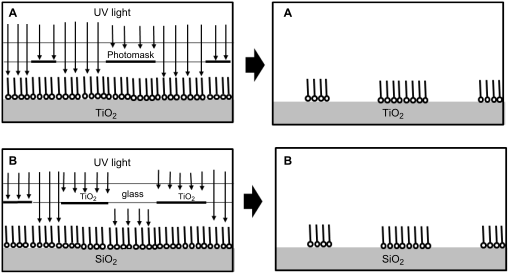
- and the rare photocatalytic properties of titanium dioxide provide a rationale for the study of systems comprising both. Such systems can be realized in the form of SAMs grown on TiO2 or, in a complementary manner, as TiO2 grown on SAMs. Accordingly, the current status of knowledge regarding SAMs on
- titanium dioxide based devices. Accordingly, particular attention is given to the description of a variety of methods and techniques aimed at utilizing the photocatalytic properties of titanium dioxide for patterning. Reports on a variety of applications are discussed. These examples, representing the
- monolayers may affect the photocatalytic properties of titania as well as be affected by these properties. Likewise, the superhydrophilicity of TiO2 known to be induced upon exposure to UV light [13] may affect the chemisorption process of SAMs. This gives rise to diverse phenomena, which can be utilized in