


Search results
Search for "photodegradation" in Full Text gives 87 result(s) in Beilstein Journal of Nanotechnology.
Perovskite-structured CaTiO3 coupled with g-C3N4 as a heterojunction photocatalyst for organic pollutant degradation
Beilstein J. Nanotechnol. 2018, 9, 671–685, doi:10.3762/bjnano.9.62
- , visible and sunlight). To demonstrate the photocatalytic performance of the as-prepared catalysts more precisely, the kinetics of the photodegradation of RhB aqueous solutions was studied by fitting the obtained degradation results to a pseudo-first-order reaction model [54][55] and modified Freundlich
- materials as it could appreciably reduce the costs of the photocatalytic process and reveals the most promising photocatalysis candidates. Hence, we carried out three successive cycles of photodegradation of RhB in order to comment on the reusability of the CTCN heterojunction as an efficient photocatalyst
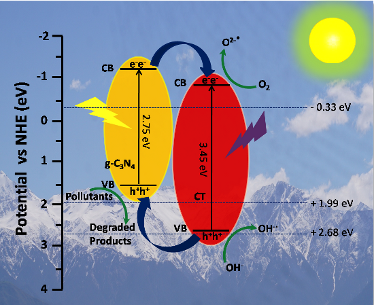
- the photodegradation of the pollutant. The entire photocatalytic reaction mechanism under sunlight irradiation can be summarized as follows: To validate the proposed mechanism and to gain insight into the role played by active species, radical trapping experiments were performed for RhB degradation


Mechanistic insights into plasmonic photocatalysts in utilizing visible light
Beilstein J. Nanotechnol. 2018, 9, 628–648, doi:10.3762/bjnano.9.59
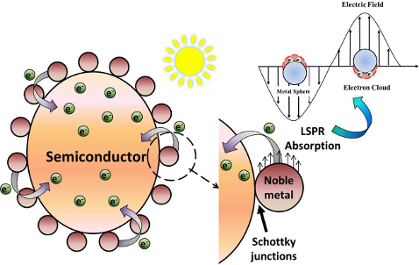
- Society of Chemistry. Photodegradation of GO in the presence of an electron donor (Ag NPs). Reprinted with permission from [95], copyright 2011 Royal Society of Chemistry. (a) Pure metal nanoparticles (NPs) without any semiconductor. (b) Metal NPs partially embedded into the semiconductor and partially





Fabrication and photoactivity of ionic liquid–TiO2 structures for efficient visible-light-induced photocatalytic decomposition of organic pollutants in aqueous phase
Beilstein J. Nanotechnol. 2018, 9, 580–590, doi:10.3762/bjnano.9.54
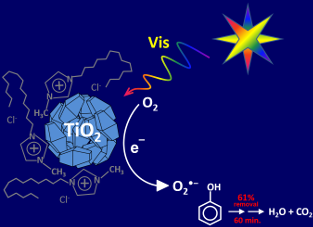
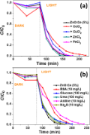
- Table 4. It was observed that application of AgNO3 as a scavenger of e− for the both samples (TiO2_T(1:3) and TiO2_O(1:3) did not affect the effectiveness of the photocatalytic process compared to that carried out without scavengers. Participation of O2• in the photodegradation process was investigated
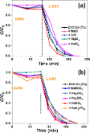
- ) photocatalysts, respectively. It is deduced that the oxidation inhibition of phenol is due to the suppression of the superoxide anion formation by the BQ addition. Addition of AO (holes scavenger) resulted in a slight inhibition of the photodegradation process under visible-light irradiation for both samples
- observed in the absence of either the photocatalyst or illumination. Determination of reactive species To clarify which active species are involved in the photodegradation of the model compound, the phenol irradiation process was preceded by analogous experiments performed in the presence of different




Influence of the preparation method on the photocatalytic activity of Nd-modified TiO2
Beilstein J. Nanotechnol. 2018, 9, 447–459, doi:10.3762/bjnano.9.43
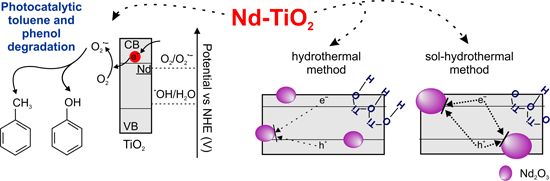
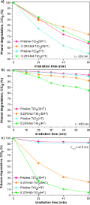
- pristine and Nd-modified TiO2 were investigated using the photocatalytic degradations of phenol in aqueous solution and of gaseous toluene. Kinetics and degradation rate of model pollutants are presented in Figure 7 and Table 4. The photodegradation of phenol was performed in aqueous solution under UV–vis
- ). The rate of toluene degradation was 3.36 μmol·dm−1·min−1 for HT-prepared TiO2 modified with Nd, while the photodegradation efficiency decreased in SHT-prepared TiO2 down to 2.71 μmol·dm−1·min−1. Pristine TiO2 exhibits only low activity (Figure 6c). As photolysis of toluene was not observed and the
- surface properties and the charge carrier recombination processes is presented in Figure 8. The results of the photodegradation significant differences between aqueous solution and gas phase. The quantum yield of the reaction in the gas phase is much higher than that one in aqueous solution due to lower




Facile synthesis of ZnFe2O4 photocatalysts for decolourization of organic dyes under solar irradiation
Beilstein J. Nanotechnol. 2018, 9, 436–446, doi:10.3762/bjnano.9.42
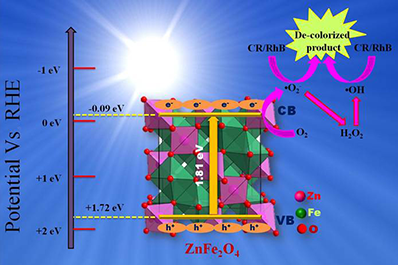
- of Congo red and Rh B Based upon the above results, the mechanism of the photocatalytic decolourization of Congo red and Rh B is illustrated in Figure 13. Electron and holes generated in ZFO are the agents for the production of the main active species in the photodegradation. CB and VB position of
- . The photocatalytic degradation rate of 10 ppm phenol was found to be 60% after 60 min over ZFO-500. The degradation procedure of phenol is similar to the degradation of Rh B and Congo red [35]. Photodegradation of phenol was performed by using 20 mL of a 10 ppm phenol solution containing 0.02 g of
- Rh B over ZFO-500. Adsorption spectra of the phenol solution before and after photodegradation over ZFO-500. Formation of luminescent 2-hydroxyterephthalic acid from terephthalic acid. First-order fitting results of Congo red decolourization over ZFO samples. Zero-order fitting parameters of Rh B


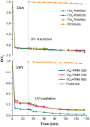
Photocatalytic and adsorption properties of TiO2-pillared montmorillonite obtained by hydrothermally activated intercalation of titanium polyhydroxo complexes
Beilstein J. Nanotechnol. 2018, 9, 364–378, doi:10.3762/bjnano.9.36
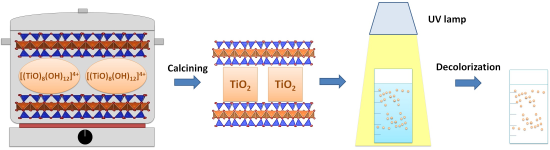
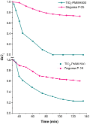
- 8% and 4%, respectively, thus that process can be neglected. Prior to obtaining the kinetic curves of photodegradation for the MO and RhB solutions, the photocatalyst samples were exposed to solutions of respective dyes with constant stirring in the dark for 30 min to reach adsorption–desorption






Sugarcane juice derived carbon dot–graphitic carbon nitride composites for bisphenol A degradation under sunlight irradiation
Beilstein J. Nanotechnol. 2018, 9, 353–363, doi:10.3762/bjnano.9.35
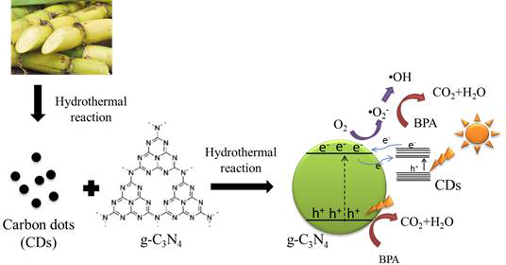
- radicals involved in the photoreaction. The influence order of the active radical species on the degradation of BPA was O2•− > h+ > hydroxyl radical (•OH) > e−. It is obvious that O2•− was the main radical species generated since the photodegradation of BPA was significantly inhibited after the addition of


Facile synthesis of silver/silver thiocyanate (Ag@AgSCN) plasmonic nanostructures with enhanced photocatalytic performance
Beilstein J. Nanotechnol. 2017, 8, 2781–2789, doi:10.3762/bjnano.8.277
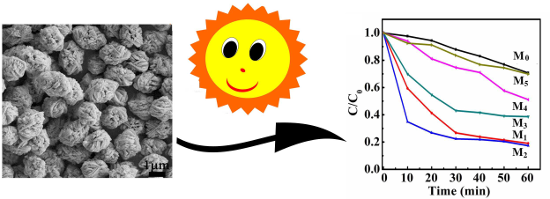
- showed that the photodegradation process of oxytetracycline nearly complied with the first-order kinetics, and the corresponding reaction rate constants (Ka) with M0, M1, M2, M3, M4 and M5 as catalysts were 0.0058, 0.0269, 0.02832, 0.01531, 0.01115, 0.006 min−1, respectively. The value of Ka for M2 was
- 4.8-fold faster than that of the bare AgSCN, so the existence of an appropriate amount of Ag played a prominent role in the photodegradation process. Electrochemical impedance spectrum (EIS) was used to illustrate the rate of charge transfer for the photocatalysts. Nyquist plots of M0, M1, M2, M3, M4


CdSe nanorod/TiO2 nanoparticle heterojunctions with enhanced solar- and visible-light photocatalytic activity
Beilstein J. Nanotechnol. 2017, 8, 2741–2752, doi:10.3762/bjnano.8.273
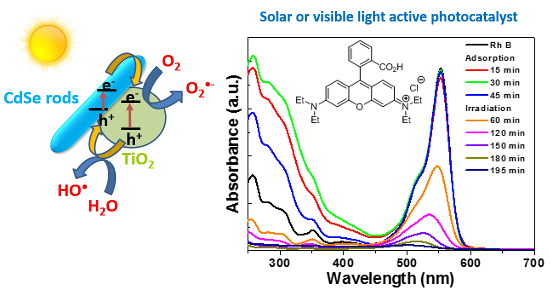
- remove the CdSe/TiO2 photocatalyst. The relative concentration of RhB in the solution was determined by comparing its UV−visible absorption at 554 nm with that of the starting solution. The mechanism of RhB photodegradation in aqueous solution was investigated through the use of scavengers. t-BuOH and p
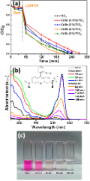
- photocatalyst, the photodegradation of RhB was found to be negligible. As shown in Figure 6a, the highest photocatalytic activity was reached for the CdSe (2 wt %)/TiO2 material which fully bleached the dye in 150 min. Thereafter, the activity decreases when increasing the amount of CdSe NRs associated to TiO2
- photodegradation of RhB over CdSe/TiO2 composites follows a pseudo-first-order kinetic model (C0 is the initial concentration of RhB and C is the concentration of the dye at time t). The rate constants k determined from the slopes of ln(C0/C) vs time were found to be 0.017, 0.012, 0.013, 0.019, and 0.014 min−1 for






AgCl-doped CdSe quantum dots with near-IR photoluminescence
Beilstein J. Nanotechnol. 2017, 8, 1156–1166, doi:10.3762/bjnano.8.117
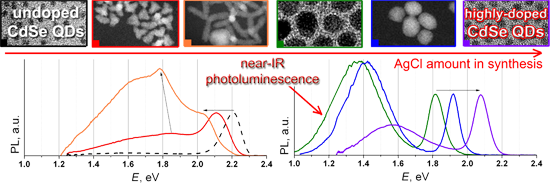
- to the nanocrystals. This is exactly the region, in which Ag2Se shows its most intense Bragg peaks [31]. From these data it can be concluded that Ag2Se was formed during the XRD measurements as a product of the photodegradation of CdSe–Ag NPs through the X-ray irradiation. Together these facts point


ZnO nanoparticles sensitized by CuInZnxS2+x quantum dots as highly efficient solar light driven photocatalysts
Beilstein J. Nanotechnol. 2017, 8, 1080–1093, doi:10.3762/bjnano.8.110
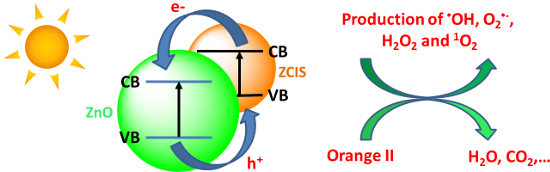
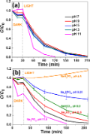
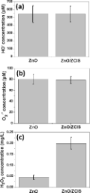
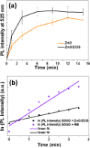
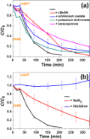
- range by the photocatalyst but also acts to decrease electron/hole recombination. Interestingly, the ZnO/ZCIS composite was found to produce increased amounts of H2O2 and singlet oxygen 1O2 compared to ZnO, suggesting that these reactive oxygen species play a key role in the photodegradation mechanism
- composites prepared for the photocatalytic degradation of pollutants require a relatively large quantity of CIS nanocrystals to be complete (20 wt % CIS QDs relative to ZnO) [34][37]. When the ZCIS/ZnO weight ratio was decreased to ≈7%, the photodegradation never exceeded 80% even using a light source
- continuous stirring. Using a radiometer, the light intensity was estimated to be 5 mW/cm2. At regular intervals, 2 mL sample aliquots were withdrawn from the reaction flask and centrifuged (15,000 rpm for 2 min) to remove the photocatalyst. The photodegradation progress was monitored by measuring the UV–vis
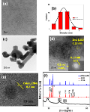
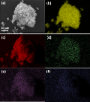
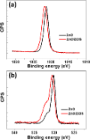

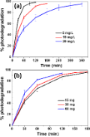



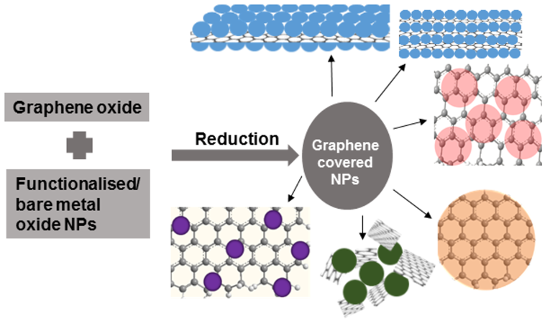
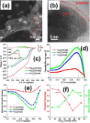
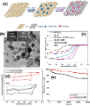
Synthesis of graphene–transition metal oxide hybrid nanoparticles and their application in various fields
Beilstein J. Nanotechnol. 2017, 8, 688–714, doi:10.3762/bjnano.8.74






Investigation of the photocatalytic efficiency of tantalum alkoxy carboxylate-derived Ta2O5 nanoparticles in rhodamine B removal
Beilstein J. Nanotechnol. 2017, 8, 604–613, doi:10.3762/bjnano.8.65
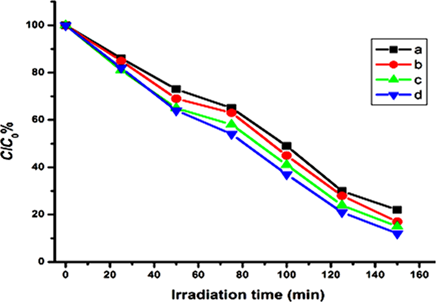
- with the Scherrer equation, are in the range of 15–28 nm. The samples attained good crystallinity after calcination at 750 °C. SEM micrographs show that the synthesized samples are almost spherical and agglomerate to some extent. The photodegradation of rhodamine B by the semiconductor photocatalyst


Selective photodissociation of tailored molecular tags as a tool for quantum optics
Beilstein J. Nanotechnol. 2017, 8, 325–333, doi:10.3762/bjnano.8.35
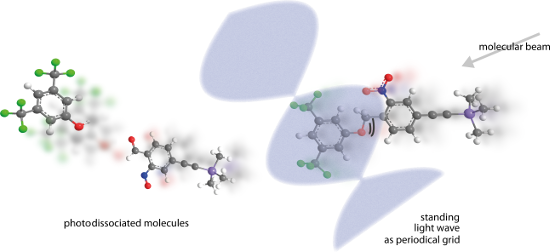
- of the target trimer 1 by NMR spectroscopy to be able to analyse the products of the photodegradation. Due to the poor solubility of the trimer 1, these studies were made with the monomeric building block 4, which allowed for suitable concentrations in dichloromethane-d2 for the NMR experiment. In a
- the 3,5-bis(trifluoromethyl)phenol (7) were observed during irradiation. Figure 2 displays the increase of the aldehyde proton (HA) at 10.35 ppm with increasing duration of the light exposure. The limited solubility of the trimer 1 prevented the investigation of its photodegradation by the same set-up
- solution spectra display the expected photodegradation of these model compounds in solution. Their optical properties and photoreaction pathways may, however, vary in high vacuum, where the stabilization of the intermediates by surrounding solvent molecules is no longer possible and bathochromic line


Photocatalysis applications of some hybrid polymeric composites incorporating TiO2 nanoparticles and their combinations with SiO2/Fe2O3
Beilstein J. Nanotechnol. 2017, 8, 272–286, doi:10.3762/bjnano.8.30
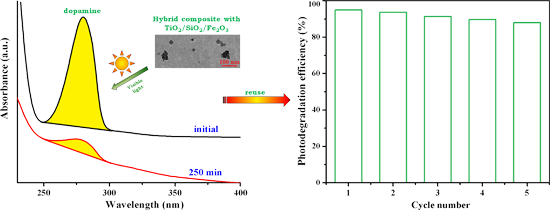
- nanoparticles and hybrid polymeric composites with 10 wt % NPs (S1–S4) was realized through XRD, TEM and FTIR analyses. The mean size (10–30 nm) and the crystallinity of the NPs varied as a function of the inorganic constituent. The catalytic activity of these hybrid films was tested for the photodegradation of
- an amine function (dopamine). The photodegradation experiments for these model pollutants were performed under ambient conditions, under UV irradiation with low intensity (ca. 8 mW/cm2) to imitate the UV radiation from solar light, as well as under irradiation with visible light. The degradation
- collected during UV irradiation in the presence of S1 and S4 hybrid films. As can be observed, the absorption band of phenol underwent a gradual decrease because of its photodegradation without any change in the shape and position (after 250 min irradiation). Furthermore, for determining the phenol


Optical and photocatalytic properties of TiO2 nanoplumes
Beilstein J. Nanotechnol. 2017, 8, 190–195, doi:10.3762/bjnano.8.20
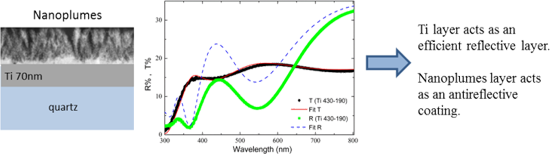
- of the synthesized material and related them to the efficiency of UV photodegradation of methylene blue dye. The obtained results show that TiO2 nanoplumes act as an effective antireflective layer increasing the UV photocatalytic yield of the film. Keywords: black titania; nanostructures
- Ti films as an easy, rapid, and low-cost method to synthesize hydrogenated TiO2 nanoplumes with significant photocatalytic properties under UV and visible light irradiation. Here we report the optical properties of the TiO2 nanoplumes and their correlation with the efficiency of UV photodegradation


Organoclay hybrid materials as precursors of porous ZnO/silica-clay heterostructures for photocatalytic applications
Beilstein J. Nanotechnol. 2016, 7, 1971–1982, doi:10.3762/bjnano.7.188
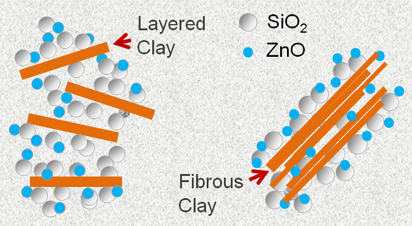
- observed in the MB photodegradation study, ZnO nanoparticles alone exhibit a higher activity compared to the activity of the heterostructures, reaching 84% of ibuprofen decomposition after 6 h of irradiation. This feature could be tentatively explained by admitting a more effective UV shielding in the
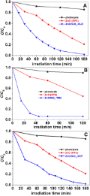
- M) of MB as a function of the UV irradiation time in presence of the heterostructures (experiments carried out at 17 °C): (A) ZnO/SiO2-CLO, (B) ZnO/SiO2-TSM and (C) ZnO/SiO2-SEP. “Photolysis” corresponds to photodegradation of MB in the absence of catalyst. “Photolysis” and ZnO(NP) data are the same





Surface-enhanced infrared absorption studies towards a new optical biosensor
Beilstein J. Nanotechnol. 2016, 7, 1736–1742, doi:10.3762/bjnano.7.166
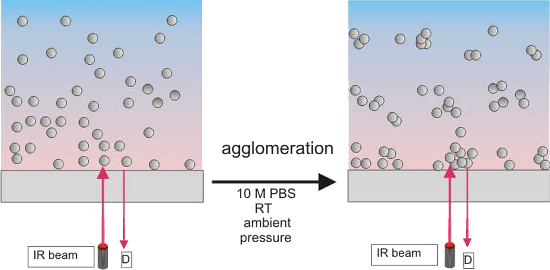
- without the use of labels. They lack the disadvantages of fluorescence technologies such as photodegradation, loss of bioactivity or costs of labeling. An early overview in the field of direct optical sensors, including optical principles and assay formats for selective detection, is given in [3] and


Role of RGO support and irradiation source on the photocatalytic activity of CdS–ZnO semiconductor nanostructures
Beilstein J. Nanotechnol. 2016, 7, 1684–1697, doi:10.3762/bjnano.7.161
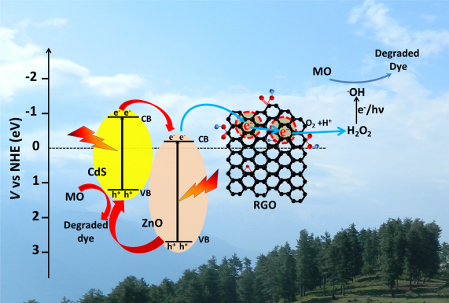
- performance The photocatalytic performance of CdS–ZnO binary and CdS–ZnO–RGO ternary nanocomposites is evaluated by measuring the photodegradation of methyl orange (MO), as model dye, under visible light irradiation from a solar simulator or under natural sun light. Prior to illumination, the suspension was
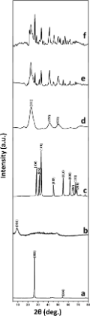


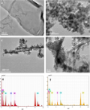


An efficient recyclable magnetic material for the selective removal of organic pollutants
Beilstein J. Nanotechnol. 2016, 7, 1447–1453, doi:10.3762/bjnano.7.136
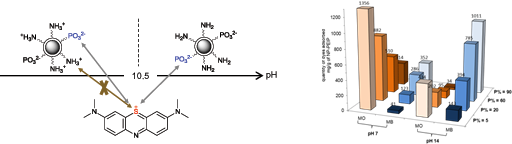
- hazard for human health, even at low concentrations [1][2][3]. Many technologies such as photodegradation, biodegradation, the Fenton process, or extraction by liquid membranes have been developed to eliminate these compounds in wastewater [4][5][6]. Among them, adsorption-based methods are extensively


High performance Ce-doped ZnO nanorods for sunlight-driven photocatalysis
Beilstein J. Nanotechnol. 2016, 7, 1338–1349, doi:10.3762/bjnano.7.125
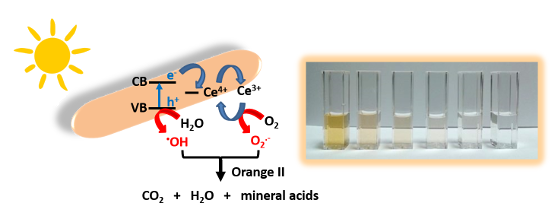
- light irradiation. The possible mechanism of photodegradation is discussed. Finally, ZnO:Ce rods are highly stable, so that they can be reused up to five times without significant performance loss, which is a very attractive feature for practical photocatalytic applications. Results and Discussion
- ability of the Ce dopant to reduce charge recombinations is promising for the efficient photodegradation of pollutants. Photocatalytic degradation of Orange II We first investigated the photocatalytic activities of Ce-doped ZnO in comparison to ZnO rods in the photodegradation of Orange II used at a 10 mg
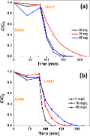
- (5%) catalyst and demonstrates that the photodegradation is complete (see also Figure 8c). The ln(C/C0) plots show a linear relationship with the irradiation time, indicating that the photodegradation of Orange II occurs via a pseudo-first-order kinetic reaction ln(C/C0) = −kt, where k is the







Impact of ultrasonic dispersion on the photocatalytic activity of titania aggregates
Beilstein J. Nanotechnol. 2015, 6, 2423–2430, doi:10.3762/bjnano.6.250
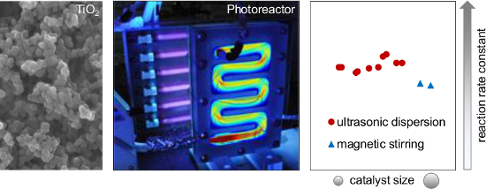
- the insignificant enhancement of MB discoloration. Conclusion This study addressed the photocatalysis performance of suspended catalysts in an aggregated state. In particular, we examined to what degree the state of dispersion of aggregated TiO2 nanoparticles (P25) affects the photodegradation of


Surface-enhanced Raman scattering by colloidal CdSe nanocrystal submonolayers fabricated by the Langmuir–Blodgett technique
Beilstein J. Nanotechnol. 2015, 6, 2388–2395, doi:10.3762/bjnano.6.245
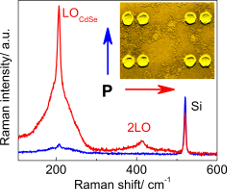
- first can be attributed to scattering by surface optical modes, which was previously well-investigated in CdSe NCs [45][49][50]. The latter may originate from SERS by amorphous selenium formed on the NC surface due to partial photodegradation of CdSe NCs under laser illumination [51][52]. This mode has


High photocatalytic activity of V-doped SrTiO3 porous nanofibers produced from a combined electrospinning and thermal diffusion process
Beilstein J. Nanotechnol. 2015, 6, 1281–1286, doi:10.3762/bjnano.6.132
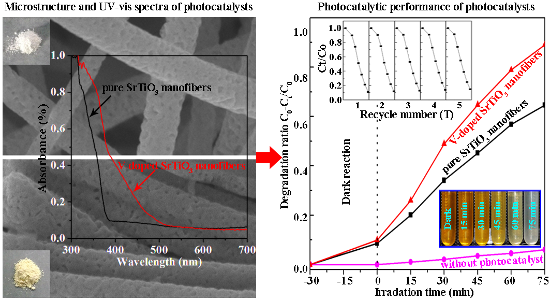
- versatile, economic and simple approach to the preparation of 1D organic or inorganic nanomaterials [23][24]. This is followed by doping of V ions by a low temperature, thermal diffusion process. The photodegradation measurement indicates that V-doped, SrTiO3 porous nanofibers show an enhanced


Tm-doped TiO2 and Tm2Ti2O7 pyrochlore nanoparticles: enhancing the photocatalytic activity of rutile with a pyrochlore phase
Beilstein J. Nanotechnol. 2015, 6, 605–616, doi:10.3762/bjnano.6.62
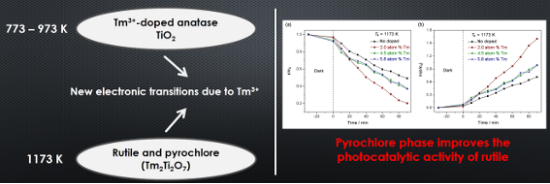
- obtained with a predominant rutile phase. The photodegradation of methylene blue showed that this pyrochlore phase enhanced the photocatalytic activity of the rutile phase. Keywords: nanoparticles; photocatalysis; pyrochlore; titanium dioxide; thulium; Introduction TiO2 is one of the most efficient
- the samples annealed at 1173 K. In turn, the influence of this pyrochlore phase on the photocatalytic activity of rutile-phase TiO2 was analyzed by a study of the photodegradation of methylene blue. Experimental The synthesis method was based on the hydrolysis reaction of titanium(IV) isopropoxide
- photodegradation of methylene blue (MB) was performed using a set of five actinic lamps emitting at around 360 nm. The initial concentration of the aqueous solution of MB (purity 82%, Panreac) was 1.56 · 10−5 M, and the concentration of the photocatalyst was 0.3 g·L−1. The photocatalyst/MB mixture was kept in





