Search results
Search for "polypropylene" in Full Text gives 63 result(s) in Beilstein Journal of Nanotechnology.
Nanofibers for drug delivery – incorporation and release of model molecules, influence of molecular weight and polymer structure
Beilstein J. Nanotechnol. 2015, 6, 1939–1945, doi:10.3762/bjnano.6.198
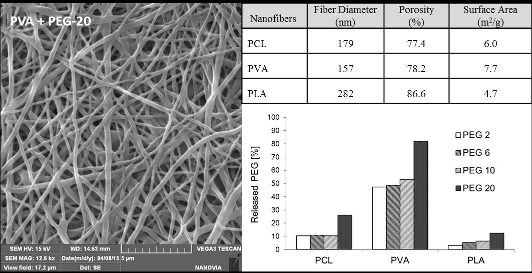
- Penta, Prague, Czech Republic. The deionized water was produced by Milli-Q Millipore, Bedford, MA. Polypropylene nonwoven spunbond material used as a substrate for all polymers was purchased from ATEX, Milan, Italy. Polyethylene glycols with molecular weights of 2,000, 6,000, 10,000 and 20,000 were



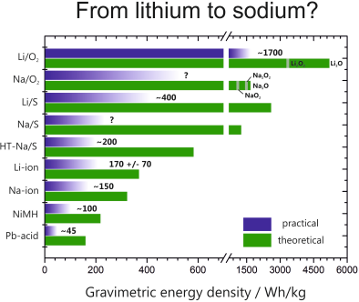
From lithium to sodium: cell chemistry of room temperature sodium–air and sodium–sulfur batteries
Beilstein J. Nanotechnol. 2015, 6, 1016–1055, doi:10.3762/bjnano.6.105


The influence of molecular mobility on the properties of networks of gold nanoparticles and organic ligands
Beilstein J. Nanotechnol. 2014, 5, 1664–1674, doi:10.3762/bjnano.5.177
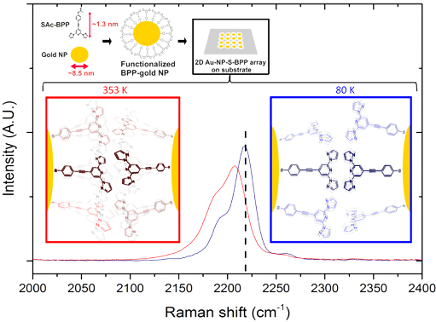
- onto a Si wafer substrate (covered with 300 nm of SiO2) by using a polydimethylsiloxane (PDMS) microcontact printing method [8]. Other suitable types of substrates for the microcontact printing of these samples are glass, quartz, several types of plastics (like polyethylene, polypropylene foils and




Liquid fuel cells
Beilstein J. Nanotechnol. 2014, 5, 1399–1418, doi:10.3762/bjnano.5.153
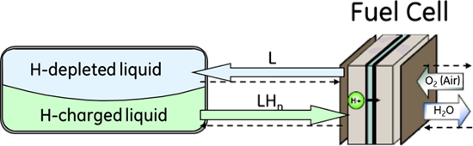
- with a fiber separator made of inexpensive polymer materials (polypropylene or polyamide) and allowing the free movement of all ions resulted in substantial increase in the power density compared to Nafion® CEMs. A cell with non-PGM catalysts (LaNiO3 in the cathode and Co(II) oxide in the anode

Surface topography and contact mechanics of dry and wet human skin
Beilstein J. Nanotechnol. 2014, 5, 1341–1348, doi:10.3762/bjnano.5.147
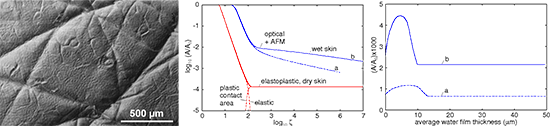
- bridges can form. In a second friction experiment Adams et al. [3] used a polypropylene sphere and in this case no increase in the friction was observed during drying. This is consistent with the fact that the water–polypropylene contact angle θ2 ≈ 102° so that cosθ1 + cosθ2 ≈ −0.03 < 0. Hence, the


Dynamic nanoindentation by instrumented nanoindentation and force microscopy: a comparative review
Beilstein J. Nanotechnol. 2013, 4, 815–833, doi:10.3762/bjnano.4.93
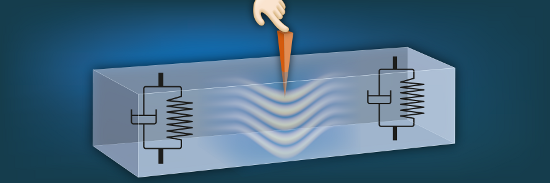
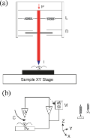
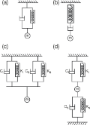
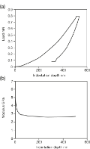
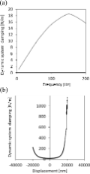
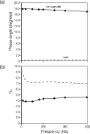
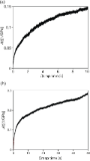
- performed on isotactic polypropylene (iPP, 127,000 g/mol) by using instrumented nanoindentation (Agilent DCM) and AFM tip based nanoindentation (NTMDT NTEGRA). A typical INI load-vs-displacement curve is displayed in Figure 5A. The modulation results (continuous stiffness measurement CSMTM, modulation




Multiple regimes of operation in bimodal AFM: understanding the energy of cantilever eigenmodes
Beilstein J. Nanotechnol. 2013, 4, 385–393, doi:10.3762/bjnano.4.45
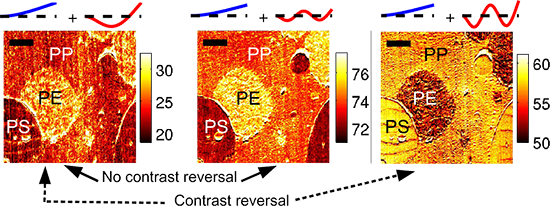
- polypropylene (PP, ExxonMobil Chemical Company), high density polyethylene (PE, ExxonMobil Chemical Company), and polystyrene (PS, Polysciences). A blend of 3:1:1 (by mass) of PP/PE/PS was prepared in a Brabender mixer (Brabender Instruments, South Hackensack, NJ) at 180 °C, 60 rpm, and 5 min of mixing and then
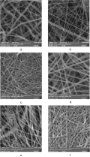
- AFM images based on morphology, surface roughness, and height. Specifically, the matrix (dominant component) is polypropylene, with approximately circular polyethylene and polystyrene domains. The polyethylene domains appear rough because of the lamellar structure, and the polystyrene domains show
- polyethylene has a lower (darker) amplitude (b) and phase (d) than either the polystyrene or the polypropylene. A second observed difference between the bimodal images in “1st + 2nd” eigenmode versus “1st + 4th” eigenmode occurs in the first eigenmode phase (lag) channel. The overall first eigenmode phase (lag


![[Graphic 3]](/bjnano/content/inline/2190-4286-4-45-i5.png?max-width=637&scale=1.18182) . In the top row (a, b) the first eigen...
. In the top row (a, b) the first eigen...



Continuous parallel ESI-MS analysis of reactions carried out in a bespoke 3D printed device
Beilstein J. Nanotechnol. 2013, 4, 285–291, doi:10.3762/bjnano.4.31
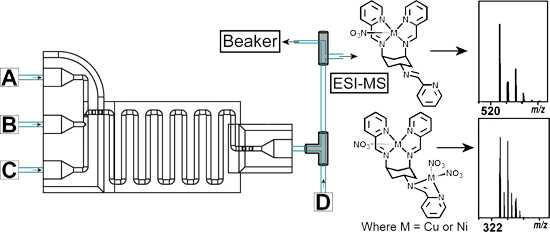
- conducted in a layer-by-layer fashion, and the device used was printed in polypropylene (PP) by using a 3DTouchTM printer, which deposits layers of thermopolymers through heated extruder nozzles to build the designed reactionware. PP is an attractive material for the fabrication of micro- and milliscale


Dimer/tetramer motifs determine amphiphilic hydrazine fibril structures on graphite
Beilstein J. Nanotechnol. 2012, 3, 658–666, doi:10.3762/bjnano.3.75
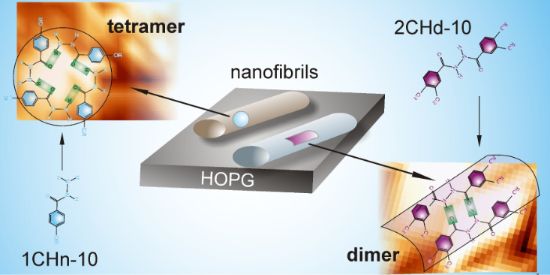
- successful in studying films of strands [22][23][24] and innate graphitic structures [25][26][27], but less so with isolated organic strands. Some reports of STM imaging to obtain high-quality images of strands include those of polypropylene [28], molecular chains of magnetic molecules [29], silicon




Repulsive bimodal atomic force microscopy on polymers
Beilstein J. Nanotechnol. 2012, 3, 456–463, doi:10.3762/bjnano.3.52
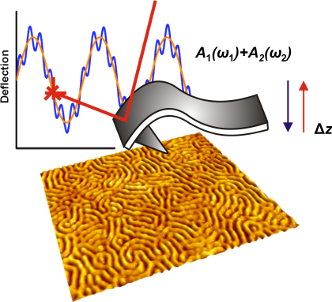
- demonstrated on graphite and DNA [7] and has been combined with nanotomography for the analysis of semicrystalline polypropylene [14]. The additional oscillation of a higher flexural eigenmode adds compositional information to the signal. Polymers are usually characterized in the repulsive regime [17]. Because



Synthesis and catalytic applications of combined zeolitic/mesoporous materials
Beilstein J. Nanotechnol. 2011, 2, 785–801, doi:10.3762/bjnano.2.87
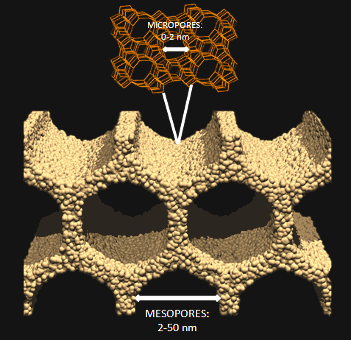
- over 90%. Both Enichem as well as Sumitomo Chemical Co. operate such a TS-1 based caprolactam plant. Epoxidation of propylene: Propylene oxide is one of the largest propene derivatives in production, ranking second behind polypropylene, and is primarily used as a reactive chemical intermediate. The





Recrystallization of tubules from natural lotus (Nelumbo nucifera) wax on a Au(111) surface
Beilstein J. Nanotechnol. 2011, 2, 261–267, doi:10.3762/bjnano.2.30
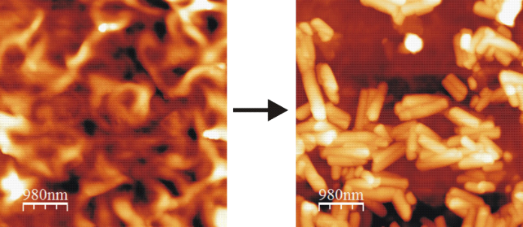
- parallel orientation of tubules on a number of different substrates, e.g., polyethylene, polypropylene, Teflon, alumina, mica, glass, etc. However, they applied a larger volume of solution of 50–250 µL (10 mg·mL−1) which effectively masks any effect of the substrate. A more recent study by Koch et al. [9


Enhanced visible light photocatalysis through fast crystallization of zinc oxide nanorods
Beilstein J. Nanotechnol. 2010, 1, 14–20, doi:10.3762/bjnano.1.3
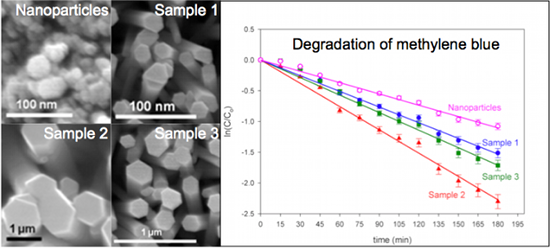
- , polypropylene, steel, cotton, amongst others, through proper seeding and hence is suitable for a large number of applications, e.g., wastewater treatment, etc. that is scalable for practical uses. Experimental Materials used Zinc acetate dihydrate [(CH3COO)2Zn·2H2O, Merck], sodium hydroxide [NaOH, Merck], zinc