


Search results
Search for "remediation" in Full Text gives 78 result(s) in Beilstein Journal of Nanotechnology.
Nanocellulose: Recent advances and its prospects in environmental remediation
Beilstein J. Nanotechnol. 2018, 9, 2479–2498, doi:10.3762/bjnano.9.232
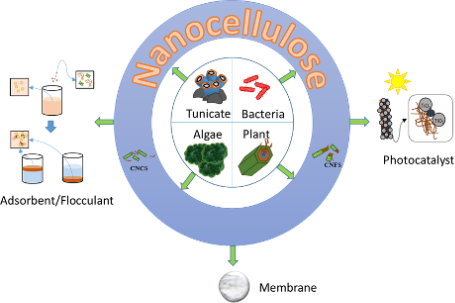
- many other sustainable functional nanomaterials, nanocellulose is drawing increasing interest for use in environmental remediation technologies due to its numerous unique properties and functionalities. Nanocellulose is usually derived from the disintegration of naturally occurring polymers or produced
- by the action of bacteria. In this review, some invigorating perspectives on the challenges, future direction, and updates on the most relevant uses of nanocellulose in environmental remediation are discussed. The reported applications and properties of nanocellulose as an adsorbent, photocatalyst
- , flocculant, and membrane are reviewed in particular. However, additional effort will be required to implement and commercialize nanocellulose as a viable nanomaterial for remediation technologies. In this regard, the main challenges and limitations in working with nanocellulose-based materials are identified


Block copolymers for designing nanostructured porous coatings
Beilstein J. Nanotechnol. 2018, 9, 2332–2344, doi:10.3762/bjnano.9.218

- many separation processes of complex matrices, such as in the clarification of beverages (i.e., milk, beer, and juices), the remediation of polluted water, or in the selective removal of bacteria and viruses from bloods. The main advantage of this technique is that membrane technology is a simple


Hierarchical heterostructures of Bi2MoO6 microflowers decorated with Ag2CO3 nanoparticles for efficient visible-light-driven photocatalytic removal of toxic pollutants
Beilstein J. Nanotechnol. 2018, 9, 2297–2305, doi:10.3762/bjnano.9.214
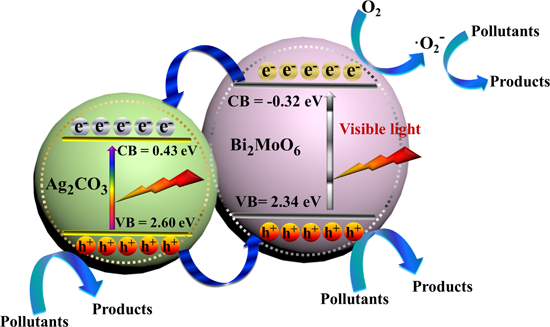
- environmental remediation [3][4][5][6]. Crucial to photocatalysis is to obtain high-performance photocatalysts [7][8]. Obtaining excellent photocatalysts that can be excited by visible light (43% of the solar energy spectrum) is very important for practical applications [9][10][11][12][13][14]. Bi2MoO6 has been
- efficient VLD photocatalyst with promising applications in environmental remediation. Experimental Materials Bi(NO3)3·5H2O, NaHCO3, NH3·H2O, Na2MoO4·2H2O, rhodamine B (RhB), methyl blue (MB), tetracycline hydrochloride (TC), methyl orange (MO), isopropanol (IPA), AgNO3, p-benzoquinone (BQ), and ammonium





Cr(VI) remediation from aqueous environment through modified-TiO2-mediated photocatalytic reduction
Beilstein J. Nanotechnol. 2018, 9, 1448–1470, doi:10.3762/bjnano.9.137

- industrial processes pose threat to aquatic life and downstream users. Various treatment techniques, such as chemical reduction, ion exchange, bacterial degradation, adsorption and photocatalysis, have been exploited for remediation of Cr(VI) from wastewater. Among these, photocatalysis has recently gained
- practical applications in remediation of Cr(VI) from wastewater were addressed in the Conclusion section as well. The future perspectives of the field presented in this review are focused on the development of whole-solar-spectrum responsive, TiO2-coupled photocatalysts which provide efficient


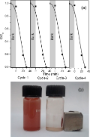

Facile synthesis of a ZnO–BiOI p–n nano-heterojunction with excellent visible-light photocatalytic activity
Beilstein J. Nanotechnol. 2018, 9, 789–800, doi:10.3762/bjnano.9.72
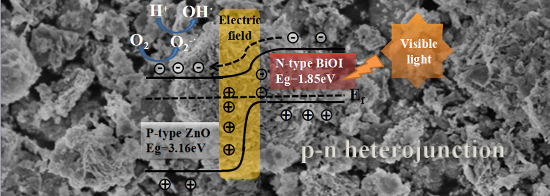
- well as the high specific area. Keywords: BiOI; photocatalytic degradation; p–n heterojunction; ZnO; Introduction The development of semiconductor photocatalysis has opened a new horizon for environmental pollution remediation and provides a potential solution to the global energy problem given the


Surface-plasmon-enhanced ultraviolet emission of Au-decorated ZnO structures for gas sensing and photocatalytic devices
Beilstein J. Nanotechnol. 2018, 9, 771–779, doi:10.3762/bjnano.9.70
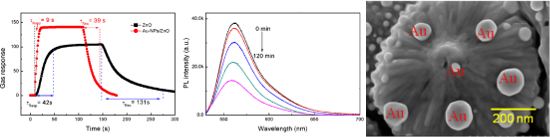
- are expected to serve as a potential photocatalysts with highly effective performance. For instance, plasmonic Au NP/vertically aligned ZnO nanorod structures were proposed for water splitting, solar cells, and environmental remediation [17][18][19]. Ag/ZnO nanohybrid structures were synthesized and

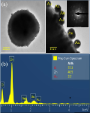


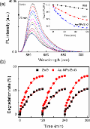

Perovskite-structured CaTiO3 coupled with g-C3N4 as a heterojunction photocatalyst for organic pollutant degradation
Beilstein J. Nanotechnol. 2018, 9, 671–685, doi:10.3762/bjnano.9.62
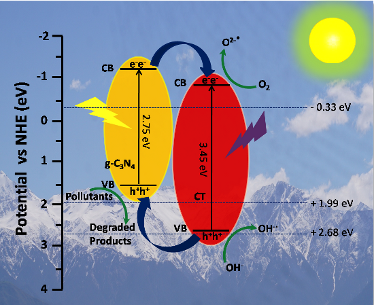
- degradation of pollutants has been proposed and discussed. Keywords: CaTiO3; graphitic carbon nitride (g-C3N4); heterojunction photocatalyst; pollutant degradation; Introduction Photocatalysis is recognized as an attractive approach for environmental remediation and energy generation applications due to its
- earth-abundant carbon and nitrogen elements and the low cost of the initial precursors promotes it as a promising photocatalytic material for diverse applications, such as energy generation [17][18][19], sensor [20], and fuel cell applications [21], as well as environmental remediation [22]. The band
- attributed to the exact positions of energy band offsets of the coupled materials, which facilitates the photogenerated charge transfer and effectively suppresses their recombination. Moreover, perovskite materials are also potential candidates for environmental remediation applications and are well-explored


Mechanistic insights into plasmonic photocatalysts in utilizing visible light
Beilstein J. Nanotechnol. 2018, 9, 628–648, doi:10.3762/bjnano.9.59
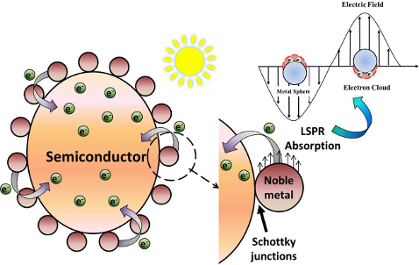
- , promising and reliable approach towards energy generation and environmental remediation [1][2]. In line with this, the identification of photocatalysts capable of harvesting energy from the wider electromagnetic spectrum has become the focus of most researchers. The ability to harvest such a wide spectrum
- the formation and identification of ROSs and their interaction with pollutants was clearly presented. The future prospects of these sustainable photocatalysts with real-time applications for energy storage and environmental remediation were thoroughly reviewed. The present review also revealed the




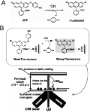


Sugarcane juice derived carbon dot–graphitic carbon nitride composites for bisphenol A degradation under sunlight irradiation
Beilstein J. Nanotechnol. 2018, 9, 353–363, doi:10.3762/bjnano.9.35
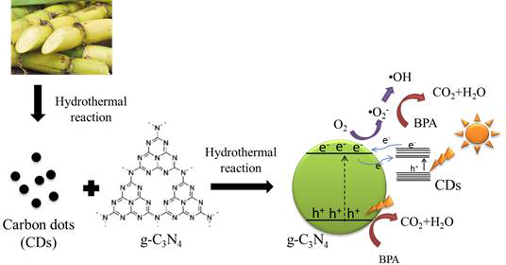
- amount of Ag (3.0 wt %) and CDs (1.0 wt %) resulted in a 10-fold higher degradation rate of naproxen [40]. Much of the work on g-C3N4 has been reported for environmental and energy remediation [41][42]. The above-mentioned research works suggested that the enhancement of the photocatalytic performance


Involvement of two uptake mechanisms of gold and iron oxide nanoparticles in a co-exposure scenario using mouse macrophages
Beilstein J. Nanotechnol. 2017, 8, 2396–2409, doi:10.3762/bjnano.8.239
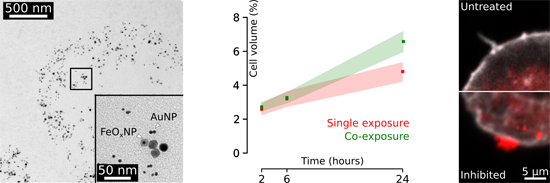
- rise of nanotechnology-containing products [1]. Numerous contemporary developments in consumer products (e.g., food additives, cosmetics and sporting equipment), environmental remediation, medicine and information technology heavily rely on innovative nanomaterial-driven industrial technology [2]. A




Two-dimensional carbon-based nanocomposites for photocatalytic energy generation and environmental remediation applications
Beilstein J. Nanotechnol. 2017, 8, 1571–1600, doi:10.3762/bjnano.8.159
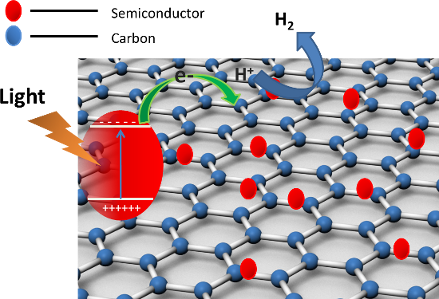
- sustainable source for energy generation and environmental remediation, photocatalytic water splitting and photocatalytic pollutant degradation have recently gained significant importance. Research in this field is aimed at solving the global energy crisis and environmental issues in an ecologically-friendly
- energy generation and environmental remediation using two-dimensional carbon-based nanocomposites. It begins with a brief introduction to the field, basic principles of photocatalytic water splitting for energy generation and environmental remediation, followed by the properties of carbon-based
- perspectives of research in this field are also briefly mentioned. Keywords: energy generation; environmental remediation; graphene; graphitic carbon nitride; nanocomposites; photocatalysis; two-dimensional carbon; Review Introduction The problems of global energy shortage and environmental pollution are


Needs and challenges for assessing the environmental impacts of engineered nanomaterials (ENMs)
Beilstein J. Nanotechnol. 2017, 8, 989–1014, doi:10.3762/bjnano.8.101

- remediation [4]. Given the rapid growth of the market for ENMs, there is concern about potential adverse impacts from possible exposures to ENMs during production, distribution, use, and disposal [5]. Human exposure to ENMs can occur through inhalation, ingestion or dermal absorption. Despite the fact that

High photocatalytic activity of Fe2O3/TiO2 nanocomposites prepared by photodeposition for degradation of 2,4-dichlorophenoxyacetic acid
Beilstein J. Nanotechnol. 2017, 8, 915–926, doi:10.3762/bjnano.8.93
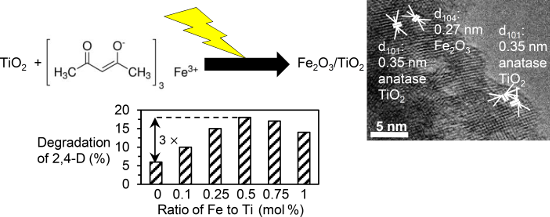
- have been widely suggested for environmental remediation under mild conditions. In the presence of only a photocatalyst and a light source of appropriate energy, the process can mineralize organic pollutants to harmless products such as carbon dioxide and water. Among the semiconductor photocatalysts


Laser irradiation in water for the novel, scalable synthesis of black TiOx photocatalyst for environmental remediation
Beilstein J. Nanotechnol. 2017, 8, 196–202, doi:10.3762/bjnano.8.21
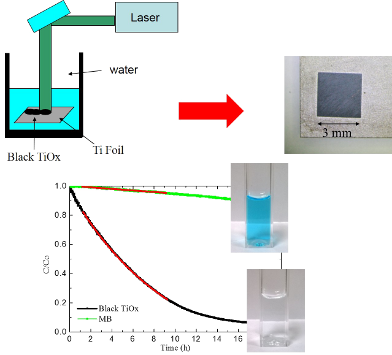
- inertness (even in a corrosive environment), stability, abundance and nontoxicity. Nevertheless, its exploitation in environmental remediation, and in particular in water purification, is relatively limited due to its wide band gap (≈3.2 eV). This means that only 5% of the incoming solar radiation can be


An efficient recyclable magnetic material for the selective removal of organic pollutants
Beilstein J. Nanotechnol. 2016, 7, 1447–1453, doi:10.3762/bjnano.7.136
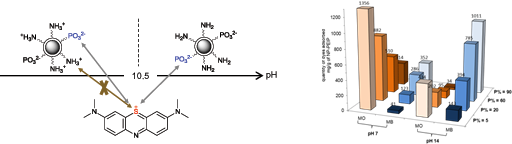
- successfully tested on both [15]. In addition, they often adsorb a limited amount of contaminant, considerably lower than the capacity of activated charcoal. We report herein a new adsorption process for water remediation, based on partially phosphonated polyethylenimine (PEIP)-coated magnetic nanoparticles
- . All of these results show that, in the case of maghemite coated with phosphonated PEI adsorbing MO and MB, electrostatic interactions are predominant. Quantities of pollutant extracted according to the percentage of phosphonation Performances of remediation for nanoparticles coated with different


Development of highly faceted reduced graphene oxide-coated copper oxide and copper nanoparticles on a copper foil surface
Beilstein J. Nanotechnol. 2016, 7, 1010–1017, doi:10.3762/bjnano.7.93
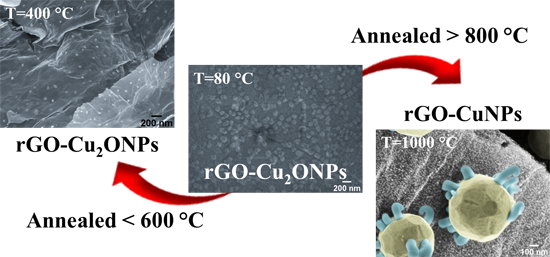
- combine GO with inorganic nanoparticles has led to nanocomposites with multiple functionalities [4][5]. Because of this, nanocomposites based on GO/inorganic nanoparticles are currently of interest for applications in biomedicine, energy production, electronics and environmental remediation [6][7][8]. A


Novel roles for well-known players: from tobacco mosaic virus pests to enzymatically active assemblies
Beilstein J. Nanotechnol. 2016, 7, 613–629, doi:10.3762/bjnano.7.54
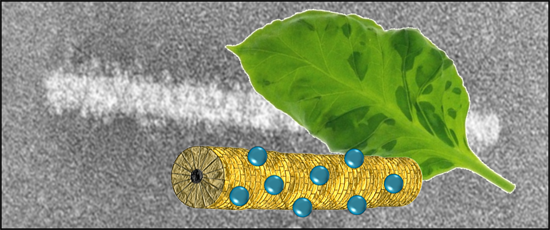
- , batteries, photoelectrochemical cells or environmental remediation [63][93][94][95][96][97][98][99][100][101][102][103][104][105][106][107][108][109][110][111][112][113], as scaffolds for the display of reporter dyes, nanoparticles or contrast agents such as gadolinium complexes, for light harvesting


Application of biclustering of gene expression data and gene set enrichment analysis methods to identify potentially disease causing nanomaterials
Beilstein J. Nanotechnol. 2015, 6, 2438–2448, doi:10.3762/bjnano.6.252

- applications [43]. Current applications of NMs include therapeutic applications (e.g., nanomedicine, drug delivery, diagnostics), agriculture, manufacturing, electronics, cosmetics, textiles, and environmental remediation and protection. Although NMs are synthesized from their corresponding, known, bulk


Structural and magnetic properties of iron nanowires and iron nanoparticles fabricated through a reduction reaction
Beilstein J. Nanotechnol. 2015, 6, 1652–1660, doi:10.3762/bjnano.6.167
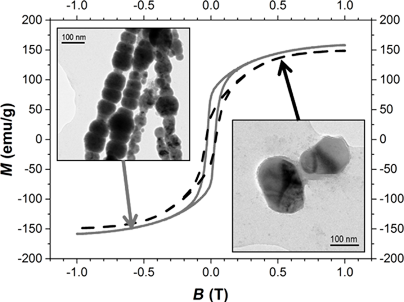
- treatment [3] as well as labelling and separation of biological materials [4]. Besides the biomedical exploitation, iron-based nanostructures can be used in the fields of data storage [5], catalysis [6], energy storage [7] and environmental remediation [8]. However, different properties are required for




Thermal treatment of magnetite nanoparticles
Beilstein J. Nanotechnol. 2015, 6, 1385–1396, doi:10.3762/bjnano.6.143
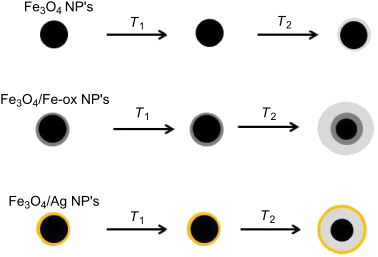
- materials, sensors and catalysts [4], or even environmental remediation or sieves [5]. For this reason, the study of the physical properties and the chemical and thermal stability of ferrite nanoparticles is of crucial importance [6]. Moreover, magnetite nanostructures can be relatively easy to obtain by a





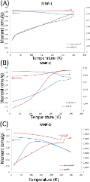

Simulation tool for assessing the release and environmental distribution of nanomaterials
Beilstein J. Nanotechnol. 2015, 6, 938–951, doi:10.3762/bjnano.6.97

- associated with cosmetic applications, which represent the largest fraction at ≈53%, while those associated with coatings, paints, pigments represent ≈44%, with remainder due to energy applications (e.g., photovoltaics, energy storage [7]), environmental (e.g., remediation [7]), and plastic applications



Applications of three-dimensional carbon nanotube networks
Beilstein J. Nanotechnol. 2015, 6, 792–798, doi:10.3762/bjnano.6.82

- -sustaining assemblies that show high porosity [3], structural stability, and good electrical conductivity [4] are the best candidates for environmental applications such as filtration [5], separation [6], biological sensors [7], and oil-spill remediation [8] but also as mechanical actuators [9], catalytic


Multifunctional layered magnetic composites
Beilstein J. Nanotechnol. 2015, 6, 134–148, doi:10.3762/bjnano.6.13
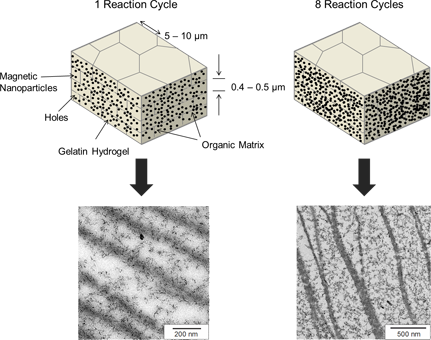
- in aqueous solution by using empirical force fields [44][45][63][64]. Investigation of biologically designed metal-specific chelators for potential metal recovery and waste remediation applications [65], and the Kawska–Zahn docking procedure were described previously [43]. Along this line, ion






Carbon nano-onions (multi-layer fullerenes): chemistry and applications
Beilstein J. Nanotechnol. 2014, 5, 1980–1998, doi:10.3762/bjnano.5.207

- layers between the biomolecules and the gold surface of the sensor and led to an amplified signal of the biosensor, as determined by surface plasmon resonance spectroscopy. In addition, the biocompatibility of CNOs was investigated and found to be excellent. Environmental remediation: An application of
- CNO in environmental remediation was studied by Li group [54], who revealed that surface-oxidized CNO in aqueous suspensions have a high sorption capacity for heavy metal ions such as Pb2+, Cu2+, Cd2+, Ni2+ and Zn2+. The sorption capacity of oxidized CNOs was found to be up to ten times higher than
- the one of fullerene C60. These encouraging results could be a first step toward in situ remediation of heavy metal contaminants. Electronic applications Capacitors: Carbon materials are commonly used as electrode materials in capacitors, but the first study probing CNOs as electrode materials in


Pyrite nanoparticles as a Fenton-like reagent for in situ remediation of organic pollutants
Beilstein J. Nanotechnol. 2014, 5, 855–864, doi:10.3762/bjnano.5.97
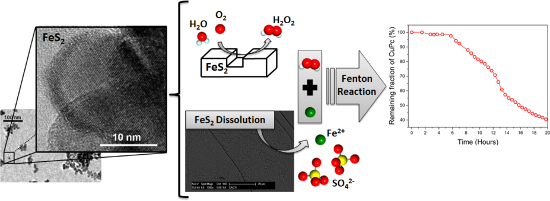
- growing interest in nanomaterials for green environmental remediation. For example, catalytically active synthetic nanoparticles inspired by natural minerals have been combined with in situ advanced oxidation processes (AOPs) as a potential strategy to remediate contaminants [1][2][3]. These AOPs generate
- the precipitation of iron oxyhydroxides. However, this control makes the process difficult and cost expensive. Green nanotechnology can be used in various industrial and in situ remediation processes and can be an effective option for wastewater treatment. Several studies have recently reported the





