


Search results
Search for "seeds" in Full Text gives 98 result(s) in Beilstein Journal of Nanotechnology.
A highly efficient porous rod-like Ce-doped ZnO photocatalyst for the degradation of dye contaminants in water
Beilstein J. Nanotechnol. 2019, 10, 1157–1165, doi:10.3762/bjnano.10.115
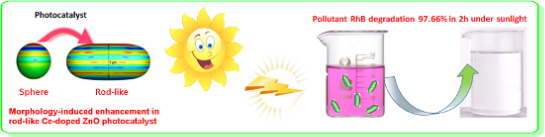
- affects the formation of ZIF-8. More specifically, it undergoes three main stages: gel formation, nucleation and crystallization [23]. According to Mahmoud’s [35] report, the Ce element which is doped into the lattice of Zn seeds may lower the surface energy, thus leading to a new morphology. Labhane et


Features and advantages of flexible silicon nanowires for SERS applications
Beilstein J. Nanotechnol. 2019, 10, 725–734, doi:10.3762/bjnano.10.72

- signal significantly increases after washing with water. The first observation can be clearly explained as follows: The temperature during annealing prior to VLS synthesis influences the size and distribution of the Au seeds on the Si wafer, while the VLS process temperature determines growth rate and


Self-assembly and wetting properties of gold nanorod–CTAB molecules on HOPG
Beilstein J. Nanotechnol. 2019, 10, 696–705, doi:10.3762/bjnano.10.69
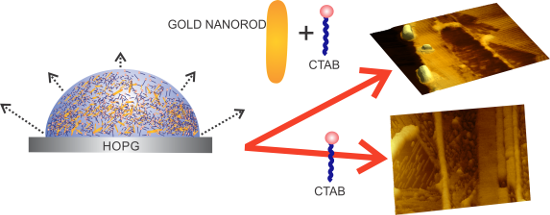
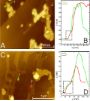
- continuously stirred for 3 min. The mixture quickly turned light brown, indicating the formation of gold seeds. The solution was kept unperturbed at room temperature (25 °C) for two hours. To synthesize gold nanorods with an aspect ratio (AR) of ≈3, the growth solution was prepared by introducing 50 µL of


Ultraviolet patterns of flowers revealed in polymer replica – caused by surface architecture
Beilstein J. Nanotechnol. 2019, 10, 459–466, doi:10.3762/bjnano.10.45
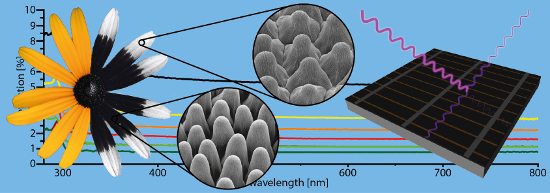
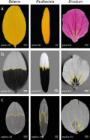
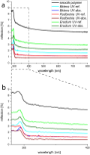
- have been found in leaves, petals or seeds [17][18][19]. Whitney et al. [20] reported, for example, that this iridescence acts as a cue for pollinators and has also assumed such an effect in the UV-range. However, the influence of the plant surface structure – especially papillae – on UV-reflection up


Advanced scanning probe lithography using anatase-to-rutile transition to create localized TiO2 nanorods
Beilstein J. Nanotechnol. 2019, 10, 412–418, doi:10.3762/bjnano.10.40
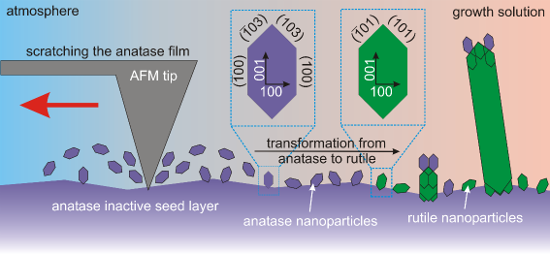
- for 256 times (128 times in each direction) in order to generate a sufficient amount of seeds. The technique was performed under ambient conditions with a writing speed of 10 μm/s (scan frequency: 0.5 Hz; line length: 10 μm). After seed generation, the samples were placed top-side down in a Teflon
- techniques yield equal results. In case of conventional electron-beam lithography, titanium was deposited on a patterned electron resist. After removing the mask, the titanium was oxidized at 850 °C resulting in polycrystalline rutile seeds along the pattern lines as we described previously [36]. The seed
- nanocrystals happens during the hydrothermal growth process at temperatures above 120 °C as described by Li et al. [37]. The resulting rutile seeds are significantly smaller than the final dimensions of the rutile nanorods. Excluding competing processes resulting in localized growth of nanorods Before specific


New micro/mesoporous nanocomposite material from low-cost sources for the efficient removal of aromatic and pathogenic pollutants from water
Beilstein J. Nanotechnol. 2019, 10, 119–131, doi:10.3762/bjnano.10.11
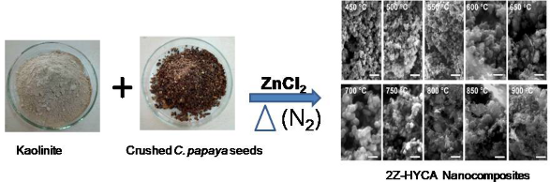
- Science), Theodor-Körner-Allee 16, 02763 Zittau, Germany Department of Earth and Environmental Science, University of Potsdam, 14476 Potsdam, Germany 10.3762/bjnano.10.11 Abstract A new micro/mesoporous hybrid clay nanocomposite prepared from kaolinite clay, Carica papaya seeds, and ZnCl2 via calcination
- matter. The new composite is stable up to 900 °C and is an efficient adsorbent for the removal of a water micropollutant, 4-nitrophenol, and a pathogen, E. coli, from an aqueous medium, suggesting applications in water remediation are feasible. Keywords: 4-nitrophenol; Carica papaya seeds; clay; E. coli
- to produce hybrid carbon/inorganic adsorbents [19][20]. We have previously described the synthesis and performance of a new hybrid material based on kaolinite and Carica papaya seeds for water treatment [1]. The material has several advantages over conventional processes: (i) it can be made from




Colloidal chemistry with patchy silica nanoparticles
Beilstein J. Nanotechnol. 2018, 9, 2989–2998, doi:10.3762/bjnano.9.278
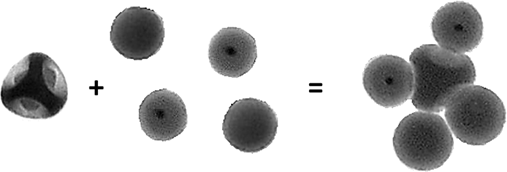
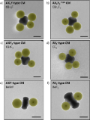
- . Butyl chloromethyl ether was synthesized according to a recipe already published [27]. Synthesis and surface modification of the spherical satellites Synthesis of the “pre-seeds” In a similar manner as described in [28], 100 mL of L-arginine aqueous solution (6 mM) were added into a 150 mL vial
- phase undisturbed and the aqueous phase efficiently mixed (ca. 150 rpm). The reaction was stopped after three days. Silica concentrations were determined by gravimetric analysis. In a given volume, the number of silica seeds was calculated from the silica concentration and the particle average diameter
- hydroxide and 10 mL of the aqueous dispersion of silica “pre-seeds” were successively introduced. Then, a calculated amount of TEOS (Table 2) was added at the rate of 0.5 mL·h−1. The mixture was stirred until 2 h after the end of the TEOS addition. The polydispersity index (PDI) given in Table 2 was


Comparative biological effects of spherical noble metal nanoparticles (Rh, Pd, Ag, Pt, Au) with 4–8 nm diameter
Beilstein J. Nanotechnol. 2018, 9, 2763–2774, doi:10.3762/bjnano.9.258
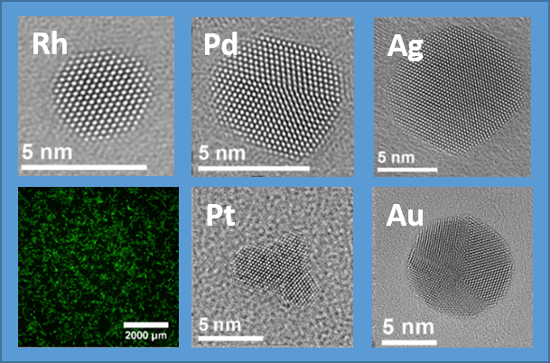
- -octadecene, OAm) [68], or in aqueous solutions. Depending on the additives and the reaction conditions, a variety of different shapes and sizes can be realized [66][67][69][70][71][72][73][74]. The generation of small silver nanoparticles (3–6 nm) is often performed only to generate seeds as a precursor for


Size-selected Fe3O4–Au hybrid nanoparticles for improved magnetism-based theranostics
Beilstein J. Nanotechnol. 2018, 9, 2684–2699, doi:10.3762/bjnano.9.251
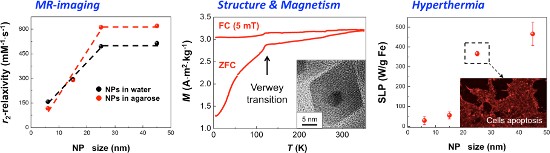
- be adjusted by heterogeneous nucleation of NPs on noble metal seeds [21][22]. Additionally, such bifunctional Fe3O4–Au NPs are potentially applicable for targeted drug delivery, enhanced hyperthermia, multimodal imaging and theranostics [8][23][24][25][26][27]. In this work, we present the first size
- . Details regarding the synthesis are given in the Experimental section. In brief, Fe3O4 was grown on either in situ synthesized Au NPs (samples MNP-6 and MNP-15) or presynthesized Au seeds (samples MNP-25 and MNP-44). In addition, by using three different solvents (phenyl ether, benzyl ether, 1-octadecene
- are pairwise connected and form hybrid NPs. The magnetite NPs formed using the in situ synthesized Au seeds have a spherical or poorly facetted shape (Figure 1A and 1B), while NPs obtained using presynthesized Au seeds are highly facetted (Figure 1C and 1D). The formation of highly facetted magnetite


Synthesis of hafnium nanoparticles and hafnium nanoparticle films by gas condensation and energetic deposition
Beilstein J. Nanotechnol. 2018, 9, 1868–1880, doi:10.3762/bjnano.9.179
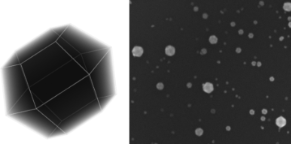
- target (99.95%). Due to collisions with Ar gas, cooling of the sputtered metal atoms takes place, leading to a supersaturated metal atom vapor. Collisions between the cooled metal atoms lead to nucleation and growth of initial clusters. Collisions between these initial cluster ‘seeds’ followed by






Formation and development of nanometer-sized cybotactic clusters in bent-core nematic liquid crystalline compounds
Beilstein J. Nanotechnol. 2018, 9, 1288–1296, doi:10.3762/bjnano.9.121
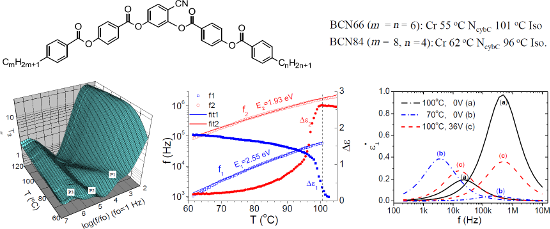
- layers being present in the nematic phase. Hence these are found to exist only at temperatures close to the nematic–smectic transition temperature. We surmise that the mechanism for the formation of cybotactic clusters in the bent-core LCs may differ from that in calamitics. In the former, the seeds of
- above the isotropic–nematic transition temperature. The latter observation arises as seeds of cybotactic clusters are formed in the isotropic phase. Small clusters have also been observed by dynamic light scattering (DLS) [57]. The strength of this process is observed to increase with a reduction in


Bioinspired self-healing materials: lessons from nature
Beilstein J. Nanotechnol. 2018, 9, 907–935, doi:10.3762/bjnano.9.85
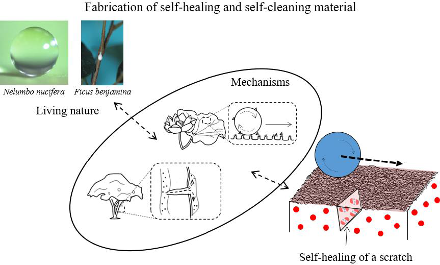
- remove damaged tissue and to drop seeds and replicate [33]. Because plants cannot move, another mechanism has evolved to remove material. Plants use abscission, a process of weakening part of a stem to cause it to break. After deciding the location of the break, known as the abscission zone, the plant
- functional coating, this process lets a plant simulate complex behavior without the need to move. To sum up, in order to remove material from itself or to drop seeds, plants have developed the ability to weaken stem and branches allowing them to break more easily. They accomplish this by protecting the part








Surface-plasmon-enhanced ultraviolet emission of Au-decorated ZnO structures for gas sensing and photocatalytic devices
Beilstein J. Nanotechnol. 2018, 9, 771–779, doi:10.3762/bjnano.9.70
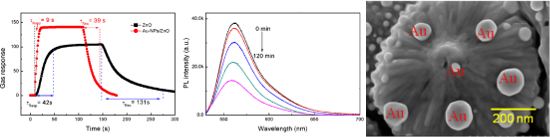
- Figure 2b. The formation of such a ZnO sub-micrometer sphere suggests that the acetate ions from the precursor salt can be helpful ZnO seeds, which grow preferentially along the c-axis during the thermal treatment. Mono-ethanolamine (MEA) molecules not only act as a dispersant to prevent particle




Tuning adhesion forces between functionalized gold colloidal nanoparticles and silicon AFM tips: role of ligands and capillary forces
Beilstein J. Nanotechnol. 2018, 9, 660–670, doi:10.3762/bjnano.9.61
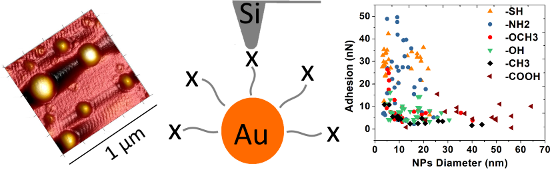
- transmission electron microscopy (TEM) images of Au NPs of 30 ± 5 nm diameter. Growth of Au NPs from 30 to 70 nm in diameter. Au NPs were synthesized by a seed-mediated process described in [48]. Immediately after the synthesis of the Au seeds (NPs of 15 nm diameter) the same reaction vessel was heated until


Colloidal solution of silver nanoparticles for label-free colorimetric sensing of ammonia in aqueous solutions
Beilstein J. Nanotechnol. 2018, 9, 499–507, doi:10.3762/bjnano.9.48
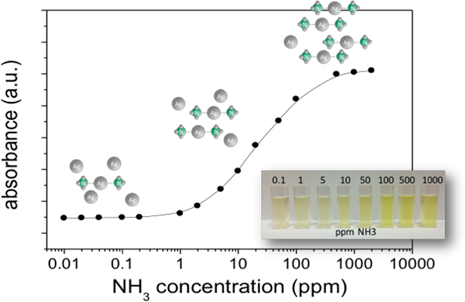
- detection of ammonia. The seeds of AgNPs have been prepared using an environmentally friendly hydrothermal method that uses sucralose as a stabilizer and glucose as a reducing agent. Briefly, 2 g of α-D-glucose and 2 g of sucralose were dissolved in 100 mL of ultrapure water. The solution is heated to 90 °C
- , then 2.5 mL of an aqueous AgNO3 solution (c = 10−2 M) is added and the solution is maintained at this temperature for 5 min until it becomes pale yellow, which is indicative for the formation of AgNPs seeds. The colloidal solution with newly formed seeds is not stable. It is necessary to reduce the



The rational design of a Au(I) precursor for focused electron beam induced deposition
Beilstein J. Nanotechnol. 2017, 8, 2753–2765, doi:10.3762/bjnano.8.274
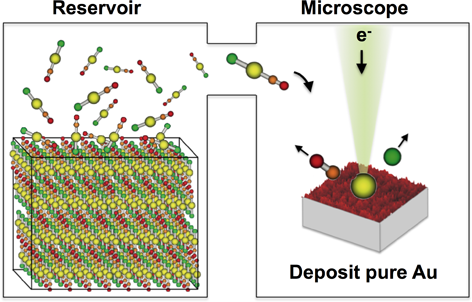
- . High-purity Au deposits are of interest for many applications, such as the directed self-assembly of functional organic molecules [45], seeds for the growth of nanorods or nanotubes [46] and for plasmonics [47]. Two Au(I) compounds have been used for the deposition of pure gold. Utke et al


The role of ligands in coinage-metal nanoparticles for electronics
Beilstein J. Nanotechnol. 2017, 8, 2625–2639, doi:10.3762/bjnano.8.263
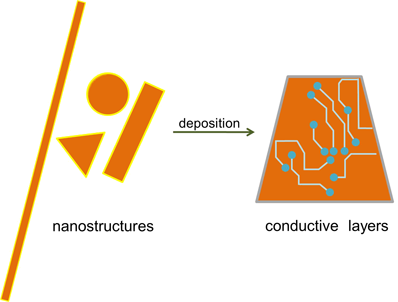
- depending on their binding affinity on different facets. They cover the nuclei as they form from the molecular precursor and prevent their aggregation [63]. Once the nuclei have grown into structurally well-defined seeds, the ligands can lead to preferential capping, hindering or promoting the growth of
- combination with ascorbic acid and spherical silver seeds yielded rod-like structures in water by reduction of AgNO3. Jana, Gearheart, and Murphy suggested that CTAB forms micellar templates for the anisotropic growth of nanostructures [65]. Recent studies modified this picture and indicated that CTAB
- passivates certain crystal faces (circumferential {100} planes), promoting the growth of nanorods along the ends. It depends on the structure of the initially formed seeds whether the growth occurs in one or two directions [66][67]. Silver nanobars were synthesized in ethylene glycol by the reduction of


Localized growth of carbon nanotubes via lithographic fabrication of metallic deposits
Beilstein J. Nanotechnol. 2017, 8, 2592–2605, doi:10.3762/bjnano.8.260
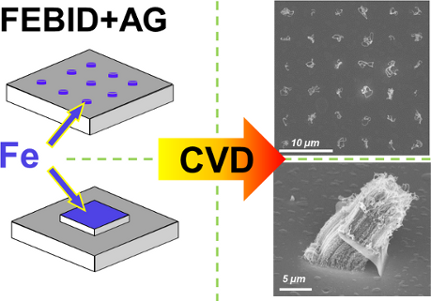
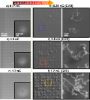
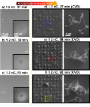
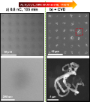
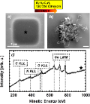
- morphology, for example, as individual nanotubes or as CNT forests. Electron beam induced deposition (EBID) with subsequent autocatalytic growth (AG) was applied to lithographically produce catalytically active seeds for the localized growth of CNTs via chemical vapor deposition (CVD). With the precursor Fe
- (CO)5 we were able to fabricate clean iron deposits via EBID and AG. After the proof-of-principle that these Fe deposits indeed act as seeds for the growth of CNTs, the influence of significant EBID/AG parameters on the deposit shape and finally the yield and morphology of the grown CNTs was
- catalysts to synthesize well-defined CNTs with controllable morphology via CVD. The influence of the chemical composition and, in particular, of the fabrication parameters (i.e., electron dose and AG time) of Fe deposits were investigated with respect to their suitability and properties as seeds for




Advances and challenges in the field of plasma polymer nanoparticles
Beilstein J. Nanotechnol. 2017, 8, 2002–2014, doi:10.3762/bjnano.8.200
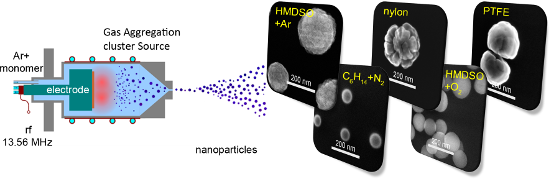
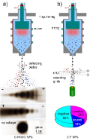
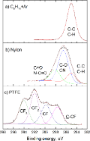
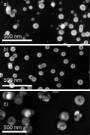
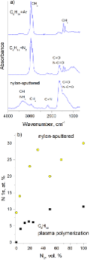
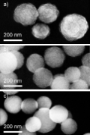
- 16c,d shows their counterparts deposited over the preseeded nylon-sputtered NPs. As expected, normal depositions produce compact coatings with the surface replicating the underlying structure (correspondingly, smooth blank Si or roughened NP seeds). Using GLAD, a columnar structure develops with






Comprehensive Raman study of epitaxial silicene-related phases on Ag(111)
Beilstein J. Nanotechnol. 2017, 8, 1357–1365, doi:10.3762/bjnano.8.137
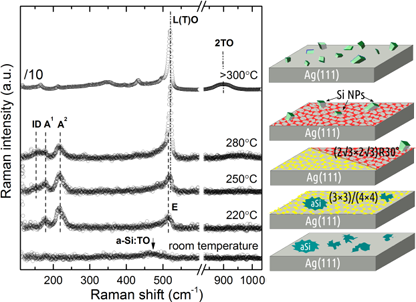
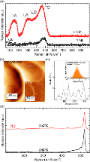
- temperatures (≤20 °C) leads to a similar result. It was recently suggested that impinging Si atoms at room temperature penetrate the Ag(111) surface, exchange with Ag atoms and act as seeds for the growth of recessed islands [29]. At the same time the released Ag atoms would form new Ag(111) terraces by a



Optical response of heterogeneous polymer layers containing silver nanostructures
Beilstein J. Nanotechnol. 2017, 8, 1065–1072, doi:10.3762/bjnano.8.108
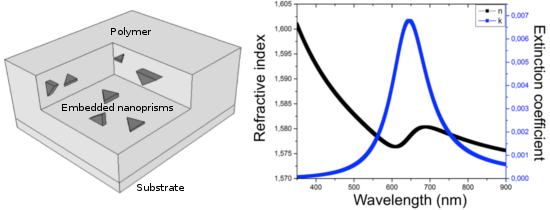
- synthesized, the nanospheres and nanoprisms were at first dispersed in water. The growth of the nanoprisms was fulfilled in two steps: first spherical seeds with specific crystallographic defects were produced, and second, the growth took place on these defects to form nanoprisms [18][21][22]. The absorption
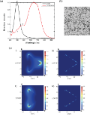
- of the colloidal solutions of the first and second step, as seeds and prisms (Figure 1a), shows the characteristic plasmonic absorption peaks. The peaks 1 and 1’ were identified as the dipolar resonance of the nanoprisms and the nanospheres, respectively. The dipolar resonance of the nanoprisms
- induced absorption between 540–750 nm. The width of this absorption was not due to the distribution in size of the NPs, but rather to the random orientation of the NPs in the solution. The nanoprisms, as synthetized, are visualized in TEM images (Figure 1b). The residual seeds are removed by successive


Formation and shape-control of hierarchical cobalt nanostructures using quaternary ammonium salts in aqueous media
Beilstein J. Nanotechnol. 2017, 8, 494–505, doi:10.3762/bjnano.8.53
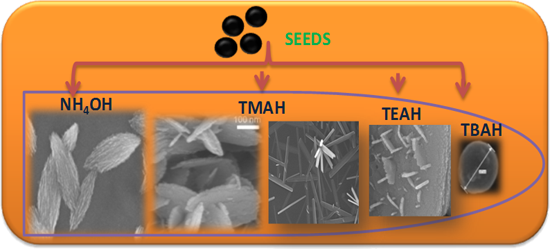
- temperature was maintained at 27 °C unless mentioned otherwise. Synthesis In a typical procedure, cobalt chloride hexahydrate (CoCl2·6H2O) was reduced by sodium borohydride (NaBH4) to obtain spherical cobalt seed nanoparticles with an average size of 29 ± 3 nm. These seeds were washed with an ethanol–water
- ambient conditions and under zero shear is discussed first. The critical steps for the formation of nanoplates are the twinning of seed crystals, the size reduction of particles and their controlled assembly to form two-dimensional nanoplates. The cobalt seeds are small spherical nanoparticles of ca. 30
- –50 nm that show no surface defects or faults (Figure S2, Supporting Information File 1). A mixed population of twinned and un-twinned spherical nanoparticles with an average particle of ca. 15 nm is obtained (Figure 3a) when these seeds are ultrasonicated followed by the instantaneous addition of


Biological and biomimetic materials and surfaces
Beilstein J. Nanotechnol. 2017, 8, 403–407, doi:10.3762/bjnano.8.42

- Barthlott studied the micro- and nanostructures on the surfaces of plant leaves, flowers, seeds and pollen during his Ph.D. thesis at the University of Heidelberg using one of the first scanning electron microscopes (SEMs) available for German botanists. His main interest in these years was plant
Innovations from the “ivory tower”: Wilhelm Barthlott and the paradigm shift in surface science
Beilstein J. Nanotechnol. 2017, 8, 394–402, doi:10.3762/bjnano.8.41
- , the unique natural history of isolated rocky outcrops called inselbergs, or the global distribution of biodiversity), plant surfaces and especially the tremendous diversity of minute structures on leaves, fruits, seeds and other parts of plants represent a common thread through 40 years of scientific
- microscopes in German botany and started to intensively study the fascinating world of micro- and nanostructures of leaves, flowers, seeds or pollen grains. Starting point was a distinct interest in systematics, i.e., the science of recording and arranging organisms according to their relation to each other
- characteristic for distinct genera, families or higher-order groups. One of the first structures studied in detail were seeds [3][4][5][6][7][8]. Apart from the sole description of structures based on the surveys functional aspects of plants were always considered as well [3][6][9][10][11]. Soon, and even more


Association of aescin with β- and γ-cyclodextrins studied by DFT calculations and spectroscopic methods
Beilstein J. Nanotechnol. 2017, 8, 348–357, doi:10.3762/bjnano.8.37
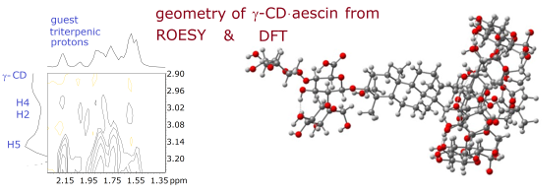
- the seeds of the horse chestnut tree, Aesculus hippocastanum (Hippocastanaceae). It is a natural mixture of acylated triterpene glycosides. In early studies, the saponins present in aescin were divided into two forms, α-aescin and β-aescin, with distinct melting point, hemolytic index, specific





