


Search results
Search for "X-ray spectroscopy" in Full Text gives 211 result(s) in Beilstein Journal of Nanotechnology. Showing first 200.
Antimicrobial metal-based nanoparticles: a review on their synthesis, types and antimicrobial action
Beilstein J. Nanotechnol. 2020, 11, 1450–1469, doi:10.3762/bjnano.11.129

- for the combination of multiple antimicrobial agents in the same NP in order to improve their effects and overcome resistance mechanisms, such as the efflux pump systems. The absence of lipid peroxidation biomarkers and a small amount of metal ions detected by energy-dispersive X-ray spectroscopy in


Ultrasensitive detection of cadmium ions using a microcantilever-based piezoresistive sensor for groundwater
Beilstein J. Nanotechnol. 2020, 11, 1242–1253, doi:10.3762/bjnano.11.108
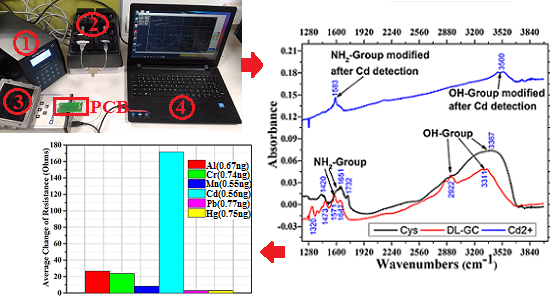
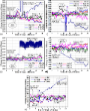
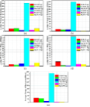
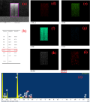
- capture Cd(II) at the picomolar level and the verification of the experimental results using energy-dispersive X-ray spectroscopy (EDX). Fabrication and Calibration of the Piezoresistive Device Previously, a polysilicon-based piezoresistive sensor was fabricated using a standard microfabrication process




Gram-scale synthesis of splat-shaped Ag–TiO2 nanocomposites for enhanced antimicrobial properties
Beilstein J. Nanotechnol. 2020, 11, 1119–1125, doi:10.3762/bjnano.11.96

- Rigaku D/Max 2500 powder diffractometer with Cu Kα radiation (λ = 1.5406 Å). Scanning electron microscopy (SEM, JSM5610LV, JEOL, Japan) was used to observed the morphology of the Ag–TiO2 NPs. The sample components were examined by energy-dispersive X-ray spectroscopy. Fourier-transform infrared


Straightforward synthesis of gold nanoparticles by adding water to an engineered small dendrimer
Beilstein J. Nanotechnol. 2020, 11, 1110–1118, doi:10.3762/bjnano.11.95
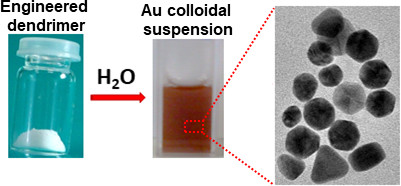
- when the powdered form of this dendrimer was dissolved in water, as shown by transmission electron microscopy (TEM) and energy dispersive X-ray spectroscopy (EDX) analyses. The dendrimers acted simultaneously as mild reducers and as nanoreactors, favoring the self-assembly of gold atoms and promoting
- -controlled nanoparticles (triangles and associated triangles) in an unprecedented way. Characterization of gold nanoparticles by energy-dispersive X-ray spectroscopy In order to determine the presence and location of the different elements energy-dispersive X-ray spectroscopy (EDX) analysis was also


Uniform Fe3O4/Gd2O3-DHCA nanocubes for dual-mode magnetic resonance imaging
Beilstein J. Nanotechnol. 2020, 11, 1000–1009, doi:10.3762/bjnano.11.84
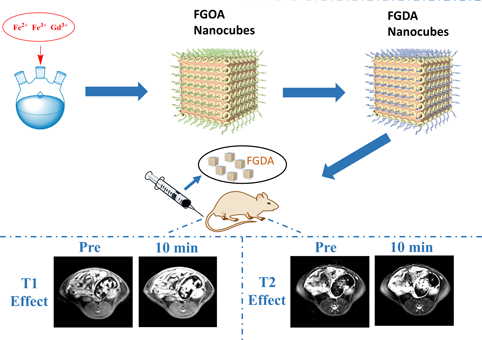
- . Characterization of nanocubes and nanoparticles A high-resolution transmission electron microscope (HRTEM, JEM-2010F, Japan), operated at an acceleration voltage of 200 kV, was used to investigate the morphology and size of the nanocubes. Energy-dispersive X-ray spectroscopy (EDS, Oxford, X-MaxN, UK) was used to
- (about 6.33 ± 0.09 nm) but were still monodisperse (Figure 2b,e). The change in size might have happened due to changes in the surface when the FGOA nanocubes were converted into FGDA nanocubes. In order to verify the composition and distribution of elements in the FGDA nanocubes, energy-dispersive X-ray
- spectroscopy (EDS) was performed. The EDS spectrum shows that iron, gadolinium and oxygen were the main elements present in the nanocubes. No other impurity elements can be detected except carbon element, which contributes from carbon film on copper mesh used in the EDS experiments. EDS mapping indicates that



Effect of Ag loading position on the photocatalytic performance of TiO2 nanocolumn arrays
Beilstein J. Nanotechnol. 2020, 11, 717–728, doi:10.3762/bjnano.11.59
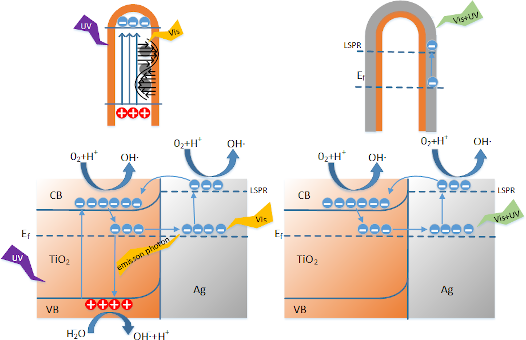
- structure. Figure 2c shows the energy-dispersive X-ray spectroscopy (EDS) spectrum of TNC, and we find that the elements of the array are mainly composed of C, O, and Ti. Among them, C comes from organic substrates. Figure 2d, 2e, and 2f are AFT structures with thickness of Ag deposition of 10, 20, and 40


Structural optical and electrical properties of a transparent conductive ITO/Al–Ag/ITO multilayer contact
Beilstein J. Nanotechnol. 2020, 11, 695–702, doi:10.3762/bjnano.11.57
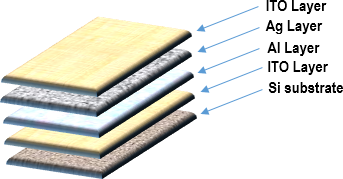
- annealing on the Si substrate obtained using energy-dispersive X-ray spectroscopy (EDXS) are displayed in Table 1. A reduction of the oxygen content was observed after annealing. The content of metal and semiconductor materials accordingly increases. Si as substrate material shows the highest content. The
- calculate the crystallite (grain) size. Elemental composition analyses The elemental composition of as-deposited and annealed IAAI multilayer films was investigated using energy-dispersive X-ray spectroscopy (EDXS). A FESEM JEOL JSM-7600F, Japan, equipped with an energy-dispersive X-ray spectrometer EDS


High-performance asymmetric supercapacitor made of NiMoO4 nanorods@Co3O4 on a cellulose-based carbon aerogel
Beilstein J. Nanotechnol. 2020, 11, 240–251, doi:10.3762/bjnano.11.18
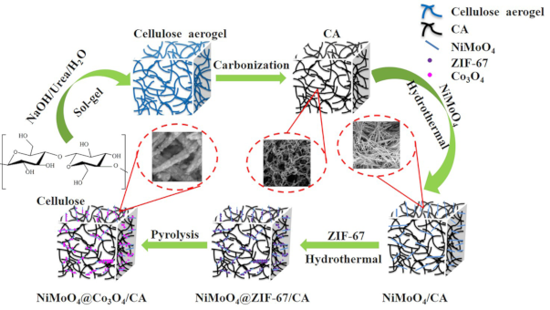
- . To confirm the structure of NiMoO4@Co3O4/CA, energy-dispersive X-ray spectroscopy (EDS) and elemental mappings were carried out as shown in Figure 3b and Figure 3d–h. It can be clearly seen that there are signals for C, O, Co, Ni and Mo indicating the coexistence of the Co3O4 phase and NiMoO4 phase




Simple synthesis of nanosheets of rGO and nitrogenated rGO
Beilstein J. Nanotechnol. 2020, 11, 68–75, doi:10.3762/bjnano.11.7
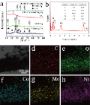
- ) shows that the nanosheets possess a smooth surface and are loosely stacked. Energy-dispersive X-ray spectroscopy (EDS) was also measured to determine the chemical composition of rGO. Result from EDS shows (Figure 4c) that the product contains only C and O. The atomic fractions of C and O are found to be
- Mira3 field-emission scanning electron microscope (FESEM) equipped with an energy-dispersive X-ray spectroscopy (EDS). The TEM, HRTEM images and SAED patterns were obtained on a TALOS F200S G2, 200 kV FEG, and a CMOS camera (4k × 4k). The TEM samples were prepared by suspending the samples in ethanol


Synthesis of amorphous and graphitized porous nitrogen-doped carbon spheres as oxygen reduction reaction catalysts
Beilstein J. Nanotechnol. 2020, 11, 1–15, doi:10.3762/bjnano.11.1
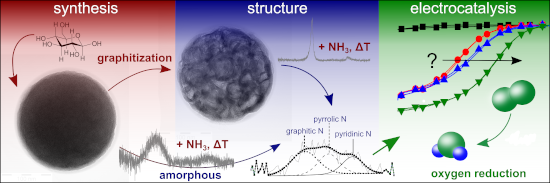
- particles are observed for the graphitized samples via energy dispersive X-ray spectroscopy (EDX) and X-ray photoelectron spectroscopy (XPS). However, we cannot fully exclude small amounts of residual iron in the graphitized catalysts below the detection limit of XPS (about 0.2 atom %) and EDX (about 0.1 wt
- Scanning electron microscopy (SEM) images were recorded with a field-emission scanning electron microscope (FE-SEM, Zeiss Ultra Plus) at 10 to 12 keV beam energy. For imaging, the samples were deposited on a conducting carbon film. Energy-dispersive X-ray spectroscopy (EDX) measurements were performed on




Synthesis and acetone sensing properties of ZnFe2O4/rGO gas sensors
Beilstein J. Nanotechnol. 2019, 10, 2516–2526, doi:10.3762/bjnano.10.242
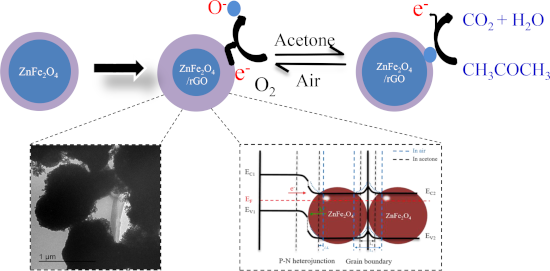
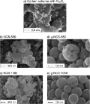
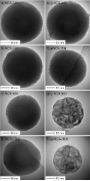
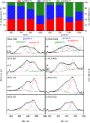
- in the ZnFe2O4/rGO composites [17][39]. We analyzed the actual composition of the spheres by energy-dispersive X-ray spectroscopy (EDS). As shown in Figure 4, the weight percentage of carbon in the spheres of ZnFe2O4/rGO with 0.5 and 1 wt % rGO was determined as 1.17 and 1.53%, respectively. The


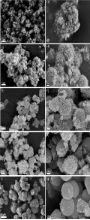


Label-free highly sensitive probe detection with novel hierarchical SERS substrates fabricated by nanoindentation and chemical reaction methods
Beilstein J. Nanotechnol. 2019, 10, 2483–2496, doi:10.3762/bjnano.10.239
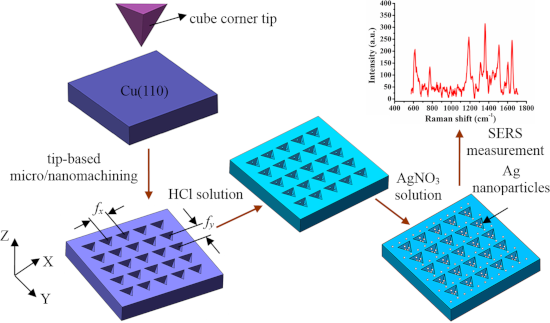
- -up regions of cavities as shown in Figure 1d. Elemental analysis of the arrayed pyramidal cavities The parameters of the feeds (fx, fy) for fabricating micro/nanostructures using the method presented are shown in Table 1. Figure 3 shows SEM and energy-dispersive X-ray spectroscopy (EDX) images of the


Semitransparent Sb2S3 thin film solar cells by ultrasonic spray pyrolysis for use in solar windows
Beilstein J. Nanotechnol. 2019, 10, 2396–2409, doi:10.3762/bjnano.10.230
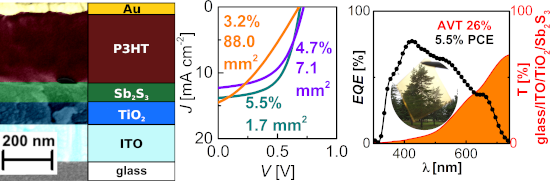
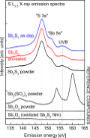
- absorption coefficient, such as Sb2S3 (>105 cm−1 at 450 nm), offer semitransparency, appreciable efficiency, and long-term durability at low cost. Oxide-free throughout the Sb2S3 layer thickness, as confirmed by combined studies of energy dispersive X-ray spectroscopy and synchrotron soft X-ray emission
- detected, which is an expected result when crystalline Sb2S3 is formed [28][46][49]. No traces of additional phases were detected by either XRD or Raman in any glass/ITO/TiO2/Sb2S3 samples. Chlorine, which could originate from the SbCl3 precursor, was not detected by energy-dispersive X-ray spectroscopy



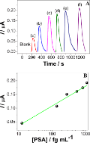
Use of data processing for rapid detection of the prostate-specific antigen biomarker using immunomagnetic sandwich-type sensors
Beilstein J. Nanotechnol. 2019, 10, 2171–2181, doi:10.3762/bjnano.10.210

- spectroscopy (FTIR), field-emission scanning electron microscopy (FE-SEM), energy-dispersive X-ray spectroscopy (EDX), and polarization-modulated infrared reflection absorption spectroscopy (PM-IRRAS, Figure S1) is described. The Silhouette coefficients calculated for IDMAP, Sammon’s mapping (SM), principal


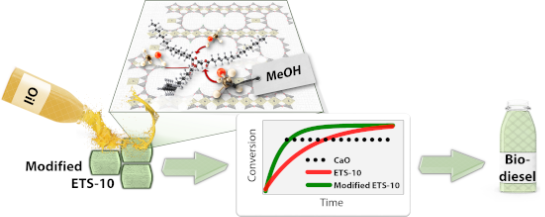
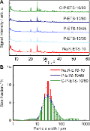
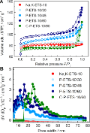
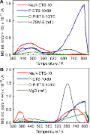
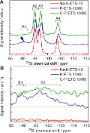
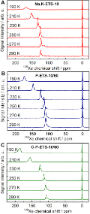
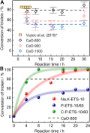
Synthesis of highly active ETS-10-based titanosilicate for heterogeneously catalyzed transesterification of triglycerides
Beilstein J. Nanotechnol. 2019, 10, 2039–2061, doi:10.3762/bjnano.10.200








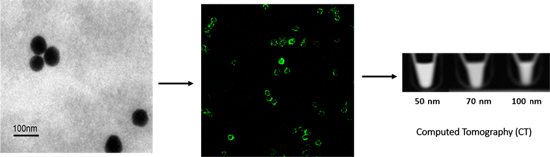
Gold-coated plant virus as computed tomography imaging contrast agent
Beilstein J. Nanotechnol. 2019, 10, 1983–1993, doi:10.3762/bjnano.10.195
- concentration of 0.01–0.05 mg/mL and deposited on 400 mesh carbon grids (SPI supplies), samples were air dried prior to imaging. Energy-dispersive X-Ray spectroscopy A FIB Scios system was used combined with a scanning electron microscope (SEM) and a focused ion beam equipped with X-MaxN 50 mm2 EDS system to




Synthesis of nickel/gallium nanoalloys using a dual-source approach in 1-alkyl-3-methylimidazole ionic liquids
Beilstein J. Nanotechnol. 2019, 10, 1754–1767, doi:10.3762/bjnano.10.171
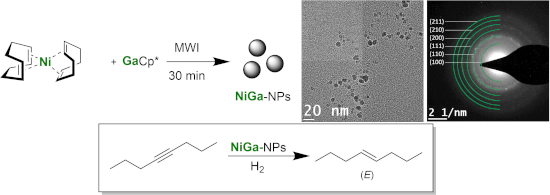
- accelerating voltage [79] or with a Philips CM20 operated at 200 kV accelerating voltage. Conventional TEM images were recorded with a Gatan UltraScan 1000P detector. Energy-dispersive X-ray spectroscopy. EDX spectra for elemental (metal) analysis were recorded using an exposure time of 3 min. High-angle




TiO2/GO-coated functional separator to suppress polysulfide migration in lithium–sulfur batteries
Beilstein J. Nanotechnol. 2019, 10, 1726–1736, doi:10.3762/bjnano.10.168
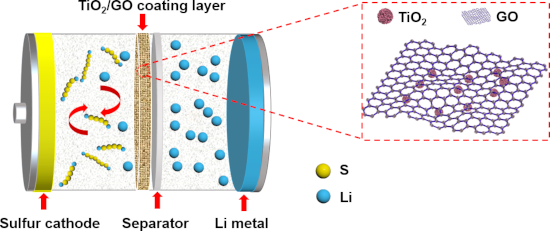
- synthesized by selectively dissolving Al atoms from a Ti10Al90 alloy. It can be readily observed that the abundant nanowires and uniform nanopores, with a pore size of ≈40 nm, formed a sea-urchin-like structure. Furthermore, the energy-dispersive X-ray spectroscopy (EDS) analysis confirms the homogenous


Direct observation of oxygen-vacancy formation and structural changes in Bi2WO6 nanoflakes induced by electron irradiation
Beilstein J. Nanotechnol. 2019, 10, 1434–1442, doi:10.3762/bjnano.10.141
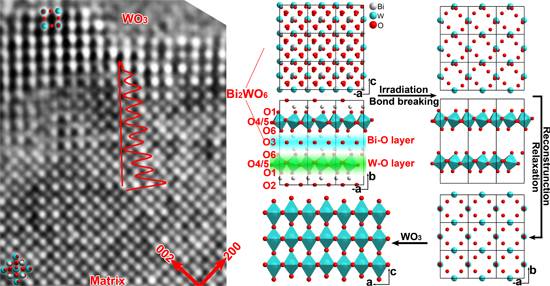
- = 1.5406 Å). Morphological analyses were carried out on a field-emission scanning electron microscope (SEM, Hitachi S-4800) equipped with an energy-dispersive X-ray spectroscopy (EDX) detector operating at 10 kV and 10 μA. Selected-area electron diffraction (SAED) and high-resolution transmission electron


BiOCl/TiO2/diatomite composites with enhanced visible-light photocatalytic activity for the degradation of rhodamine B
Beilstein J. Nanotechnol. 2019, 10, 1412–1422, doi:10.3762/bjnano.10.139
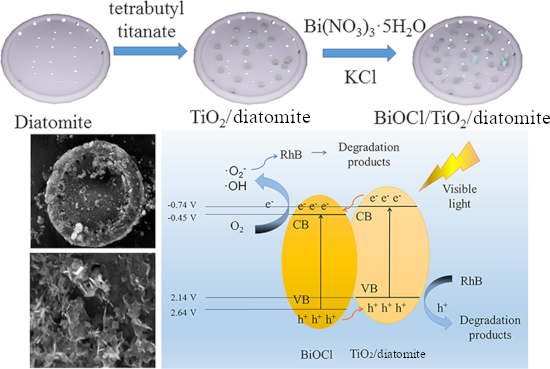
- nanosheets can be found on the surface. Elemental mapping was carried out by energy-dispersive X-ray spectroscopy (EDS) to study the elemental dispersion on the BTD surface. Figure 5 shows that the elements Bi, Si, Cl, O and Ti distribute uniformly on the diatomite disc, which confirms the successful
- the survey scan (a) and detailed Bi 4f (b), Si 2p (c), Cl 2p (d), O 1s (e) and Ti 2p (f) spectra. SEM images of BiOCl (a), TiO2 (b), TiO2/diatomite (c) and BTD (d and e). Energy-dispersive X-ray spectroscopy (EDS) mapping of BTD, including SEM image (a), O element (b), Si element (c), Cl element (d


Gas sensing properties of individual SnO2 nanowires and SnO2 sol–gel nanocomposites
Beilstein J. Nanotechnol. 2019, 10, 1380–1390, doi:10.3762/bjnano.10.136
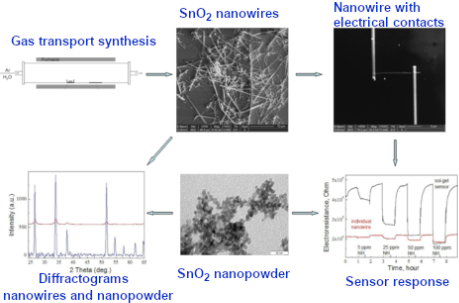
- calcination as follows: Figure 2 shows a TEM image of the obtained material. The particle diameter derived from this measurement was found to be 4–6 nm. X-ray spectroscopy of the materials In the present study, we used the non-destructive techniques, X-ray photoelectron spectroscopy (XPS) and X-ray absorption
- . After drying at 90 °C for 1 hour, the substrate was heated to 750 °С for 15 minutes and kept thereafter at 400 °C for several hours. The measurements were carried out in a special chamber integrated together with a specially designed multichannel measuring device. Results and Discussion X-ray
- spectroscopy: Comparison of nanowire and nanopowder properties XRD spectra obtained by different methods (Figure 4) show a principal difference between the nanowires obtained by gas transport synthesis and the samples precipitated from nanopowder. The spectral band width at half-height characterizes the size




The effect of magneto-crystalline anisotropy on the properties of hard and soft magnetic ferrite nanoparticles
Beilstein J. Nanotechnol. 2019, 10, 1348–1359, doi:10.3762/bjnano.10.133
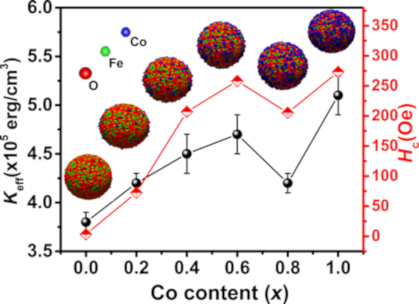
- magnetic interactions are discussed in more detail in the following sections. The qualitative chemical composition of the samples was investigated by using energy-dispersive X-ray spectroscopy (EDX). Figure 4 shows the EDX spectra for the samples with x = 0.2, 0.6 and 1. The EDX spectra confirm the


Alloyed Pt3M (M = Co, Ni) nanoparticles supported on S- and N-doped carbon nanotubes for the oxygen reduction reaction
Beilstein J. Nanotechnol. 2019, 10, 1251–1269, doi:10.3762/bjnano.10.125
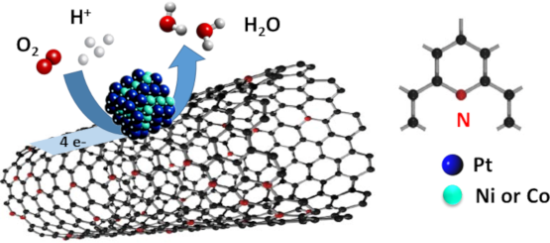
- Co islands (Supporting Information File 1, Figure S7a,b) were identified using the scanning transmission electron microscopy/high-angle annular dark-field imaging (STEM-HAADF) technique. Energy-dispersive X-ray spectroscopy (EDX) analysis on the N-CNT surface or in the Co aggregates confirmed the







Porous N- and S-doped carbon–carbon composite electrodes by soft-templating for redox flow batteries
Beilstein J. Nanotechnol. 2019, 10, 1131–1139, doi:10.3762/bjnano.10.113
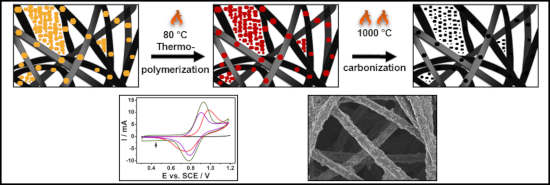
- -dispersive X-ray spectroscopy (EDX) analyses were performed with an X-Max 50 silicon drift detector (Oxford Instruments) at an acceleration voltage of 10 kV. Nitrogen adsorption and desorption isotherms were recorded at 77 K using a high-resolution Micromeritics 3Flex instrument. Prior to the measurement the



Synthesis and characterization of quaternary La(Sr)S–TaS2 misfit-layered nanotubes
Beilstein J. Nanotechnol. 2019, 10, 1112–1124, doi:10.3762/bjnano.10.111
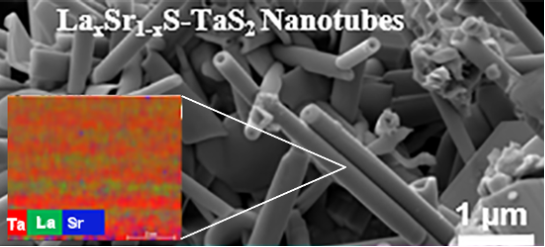
- electron microscopy (SEM) was done by LEO model Supra 55VP SEM. Transmission electron microscopy (TEM) and scanning transmission electron microscopy (STEM) were performed on a Titan Themis 80-300 microscope with probe and image spherical aberration (Cs) correctors, at 200 kV. Energy-dispersive X-ray
- spectroscopy (EDX) was performed using a SuperX EDX detector attached to this microscope using Bruker Esprit software. The quantification was done using the Cliff–Lorimer method. The samples for electron microscopy were prepared by dispersing the synthesized powder in ethyl alcohol, followed by ultrasonication





