Search results
Search for "absorption spectra" in Full Text gives 292 result(s) in Beilstein Journal of Nanotechnology. Showing first 200.
Sputtering onto liquids: a critical review
Beilstein J. Nanotechnol. 2022, 13, 10–53, doi:10.3762/bjnano.13.2



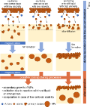


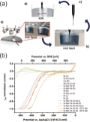


Enhancement of the piezoelectric coefficient in PVDF-TrFe/CoFe2O4 nanocomposites through DC magnetic poling
Beilstein J. Nanotechnol. 2021, 12, 1262–1270, doi:10.3762/bjnano.12.93
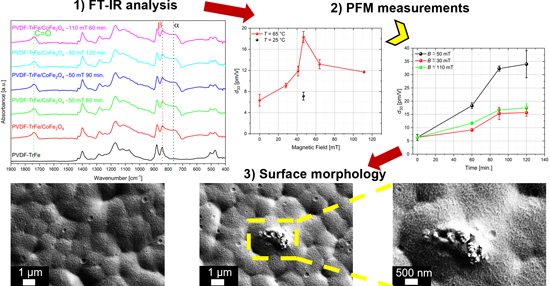
- composition analysis was performed through EDX using the FESEM, equipped with a Bruker Quantax EDX setup capable of an energy resolution of 123 eV at Mn Kα. In order to prevent charging the samples were metalized with 20 nm of Cr using a Quorum Technologies Q150T ES sputter coater. All FTIR absorption spectra


First-principles study of the structural, optoelectronic and thermophysical properties of the π-SnSe for thermoelectric applications
Beilstein J. Nanotechnol. 2021, 12, 1101–1114, doi:10.3762/bjnano.12.82
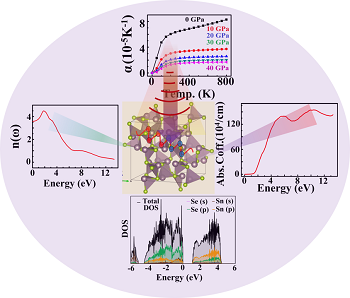
- entire optical region of an alloy and shows the absorption peaks from the occupied to unoccupied states which occur due to electronic transitions. The studied π-SnSe alloy reveals the broader part of the electromagnetic spectrum. It can be noted from the absorption spectra (Figure 11c) that the value of


Modification of a SERS-active Ag surface to promote adsorption of charged analytes: effect of Cu2+ ions
Beilstein J. Nanotechnol. 2021, 12, 902–912, doi:10.3762/bjnano.12.67
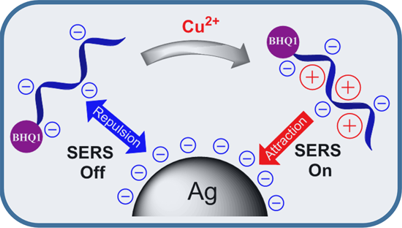
- agreement with electron microscopy and literature [30]. Immobilization of Ag NPs on a glass surface Utilizing glass slides for the preparation of SERS substrates permitted us to use siloxane chemistry to modify the surface and to control the immobilization process via the absorption spectra. Glass also
- , which leads to a high immobilization efficiency. The sodium citrate concentration (2.5 mM) was adjusted to obtain a maximal NP surface filling and, at the same time, to avoid NP aggregation caused by high salt concentration. Figure 2 shows absorption spectra of the polyethylenimine (PEI)-modified glass
- NP water solution (Ag concentration of 32 µg/mL) with 2.5 mM sodium citrate and kept at room temperature. A 2.5 mm quartz cuvette filled with 2.5 mM sodium citrate water solution was used to measure the absorption spectra. The glass substrate covered by Ag NPs was placed into the cuvette after


High-yield synthesis of silver nanowires for transparent conducting PET films
Beilstein J. Nanotechnol. 2021, 12, 624–632, doi:10.3762/bjnano.12.51
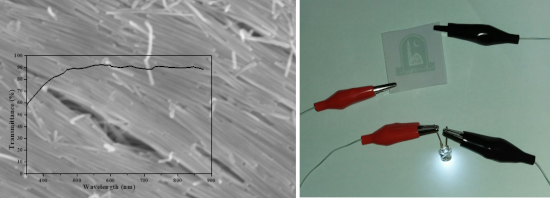
- structure and bend the film. The experimental results revealed that after ink coating, the substrate PET film retained its flexibility and transparency, as shown in Figure 2. Characterization UV–vis absorption spectra of liquid AgNW samples were recorded with a Cecil 7500 double-beam UV–vis
- flexibility and transparency. (a) UV–vis absorption spectra indicating the formation of AgNPs just after complete addition of AgNO3 (red line) and the end of the reaction with the formation of AgNWs (black line). The spectra after 10 min (green line) and 20 min (blue line) are also given. The insets showing


Surface-enhanced Raman scattering of water in aqueous dispersions of silver nanoparticles
Beilstein J. Nanotechnol. 2021, 12, 497–506, doi:10.3762/bjnano.12.40
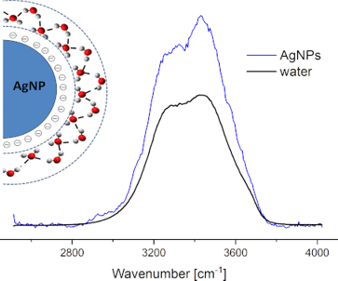
- phenomenon is present only in the AgNPs blue sample, not in the AgNPs yellow sample. Also, changes in the structure of AgNPs induced by laser irradiation may be excluded, as an identical UV–vis absorption spectra of the investigated AgNPs dispersions (see Figure S1 in Supporting Information File 1) collected
- spectra were analysed further to eliminate additional influence of the polarisers on the final (measured) signal. As AgNPs dispersions have non-zero absorption in the spectral ranges of both the Raman pump (514.5 nm) and Raman scattered light (in the range of 610–635 nm; for the absorption spectra of the
- AgNPs were studied by UV–vis and Raman spectroscopy without any purification. Characterization of silver nanoparticles The absorption spectra of AgNP dispersions were obtained by using double-beam UV–vis–NIR spectrophotometer (Cary 5000 - Varian) in the 200–800 nm range in relation to pure water, used


Rapid controlled synthesis of gold–platinum nanorods with excellent photothermal properties under 808 nm excitation
Beilstein J. Nanotechnol. 2021, 12, 462–472, doi:10.3762/bjnano.12.37
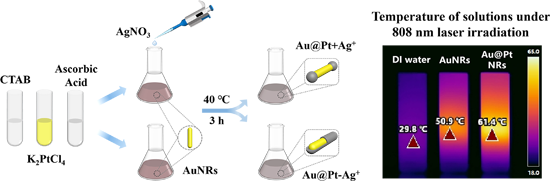
- Au@Pt-1, Au@Pt-2, Au@Pt-3, and Au@Pt-4) were redshifted to 796, 836, 868, and 870 nm, respectively, as shown in Figure 2a. The obvious change of absorption spectra reveals non-negligible differences in the morphology of the different Au@Pt NRs. This hypothesis was further confirmed by TEM
- and structure of the products. Therefore, in the absence and presence of Ag+, K2PtCl4 solutions of different concentration were added to the reaction solution for the deposition of Pt on AuNRs. In the absence of Ag+, it can be seen from the absorption spectra that when the concentrations of added
- , as shown in curve Au@Pt-3 and Au@Pt-4 in Figure 3a. We hypothesize that with the increase of K2PtCl4 content, the collision frequency between PtCl42−-CTAB micelles and AuNRs also increased, and eventually, Pt smoothly covers the surface of AuNRs and forms a thicker Pt coating. The absorption spectra


A review on nanostructured silver as a basic ingredient in medicine: physicochemical parameters and characterization
Beilstein J. Nanotechnol. 2021, 12, 440–461, doi:10.3762/bjnano.12.36


Structural and optical characteristics determined by the sputtering deposition conditions of oxide thin films
Beilstein J. Nanotechnol. 2021, 12, 354–365, doi:10.3762/bjnano.12.29
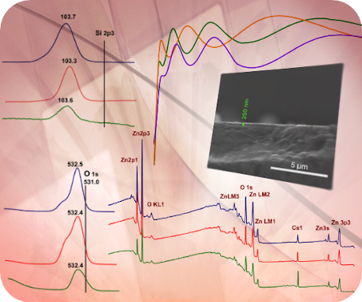
- calculated from the absorption spectra. The influence of thickness on the structural and optical properties of the oxide films was investigated. Good optical quality and performance were noticed, which makes these thin films worthy of integration into metamaterial structures. Keywords: magnetron sputtering


The patterning toolbox FIB-o-mat: Exploiting the full potential of focused helium ions for nanofabrication
Beilstein J. Nanotechnol. 2021, 12, 304–318, doi:10.3762/bjnano.12.25

- modulation setup. The spatial displacement of the focus modulates the signal [61] and the lock-in coupled detector provides an excellent signal-to-noise ratio for individual small scatterers. Figure 7d–f shows the extinction (sum of scattering and absorption) spectra corresponding to the tetramers in Figure


Doxorubicin-loaded gold nanorods: a multifunctional chemo-photothermal nanoplatform for cancer management
Beilstein J. Nanotechnol. 2021, 12, 295–303, doi:10.3762/bjnano.12.24
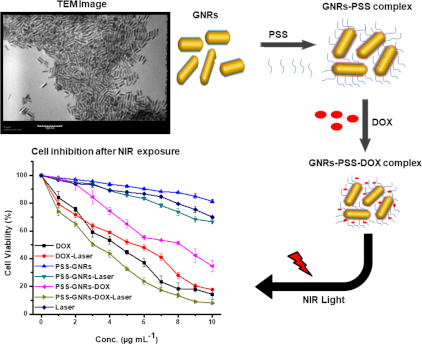
- ) to negative after PSS modification, which also confirmed the successful surface modification as described in previous reports [28]. Absorption spectra confirmed the successful loading of DOX on the PSS-coated GNRs (Figure 1c). The polyelectrolyte coating allowed the GNRs to easily interact with the


Characterization, bio-uptake and toxicity of polymer-coated silver nanoparticles and their interaction with human peripheral blood mononuclear cells
Beilstein J. Nanotechnol. 2021, 12, 282–294, doi:10.3762/bjnano.12.23
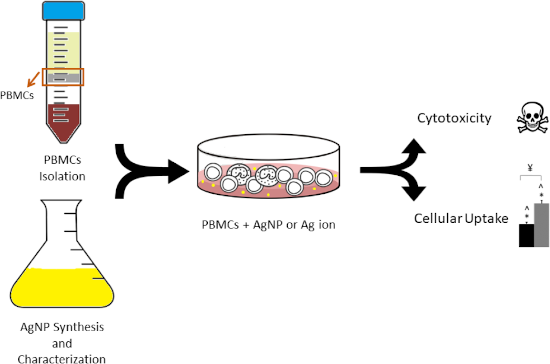
- laser Doppler electrophoresis (Malvern Zetasizer NanoZS, MA, USA). The mean of at least three consecutive measurements was reported. DLS data for AgNPs in RPMI medium was not included because of the low concentrations used. Absorption spectra of PVP-AgNPs was recorded in triplicate over the wavelength



Absorption and photoconductivity spectra of amorphous multilayer structures
Beilstein J. Nanotechnol. 2020, 11, 1757–1763, doi:10.3762/bjnano.11.158
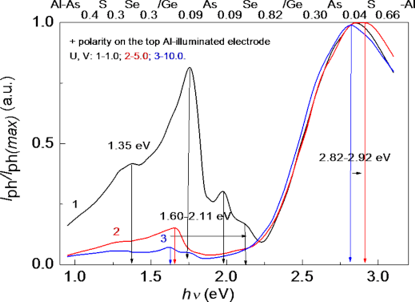
- agreement with the absorption spectra. The spectral distribution of the photocurrent for the HS is situated between the distributions of the separate layers and depends on the polarity of the illuminated electrode. The positions of the maximum of Al–Ge0.09As0.09Se0.82–Al (hν = 2.47 eV) and the maxima of Al
- = f(λ) of separate amorphous thin films and multilayer HS (1: Ge0.30As0.04S0.66, 2: Ge0.09As0.09Se0.82, 3: As0.40S0.30Se0.30, 4: As0.40S0.30Se0.30/Ge0.09As0.09Se0.82/Ge0.30As0.04S0.66). Absorption spectra α = f(hν) of separate amorphous thin films and multilayer HS (1: Ge0.30As0.04S0.66, 2


Cardiomyocyte uptake mechanism of a hydroxyapatite nanoparticle mediated gene delivery system
Beilstein J. Nanotechnol. 2020, 11, 1685–1692, doi:10.3762/bjnano.11.150
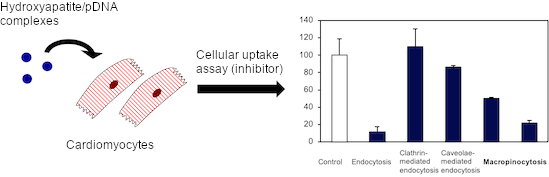
- the as-prepared sample are consistent with the characteristic peaks of the standard hydroxyapatite peak positions and with the corresponding intensities of the diffraction peaks for HAp (International Centre for Diffraction Data, ICDD, no. 09-0432, vertical lines). The FTIR absorption spectra of the


The influence of an interfacial hBN layer on the fluorescence of an organic molecule
Beilstein J. Nanotechnol. 2020, 11, 1663–1684, doi:10.3762/bjnano.11.149
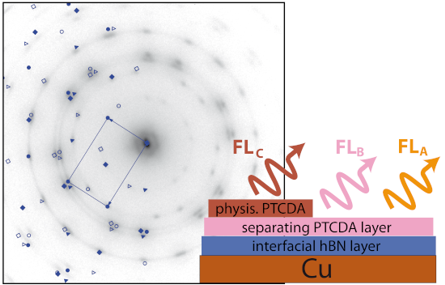
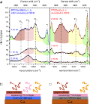
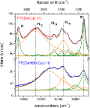
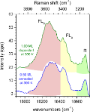
- values are given in Table 2. Note that only PTCDA/hBN/SiO2 was investigated by FL spectroscopy while for PTCDA/hBN/Pt(111) and PTCDA/hBN/Rh(111) absorption spectra were measured. We cannot explain the differences of the S0/S1 transition energies, yet. However, we observe a trend of higher transition





Cu2O nanoparticles for the degradation of methyl parathion
Beilstein J. Nanotechnol. 2020, 11, 1546–1555, doi:10.3762/bjnano.11.137
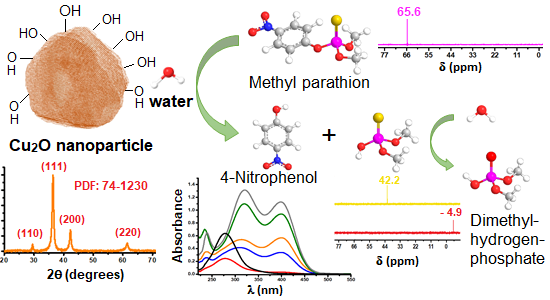
- similar results. Likewise, degradation experiments in the darkness were also performed giving identical results to those under daylight thus photocatalytic degradation was ruled out. Instrumentation UV–vis electronic absorption spectra were acquired on an Ocean Optics CHEM-2000 spectrophotometer equipped


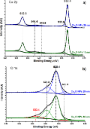
Self-assembly and spectroscopic fingerprints of photoactive pyrenyl tectons on hBN/Cu(111)
Beilstein J. Nanotechnol. 2020, 11, 1470–1483, doi:10.3762/bjnano.11.130
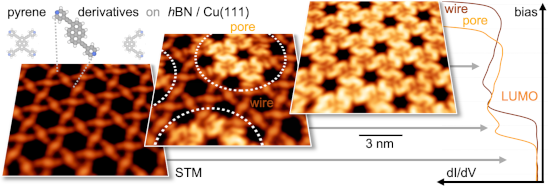
- pyrene derivatives, respectively) confirmed the fact that for both structures, the ground and excited states were similar, while the matching excitation and absorption spectra pointed at an efficient radiative deactivation of the excited state (Figure S13, Supporting Information File 1) [71]. TDDFT
- absorption and emission spectra. Absorption spectra were recorded using air-equilibrated solutions at rt, with an Agilent Cary 5000 UV–vis spectrophotometer using quartz cells with a path length of 1.0 cm. Emission spectra were recorded on an Agilent Cary Eclipse fluorescence spectrofluorometer. Emission





Plant growth regulation by seed coating with films of alginate and auxin-intercalated layered double hydroxides
Beilstein J. Nanotechnol. 2020, 11, 1082–1091, doi:10.3762/bjnano.11.93
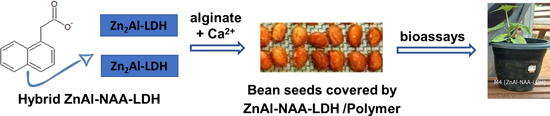
- ) were recorded in a Shimadzu X-ray Diffractometer XRD-6000 mode using Cu Kα1 radiation (λ = 1.5406 Å), 40 kV, 40 mA, sweep range 2θ from 2° to 70° with a scan step of 0.02°/s. Electronic absorption spectra were acquired in an equipment Thermo Scientific model Evolution 300. The morphology of the LDH



A few-layer graphene/chlorin e6 hybrid nanomaterial and its application in photodynamic therapy against Candida albicans
Beilstein J. Nanotechnol. 2020, 11, 1054–1061, doi:10.3762/bjnano.11.90
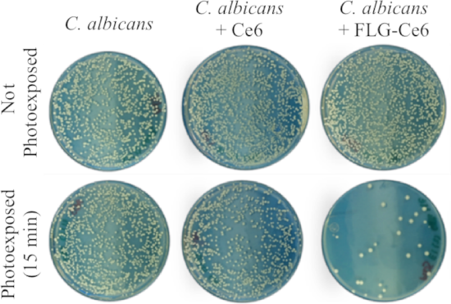
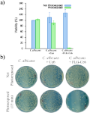
- system characterization. a) UV–vis absorption spectra of pristine Ce6 (blue) and FLG-Ce6 (green). b) Singlet oxygen production assays. Singlet oxygen is indirectly observed through the fluorescence of the reporter molecule, singlet oxygen sensor green reagent; the higher fluorescence is related to higher


Excitonic and electronic transitions in Me–Sb2Se3 structures
Beilstein J. Nanotechnol. 2020, 11, 1045–1053, doi:10.3762/bjnano.11.89
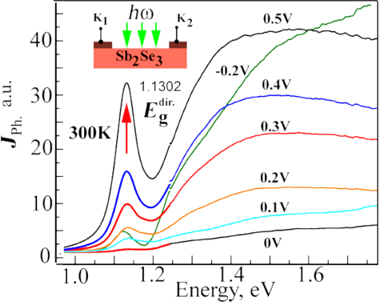
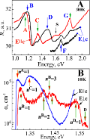
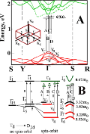
- triselenide; band structure; excitons; optical spectroscopy; reflection and absorption spectra; Introduction Antimony selenide (Sb2Se3) is an inorganic semiconductor compound with interesting photoelectric properties. This material has a high absorption coefficient (≈105 cm−1) in the region of maximum solar
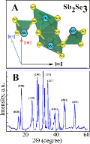
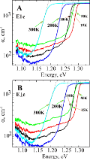
- crystal lattice, Sb2Se3 is a 2D semiconductor with a layered structure in which the Sb and Se atoms are connected with three other atoms of the opposite type, which in turn are connected within the crystal through weak secondary bonds. Figure 2 shows the absorption spectra of the Sb2Se3 crystal (thickness
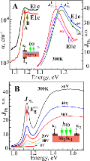
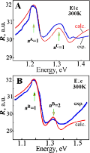
- absorption spectra of the Sb2Se3 single crystal with a 13 μm thickness measured at room temperature under E||c and E⟂c polarization conditions. The spectra show the high absorption coefficients with maxima at 1.162 eV (marked as A, E||c) and 1.185 eV (marked as B, E⟂c) at the absorption level of 2 × 104 cm−1


A new photodetector structure based on graphene nanomeshes: an ab initio study
Beilstein J. Nanotechnol. 2020, 11, 1036–1044, doi:10.3762/bjnano.11.88
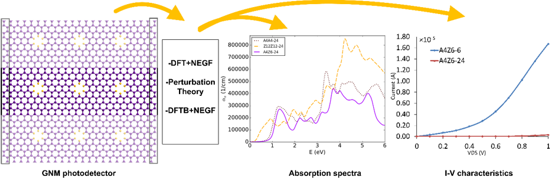
- makes it suitable for optical devices. Keywords: absorption spectra; DFT calculations; graphene nanomesh; graphene nanoribbon; photodetectors; Introduction Graphene monolayers with honeycomb crystal structure have unique electrical and optical properties and have received a lot of attention recently
- shows the absorption spectra of different GNM structures. For better comparison, spectra of GNMs with equal hole size are plotted together with the absorption spectrum of graphene. The absorption spectrum of these nanostructures also has a peak in the range of 0 to 2 eV. The maximum value of these peaks
- is around 300,000 cm−1, which is larger than that of GNRs. By comparing the absorption spectra of GNRs and GNMs, it can be concluded that when the ribbon width is increased and, thus, the effect of quantum confinement is reduced, the spectra approach the absorption spectrum of graphene. The same


Effect of Ag loading position on the photocatalytic performance of TiO2 nanocolumn arrays
Beilstein J. Nanotechnol. 2020, 11, 717–728, doi:10.3762/bjnano.11.59
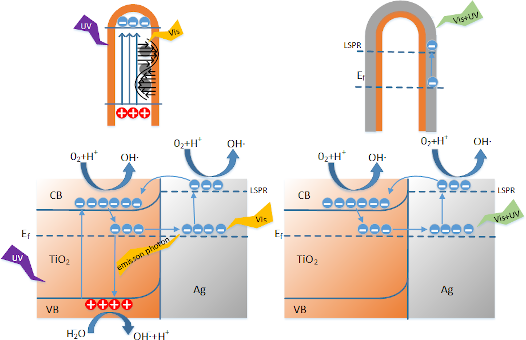
- the optical absorption spectra of TNC and AFT structure samples. It can be seen that the absorption peak of TiO2 is located at 276 nm and the absorption of the samples in the visible light portion increase as the thickness of Ag increases. Moreover, the increase of the Ag thickness does not hinder the
- absorption of TiO2 in the ultraviolet region. Figure 6b is the optical absorption spectra of ACT structure samples. It can be seen that, with the increase of Ag deposition, the visible absorption intensity of the samples increases gradually, but the absorption peak of TiO2 at 276 nm decreases obviously. The
- spectra and (c,d) bandgaps of the different samples. Photocatalytic activity for the degradation of MB: (a) UV–vis absorption spectra for the photocatalytic degradation of MB in the presence of AFT1 sample, (b) photocatalytic degradation rate of MB by different samples and pure MB under UV–vis light, (c


Soybean-derived blue photoluminescent carbon dots
Beilstein J. Nanotechnol. 2020, 11, 606–619, doi:10.3762/bjnano.11.48
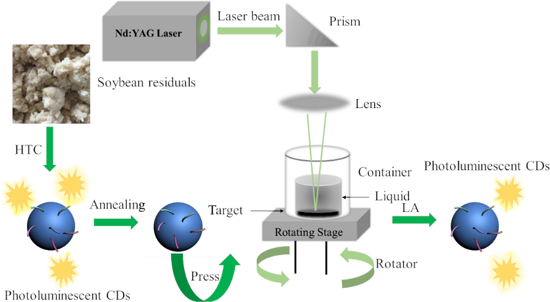
- significant n–π* absorption from the annealed-CDs. Coupling the UV–vis absorption spectra with the PL spectra, we suggest that the observed PL originates from excited states produced by the n–π* excitation or from functionalized surface groups. The time-correlated single photon counting (TCSPC) lifetime


Luminescent gold nanoclusters for bioimaging applications
Beilstein J. Nanotechnol. 2020, 11, 533–546, doi:10.3762/bjnano.11.42

- easy oxidation, the extensive use in bioimaging remained a challenge. Therefore, efforts have been made to prepare silicon quantum dots (SQDs) [28]. SQDs exhibit relatively low cytotoxicity and better biocompatibility compared to SCQDs. Moreover, SQDs show broad absorption spectra, higher


Evolution of Ag nanostructures created from thin films: UV–vis absorption and its theoretical predictions
Beilstein J. Nanotechnol. 2020, 11, 494–507, doi:10.3762/bjnano.11.40
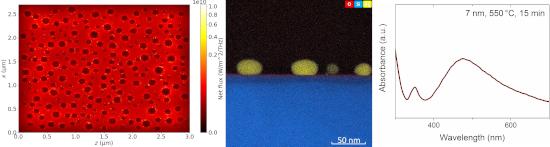
- quality of the nanostructures, in terms of their use as plasmonic platforms, is reflected in the UV–vis absorption spectra. The absorption spectrum is dominated by a maximum in the range of 450–500 nm associated with the plasmon resonance. As the initial layer thickness increases, an additional peak
- FDTD simulations are only capable to determine the absorption spectra. Results and Discussion Structure and UV–vis absorption The SEM results show that the formation of nanostructures from thin metallic layers is influenced by the initial layer thickness as well as the temperature and the time of
- nanostructures resulting from the thermal treatment (in view of the presence of plasmon resonance) is reflected in the UV–vis absorption spectra. The UV–vis spectrum of Ag nanostructures is quite complicated. It can be influenced by many factors, such as the size of nanostructures, their shape, changes in the