


Search results
Search for "carrier mobility" in Full Text gives 98 result(s) in Beilstein Journal of Nanotechnology.
Charge injection and transport properties of an organic light-emitting diode
Beilstein J. Nanotechnol. 2016, 7, 47–52, doi:10.3762/bjnano.7.5
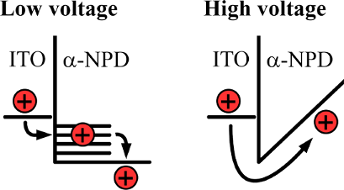
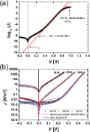
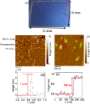
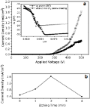
- density and carrier mobility, it reflects the impact of charge traps on the carrier transport as well as that of energy barriers on the carrier injection. Figure 5b depicts the voltage dependence of the activation energies estimated from the steady-state current–voltage and impedance spectroscopy


High Ion/Ioff current ratio graphene field effect transistor: the role of line defect
Beilstein J. Nanotechnol. 2015, 6, 2062–2068, doi:10.3762/bjnano.6.210
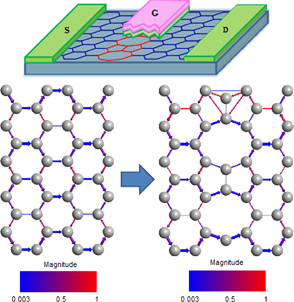
- carrier mobility and velocity of graphene is utilized in ballistic and high switching speeds devices [3][4]. However, the very large off-current of graphene at room temperature, which is associated with the small band gap, renders it incapable of being integrated as a building block for pure carbon-based


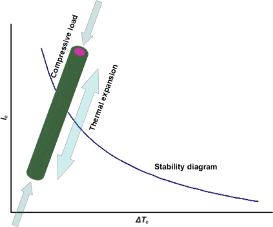
Simulation of thermal stress and buckling instability in Si/Ge and Ge/Si core/shell nanowires
Beilstein J. Nanotechnol. 2015, 6, 1970–1977, doi:10.3762/bjnano.6.201
- for next generation transistor devices. The radial heterostructure offers the advantage of control of the band gap and charge carrier mobility by tuning their size [5] and selecting suitable impurity doping scheme [3][6]. In addition, they exhibit significantly suppressed phonon thermal conductivity
- ], it is prohibitively difficult to experimentally measure the thermal load on ultrathin CSNWs. The effect of thermal stress on the performance of the device is again two-fold. The mechanical load would alter its electronic band structure and charge carrier mobility [11][12][13], which is particularly


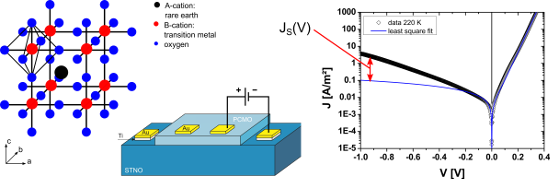
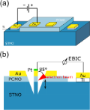
Current–voltage characteristics of manganite–titanite perovskite junctions
Beilstein J. Nanotechnol. 2015, 6, 1467–1484, doi:10.3762/bjnano.6.152





Attenuation, dispersion and nonlinearity effects in graphene-based waveguides
Beilstein J. Nanotechnol. 2015, 6, 1221–1228, doi:10.3762/bjnano.6.125
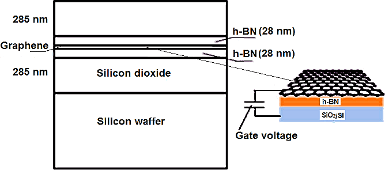
- isomorphic insulator in which the boron and nitrogen atoms occupy positions A and B in the Bernal structure. Therefore, the atomic structure of h-BN is similar (hexagonal) to the structure of graphene. It is worth noting that graphene on a layer of h-BN has a charge carrier mobility value and homogeneity of


Electronic interaction in composites of a conjugated polymer and carbon nanotubes: first-principles calculation and photophysical approaches
Beilstein J. Nanotechnol. 2015, 6, 1138–1144, doi:10.3762/bjnano.6.115
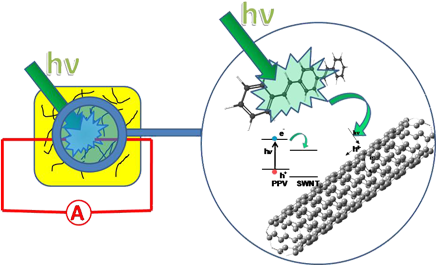
- polymer matrix increases. In the composite the SWNTs operate as exciton dissociation centers. The augmented carrier mobility is confirmed by the photoconductive behavior of the composites and is consistent with our DFT calculations showing strong coupling between PPV and semiconducting SWNT electronic


Charge carrier mobility and electronic properties of Al(Op)3: impact of excimer formation
Beilstein J. Nanotechnol. 2015, 6, 1107–1115, doi:10.3762/bjnano.6.112
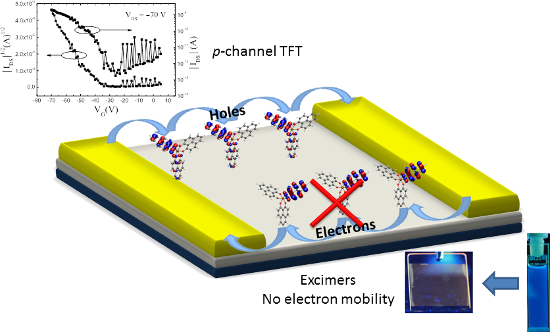
- carrier mobility of the organic semiconductor tris(1-oxo-1H-phenalen-9-olate)aluminium(III) (Al(Op)3) both experimentally and theoretically. We experimentally estimated the HOMO and LUMO energy levels to be −5.93 and −3.26 eV, respectively, which were close to the corresponding calculated values. Al(Op)3
- the formation of excimers in the solid state, which is crucial for the transport properties. The incorporation of Al(Op)3 into organic thin film transistors (TFTs) was performed in order to measure the charge carrier mobility. The experimental setup detected no electron mobility, while a hole mobility
- . Keywords: charge carrier mobility; HOMO–LUMO energy levels; photophysical characterization; TFT devices; tris-(1-oxo-1H-phenalen-9-olate)aluminum(III); Introduction Since the field of organic electronics has emerged, interest in organic semiconductors (OSCs) has substantially increased [1]. The efficiency


Microwave assisted synthesis and characterisation of a zinc oxide/tobacco mosaic virus hybrid material. An active hybrid semiconductor in a field-effect transistor device
Beilstein J. Nanotechnol. 2015, 6, 785–791, doi:10.3762/bjnano.6.81
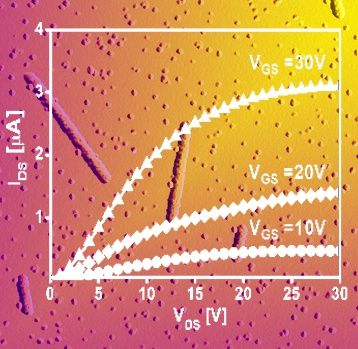
- current and voltage of 40 mA and 40 kV, respectively. FET characterizations were measured in the dark, using an HP 4155A semiconductor parameter analyzer (Agilent) in a glove box under constant O2 and H2O (<0.5 ppm). Charge carrier mobility in the saturation regime µSAT and the threshold voltage Vth were
- the zinc oximato complex as precursor [13]. The transistor behaviour of the wt TMV/ZnO hybrid material was then optimized based on the crucial characteristic FET values, current on/off ratio (Ion/off), threshold voltage (Vth) and charge carrier mobility (µ) which are considered to be essential


Electroburning of few-layer graphene flakes, epitaxial graphene, and turbostratic graphene discs in air and under vacuum
Beilstein J. Nanotechnol. 2015, 6, 711–719, doi:10.3762/bjnano.6.72
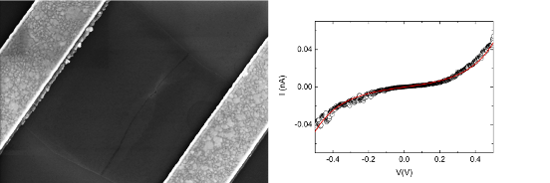
- process in multilayered graphene microstructures, employing thin discs of turbostratically stacked graphene (TG, see Experimental for details on the preparation). These discs are comprise up to 100 graphene layers exhibiting a rather large charge carrier mobility in the range of 105 cm2/V·s which



Nanoporous Ge thin film production combining Ge sputtering and dopant implantation
Beilstein J. Nanotechnol. 2015, 6, 336–342, doi:10.3762/bjnano.6.32
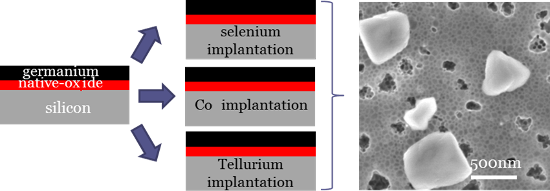
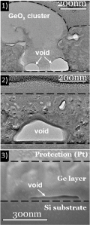
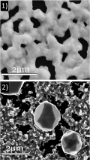
- applications, since they can lead to multiple exciton generation [7]. In particular, multiple exciton generation has been previously demonstrated in Si nanostructures [8]. Ge has a similar structure to Si, however, it offers several benefits compared to Si such as faster carrier mobility, smaller band gap and


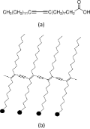
Characterization of 10,12-pentacosadiynoic acid Langmuir–Blodgett monolayers and their use in metal–insulator–metal tunnel devices
Beilstein J. Nanotechnol. 2014, 5, 2240–2247, doi:10.3762/bjnano.5.233
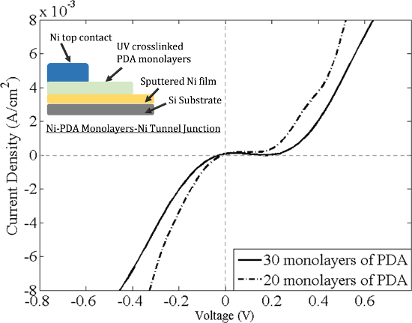
- the π bond conjugation, which provides high carrier mobility, there is still a very low concentration of carriers, as can be seen by the insulating behavior of the material [22][23]. Figure 5 shows the relation of the current density to the (scan rate)1/2, which was clearly not linear, as would be the


Effect of channel length on the electrical response of carbon nanotube field-effect transistors to deoxyribonucleic acid hybridization
Beilstein J. Nanotechnol. 2014, 5, 2081–2091, doi:10.3762/bjnano.5.217
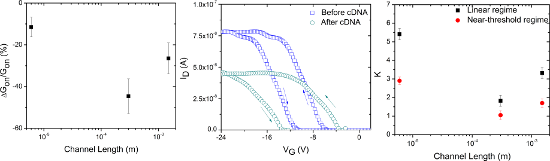
- . Calculations The effective mobility (µe) represents the intrinsic physical charge carrier mobility of the CNT channel without including any device attributes and is given by, where G = δID/δVDS at constant VG, G is the conductance at a particular gate voltage and Vth is the threshold voltage [24]. The


Optical properties and electrical transport of thin films of terbium(III) bis(phthalocyanine) on cobalt
Beilstein J. Nanotechnol. 2014, 5, 2070–2078, doi:10.3762/bjnano.5.215
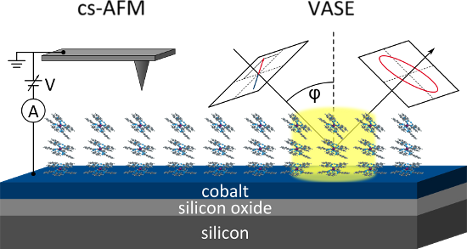
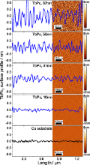
- microscale. The AFM-based electrical measurements allow the local charge carrier mobility of the TbPc2 thin films to be quantified with nanoscale resolution. Keywords: current sensing AFM; ellipsometry; spintronics; TbPc2; transport properties; Introduction Molecular spintronic devices could bring a new
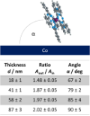
- of the organic film, ε is the relative dielectric constant, ε0 is the permittivity of free space, µ is the charge carrier mobility and V is the applied voltage. From the ohmic-like regime (see Figure 7b) we obtained parameters of σ/L equal to 1.38 and 0.97 kA/cm2 V for the samples of 20 and 80 nm
- charge density per unit volume in all films, a reduction in the ratio σ/L corresponds to a reduction in the carrier mobility in the direction perpendicular to the substrate. This is in agreement with the increasingly standing molecules. The validity of the model applied for the ohmic region should be



Electronic and electrochemical doping of graphene by surface adsorbates
Beilstein J. Nanotechnol. 2014, 5, 1842–1848, doi:10.3762/bjnano.5.195
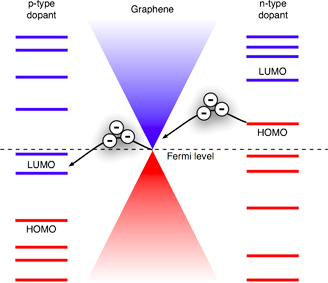
- behaves like an n-type doped semiconductor but exhibits a low charge carrier mobility [16]. The surface transfer doping is non-destructive and occurs due to the charge transfer between graphene and surface adsorbates. Two mechanisms of charge transfer doping can be distinguished, electronic and
- ionized dopants become additional charge scatterers leading to a reduction in the charge carrier mobility. The electrochemical doping of graphene occurs as a result of redox reactions that can take place near the graphene surface. Unlike electronic doping it does not reduce the charge carriers mobility


An insight into the mechanism of charge-transfer of hybrid polymer:ternary/quaternary chalcopyrite colloidal nanocrystals
Beilstein J. Nanotechnol. 2014, 5, 1235–1244, doi:10.3762/bjnano.5.137
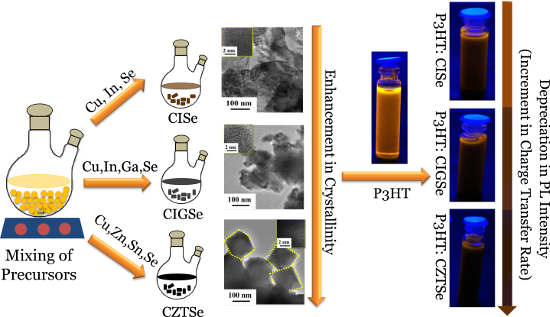
- cells, the performance of OPVs is often restricted by low carrier mobility issues. The emergence of hybrid solar cells is based on the concept of promoting carrier mobility in OPV systems by the incorporation of inorganic semiconductor materials as electron acceptors into organic photovoltaics [5]. Here
- , a charge-separation at donor–acceptor heterojunctions is a key process, which takes center stage in determining the energy conversion efficiency of hybrid photovoltaics. Hybrid solar cells enjoy an advantage of intrinsically high carrier mobility, which is caused by inorganic materials dispersed in


Sublattice asymmetry of impurity doping in graphene: A review
Beilstein J. Nanotechnol. 2014, 5, 1210–1217, doi:10.3762/bjnano.5.133
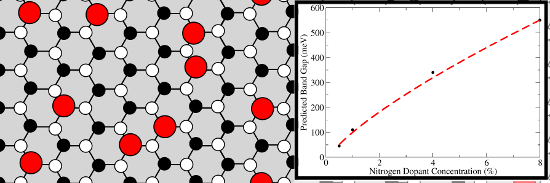
- semiconductor technology, which is characterised by a current on/off ratio of roughly 104–107 and a band gap of at least 340 meV whilst maintaining high carrier mobility [5][13][14]. Alteration of the crystal structure through the introduction of foreign dopants is one of the more realistic avenues of approach


Challenges in realizing ultraflat materials surfaces
Beilstein J. Nanotechnol. 2013, 4, 875–885, doi:10.3762/bjnano.4.99
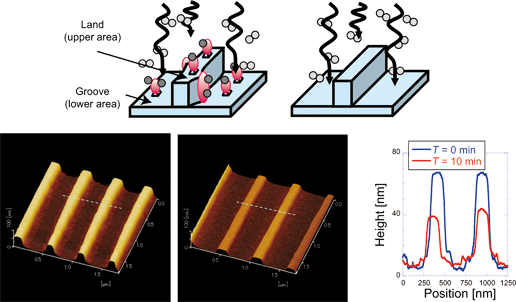
- , and excellent semiconductor properties such as a high dielectric breakdown field and a high carrier mobility [5]. However, at the same time, the hardness of diamond makes it difficult to realize a flattened surface, and therefore the performance of diamond devices has not been as good as expected

Micro- and nanoscale electrical characterization of large-area graphene transferred to functional substrates
Beilstein J. Nanotechnol. 2013, 4, 234–242, doi:10.3762/bjnano.4.24
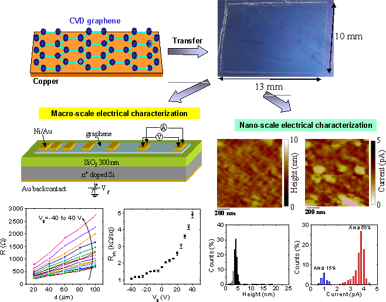
- effect due to carrier trapping, and, consequently, an underestimation of the carrier mobility. Furthermore, the presence of charged traps at the graphene/substrate interface strongly affects the mobility in graphene due to Coulomb scattering [11][26], leading to a degradation with respect to the ideal



Functionalization of vertically aligned carbon nanotubes
Beilstein J. Nanotechnol. 2013, 4, 129–152, doi:10.3762/bjnano.4.14
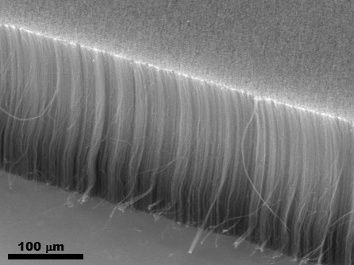
- products showed a high-quality structural arrangement and an enhanced electrical conductivity. Many physical properties such as morphology, thermal stability, conductivity and charge carrier mobility are disrupted by this treatment. This can be crucial for applications in the photovoltaic field. We can




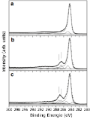


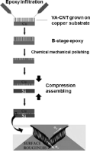


Highly ordered ultralong magnetic nanowires wrapped in stacked graphene layers
Beilstein J. Nanotechnol. 2012, 3, 846–851, doi:10.3762/bjnano.3.95
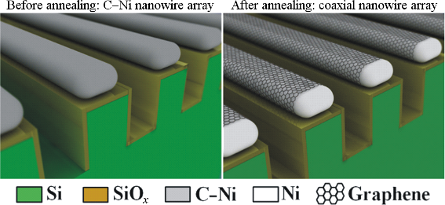
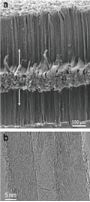
- ferromagnetic metal nanowire appears to be an interesting building block for spintronics, for example, for the injection of a spin-polarized current from the metal to the high-carrier-mobility graphene structure. Its integration in a planar configuration opens the way to further device characterization


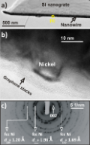
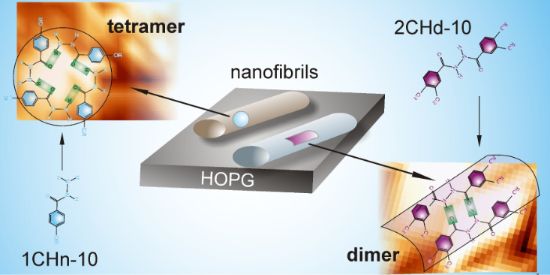
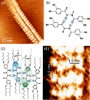
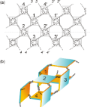
Dimer/tetramer motifs determine amphiphilic hydrazine fibril structures on graphite
Beilstein J. Nanotechnol. 2012, 3, 658–666, doi:10.3762/bjnano.3.75
- functional arrangements up to millimetre dimensions [6]. With suitable functional moieties, they can guide ions, electrons or even photons and can serve as interconnects when integrated into electronic or bioelectronic devices [1][5][7]. Further progress in this area is mostly limited by low charge-carrier
- mobility and the mostly amorphous local packing. Therefore, it is essential to synthesize optimized materials, explore supramolecular routes towards new functional structures, and understand processes of structure formation at interfaces [8][9]. The knowledge about the internal structure of the columns




Molecular-resolution imaging of pentacene on KCl(001)
Beilstein J. Nanotechnol. 2012, 3, 186–191, doi:10.3762/bjnano.3.20
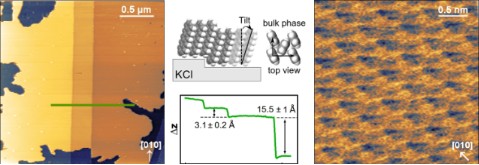
- thin-film electronic devices due to its high carrier mobility [12]. Besides its high carrier mobility, this π-conjugated organic molecule shows shape anisotropy, which leads to a preferential orientation with respect to the substrate in bulk crystals and crystalline thin films. Shape anisotropy also


Simple theoretical analysis of the photoemission from quantum confined effective mass superlattices of optoelectronic materials
Beilstein J. Nanotechnol. 2011, 2, 339–362, doi:10.3762/bjnano.2.40
- , characterizing the screening of the Coulomb field of the ionized impurity centers by the free carriers. It affects many special features of the modern semiconductor devices, the carrier mobility under different mechanisms of scattering, and the carrier plasmas in semiconductors [23]. The DSL (LD) can, in general





