Search results
Search for "charge separation" in Full Text gives 90 result(s) in Beilstein Journal of Nanotechnology.
Nanostructure sensitization of transition metal oxides for visible-light photocatalysis
Beilstein J. Nanotechnol. 2014, 5, 696–710, doi:10.3762/bjnano.5.82
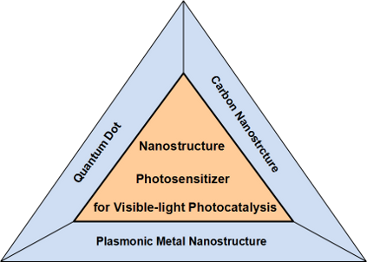
- quantum dots, plasmonic metal nanostructures, and carbon nanostructures for coupling with wide-bandgap transition metal oxides to design better visible-light active photocatalysts. The underlying mechanisms of the composite photocatalysts, e.g., the light-induced charge separation and the subsequent
- –hole pairs. Then, if coupled with a transition metal oxide, the photogenerated electrons can be easily transferred from the CB minimum of the photosensitizer or LUMO to that of a transition metal oxide. Thus the efficient charge separation in the metal oxide-photosensitizer nanocomposites facilitates
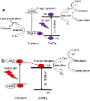
- adjacent TiO2, while the photogenerated holes stay in the VB of CdS. Consequently, the charge separation is improved, and the separated electrons and holes are continually involved in the following reduction and oxidation reactions. The charges transfer scheme is shown in Figure 2. Zhang et al. have




A visible-light-driven composite photocatalyst of TiO2 nanotube arrays and graphene quantum dots
Beilstein J. Nanotechnol. 2014, 5, 689–695, doi:10.3762/bjnano.5.81
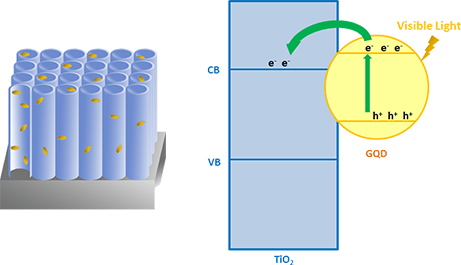
- light irradiation. Figure 6 clearly shows a significant enhancement of photocurrent after the loading of GQDs, indicating the charge separation efficiency of TNAs is greatly enhanced. The stable current reveals that GQDs are covalently bonded to TNAs instead of adsorbed onto the surface of TNAs. The
- interfacial electron transfer from GQDs to TNAs is possible. Meanwhile, such a directional charge transfer promotes charge separation and reduces the probability of charge recombination, then further increases the activity of the photocatalyst. Conclusion In summary, a visible-light-driven photocatalyst was


Enhanced photocatalytic activity of Ag–ZnO hybrid plasmonic nanostructures prepared by a facile wet chemical method
Beilstein J. Nanotechnol. 2014, 5, 639–650, doi:10.3762/bjnano.5.75
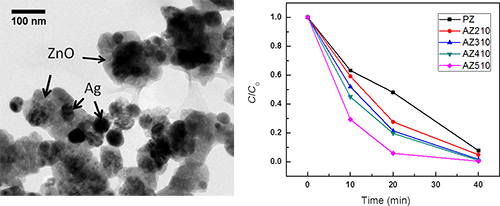
- charge separation in ZnO. When ZnO absorbs photons of energy greater than or equal to its band gap, electrons are promoted from its valence band to conduction band, creating an equal number of holes in the valence band. Since the energy level of conduction band of ZnO is higher than the Fermi level of Ag


High activity of Ag-doped Cd0.1Zn0.9S photocatalyst prepared by the hydrothermal method for hydrogen production under visible-light irradiation
Beilstein J. Nanotechnol. 2014, 5, 587–595, doi:10.3762/bjnano.5.69
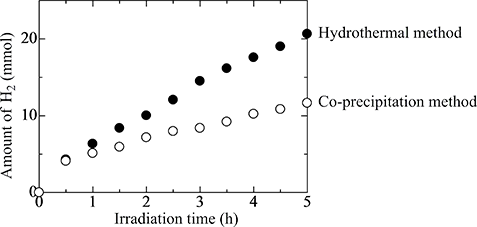
- crystallinity, the improved absorption in the visible-light region, as well as the presence of Ag species. Regarding the latter it has been proposed that both Ag0 and Ag+ played an important role in facilitating the charge separation and suppressing the recombination of photoexcited charge carries [18][19


Mesoporous cerium oxide nanospheres for the visible-light driven photocatalytic degradation of dyes
Beilstein J. Nanotechnol. 2014, 5, 517–523, doi:10.3762/bjnano.5.60
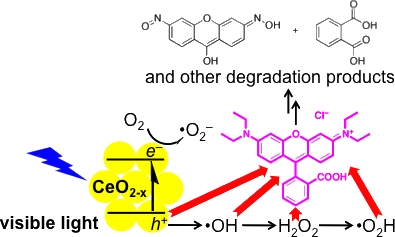
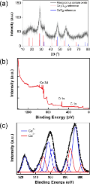
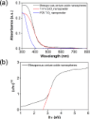
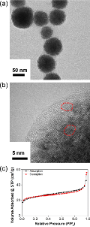
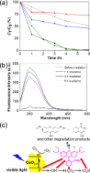
- and solar energy absorption processes by providing higher surface areas and more effective charge separation in semiconductor materials on the nanoscale. In fact, the commercially available Degussa P25 mixed-phase TiO2 is commonly employed as a benchmark in photocatalysis for applications ranging from

Dye-sensitized Pt@TiO2 core–shell nanostructures for the efficient photocatalytic generation of hydrogen
Beilstein J. Nanotechnol. 2014, 5, 360–364, doi:10.3762/bjnano.5.41
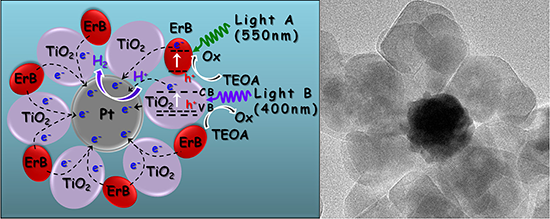
- noble metal (e.g., Pt) nanoparticles as co-catalysts that can act as electron-sinks to achieve effective charge separation on TiO2 [7][8][9][10][11]. Dye-sensitization has been widely used to enable visible light harvesting by wide band gap semiconductors. Since the seminal work reported by O’Regan and


Study of mesoporous CdS-quantum-dot-sensitized TiO2 films by using X-ray photoelectron spectroscopy and AFM
Beilstein J. Nanotechnol. 2014, 5, 68–76, doi:10.3762/bjnano.5.6
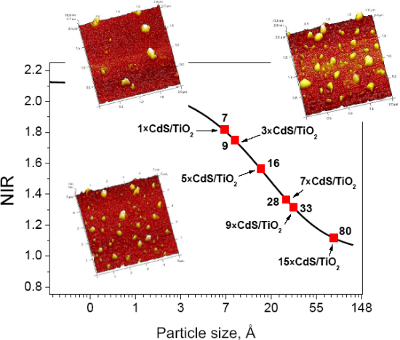
- sensitize TiO2. The suitable positions of the potential energies allow for an easy transfer of the exciton between the semiconductors. Not only does that help to optimize the charge separation by reducing the recombination of charges, it also allows for an extension of the photoresponse of the photocatalyst


Template based precursor route for the synthesis of CuInSe2 nanorod arrays for potential solar cell applications
Beilstein J. Nanotechnol. 2013, 4, 868–874, doi:10.3762/bjnano.4.98
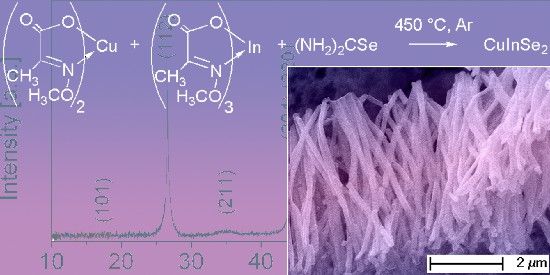
- unique ability for independent adjustment of light absorption (by nanowire length) and charge separation (by nanowire diameter). Nanowire-based photovoltaic layers will allow the fabrication of low-cost small size energy devices with economical use of materials. Very recently, Schoen et al. reported the


Kelvin probe force microscopy of nanocrystalline TiO2 photoelectrodes
Beilstein J. Nanotechnol. 2013, 4, 418–428, doi:10.3762/bjnano.4.49
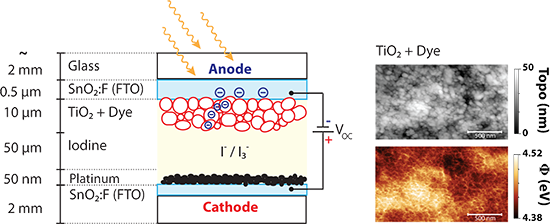
- linear dependency on the light intensity up to a value of −250 mV. A logarithmic dependence on the light intensity would be typical for a charge separation at a built-in potential, for instance at the surface space-charge region. However, the linear dependence indicates a charge separation, which is


Photocatalytic antibacterial performance of TiO2 and Ag-doped TiO2 against S. aureus. P. aeruginosa and E. coli
Beilstein J. Nanotechnol. 2013, 4, 345–351, doi:10.3762/bjnano.4.40
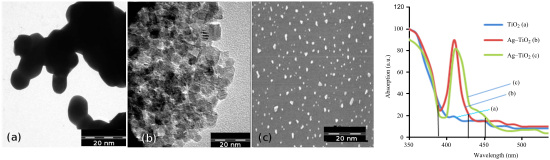
- into the TiO2 matrix. The results observed from this study, alongside a previous study [22] , suggest that the doping of metal and metal oxides on the surface of TiO2 nanoparticles increases the value of the e−–h+ charge separation by decreasing the band-gap energy, and leads to a delay in the


Near-field effects and energy transfer in hybrid metal-oxide nanostructures
Beilstein J. Nanotechnol. 2013, 4, 306–317, doi:10.3762/bjnano.4.34
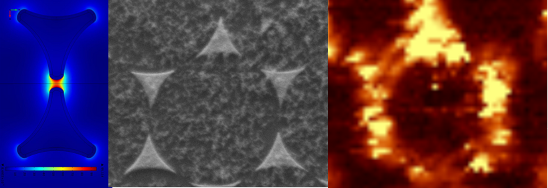
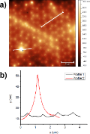
- other forms of energy by charge separation and transfer. This may be achieved by utilizing hybrid nanostructures, which combine metallic and nonmetallic components. Metallic nanostructures can interact strongly with light. Plasmonic excitations of such structures can cause local enhancement of the








Horizontal versus vertical charge and energy transfer in hybrid assemblies of semiconductor nanoparticles
Beilstein J. Nanotechnol. 2012, 3, 629–636, doi:10.3762/bjnano.3.72
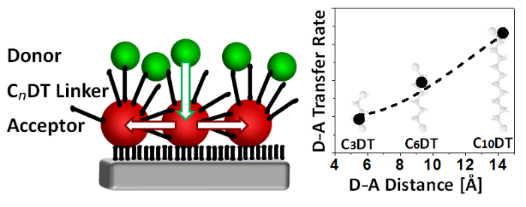
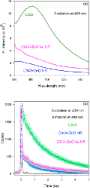
- . Keywords: charge transfer; energy transfer; nanoparticles; organic linker; quantum dots; Introduction Self-assembled structures of semiconductor nanoparticles (NPs) are viewed as a possible avenue for producing photovoltaic devices with efficient collection of light and charge separation processes [1
- type of transfer process. Wu et al. studied charge separation in type-II heterojunction assemblies of CdSe–CdTe NPs as a function of linker length [23]. They found that for longer linkers, the charge transfer efficiency is smaller. In another study, photogenerated exciton dissociation in PbS NP thin
- . This is a tunneling-based effect; therefore, it strongly depends on the length of the linker (as seen in Figure 2a). Dithiolated-linker length-dependent PL and PL-lifetime quenching, owing to charge separation within the NPs layer, was reported previously for PbS NP thin films [24]. To validate this


Junction formation of Cu3BiS3 investigated by Kelvin probe force microscopy and surface photovoltage measurements
Beilstein J. Nanotechnol. 2012, 3, 277–284, doi:10.3762/bjnano.3.31
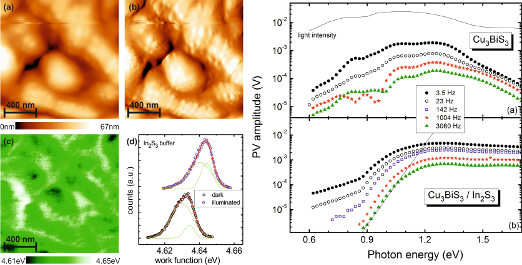
- the influence of defect states below the band gap on charge separation and a surface-defect passivation by the In2S3 buffer layer. Our findings indicate that Cu3BiS3 may become an interesting absorber material for thin-film solar cells; however, for photovoltaic application the band bending at the
- compare the SPV between the different samples. This is shown in the upper panel of Figure 3. While the etched Cu3BiS3 surface and the CdS and ZnS buffer layers exhibit a positive SPV, only the In2S3 buffer layer exhibits a negative SPV. This corresponds to charge separation due to band bending at the
- , the spectrum of the light intensity is shown for comparison. There are distinct shoulders and peaks in the amplitude spectra, which are related to the onset of electronic transitions from which charge separation is possible and that depend also on the light intensity. A normalization of SPV spectra to


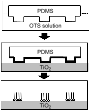
Self-assembled monolayers and titanium dioxide: From surface patterning to potential applications
Beilstein J. Nanotechnol. 2011, 2, 845–861, doi:10.3762/bjnano.2.94
- . A claim was made that similar paths yielding long-lived charge separation situations may be relevant also in natural photosynthetic systems, and should be considered in the development of dye-sensitized solar cells. In certain cases, feasibility studies with TiO2-containing systems were later



Highly efficient ZnO/Au Schottky barrier dye-sensitized solar cells: Role of gold nanoparticles on the charge-transfer process
Beilstein J. Nanotechnol. 2011, 2, 681–690, doi:10.3762/bjnano.2.73
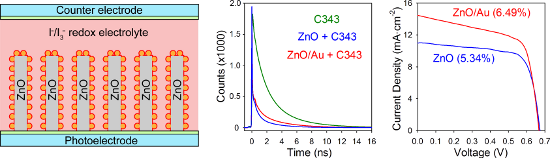
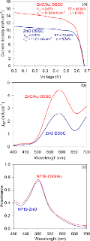
- improve the device performance through better charge separation in the photoelectrodes. In this regards, several reports have been previously published [19][20][21][22][23] demonstrating the rapid charge transfer and improved charge separation upon the incorporation of Au nanoparticles in ZnO- or TiO2