


Search results
Search for "dwell time" in Full Text gives 87 result(s) in Beilstein Journal of Nanotechnology.
In situ growth optimization in focused electron-beam induced deposition
Beilstein J. Nanotechnol. 2013, 4, 919–926, doi:10.3762/bjnano.4.103
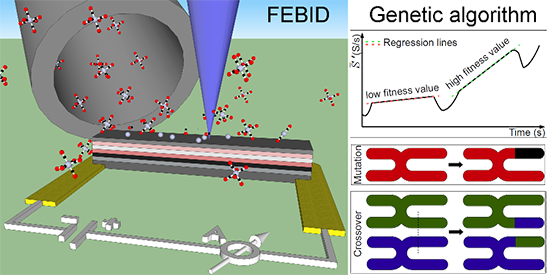
- achieved with the GA by solely varying the process parameters pitch p and dwell-time tD in the deposition process. The precursor-specific limitations of the approach are also exemplified for another precursor, MeCpPt(Me)3, which is known to show only one bond-cleavage in the initial step [18]. This results
- process, the set of parameters used for the deposition of one specific layer consists of the x- and y-size of the deposit, the dwell time (tD), the pitch in x (px) and y (py) direction, the beam current (I), the acceleration voltage (U), the temperature (T), refresh-time (tr), scan-type (raster or
- parameter sets. The measured rate of change of conductance during the FEBID process for the reference sample is displayed in Figure 3a (Sample 1). Subsequently the GA was applied for finding the optimized parameters for the deposition that used W(CO)6 as a precursor. First, only the dwell time tD was used


Dynamic nanoindentation by instrumented nanoindentation and force microscopy: a comparative review
Beilstein J. Nanotechnol. 2013, 4, 815–833, doi:10.3762/bjnano.4.93
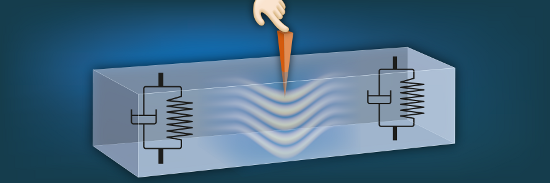
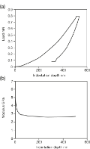
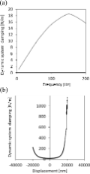
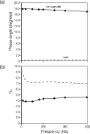
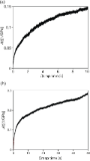
- viscoelastic/plastic deformation, as well as capillary and adhesive forces. The analysis of AFM force–distance curves of polydimethylsiloxane (PDMS) showed a strong influence of the measurement conditions such as the loading–unloading rate and the dwell time, as well as intrinsic material properties like the




Ultramicrosensors based on transition metal hexacyanoferrates for scanning electrochemical microscopy
Beilstein J. Nanotechnol. 2013, 4, 649–654, doi:10.3762/bjnano.4.72
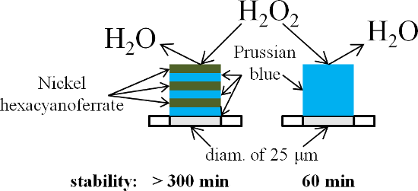
- deposited onto a microelectrode using a focused ion beam gas-assisted process (Quanta 3D FEG, FEI Eindhoven). The circular Pt/C composite were deposited on 10 µm Pt electrodes and had a radius of approx. 6.5 µm and a thickness of approx. 150 nm (ion beam current: 300 pA and a dwell time of 200 ns) with a


The role of electron-stimulated desorption in focused electron beam induced deposition
Beilstein J. Nanotechnol. 2013, 4, 474–480, doi:10.3762/bjnano.4.56
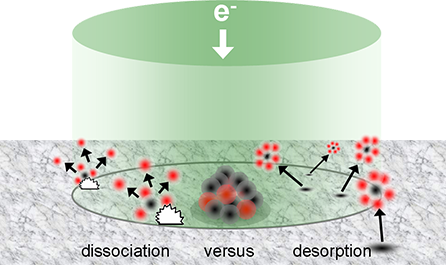
- given in Table 1 and range between 1 and 6 pA, which is consistent with values reported in literature [20][21]. Figure 1b shows the average deposited mass per dot as a function of beam current and substrate temperature. In this case the dwell time was 3 s per dot for all arrays. From the fact that the
- deposited mass increases with the beam current, we conclude that the growth is electron-limited at all substrate temperatures. The effect of the dwell time is studied by writing arrays of dots with spot 9 at three temperatures, 306 K, 341 K and 371 K. The average deposited mass per dot is plotted as a
- function of the dwell time in Figure 2a (see below), from which Edes can be determined. Following the model proposed by Müller et al. [22], the precursor coverage, N·(cm−2), depends on the adsorption from the gas phase, the diffusion of precursor molecules over the surface, the number of molecules consumed


Digging gold: keV He+ ion interaction with Au
Beilstein J. Nanotechnol. 2013, 4, 453–460, doi:10.3762/bjnano.4.53
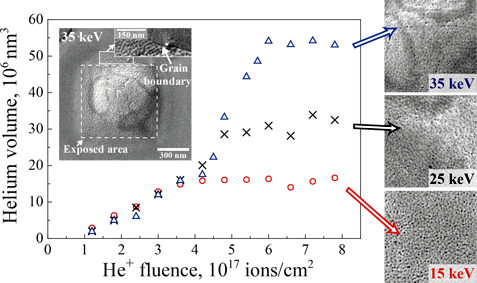
- was oriented perpendicular to the surface. Three primary ion energies were used in the experiments: 15, 25 and 35 keV. The images were recorded with 0.68 nm pixel spacing, 2 μs dwell time and 32-line averaging, giving an ion dose per image of 6 × 1016 cm−2. The chamber base pressure during imaging was


Porous polymer coatings as substrates for the formation of high-fidelity micropatterns by quill-like pens
Beilstein J. Nanotechnol. 2013, 4, 377–384, doi:10.3762/bjnano.4.44
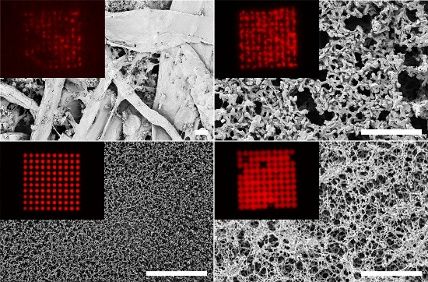
- ). After filling of the reservoir on the SPT with the dye solution, it is brought into contact with the substrate surface for a defined dwell time to allow a flow to the substrate by capillary forces. The SPT is retracted and moved to the next spotting position. The process of relocation, contacting and
- retracting is repeated until the desired spot features are created. The writing procedure can be relatively fast: our standard pattern of 100 spots arranged in a square with pitch of 50 µm (yielding a patterned area of 500 × 500 µm2) with a dwell time of 0.5 s was written with a single cantilever in about a
- platforms for the microarray spotting using SPTs. A pattern of 10 × 10 spots with a 50 µm pitch and dwell time of 0.5 s was written on each of the substrates by using a 10 mM solution of phloxine B in isopropanol mixed with 30 vol % glycerol (87% in water) to prevent drying of the dye solution in the SPT


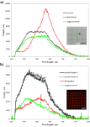
Low-dose patterning of platinum nanoclusters on carbon nanotubes by focused-electron-beam-induced deposition as studied by TEM
Beilstein J. Nanotechnol. 2013, 4, 77–86, doi:10.3762/bjnano.4.9
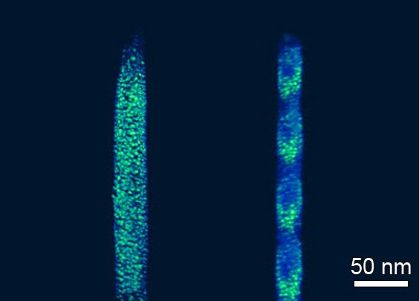
- is studied by changing the beam accelerating voltage (primary energy, PE) and dwell time, whereas the beam current is not varied in the current study. Figure 6 summarizes the deposition of Pt for an increasing PE of 1 kV, 3 kV, 5 kV, 10 kV, 15 kV and 30 kV in each row. For each PE, different dwell
- distribution. Comparing the nanoclusters in the same column in which PE is increasing and dwell time is not varied, it can be seen that their average size and lateral density decreases. The higher lateral density indicates a higher dissociation probability at lower PE, where PE contributes more to the
- constant and dwell time is increased, it is noticed that the change in lateral density of the nanoclusters does not follow the same trend. When PE is 1 kV and 3 kV, the deposited nanoclusters have the same high density for all dwell times from 50 ns to 10 μs. Nevertheless, when PE is 15 kV and 30 kV, the


Growth behaviour and mechanical properties of PLL/HA multilayer films studied by AFM
Beilstein J. Nanotechnol. 2012, 3, 778–788, doi:10.3762/bjnano.3.87
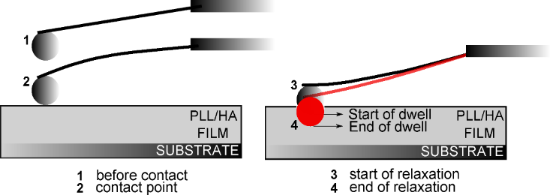
- velocity, but unlike a standard elasticity measurement, the indenter was not retracted instantly after the initial indentation. It was left to dwell in the film while the z-piezo drive was paused. The AFM detector continued collecting the cantilever deflection data F as a function of time t. The dwell time
- (“Relaxation” in Figure 9, viscous response). After 40 s (“Dwell Time” in Figure 9) the cantilever was retracted from the film, as in the case of a standard elasticity measurement (“Retraction” in Figure 9). Data points were collected every 0.1 s. Typical F versus t relaxation curves on (PLL/HA)72 are
- is stopped. “End of dwell” shows the maximum indentation depth caused by the relaxation on the cantilever. Stress relaxation curve with a dwell time of 40 s. The biexponential fit is represented by the thick lines on the decaying part of the force curve, in the dwell regime. The cantilever’s stress


Focused electron beam induced deposition: A perspective
Beilstein J. Nanotechnol. 2012, 3, 597–619, doi:10.3762/bjnano.3.70
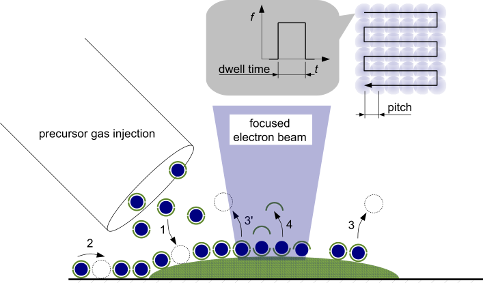
- independently controlled, is analyzed within a continuum model of FEBID that employs rate equations. Predictions are made for the tunability of the composition of the Co–Pt system by simply changing the dwell time of the electron beam during the writing process. The charge-transport regimes of nanogranular
- govern the writing process are the primary-beam energy E and beam current I, the time for which the electron beam is held constant on a particular point on the surface, the dwell time tD, the distance between neighboring dwell points, the pitch p, and the number of loops for which the writing pattern is
- [22] where J is the precursor flux modified by the sticking coefficient s. The local growth rate R(r) of the deposit, assuming the volume V for the nonvolatile dissociation product of an individual precursor molecule, is then obtained from with tD denoting the beam dwell time. Valuable insight can be


Nano-structuring, surface and bulk modification with a focused helium ion beam
Beilstein J. Nanotechnol. 2012, 3, 579–585, doi:10.3762/bjnano.3.67
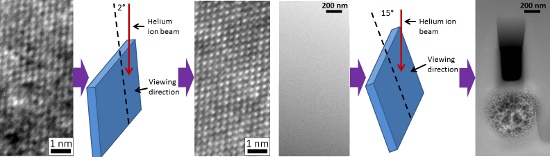
- process as sample 1. Sample 3 is a silicon sample; it was treated with an extra final step. The sample face was tilted 2° into the beam and scanned with reduced energy gallium beam of 5 keV for one minute on each side, the beam current was 20 pA. A short dwell time and a large number of scan repeats were
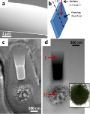
- was 1.2 pA. The beam was rastered in a single scan over the area with a pixel spacing of 1 nm and a dwell time at each point of 1.3 × 10⁻³ s. The sample was rotated through 180° and the process was repeated on the opposite sidewall. The scanning time per sidewall was 68 s. This section of the sample
- × 200 nm area was exposed to a dose of 6.2 × 10¹⁸ ions/cm2. The beam current used was 3.4 pA. The beam was rastered in a single scan over the area with a pixel spacing of 0.7 nm and a dwell time at each point of 5 × 10⁻³ s. The total scanning time was 612 s. This process produced a hole straight through


Spontaneous dissociation of Co2(CO)8 and autocatalytic growth of Co on SiO2: A combined experimental and theoretical investigation
Beilstein J. Nanotechnol. 2012, 3, 546–555, doi:10.3762/bjnano.3.63
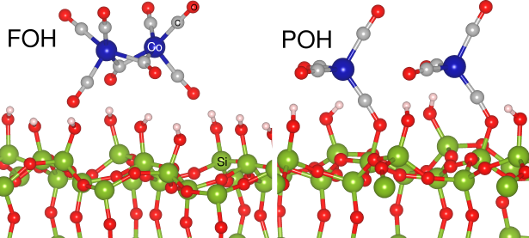
- pregrowth irradiated with a focused electron beam, which was moved in a raster fashion (dwell time 100 μs, pitch 20 nm) for 30 min over a rectangular region of 3.7 × 1.0 μm2 bridging the gap between two prepatterned Cr/Au electrodes. The background pressure during the irradiation process was 6 × 10⁻⁶ mbar


Distinguishing magnetic and electrostatic interactions by a Kelvin probe force microscopy–magnetic force microscopy combination
Beilstein J. Nanotechnol. 2011, 2, 552–560, doi:10.3762/bjnano.2.59
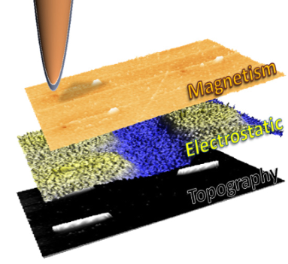
- ]. All the structures presented in this study were deposited with an electron beam current of 2.1 nA, an acceleration voltage of 10 kV and 1 µs dwell time. The nanowires grown by this technique are polycrystalline with grain sizes of a few nanometers oriented randomly, thus shape anisotropy is the main





