


Search results
Search for "electric field" in Full Text gives 398 result(s) in Beilstein Journal of Nanotechnology. Showing first 200.
Direct measurement of surface photovoltage by AC bias Kelvin probe force microscopy
Beilstein J. Nanotechnol. 2022, 13, 712–720, doi:10.3762/bjnano.13.63
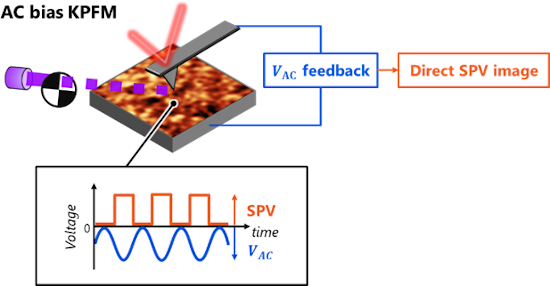
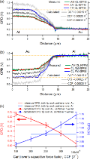
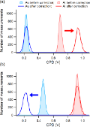
- thermal drift between darkness and illumination. In the case of semiconductors, an electric field is screened on the scale of the Debye length LD [3], where kB is the Boltzmann constant, T is the temperature, ε0 is the vacuum permittivity, εr is the relative permittivity of the semiconductor, e is the
- intrinsic electric field [57][58][59]; however, this is beyond the scope of this paper. We note that the time scale of SPV measured with AC-KPFM is determined by the modulation frequency of the laser power and is faster (microseconds to milliseconds) than that in the case of classical KPFM (seconds to hours


Tunable high-quality-factor absorption in a graphene monolayer based on quasi-bound states in the continuum
Beilstein J. Nanotechnol. 2022, 13, 675–681, doi:10.3762/bjnano.13.59
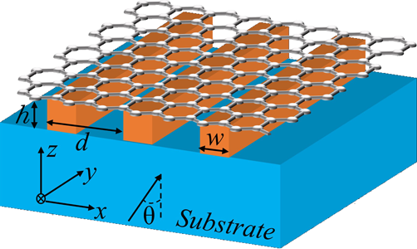
- normal incidence owing to the subwavelength unit cell of this structure. Therefore, the radiation mode will be confined in the dielectric grating, which results in large electric field intensity enhancement and concentration inside the grating, as presented in Figure 3d. For a nonmagnetic dispersive
- medium, the time-averaged power loss density is described by [59]: dPloss/dV = 1/2ε0ω·Im (ε(ω))|E|2, where Im(ε) denotes the imaginary part of relative permittivity and E is the electric field. Thus, the strong electric intensity enhancement inside the dielectric grating will boost light absorption in


Revealing local structural properties of an atomically thin MoSe2 surface using optical microscopy
Beilstein J. Nanotechnol. 2022, 13, 572–581, doi:10.3762/bjnano.13.49
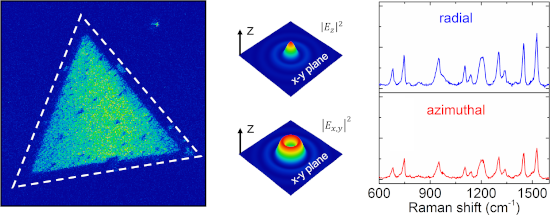
- and microscopy are used to reveal the structural irregularities of the MoSe2 flake. The Raman enhancement in the focus of an azimuthally polarized beam, which possesses exclusively an in-plane electric field component is stronger than the enhancement by a focused radially polarized beam, where the out
- -of-plane electric field component dominates. This phenomenon indicates that the face-on oriented CuPc molecules strongly interact with the MoSe2 flake via charge transfer and dipole–dipole interaction. Furthermore, the Raman scattering maps on the irregular MoSe2 surface show a distinct correlation
- at the center. The insets in Figure 1f and Figure 1h show the calculated intensity distribution of the electric field in the x–y plane in the focus of the radially and azimuthally polarized laser beam, respectively. The center of a focused radial polarization beam exhibits mainly a z-direction field


Zinc oxide nanostructures for fluorescence and Raman signal enhancement: a review
Beilstein J. Nanotechnol. 2022, 13, 472–490, doi:10.3762/bjnano.13.40
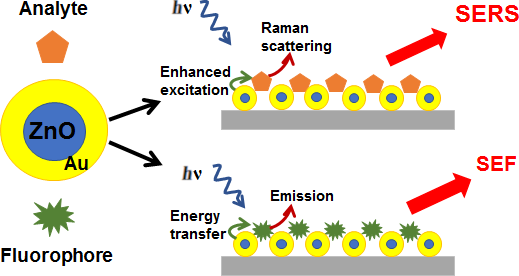
- great interest and will be the focus of this review. The electromagnetic (EM) enhancement in surface-enhanced Raman scattering (SERS) appears due to the enhanced local electric field that is generated when localized surface plasmon resonances (LSPRs) are excited by light incident on noble metal
- Previous simulations have shown that the Ag NPs exhibit the greatest plasmonic activity in the excitation wavelength range of 400–520 nm and the greatest absorption and electric field energy enhancement at the size of 50–60 nm, while for AuNPs these ranges are 525–580 and 90–100 nm (and potentially bigger




Electrostatic pull-in application in flexible devices: A review
Beilstein J. Nanotechnol. 2022, 13, 390–403, doi:10.3762/bjnano.13.32
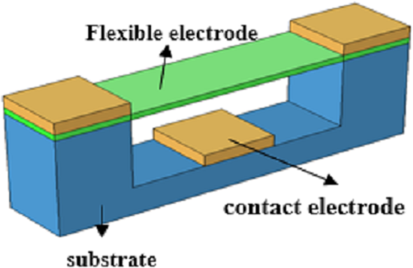
- switch to open. After the circuit conduction or charge disappears, the switch is pulled in again. By analyzing the electric field in the comb structure, He et al. [91] showed that the side electrode would generate a repulsive force without introducing a current. Pallay et al. [85] proposed a sensor


The effect of metal surface nanomorphology on the output performance of a TENG
Beilstein J. Nanotechnol. 2022, 13, 298–312, doi:10.3762/bjnano.13.25
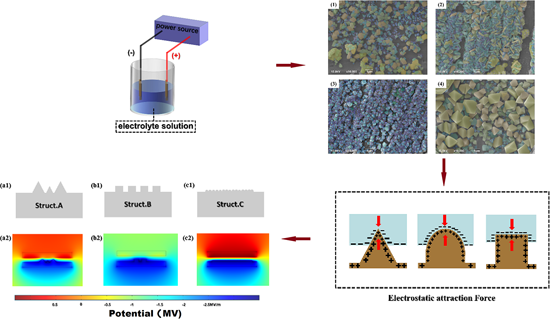
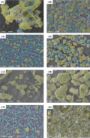
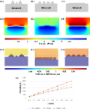
- with different shapes of nanoscale crystallites. (a1–c1) Models of pyramids, strips, and spheroids. (a2–c2) COMSOL simulation of the electric field distribution with a surface charge density of 12.5 μC·m−2 at the contact surface of PTFE. (a3–c3) COMSOL simulation of the displacement distribution under




Impact of device design on the electronic and optoelectronic properties of integrated Ru-terpyridine complexes
Beilstein J. Nanotechnol. 2022, 13, 219–229, doi:10.3762/bjnano.13.16
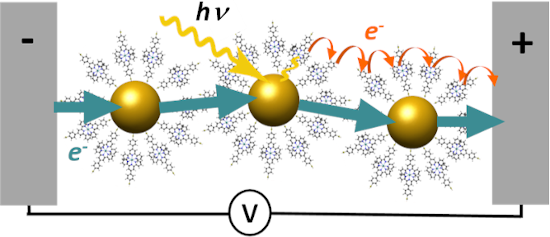
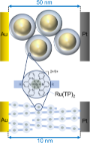
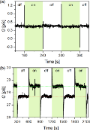
- transfer is induced by irradiation with light of a wavelength of 530 nm, which finally leads to a small current increase through the device after charge separation of the excited [Ru3+(MPTP)2−]-complex in the applied electric field. This supposed mechanism for current increase in Ru(MPTP)2–AuNP devices
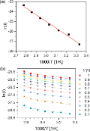
- demands the adjustment of an effective equilibrium between light intensity, local surface plasmons of the AuNP, fraction of Ru(MPTP)2-complexes in the ground state, charge carrier density, density of trap states on the AuNP cores or TP ligands and the applied electric field. The resulting steady-state


Thermal oxidation process on Si(113)-(3 × 2) investigated using high-temperature scanning tunneling microscopy
Beilstein J. Nanotechnol. 2022, 13, 172–181, doi:10.3762/bjnano.13.12
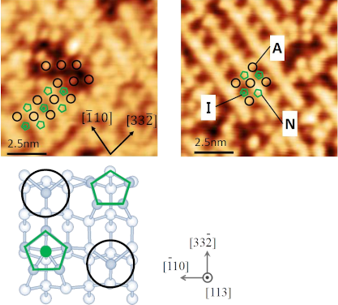
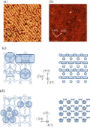
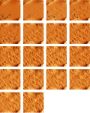
- significance because the corners of the Fin-type FETs should have such surfaces, where the electric field is enhanced, which significantly affects the device performance [3]. Recently, the observation of oxidation at the atomic level in both real time and real space has been recognized as an important


A comprehensive review on electrospun nanohybrid membranes for wastewater treatment
Beilstein J. Nanotechnol. 2022, 13, 137–159, doi:10.3762/bjnano.13.10
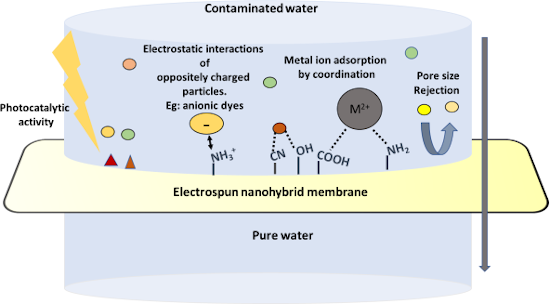
- distance from nozzle to collector has an effect on the jet flight time and the electric field strength. Similar to the voltage, at first, the increase of distance results in the decrease of fiber diameter, while the further increase of the distance will yield larger fiber diameters. An optimum distance
- collector distance was reduced, while the ribbon shaped morphology was preserved [26]. The combination of applied voltage and spinning distance is important. Longer distances allow for a greater time for jet stretching and solvent evaporation at low applied voltages, but they diminish the electric field (E
- = V/D). The electric field strength, however, is strong at high applied voltages and becomes a dominant factor. The combination of these two factors will define the eventual fiber shape [25]. 3.1.3 Polymer flow rate. The amount of polymer to be electrospun depends on the polymer flow rate. To obtain a




Tin dioxide nanomaterial-based photocatalysts for nitrogen oxide oxidation: a review
Beilstein J. Nanotechnol. 2022, 13, 96–113, doi:10.3762/bjnano.13.7
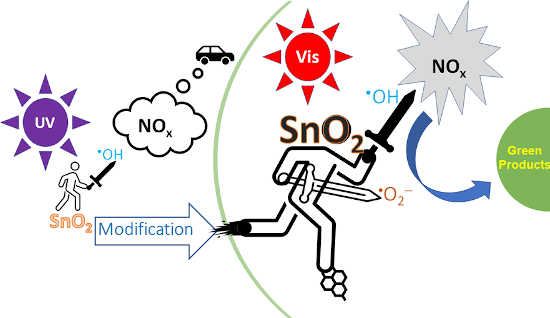
- products was inhibited effectively. The charge movement at the BiOBr/SnO2 p–n interface was also revealed via theoretical and experimental findings. Electrons in SnO2 transfer into BiOBr over pre-formed charge migration channels and an internal electric field at the BiOBr/SnO2 interface, which directs


Theranostic potential of self-luminescent branched polyethyleneimine-coated superparamagnetic iron oxide nanoparticles
Beilstein J. Nanotechnol. 2022, 13, 82–95, doi:10.3762/bjnano.13.6
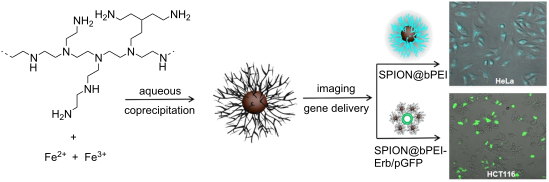
- solution, added into the gel wells, and separated under an electric field (80 mV, 400 mA) for 60 min using a Bio-Rad Mini-Sub Cell GT Cell. DLS and zeta potential measurements The hydrodynamic radius and ζ-potential of the nanoparticles were determined using a Zetasizer Ultra (Malvern Instruments Ltd, UK




Design aspects of Bi2Sr2CaCu2O8+δ THz sources: optimization of thermal and radiative properties
Beilstein J. Nanotechnol. 2021, 12, 1392–1403, doi:10.3762/bjnano.12.103
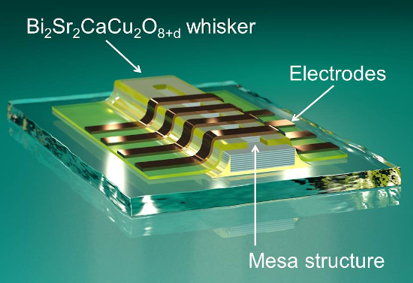
- electrode and whisker is set to ≃6 × 10⁵ (Ω·m)−1 and the relative dielectric permittivity of the substrate is εr = 10. First we consider the case without dielectric losses, tan(δ) = 0. The middle panels in Figure 6 show the local distributions of electric field amplitudes in the xz crosssection through the
- mesa. The same color scale is used, indicated in the middle panel of Figure 6b. The rightmost panels represent far-field radiation patterns (directionality diagrams) of the electric field amplitude outside the simulation sphere. From comparison of the middle panels in Figure 6a,b it can be seen that
- the electric field distribution is significantly different. In the crystal-based device the field is locked between the electrode and the crystal. This occurs because the electrode is laying on top of the crystal, forming together a parallel plate capacitor. The field is trapped inside this capacitor


Plasmon-enhanced photoluminescence from TiO2 and TeO2 thin films doped by Eu3+ for optoelectronic applications
Beilstein J. Nanotechnol. 2021, 12, 1271–1278, doi:10.3762/bjnano.12.94
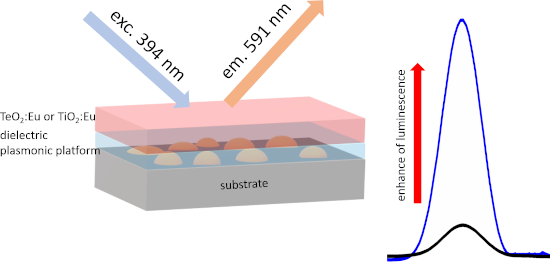
- increase of luminescence for samples with plasmonic nanostructures can be explained by a local concentration of the electric field around the nanostructures. It could increase the rate of excitation [3]. The additional Al2O3 dielectric layer separates plasmonic gold nanostructures and TiO2:Eu luminescent


Enhancement of the piezoelectric coefficient in PVDF-TrFe/CoFe2O4 nanocomposites through DC magnetic poling
Beilstein J. Nanotechnol. 2021, 12, 1262–1270, doi:10.3762/bjnano.12.93
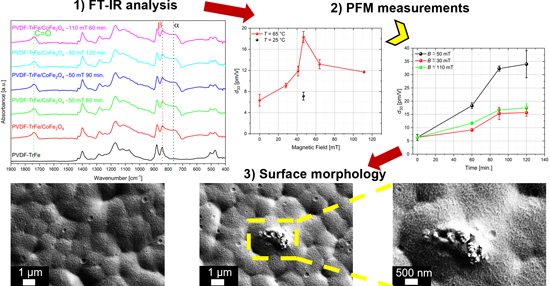
- investigated piezoelectric polymers, due to the high β phase content resulting from specific curing or processing conditions. However, to obtain a high piezoelectric coefficient (d33) alignment of the β phase domains is needed, which is usually reached through applying a high electric field at moderate
- , the dipoles in PVDF/PVDF-TrFe must be oriented along a preferential direction. The dipole orientation is generally obtained by electrical poling, that is, the application of a strong DC electric field (ca. 106 V·cm−1) at elevated temperature (ca. 120 °C) through top and bottom electrodes [18]. However


A review on slip boundary conditions at the nanoscale: recent development and applications
Beilstein J. Nanotechnol. 2021, 12, 1237–1251, doi:10.3762/bjnano.12.91
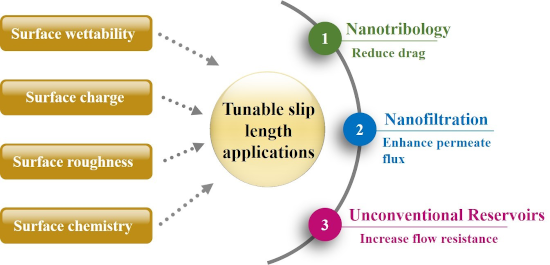
- applied electric field. Due to the surface charge on the solid surface, an electrical double layer (EDL), which is comprised of oppositely charged ions, naturally forms within the liquid in the vicinity of the solid surface. As shown in Figure 5, the EDL consists of an immobile Stern layer and a mobile
- –liquid interface, and when the thickness of the EDL is much smaller than the characteristic geometrical length, the shape of the velocity profile appears to be plug-like. Nonetheless, many studies have shown that on hydrophobic solid surfaces, the ionized solution driven by an external electric field may
- mobility of surface charges to describe the motion of electro-osmosis. The approximate expressions for the electro-osmotic velocity can be derived even when the surface charge density is large [75]. When investigating the motion of an electrolyte solution driven by an external electric field, Celebi and


Open-loop amplitude-modulation Kelvin probe force microscopy operated in single-pass PeakForce tapping mode
Beilstein J. Nanotechnol. 2021, 12, 1115–1126, doi:10.3762/bjnano.12.83
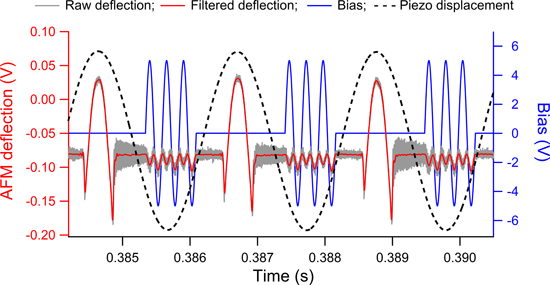
- microscopy [29][30], pump–probe KPFM [31][32], or fast free force recovery KPFM [33] that are capable of observing the dynamics of the optoelectronic response of materials and electric field-induced charge migration at time scales of the order of tens of microseconds. Various OL KPFM implementations with





First-principles study of the structural, optoelectronic and thermophysical properties of the π-SnSe for thermoelectric applications
Beilstein J. Nanotechnol. 2021, 12, 1101–1114, doi:10.3762/bjnano.12.82
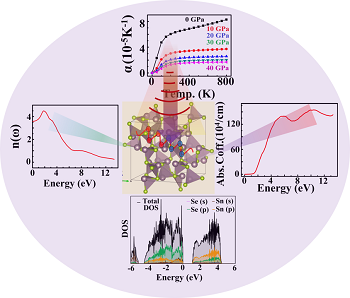
- entries of the momentum operator between the filled and unfilled energy states by applying the following relation [71]: where the potential vector δ describes the electric field component, k is the reciprocal lattice vector, Mcv(k) is equivalent to dipole moment values, v and c represent the valence and


A Au/CuNiCoS4/p-Si photodiode: electrical and morphological characterization
Beilstein J. Nanotechnol. 2021, 12, 984–994, doi:10.3762/bjnano.12.74
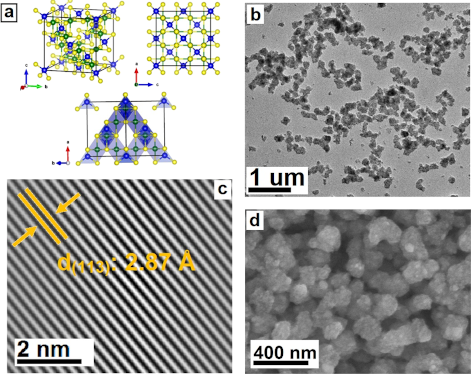
- photodiode [40][41]. The sudden increase of the conductance values with increasing reverse bias can be attributed to the applied electric field causing a change of the behavior of the semiconductor. C−2–V graphs of the Au/CuNiCoS4/p-Si device are displayed in Figure 11 for various frequencies. The graphs
- exhibit sometimes straight lines and sometimes deviations from linearity due to a non-homogenous interfacial layer of CuNiCoS4 [42]. Various electrical parameters, such as Fermi energy level (EF), barrier height (ϕb), maximum electric field (Em), depletion width (Wd), and doping concentration of acceptor



Comprehensive review on ultrasound-responsive theranostic nanomaterials: mechanisms, structures and medical applications
Beilstein J. Nanotechnol. 2021, 12, 808–862, doi:10.3762/bjnano.12.64
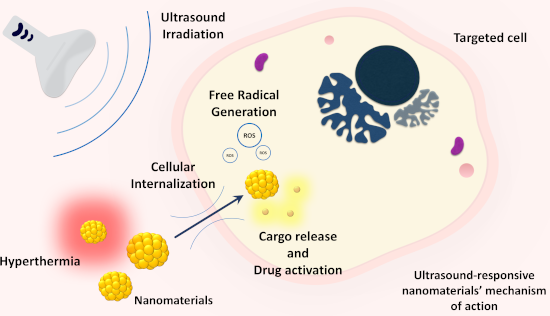
- temperature, pH, enzyme, redox potential, ionic strength, or solvent composition of the media. Other stimuli are external, such as heat, light, electric field, magnetic field, or ultrasound (US) [5][6][7]. Designing such single, dual, or multi-stimulus-responsive smart delivery vehicles provides an


Recent progress in actuation technologies of micro/nanorobots
Beilstein J. Nanotechnol. 2021, 12, 756–765, doi:10.3762/bjnano.12.59
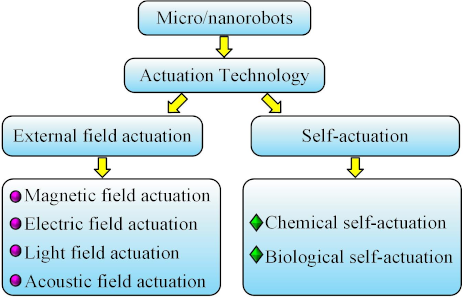
- under environmental perception, thereby solving the problem of integrated operation of microrobots in a closed living environment. This application in minimally invasive medicine, soft robotics, and smart materials has attracted more and more attention. Electric field actuation External electric fields
- this, the new microrobot is expected to be used in targeted drug delivery and other biomedical fields. Si et al. [27] proposed a theoretical concept of a nanorobot consisting of a nanoparticle and four single-stranded DNAs placed on a quad-nanopore device for motion control. When an electric field is
- conductive materials into a micro/nanorobot and then adjusting the surface charge of the robot or the electrochemical reaction on the interface through electric fields can also yield actuation. Zhang et al. [29] proposed an interdigital microelectrode system. When an AC electric field is applied, metal


Recent progress in magnetic applications for micro- and nanorobots
Beilstein J. Nanotechnol. 2021, 12, 744–755, doi:10.3762/bjnano.12.58
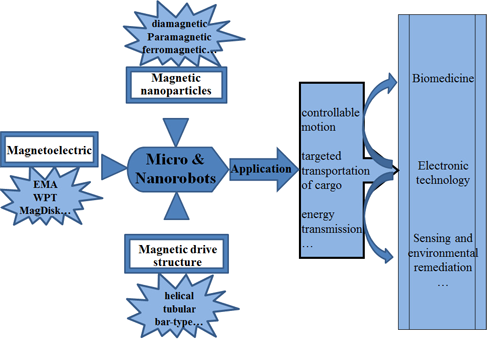
- ]. Also, they respond more sensitively than other stimuli-responsive hydrogels [67]. The proposed microrobot had two arms, both of which were composed of anodic and cathodic electroactive hydrogels and MNPs. So they could be driven in a magnetic field and bent in an electric field to pick up and release


Electromigration-induced formation of percolating adsorbate islands during condensation from the gaseous phase: a computational study
Beilstein J. Nanotechnol. 2021, 12, 694–703, doi:10.3762/bjnano.12.55
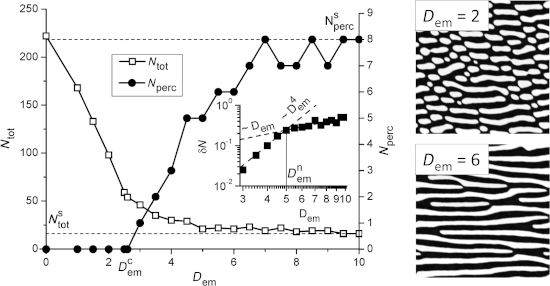
- islands during condensation from the gaseous phase. We will show that the elongated morphology of adsorbate islands remains stable if the electric field is turned off. Keywords: adsorptive systems; electromigration; numerical simulations; pattern formation; thin films; Introduction The processes of
- properties. The electric field applied to a substrate with a direction parallel to the substrate results in a change in the internal local electric field leading to a directed force Fel = eZE. The strength |E| = −Φ/L is determined by the potential difference Φ and the linear size of the substrate L (distance
- between anode and cathode); e is the electron charge. The direction of the force Fel is defined by the effective valence Z, which is negative for most metals. Thus, the adsorbed atoms move in the opposite direction to the electric field. In the general case if the electric field is applied across the




![[Graphic 29]](/bjnano/content/inline/2190-4286-12-55-i36.svg?max-width=637&scale=1.18182) on the adsorption coefficient α ...
on the adsorption coefficient α ...

A review of defect engineering, ion implantation, and nanofabrication using the helium ion microscope
Beilstein J. Nanotechnol. 2021, 12, 633–664, doi:10.3762/bjnano.12.52


Properties of graphene deposited on GaN nanowires: influence of nanowire roughness, self-induced nanogating and defects
Beilstein J. Nanotechnol. 2021, 12, 566–577, doi:10.3762/bjnano.12.47
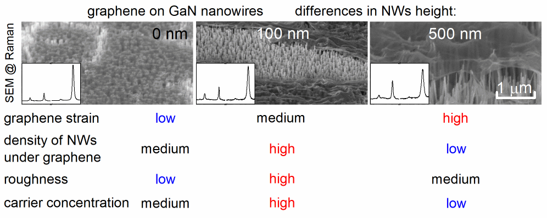
- graphene deposited on gallium nitride nanowires (GaN NWs) with different variations in height. The electric field induced in GaN predicted by theoretical calculations could reach 5 MV/cm [21]. This is an effect of high spontaneous and piezoelectric polarisations in the wurtzite structure of GaN




Local stiffness and work function variations of hexagonal boron nitride on Cu(111)
Beilstein J. Nanotechnol. 2021, 12, 559–565, doi:10.3762/bjnano.12.46
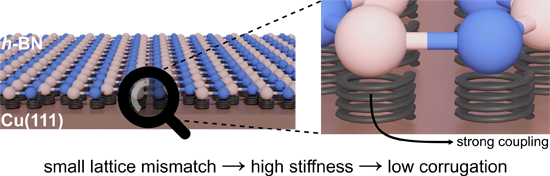
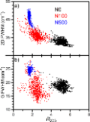
- for atomic and molecular adsorbates owing to its local electronic trapping potential due to the in-plane electric field. We obtain work function (Φ) variations on the h-BN/Cu(111) superstructure of the order of 100 meV using two independent methods, namely the shift of field emission resonances and
- ), states arising from the long-range image potential experienced by an electron in front of a metal surface, are delocalised in the surface plane and contain the full band of the 2D electron gas. However, the electric field exerted by the proximity of the probing tip distorts the energy spacing of the IPSs





