


Search results
Search for "image" in Full Text gives 1504 result(s) in Beilstein Journal of Nanotechnology. Showing first 200.
Structural and magnetic properties of microwave-synthesized reduced graphene oxide/VO2/Fe2O3 nanocomposite
Beilstein J. Nanotechnol. 2025, 16, 921–932, doi:10.3762/bjnano.16.70
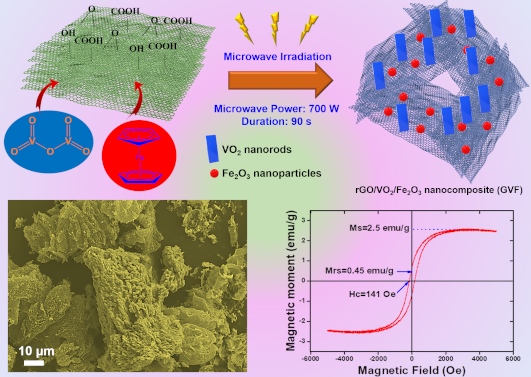
- demonstrating improved magnetic characteristics due to alterations in the electronic structure. To further comprehend the elemental composition of GVF, the elemental analysis was also performed, and the corresponding elemental distribution and EDX spectrum are shown in Figure 5a,b. The SEM image displays a wide
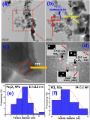
- . The detailed structure of the GVF was monitored by HRTEM analysis. The corresponding images are shown in Figure 8a–f. As shown in Figure 8a, the rGO nanosheets are found to be transparent and thin in nature. In the magnified HRTEM image, an agglomerated dispersion of Fe2O3 NPs and VO2 nanospheres (NSs
- , d) GVF NC at lower and higher magnifications. EDX analysis of GVF NC: (a) SEM image (scale bar – 50 μm), (b) EDX spectrum, and the corresponding elemental mapping showing the distribution of C, O, V, and Fe. Morphology analysis of GV: (a–c) SEM images at lower and higher magnifications; (d–h) SEM



Focused ion beam-induced platinum deposition with a low-temperature cesium ion source
Beilstein J. Nanotechnol. 2025, 16, 910–920, doi:10.3762/bjnano.16.69
- Figure 7. These bright-field TEM images were used for grain diameter measurements in the same way as done in [11]. In short, bright-field TEM images similar to those shown in Figure 7, but taken at two times higher magnification, were analyzed using the particle analyzer option provided by the image
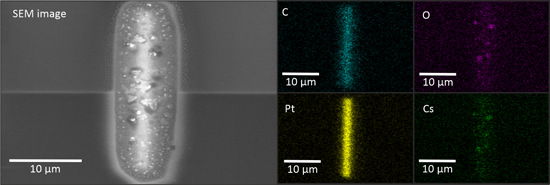
- using the two upper contacts, while the resulting voltage was measured between the two lower contacts to evaluate the resistivity R in the same way as in [11]. After these measurements were done, the area A of the cross section was determined with a FIB cut and SEM image (see Figure 8b). The length l
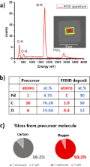
- lead to a higher electrical resistivity. Appendix Table 2 contains the complete set of parameters of the FIBID for the growth rate measurements. (a) SEM images of Pt deposited with Cs+ ions at 16, 8, 5, and 2 kV on Si. The upper part of the image appears brighter because the native oxide of Si was


Characterization of ion track-etched conical nanopores in thermal and PECVD SiO2 using small angle X-ray scattering
Beilstein J. Nanotechnol. 2025, 16, 899–909, doi:10.3762/bjnano.16.68
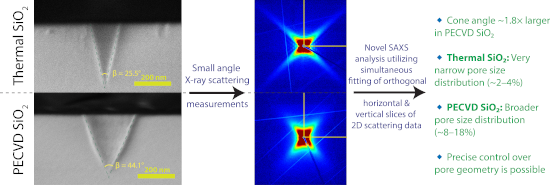
- analyzing and fitting one-dimensional (1D) sections of the SAXS patterns employing different form factors rather than performing 2D image fitting. We implemented our new fitting method to investigate conical nanopores in the two different SiO2 membrane materials. For nanopores in thermal SiO2 we confirm
- uncertainties in dimensional measurements and makes it challenging to obtain robust structural information about the nanopores. Figure 2 shows a representative 2D scattering pattern obtained from conical nanopores in thermal SiO2. This image represents the simultaneous measurement of approximately 107 parallel
- nanopores, tilted by ≈20° with respect to the X-ray beam. Although fitting the entire image can give precise information on the nanopore size and cone angle, fitting the size distribution is computationally too expensive [29]. Our new approach of fitting the scattering intensities uses two orthogonal 1D


Ar+ implantation-induced tailoring of RF-sputtered ZnO films: structural, morphological, and optical properties
Beilstein J. Nanotechnol. 2025, 16, 872–886, doi:10.3762/bjnano.16.66
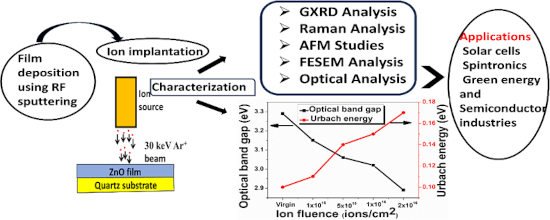
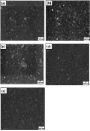
- surface RMS roughness and grain size of films after implantation, FESEM images have been processed with Image J software [36] and the results are given in Table 5. It is observed from Figure 8 that average grain size and surface RMS roughness reduce with ion fluence. As the implantation dose of argon ions






Insights into the electronic and atomic structures of cerium oxide-based ultrathin films and nanostructures using high-brilliance light sources
Beilstein J. Nanotechnol. 2025, 16, 860–871, doi:10.3762/bjnano.16.65

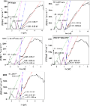
- spectra in photoemission electron microscopy (PEEM) mode, in which the photon energy is scanned across the XAS edge and the intensity of the secondary electrons is detected using a PEEM. This allowed to image the shape and size of ceria nanoislands on Ru(0001) and to probe and compare the oxidation state


Synchrotron X-ray photoelectron spectroscopy study of sodium adsorption on vertically arranged MoS2 layers coated with pyrolytic carbon
Beilstein J. Nanotechnol. 2025, 16, 847–859, doi:10.3762/bjnano.16.64
- on the surface of the MoS2 film annealed in a hydrogen atmosphere (Figure 1c). An attempt to measure the cross section of this film did not yield a contrast image because of the charging effect. Therefore, to estimate the thickness of the studied film, we used a thicker MoS2 film synthesized with a
- molybdenum layer sputtered for 90 s. Part of the film surface was covered with a protective Pt layer and a lamella was cut using a focused ion beam (FIB) system (see the Experimental section for details). Figure 1d shows the SEM image of the cross section of the lamella. The bright round spots on the film
- different sizes formed during CVD synthesis (Figure 1b). The thickness of the MoS2 film estimated from the cross-sectional SEM image is about 33 nm (Figure 1d). Therefore, it can be estimated that the MoS2 film obtained using a molybdenum layer sputtered for 10 s has a thickness of no more than 4 nm. The


Facile one-step radio frequency magnetron sputtering of Ni/NiO on stainless steel for an efficient electrode for hydrogen evolution reaction
Beilstein J. Nanotechnol. 2025, 16, 837–846, doi:10.3762/bjnano.16.63
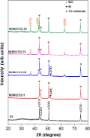
- importantly, the XRD image of Ni/NiO/SS-10 presents peaks at 37.20°, 43.21°, and 62.91°, which correspond to the (111), (200), and (220) planes of the NiO phase (PDF 00-004-0835) [34][35]. Meanwhile, the peak of the Ni metal phase still appeared in the Ni/NiO/SS-10 sample, proving the co-existence of metal
- -5, Ni/NiO/SS-10, Ni/NiO/SS-15, and Ni/NiO/SS-20 electrodes. SEM images of (a, e) Ni/NiO/SS-5, (b, f) Ni/NiO/SS-10, (c, g) Ni/NiO/SS-15, and (d, h) Ni/NiO/SS-20 electrodes. Raman spectrum of the Ni/NiO/SS-10 electrode. (a) SEM image, (b) overall element mapping, and (c) nickel and (d) oxygen element


Supramolecular hydration structure of graphene-based hydrogels: density functional theory, green chemistry and interface application
Beilstein J. Nanotechnol. 2025, 16, 806–822, doi:10.3762/bjnano.16.61
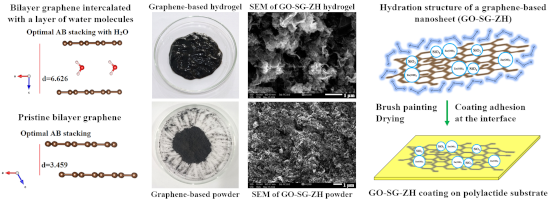
- (Figure 3h and 3i). Although GO-SG-ZH nanosheets agglomerated into microstructures (Figure 3h), the self-assembly of graphene-based nanosheets was different from the stacked morphology of the GO-SG-ZH powder. At a higher magnification of 20,000×, SEM image in Figure 3i revealed the porous structure with


Morphology and properties of pyrite nanoparticles obtained by pulsed laser ablation in liquid and thin films for photodetection
Beilstein J. Nanotechnol. 2025, 16, 785–805, doi:10.3762/bjnano.16.60






Changes of structural, magnetic and spectroscopic properties of microencapsulated iron sucrose nanoparticles in saline
Beilstein J. Nanotechnol. 2025, 16, 762–784, doi:10.3762/bjnano.16.59
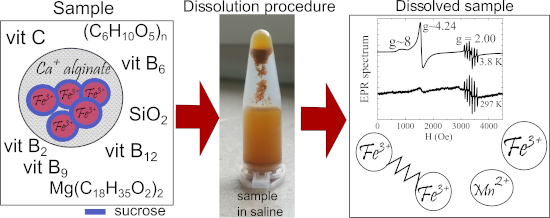
- . This unknown quantity of core–shell nanoparticles is encapsulated within a Ca alginate coating. SEM and TEM studies were conducted to compare the postulated structure of the microcapsule with its actual image. Figure 2 shows representative SEM micrographs of the FS0 sample. The observed grains exhibit
- probably representing cellulose (b). Figure 3b,e show that the core–sucrose shell structure of the nanoparticles in FS0 is clearly visible. Moreover, the dark-field image proved the presence of crystalline metallic cores (Figure 3d). It can be distinguished nanoparticles of larger, ≈18 nm, and smaller, <5
- nm, cores, while the thickness of the shell seems constant ≈10 nm. The sucrose shell is homogenous; thus the individual cores appear to be well separated from each other. In Figure 3c, the high-resolution transmission electron microscopy (HRTEM) image presents a single crystalline nanoparticle. The





Thickness dependent oxidation in CrCl3: a scanning X-ray photoemission and Kelvin probe microscopies study
Beilstein J. Nanotechnol. 2025, 16, 749–761, doi:10.3762/bjnano.16.58
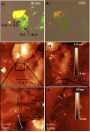
- optical microscope. Therefore, we opted for an alternative substrate, indium tin oxide (ITO), to conduct the SPEM measurements on thinner layers. Figure 1 gives a direct comparison of AFM images and O.C. on the 1 nm SiO2/Si substrate. Optical contrast, AFM image, and a complete series of profiles showing
- very fade contrast in the optical image in Figure 1a. In contrast, in Figure 2a, clear microscopy images of a few layers of flakes are shown. Based on the optical contrast value, L and T denote lean and thick steps, respectively, and the thickness variation has been confirmed through AFM images in
- through a 48-channel delay line detector. To analyze the photoelectron intensity of an individual atomic element on the captured SPEM maps, the image underwent background correction by eliminating the topographic features. We also applied the (3 × 3) filter to reduce the noise before extracting the





Synthesis of a multicomponent cellulose-based adsorbent for tetracycline removal from aquaculture water
Beilstein J. Nanotechnol. 2025, 16, 728–739, doi:10.3762/bjnano.16.56
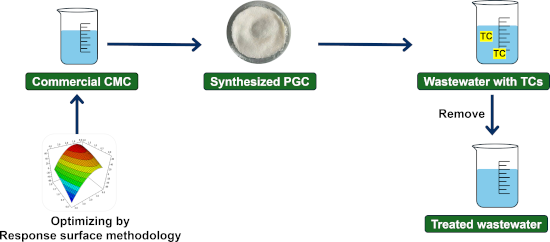
- efficiency of the synthesis. (a‒c) FE-SEM images of commercial CMC, (d‒f) FE-SEM images of PGC, and (g) FTIR spectra of commercial CMC and PGC. (a, b) EDX spectra and elemental compositions of commercial CMC and PGC, respectively; (c) morphology image of CMC; (d–f) elemental mapping images of commercial CMC
- ; (g) morphology image of PGC; and (h–l) elemental mapping images of PGC. (a) Effect of adsorption time and initial concentration on the adsorption capacity of PGC. (b) Effect of adsorbent dosage on the adsorption capacity and adsorption efficiency of PGC. (c) Effect of pH on the adsorption capacity of


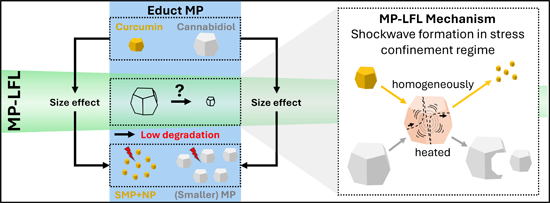
Efficiency of single-pulse laser fragmentation of organic nutraceutical dispersions in a circular jet flow-through reactor
Beilstein J. Nanotechnol. 2025, 16, 711–727, doi:10.3762/bjnano.16.55


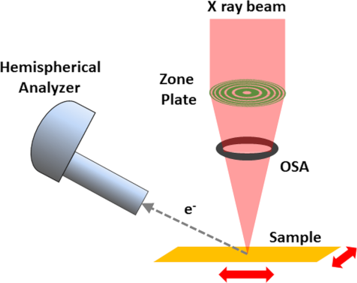
Nanostructured materials characterized by scanning photoelectron spectromicroscopy
Beilstein J. Nanotechnol. 2025, 16, 700–710, doi:10.3762/bjnano.16.54
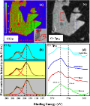
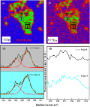
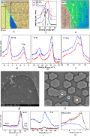
- crystal, regions displaying differential contrast in the Se 3d line were observed (Figure 1a–c). In the regions of image a) delineated by the red rectangle, the shape and binding energy of the Se 3d line approximated those observed in TiSe2 (Figure 1b). In the region defined by the blue rectangle, values
- suitable substrates for characterization by scanning probe microscopy and SPEM. An atomic force microscopy (AFM) image of a typical InP p–n junction nanowire is shown in Figure 2a, confirming a homogeneous shape with a nanowire length of about 2.5 µm and a diameter of about 200 nm, fluctuating only by a
- samples including marker structures were used to directly navigate to suitable nanowires in the SPEM measurements. Figure 2b shows elemental-sensitive In 4d and P 2p SPEM images, highlighting the nanowire shape and position, which can even be noticed as a shadow in the Au 4f image, where the signal from


High-temperature epitaxial growth of tantalum nitride thin films on MgO: structural evolution and potential for SQUID applications
Beilstein J. Nanotechnol. 2025, 16, 690–699, doi:10.3762/bjnano.16.53
- makes this film an excellent candidate for superconducting applications, particularly in devices such as superconducting quantum interference devices (SQUIDs). Figure 7 presents an AFM image revealing the low surface roughness (2.2 nm) of even the film deposited at an elevated growth temperature of 850
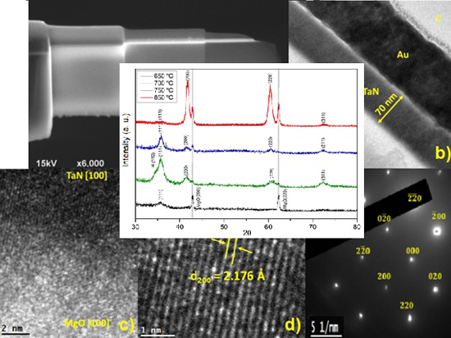
- mTorr as a function of the deposition temperature: (a) 650 °C, (b) 700 °C, (c) 750 °C, and (d) 850 °C. (a) SEM image of the cross section of a TaN thin film prepared with FIB. (b) TEM analysis of the lateral region of the TaN film deposited at T = 750 °C and pN2 = 90 mTorr. (c) TEM image at the
- interface between MgO substrate and TaN thin film. (d) Transversal section showing the interplanar spacing of TaN. (e) Indexed electron diffraction pattern of the TaN thin film. AFM image of the TaN film deposited at pN2 = 90 mTorr and T = 850 °C. Atomic composition of TaN thin films as function of pN2


Colloidal few layered graphene–tannic acid preserves the biocompatibility of periodontal ligament cells
Beilstein J. Nanotechnol. 2025, 16, 664–677, doi:10.3762/bjnano.16.51
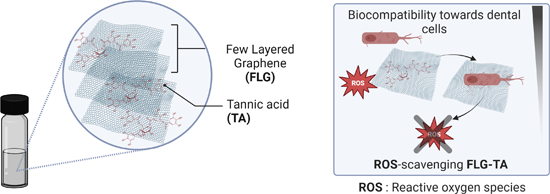
- exfoliation of graphite assisted by TA (B,C). Image (C) originates from the marked box in image (B). Transmission electron microscopy (TEM) micrographs of exfoliated FLG–TA (D,E). Size distribution and average lateral size of FLG sheets (F). Raman spectra (A) and survey XPS spectra (B) of FLG–TA and initial




Nanoscale capacitance spectroscopy based on multifrequency electrostatic force microscopy
Beilstein J. Nanotechnol. 2025, 16, 637–651, doi:10.3762/bjnano.16.49

- increase of sample permittivity [95][96]. We measured a CPD difference between Si and F14H20 of −0.72 ± 0.08 V (see Figure S15, Supporting Information File 1), which is close to the literature value of −0.8 V [97]. Interestingly, the image of the C′ signal (Figure 7c,e) showed a more blurry structure
- as normalized data over a wider frequency range, can be viewed in Figures S3–S6 and S9–S12, Supporting Information File 1. MFH-EFM images taken on F14H20. (a) Topography image. (b) C′ image detected at ωm,2 under excitation at 235.579 kHz. (c) Electric phase φel of the C′ signal detected at ωm,2
- under excitation at 235.579 kHz. (d) C″ image detected at ωm,2 under excitation at frequencies of 1.59 and 1.98 MHz. (e) Electric phase φel of the C″ signal detected at ωm,2 under excitation at frequencies of 1.59 and 1.98 MHz. (f) Profiles of the phase images shown in (c) and (e) with 128 pixels width




Feasibility analysis of carbon nanofiber synthesis and morphology control using a LPG premixed flame
Beilstein J. Nanotechnol. 2025, 16, 581–590, doi:10.3762/bjnano.16.45
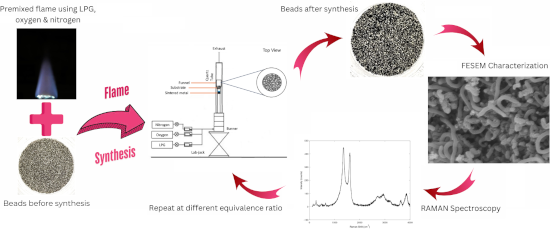
- aluminum foil covered drum was placed 18 cm from the needle to collect the nanofibers. The flow rate of the solution was 0.5 mL/h. The as-prepared nanofibers underwent thermal treatments, and it was found that the nanofibers exhibited optimal properties after treatment at 850 °C. The SEM and TEM image
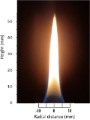
- temperature distribution at the center of the flame. Figure 2 shows a line-of-sight image of the stable diffusion flame, burning at lean combustion with Φ = 0.77, where the equivalence ratio was calculated based on the inlet conditions. The diffusion flame has a bright yellow color, due to soot formation, and
- additional oxygen that mixes with the excess fuel. This process allows for continuous combustion further from the source, producing a secondary diffusion flame as shown in the image in Figure 4a. The flame height based on the tip of the secondary diffusion flame is about 25 mm. A diffusion flame forms at the



Electron beam-based direct writing of nanostructures using a palladium β-ketoesterate complex
Beilstein J. Nanotechnol. 2025, 16, 530–539, doi:10.3762/bjnano.16.41
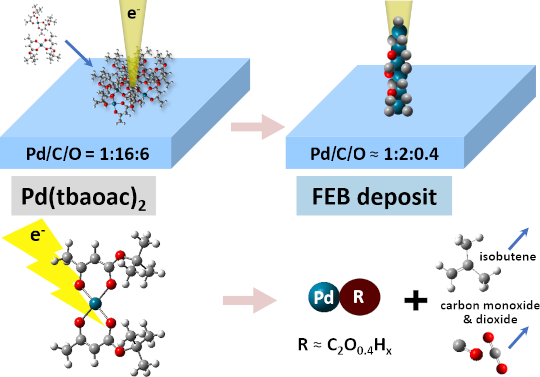
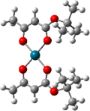
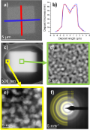
- )palladium(II) precursor. The atom color labeling is white: H, grey: C, red: O, and bluish green: Pd [42]. Characteristics of FEB nanoprinted square deposits with [Pd(tbaoac)2]. (a) Secondary electron SEM image of the FEB deposit on a native-oxide Si substrate with indicated AFM scan lines. (b) AFM thickness
- profiles along vertical and horizontal directions. (c) STEM image of the FEB deposit on a carbon membrane. (d) High-resolution STEM image from the center of the deposit. (e) High-resolution STEM image from the edge of the deposit. (f) SAED pattern from the edge of the deposit. Enlarged version of the
- images in panels (e) and (f) can be found in Supporting Information File 1, section S1 along with an additional STEM image. (a) EDX spectrum taken at the center of the deposit (red area) shown in inset. The BSE exit area is indicated with a yellow border. (b) Composition of the pristine [Pd(tbaoac)2


Zeolite materials with Ni and Co: synthesis and catalytic potential in the selective hydrogenation of citral
Beilstein J. Nanotechnol. 2025, 16, 520–529, doi:10.3762/bjnano.16.40
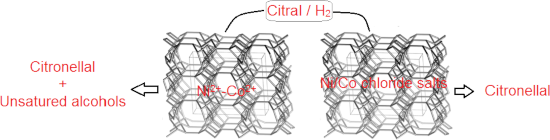
- -type zeolites through their main diffraction peaks indicated on the ZSA graph. Other minor phases such as quartz are also present. The SEM image shows a variety of crisscross crystals, which have the morphology expected for the zeolite types evidenced by XRD [16][17]. Very elongated crystals with
- acicular to fibrous characteristics, associated with mordenite, can be observed. Additionally, clinoptilolite–heulandite crystals with slats and tabular morphology are present. The amounts of clinoptilolite–heulandite and mordenite crystals displayed in the SEM image correspond to the intensity order of
- SEM image (Figure 2). To remove excess solution, water washes are typically applied. The materials obtained via IE underwent extensive washing with distilled water, while those obtained via Imp were only lightly washed, leading to the observed differences in chloride content. According to this, there


Performance optimization of a microwave-coupled plasma-based ultralow-energy ECR ion source for silicon nanostructuring
Beilstein J. Nanotechnol. 2025, 16, 484–494, doi:10.3762/bjnano.16.37

- increases with bombardment time. Fast Fourier transform (FFT) images of the nanopatterned surface are inset in the lower right corner of each image. In the present case, the fluence is represented by irradiation time. The quality and the growth of the nanostructures are quantitatively discussed in Figure 6
- , where variations of ripple wavelength, rms roughness, and power spectral density are discussed. Figure 5g shows the cross-sectional TEM image after 450 eV Ar-ion bombardment of the Si surface at an angle of 60° for a time of 3 h. The presence of Ar-ion-induced surface corrugation in terms of ripple-like
- nanostructures is evidenced in Figure 5g. Although the amplitude of the ripples is not large, the observed ripple wavelength of around 31 nm from the TEM image is consistent with that of AFM data (Figure 6e). However, in addition to the ripple-like nanostructures, an ultrathin amorphous layer is formed because


Effect of additives on the synthesis efficiency of nanoparticles by laser-induced reduction
Beilstein J. Nanotechnol. 2025, 16, 464–472, doi:10.3762/bjnano.16.35
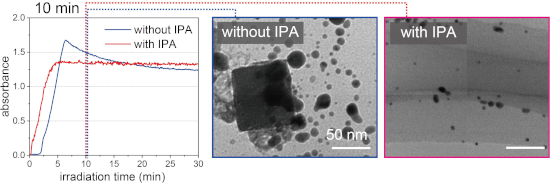
- ) images of the samples extracted from solutions with and without and IPA after 10 and 30 min of laser irradiation. In the case of the sample without IPA, in the TEM image of the sample after 10 min of laser irradiation, which is the initial stage of laser fragmentation, in addition to spherical particles
- % IPA, even in the TEM image of the sample after 10 min of laser irradiation, nanoparticles with a narrow particle size distribution of less than 10 nm in diameter were observed. This suggests that the nanoparticle synthesis reaction finished after 10 min of irradiation. This is due to the fact that the
- Au–Pt alloy (atomic ratio, Au/Pt = 1:1) that has an immiscible gap in the binary phase diagram and is difficult to form a solid–solution alloy in a bulk form. Figure 6 shows a a) TEM image and b) STEM-EDS mappings of the particles produced after laser irradiation. The TEM results (Figure 6a


Synthetic-polymer-assisted antisense oligonucleotide delivery: targeted approaches for precision disease treatment
Beilstein J. Nanotechnol. 2025, 16, 435–463, doi:10.3762/bjnano.16.34


Quantification of lead through rod-shaped silver-doped zinc oxide nanoparticles using an electrochemical approach
Beilstein J. Nanotechnol. 2025, 16, 422–434, doi:10.3762/bjnano.16.33
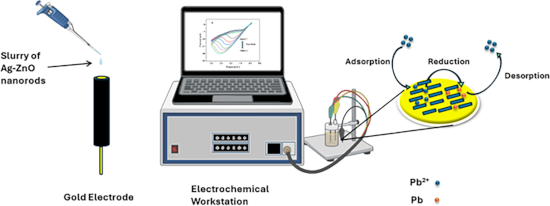
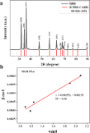
- electron microscopy (FESEM) image of the as-obtained nanomaterials. The produced nanomaterials had rod-shaped morphologies and were grown at extremely high densities, as seen by the SEM image. Figure 2b represents the average diameter of Ag@ZnO NRs which was calculated using the Image J software. The





Size control of nanoparticles synthesized by pulsed laser ablation in liquids using donut-shaped beams
Beilstein J. Nanotechnol. 2025, 16, 407–417, doi:10.3762/bjnano.16.31
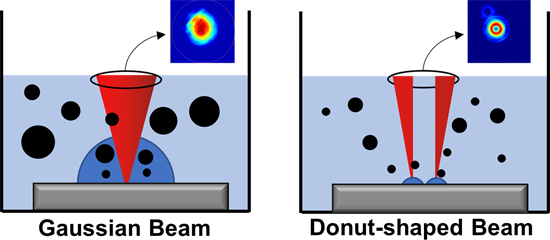
- -shaped beam, w = 0.34, than for the Gaussian beam, w = 0.53. Furthermore, PLAL with donut-shaped pulses improves the shape of Y2O3 NPs, which are more regular (Figure 3a) than the rather elongated and aggregated NPs produced with the Gaussian pulses (Figure 3b). Figure 4c shows an SEM image and the size
- with Gaussian and donut-shaped laser beams at a pulse energy of 100 µJ. (a, b) SEM micrographs of NPs obtained with the Gaussian beam at fluences of 6 and 2 J·cm−2, respectively. (c) SEM image of NPs obtained with the donut-shaped beam at a fluence of 2 J·cm−2. (d) NP size distributions showing the





