


Search results
Search for "metal nanoparticles" in Full Text gives 212 result(s) in Beilstein Journal of Nanotechnology. Showing first 200.
Growth dynamics and light scattering of gold nanoparticles in situ synthesized at high concentration in thin polymer films
Beilstein J. Nanotechnol. 2019, 10, 1768–1777, doi:10.3762/bjnano.10.172
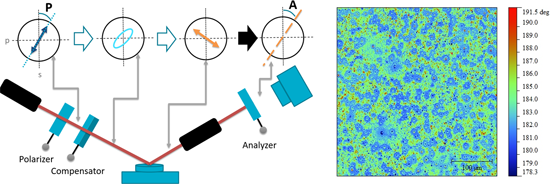
- regimes in the dynamics of the nanoparticle growth and in the optical response of the nanocomposite. Keywords: gold; imaging ellipsometry; metal nanoparticles; plasmonic nanocomposite; polymer films; Introduction Over the last 20 years, numerous studies were carried out to investigate the optical
- properties of plasmonic nanocomposite materials from experimental, theoretical as well as numerical points of view [1][2]. Metal nanoparticles (NPs) play a central role in the development of nanotechnology-based optical devices. Gold nanoparticles (AuNPs) are used in spectrally selective coatings to block
- the real part of the dielectric function varies is larger than the one over which the energy absorption takes place. When far off the resonance, detecting the optical response of the growing metal nanoparticles can therefore be achieved in considering the variations of the real part of the refractive


Synthesis of nickel/gallium nanoalloys using a dual-source approach in 1-alkyl-3-methylimidazole ionic liquids
Beilstein J. Nanotechnol. 2019, 10, 1754–1767, doi:10.3762/bjnano.10.171
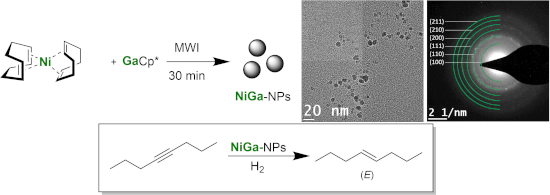
- [17]. Alternatively, ionic liquids can be used as solvents and stabilization agents for different metal nanoparticles from metal carbonyls [18] or organometallic complexes [19]. Ni nanoparticles from Ni(COD)2 in ionic liquids can be obtained through spontaneous decomposition [20] or decomposition
- ] derivates are equally known [66]. When metal nanoparticles like the Lindlar catalyst PdPb@CaCO3 are used, the formation of (Z)-alkenes [67][68][69][70][71] is favored. For the formation of (E)-alkenes the use of a tandem catalytic system Pd3Pb@SiO2 + RhSb@SiO2 [72] is needed. Catalytic semihydrogenation of




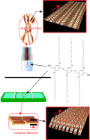
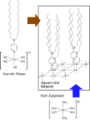
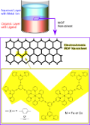
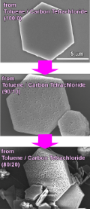
Materials nanoarchitectonics at two-dimensional liquid interfaces
Beilstein J. Nanotechnol. 2019, 10, 1559–1587, doi:10.3762/bjnano.10.153
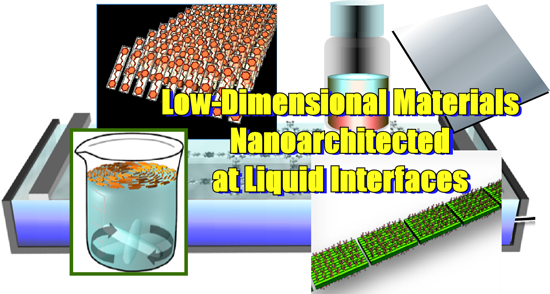
- from external disturbances [82][83][84]. Zhong and Xu summarized, in their recent review, the preparation of metal nanoparticles for hydrogen generation from liquid chemical hydrides [85]. In their review, the usage of effective catalysts within low-dimensional cages of metal-organic frameworks was















Kelvin probe force microscopy of the nanoscale electrical surface potential barrier of metal/semiconductor interfaces in ambient atmosphere
Beilstein J. Nanotechnol. 2019, 10, 1401–1411, doi:10.3762/bjnano.10.138
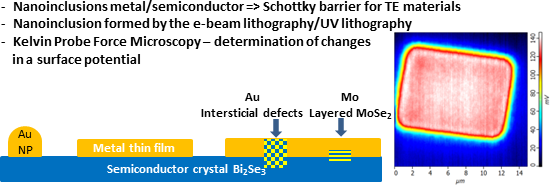
- beam source in order to remove surface contaminants. A monoatomic argon ion source was utilized with energy of 2 keV, ion current 10 µA, raster area 1 × 1 mm2 and sputtering time 30 s. Results and Discussion Separated metal nanoparticles on the substrate In TE materials the NIs applicable for an
- realized in the form of separated metal nanoparticles through dc sputtering, or through the local reaction/diffusion of a metallic layer irradiated with electrons or UV photons. The value of the work function barrier is measurable by KPFM at the nanoscale even in ambient atmosphere and, most importantly


Highly ordered mesoporous silica film nanocomposites containing gold nanoparticles for the catalytic reduction of 4-nitrophenol
Beilstein J. Nanotechnol. 2019, 10, 1368–1379, doi:10.3762/bjnano.10.135
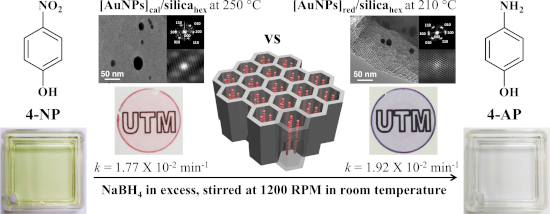
- ; Introduction Mesoporous silica nanomaterials with pore size between 2 to 50 nm [1] have been recently applied to the development of biomedical adsorbents [2][3][4], drug delivery systems [5][6][7], catalysts [8][9][10], as well as supports for metal nanoparticles [11][12][13] due to their large surface area
- the performance for the above-mentioned applications, it is crucial to find a method for template removal. As a host for metal nanoparticles, mesoporous matrixes have been extensively used for the controlled growth of gold nanoparticles (AuNPs) [11][19]. For mesoporous silica, gold sources derived


A silver-nanoparticle/cellulose-nanofiber composite as a highly effective substrate for surface-enhanced Raman spectroscopy
Beilstein J. Nanotechnol. 2019, 10, 1270–1279, doi:10.3762/bjnano.10.126
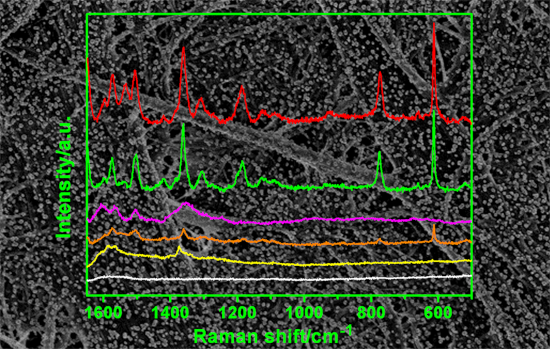
- and biological substances where the substrates are crucial for obtaining an enhanced Raman signal [43][44][45]. The Raman signal of SERS is enhanced remarkably in the “hot spots” that are generated in the nanogaps of plasmonic metal nanoparticles (e.g., Au, Ag and Cu) through the amplification of the
- which the metal nanoparticles are deposited influences both the collection efficiencies and detection sensitivities. Cellulose, such as laboratory filter paper and bacterial nanocellulose, have been considered as superior candidates for the fabrication of SERS substrates with silver nanoparticles, due


Alloyed Pt3M (M = Co, Ni) nanoparticles supported on S- and N-doped carbon nanotubes for the oxygen reduction reaction
Beilstein J. Nanotechnol. 2019, 10, 1251–1269, doi:10.3762/bjnano.10.125
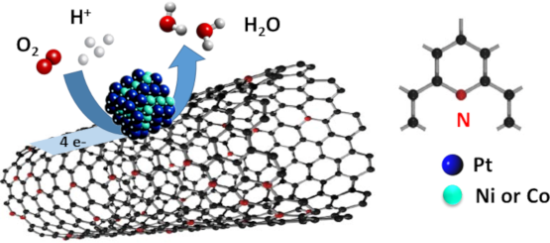
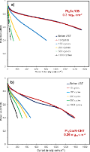
- reaction (ORR) have been evaluated in a rotating ring disk electrode experiment. The Pt3M/N-CNT catalysts revealed excellent electrochemical properties compared to a commercial Pt3Co/Vulcan XC-72 catalyst. The nature of the carbon support plays a key role in determining the properties of the metal
- nanoparticles, on the preparation of the catalytic layer, and on the electrocatalytic performance in the ORR. On N-CNT supports, the specific activity followed the expected order Pt3Co > Pt3Ni, whereas on the annealed N-CNT support, the order was reversed. Keywords: carbon nanotubes; cobalt; ionic liquid










Enhanced inhibition of influenza virus infection by peptide–noble-metal nanoparticle conjugates
Beilstein J. Nanotechnol. 2019, 10, 1038–1047, doi:10.3762/bjnano.10.104
- exert its antiviral activity from the outside of the cell. Thus, the addition of FluPep to cells in culture prevents infection by influenza viruses, as does intranasal delivery of the peptide in a murine model of human influenza [15]. Noble-metal nanoparticles possess a strong plasmon absorbance, which
- allows for the detection at very low levels, using a range of approaches, from absorbance [17][18] to photothermal microscopy [19] and various extensions of the latter [20][21]. Noble-metal nanoparticles can be passivated and functionalised with biomolecules such that they possess the biological
- biological activity of the peptide, for example, due to multivalent functionalisation of the nanoparticles. In addition, silver possesses innate antimicrobial activities [25]. Thus, noble-metal nanoparticles are potentially useful as both functional probes for antiviral peptides and as therapeutic delivery






Features and advantages of flexible silicon nanowires for SERS applications
Beilstein J. Nanotechnol. 2019, 10, 725–734, doi:10.3762/bjnano.10.72

- , preferably with clusters of metal nanoparticles, sharp edges and tips, are the key to strong electromagnetic enhancement ranging from 1010 to 1014 [3]. If the values of Raman cross section of the analyte and of SERS enhancement are appropriate, even single-molecule detection is possible. For example, under
- factor increases approximately as d−8 in the case of two metal nanoparticles with the polarization along the particle axis, which can be roughly applied to the case of two nanowires. However, in the reported substrates SiNWs are randomly oriented and the polarization measurement was not tested in detail


Deposition of metal particles onto semiconductor nanorods using an ionic liquid
Beilstein J. Nanotechnol. 2019, 10, 718–724, doi:10.3762/bjnano.10.71
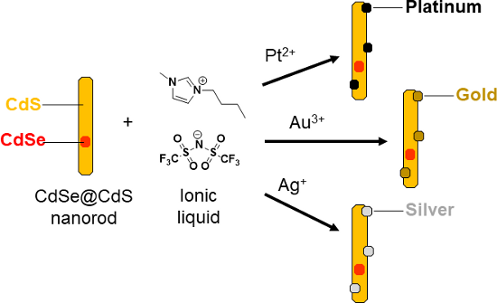
- potential to impact a number of applications [1][2][3][4]. Deposition of metal nanoparticles onto the nanorod surface competes with homogeneous nucleation of the metal nanoparticles, with the size and number of metal nanoparticles attached to each nanorod controlled by lattice matching of the materials and
- using gold. Conclusion In conclusion, we have demonstrated that deposition of noble metal nanoparticles onto CdSe@CdS nanorods is possible using the ionic liquid [bmim][Tf2N] without the need for additional surfactants or reducing agents. These procedures resulted in heterostructured particles with


Enhancement in thermoelectric properties due to Ag nanoparticles incorporated in Bi2Te3 matrix
Beilstein J. Nanotechnol. 2019, 10, 634–643, doi:10.3762/bjnano.10.63
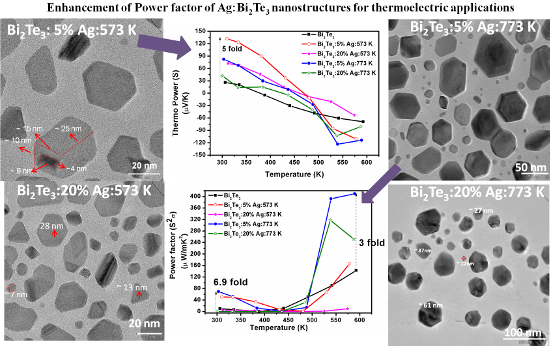
- enhancement of the Seebeck coefficient for a given carrier concentration. Several groups have used this approach using different metal–semiconductor combinations to improve thermoelectric properties [13][14]. One group has reported the synthesis of bismuth metal nanoparticles (NPs) were through a solvothermal
- investigation of Ag in a Bi2Te3 matrix while focusing on an easy, reproducible low-cost synthesis suitable for scale-up. We show how to tune S and σ independently to achieve high S2σ values. One objective is to see which fraction of metal nanoparticles is required for the TE enhancement of a Bi2Te3 matrix and




Hydrophilicity and carbon chain length effects on the gas sensing properties of chemoresistive, self-assembled monolayer carbon nanotube sensors
Beilstein J. Nanotechnol. 2019, 10, 565–577, doi:10.3762/bjnano.10.58
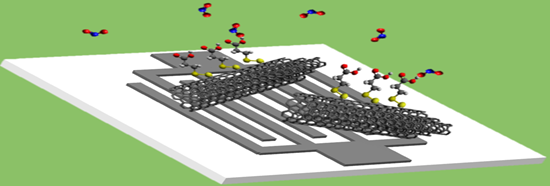
- MWCNTs decorated with Au nanoparticles were analyzed by TEM in order to observe the distribution of metal nanoparticles on the carbon nanotubes. Figure 1 shows that the CNT sidewalls are densely and quite homogeneously decorated with Au nanoparticles (Table S1 in Supporting Information File 1 shows


Mo-doped boron nitride monolayer as a promising single-atom electrocatalyst for CO2 conversion
Beilstein J. Nanotechnol. 2019, 10, 540–548, doi:10.3762/bjnano.10.55
- because it can take place at room temperature and atmospheric pressure with useful catalysts, making it feasible for extensive application and integration [12][13][14]. Metal nanoparticles supported on various substrates have been extensively investigated as heterogeneous catalysts in many reactions [10
- ][15][16][17]. Over the past few decades, researchers have focused on decreasing the size of metal nanoparticles in order to improve the surface area/volume ratio of low-coordinated metal atoms in order to enhance the selectivity toward specific species and to improve the electrocatalytic performance


Electromagnetic analysis of the lasing thresholds of hybrid plasmon modes of a silver tube nanolaser with active core and active shell
Beilstein J. Nanotechnol. 2019, 10, 294–304, doi:10.3762/bjnano.10.28
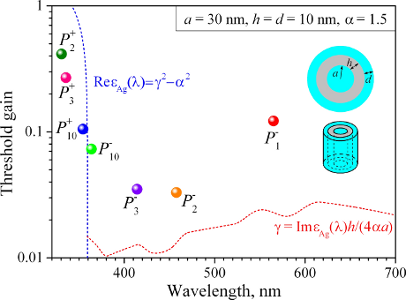
- of publications have dealt with the modeling of nanolasers based on metal nanoparticles and nanowires equipped with active cores or shells [4][5][6][7][8][9]. Note that in [4], the authors studied the effect of a metal tube on the lowest-order modes of the active core while the presence of the
- plasmon modes of the tube itself was neglected. More recently, the attention of researchers became focused on lasing in periodic arrays of metal nanoparticles supported by or immersed into an active layer [10][11][12][13] or with other active region configurations [14]. In this paper, we explore the modes


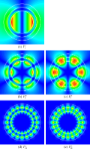
![[Graphic 29]](/bjnano/content/inline/2190-4286-10-28-i46.svg?max-width=637&scale=1.18182) λ = 565.03...
λ = 565.03...

![[Graphic 36]](/bjnano/content/inline/2190-4286-10-28-i53.svg?max-width=637&scale=1.18182) ...
...


Comparative biological effects of spherical noble metal nanoparticles (Rh, Pd, Ag, Pt, Au) with 4–8 nm diameter
Beilstein J. Nanotechnol. 2018, 9, 2763–2774, doi:10.3762/bjnano.9.258
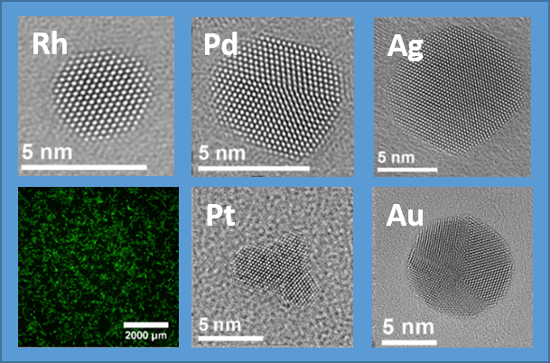
- determine the effect of particle exposure on the viability of human mesenchymal stem cells (hMSCs). Except for silver, no adverse effect of any of the metal nanoparticles was observed for concentrations up to 50 ppm (50 mg L−1) incubated for 24 h, indicating that noble metal nanoparticles (rhodium
- , and nanomedicine [1][2][3]. Noble metal nanoparticles are of particular importance due to their diverse properties such as surface plasmon resonance, chemical inertness, and antibacterial action (silver) [4][5][6][7][8][9]. However, concerns have been raised with respect to their biological effect
- after unintended exposure [10][11][12][13][14]. Noble metal nanoparticles such as Au, Pt, Pd, and Rh have distinct catalytic properties in biology, and have been reported to show several enzyme-like activities in vitro, including reactive oxygen species scavenger activity [15][16][17][18][19][20][21][22


Enhancement of X-ray emission from nanocolloidal gold suspensions under double-pulse excitation
Beilstein J. Nanotechnol. 2018, 9, 2609–2617, doi:10.3762/bjnano.9.242
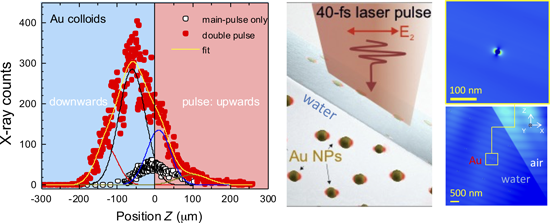
- -absorption efficiency and an enhanced generation of high-energy electrons from a highly ionized plasma with high electron temperature [10][11] under intense laser irradiation. For an efficient augmentation in X-ray intensity, femtosecond (fs)-laser excitation of metal nanoparticles and nanoclusters is of


Au–Si plasmonic platforms: synthesis, structure and FDTD simulations
Beilstein J. Nanotechnol. 2018, 9, 2599–2608, doi:10.3762/bjnano.9.241
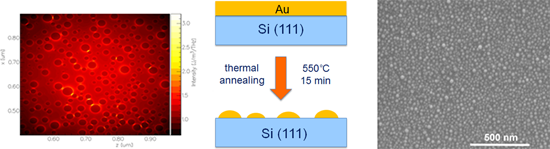
- concluded that the proposed method of manufacturing nanostructures yields good results. Of course, there are also other methods for the production of nanostructures or metal nanoparticles, for example laser irradiation of thin metallic films deposited on various substrates [29][30][31][32][33]. This method



High-throughput micro-nanostructuring by microdroplet inkjet printing
Beilstein J. Nanotechnol. 2018, 9, 2372–2380, doi:10.3762/bjnano.9.222
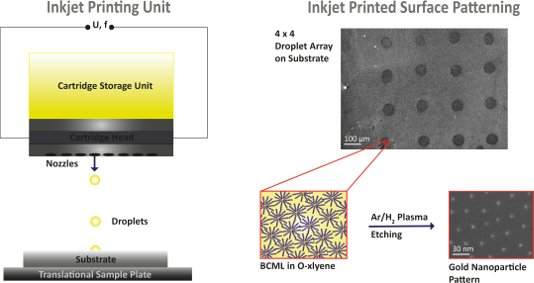
- densities is highly important in many fields, ranging from nano-optics to biosensor technologies and biomaterials. A well-established method to fabricate quasi-hexagonal patterns of metal nanoparticles is block copolymer micelle nanolithography, which relies on the self-assembly of metal-loaded micelles on
- nanoparticle structures is dip-pen nanolithography [7]. Although all these methods are highly precise, it would be expensive and time consuming to use them to coat large areas on the centimeter scale. A convenient, high-throughput method to achieve hexagonal patterns of metal nanoparticles with a well-defined


The role of adatoms in chloride-activated colloidal silver nanoparticles for surface-enhanced Raman scattering enhancement
Beilstein J. Nanotechnol. 2018, 9, 2236–2247, doi:10.3762/bjnano.9.208
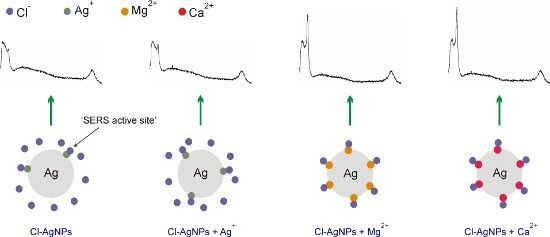
- the order of 106–107 for isolated metal nanoparticles [8]. The chemical mechanism of Raman signal enhancement is based on a metal–molecule electronic transition [8][12]. The electronic coupling of the molecule with the metal surface of the nanoparticle leads to a significant increase in the Raman

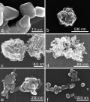


Electrospun one-dimensional nanostructures: a new horizon for gas sensing materials
Beilstein J. Nanotechnol. 2018, 9, 2128–2170, doi:10.3762/bjnano.9.202
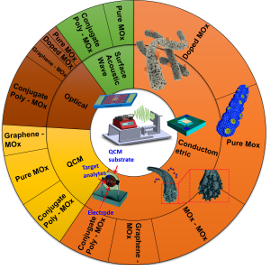
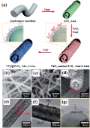
- (e.g., polypyrrole (PPy), polyaniline (PANI), polythiophene (PTh) and their derivatives) [32][87][88][90], MOx nanofibers surface functionalized by metal nanoparticles [75] and graphene sheets incorporated with MOx nanofibers [89]. 4.1 Conductometric gas sensors Nanostructure-based conductometric







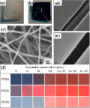
Self-assembled quasi-hexagonal arrays of gold nanoparticles with small gaps for surface-enhanced Raman spectroscopy
Beilstein J. Nanotechnol. 2018, 9, 1977–1985, doi:10.3762/bjnano.9.188
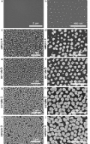
- . A combination of micellar nanolithography and electroless deposition (ED) enables the tuning of the spacing and size of the noble metal nanoparticles. Long-range ordered quasi-hexagonal arrays of gold nanoparticles on silicon substrates with a variation of the particle sizes from about 20 nm to 120
- lithography; optical antenna; self-assembly; SERS; Introduction Over the last decades self-assembled layers of gold nanoparticles have taken an important role in emerging nanotechnologies. Noble metal nanoparticles show localized surface plasmon polariton resonances (LSPRs) in the visible and infrared
- remarkable optical properties make them attractive for applications in biosensing, biomedical science and as optical antennas [6][7][8]. In particular, metal nanoparticles can be employed to strongly enhance the signal intensity in chemically specific Raman sensing [9]. This technique is known as surface



Synthesis of rare-earth metal and rare-earth metal-fluoride nanoparticles in ionic liquids and propylene carbonate
Beilstein J. Nanotechnol. 2018, 9, 1881–1894, doi:10.3762/bjnano.9.180
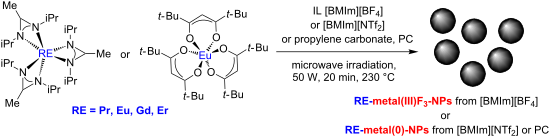
- ([BMIm][BF4]), 1-butyl-3-methylimidazolium bis(trifluoromethylsulfonyl)imide ([BMIm][NTf2]) and in propylene carbonate (PC) yield oxide-free rare-earth metal nanoparticles (RE-NPs) in [BMIm][NTf2] and PC for RE = Pr, Gd and Er or rare-earth metal-fluoride nanoparticles (REF3-NPs) in the fluoride-donating
- diameters of (1.5 ± 0.5) to (5 ± 1) nm. The characterization was completed by energy-dispersive X-ray spectroscopy (EDX). Keywords: ionic liquids; metal amidinates; rare-earth metal-fluoride nanoparticles; rare-earth metal nanoparticles; soft wet-chemical synthesis; Introduction Rare-earth (RE) elements
- general metal-fluoride nanoparticles, are important in materials science and modern chemistry [21][22]. However, in the absence of fluoride donors we obtained oxide-free rare-earth metal nanoparticles (RE-NPs) of Pr, Gd and Er (Scheme 1). By using either the chemically more inert IL 1-butyl-3


Synthesis of hafnium nanoparticles and hafnium nanoparticle films by gas condensation and energetic deposition
Beilstein J. Nanotechnol. 2018, 9, 1868–1880, doi:10.3762/bjnano.9.179

- nanoparticles is reported for the first time in the literature. Keywords: energetic deposition; hafnium; inert-gas condensation; nanomechanical properties; nanoparticles; nanoparticle thin films; Introduction In the past decades, the interest in and the exploitation of metal nanoparticles (NPs) spread across
- . While for face-centered (fcc) metal NPs a lot of studies have been made [14][15][16], the knowledge regarding hexagonal close-packed (hcp) metal nanoparticles, despite their interesting properties, is limited. Some examples of hcp nanoparticles reported in bibliography are ruthenium NPs, which
- have already excluded oxidation in the aggregation zone, there is no physical reason why there should be oxidation within the deposition chamber where the pressure is lower than within the aggregation zone. The distinct core–shell structure is typical of most metal nanoparticles when exposed to air at








Uniform cobalt nanoparticles embedded in hexagonal mesoporous nanoplates as a magnetically separable, recyclable adsorbent
Beilstein J. Nanotechnol. 2018, 9, 1770–1781, doi:10.3762/bjnano.9.168
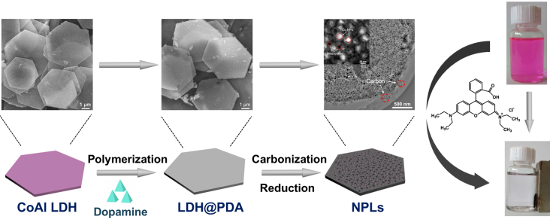
- number of researches have demonstrated that carbon-based nanocomposites can serve as effective adsorbents for wastewater purification [6][7][8][9]. The introduction of transition metal nanoparticles into a mesoporous carbon matrix to form transition-metal-loaded mesoporous carbon nanocomposites (TM-MCNs
- composition [18][19]. They are a typical class of inorganic lamellar clays with dual-metal cations (e.g., CoAl) and anions or guest molecules within the interlayer region. The reduction of metal cations uniformly distributed in the lattice of LDHs by reducing agents to form well-dispersed metal nanoparticles
- in their framework has become a quite possible strategy for introduction of metal nanoparticles onto the support. The metal cations might migrate across the interlayer space during the thermal reduction process at high temperature due to the weak van der Waals forces between the interlayer of the LDH


Atomistic modeling of tribological properties of Pd and Al nanoparticles on a graphene surface
Beilstein J. Nanotechnol. 2018, 9, 1239–1246, doi:10.3762/bjnano.9.115
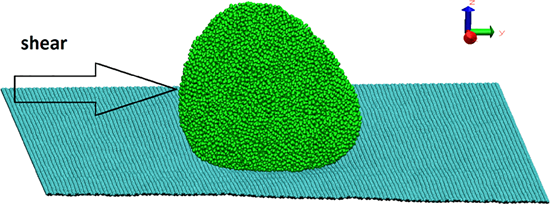
- canonical ensemble and account for numerical and round errors. Results and Discussion We have performed MD calculations for the sliding of Al and Pd metallic nanoparticles on graphene. The lateral sizes Lx, Ly, Lz of metal nanoparticles along the x,y,z-axes have been calculated as the difference between the





