


Search results
Search for "monodisperse" in Full Text gives 143 result(s) in Beilstein Journal of Nanotechnology.
From iron coordination compounds to metal oxide nanoparticles
Beilstein J. Nanotechnol. 2016, 7, 2074–2087, doi:10.3762/bjnano.7.198
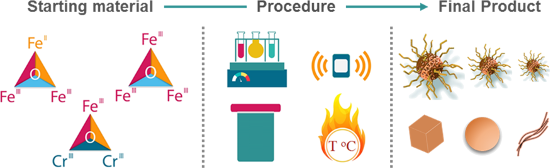
- developing new methods. The preparation of iron oxide nanoparticles is a complex process. The main challenges are finding the optimal experimental conditions in order to obtain monodisperse nanoparticles, ensuring reproducibility and scalability of the process, while limiting complex purification steps [5
- , Figure S5b) were assigned to magnetite (JCPDS 190629). Thus, the possibility to obtain magnetite nanoparticles from a mixed-valence iron acetate cluster has been demonstrated. In this procedure, small monodisperse nanoparticles were separated from polydisperse ones by a simple filtration. Preparation
- , spherical, hedgehog-like) by changing the type and amount of surfactants, reaction temperature and time. By thermal decomposition followed by simple filtration, monodisperse nanoparticles were obtained and separated from polydisperse nanoparticles. Starting from the similar reaction mixture as in the


Fundamental properties of high-quality carbon nanofoam: from low to high density
Beilstein J. Nanotechnol. 2016, 7, 2065–2073, doi:10.3762/bjnano.7.197
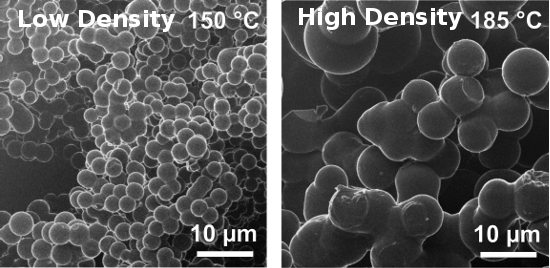
- µm. The low-density foams consist of nearly monodisperse small spheres with diameters between 2 and 3 µm. These micropearls have a narrow size distribution. The sample morphology is quite uniform over large areas. Occasionally, the micropearls are grown together forming larger units. However, in most


A novel electrochemical nanobiosensor for the ultrasensitive and specific detection of femtomolar-level gastric cancer biomarker miRNA-106a
Beilstein J. Nanotechnol. 2016, 7, 2023–2036, doi:10.3762/bjnano.7.193
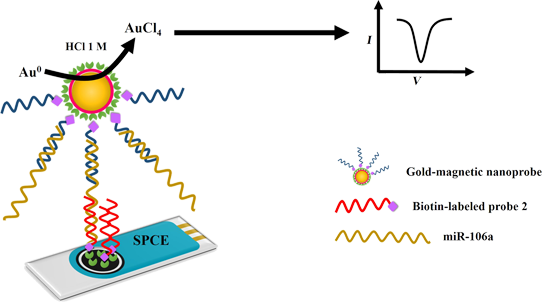
- observed in Figure 2A(a). These NPs were essentially monodisperse and partially aggregated because of their magnetic nature. Figure 2A(b) shows the gold NPs with a mean diameter of 12 nm and spherical morphology. TEM results of the magnetic TMC@Fe3O4 NPs demonstrated their homogenous structure with a mean


Functionalized platinum nanoparticles with surface charge trigged by pH: synthesis, characterization and stability studies
Beilstein J. Nanotechnol. 2016, 7, 1822–1828, doi:10.3762/bjnano.7.175
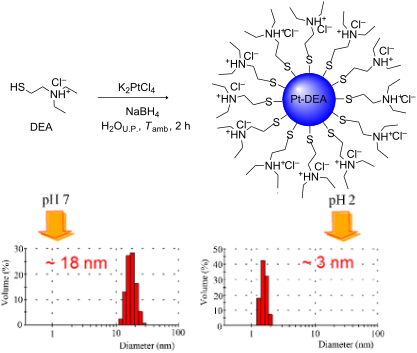
- rise to monodisperse nanoparticles [20][21]. PtNPs are generally obtained from reduction of Pt(II) or Pt(IV) ions, starting from [PtCl4]2− or [PtCl6]2− precursors, in the presence of a strong reducing agent, to obtain the chemical reduction to Pt(0) atoms that starts the nucleation process. If a ligand
- , monodisperse nanoparticles with diameters in the range of 3–40 nm were isolated. The amino functionality allows acid–base equilibria [31], and with this system, it is possible to obtain neutral particles in basic water solution and positive charged nanoparticles in acidic water solution. Results and Discussion
- predominant in the acidic–base equilibrium and aggregation occurs. Conclusion In this work stable, monodisperse PtNPs with small diameter have been obtained. Among the various Pt/DEA molar ratios, the 1:0.25 sample was studied in detail. The FTIR and far IR measurements confirmed the formation of the Pt–S


Microwave synthesis of high-quality and uniform 4 nm ZnFe2O4 nanocrystals for application in energy storage and nanomagnetics
Beilstein J. Nanotechnol. 2016, 7, 1350–1360, doi:10.3762/bjnano.7.126
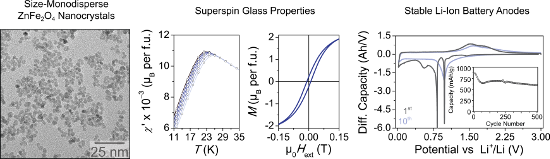
- narrow size distribution hold promise for many applications in different areas ranging from biomedicine to electronics and energy storage. Herein, the microwave-assisted sol–gel synthesis and thorough characterization of size-monodisperse zinc ferrite nanoparticles of spherical shape is reported. X-ray
- general formula MFe2O4 constitute a well-known class of materials with unique physical and chemical properties and they hold promise for use in various fields of nanotechnology [1][2]. One of those properties is magnetism. In recent years, it has been shown that particularly size-monodisperse
- diameter MFe2O4 (M = Fe, Co, Mn, Ni) nanoparticles has been achieved by microwave-assisted nonaqueous sol–gel synthesis using benzyl alcohol as a high-boiling solvent [22][23]. Inspired by this work, we show here that high-quality and size-monodisperse zinc ferrite (referred to as ZFO in the following


Straightforward and robust synthesis of monodisperse surface-functionalized gold nanoclusters
Beilstein J. Nanotechnol. 2016, 7, 1278–1283, doi:10.3762/bjnano.7.118
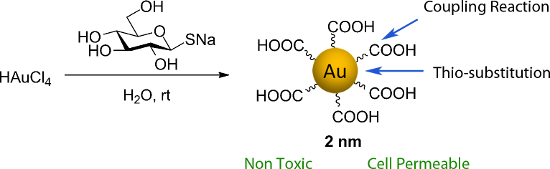
- discovered by serendipity. The resultant monodisperse gold nanoclusters are more stable than those generated using some other common methods. The carboxylic acid contained in the stabilizing agent on the cluster surface serves as anchor for nanocluster functionalization. Alternatively, the addition of thiols
- prepared under reflux using 1-thioglucose as reducing and stabilizing agent [24] but the resulting nanoparticles are too unstable to be used as biosensors [25]. In an effort to create monodisperse, stable and surface-functionalized gold nanoclusters, we explored 1-thioglucose as a stabilizing and reducing
- agent. By serendipity we discovered a novel one-pot method to prepare gold nanoclusters using 1-thioglucose at room temperature. This simple and robust synthesis produces stable, and monodisperse nanoclusters. Oxidation of the carbohydrate results in carboxylic acid as determined by X-ray photoelectron


Tunable longitudinal modes in extended silver nanoparticle assemblies
Beilstein J. Nanotechnol. 2016, 7, 1219–1228, doi:10.3762/bjnano.7.113
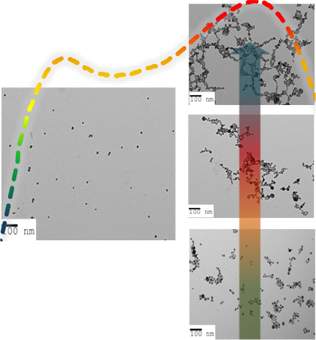
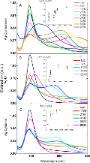
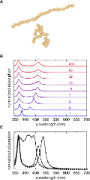
- , unlike AgNP–cysteamine, higher ligand ratios are needed to initiate assembly. This is consistent with the spectral evolution depicted in Figure 1. 20 µm long assemblies were noticed for r = 3250 (Supporting Information File 1, Figure S4). For all samples, TEM shows a fairly monodisperse nanoparticle size


Development of highly faceted reduced graphene oxide-coated copper oxide and copper nanoparticles on a copper foil surface
Beilstein J. Nanotechnol. 2016, 7, 1010–1017, doi:10.3762/bjnano.7.93
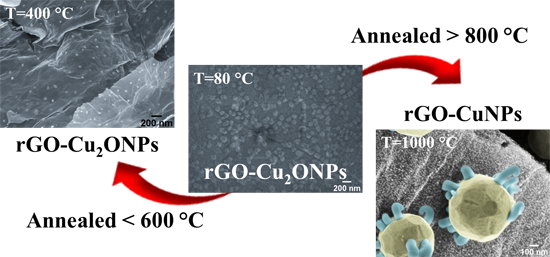
- arrows in Figure 4a. The FE-SEM images (Figure 4b,c) display the striking morphology of the sample prepared at 1000 °C. It consists of highly faceted core–shell Cu-rGO nanostructures and small, nearly monodisperse 3 nm in size, rGO-CuNPs, all of them decorating the rGO sheets. Some holes in the rGO


Efficient electron-induced removal of oxalate ions and formation of copper nanoparticles from copper(II) oxalate precursor layers
Beilstein J. Nanotechnol. 2016, 7, 852–861, doi:10.3762/bjnano.7.77
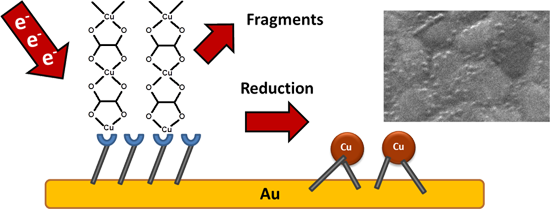
- rather homogeneous distribution of monodisperse NPs has been achieved by electron irradiation and subsequent washing of well-organized silver(I) dodecanethiolate layers [19]. Also, self-assembled layers can be prepared by simple wet-chemical dipping processes [21][22] or high-throughput spray


Assembling semiconducting molecules by covalent attachment to a lamellar crystalline polymer substrate
Beilstein J. Nanotechnol. 2016, 7, 784–798, doi:10.3762/bjnano.7.70
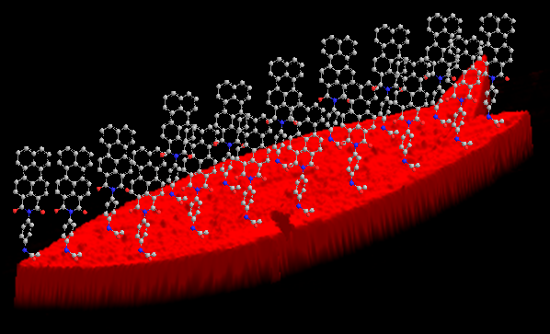
- with hexagonal or lozenge-like particles differing in size is available. Even for particles of a uniform and simple shape like disks or squares, their maximum packing density is affected by their size distribution. For monodisperse disks in a hexagonal two-dimensional arrangement, a maximum packing
- density of 90.7% can be achieved [12]. For a square packing of monodisperse disks, the packing density is reduced to 79% [13]. For disks having a variation in size similar to the dispersion of CPE45 nanocrystals, no long range order can be achieved and a maximum packing density of about 84% is expected
- the order or the packing density of the nanocrystal film, which we attribute to random jamming of nanocrystals. We note that the area coverage of the CPE45 nanocrystal films was close to 82.6%, which is the area coverage where jamming of a monolayer of monodisperse, frictionless disks is expected [17


Magnetic switching of nanoscale antidot lattices
Beilstein J. Nanotechnol. 2016, 7, 733–750, doi:10.3762/bjnano.7.65
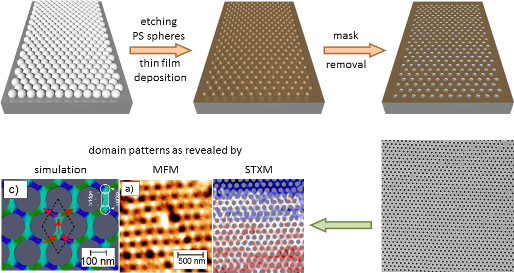
- , nanosphere lithography offers the preparation of a self-assembled monolayer on the time scale of minutes even on a centimetre length scale. In this work, polystyrene(PS)-based nanosphere lithography was chosen, since monodisperse PS nanosphere suspensions are nowadays commercially available with a wide range
- self-assembly of monodisperse PS spheres on the chosen substrate; (b) the homogeneous reduction of the PS sphere diameter by setting the plasma etching time while maintaining their initial positions on the substrate. Then, the nanoscale masks are ready for the deposition of a magnetic film and a

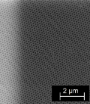


Cantilever bending based on humidity-actuated mesoporous silica/silicon bilayers
Beilstein J. Nanotechnol. 2016, 7, 637–644, doi:10.3762/bjnano.7.56
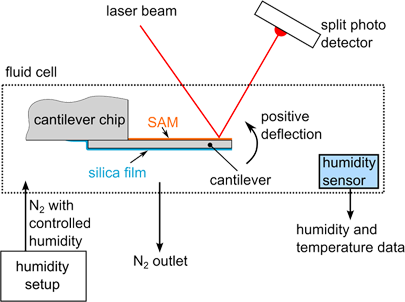
- water sorption isotherms measured for similar materials, indicating the different pressures for capillary condensation during adsorption and capillary evaporation during desorption, respectively, in pores with quite monodisperse size distributions [22]. It is well known that adsorption and desorption of
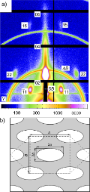
- the nanostructure characterization using GISAXS. The nanostructure of this material consists of quite monodisperse cylindrical pores ordered on 2D pore lattice [24]. The GISAXS pattern of the corresponding sample shown in Figure 3 reveals sharp Bragg reflections from this pore lattice. The fact that


Surface coating affects behavior of metallic nanoparticles in a biological environment
Beilstein J. Nanotechnol. 2016, 7, 246–262, doi:10.3762/bjnano.7.23
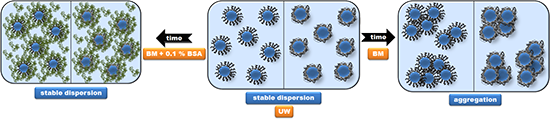
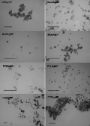
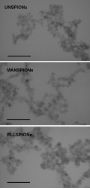
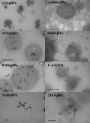
- is known that intensity size distributions are subject to scattering interferences because the intensity of scatter light is much greater for large agglomerates compared to small particles. In accordance with the obtained DLS data, TEM images in UW showed monodisperse AOTAgNPs, PVPAgNPs, TweenAgNPs




Controlled graphene oxide assembly on silver nanocube monolayers for SERS detection: dependence on nanocube packing procedure
Beilstein J. Nanotechnol. 2016, 7, 9–21, doi:10.3762/bjnano.7.2
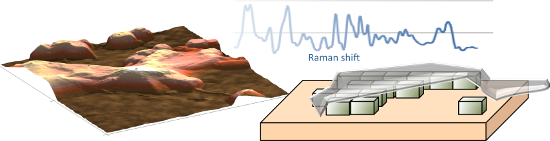
- synthesized through a polyol synthesis, in the presence of poly(vinylpyrrolidone) (PVP) as a stabilizing agent, adopting an established literature protocol [35]. The resulting nanocube samples were mainly monodisperse with 45 nm average size and contained only a negligible fraction of Ag rods and irregular


pH-Triggered release from surface-modified poly(lactic-co-glycolic acid) nanoparticles
Beilstein J. Nanotechnol. 2015, 6, 2504–2512, doi:10.3762/bjnano.6.260
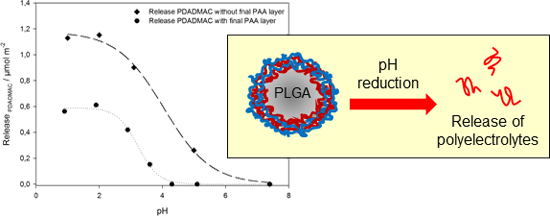
- the PDADMAC layer on the pH value during adsorption is shown in Figure 3. All particle samples show a monodisperse size distribution, indicated by a low polydispersity index (PDI ≤ 0.1). As expected, the nanoparticle size does not depend on the pH value during adsorption of PDADMAC, since the polymer


Two step formation of metal aggregates by surface X-ray radiolysis under Langmuir monolayers: 2D followed by 3D growth
Beilstein J. Nanotechnol. 2015, 6, 2406–2411, doi:10.3762/bjnano.6.247
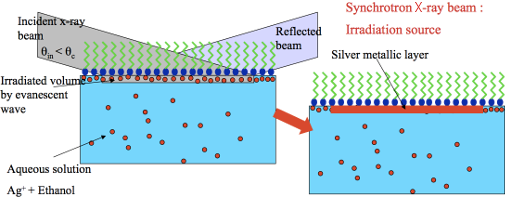
- precursors. The radiolysis induced by reduction of metal ions is generally considered as an efficient method to control this synthesis in solution as it leads to the formation of monodisperse, tailored, metal nano-objects [3]. The synthesis route involves the irradiation of a metal-ion aqueous solution that


Green and energy-efficient methods for the production of metallic nanoparticles
Beilstein J. Nanotechnol. 2015, 6, 2354–2376, doi:10.3762/bjnano.6.243
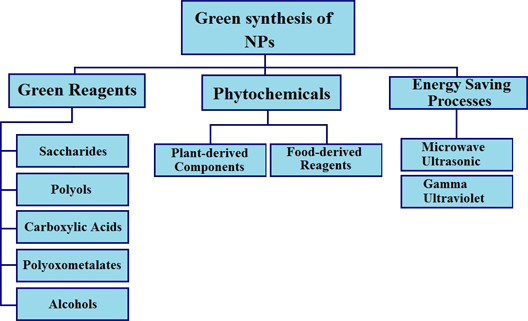
- ionic surfactants can reduce the zeta potential of Ag NPs from −20 to −50 mV, which is favorable for stabilization. They concluded that non-ionic surfactants can form a layer with inhibition function to prevent the formation of other nuclei and consequently lead to monodisperse NPs [100]. Lu et al


An adapted Coffey model for studying susceptibility losses in interacting magnetic nanoparticles
Beilstein J. Nanotechnol. 2015, 6, 2173–2182, doi:10.3762/bjnano.6.223

- solution. We extended this concept to clusters of nanoparticles, too. Results and Discussion In this work, we considered monodisperse systems of nanoparticles, with diameters of 7 nm and 17 nm and a constant anisotropy, and we simulated for various nanoparticle volume fractions ranging between 0.01 and
- concentration of nanoparticles increases. In clusters, SLP is lower with random orientations than with parallel orientations, for small as well as high diameters of nanoparticles (Figure 4). When simulating the SLP dependence on the nanoparticle size in a monodisperse system of uniformly distributed


Distribution of Pd clusters on ultrathin, epitaxial TiOx films on Pt3Ti(111)
Beilstein J. Nanotechnol. 2015, 6, 2007–2014, doi:10.3762/bjnano.6.204
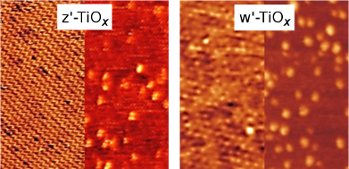
- [8][9][10] for example. In the ideal case, the clusters should be monodisperse or have at least a known size distribution. Ideal oxide surfaces can be favourably implemented in the form of thin epitaxial films. Such films grown on a single crystalline, metal support have several advantages: (a


NanoE-Tox: New and in-depth database concerning ecotoxicity of nanomaterials
Beilstein J. Nanotechnol. 2015, 6, 1788–1804, doi:10.3762/bjnano.6.183
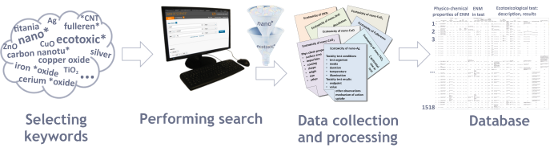
- , crustaceans and mammalian cells in vitro Ivask et al. [39] showed that the toxicity of 20, 40, 60 and 80 nm monodisperse citrate-coated Ag NPs could fully be explained by released Ag ions whereas 10 nm Ag NPs proved more toxic than predicted. Analysis of the data in NanoE-Tox database revealed that the


A facile method for the preparation of bifunctional Mn:ZnS/ZnS/Fe3O4 magnetic and fluorescent nanocrystals
Beilstein J. Nanotechnol. 2015, 6, 1743–1751, doi:10.3762/bjnano.6.178
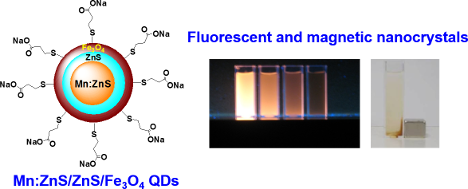
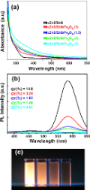
- nanocrystals were nearly monodisperse and of spherical shape. The average diameter of these QDs was determined to be 3.8 ± 0.7 nm (Figure 3a,b,e). The TEM and HR-TEM micrograph of Mn:ZnS/ZnS/Fe3O4 (1.5) crystals shows almost spherical particles with an average size of 4.4 ± 0.9 nm (Figure 3c,d,f). The measured




Synthesis, characterization and in vitro biocompatibility study of Au/TMC/Fe3O4 nanocomposites as a promising, nontoxic system for biomedical applications
Beilstein J. Nanotechnol. 2015, 6, 1677–1689, doi:10.3762/bjnano.6.170
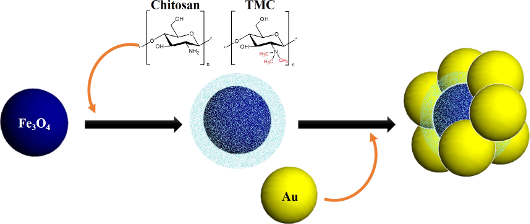
- important that the Fe3O4 nanoparticles are stable under physiological conditions that are necessary for biomedical applications, it is crucial to use controllable synthesis conditions in order to obtain monodisperse, uniform nanoparticles with desired properties [18]. Despite their low toxicity, fine
- this study to achieve the optimum results presented by the reaction: 2FeCl3 + FeCl2 + 8NaOH → Fe3O4(s) + 4H2O + 8NaCl. As the TEM image in Figure 1a shows, the typical uncoated Fe3O4 nanoparticles had an average diameter of 10 nm and were monodisperse and partially aggregated because of their magnetic
- biocompatible and nontoxic to the cells. Conclusion In summary, this study reports the preparation of two nanocomposites using a three step procedure. The monodisperse, uniform, Fe3O4 nanoparticles were synthesized through a co-precipitation method resulting in a diameter of about 10 nm, followed by surface




Synthesis, characterization and in vitro effects of 7 nm alloyed silver–gold nanoparticles
Beilstein J. Nanotechnol. 2015, 6, 1212–1220, doi:10.3762/bjnano.6.124
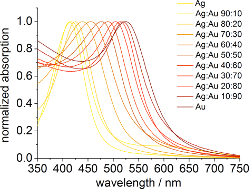
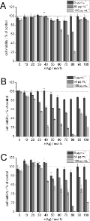
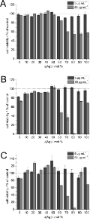
- ) showed spherical, monodisperse, colloidally stable silver–gold nanoparticles of ≈7 nm diameter with measured molar metal compositions very close to the theoretical values. The examination of the nanoparticle cytotoxicity towards HeLa cells and human mesenchymal stem cells (hMSCs) showed that the toxicity
- size and morphology of the nanoparticles were determined by transmission electron microscopy (TEM), differential centrifugal sedimentation (DCS) and dynamic light scattering (DLS). TEM showed that the nanoparticles were nearly monodisperse, quasi-spherical, polycrystalline, and had a uniform diameter
- order to compare the samples, the total amount of metal was chosen as the fixed parameter. The actual nanoparticle concentration, shown in Table 3, was calculated on the basis of the measured nanoparticle diameter from DCS and the assumption that the particles are perfectly spherical and monodisperse


Experimental determination of the light-trapping-induced absorption enhancement factor in DSSC photoanodes
Beilstein J. Nanotechnol. 2015, 6, 886–892, doi:10.3762/bjnano.6.91
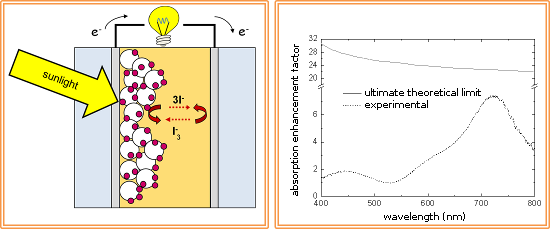
- form a compact monolayer coating all the available titania surface. The available surface was calculated by representing the PA as a parallelepiped filled with titania spheres. In a simplified scheme, the nanoparticles were assumed to be monodisperse with a fixed packing density (0.64 according to [17


Pulmonary surfactant augments cytotoxicity of silica nanoparticles: Studies on an in vitro air–blood barrier model
Beilstein J. Nanotechnol. 2015, 6, 517–528, doi:10.3762/bjnano.6.54
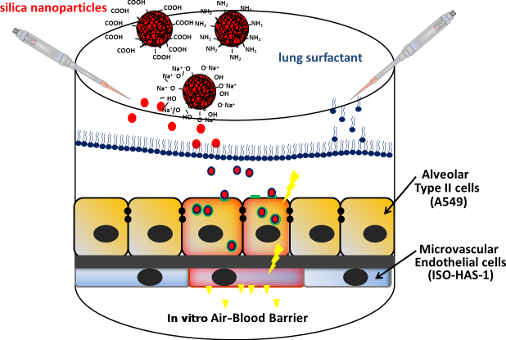
- cytotoxicity following interaction with lung surfactant, we investigated and compared aSNPs with three different surface modifications (aSNP–plain, –NH2, –COOH). Material and Methods Nanoparticles: Sicastar Red, which were already described in Kasper et al. [10][11] are monodisperse amorphous silica
- assumptions about sample properties (i.e., about size distribution), the data analysis method "Monodisperse" was used for the evaluation of the measurements. The results are summarized in Table 1. These results are comparable to previously reported data for particles of this manufacturer [10]: No significant





