


Search results
Search for "penetration depth" in Full Text gives 130 result(s) in Beilstein Journal of Nanotechnology.
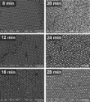
Electron-driven and thermal chemistry during water-assisted purification of platinum nanomaterials generated by electron beam induced deposition
Beilstein J. Nanotechnol. 2018, 9, 77–90, doi:10.3762/bjnano.9.10
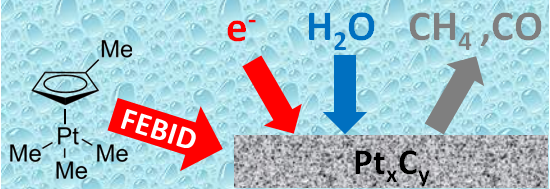
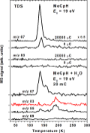
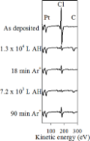
- when the irradiated molecular layers were sufficiently thick. This effect was explained by deactivation of the OH radicals by capturing of thermalized electrons, an effect that can only occur near the surface and not below a depth roughly corresponding to the effective penetration depth of the electron



Study of the vertically aligned in-plane switching liquid crystal mode in microscale periodic electric fields
Beilstein J. Nanotechnol. 2018, 9, 11–19, doi:10.3762/bjnano.9.2
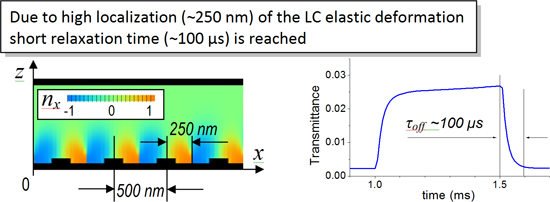
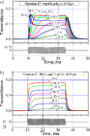
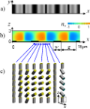
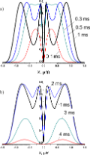
- elastic deformation from the surface into the bulk. The relaxation time of the bulk mode depends on the penetration depth of the deformation into the LC layer volume along the layer normal. This depth can be controlled by both the driving pulse duration and the thickness of the LC layer. By varying the






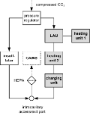
Hyperthermic intracavitary nanoaerosol therapy (HINAT) as an improved approach for pressurised intraperitoneal aerosol chemotherapy (PIPAC): Technical description, experimental validation and first proof of concept
Beilstein J. Nanotechnol. 2017, 8, 2729–2740, doi:10.3762/bjnano.8.272
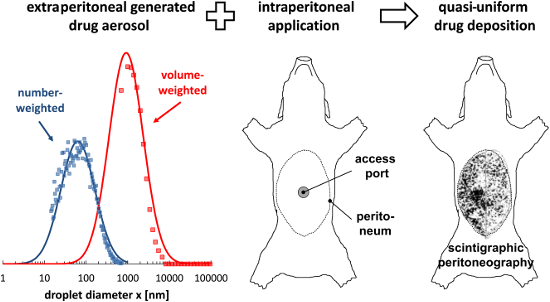
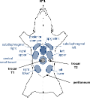
- , Erlangen, Germany) and analysed by means of suitable add-ons for planar scintigraphy (MM Oncology application) and SPECT-CT (mMR General application). Multilocal in-tissue penetration (ITP) depth analyses Multilocal in-tissue doxorubicin penetration depth analyses were performed after doxorubicin exposure
- liquid nitrogen. Analyses of in-tissue doxorubicin penetration depth (i.e., distance between luminal surface and innermost positive staining for doxorubicin accumulation) were performed by confocal laser microscopy (Leica TCS SP8, Leica Microsystems GmbH, Wetzlar, Germany) with immersion oil on ten
- , but also on electrostatic and thermophoretic effects. In order to estimate the actual drug dose for scintigraphic peritoneography and multilocal in-tissue penetration depth analyses, the peritoneal drug deposition efficiency was determined gravimetrically by weighing the drug chamber as well the




Localized growth of carbon nanotubes via lithographic fabrication of metallic deposits
Beilstein J. Nanotechnol. 2017, 8, 2592–2605, doi:10.3762/bjnano.8.260
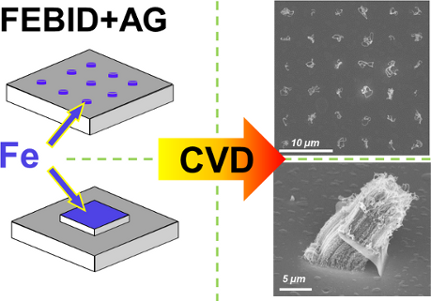
- the bulk material dominates the detected EDX signals. For example, the penetration depth, d, of the focused electron beam with a primary energy of 10 keV within amorphous carbon or silicon can be estimated to be in the range of 1.8 µm by the following equation [44]: d (μm) = 0.1E1.5/ρ, where E is the




Comparing postdeposition reactions of electrons and radicals with Pt nanostructures created by focused electron beam induced deposition
Beilstein J. Nanotechnol. 2017, 8, 2410–2424, doi:10.3762/bjnano.8.240
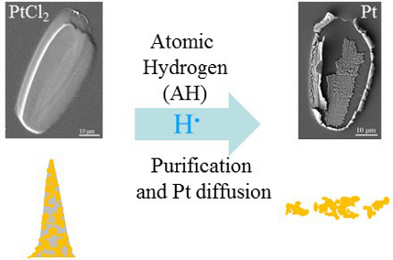
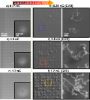
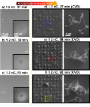
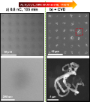
- surface area Pt catalysts and may reverse the effects of sintering. In marked contrast to the effect observed with AH, densification of the structure was observed during the postdeposition purification of PtCx deposits created from MeCpPtMe3 using atomic oxygen (AO), although the limited penetration depth
- occur in a top-down manner, but is rather controlled by the penetration depth of the incident electron beam. At a beam energy of 5 keV, complete carbon removal could be obtained up to an initial thickness of 150 nm. In addition to purification, the purified deposit was compacted to form a high-fidelity
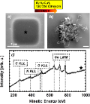
- only Pt and Cl as determined by analysis in the AES system and by EDS (Figure 1b,c). Based on the attenuation of the substrate peaks in EDS, and using an estimated penetration depth of ≈200 nm for the 10 keV electron beam together with the software package CASINO v2.48 [50], the PtCl2 deposits studied




Electron beam induced deposition of silacyclohexane and dichlorosilacyclohexane: the role of dissociative ionization and dissociative electron attachment in the deposition process
Beilstein J. Nanotechnol. 2017, 8, 2376–2388, doi:10.3762/bjnano.8.237
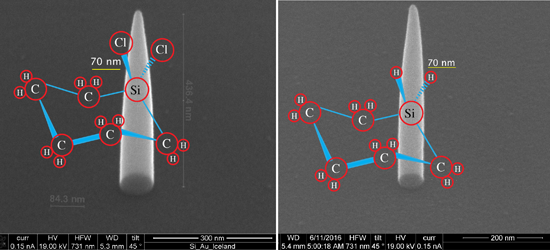
- substrate, significant inelastic and elastic scattering will take place at the surface and within the substrate along the penetration depth of the beam [3][4]. Furthermore, a significant number of secondary electrons are produced through inelastic ionizing scattering of the primary beam and its scattered
- size of the interaction volume in a pillar does not necessarily have to be the same as in the bulk, because of the reduced scattering in a pillar. For example, the Monte Carlo simulated mean electron penetration depth for 20 keV electrons in a flat aluminium substrate is 3200 nm [42] while the
- simulated electron penetration depth for 20 keV electrons in a pillar with a cone angle of 10° is only 240 nm [42]. Similarly, the simulated depth of the interaction volume for 20 keV electrons in bulk SiO2 is ca. 3 μm [43], while the calculated averaged depth of the interaction volume for 20 keV electrons





Bi-layer sandwich film for antibacterial catheters
Beilstein J. Nanotechnol. 2017, 8, 1982–2001, doi:10.3762/bjnano.8.199
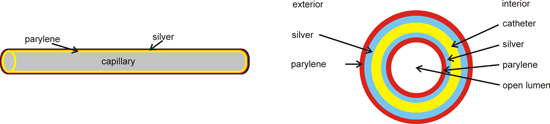
- of the depositing molecules decreases exponentially with penetration depth not only by diffusion but also by deposition losses, which causes a steeply dropping layer thickness. The reaction can occur in the gas phase as well as during or after the process of condensation (physisorption). By diluting


Optical techniques for cervical neoplasia detection
Beilstein J. Nanotechnol. 2017, 8, 1844–1862, doi:10.3762/bjnano.8.186




Nanotribological behavior of deep cryogenically treated martensitic stainless steel
Beilstein J. Nanotechnol. 2017, 8, 1760–1768, doi:10.3762/bjnano.8.177
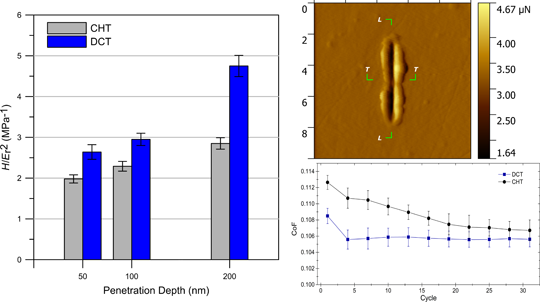
- radius of ca. 100 nm. Penetration depths of 50, 100, and 200 nm were set. A 3 × 4 array of indentations was performed in the specimens at each penetration depth, spaced at 20 μm from each other. The significance of the obtained results was determined by analysis of variance (ANOVA), using the statistical
- area A of the tip as a function of the penetration depth (h): A = (2Rh − h2), where R is the tip radius. The volume of the displaced material during each cycle is calculated as the sum of areas at the different penetration depths of the track. Additionally, the evolution of the average trench roughness
- amount of elastic recovery during unloading also depicted by the higher values of the hr/ht ratios. The ANOVA test indicated that these differences were statistically significant. Furthermore, the ANOVA analysis of the maximum applied load (Pmax) for each penetration depth has shown no statistically


Near-infrared-responsive, superparamagnetic Au@Co nanochains
Beilstein J. Nanotechnol. 2017, 8, 1680–1687, doi:10.3762/bjnano.8.168
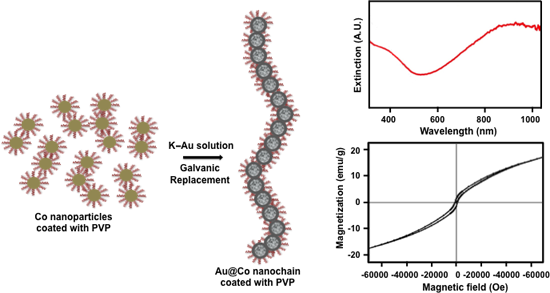
- to Au 4f electrons, as well as peaks at 780.2 and 795.3 eV, which can be attributed to Co 2p electrons. The minor broadened peaks that were observed at binding energies of ca. 790 eV and just above 800 eV can be attributed to cobalt oxide [37]. Since XPS is a surface technique, the penetration depth


Air–water interface of submerged superhydrophobic surfaces imaged by atomic force microscopy
Beilstein J. Nanotechnol. 2017, 8, 1671–1679, doi:10.3762/bjnano.8.167
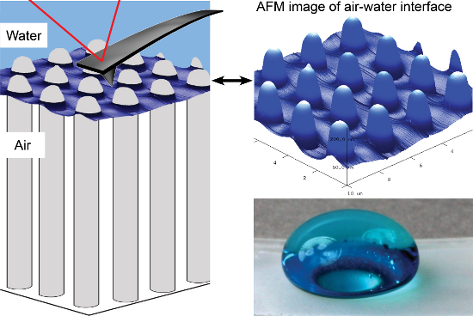
- were thus able to determine the penetration depth of the water into the hydrophobic pillar structure. The depth is linearly dependent on the force applied in accordance to Hooke’s law. We measured the depth by applying zero resulting force to the interface. This value was confirmed by linear regression



Vapor-phase-synthesized fluoroacrylate polymer thin films: thermal stability and structural properties
Beilstein J. Nanotechnol. 2017, 8, 933–942, doi:10.3762/bjnano.8.95
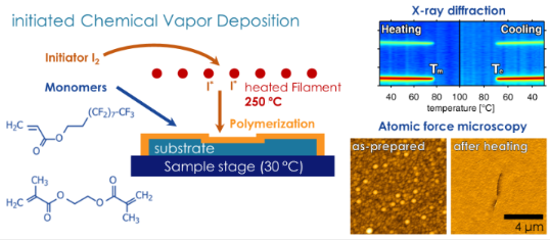
- S1 for larger scales). The line profiles of these cracks reveal a penetration depth of approximately 20 nm, which means that they are limited to the interfacial area (the film thickness is approximately 350 nm). For cross-linked films, the temperature treatment results in no observable changes


Bio-inspired micro-to-nanoporous polymers with tunable stiffness
Beilstein J. Nanotechnol. 2017, 8, 906–914, doi:10.3762/bjnano.8.92
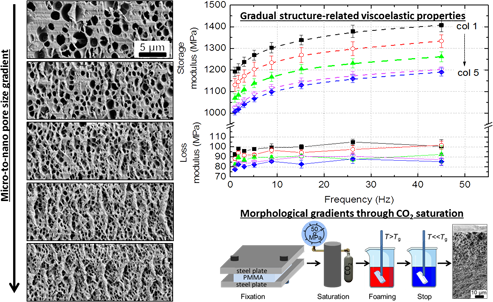
- . [26]. Briefly, a flat diamond punch of 20 μm diameter was brought into contact with the material and loaded to reach a penetration depth of 3 μm. After a stabilisation period, the punch then oscillated at different frequencies between 1 and 45 Hz while maintaining the depth of 3 μm. The frequency


Relationships between chemical structure, mechanical properties and materials processing in nanopatterned organosilicate fins
Beilstein J. Nanotechnol. 2017, 8, 863–871, doi:10.3762/bjnano.8.88

- attributed to the limited penetration depth and diffusion length for ions, radicals and other chemically active species present during plasma etching and ashing, and wet cleans through the overlying hard mask and the interconnected porosity in the organosilicate. More specifically, as the fin dimensions
- decrease, the penetration depth and diffusion length start to represent an increasingly larger percentage of the fin width. The nearly complete disappearance of the SiC–H3 deformation band for the 20 and 90 nm wide fins suggests that the penetration depth and diffusion lengths in this case are of the order



Anodization-based process for the fabrication of all niobium nitride Josephson junction structures
Beilstein J. Nanotechnol. 2017, 8, 539–546, doi:10.3762/bjnano.8.58
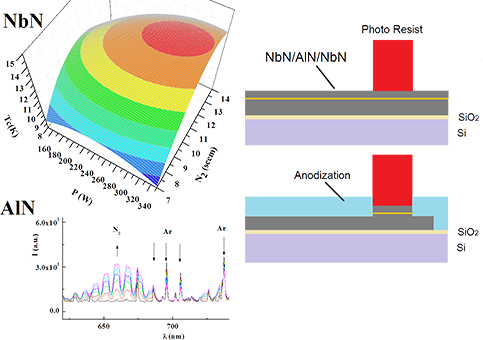
- the London penetration depth of our NbN films of 500 ± 30 nm. This result is in good agreement with previous results obtained through NbN deposition on non-heated substrates [18][19]. The pattern shows a somewhat non-uniform Josephson current distribution [20], which we speculate to be due to a


Diffusion of dilute gas in arrays of randomly distributed, vertically aligned, high-aspect-ratio cylinders
Beilstein J. Nanotechnol. 2017, 8, 64–73, doi:10.3762/bjnano.8.7
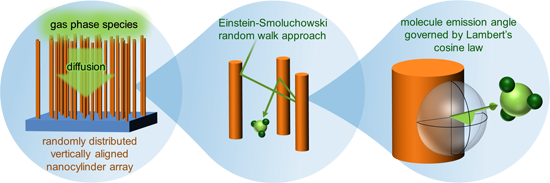
- nanocylinders the diffusion occurs in a molecular regime. The system of nanocylinders is of high aspect ratio, which from the point of view of diffusion means a large ratio of cylinder length to mean horizontal penetration depth. The system exhibits a continuous translational symmetry in transverse direction


Annealing-induced recovery of indents in thin Au(Fe) bilayer films
Beilstein J. Nanotechnol. 2016, 7, 2088–2099, doi:10.3762/bjnano.7.199
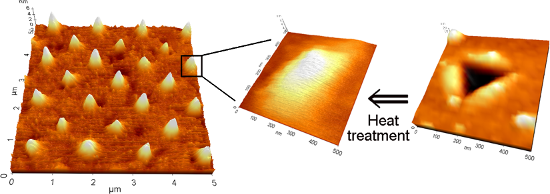
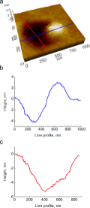
- × 100 nanoimprints, so that the distance between the imprints was 1 µm. For both loading conditions, the penetration depth was significantly lower than the film thickness. The indented samples were annealed in a quartz tube resistance furnace under forming gas flow (Ar + 10% H2, 99.999% pure) at a





Ferromagnetic behaviour of ZnO: the role of grain boundaries
Beilstein J. Nanotechnol. 2016, 7, 1936–1947, doi:10.3762/bjnano.7.185
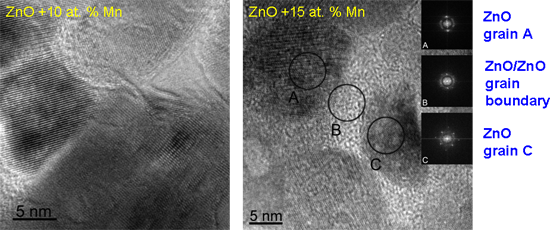
- (10 to 75 nm). No dependence on temperature or penetration depth was observed. Therefore, the µSR spectra were obtained by averaging the data obtained at different temperatures and different sample penetration depths in order to improve the signal to noise ratio. Three different samples were


Surface-enhanced infrared absorption studies towards a new optical biosensor
Beilstein J. Nanotechnol. 2016, 7, 1736–1742, doi:10.3762/bjnano.7.166
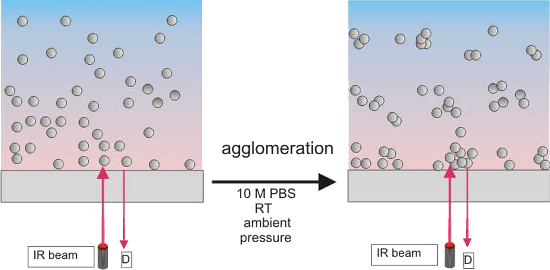
- ”), larger sensing volume (for evanescent field sensors due to the enhanced penetration depth), and the possibility to extract additional information by chemometric methods. An additional advantage is the increasing manufacturing tolerance compared to the visible region. This leads to the proposal to combine
- evanescent field of a guided wave (as is the above-mentioned MZI sensor), will show only a moderate absorption spectra, as the sensing volume is limited by the penetration depth of the evanescent field. This fact is both an advantage and a disadvantage. Biosensors often operate in aqueous solution, which
- strongly absorbs in the MIR. The small penetration depth ensures that the analyte spectrum is not obscured by the water bands. For the same reason, the analyte spectrum is poor. A solution to the problem of weak signal could be the implementation of surface-enhanced infrared absorption (SEIRA), which has


Graphene-enhanced plasmonic nanohole arrays for environmental sensing in aqueous samples
Beilstein J. Nanotechnol. 2016, 7, 1564–1573, doi:10.3762/bjnano.7.150
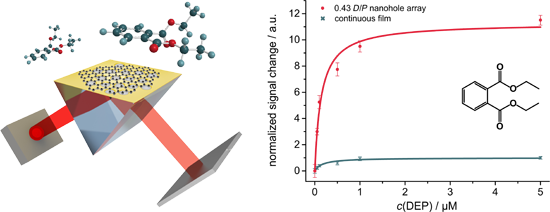
- analytical application were studied, as the optimal plasmonic properties, e.g., penetration depth of the plasmonic field and sensitivity depend on the excitation method [41]. In order to vary the D/P (Figure 3) of the nanostructured substrate, the spheres were changed in size without altering their position




Localized surface plasmons in structures with linear Au nanoantennas on a SiO2/Si surface
Beilstein J. Nanotechnol. 2016, 7, 1519–1526, doi:10.3762/bjnano.7.145
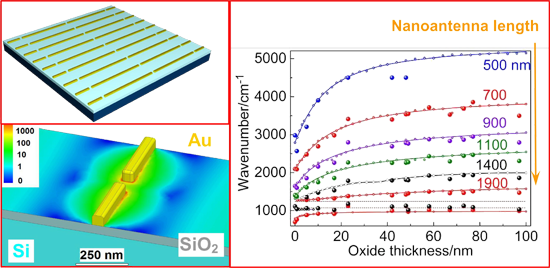
- surface with underlying SiO2 layers of various thicknesses allowed the penetration depth of localized surface plasmons into SiO2 to be determined. The value of the penetration depth derived experimentally (20 ± 10 nm) corresponds to that obtained from electromagnetic simulations (12.9–30.0 nm). Coupling
- amplification distribution. Similarly, Figure 5c represents the simulated E-field distribution referred to the middle vertical plane (XY) and shows that the field penetrates to the SiO2 layer at a relatively small distance. Quantitatively, the LSPR penetration depth δLSPR in Si and SiO2 can be derived from
- effective refractive index neff = [(ε1 + ε2)/2]1/2: νε1,ε2 = ν1,1/neff [12]. This allows one to conclude that when the nanoantennas are backed by a SiO2 layer the thickness of which is noticeably larger than the LSPR penetration depth δLSPR, the following relation between the LSPR frequencies νSi and νSiO2


Multiwalled carbon nanotube hybrids as MRI contrast agents
Beilstein J. Nanotechnol. 2016, 7, 1086–1103, doi:10.3762/bjnano.7.102
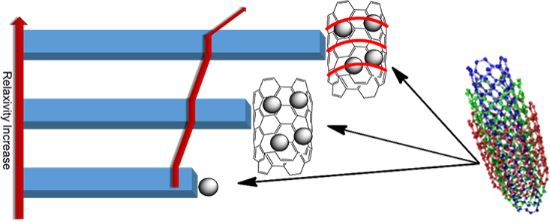
- over other tomographic methods due to its non-invasive character, the high spatial and temporal resolution and the possibility of analyzing soft tissues. The substitution of X-rays (as used in computer tomography) by a magnetic field that causes no side effects and has no limit to penetration depth



The role of morphology and coupling of gold nanoparticles in optical breakdown during picosecond pulse exposures
Beilstein J. Nanotechnol. 2016, 7, 869–880, doi:10.3762/bjnano.7.79
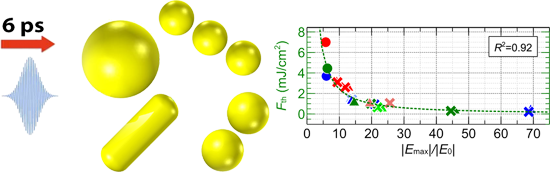
- resonance peaks of gold nanospheres towards the near infrared region. (This is useful in biological applications, where light has a good penetration depth) [5][16]. The use of plasmonic nanoparticles and the associated near-field enhancement has been used in applications based on the laser-induced breakdown




Hemolysin coregulated protein 1 as a molecular gluing unit for the assembly of nanoparticle hybrid structures
Beilstein J. Nanotechnol. 2016, 7, 351–363, doi:10.3762/bjnano.7.32
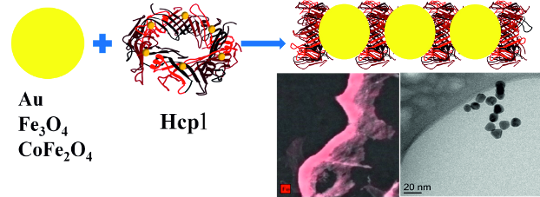
- Information File 1 and by calculation following Equation S1, Supporting Information File 1, reveals a value of 1.5 ± 0.5 nm and 3.32 nm. The reason for the large discrepancy compared to the calculated value can be caused by the smaller size of the Fe3O4 NPs, leading to higher penetration depth into the
- high indulgence of the Hcp1 ring structure. This results in a greater penetration depth of the NP into the protein cavity, leading to a smaller interparticle distance. Conclusion In this study, we used the toroidal protein Hcp1_cys3 as a protein adaptor to glue NPs in a “Lego-like” manner into linear




Impact of ultrasonic dispersion on the photocatalytic activity of titania aggregates
Beilstein J. Nanotechnol. 2015, 6, 2423–2430, doi:10.3762/bjnano.6.250
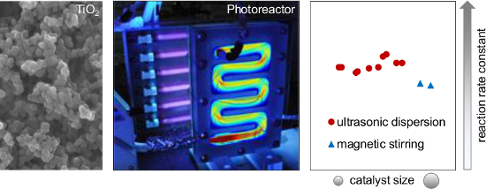
- absorbance increases with further dispersion. Obviously, the maximum reaction rate is already achieved after short ultrasonication time, which disperses the large micrometer-sized agglomerates into submicron aggregates. This outcome is explained by the limited UV penetration depth into the concentrated





