Search results
Search for "quartz" in Full Text gives 415 result(s) in Beilstein Journal of Nanotechnology. Showing first 200.
Self-assembly of C60 on a ZnTPP/Fe(001)–p(1 × 1)O substrate: observation of a quasi-freestanding C60 monolayer
Beilstein J. Nanotechnol. 2022, 13, 857–864, doi:10.3762/bjnano.13.76
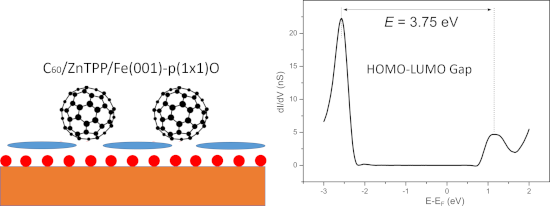
- sublimated by Knudsen effusion cells. The deposition flux was 0.5 ML/min, with 1 ML = 3.06 Å, as monitored by a quartz microbalance. C60 was evaporated on top of 1 ML ZnTPP/Fe(001)–p(1 × 1)O. STM images have been acquired at room temperature in constant-current mode with custom-made electrochemically etched


Temperature and chemical effects on the interfacial energy between a Ga–In–Sn eutectic liquid alloy and nanoscopic asperities
Beilstein J. Nanotechnol. 2022, 13, 817–827, doi:10.3762/bjnano.13.72
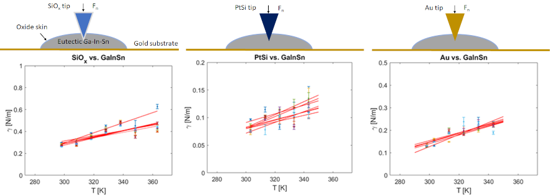
- force–distance curve with each cantilever on a quartz glass sample (manufactured by Goodfellow, United Kingdom) and extracting its slope in the range of repulsive forces. Subsequently, we determined the bending stiffness Cn of each cantilever by analyzing its thermal noise vibration [18]. After


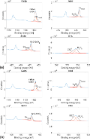

Optimizing PMMA solutions to suppress contamination in the transfer of CVD graphene for batch production
Beilstein J. Nanotechnol. 2022, 13, 796–806, doi:10.3762/bjnano.13.70
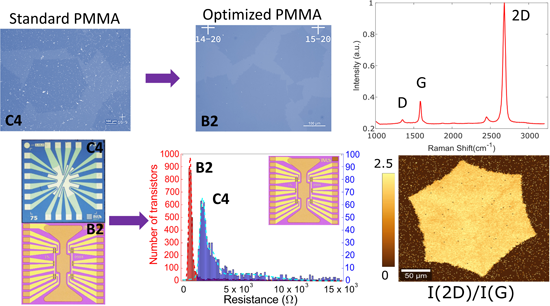
- controllers. The Cu foil was first annealed in argon atmosphere (500 sccm, 9.0 Torr) for 30 min in a quartz tube furnace. In the growth process, the gas mixture of argon (250 sccm), hydrogen (100 sccm), and methane (1.2 sccm) was subsequently introduced into the quartz chamber, where a reaction pressure of




Efficient liquid exfoliation of KP15 nanowires aided by Hansen's empirical theory
Beilstein J. Nanotechnol. 2022, 13, 788–795, doi:10.3762/bjnano.13.69
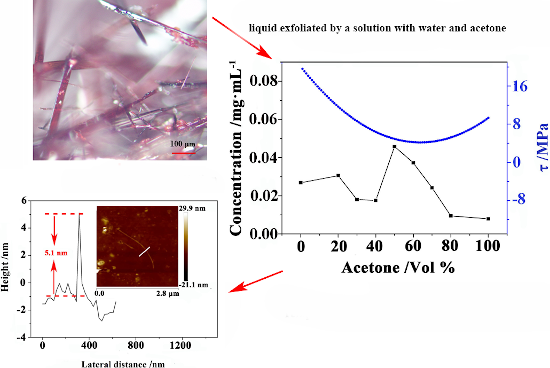
- bulks The KP15 bulks were prepared by the gas-phase transfer method. High-purity red phosphorus (1.370 g, 99.9999%) and metallic potassium (0.130 g, 97%) were mixed in a quartz tube. The temperature gradient in the quartz tube was 650 °C/400 °C and the heat treatment time was 12 h. After annealed, dark


Hierarchical Bi2WO6/TiO2-nanotube composites derived from natural cellulose for visible-light photocatalytic treatment of pollutants
Beilstein J. Nanotechnol. 2022, 13, 745–762, doi:10.3762/bjnano.13.66
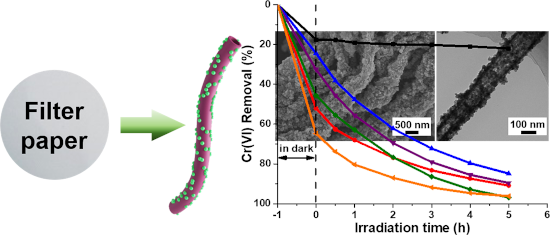
- 5.0 cm from the quartz tube reactor. The photocatalyst (10.0 mg) was dispersed in the pollutant solution (20.0 mL, 10.0 mg·L−1) and stirred in the dark for 1 h to guarantee the adsorption−desorption equilibrium. Then, the visible light was switched on, and the suspension containing photocatalyst and


Revealing local structural properties of an atomically thin MoSe2 surface using optical microscopy
Beilstein J. Nanotechnol. 2022, 13, 572–581, doi:10.3762/bjnano.13.49
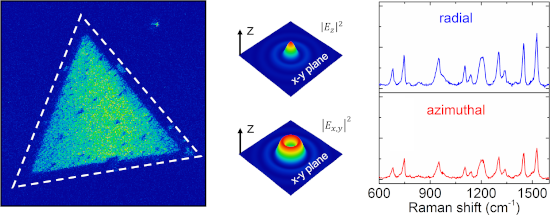
- pressure of 10−8 mbar, CuPc powder (Sensient Imaging Technologies SA) is evaporated from a resistively heated crucible. The nominal deposition rate (0.2–0.3 nm/min) is monitored by a quartz crystal micro balance. A commercial optical microscope (MX50, Olympus) is used to obtain the bright-field optical


Zinc oxide nanostructures for fluorescence and Raman signal enhancement: a review
Beilstein J. Nanotechnol. 2022, 13, 472–490, doi:10.3762/bjnano.13.40
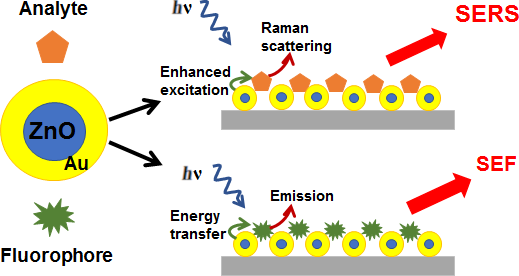
- ), respectively [63]. For pure spherical Zn NPs, on average 28 ± 5 nm in diameter, obtained by vacuum magnetron sputtering on molten quartz, the plasmonic resonance is located around 240 and 290 nm, while for ZnO NPs, the maximum is around 360 nm [64]. In addition, ZnO nanosubstrates serve as carriers of Ag or Au




Investigation of electron-induced cross-linking of self-assembled monolayers by scanning tunneling microscopy
Beilstein J. Nanotechnol. 2022, 13, 462–471, doi:10.3762/bjnano.13.39
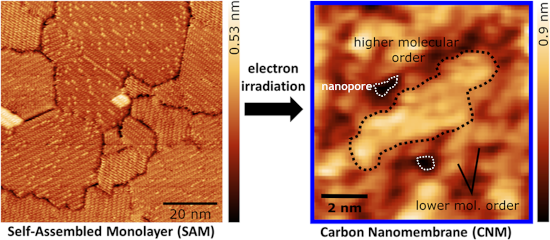
- were performed. Immediately after sputtering, the gold substrate was exposed to the molecular beam from a quartz crucible inside a Knudsen-type organic evaporator (TCE-BSC, Kentax). The crucible was filled with TPT crystals previously purified by sublimation. The sublimation temperature was set to 398


Piezoelectric nanogenerator for bio-mechanical strain measurement
Beilstein J. Nanotechnol. 2022, 13, 192–200, doi:10.3762/bjnano.13.14
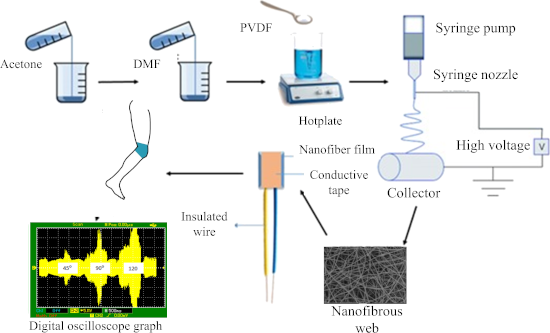
- . Piezoelectric materials offer advantages as transducers, sensors, and energy-harvesting devices. Commonly, ceramics and quartz are used in such applications. However, polymeric piezoelectric materials have the advantage that they can be converted into any shape and size. In smart textiles, polyvinylidene


A photonic crystal material for the online detection of nonpolar hydrocarbon vapors
Beilstein J. Nanotechnol. 2022, 13, 127–136, doi:10.3762/bjnano.13.9
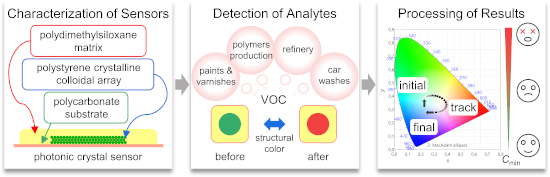
- detection of volatile organic compounds [30][31][32]. In most cases, the response of such sensors is a change in mass recorded using a quartz microbalance. A simpler design and research method made it possible to investigate in more detail the processes occurring during the absorption of solvents. The


Influence of magnetic domain walls on all-optical magnetic toggle switching in a ferrimagnetic GdFe film
Beilstein J. Nanotechnol. 2022, 13, 74–81, doi:10.3762/bjnano.13.5
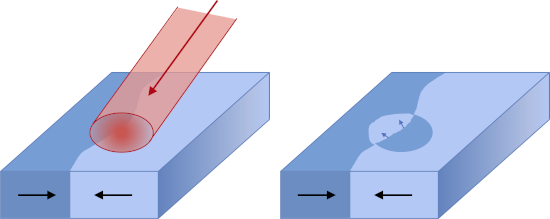
- thermally oxidized SiOx layer and covered with a 3 nm Al capping layer to prevent oxidation. Composition and layer thicknesses were determined by calibrating the sputter rates with a quartz balance before the depositions. Thus, the sample structure was as follows: Al (3 nm)/Gd26Fe74 (15 nm)/Pt (5 nm)/SiOx


Sputtering onto liquids: a critical review
Beilstein J. Nanotechnol. 2022, 13, 10–53, doi:10.3762/bjnano.13.2







Topographic signatures and manipulations of Fe atoms, CO molecules and NaCl islands on superconducting Pb(111)
Beilstein J. Nanotechnol. 2022, 13, 1–9, doi:10.3762/bjnano.13.1
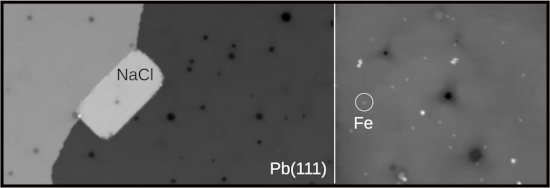
- minute. This leads to a surface coverage of about 0.1–0.3 monolayers, as we readily observed on noble metals such as Cu, Ag or Au [45][46]. Iron adatoms were evaporated in the microscope head on the substrate at a temperature below 15 K. NaCl was evaporated from a quartz crucible on samples kept at room
- apparent (see Figure 2a). Growth of NaCl islands on Pb(111) We next investigated the adsorption of NaCl on Pb(111) (Figure 3). Upon sublimation from a quartz crucible on a Pb(111) surface, which is kept at room temperature, NaCl forms, without any post-annealing, rectangular islands with round corners


Plasmon-enhanced photoluminescence from TiO2 and TeO2 thin films doped by Eu3+ for optoelectronic applications
Beilstein J. Nanotechnol. 2021, 12, 1271–1278, doi:10.3762/bjnano.12.94
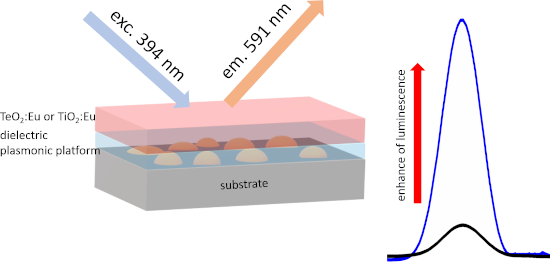
- . The round Au target with 99.99% purity was sputtered by 30 W of incident power. The rate of Au layer deposition was about 4 Å/s. Thickness was controlled by a built-in quartz crystal microbalance. As prepared films were subsequently put in a hot furnace for the formation of nanostructures. Samples
- :Eu, and TiO2:Eu layers was conducted at 200 °C. The pressure in the chamber was approximately 0.2 Pa and the distance between target and substrate was approximately 10 cm. The sputtering system was equipped with a quartz crystal microbalance for the in situ measurements of film thickness. In order to


Modification of a SERS-active Ag surface to promote adsorption of charged analytes: effect of Cu2+ ions
Beilstein J. Nanotechnol. 2021, 12, 902–912, doi:10.3762/bjnano.12.67
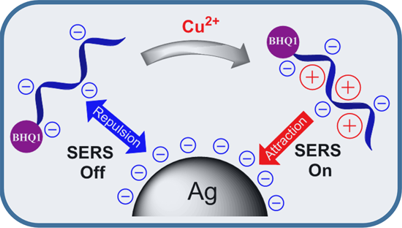
- NP water solution (Ag concentration of 32 µg/mL) with 2.5 mM sodium citrate and kept at room temperature. A 2.5 mm quartz cuvette filled with 2.5 mM sodium citrate water solution was used to measure the absorption spectra. The glass substrate covered by Ag NPs was placed into the cuvette after


Silver nanoparticles nucleated in NaOH-treated halloysite: a potential antimicrobial material
Beilstein J. Nanotechnol. 2021, 12, 798–807, doi:10.3762/bjnano.12.63
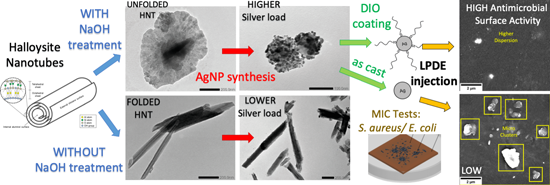
- of quartz (ICDD 46-1045), a commonly found secondary phase in HNT samples [30]. This result confirms that the substrate is indeed halloysite clay and the absence of any NaOH phase indicates that the treatment waste was successfully washed away. For Ag/HNT-8, diffraction peaks were found at 2θ = 38.12




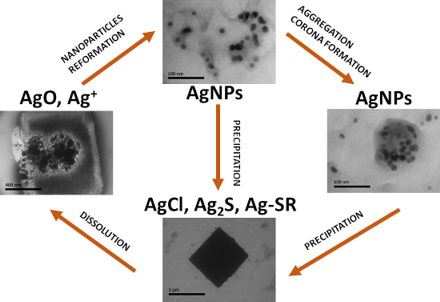
Fate and transformation of silver nanoparticles in different biological conditions
Beilstein J. Nanotechnol. 2021, 12, 665–679, doi:10.3762/bjnano.12.53
- mixing. Additionally, UV–vis spectra of all AgNPs suspensions in UPW and different biological media were recorded on a CARY 300 spectrophotometer (Varian Inc., Australia) following the same conditions. The UV–vis measurements were performed in a quartz cuvette with an optical path of 1 cm, in the





Impact of GaAs(100) surface preparation on EQE of AZO/Al2O3/p-GaAs photovoltaic structures
Beilstein J. Nanotechnol. 2021, 12, 578–592, doi:10.3762/bjnano.12.48
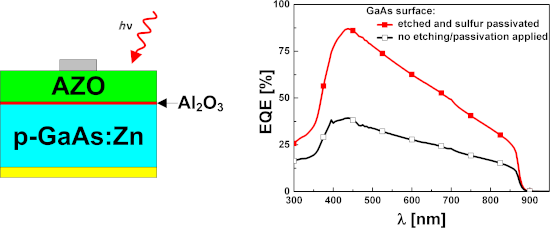
- excitation source and a Hamamatsu R928P photomultiplier. The optical slits used in the measurements were 5 and 1 nm for excitation and emission, respectively. The external quantum efficiency was measured using a Bentham PVE300 photovoltaic system operating with a 75 W xenon lamp and a 100 W quartz halogen


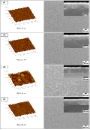
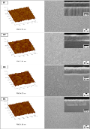


Influence of electrospray deposition on C60 molecular assemblies
Beilstein J. Nanotechnol. 2021, 12, 552–558, doi:10.3762/bjnano.12.45

- deposition to maintain stable conditions. Deposition times were typically around 10 min. Thermal evaporation C60 was evaporated from a quartz crucible in a Kentax evaporator onto samples kept at room temperature. Evaporation was calibrated using a quartz microbalance and was performed at 410 °C for 3 min. (a


Surface-enhanced Raman scattering of water in aqueous dispersions of silver nanoparticles
Beilstein J. Nanotechnol. 2021, 12, 497–506, doi:10.3762/bjnano.12.40
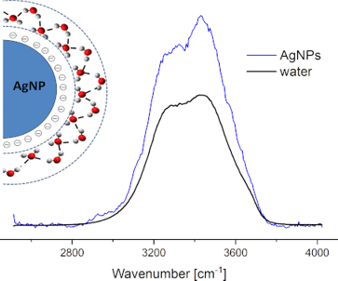
- (received from Merck). Raman spectroscopy The Raman spectra were obtained by using a T64000 (Jobin Yvon) triple-grating spectrometer (Ar laser excitation line – 514.5 nm) with a spectral resolution of approx. 0.5 cm−1. The measurements were carried out in a macro chamber, in a spectrofluorometric QX quartz


Interface interaction of transition metal phthalocyanines with strontium titanate (100)
Beilstein J. Nanotechnol. 2021, 12, 485–496, doi:10.3762/bjnano.12.39
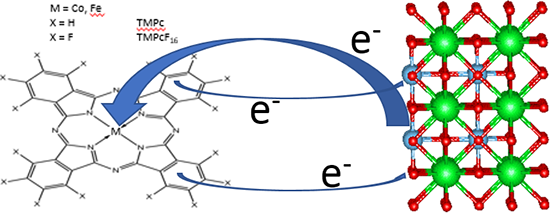
- oxygen atmosphere (p(O2) = 4 × 10⁻⁵ mbar) at a substrate temperature of 910 K. The Ti thickness was monitored by the ion flux of the electron beam evaporator (EFM 3s, Focus GmbH) calibrated by a quartz microbalance. The estimation of the TiO2 thickness from the attenuation of the Sr 3d peak intensity


Rapid controlled synthesis of gold–platinum nanorods with excellent photothermal properties under 808 nm excitation
Beilstein J. Nanotechnol. 2021, 12, 462–472, doi:10.3762/bjnano.12.37
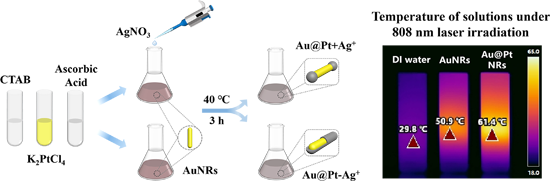
- water so that they had the same OD of 0.5. Then, 2 mL AuNRs solution and 2 mL Au@Pt NRs solution were added to two quartz cuvettes and exposed to an 808 nm cw laser at 2.0 W/cm2 for 10 min. At definite time intervals, the temperature changes were recorded with the infrared thermal camera. For comparison


Structural and optical characteristics determined by the sputtering deposition conditions of oxide thin films
Beilstein J. Nanotechnol. 2021, 12, 354–365, doi:10.3762/bjnano.12.29
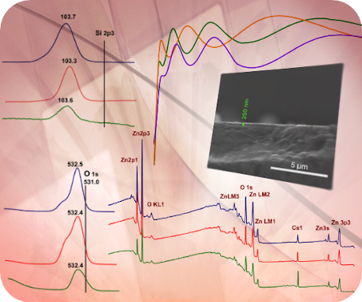
- dioxide (SiO2) and zinc oxide (ZnO) thin films deposited by radio frequency magnetron sputtering on quartz substrates was investigated. The deposition conditions were optimized to achieve stoichiometric thin films. The orientation of crystallites, structure, and composition were investigated by X-ray
- dielectric interfaces in the structure of a metamaterial. This paper reports the experimental conditions for deposition of ZnO and SiO2 films as an improvement of the rfMS vacuum deposition technique for dielectric layers (e.g., ZnO and SiO2) onto quartz substrates. Here we investigated SiO2 and ZnO thin
- situ thickness monitoring. Thus, rfMS [27][36][37] was used to deposit SiO2 and ZnO oxide films. This technique ensures material deposition onto large areas and quality thin films for multiple applications. They are obtained at room temperature on quartz substrates with thickness values ranging from


The nanomorphology of cell surfaces of adhered osteoblasts
Beilstein J. Nanotechnol. 2021, 12, 242–256, doi:10.3762/bjnano.12.20
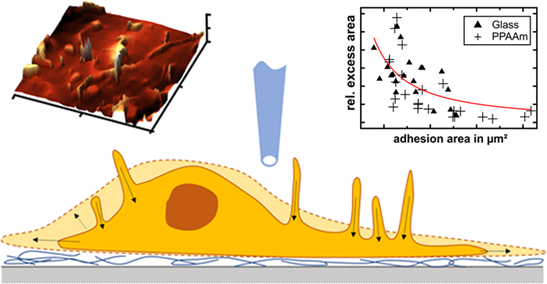
- predominantly observed on primary rat osteoblasts cultured on bioglass, which is less negative in zeta potential compared to quartz glass. Membrane holes and smaller protrusions Though the ruffles are the most prominent feature we observe on the osteoblastic cells, further membrane features, such as holes and
- coating was measured online by a quartz crystal thickness monitor (Cressington MTM 10, UK) and the sputter process was stopped at a nominal value of approximately 10 nm. The Au layers were only applied to half of the glass area in order to create an in situ reference. Since we observed spread cells


TiOx/Pt3Ti(111) surface-directed formation of electronically responsive supramolecular assemblies of tungsten oxide clusters
Beilstein J. Nanotechnol. 2021, 12, 203–212, doi:10.3762/bjnano.12.16

- monolayer/s. The deposition rate was obtained by previously performed calibration measurements using a quartz microbalance, which was positioned in the same direction and distance toward the evaporation source as the sample in order to obtain comparable results. The surface coverages shown herein represent