Search results
Search for "surfaces" in Full Text gives 1303 result(s) in Beilstein Journal of Nanotechnology. Showing first 200.
Synthesis of biowaste-derived carbon-dot-mediated silver nanoparticles and the evaluation of electrochemical properties for supercapacitor electrodes
Beilstein J. Nanotechnol. 2025, 16, 933–943, doi:10.3762/bjnano.16.71
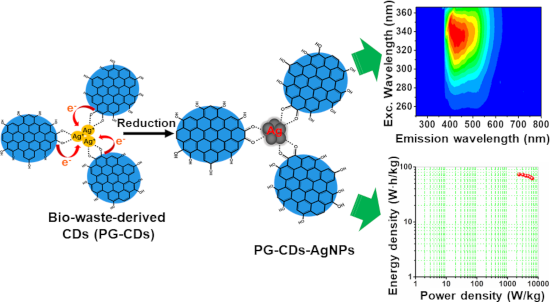
- reduction of Ag+ to Ag(0) via oxygen-containing functionalities on their surfaces. The electrostatic attraction between the oxygen-containing functionalities on the surface of CDs binds with the positively charged Ag+ ions, which were then reduced by electron transfer from PG-CDs to the Ag+ ions [27]. The
- successfully adopted for the production of AgNPs using CDs produced from waste biomass as a stabilizing and reducing agent. The TEM analysis showed that the produced PG-CDs-AgNPs have more uniform surfaces and spherical shapes with an average particle size of 10–11 nm. The synthesized PG-CD-AgNPs are


Structural and magnetic properties of microwave-synthesized reduced graphene oxide/VO2/Fe2O3 nanocomposite
Beilstein J. Nanotechnol. 2025, 16, 921–932, doi:10.3762/bjnano.16.70
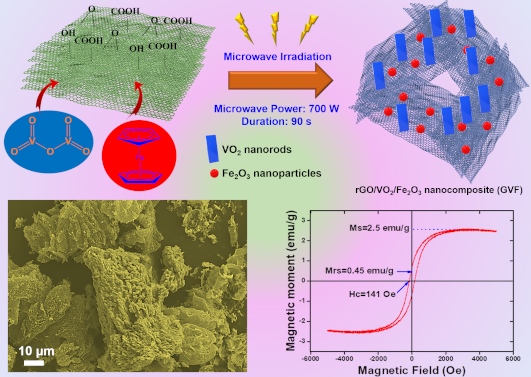
- surfaces through substantial interactions. To confirm the formation of the ternary NC, the XRD analysis of the GVF was performed. As shown in Figure 3a, the characteristic peaks of GVF corresponding to the α phase of Fe2O3 and VO2, along with the signature peak of rGO were observed. To be specific, the
- presence of these elements. For a comparative study, the morphological analysis of the GV was performed, and the corresponding FESEM images are shown in Figure 6a–c. As shown in the SEM micrographs, at various magnifications, the spherical-shaped VO2 particles are covered on the graphene surfaces. Notably
- ) was visible on the thin rGO surfaces. Notably, a clear difference between the size of Fe2O3 NPs (average particle diameter – 8.1 ± 2.2 nm) and VO2 NSs (average particle diameter – 34 ± 5.2 nm) indicates the formation of these two different types of metal oxides on top of the rGO nanosheets (Figure 8e



Heat-induced transformation of nickel-coated polycrystalline diamond film studied in situ by XPS and NEXAFS
Beilstein J. Nanotechnol. 2025, 16, 887–898, doi:10.3762/bjnano.16.67
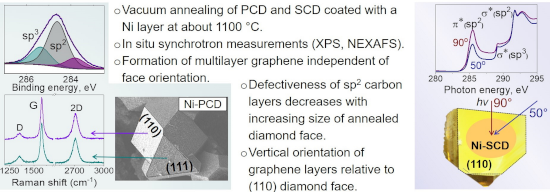
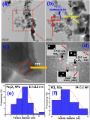
- of diamond surfaces is important for many applications, which require the formation of thin conductive electrodes on dielectric substrates. Transition metal catalysts can facilitate the graphitization process, which depends on the diamond face orientation. In the present work, the role of a nickel
- diamond surfaces is initiated at 750 °C. A temperature of about 1500 °C is needed for the formation of extended graphene-like layers, and temperatures higher than 2000 °C are required for the complete conversion of the diamond (111) surface to graphitic layers [10][11]. Thermal stability of diamond
- contrast, the Ni nanoparticles penetrate beneath the (110) and (100) surfaces, creating pits that were partially filled with graphite covalently bonded to the etched diamond surface. From prior works, it can be seen that the Ni-assisted graphitization of diamond has been studied on either SCDs, which have


Ar+ implantation-induced tailoring of RF-sputtered ZnO films: structural, morphological, and optical properties
Beilstein J. Nanotechnol. 2025, 16, 872–886, doi:10.3762/bjnano.16.66
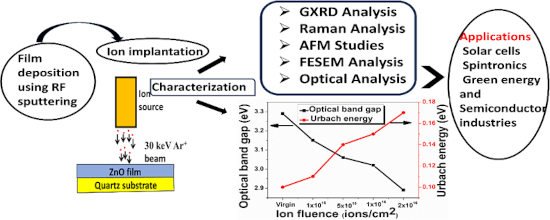
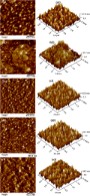
- explains the mechanism of the evolution of nanostructures on ion beam-implanted surfaces at normal incidence. According to this theory, in the early stages, sputtering leads to the formation of tiny wavy perturbations induced via instabilities created by the ion beam. These instabilities are followed by a
- observed higher reductions of optical bandgap values than other earlier studies using low-energy ion beams [3][12]. Thus, low-energy argon ion implantation of ZnO films provides us with an approach to fabricate advanced materials having smoother surfaces, lower particle sizes, lower bandgap, and higher






Insights into the electronic and atomic structures of cerium oxide-based ultrathin films and nanostructures using high-brilliance light sources
Beilstein J. Nanotechnol. 2025, 16, 860–871, doi:10.3762/bjnano.16.65

- applications. Studies on cerium oxide nanostructures and powders prepared by chemical synthesis methods are quite numerous, and they are typically carried out on systems with a marked and often unexplored complexity [14][15][16][17]. For studies on cerium oxide as model systems, such as low-index surfaces
- was possible to identify different types of interactions between Pt NPs and cerium oxide surfaces including electron transfer from Pt NPs to CeO2 and transport of oxygen atoms from ceria to Pt NPs, the latter occurring only when the ceria support surface is nanostructured [26]. In addition, thanks to
- that form the film, while the Pt ions in the 2+ oxidation state are confined at the outermost layers [29]. The interplay of ceria surfaces with adsorbed molecules, a crucial factor in understanding reactivity, has become a significant research focus, also thanks to synchrotron-radiation-based XPS


Synchrotron X-ray photoelectron spectroscopy study of sodium adsorption on vertically arranged MoS2 layers coated with pyrolytic carbon
Beilstein J. Nanotechnol. 2025, 16, 847–859, doi:10.3762/bjnano.16.64
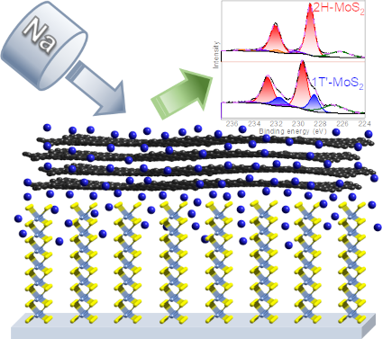
- source was simultaneously deposited in vacuum on the surfaces of MoS2, pyrolytic carbon, and a hybrid sample obtained by transferring a pyrolytic carbon film onto the MoS2 film. According to XPS data, sodium easily penetrates into the space between the vertical layers of the uncoated film, and its
- films were synthesized by CVD and transferred onto the surfaces of SiO2/Si and MoS2. PyC, MoS2 film, and PyC-MoS2 hybrid were used to deposit equal amounts of sodium via evaporation in UHV. Analysis of XPS data revealed a higher sodium concentration on the PyC-MoS2 surface than on the MoS2 surface since
- then dried under ambient conditions. Morphology of sample surfaces was examined by SEM with a CIQTEK SEM5000 (CIQTEK Ltd., Hefei, Anhui, PRC) microscope at an accelerating voltage of 15 kV. The cross section of MoS2 film was prepared using a gallium-ion column FIB system and a two-stage protective cap


Supramolecular hydration structure of graphene-based hydrogels: density functional theory, green chemistry and interface application
Beilstein J. Nanotechnol. 2025, 16, 806–822, doi:10.3762/bjnano.16.61
- cell content includes about 70–95% water that creates an aqueous environment for biological processes. Water molecules are bound to biomolecular surfaces and participate in the structuring and functioning of biomolecules, typically the folding of protein and the twisting of the double helix of
- interface of biomolecules has considerably slower dynamics than water molecules in the bulk. Besides, the first water layer on the interface is responsible for hydration forces between biomolecular structures [5]. The rearrangement of water molecules through hydrogen bonding on hydrated surfaces generates
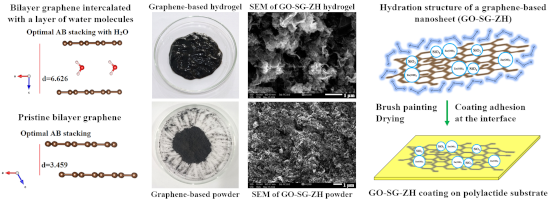
- circular economy [18][19][20][21]. Especially, GO nanosheets decorated with SG-ZH nanoparticles have hydrophilic surfaces to retain hydration layers in the hydrogel structure of the GO-SG-ZH nanocomposite. Hydration layers in the GO-SG-ZH hydrogel also function as lubricants at the nanomaterials interfaces


Morphology and properties of pyrite nanoparticles obtained by pulsed laser ablation in liquid and thin films for photodetection
Beilstein J. Nanotechnol. 2025, 16, 785–805, doi:10.3762/bjnano.16.60
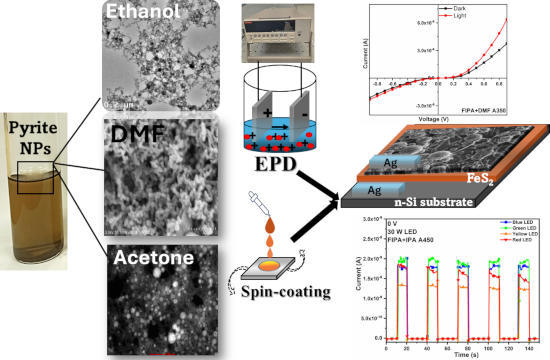
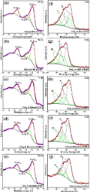
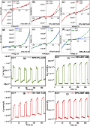
- images of the film (FDMF) before sulfurization is also presented (Supporting Information File 1, Figure S5a,b). Umehara et al. has reported the effect of sulfurization temperatures and observed that temperatures above 500 °C are not preferable for device fabrication processes due to roughnened surfaces






Changes of structural, magnetic and spectroscopic properties of microencapsulated iron sucrose nanoparticles in saline
Beilstein J. Nanotechnol. 2025, 16, 762–784, doi:10.3762/bjnano.16.59
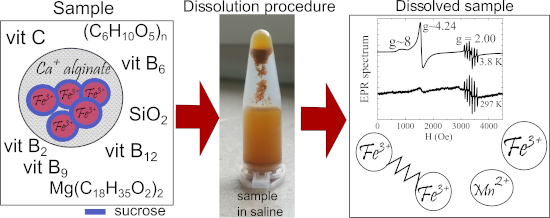
- various shapes and dimensions of several dozens of micrometers. The surfaces of the grains are notably rough and torn, and during the measurement displayed high susceptibility to electron beam charging, which is a characteristic of organic compounds. Consequently, these grains were recognized as
- if there is a fraction of iron sucrose that is not bound into microcapsules. Beyond the grains depicted in Figure 2, SEM measurements also registered elongated shreds and numerous smaller grains with more regular shapes and flat surfaces (not shown in the text). The former is most probably reflecting
- Raman spectra exhibited a similar pattern. They included a complex of bands in the 3000–2800 cm−1 region related to CHx modes and strong bands in the 1600–1000 cm−1 region. These bands originated from carboxylate and glycosidic modes, which are structurally sensitive to interactions with metal surfaces





Thickness dependent oxidation in CrCl3: a scanning X-ray photoemission and Kelvin probe microscopies study
Beilstein J. Nanotechnol. 2025, 16, 749–761, doi:10.3762/bjnano.16.58
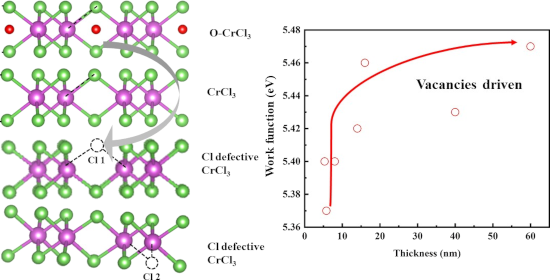
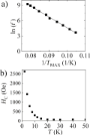
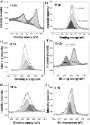
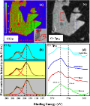
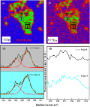
- investigates interfaces made by dry transfer of CrCl3 flakes in an atmospheric environment. Cl vacancies and the formation of O/CrCl3 are induced, serving as dissociation centers that facilitate the migration of Cl vacancies between the top and bottom surfaces. By manipulating 2D atomic layers via surface
- showed that oxygen adsorption on cleaved surfaces facilitates the formation of a stable structure with charge transfer signatures, as identified by high-resolution photoemission spectroscopy [8]. It remains unclear whether similar effects occur in exfoliated thin flakes. Like in other materials, the
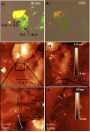
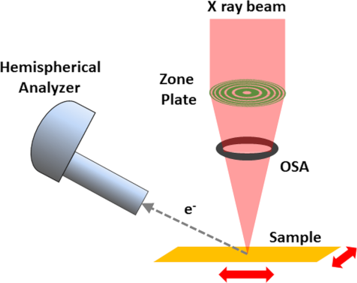
- effect) [19][20][21]. A well-known and suitable technique to investigate the electronic structure of surfaces is X-ray photoemission spectro-microscopy [22][6]; in order to obtain the necessary spatial resolution, the beam size must be reduced to tens of nanometers. The Electron Spectroscopy for Chemical





Nanostructured materials characterized by scanning photoelectron spectromicroscopy
Beilstein J. Nanotechnol. 2025, 16, 700–710, doi:10.3762/bjnano.16.54
- surfaces. The characterization of the building blocks is of paramount importance to deeply understand their functionalities and mutual interactions when they are part of a nanostructured body. The building blocks may differ in their atomic structure, crystallographic orientation, chemical composition, and
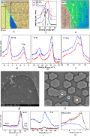
- enhanced sensitivities are examples of capabilities that modern techniques of characterization in nanotechnology must possess. X-ray photoelectron spectroscopy (XPS) is still one of the fundamental tools for chemical and electronic characterization of surfaces and subsurface layers. In the last three to
- promising, their performance is often limited by surface properties of the III–V semiconductor material, which furthermore can vary for individual nanowires. This includes native oxides on semiconductor surfaces and their possible removal, surface passivation, and interface defects [27]. Therefore, in-depth


Colloidal few layered graphene–tannic acid preserves the biocompatibility of periodontal ligament cells
Beilstein J. Nanotechnol. 2025, 16, 664–677, doi:10.3762/bjnano.16.51
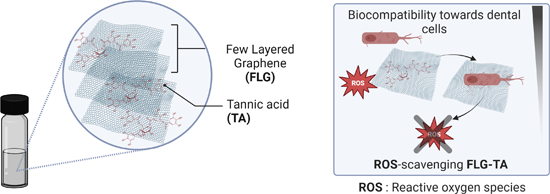
- hydrogen bonds and coat various surfaces [23]. Our results are compatible with a model where adsorbed TA molecules create a partially active antioxidant layer on the FLG surface, maintaining bioactivity while enhancing graphene colloid stability. Unfortunately, the zeta potential of the FLG–TA material in
- . The cellular response on different graphene surfaces was previously studied, and it was demonstrated that substrate characteristics such as surface roughness, surface chemistry, and electronic properties can influence cell response [38]. The implications of these results are particularly significant
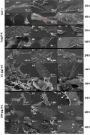
- surfaces as observed through SEM, we undertook additional confocal microscopy analyses concentrating on the actin cytoskeleton, which is a pivotal determinant of cellular structural integrity and adhesion capability, as well as overall cell viability [39][40]. The arrangement of actin filaments is




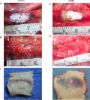
Polyurethane/silk fibroin-based electrospun membranes for wound healing and skin substitute applications
Beilstein J. Nanotechnol. 2025, 16, 591–612, doi:10.3762/bjnano.16.46
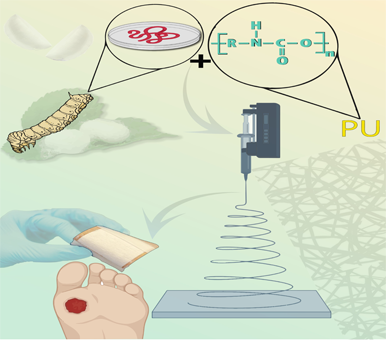
- , SF, cellulose, and collagen, along with their composites and derivatives can be electrospun [58]. Electrospinning has emerged as a versatile technique investigated across various fields, including tissue engineering, drug delivery, filtration, wound dressings, self-cleaning surfaces, biotechnology
- , environmental engineering, and green chemistry [59]. This method facilitates the creation of highly porous 3D structures with an extensive surface area and desirable chemical and physical properties, making the resulting nanofibers ideal for applications such as biosensors, antimicrobial surfaces, scaffolds



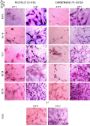
Nanomaterials in targeting amyloid-β oligomers: current advances and future directions for Alzheimer's disease diagnosis and therapy
Beilstein J. Nanotechnol. 2025, 16, 561–580, doi:10.3762/bjnano.16.44
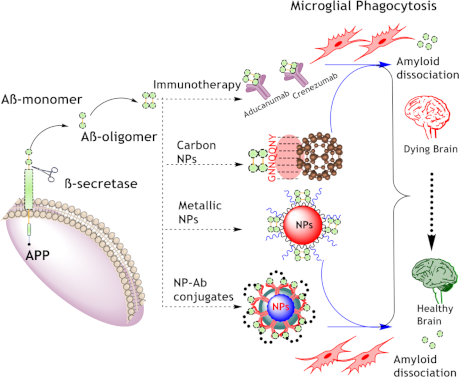
- promising alternative with NPs specifically designed for AD diagnosis and AβO inhibition. These NPs possess unique properties, including variable size and shape and readily modifiable surfaces. These features allow for targeted and effective therapeutic strategies. In this section, we discuss NPs
- MNSs was further modified with oligomer-specific antibodies, creating a stable nanobioconjugate for both in vitro and in vivo applications. The MNSs could detect toxic AβOs present on nerve cell surfaces in vitro, demonstrating their specificity and effectiveness. Additionally, upon intranasal delivery
- physicochemical properties, diverse structural forms, and potential applications in combating NDs. The unique characteristics of CNMs, including their hydrophobic surfaces and variable dimensions, enable them to interact effectively with biomolecules, making them valuable tools in biomedical research and


Performance optimization of a microwave-coupled plasma-based ultralow-energy ECR ion source for silicon nanostructuring
Beilstein J. Nanotechnol. 2025, 16, 484–494, doi:10.3762/bjnano.16.37

- generating ion beams in a microwave-coupled plasma-based ultralow-energy electron cyclotron resonance ion source, generally used for nanostructuring solid surfaces. The investigation focuses on developing, accelerating, and extracting Ar ions from a magnetron-coupled plasma cup utilizing a three-grid ion
- extraction-based ion sources. Plasma physics principles are employed to interpret the observed variations in the beam current with various parameters. The optimized beam current is used to investigate the inert ion-induced nanopatterning of silicon surfaces, at various ion fluences and incidence angles. The
- pre- and post-bombardment changes in optical properties, resulting from nanopatterned surfaces, are investigated using UV–vis reflectivity measurements and correlated with the dimensions of the nanopatterns. This manuscript highlights the potential applications arising from these findings, emphasizing


Impact of adsorbate–substrate interaction on nanostructured thin films growth during low-pressure condensation
Beilstein J. Nanotechnol. 2025, 16, 473–483, doi:10.3762/bjnano.16.36

- neglected (e.g., during deposition of Al atoms on TiN surfaces, the lattice mismatch is about 4%) [40]. From Equation 3, it follows that these interactions do not affect the lateral flux J ∝ ∇U. At the same time, for systems with strong lattice mismatch, strong adatom–substrate bonding makes desorption


Biomimetics and bioinspired surfaces: from nature to theory and applications
Beilstein J. Nanotechnol. 2025, 16, 418–421, doi:10.3762/bjnano.16.32

- ; microstructures; nanostructures; wettability; The surfaces of living organisms are continuously interacting with their surroundings. As a result, they encounter a variety of challenges arising from both external and internal stimuli. Consequently, these surfaces must be multifunctional and adapt to numerous
- environmental pressures. Such pressures involve intricate interactions between surface structures and the environment across different scales, including nano-, micro-, and macroscales. Biomimetics aims at making use of understanding how these adaptations and the particular material properties of these surfaces
- . Bioinspired nanotechnology plays a crucial role by harnessing nanoscale properties and processes to create highly effective surfaces and interfaces at various scales. In May 2023, the Beilstein Nanotechnology Symposium “Functional Micro- and Nanostructured Surfaces: from Biology to Biomimetics” gathered

ReactorAFM/STM – dynamic reactions on surfaces at elevated temperature and atmospheric pressure
Beilstein J. Nanotechnol. 2025, 16, 397–406, doi:10.3762/bjnano.16.30
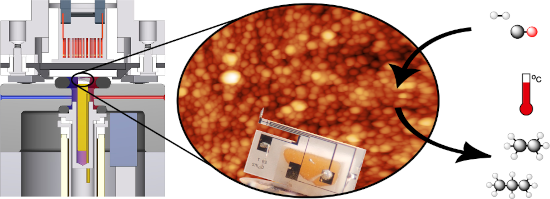
- in counts while between 490 and 550 K. The added ability to scan various surfaces with combined AFM/STM while monitoring the reaction products demonstrates the versatility offered by the ReactorAFM/STM to study catalysts under realistic industrial conditions. Keywords: combined AFM/STM; conductive


Engineered PEG–PCL nanoparticles enable sensitive and selective detection of sodium dodecyl sulfate: a qualitative and quantitative analysis
Beilstein J. Nanotechnol. 2025, 16, 385–396, doi:10.3762/bjnano.16.29
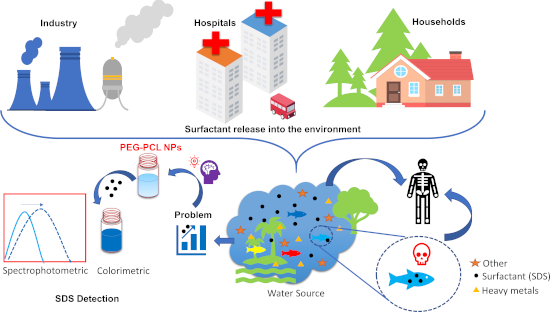
- PEG–PCL NPs have smooth and homogenous surfaces with small pore sizes. The nanoparticles demonstrated high uniformity and were predominantly quasi-spherical in shape, with an average size of 53.7 ± 10 nm. This quasi-spherical morphology is advantageous for many applications, as it provides a high


Development of a mucoadhesive drug delivery system and its interaction with gastric cells
Beilstein J. Nanotechnol. 2025, 16, 371–384, doi:10.3762/bjnano.16.28

- ) nanoparticles, topography, surface composition, size, and charge distribution of the delivery system were determined. The topography of the nanoparticles was studied with SEM (Figure 1). Both Alg and EudAlg nanoparticles are spherical with smooth surfaces (Figure 1A,B). It should be noted that during SEM
- particles is also very important. The zeta potential of Alg nanoparticles is negative (−25.85 ± 7.7 mV), as expected, because of the presence of –COOH and –OH groups in the polymer. This may hinder its interaction with negatively charged surfaces like mucus because of charge repulsion [42]; in contrast


Pulsed laser in liquid grafting of gold nanoparticle–carbon support composites
Beilstein J. Nanotechnol. 2025, 16, 349–361, doi:10.3762/bjnano.16.26
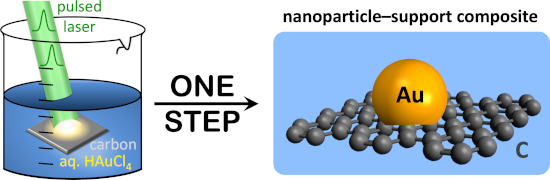
- synthesis–attachment are long preparation times, the generation of hazardous organic solvent and ligand waste [15], and poor electrical contact at the nanoparticle–support interface, particularly for nanoparticles with surfactant-terminated surfaces [16]. Conventionally made nanoparticles rely on
- nanoparticles and supports, lowering electrical contact fidelity and energy efficiency of the composite electrodes. Surfactants alter nanoparticle surfaces, complicating understanding and often lowering catalytic performance by blocking active sites. Surfactants (like binders) partake in electrochemical
- that the carbon support is wettable by water. Making macroscopic carbon surfaces hydrophilic necessitates carbon surface oxygenates that are thermodynamically stable only at graphitic edges spaced closely enough to retain adsorbed water [22]. This precludes glassy carbon and basal-plane highly ordered


Correction: AFM-IR investigation of thin PECVD SiOx films on a polypropylene substrate in the surface-sensitive mode
Beilstein J. Nanotechnol. 2025, 16, 252–253, doi:10.3762/bjnano.16.19
- Hendrik Muller Hartmut Stadler Teresa de los Arcos Adrian Keller Guido Grundmeier Technical and Macromolecular Chemistry, Paderborn University, Warburger Str. 100, 33098 Paderborn, Germany Bruker Nano Surfaces and Metrology Division, Östliche Rheinbrückenstr. 49, 76187 Karlsruhe, Germany 10.3762
Radiosensitizing properties of dual-functionalized carbon nanostructures loaded with temozolomide
Beilstein J. Nanotechnol. 2025, 16, 229–251, doi:10.3762/bjnano.16.18
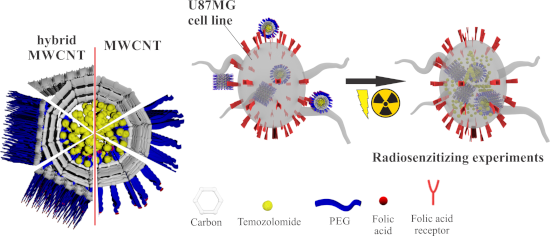
- dual functionalization of MWCNTs (Figure 1a–d) was visible by enlarged tubes/thicker walls and non-uniform surfaces of the tubes. The images of PEGylated and dual-functionalized hybrid MWCNTs-G (Figure 1e–h) showed, in addition to the thicker side walls and rounded ends of the tubes, spherical
- the successful introduction of functional groups on their surfaces, that is, chemical modification of their outer layers [62]. The spectra of covalently functionalized MWCNTs-G with PEG6000 follow this behavior and are also accompanied by a broadening of the G band. The broadening and its intensity
- for the surface charge (−38 vs −33 mV), and the smaller length of the hybrid CN (less than 10 vs 10–30 µm, data from the producers), one can say that the higher fraction of flat surfaces in the hybrid CN, that is, the more intense contact with the cells and the length of the hybrid CN are dominant






Recent advances in photothermal nanomaterials for ophthalmic applications
Beilstein J. Nanotechnol. 2025, 16, 195–215, doi:10.3762/bjnano.16.16
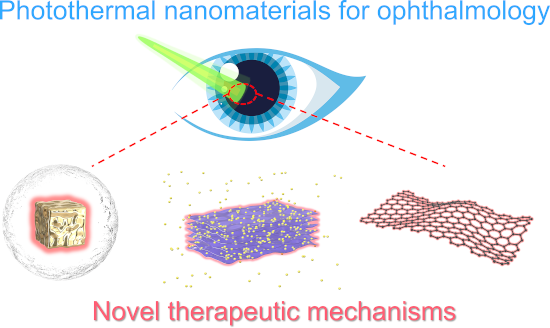
- the dielectric environment present during their synthesis (see below in Figure 2b) [48][49]. Because of the direct occurrence of photothermal conversion on the surfaces of LSPR metals and its rapid nature, combined with the metals’ inherent high thermal conductivity and strong hydrophilicity, LSPR
- , and can be easily removed post-laser treatment. The spatially selective single-cell killing capability of iron oxide PLA bubble films has great potential for ocular tumor therapy. However, clinical treatment of tumors requires the application of films on surfaces with “odd” tissues. Using a


A review of metal-organic frameworks and polymers in mixed matrix membranes for CO2 capture
Beilstein J. Nanotechnol. 2025, 16, 155–186, doi:10.3762/bjnano.16.14
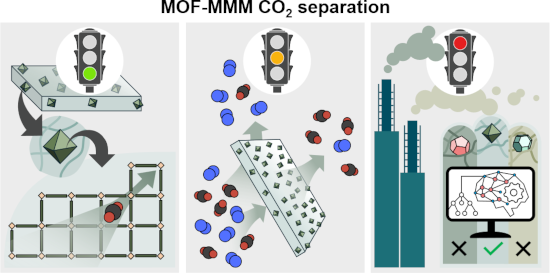
- densities of OMSs on their channel pore surfaces [61], with a volumetric density of accessible metal sites of 7.5–7.7 mmol·cm−3 [62]. The CO2 binding strength and selectivity are influenced by the nature of the metal center, with Mg2+ ions identified as the preferential adsorption site according to density