


Search results
Search for "accelerating voltage" in Full Text gives 170 result(s) in Beilstein Journal of Nanotechnology.
Nematic liquid crystal alignment on subwavelength metal gratings
Beilstein J. Nanotechnol. 2018, 9, 42–47, doi:10.3762/bjnano.9.6
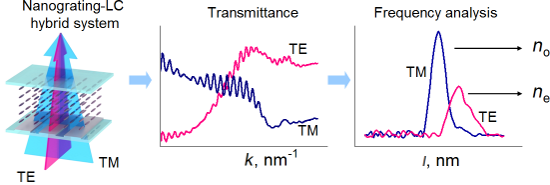
- gratings (Figure 1) are produced by ion-beam milling of the films using an FEI Scios dual beam electron-ion microscope (accelerating voltage 30 kV, ion beam current 0.1–0.3 nA). We have produced a series of gratings on the same substrate in order to be able to observe the influence on LC alignment of such


![[Graphic 3]](/bjnano/content/inline/2190-4286-9-6-i7.svg?max-width=637&scale=1.18182) , the sample axis (rubbing direction) ...
, the sample axis (rubbing direction) ...


Facile synthesis of silver/silver thiocyanate (Ag@AgSCN) plasmonic nanostructures with enhanced photocatalytic performance
Beilstein J. Nanotechnol. 2017, 8, 2781–2789, doi:10.3762/bjnano.8.277
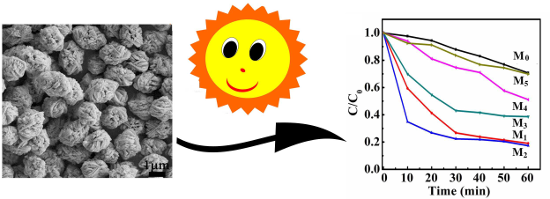
- microscope (FE-SEM, JSM-6700F), a transmission electron microscope (TEM, JEM 100-CXII) with an accelerating voltage of 80 kV, and a high-resolution TEM (HRTEM, GEOL-2010) with an accelerating voltage of 200 kV. Also, powder X-ray diffraction (XRD) patterns were collected on an X-ray diffractometer (Rigaku D


Patterning of supported gold monolayers via chemical lift-off lithography
Beilstein J. Nanotechnol. 2017, 8, 2648–2661, doi:10.3762/bjnano.8.265
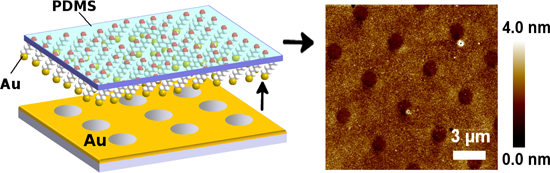
- accelerating voltage, sample height, and vapor pressure were adjusted so that patterns could be discerned. The level of contrast in VP-SEM also depends on the nature of the alkanethiol molecules and SAM disorder (e.g., the orientation and conformation of the molecules in the SAM) [5]. The Au–mercaptoundecanol
- microscopy was performed using a JEOL JSM-6700F scanning electron microscope (JEOL, Inc., Tokyo, Japan) with a 750 V DC detector bias and 5 kV accelerating voltage. Field-emission gun variable pressure electron microscopy of Au on PDMS The scanning electron micrographs of Au–alkanethiolate monolayers on flat
- PDMS were imaged with a low-vacuum detector in a Nova NanoSEM 230 microscope (FEI, Czech Republic) operating at an accelerating voltage of 5 kV. The samples were affixed to the SEM stub and grounded by conductive carbon and copper tape. Variable pressure SEM (VP-SEM) was performed under 50 Pa of water


Localized growth of carbon nanotubes via lithographic fabrication of metallic deposits
Beilstein J. Nanotechnol. 2017, 8, 2592–2605, doi:10.3762/bjnano.8.260
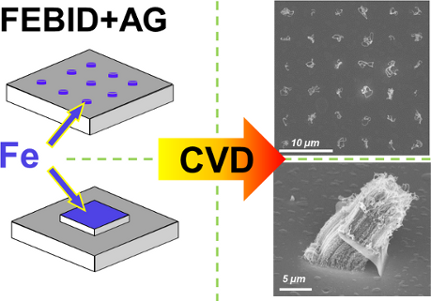
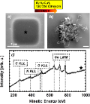
- accelerating voltage in keV and ρ is the density of the detected sample. Considering the thickness of Fe nanostructure is approximately ≈30 nm, one can expect ≈1.6% Fe signal, which is below the detection limit of the method [45]. In additional experiments on other samples, the fabrication of CNT forests and
- S-4700 Type II cold field emission SEM instrument operated at 10–15 kV accelerating voltage with an integrated Röntec QX2 EDX detector. (a) Scheme of the electron beam induced deposition (EBID) process with Fe(CO)5 as precursor molecule, producing a point matrix of Fe deposits. (b) SEM micrograph of




Synthesis of metal-fluoride nanoparticles supported on thermally reduced graphite oxide
Beilstein J. Nanotechnol. 2017, 8, 2474–2483, doi:10.3762/bjnano.8.247
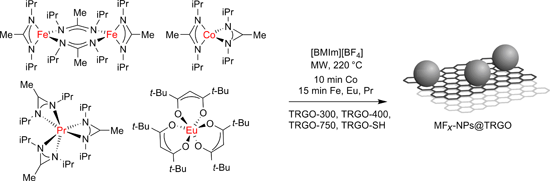
- reference material causing lattice contraction or expansion and strain [97][98][99][100][101]. The HR-TEM imaging was performed on a FEI Tecnai G2 F20 electron microscopy operated at 200kV accelerating voltage [102]. Digital images were recorded by a Gatan UltraScan 1000P detector. Samples were prepared
- irradiated for 10 min (Co) or 15 min (Fe, Pr, Eu) at a power of 50 W to a temperature of 220 °C. Examples of selected area electron diffraction (SAED) patterns (Figures S4 and S6 in Supporting Information File 1) have been recorded with an FEI Titan 80-300 TEM [103], operated at 300 kV accelerating voltage


Strategy to discover full-length amyloid-beta peptide ligands using high-efficiency microarray technology
Beilstein J. Nanotechnol. 2017, 8, 2446–2453, doi:10.3762/bjnano.8.243
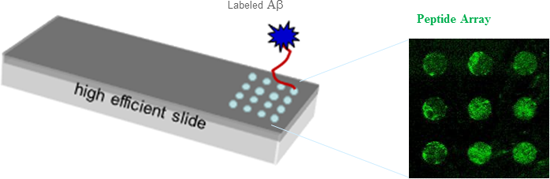
- operating at 200 kV accelerating voltage. Preparation of peptide microarray KLVFF and Semax peptides were dissolved in phosphate buffer at a concentration of 1 mg/mL and aliquots were stored at −80 °C until use. Cy3-Aβ40 conjugate was dissolved in a saline phosphate buffer containing 10 vol % of DMSO (0.01


A comparative study of the nanoscale and macroscale tribological attributes of alumina and stainless steel surfaces immersed in aqueous suspensions of positively or negatively charged nanodiamonds
Beilstein J. Nanotechnol. 2017, 8, 2045–2059, doi:10.3762/bjnano.8.205
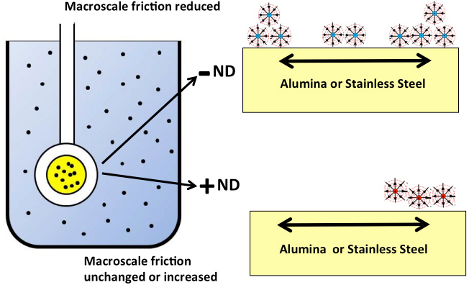
- typical settings of an accelerating voltage and a bias of 2.00 kV and 200 V, respectively. Quartz crystal microbalance apparatus QCM data were collected using a QCM100 (Stanford Research Systems, Sunnyvale, CA, USA) system. The system includes a controller, oscillator electronics and a Teflon holder and a


Systematic control of α-Fe2O3 crystal growth direction for improved electrochemical performance of lithium-ion battery anodes
Beilstein J. Nanotechnol. 2017, 8, 2032–2044, doi:10.3762/bjnano.8.204
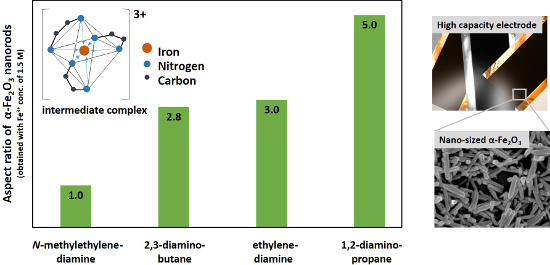
- samples was analyzed using a JEOL 6340F field emission scanning electron microscope (FESEM) in secondary electron imaging mode. The accelerating voltage was set to 5 kV. The electrodes were prepared by mixing 40% of as-synthesized active iron oxide powder with 40% of conductive additives (Super P Li


Fabrication of carbon nanospheres by the pyrolysis of polyacrylonitrile–poly(methyl methacrylate) core–shell composite nanoparticles
Beilstein J. Nanotechnol. 2017, 8, 1897–1908, doi:10.3762/bjnano.8.190

- aqueous solution. TEM observations were performed on a Philips CM 120 electron microscope at an accelerating voltage of 80 kV. The sample for FESEM observation was prepared by placing a drop of properly diluted nanoparticle dispersion on a clean glass sheet, and was allowed to dry in the air. FESEM


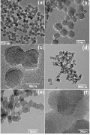

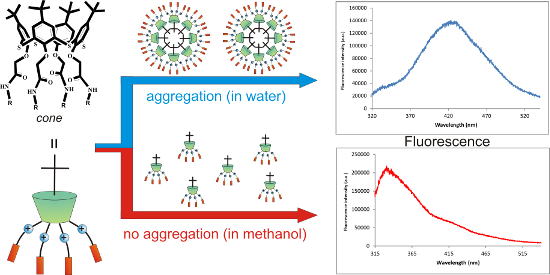
Self-assembly of chiral fluorescent nanoparticles based on water-soluble L-tryptophan derivatives of p-tert-butylthiacalix[4]arene
Beilstein J. Nanotechnol. 2017, 8, 1825–1835, doi:10.3762/bjnano.8.184
- in a transmission electron microscope. The analysis was performed at an accelerating voltage of 100 kV in TEM mode. Determination of particle diameter by SEM Additional measurements of the particle diameter were carried out by using a field-emission high-resolution scanning electron microscope (SEM
- ) by Merlin Carl Zeiss. Observations of the morphology of the surface were made by applying an accelerating voltage of incident electrons at 5 kV and a current probe at 300 pA in order to minimize modifications to sample. The sample preparation was as follows: samples of compounds 8–11 (1 × 10⁻⁴ М


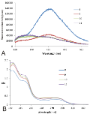

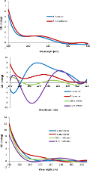
Methionine-mediated synthesis of magnetic nanoparticles and functionalization with gold quantum dots for theranostic applications
Beilstein J. Nanotechnol. 2017, 8, 1734–1741, doi:10.3762/bjnano.8.174
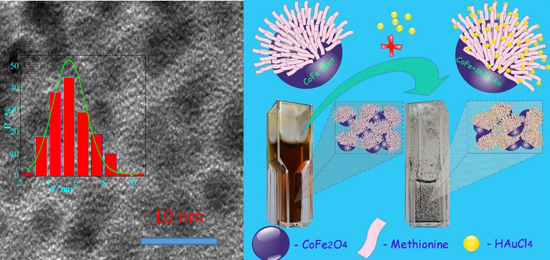
- products was investigated using a transmission electron microscope (TEM, model MORGAGNI 268) operated at an accelerating voltage of 72 keV. The average size of nanoparticles was estimated from at least 150 species observed in the TEM images. High-resolution transmission electron microscopy (HRTEM) studies
- of as-synthesized products were performed using a LIBRA 200 FE at an accelerating voltage of 200 keV. X-ray powder diffraction experiments were performed on a D8 diffractometer (Bruker AXS, Germany), equipped with a Göbel mirror as a primary beam monochromator for Cu Kα radiation. Upgraded vacuum


Near-infrared-responsive, superparamagnetic Au@Co nanochains
Beilstein J. Nanotechnol. 2017, 8, 1680–1687, doi:10.3762/bjnano.8.168
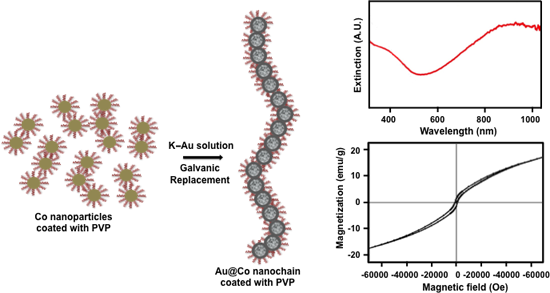
- (FE-SEM) and TEM. FE-SEM measurements were carried out using a JEOL JSM 6330F instrument operating at an accelerating voltage of 15 kV. TEM measurements were carried out using a JEOL JEM-2000 FX electron microscope operating at an accelerating voltage of 200 kV. The samples were prepared by placing


Fixation mechanisms of nanoparticles on substrates by electron beam irradiation
Beilstein J. Nanotechnol. 2017, 8, 1523–1529, doi:10.3762/bjnano.8.153
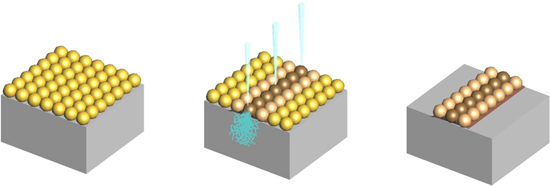
- . To understand this widening mechanisms, the effects of accelerating voltage, particle size and substrate material are investigated by means of both experiments and simulation. It is demonstrated that the fixing area is greatly affected by the electrons back-scattered by the substrate. The back
- -scattering leads to an increase in line width and thus reduces the resolution of this patterning technique. Keywords: accelerating voltage; electron beam; gold; Monte Carlo simulation; nanoparticle array; Introduction Techniques to fabricate assemblies or arrays of nanostructures on a desired area have
- the particle and the substrate fixes the particles. However, in this original technique, the area of fixed gold nanoparticles was wider than the electron-probe size of a few nanometers [8]. To understand the mechanisms of this widening, the effects of accelerating voltage, particle size and substrate


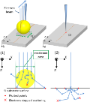
Fabrication of hierarchically porous TiO2 nanofibers by microemulsion electrospinning and their application as anode material for lithium-ion batteries
Beilstein J. Nanotechnol. 2017, 8, 1297–1306, doi:10.3762/bjnano.8.131
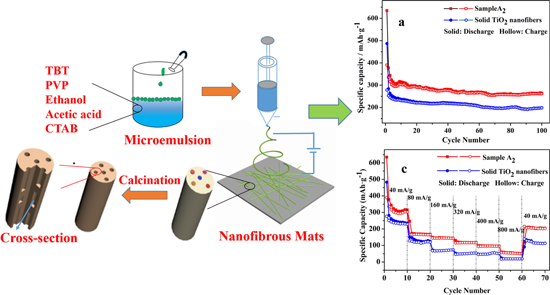
- . Prior to the FE-SEM examination, all the specimens were sputter-coated with gold to avoid charge accumulations. Transmission electron microscopy was conducted on a JEOL JEM-2100 transmission electron microscopy unit at an accelerating voltage of 120 kV. The specific surface area and pore structure of




Growth, structure and stability of sputter-deposited MoS2 thin films
Beilstein J. Nanotechnol. 2017, 8, 1115–1126, doi:10.3762/bjnano.8.113
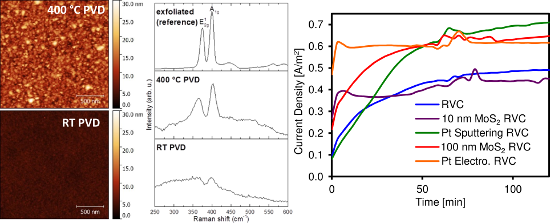
- ) preparation and transmission electron microscopy (TEM) Secondary electron images were collected using an Everhart–Thornley-detector mounted on a FEI Quanta 3D FEG applying electron beam settings of 15 kV accelerating voltage. In the same system cross-sectional electron transparent foils of the MoS2 films on
- the SiO2/Si support were fabricated using focussed ion beam (FIB) sputtering at IB settings of 30 kV accelerating voltage and successively decreasing IB currents from 65 nA to 50 pA. The 90–120 nm thick sample foils were subsequently checked for film thickness accuracy determination in a Philips CM200


3D Nanoprinting via laser-assisted electron beam induced deposition: growth kinetics, enhanced purity, and electrical resistivity
Beilstein J. Nanotechnol. 2017, 8, 801–812, doi:10.3762/bjnano.8.83
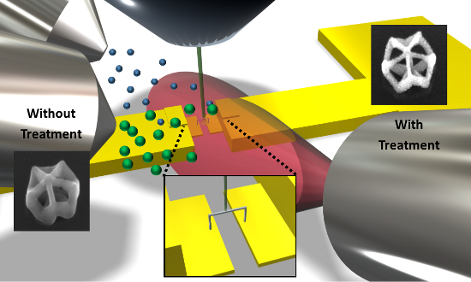
- spectroscopy (EELS) were performed using a Nion UltraSTEM 100 which is equipped with aberration correction of the probe forming lens. Beam-induced damage and contamination were minimized by using an accelerating voltage of 60 kV and a 40 pA beam current. High angle annular dark field (HAADF) and bright field


Tailoring bifunctional hybrid organic–inorganic nanoadsorbents by the choice of functional layer composition probed by adsorption of Cu2+ ions
Beilstein J. Nanotechnol. 2017, 8, 334–347, doi:10.3762/bjnano.8.36
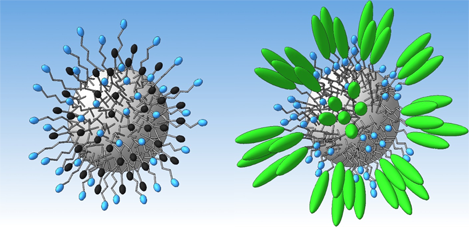
- reduction tube at 850 °C. Sulfanilamide C6H8N2O2S was used as CHNS standard. For SEM studies with a JSM-6060LA analytical scanning electron microscope (Jeol, Tokyo, Japan) using secondary electrons at an accelerating voltage of 30 kV, the samples were fixed on the objective tables. To prevent the


Nanoscale isoindigo-carriers: self-assembly and tunable properties
Beilstein J. Nanotechnol. 2017, 8, 313–324, doi:10.3762/bjnano.8.34
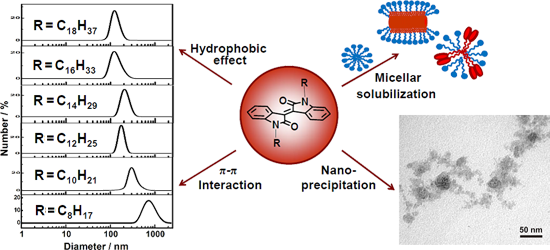
- ) Transmission electron microscopy (TEM) images were obtained using a microscope Hitachi HT7700, Japan. The images were acquired at an accelerating voltage of 110 kV. Samples were dispersed on 300 mesh copper grids with continuous carbon-formvar support films. In vitro stability of SIPs The SIP sample (5 mL) was



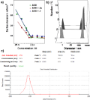

Obtaining and doping of InAs-QD/GaAs(001) nanostructures by ion beam sputtering
Beilstein J. Nanotechnol. 2017, 8, 12–20, doi:10.3762/bjnano.8.2
- vacuum chamber at a temperature of 560–580 °C allowed us to get rid of a protective oxide layer and the impurities accumulated in it. The accelerating voltage determining the ion energy varied in the range from 100 to 500 V. The energy dependence of the sputtering yields was measured with a step of 50 eV


From iron coordination compounds to metal oxide nanoparticles
Beilstein J. Nanotechnol. 2016, 7, 2074–2087, doi:10.3762/bjnano.7.198
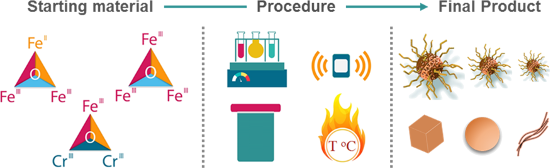
- using the STAR software from Mettler Toledo. The transmission electron microscopy (TEM) images were taken using a dedicated HITACHI HT7700 microscope operating in high contrast mode at 100 kV accelerating voltage. The samples were prepared by placing small droplets of the diluted dispersion (≈1 g/L) of


Effect of nanostructured carbon coatings on the electrochemical performance of Li1.4Ni0.5Mn0.5O2+x-based cathode materials
Beilstein J. Nanotechnol. 2016, 7, 1960–1970, doi:10.3762/bjnano.7.187
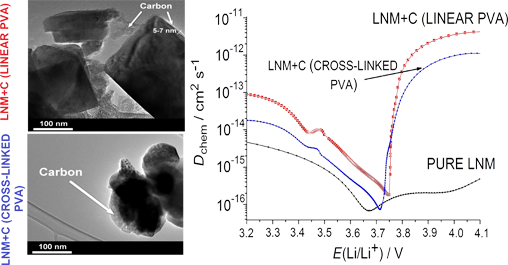
- 200 MC, Carl Zeiss) at an accelerating voltage of 200 kV and a magnification of 30,000–300,000×. The X-ray photoelectron spectra were acquired with a Kratos Ultra DLD spectrometer using a monochromatic Al Kα X-ray source that possesses an analysis area of 300 μm × 700 μm. The spectra were recorded in



Ferromagnetic behaviour of ZnO: the role of grain boundaries
Beilstein J. Nanotechnol. 2016, 7, 1936–1947, doi:10.3762/bjnano.7.185
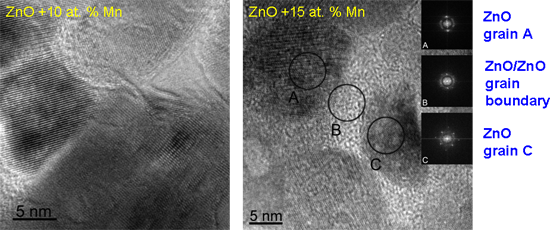
- -probe X-ray microanalysis with a Tescan Vega TS5130 MM scanning electron microscope (SEM) equipped by energy dispersive X-ray spectrometer (Oxford Instruments). TEM studies were performed using JEM-4000FX microscope at an accelerating voltage of 400 kV. X-ray diffraction (XRD) was studied using a


Sb2S3 grown by ultrasonic spray pyrolysis and its application in a hybrid solar cell
Beilstein J. Nanotechnol. 2016, 7, 1662–1673, doi:10.3762/bjnano.7.158
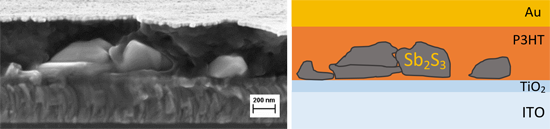
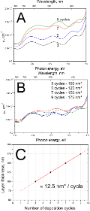
- accelerating voltage of 10 kV. The same SEM system was used for visualization of the morphology of the layers and of the cross-section of the solar cells at an electron beam accelerating voltage of 4 kV. Current–voltage scans of the solar cells were used to obtain the principal characteristics of the solar




Effect of triple junctions on deformation twinning in a nanostructured Cu–Zn alloy: A statistical study using transmission Kikuchi diffraction
Beilstein J. Nanotechnol. 2016, 7, 1501–1506, doi:10.3762/bjnano.7.143
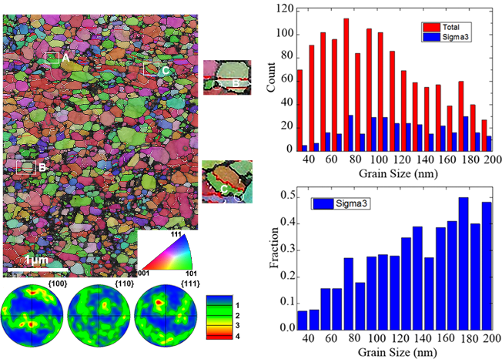
- /C2H5OH/H2O. TKD characterization was conducted in a Zeiss Auriga SEM operating with a 30 kV accelerating voltage. The measurement step size was set to 6 nm for the microscopic observation, taken into consideration the heavily deformed state and other factors. All misindexed points and unindexed pixels in


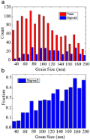
Dielectrophoresis of gold nanoparticles conjugated to DNA origami structures
Beilstein J. Nanotechnol. 2016, 7, 948–956, doi:10.3762/bjnano.7.87
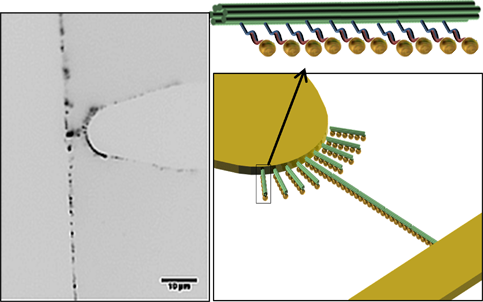
- DNA origami. Transmission electron microscopy TEM images of the DNA structures were taken with a Zeiss Libra 200MC operated at an accelerating voltage of 200 kV and performed on copper/formvar/carbon grids (400 mesh, 3.05 mm diameter, Plano GmbH). Before deposition, the grids were glow discharged for





