


Search results
Search for "damping" in Full Text gives 196 result(s) in Beilstein Journal of Nanotechnology.
Dynamic of cold-atom tips in anharmonic potentials
Beilstein J. Nanotechnol. 2016, 7, 1543–1555, doi:10.3762/bjnano.7.148
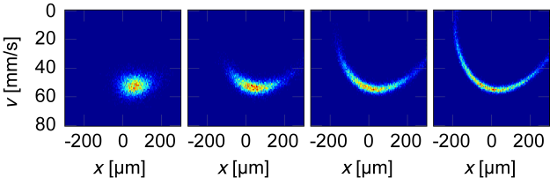
- distribution, the dephasing will thus lead to a broadening of the distribution function, a decrease of the peak density and a damping of the center-of-mass oscillation. Finally, the atoms will be spread over the whole oscillation region, with no center-of-mass oscillation remaining. The density distribution
- are identical as before, while the anharmonic trap has been extended in the transversal direction by a harmonic confinement with frequency ωy/z = 2π × 500 Hz. For comparison, Figure 3 includes the result for noninteracting particles, showing a reduced damping. Following Equation 12, the damping time
- harmonic results (black line) are shown. The oscillation of the tip and the damping due to dephasing are clearly visible in the anharmonic data. As expected, the damping is strongest for the data including particle collisions. Experiments Our experimental setup is based on a cold-atom apparatus, the same




Localized surface plasmons in structures with linear Au nanoantennas on a SiO2/Si surface
Beilstein J. Nanotechnol. 2016, 7, 1519–1526, doi:10.3762/bjnano.7.145
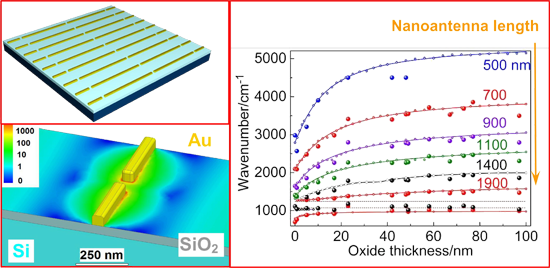
- frequency, and νp ≈ 72500 cm−1 and νc ≈ 216 cm−1 are the linear plasma frequency and the damping frequency, respectively [39]. In the simulations, the width b and the height t of the nanoantennas were assumed to be 50 nm with an the axial gap of a = 100 nm (see Figure 5a) as it was imposed by our


Electric field induced structural colour tuning of a silver/titanium dioxide nanoparticle one-dimensional photonic crystal
Beilstein J. Nanotechnol. 2016, 7, 1404–1410, doi:10.3762/bjnano.7.131
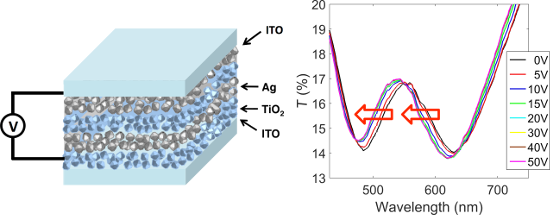
- initial carrier density (N), such that NE > N. The Drude model can be used to predict the behaviour of the plasmonic response in the photonic crystal [19]. The frequency-dependent complex dielectric function of silver can be written as where and with Γ representing the free carrier damping [20]. The
- surrounding, however, also largely influences the position of the plasmon resonance [29]. In addition, doping occurs only in a thin layer at the nanoparticle surface. These two effects also ultimately impact on the carrier damping, which in our estimation was kept constant. Studies on the accumulation of
- charges in an ITO film by applying a constant voltage demonstrated that besides an increase in carrier density, other Drude parameters such as the damping constant and the high frequency dielectric constant are altered through the introduction of additional carriers [30]. Thus, a deeper study of the




Functional diversity of resilin in Arthropoda
Beilstein J. Nanotechnol. 2016, 7, 1241–1259, doi:10.3762/bjnano.7.115
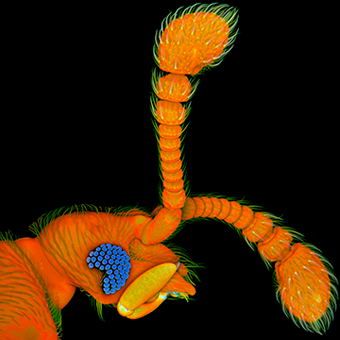
- resilin due to its low stiffness, high resilience, large and reversible extensibility, long fatigue time and ability of elastic energy storage and damping. One of these flight system elements is a sausage-like swollen thoracic dragonfly tendon, which consists of virtually pure resilin and connects the
- stiffness and to improve the damping properties of the vein as well as to delay Brazier ovalisation and to enhance the load-bearing capacity under large deformations [79][88]. By artificially stiffening single flexible, resilin-bearing vein joints in bumblebee wings through the application of micro-splints
- the resistance of the teeth to mechanical damages. Additional structures with large resilin proportions, located in the central and proximal parts of the gnathobases, are assumed to have a damping function that makes the whole gnathobases resilient and further reduces the risk of mechanical damage of


Reasons and remedies for the agglomeration of multilayered graphene and carbon nanotubes in polymers
Beilstein J. Nanotechnol. 2016, 7, 1174–1196, doi:10.3762/bjnano.7.109
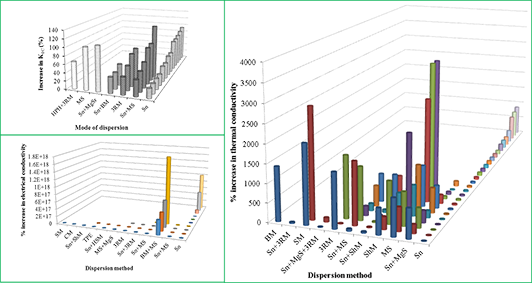
- in 1994 by Ajayan et al. [140]. Tomohiro et al. modified carbon-fiber reinforced epoxy composite with length-controlled cup-stacked CNTs and determined the mechanical properties [141]. Auad et al. produced SWNT–epoxy elastomers and showed that the nanocomposites had superior damping capacity in an
- [132]. The z-axis properties of laminated nanocomposites can also be improved by CNTs through direct reinforcement of the polymer matrix, toughening effect and fiber bridging [142]. The influence of MLG and CNTs on the mechanical, thermal, electrical, and damping properties is discussed in the


Manufacturing and investigation of physical properties of polyacrylonitrile nanofibre composites with SiO2, TiO2 and Bi2O3 nanoparticles
Beilstein J. Nanotechnol. 2016, 7, 1141–1155, doi:10.3762/bjnano.7.106
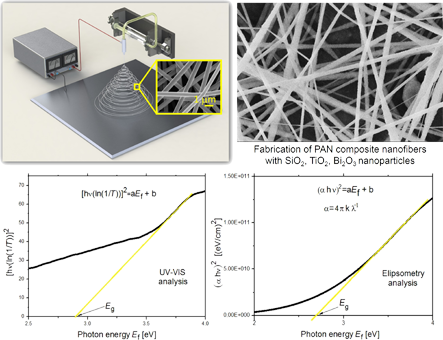
- following form [38]: where n is the concentration of the atoms in the sample, e and m are charge and mass of the electron, ε0 is the electrical transmittance of vacuum, γ is the damping coefficient, ω0 and ω are, respectively, the frequency of the electron and the electromagnetic radiation. The above



Multiwalled carbon nanotube hybrids as MRI contrast agents
Beilstein J. Nanotechnol. 2016, 7, 1086–1103, doi:10.3762/bjnano.7.102
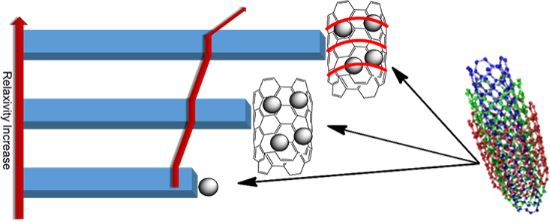
- elimination of the radiation damping problem, have all been adapted by spectroscopists and thus have only a marginal effect on the results [60]. Relaxation acceleration is observed along with increasing temperature within the room–body temperature range [61]. However, the temperature decreases the viscosity



Advanced atomic force microscopy techniques III
Beilstein J. Nanotechnol. 2016, 7, 1052–1054, doi:10.3762/bjnano.7.98

- Eva Roblegg and co-workers [20]. The local elastic stiffness and damping of individual phases in a titanium alloys was measured by using atomic force acoustic microscopy (AFAM) and mapping of contact-resonance spectra [21]. Another alloy, namely a Pt containing metallic glass, was characterized by AFM
Signal enhancement in cantilever magnetometry based on a co-resonantly coupled sensor
Beilstein J. Nanotechnol. 2016, 7, 1033–1043, doi:10.3762/bjnano.7.96
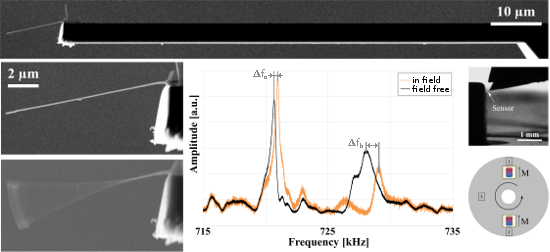
- oscillator model for both subsystems of our sensor approach, the simple model of a coupled harmonic oscillating system is derived as depicted in Figure 1. It consists of a spring, a mass and a damping element for each subsystem. Furthermore, there are an additional spring k3 and a damping element d3
- = k1,2/(2πf1,2)2. Equation 5 neglects any damping effects but this is a justified approximation since all our measurements are carried out under high vacuum, limiting damping to intrinsic effects due to the bending of the oscillating structures [9]. This was futhermore confirmed by comparison between the
- oscillators, each represented by a mass (m1, m2), a sping (k1, k2) and a damping element (d1, d2). The system is excited to oscillations by a periodic force with the driving angular frequency ωD = 2πfD applied to the first subsystem. Interactions between the system and external influences are modeled by an


![[Graphic 11]](/bjnano/content/inline/2190-4286-7-96-i21.png?max-width=637&scale=1.18182) on the interaction spring constant k3. Th...
on the interaction spring constant k3. Th...
Generalized Hertz model for bimodal nanomechanical mapping
Beilstein J. Nanotechnol. 2016, 7, 970–982, doi:10.3762/bjnano.7.89
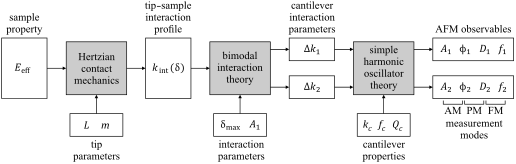
- , oscillation amplitude and drive amplitude. This section derives a general equation that makes no assumption about which of these variables is held fixed upon interaction with the sample. The response of a freely vibrating cantilever with effective stiffness kc, mass mc, and damping bc can be described by the
- imaginary components of both equations and solving for the driving force: In the presence of some interaction, the cantilever impedance is subject to a time-averaged change in stiffness Δk and a time-averaged change in damping Δb, such that the interaction impedance The interaction impedance is inferred


![[Graphic 4]](/bjnano/content/inline/2190-4286-7-89-i40.png?max-width=637&scale=1.18182) approximation applied to Equation 6 i...
approximation applied to Equation 6 i...


High-resolution noncontact AFM and Kelvin probe force microscopy investigations of self-assembled photovoltaic donor–acceptor dyads
Beilstein J. Nanotechnol. 2016, 7, 799–808, doi:10.3762/bjnano.7.71
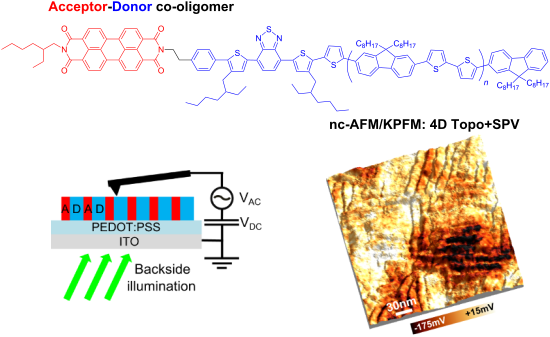
- lamellae consisting of edge-on co-oligomers (Figure 2 and Figure 5d). We note that the higher level of damping recorded over the standing domains may be reasonably attributed to the influence of the lateral alkyl side groups, which point out of the surface in the case of the edge-on oligomers (see Figure 2
- , the similarity between the damping and TEM images is remarkable when comparing Figure 4c and Figure 4d. Actually, XRD and TEM investigations [19][21] have shown that these other domains consist of flat-on lamellae (see Figure 2) and that their proportion in the film is inversely proportional to the
- length of the donor blocks. This last result is consistent with the surface morphology probed by nc-AFM (compare Figure S1a and Figure S1b in Supporting Information File 1). In the case of the longer AD3 dyad, a statistical analysis performed on large-scale damping images (by using the “flooding” tool of


Magnetic switching of nanoscale antidot lattices
Beilstein J. Nanotechnol. 2016, 7, 733–750, doi:10.3762/bjnano.7.65
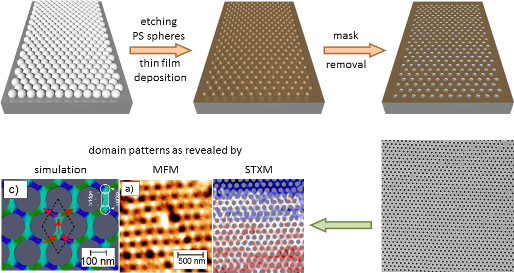
- anisotropy and the exchange stiffness at 0 K for the particular material. A realistic value for the micromagnetic damping constant is in the range of 0.1 [36][37]. In case one is not interested in the dynamics but only in the equilibrium state of the system, the damping can be increased to 1. Magnetic



Coupled molecular and cantilever dynamics model for frequency-modulated atomic force microscopy
Beilstein J. Nanotechnol. 2016, 7, 708–720, doi:10.3762/bjnano.7.63
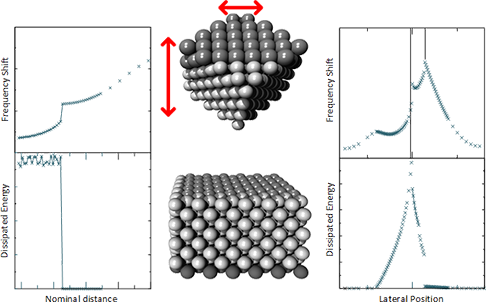
- cantilever. It gives new insight into the correlation between the experimentally monitored frequency shift and cantilever damping due to the interaction between tip atoms and scanned surface. Applying the model to ionic crystals with rock salt structure two damping mechanisms are investigated, which occur
- . When the long range ionic interaction is switched off, the two damping mechanisms occur with a completely different pattern, which is explained by the energy landscape for the apex atom of the tip. In this case the adhesion hysteresis is always associated with a distinct lateral displacement of the tip
- . It is shown how this may lead to a systematic shift between the periodic patterns obtained from the frequency and from the damping signal, respectively. Keywords: atomic force microscopy; frequency-modulated atomic force microscopy (FM-AFM); energy dissipation; Introduction The physical background


Finite-size effect on the dynamic and sensing performances of graphene resonators: the role of edge stress
Beilstein J. Nanotechnol. 2016, 7, 685–696, doi:10.3762/bjnano.7.61
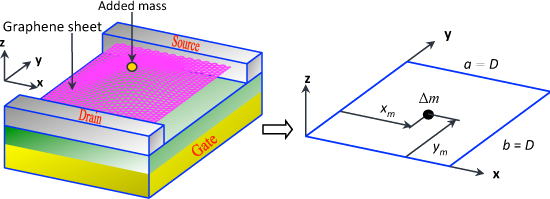
- affect the Q-factor of a graphene resonator. In order to understand the effect of edge stress on the Q-factor of a graphene resonator [29], the theoretical model described in this work has to be modified by including the intrinsic damping factors such as clamping or support loss [47][48][49] and
- thermoelastic damping loss [50], which will be considered in our future work. In conclusion, our work sheds light on the influence of edge stress on the resonant frequency and sensing performance of a graphene resonator, which allows for an insight into design rules for the effective development of graphene


Active multi-point microrheology of cytoskeletal networks
Beilstein J. Nanotechnol. 2016, 7, 484–491, doi:10.3762/bjnano.7.42

- [5][6][7]. By exciting a particle with an oscillating force, the shear modulus at a specific frequency can be determined by measuring the response of the particle. The motion of the particle also includes information about the damping and the viscosity of the surrounding medium. This method is known


Charge and heat transport in soft nanosystems in the presence of time-dependent perturbations
Beilstein J. Nanotechnol. 2016, 7, 439–464, doi:10.3762/bjnano.7.39
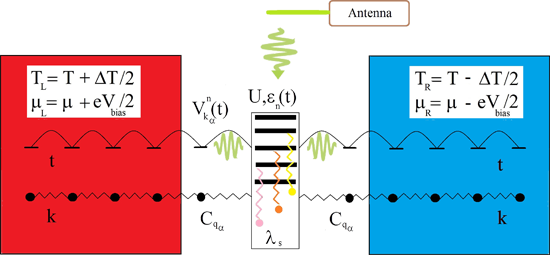
- -dependent memory-friction kernel of the oscillator [80]. In the regime for all the modes, can be approximated as real and independent of frequency, providing the damping rate . [80] If not specified, we consider the symmetric configuration: γL = γR = γ/2. In this review, we assume that the electronic and
- always gets larger with increasing the electron–vibration coupling EP. Actually, the electron–oscillator coupling gives rise to an additional damping rate on the vibrational dynamics whose effect is to enhance the thermal conductivity . In a certain sense, due to the electron–vibration coupling, the






Length-extension resonator as a force sensor for high-resolution frequency-modulation atomic force microscopy in air
Beilstein J. Nanotechnol. 2016, 7, 432–438, doi:10.3762/bjnano.7.38
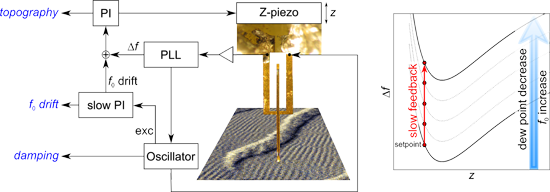
- of frequency shift, excitation and dew point [22] over time while the sensor is retracted from the surface and Z-feedback is disabled. Frequency shift and damping correlate with environmental conditions. The resonance frequency decreases whereas the damping increases when the dew point rises. Reasons
- a long time constant (τ ≈ (1 min)), which still allows us to determine damping properties of the sample with the much faster regular amplitude-controller (τ ≈ 5 ms). The slow controller applies an offset to the Δf-signal in order to maintain the excitation setpoint and thus compensates for slow


High-bandwidth multimode self-sensing in bimodal atomic force microscopy
Beilstein J. Nanotechnol. 2016, 7, 284–295, doi:10.3762/bjnano.7.26
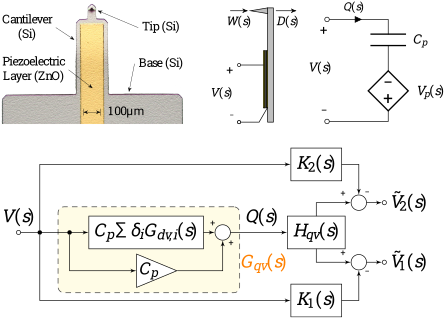
- into account varying cross-sections but system identification based on parameter optimization must be employed to reduce modeling errors [26]. In order to arrive at a system-based model and to use frequency domain system identification, a damping term is added to Equation 13 and taking the Laplace


Determination of Young’s modulus of Sb2S3 nanowires by in situ resonance and bending methods
Beilstein J. Nanotechnol. 2016, 7, 278–283, doi:10.3762/bjnano.7.25
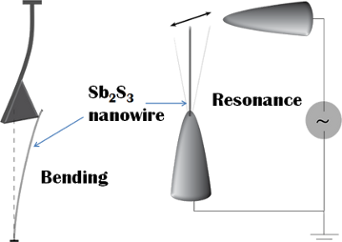
- –frequency curve is plotted for a typical single-clamped Sb2S3 NW with Q = 418. Damping ratios in resonance experiments for all NWs were in the range of 0.001–0.003, hence their contribution to the observed resonance frequencies and consequently calculated Young’s modulus values was negligible. The resonance


Current-induced runaway vibrations in dehydrogenated graphene nanoribbons
Beilstein J. Nanotechnol. 2016, 7, 68–74, doi:10.3762/bjnano.7.8
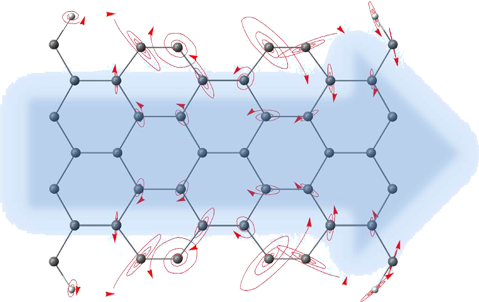
- circular “water-wheel” motion, either in real space [10] or in mode space. Another requirement is that these modes have little damping due to the coupling to the phonon reservoir. Unfortunately, there has not been a clear experimental setup where these new theoretical findings can be put to a test proving
- negative the mode is damped. The damping can be quantified by the inverse Q-factor giving the change in energy per period Thus, the run-away modes can be identified as the modes where Im(ω) > 0. The run-away modes are a linear combination of the non-perturbed normal modes. Normally, the runaway makes
- closed loops in real or in abstract mode space. Thus, the NC force allows the mode to pick up energy every time a loop is completed, eventually leading to break down of the harmonic approximation, ending with, e.g., rupture or damping by anharmonic effects leading to a limit cycle motion [24]. Numerical
Large area scanning probe microscope in ultra-high vacuum demonstrated for electrostatic force measurements on high-voltage devices
Beilstein J. Nanotechnol. 2015, 6, 2485–2497, doi:10.3762/bjnano.6.258
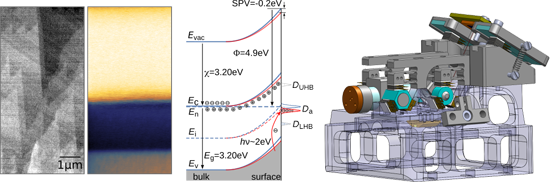
- damping of the sensor. Furthermore, UHV environment allows for the analysis of clean surfaces under controlled environmental conditions. Because of these requirements we built a large area scanning probe microscope operating under UHV conditions at room temperature allowing to perform various electrical
- under UHV condition has the advantage of a high quality factor (Q ≈ 30,000) due to the suppression of viscous damping and therefore increases the force sensitivity by orders of magnitude [27][28]. To analyse complex and large micro-structures a large positioning and scanning unit is necessary, under
- range of 20 mm in vertical direction, used for coarsely approaching the sample to the cantilever tip. All piezo elements are driven with a custom designed controller generating saw tooth voltages with amplitudes ranging from 0 to 400 V and frequencies up to 1 kHz. Damping system Figure 4 shows the CAD


Evidence for non-conservative current-induced forces in the breaking of Au and Pt atomic chains
Beilstein J. Nanotechnol. 2015, 6, 2338–2344, doi:10.3762/bjnano.6.241
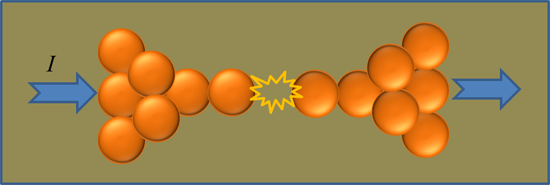
- ). They observe that a pair of nearly-degenerate vibration modes becomes coupled by the action of the current-induced forces, leading to negative damping of the atomic motion. In other words, the amplitude of the motion keeps increasing as a result of the energy that is pumped into the motion by the non


Kelvin probe force microscopy for local characterisation of active nanoelectronic devices
Beilstein J. Nanotechnol. 2015, 6, 2193–2206, doi:10.3762/bjnano.6.225
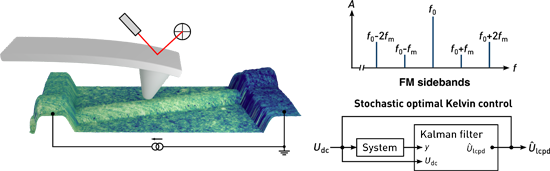
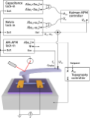
- topography of the sample. To maintain best feedback settings at every location during a scan, we introduce a novel controller for FM-KFM based on stochastic optimal control [37]. Optimal control and model-based controllers have been successfully used before in AFM, e.g., for active damping of cantilevers [38


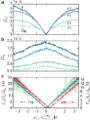
![[Graphic 33]](/bjnano/content/inline/2190-4286-6-225-i48.png?max-width=637&scale=1.18182) for different modulation amplitu...
for different modulation amplitu...




An adapted Coffey model for studying susceptibility losses in interacting magnetic nanoparticles
Beilstein J. Nanotechnol. 2015, 6, 2173–2182, doi:10.3762/bjnano.6.223
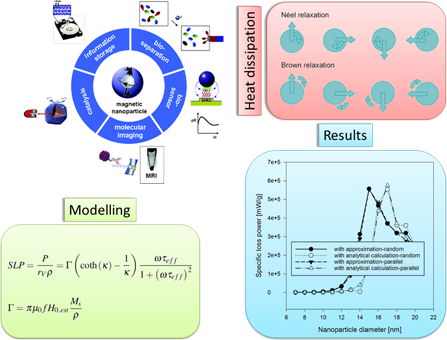
- calculation and experimental results [21]. This calculation shows the dependence of the relaxation time on the magnetic damping constant α. For the case of most ferromagnetic and ferrimagnetic nanoparticle systems, the magnetic damping constant α exhibits low values (α << 1) [22]. In this section, we adapt
- the Coffey analytical model according to Equations 9–11. Under these conditions, the time relaxation relation, in case of an oblique magnetic field, is [12]: With being the free diffusion magnetization time at low damping constants (α << 1) [12]: In Equation 21γ is the gyromagnetic ratio. If ψi is


Thermoelectricity in molecular junctions with harmonic and anharmonic modes
Beilstein J. Nanotechnol. 2015, 6, 2129–2139, doi:10.3762/bjnano.6.218
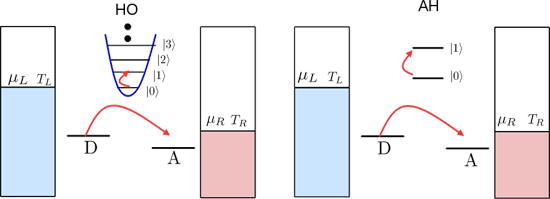
- done rigorously at the level of the quantum master equations and within the NEGF technique [7][43] to yield the rates with and a damping term Γph(ω0). Interestingly, we confirmed (not shown) that this additional energy relaxation process does not modify the thermoelectric efficiency displayed in





