


Search results
Search for "elasticity" in Full Text gives 137 result(s) in Beilstein Journal of Nanotechnology.
The capillary adhesion technique: a versatile method for determining the liquid adhesion force and sample stiffness
Beilstein J. Nanotechnol. 2015, 6, 11–18, doi:10.3762/bjnano.6.2
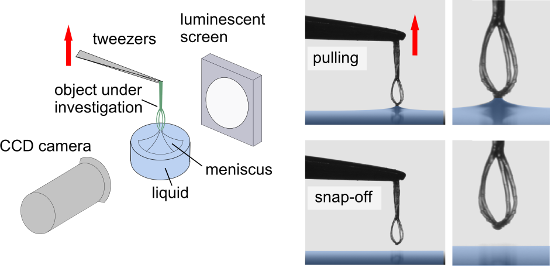
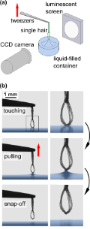
- ) determination of the water adhesion force and the elasticity of individual hairs (trichomes) of the floating fern Salvinia molesta. (2) The investigation of human head hairs both with and without functional surface coatings (a topic of high relevance in the field of hair cosmetics) was performed. The method
- ], it is interesting to study the properties of the hairs of Salvinia molesta as a model for future developments. The key factors are the high water adhesion of the trichome tips (the “Salvinia effect”, [1]) and the high elasticity of the trichomes [2][3], which allows the pinning of the air–water
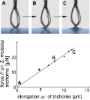
- meniscus with respect to the pulling direction. Using this method, we have investigated the hairs (trichomes) of Salvinia molesta and obtained precise values for the water adhesion force of the trichome tip and for the trichome elasticity. These data can now be used as a guideline for the design of


Aquatic versus terrestrial attachment: Water makes a difference
Beilstein J. Nanotechnol. 2014, 5, 2424–2439, doi:10.3762/bjnano.5.252
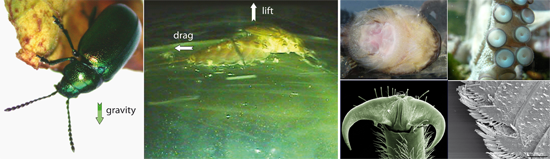
- surface texture, from smooth to very rough and smooth to hairy or covered with waxes [18][19]. Also the surface energy and with it the wettability of surfaces as well as the elasticity of the substrates are important properties, which can influence attachment [17]. Another important point needs to be
- Table 4 and Table 5. Very large attachment forces are generated by glue adhesion and suction. However, as the given values have been determined under very different conditions (substrates of different material, surface energy, roughness and elasticity; different measurement methods) the values are hard
- macrozobenthos of the marine intertidal. Third, flow forces acting on an animal depend on the flow velocity, which can show huge variations between different habitats and even inside the same habitat. Fourth, the shape and other properties (such as elasticity) of the animal also strongly influences drag and lift


Nanoparticle interactions with live cells: Quantitative fluorescence microscopy of nanoparticle size effects
Beilstein J. Nanotechnol. 2014, 5, 2388–2397, doi:10.3762/bjnano.5.248
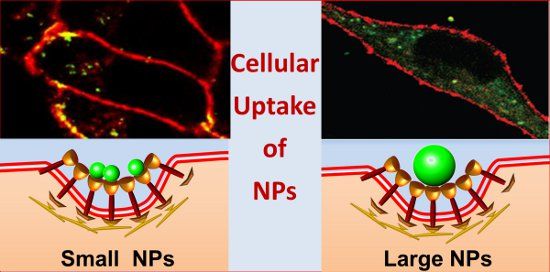
- . Based on studies of the uptake of carboxydextran-coated superparamagnetic iron oxide NPs of 20 and 60 nm by human macrophages, Lunov et al. [49] developed a mathematical model that predicts the wrapping times of different NPs. In addition, the relation between membrane elasticity, cytoskeletal forces


Nanobioarchitectures based on chlorophyll photopigment, artificial lipid bilayers and carbon nanotubes
Beilstein J. Nanotechnol. 2014, 5, 2316–2325, doi:10.3762/bjnano.5.240
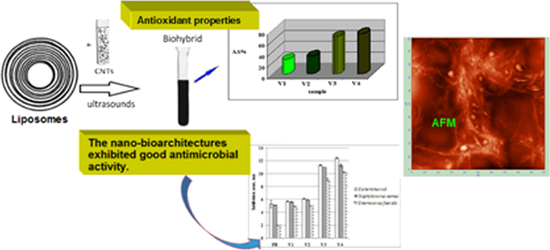
- strength (due to C–C sp2 bonds, which is one of the strongest bonds), flexibility without breakage or damage, high elasticity, good electrical conductivity, and chemical stability. These cylindrical graphene nanotubes are considered one of the most attractive nanomaterials. Applicability of CNTs in the


Anticancer efficacy of a supramolecular complex of a 2-diethylaminoethyl–dextran–MMA graft copolymer and paclitaxel used as an artificial enzyme
Beilstein J. Nanotechnol. 2014, 5, 2293–2307, doi:10.3762/bjnano.5.238
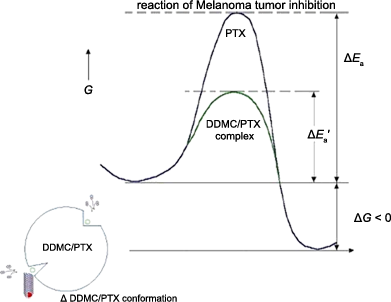
- compared to the state in which it is not bound (enthalpy–entropy compensation or isokinetic theory) [28]. The enthalpy–entropy decrease is expected to stabilize the complexes against supramolecular stress, by Brownian movement owing to the law of entropy increase (effect of entropy elasticity) [29]. This
- including a guest are now defined as artificial enzymes in which the low-molecular-weight subunit containing the active site is complexed with a high-molecular-weight carrier. These supramolecular assemblies have the characteristic of conformational flexibility (slide-ring elasticity) owing to entropy
- elasticity [32], such as a self-structural change, so that it may become advantageous functionally according to the structural change of a substrate and an intermediary body. MTT assay (WST8) The WST-8 (2-(2-methoxy-4-nitrophenyl)-3-(4-nitrophenyl)-5-(2,4-disulfophenyl)-2H-tetrazolium) method is superior to


Nanometer-resolved mechanical properties around GaN crystal surface steps
Beilstein J. Nanotechnol. 2014, 5, 2164–2170, doi:10.3762/bjnano.5.225
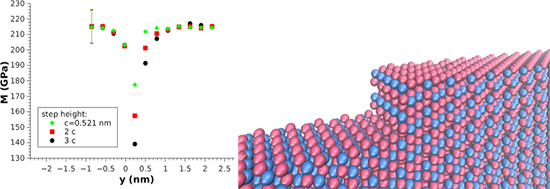
- ≥ 0} and {(x,y,0) | y ≤ 0} will be neglected as it is constant along x and y, but its treatment would follow the same procedure concerning surface elasticity and symmetry arguments as depicted in the following approach. We first sub-divide the material of interest into infinitesimal cubes of the
- for quantitative mechanical analysis [26]. From this data, we obtained M = 285 GPa with an uncertainty of 5–10%, typical for CR-AFM measurements. According to previous investigations, the radius of curvature, R, of the Si-tip hardly remains below 25 nm during elasticity measurements of stiff materials
- accurate elasticity values and thereby detecting the reduction in the indentation modulus with nanometer-sized steps. Conclusion Tensile stresses lead to a significant local effective reduction in the elastic constants. In the case for a step of several nanometers in height, this effect can lead to


![[Graphic 3]](/bjnano/content/inline/2190-4286-5-225-i13.png?max-width=637&scale=1.18182) along the y-axis of the upper Ga atom...
along the y-axis of the upper Ga atom...


Mechanical properties of sol–gel derived SiO2 nanotubes
Beilstein J. Nanotechnol. 2014, 5, 1808–1814, doi:10.3762/bjnano.5.191
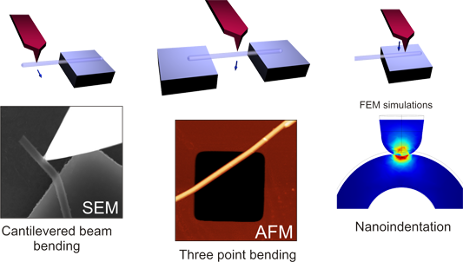
- performed by atomic force microscopy (AFM) under ambient conditions. Half-suspended and three-point bending tests were processed in the framework of linear elasticity theory. Finite element method simulations were used to extract Young’s modulus values from the nanoindentation data. Finally, the Young’s
- solutions based on elasticity theory were used to process cantilever-beam and three-point-bending tests data, while the data from nanoindentation experiments were fitted by using finite element method (FEM) simulations and compared with the analytical models (thin shell or membrane model and Hertz model
- of the NTs. Bending tests inside the HRSEM revealed a limited elasticity and high resistance to fracture of the half-suspended SiO2 NTs. A typical bending experiment is shown in Figure 2. The tip approaches the NT and pushes it near its end (Figure 2a,b). Only negligible elastic shape restoration was


Probing viscoelastic surfaces with bimodal tapping-mode atomic force microscopy: Underlying physics and observables for a standard linear solid model
Beilstein J. Nanotechnol. 2014, 5, 1649–1663, doi:10.3762/bjnano.5.176
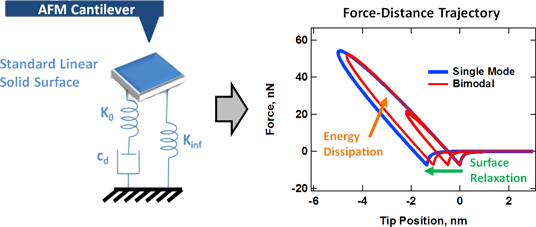
- order to simultaneously acquire the topography and quantify the elasticity of a Ge(001) surface with high resolution [17]. Li and coworkers used a bimodal method in which the first eigenmode was driven by using the phase modulation scheme and the higher mode was driven in open loop, which allowed them
- to obtain images of the sample topography, energy dissipation and elasticity of polymer surfaces immersed in a liquid environment [16]. We have also reported experiments in which images of Vts and Pts were compared for different control schemes applied to the higher mode, including open loop


Influence of the PDMS substrate stiffness on the adhesion of Acanthamoeba castellanii
Beilstein J. Nanotechnol. 2014, 5, 1393–1398, doi:10.3762/bjnano.5.152
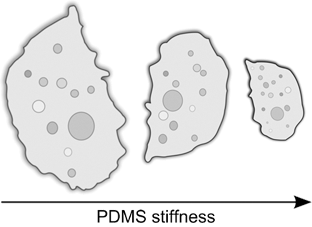
- and position themselves [6]. Once grown on a substrate with defined elasticity, cells adapt their own elasticity to the elasticity of their environment [7]. But not only differentiated cells are influenced by substrate stiffness. For stem cells it has been demonstrated that their differentiation is
- polydimethylsiloxane (PDMS) substrates with Young’s moduli of 4 kPa, 29 kPa, and 128 kPa. These Young’s moduli were chosen in order to cover an elasticity range, for which a significant effect of substrate stiffness on the adhesion of mammalian cells has already been reported [1]. We systematically investigated the
- cool down to room temperature. Elasticity measurements Mechanical properties of PDMS substrates were determined by microindentation using a micro-force measurements device (Basalt-BT01, Tetra GmbH, Ilmenau, Germany) [24]. The recorded force–distance curves were used to calculate the Young’s modulus of


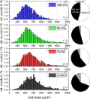

Physical principles of fluid-mediated insect attachment - Shouldn’t insects slip?
Beilstein J. Nanotechnol. 2014, 5, 1160–1166, doi:10.3762/bjnano.5.127
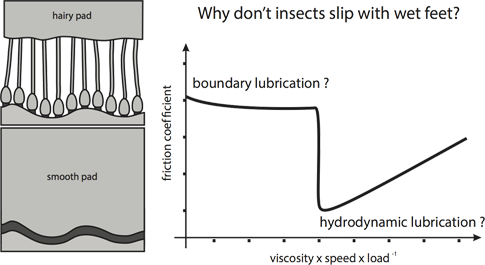
- , a softer adhesive pad/substrate (with a lower elasticity) deforms more easily at a given external force, resulting in a larger contact area. This larger contact area again increases the radius of the mediating meniscus of the liquid (the liquid is pressed towards the outside of the pad), which then


Organic and inorganic–organic thin film structures by molecular layer deposition: A review
Beilstein J. Nanotechnol. 2014, 5, 1104–1136, doi:10.3762/bjnano.5.123




Insect attachment on crystalline bioinspired wax surfaces formed by alkanes of varying chain lengths
Beilstein J. Nanotechnol. 2014, 5, 1031–1041, doi:10.3762/bjnano.5.116
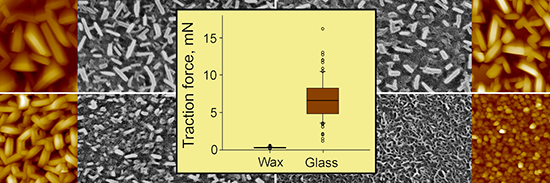
- different characteristics of crystalline wax surfaces influence the attachment? We also measured adhesion (pull-off) forces of artificial adhesive systems on these surfaces. Here, tacky and deformable polydimethylsiloxane (PDMS) semi-spheres, having elasticity moduli similar to those of insect adhesive pads


A nanometric cushion for enhancing scratch and wear resistance of hard films
Beilstein J. Nanotechnol. 2014, 5, 1005–1015, doi:10.3762/bjnano.5.114
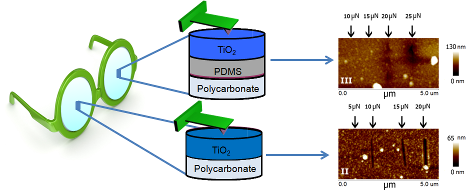
- overlayer based on the elasticity of an underlying PDMS elastomer. To demonstrate the generality of the strategy, different substrates were coated with titania, with and without a soft underlayer. We have previously reported the deposition of thin and uniform titania films on Si, kapton, and



Fibrillar adhesion with no clusterisation: Functional significance of material gradient along adhesive setae of insects
Beilstein J. Nanotechnol. 2014, 5, 837–845, doi:10.3762/bjnano.5.95
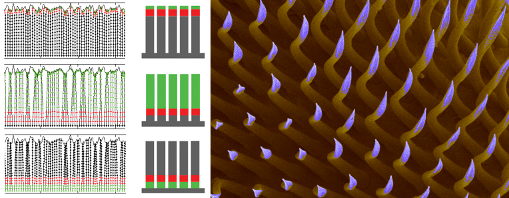
- presented the combined study on the material structure and local mechanical properties in tarsal setae of the beetle Coccinella septempunctata and demonstrated the presence of a material gradient at the level of each single seta [12]. Setal elasticity modulus, probed by atomic force microscope (AFM), ranges
- sclerotised basal part of the seta, a rather pronounced longitudinal gradient of material composition was revealed. AFM-nanoindentation experiments have revealed rather low elasticity modulus at the setal tip (1.2 ± 0.3 MPa), but the high one at the setal base (2.43 ± 1.9 GPa) [12]. This information about the


Scale effects of nanomechanical properties and deformation behavior of Au nanoparticle and thin film using depth sensing nanoindentation
Beilstein J. Nanotechnol. 2014, 5, 822–836, doi:10.3762/bjnano.5.94
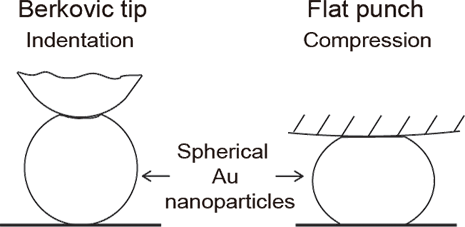
- understanding of materials behavior during contact. Mechanical properties of interest comprise hardness, Young’s modulus of elasticity, bulk modulus, elastic–plastic deformation, scratch resistance, residual stresses, time-dependent creep and relaxation properties, fracture toughness, fatigue and yield strength
- mechanical properties such as hardness and Young’s modulus of elasticity can be directly obtained as a function of depth. This can be done with a high degree of accuracy, not easily obtained with an AFM. This advancement in technology has proven useful for understanding the mechanical behavior of micro- and
- the elastic modulus. By using this method the Young’s modulus of elasticity and Poisson’s ratio for diamond were taken as 1140 GPa and 0.07, respectively. Poisson’s ratio for Au was taken as 0.42. The data from these experiments is the average of five measurements on five different nanoparticles for






Analytical development and optimization of a graphene–solution interface capacitance model
Beilstein J. Nanotechnol. 2014, 5, 603–609, doi:10.3762/bjnano.5.71
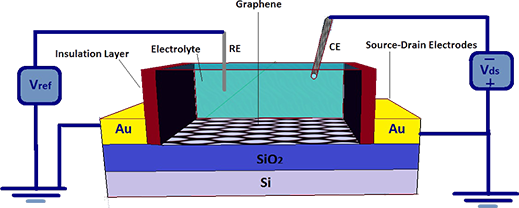
- can satisfy the major requirements of a channel in electrolyte-gated transistor (EGFET) devices due to its ballistic transport, high conductivity, and strong mechanical and elasticity properties. An analytical modeling of the graphene capacitance as a major characteristic of EGFET is studied in this




The softening of human bladder cancer cells happens at an early stage of the malignancy process
Beilstein J. Nanotechnol. 2014, 5, 447–457, doi:10.3762/bjnano.5.52
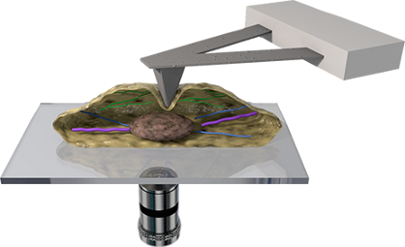
- cell mechanics, in particular elasticity, and cancer [5][6]. The first measurements showed that cancerous human bladder cells were softer than non-malignant bladder cells. Further measurements of cancerous cells have confirmed that a lowering of the elastic modulus of the cells is a general feature of
- kPa at 500 nm. The decrease of the Young’s modulus with δ has been previously reported [18] although this effect is still not fully understood [5][18][19]. Effect of cytochalasin D on the elasticity of the cells In order to verify the influence of the actin filaments and their structure on Ecell, some
- overall cell elasticity [16][33]. The correlation between the reduction of the Young’s modulus and the depolymerization of the actin filaments supports a predominant role of these filaments on the stiffness of the cells. In order to verify how the organization of the actin cytoskeleton influences the


Single-asperity contact mechanics with positive and negative work of adhesion: Influence of finite-range interactions and a continuum description for the squeeze-out of wetting fluids
Beilstein J. Nanotechnol. 2014, 5, 419–437, doi:10.3762/bjnano.5.50
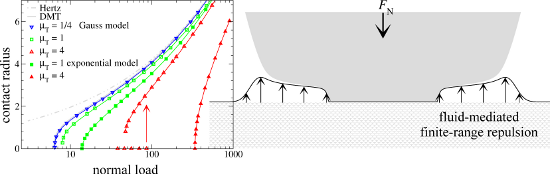
- contributions to the linear elasticity of (frictionless) single-asperity contacts most central to this work are the following: Hertz [4] solved the contact mechanics of a parabolic tip pressed against a substrate for hard-wall repulsion. He found that the contact area Ac and the separation between the two
- inspection of Figure 19a. At small loads, the sensitivity of the gap profile on the details of the model become even more apparent. This result, which can be seen in Figure 19c, is expected, since the elasticity of the tip is no longer relevant. Instead, the force-displacement curve is predominantly


Exploring the complex mechanical properties of xanthan scaffolds by AFM-based force spectroscopy
Beilstein J. Nanotechnol. 2014, 5, 365–373, doi:10.3762/bjnano.5.42
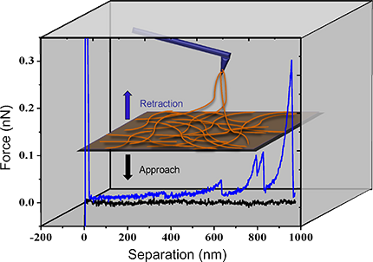
- away from each other. At P2, the rupture length is similar to that at P3. The distribution is slightly wider, which is possibly the result of the tip picking up the underlying fibril at P2. In addition to rupture force and rupture length, other information, such as the molecular elasticity, can be


Challenges and complexities of multifrequency atomic force microscopy in liquid environments
Beilstein J. Nanotechnol. 2014, 5, 298–307, doi:10.3762/bjnano.5.33
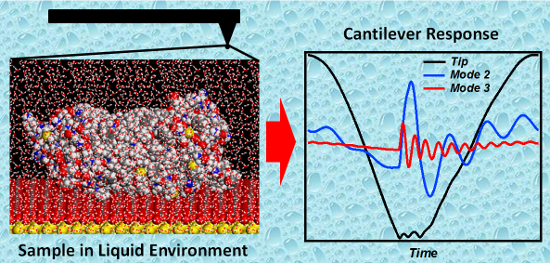
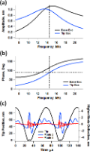
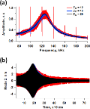
- multiple tip–sample impacts for every cycle of the fundamental eigenmode (c). The simulation parameters are ν1 = 14.5 kHz, k1 = 0.03 N/m, Q1 = 2, Q2 = 6, Afree = 75 nm, Asetpoint = 55% and sample modulus of elasticity of 2 GPa (Hertzian contact). Bimodal AFM simulation illustrating the phase and amplitude




The role of surface corrugation and tip oscillation in single-molecule manipulation with a non-contact atomic force microscope
Beilstein J. Nanotechnol. 2014, 5, 202–209, doi:10.3762/bjnano.5.22
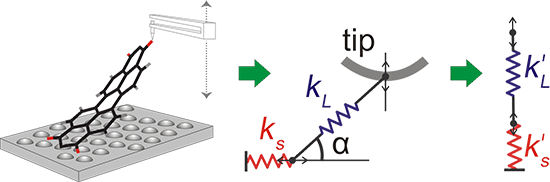
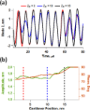
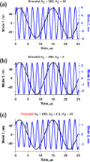
- tip elasticity, and the tip oscillation amplitude. In short, we simulate a full tip oscillation cycle at each step of the manipulation process and calculate the frequency shift by solving the equation of motion of the tip. The new model correctly reproduces previously unexplained key features of the
- main factors that have been omitted from the initial model: i) the atomic corrugation of the surface, ii) the elasticity of the tip material, and iii) the finite amplitude of the qPlus tuning fork oscillation. Here we take a step towards more realistic force-field simulations of single-molecule
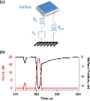
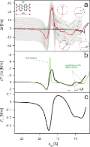
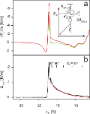
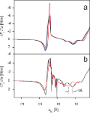
- corrugation affects ∂Fz/∂z(z) curves measured with NC-AFM can be understood by considering the model of an elastically stretchable (and compressible) rod lifted from a corrugated surface. The model consists of two connected springs, one of which mimics the elasticity of the rod, while the other accounts for

Manipulation of nanoparticles of different shapes inside a scanning electron microscope
Beilstein J. Nanotechnol. 2014, 5, 133–140, doi:10.3762/bjnano.5.13
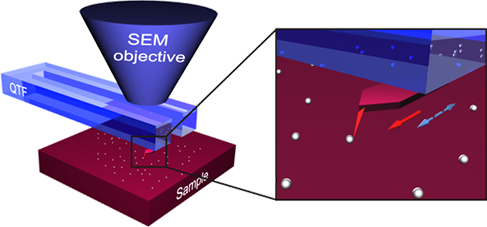
- of the contact: where Θ is the contact angle for Ag/SiO2 interface. As described previously [20], for sphere-like NPs contact mechanics (adhesive contact approach) must be applied. The contact area is typically calculated on the basis of continuum elasticity models for deformable spheres such as the


Static analysis of rectangular nanoplates using trigonometric shear deformation theory based on nonlocal elasticity theory
Beilstein J. Nanotechnol. 2013, 4, 968–973, doi:10.3762/bjnano.4.109
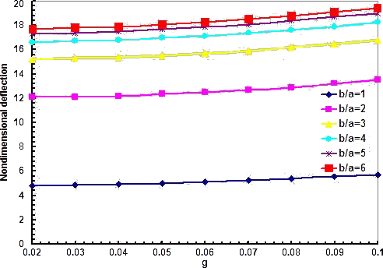
- , the nonlocal elasticity theory is used. An analytical method is adopted to solve the governing equations for static analysis of simply supported nanoplates. In the present theory, the transverse shear stresses satisfy the traction free boundary conditions of the rectangular plates and these stresses
- isotropic, orthotropic and anisotropic nanoplates. Keywords: nonlocal elasticity theory; rectangular nanoplate; static analysis; trigonometric shear deformation theory; Introduction In recent years, some new higher-order shear deformation theories have been adopted for studying macro structures such as
- deformation theory. The above mentioned methodology could be used for both thick and thin rectangular plates similar to 3D elasticity theory. In this theory, the transverse shear stresses satisfied the traction free boundary conditions of the rectangular plates and these stresses could be calculated from the


Dynamic nanoindentation by instrumented nanoindentation and force microscopy: a comparative review
Beilstein J. Nanotechnol. 2013, 4, 815–833, doi:10.3762/bjnano.4.93
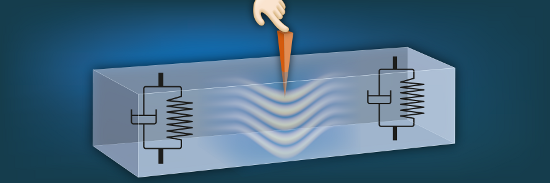
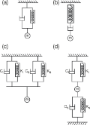
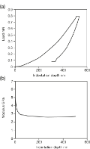
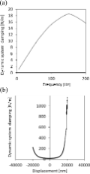
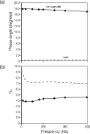
- the factors discussed in previous reviews over the past decade are still issues today [48][49][50][51]. Most notable of these are the implicit assumptions of linear elasticity, which require the contact radius and the indentation depth to be much smaller than the indenter radius, and the absence of




Size-dependent characteristics of electrostatically actuated fluid-conveying carbon nanotubes based on modified couple stress theory
Beilstein J. Nanotechnol. 2013, 4, 771–780, doi:10.3762/bjnano.4.88
- dynamics, it is rarely applied in scrutinizing NEMS because of their limitation in analyzing the complicated behaviors of such systems [9][10][11][12]. Hence, continuum modeling is more frequent and is also applied in this paper. The elasticity equations, which govern the mechanical behaviors on the micro
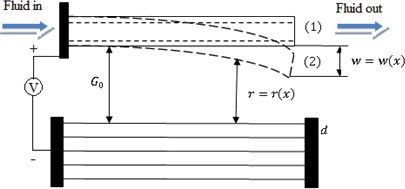
- between the electrodes lead to deflection of the CNT towards the ground plate (state 2 in Figure 1). The deflection value, w = w(x), corresponds to the applied voltage up to the point at which the elasticity of the CNT can no longer compensate the forces that result from the applied voltage and the
- boundary conditions, the axial force is a compressive force because the clamped ends transform the axial force into a compression. According to the concepts of elasticity and vibration of continuous systems, the tensile force increases the natural frequency and buckling loads of the nanobeam, here the CNT





