


Search results
Search for "frequency shift" in Full Text gives 141 result(s) in Beilstein Journal of Nanotechnology.
Probing viscoelastic surfaces with bimodal tapping-mode atomic force microscopy: Underlying physics and observables for a standard linear solid model
Beilstein J. Nanotechnol. 2014, 5, 1649–1663, doi:10.3762/bjnano.5.176
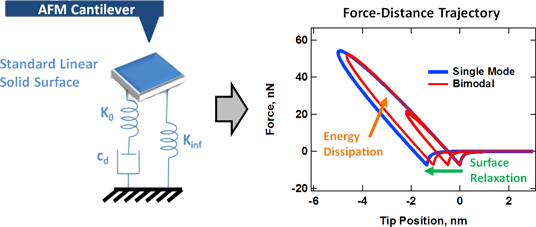
- , which requires the use of a constant-response-amplitude method such as constant-amplitude frequency-modulation [27]. However, if the frequency shift is significantly different for different regions, according to the results of Figure 4a, they may not be directly comparable since the interplay of


Multi-frequency tapping-mode atomic force microscopy beyond three eigenmodes in ambient air
Beilstein J. Nanotechnol. 2014, 5, 1637–1648, doi:10.3762/bjnano.5.175
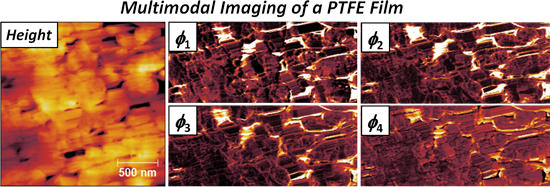
- slightly for larger amplitudes). In the second case (Figure 5b), we see that the level of perturbation increases, accompanied by a greater frequency shift (due to a greater influence of the repulsive forces in the range of conditions considered), as the cantilever is lowered towards the sample
- eigenmode frequency shift increases as its free amplitude is decreased while keeping the other higher amplitudes constant, in agreement with previous results [20] and with Figure 5a, although the shape of the response curve remains distorted for most of the range of amplitudes considered. Despite the



Trade-offs in sensitivity and sampling depth in bimodal atomic force microscopy and comparison to the trimodal case
Beilstein J. Nanotechnol. 2014, 5, 1144–1151, doi:10.3762/bjnano.5.125
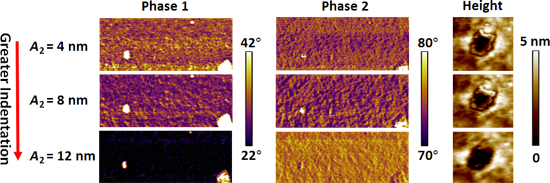
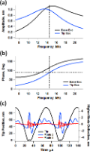
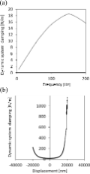
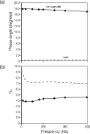
- setpoint of 45%. The scale bar is 100 nm. Illustration of the ideal response of a harmonic oscillator [22]. (a) Amplitude and phase vs excitation frequency (at the resonance frequency the phase is 90 degrees); (b) phase and effective frequency shift vs external force gradient (at zero force gradient the


Calibration of quartz tuning fork spring constants for non-contact atomic force microscopy: direct mechanical measurements and simulations
Beilstein J. Nanotechnol. 2014, 5, 507–516, doi:10.3762/bjnano.5.59
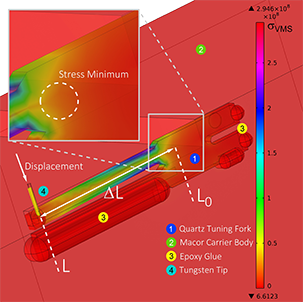
- ” sensors. The stiffness of the force sensor is necessary for the transformation of the experimental frequency shift data, Δf, to forces. Consequently, a force measurement can only be as precise as the determination of each factor in the equation that links the frequency shift to the tip–sample forces [8
- ][10][11]. To calculate the force-vs-distance curve from measured frequency shift-vs-distance data, the inversion of the dependence of the frequency shift on the tip–sample forces has been derived [11][12][13][14] with high accuracy. All those formulas contain the stiffness of the sensor kqPlus as




Impact of thermal frequency drift on highest precision force microscopy using quartz-based force sensors at low temperatures
Beilstein J. Nanotechnol. 2014, 5, 407–412, doi:10.3762/bjnano.5.48
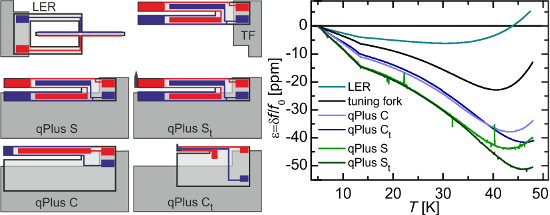
- ]. In FM-AFM the frequency shift Δf = f – f0 of a mechanical oscillator with stiffness k upon tip–sample interaction is measured, while the oscillation amplitude A is kept constant. For quantitative force measurements the uncertainty in the force gradient is crucial [7]. Frequency shift and force
- amplifier [26]. Finally, the frequency shift was determined by a digital phase locked loop stabilized by an oven-controlled quartz resonator with a precision of 1 ppb/day [27]. For the measurements, the temperature setpoint was increased at a rate of 0.5 K/min and the change in eigenfrequency was monitored
- frequency shift to force gradient, the corresponding k values from Table 1 were used, in case of TF and LER the stiffness was multiplied with a factor of 2 [7]. Acknowledgements We acknowledge financial support from the Deutsche Forschungsgemeinschaft (Grant No. SFB 689 and GRK 1570).


Uncertainties in forces extracted from non-contact atomic force microscopy measurements by fitting of long-range background forces
Beilstein J. Nanotechnol. 2014, 5, 386–393, doi:10.3762/bjnano.5.45
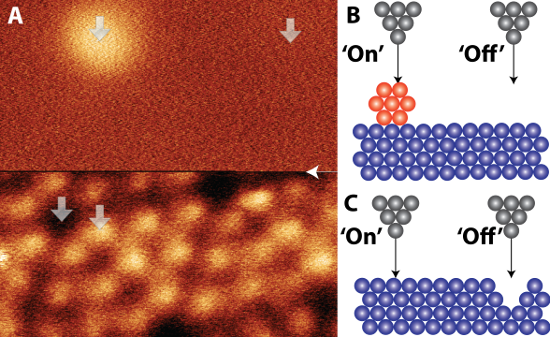
- atomic scale. In practice, however, the extraction of the often desired ‘short-range’ force from the experimental observable (frequency shift) is often far from trivial. In most cases there is a significant contribution to the total tip–sample force due to non-site-specific van der Waals and
- tip–sample interaction is usually modelled (for example using density functional theory (DFT) [1]) as the interaction between a small cluster of atoms (representing the tip) and a slab of surface atoms. In order to extract the short-range force from the frequency shift measurement, however, the


Challenges and complexities of multifrequency atomic force microscopy in liquid environments
Beilstein J. Nanotechnol. 2014, 5, 298–307, doi:10.3762/bjnano.5.33
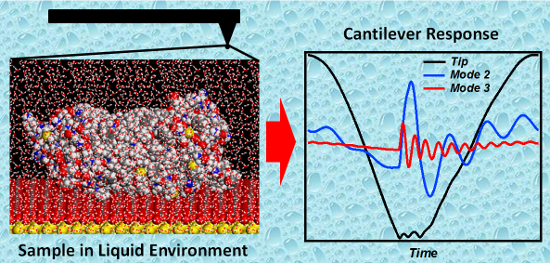
- in the nature of the conservative forces (since only the dissipative forces have changed). The user will conclude that there has been a frequency shift, when this is clearly not the case. These issues also occur in amplitude modulation AFM and can lead to phase shift measurements that are not




Frequency, amplitude, and phase measurements in contact resonance atomic force microscopies
Beilstein J. Nanotechnol. 2014, 5, 278–288, doi:10.3762/bjnano.5.30
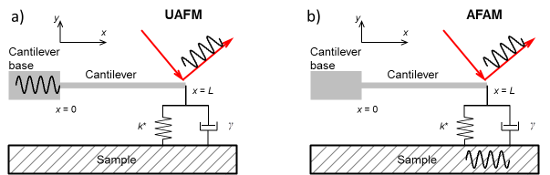
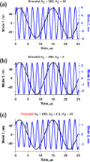
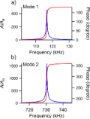
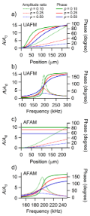
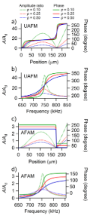
- phase of the second eigenmode along the cantilever in a) the UAFM and c) AFAM configurations, respectively. Frequency dependence of the amplitude ratio and phase of the second eigenmode at the end of the cantilever in b) the UAFM and d) AFAM configurations, respectively. Amplitude ratio, frequency shift
- , and phase of the first eigenmode versus contact stiffness in UAFM and AFAM configurations when a small contact damping of p = 0.05 was considered. Amplitude ratio, frequency shift, and phase of the first eigenmode versus contact stiffness in UAFM and AFAM configurations when a medium contact damping
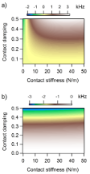
- of p = 0.25 was considered. a) Frequency shift, b) normalized amplitude, c) phase, and d) quality factor Q of the first eigenmode in the UAFM configuration as a function of contact stiffness and contact damping. e) Frequency shift, f) normalized amplitude, g) phase, and h) quality factor Q of the


Unlocking higher harmonics in atomic force microscopy with gentle interactions
Beilstein J. Nanotechnol. 2014, 5, 268–277, doi:10.3762/bjnano.5.29
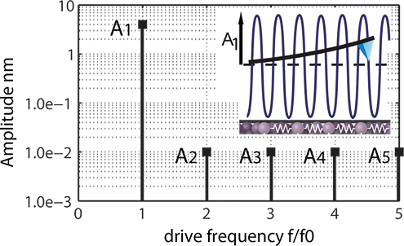
- incommensurability between external drives in the standard multifrequency approach implies that the cantilever motion is not exactly periodic relative to the fundamental drive and that a sub-harmonic excitation typically follows [32]. Furthermore, simplifications in eigenmode frequency shift theory [36] might lead

![[Graphic 7]](/bjnano/content/inline/2190-4286-5-29-i27.png?max-width=637&scale=1.18182) of higher harmonics, including the fundamental shift
of higher harmonics, including the fundamental shift ![[Graphic 8]](/bjnano/content/inline/2190-4286-5-29-i28.png?max-width=637&scale=1.18182) , when N = 10 external harmonic ...
, when N = 10 external harmonic ...


The role of surface corrugation and tip oscillation in single-molecule manipulation with a non-contact atomic force microscope
Beilstein J. Nanotechnol. 2014, 5, 202–209, doi:10.3762/bjnano.5.22
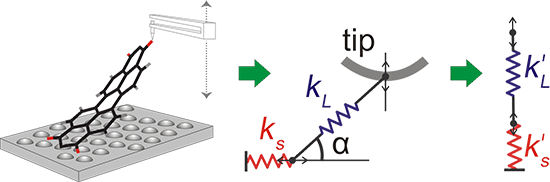
- tip elasticity, and the tip oscillation amplitude. In short, we simulate a full tip oscillation cycle at each step of the manipulation process and calculate the frequency shift by solving the equation of motion of the tip. The new model correctly reproduces previously unexplained key features of the
- experiment, and facilitates a better understanding of the mechanics of single-molecular junctions. Our simulations reveal that the surface corrugation adds a positive frequency shift to the measurement that generates an apparent repulsive force. Furthermore, we demonstrate that the scatter observed in the
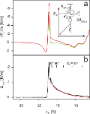
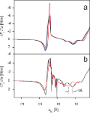
- strength to allow the lifting of the molecule from the surface up to the point of its complete removal. Recording the frequency shift Δf(z) of the qPlus tuning fork during the removal of the molecule, we have previously succeeded in reconstructing the junction structure throughout the manipulation process

Influence of the adsorption geometry of PTCDA on Ag(111) on the tip–molecule forces in non-contact atomic force microscopy
Beilstein J. Nanotechnol. 2014, 5, 98–104, doi:10.3762/bjnano.5.9
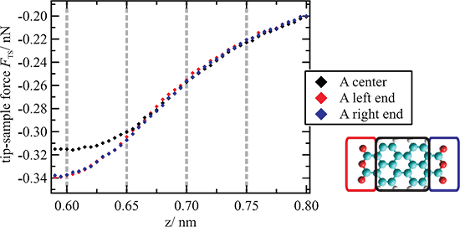
- . Above the surface area shown in Figure 1b, the frequency shift Δf(x,y,z) was measured with 40 by 30 by 200 data points within a volume of 3.2 by 2.4 by 1.0 nm. In order to account for interactions that are not site-specific and beyond the z range, which was covered by this measurement, a separate Δf(z
- measurement was about 5 3/4 h, the lateral drift of ≈40 pm/h led to a distortion of the originally rectangular surface area. In addition, a continuous drift of the frequency shift reference point of the order of 0.1 Hz/h was observed. The precise drift as a function of time was determined by a comparison of
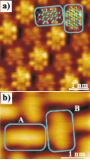
- molecules appear as featureless ovals, which results in a corresponding contrast in the topography images recorded at small frequency shift values and, thus, large tip–sample distances (compare Figure 1b). Below a certain distance, the regime of short-range forces such as chemical interactions, short-range



Noise performance of frequency modulation Kelvin force microscopy
Beilstein J. Nanotechnol. 2014, 5, 1–18, doi:10.3762/bjnano.5.1
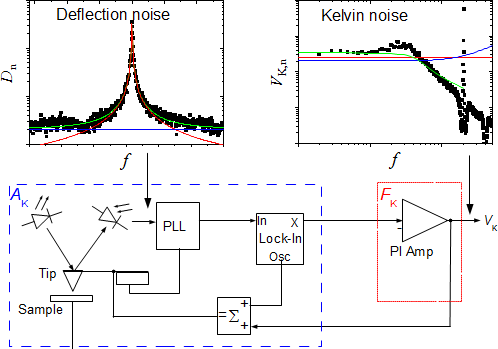
- acceptable value. The modeled noise PSD is in agreement with the measured one, showing that no significant noise contribution is added by the PLL. Since in FM-KFM the frequency shift signal is shared by both distance and potential control loops, a design rule for choosing the AC modulation frequency is
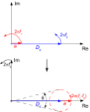
- same closed loop response. Phase detector gain - phase as function of frequency shift We shall study the phase difference between a passive oscillator and a frequency modulated drive signal. If a resonator described by a quality factor Q and a resonance frequency f0 is excited by a frequency modulated
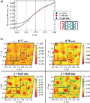
- frequency of the tip by applying a voltage between tip and sample. The first task is to determine the frequency shift induced as a function of the voltage and the fixed tip–sample distance of some tens of nanometers for the static case fpert = 0. Figure 3 shows the frequency shift Δf as a function of the





Dynamic nanoindentation by instrumented nanoindentation and force microscopy: a comparative review
Beilstein J. Nanotechnol. 2013, 4, 815–833, doi:10.3762/bjnano.4.93
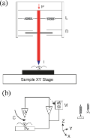
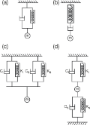
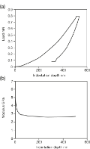
- entire force profile while starting at noncontact positions. The deconvolution implemented to convert the experimentally observed frequency shift/amplitude change to a force can also introduce some uncertainty [91]. Single-frequency techniques are still more readily accessible in most laboratories




Determining cantilever stiffness from thermal noise
Beilstein J. Nanotechnol. 2013, 4, 227–233, doi:10.3762/bjnano.4.23
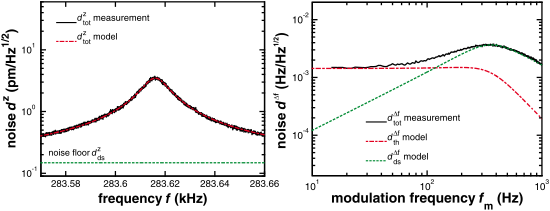
- introduce an alternative method of determining the modal stiffness by using the demodulator of an NC-AFM system to project the noise power of an excited cantilever around its resonance into the frequency range of 10 Hz to 1 kHz. Processing the resulting frequency shift signal Δf(t) to obtain the modal
- spectral density (fm) in the frequency shift signal Δf(t), the spectrum analyser is connected to the phase-locked-loop (PLL) demodulator output of the respective NC-AFM system. In all of these experiments, utmost care has to be taken to shield the NC-AFM system from mechanical and, specifically, from
- which the PLL transfer function is known. The former condition requires the detection system noise floor to be so low that, at least over a significant fraction of the PLL demodulator bandwidth, the frequency shift noise spectral density (fm) of the detection system is negligible compared to the
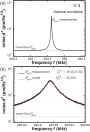
![[Graphic 34]](/bjnano/content/inline/2190-4286-4-23-i40.png?max-width=637&scale=1.18182) measured for the fundamental mode of cantilever V 4. Measureme...
measured for the fundamental mode of cantilever V 4. Measureme...
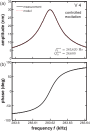
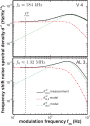
![[Graphic 23]](/bjnano/content/inline/2190-4286-4-23-i29.png?max-width=637&scale=1.18182) measured for cantilever V 4 (A0 = 16.8 nm, demodulator band...
measured for cantilever V 4 (A0 = 16.8 nm, demodulator band...
Bimodal atomic force microscopy driving the higher eigenmode in frequency-modulation mode: Implementation, advantages, disadvantages and comparison to the open-loop case
Beilstein J. Nanotechnol. 2013, 4, 198–207, doi:10.3762/bjnano.4.20
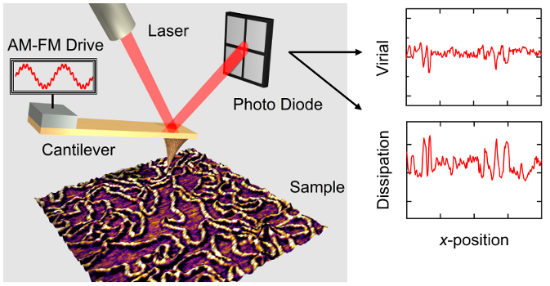
- comparison: (i) the general appeal of frequency shift and relationship to phase contrast, (ii) the amplitude control capability and its implications (especially with regards to sensitivity), and (iii) complexity and stability. Additionally, we offer a brief discussion on selection criteria in terms of sample
- type, instrumentation availability and user skill level. General appeal of frequency shift and relationship to phase contrast The first question that emerges when discussing AM-FM concerns the reasoning behind the use of FM-AFM, which has in the past been mostly reserved for vacuum operation, with a
- tip–sample-distance feedback loop. These transient times scale as 2Q/ω0, with Q being the quality factor and ω0 the natural frequency [22]. Clearly, imaging becomes impractical when Q increases significantly (as in vacuum operations). In FM-AFM, this drawback is overcome by using the frequency shift


High-resolution dynamic atomic force microscopy in liquids with different feedback architectures
Beilstein J. Nanotechnol. 2013, 4, 153–163, doi:10.3762/bjnano.4.15
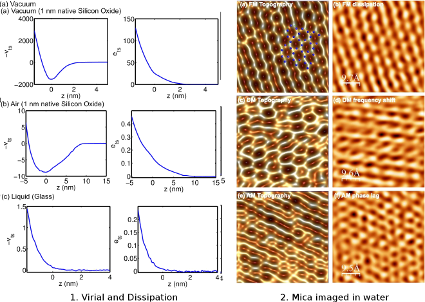
- ]. An autonomous equation describing the dynamics of a and becomes: where τ = ω0t/2Q and σ = Q0[(ω/ω0)2 − 1] is the frequency shift scaled by the half-power bandwidth of the resonance. The nonlinear tip–sample forces are captured in Equation 3 by the functionals where d(θ) = z + x* + acosθ and d′(θ
- separation regulator in FM actuates z in order to maintain the frequency shift σ according to where K5 and K6 are gain constants, and σsp is the set-point frequency shift. At equilibrium in FM, the topography is purely a reflection of the virial of the interaction and the dissipation is measured in the
- captured by the corresponding frequency shift. In this respect, DAM can be regarded as the complementary mode to FM. At this juncture, it is instructive to introduce some experimental data highlighting some of the key differences between dAFM operation in vacuum, air and liquid. In Figure 1, ets and vts


Interpreting motion and force for narrow-band intermodulation atomic force microscopy
Beilstein J. Nanotechnol. 2013, 4, 45–56, doi:10.3762/bjnano.4.5
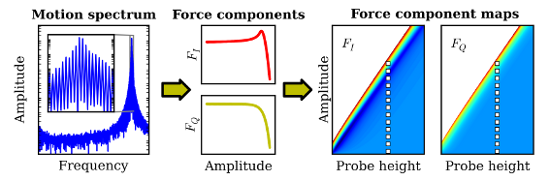
- describe amplitude- and frequency-modulated signals. For frequency modulation we define an instantaneous oscillation phase and an instantaneous oscillation frequency The instantaneous frequency shift δω compared to is then simply In a small region around the time t' the signal x(t) can be obtained by a
- -modulation AFM (FM-AFM) and amplitude-modulation AFM (AM-AFM) FI and FQ are usually probed by a slow variation of the probe height h with fixed oscillation amplitude at each height. To measure FI and FQ in FM-AFM the oscillation frequency shift and the drive force are recorded as the static probe height is
- slowly varied (frequency-shift–distance curves). Active feedback is used to adjust both the drive power and drive frequency, to keep the response amplitude and phase constant. The obtained frequency shifts and drive forces can then be converted into the force quadratures [38][39] so that the measurement




Thermal noise limit for ultra-high vacuum noncontact atomic force microscopy
Beilstein J. Nanotechnol. 2013, 4, 32–44, doi:10.3762/bjnano.4.4
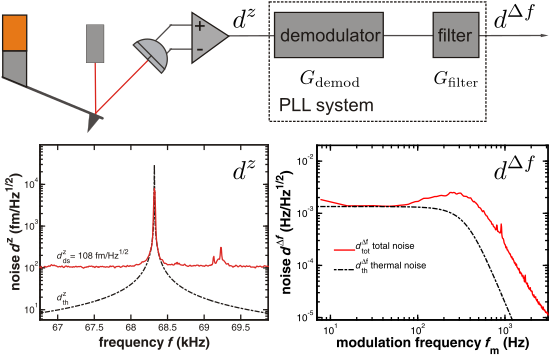
- : SmarAct GmbH, Schütte-Lanz-Strasse 9, 26135 Oldenburg, Germany now at: Department of Physics and Astronomy, The University of Utah, 115 South 1400 East, Salt Lake City, UT 84112, USA 10.3762/bjnano.4.4 Abstract The noise of the frequency-shift signal Δf in noncontact atomic force microscopy (NC-AFM
- ) consists of cantilever thermal noise, tip–surface-interaction noise and instrumental noise from the detection and signal processing systems. We investigate how the displacement-noise spectral density dz at the input of the frequency demodulator propagates to the frequency-shift-noise spectral density dΔf
- establishes a relation between the representation in mechanical and electrical units. During NC-AFM operation, the cantilever with eigenfrequency f0 is excited to oscillation at the resonance frequency fr, which differs from its eigenfrequency by the frequency shift Δf = fr − f0 when there is a tip–surface


![[Graphic 53]](/bjnano/content/inline/2190-4286-4-4-i64.png?max-width=637&scale=1.18182) =
= ![[Graphic 32]](/bjnano/content/inline/2190-4286-4-4-i43.png?max-width=637&scale=1.18182) f...
f...


![[Graphic 56]](/bjnano/content/inline/2190-4286-4-4-i67.png?max-width=637&scale=1.18182) using three diff...
using three diff...

Calculation of the effect of tip geometry on noncontact atomic force microscopy using a qPlus sensor
Beilstein J. Nanotechnol. 2013, 4, 10–19, doi:10.3762/bjnano.4.2
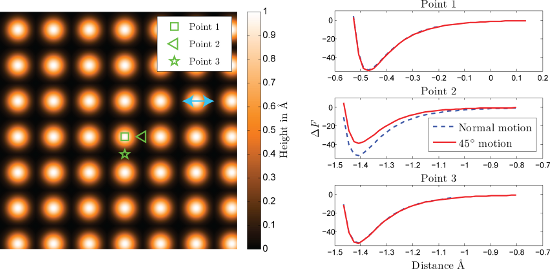
- imaging in the first eigenmode. We calculate the effect the lateral motion has on the measured frequency shift, and hence, how this affects calibration, imaging, and spectroscopy. Results and Discussion Modelling the tine of the qPlus sensor as an Euler–Bernoulli beam [16] of length L, we can write where
- images and spectra can be generated to theoretically calculate the effect; however, one must carefully consider both the amplitude calibration and the methods for calculating frequency shifts from a potential before continuing. Effect on frequency shift Under the assumption that the direction of motion
- the frequency shift can be calculated as In the case that the lateral force is zero, where is the z component of the tip–sample force. Thus, if the calibrated amplitude of the oscillation is az, rather than the total amplitude of oscillation at the tip apex a, then Δf is equal to the expected result


Characterization of the mechanical properties of qPlus sensors
Beilstein J. Nanotechnol. 2013, 4, 1–9, doi:10.3762/bjnano.4.1
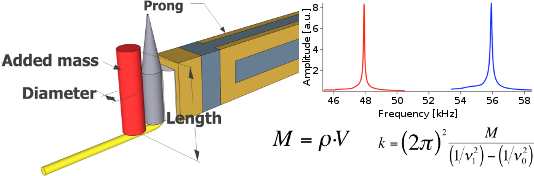
- subsequent application. Unquestionably, the glue adds some extra mass that we do not take into account in our method. However, the amount of the glue used to fix the extra wire causes a change in frequency that is negligible compared to the large frequency shift caused by the tungsten wire loading. Figure 4
- affect experimental force measurements. The force can be expressed by using the Sader formula [35] as follows where Δν is the frequency shift, νr is the resonant frequency, k is the stiffness of the sensor, A is the amplitude of oscillation, F is the tip–surface interaction force, x is the tip–surface


Spring constant of a tuning-fork sensor for dynamic force microscopy
Beilstein J. Nanotechnol. 2012, 3, 809–816, doi:10.3762/bjnano.3.90
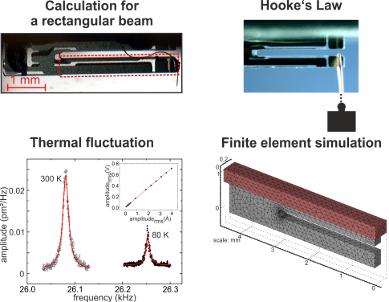
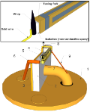
- determining the structure of an unknown organic molecule [4]. In FM-AFM, the motion of the sensor is given in very good approximation by a harmonic oscillator. For the limit of small amplitudes the measurement of the frequency shift provides the average force gradient caused by the interaction between the tip
- and sample surface, according to where is the average force gradient between tip and sample, Δf is the frequency shift, k is the spring constant of the sensor and f0 is the resonance frequency of the sensor without interaction with the sample. While the resonance frequency may be measured accurately
- frequency-shift signal. Prior to the measurements, the sensitivity of the TF in millivolts per nanometer (mV/nm) was calibrated, including the electronics for detection. This is done in several steps. First, the z-piezo of the scanning unit is calibrated by measuring the topography of a surface (Cu(111), Ag




Probing three-dimensional surface force fields with atomic resolution: Measurement strategies, limitations, and artifact reduction
Beilstein J. Nanotechnol. 2012, 3, 637–650, doi:10.3762/bjnano.3.73
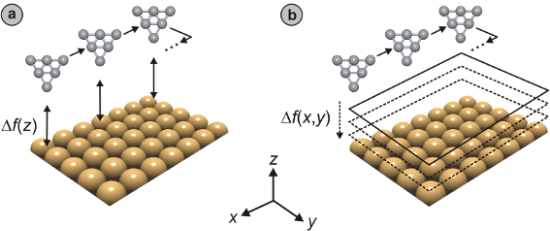
- –mica interface [35]. The methods most frequently reported in the literature to record two- and three-dimensional force fields above sample surfaces may be divided into two general categories (Figure 1): 1) The curve-by-curve method, in which individual curves of frequency shift versus tip–sample
- -dimensional ∆f(x, y, z) array may be recorded layer-by-layer, by combining a series of topographical or constant-height NC-AFM images that contain ∆f(x, y) information for certain tip–sample distances z [9][11][20][23][24]. A subset of this method involves recording the frequency shift along a single line as
- current, which is recorded together with the frequency-shift data, does not decay too fast to provide accurate calibration at all distances covered by the 3-D set. A completely different source of drift may originate from the use of analog electronics for oscillation detection and amplitude/phase-feedback




Drive-amplitude-modulation atomic force microscopy: From vacuum to liquids
Beilstein J. Nanotechnol. 2012, 3, 336–344, doi:10.3762/bjnano.3.38
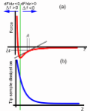
- , the adhesion changes abruptly. The curve in Figure 1a represents a typical curve of the tip–sample force versus distance in a vacuum or air environment. The FM feedback maintains the frequency shift, which is closely related to the force gradient, to infer the topography of the sample [13]. Since the
- frequency shift changes its sign (Figure 1a), stable feedback is only possible on a branch of the force curve where it is monotonic. For the case of AM, the transition between the contact and noncontact regimes can introduce bistabilities [14][15] but, as a general rule, AM can operate with similar feedback
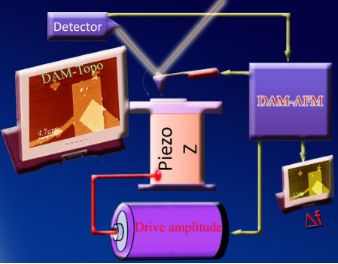
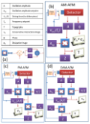
- constant by adjusting the amplitude of the driving force. A phase-locked loop (PLL) tracks the effective resonance frequency of the cantilever as it varies as a consequence of the tip–sample interaction. In FM, the position of the scanner in the z-direction is adjusted to keep the frequency shift constant


Models of the interaction of metal tips with insulating surfaces
Beilstein J. Nanotechnol. 2012, 3, 329–335, doi:10.3762/bjnano.3.37
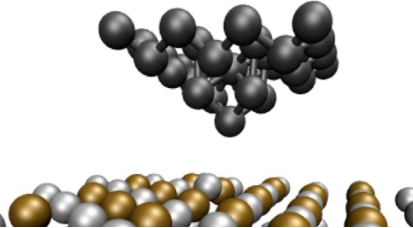
- the metal cluster interacts more attractively with anions in the surfaces than with cations, over the range of typical imaging distances, which leads to these sites being imaged as raised features (bright) in constant-frequency-shift images. We compare the results of the interaction of a chromium tip
- tip–surface combinations, the calculated force fields would result in the anions being imaged as prominent protrusions in a constant-frequency-shift image of the surfaces. To demonstrate this, and show the extent of typical atomic scale corrugation, we simulated the imaging of the NaCl surface with
- ) Energy as a function of cluster Cr tip height above the NaCl(001) surface. (b) Energy as a function of tip height above the MgO(001) surface. Energy as a function of tip height for the W tip interacting with the NaCl(001) surface. Constant-frequency-shift image (Δf = −60 Hz) of the NaCl surface imaged


Graphite, graphene on SiC, and graphene nanoribbons: Calculated images with a numerical FM-AFM
Beilstein J. Nanotechnol. 2012, 3, 301–311, doi:10.3762/bjnano.3.34
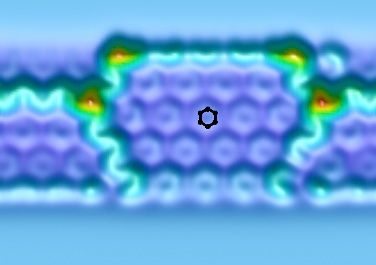
- dynamic behavior of the oscillator. Briefly speaking, an important element of the FM-AFM experimental apparatus is the frequency detection by demodulation performed with the aid of a phase-locked loop (PLL). This allows measurement of the frequency shift Δf from the fundamental resonance frequency of the
- , and giving at the end an image representing a dissipation measurement. The second one keeps the resonance frequency shift Δf due to the probe–surface interaction constant, hence providing the topographic image. The complexity of the two entangled loops of the FM-AFM, each with different gain
- interaction between the tip and the sample appears and disturbs the oscillator motion, which leads to an almost instantaneous frequency shift, Δf = − f0. The frequency shift varies depending on the tip–sample distance. This is a critical parameter of FM-AFM. As already mentioned and described in previous





