


Search results
Search for "nanotubes" in Full Text gives 490 result(s) in Beilstein Journal of Nanotechnology. Showing first 200.
Assessment of the optical and electrical properties of light-emitting diodes containing carbon-based nanostructures and plasmonic nanoparticles: a review
Beilstein J. Nanotechnol. 2021, 12, 1078–1092, doi:10.3762/bjnano.12.80
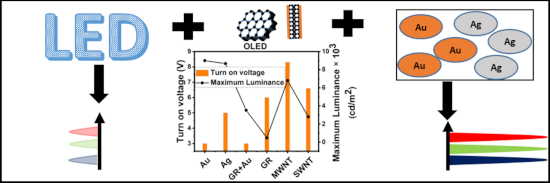
- . This review surveys the diverse possibilities to combine various inorganic, organic, and carbon nanostructures along with plasmonic nanoparticles. Such combinations would allow an enhancement in the overall properties of LED. Keywords: carbon nanotubes (CNT); graphene; light-emitting diodes (LED
- market as they suffer from energy losses due to total internal reflection at the emitter/air interface. Several methods have been proposed to tune the properties of LED. To that end, multiwall carbon nanotubes (MWNT) and single-wall carbon nanotubes (SWNT) have been applied to various layers in LED, such
- whereupon the luminous and internal quantum efficiencies of the device increase. However, SPR is very sensitive to the shape and size of MNP, which in turn directly influence the overall properties of LED. This manuscript reviews the effect of carbon nanostructures, such as carbon nanodots, carbon nanotubes


Progress and innovation of nanostructured sulfur cathodes and metal-free anodes for room-temperature Na–S batteries
Beilstein J. Nanotechnol. 2021, 12, 995–1020, doi:10.3762/bjnano.12.75
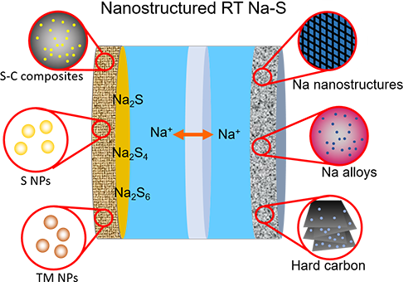
- based on nickel disulfide nanocrystals implanted in nitrogen-doped porous carbon nanotubes. It exhibits high reversible capacity of 650 mAh·g−1 after 200 cycles at 0.1 A·g−1 and excellent cycling stability for 3500 cycles. Additionally, Kumar et al. [51] described a cathode, based on manganese dioxide
- were synthesized inside carbon nanotubes by the melt diffusion method (Figure 7A) [54]. The resulting capacity of the Na–S battery after 2500 cycles at 1 A·g−1 was 80 mAh·g−1. Likewise, sulfur impregnation of hollow carbon nanocages rendered cathodes of 395 mAh·g−1 at 1 A·g−1 for 850 cycles [45
- , nanocarbon materials such as graphene and carbon aerogels, carbon microspheres, and mats, felts and papers based on carbon nanotubes and carbon fibers can also be efficiently soaked with Na and additionally provide bending and rolling flexibility, making them very attractive host materials [19][67][68][69




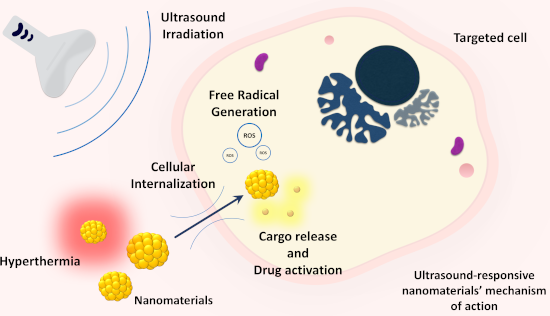
Comprehensive review on ultrasound-responsive theranostic nanomaterials: mechanisms, structures and medical applications
Beilstein J. Nanotechnol. 2021, 12, 808–862, doi:10.3762/bjnano.12.64


Silver nanoparticles nucleated in NaOH-treated halloysite: a potential antimicrobial material
Beilstein J. Nanotechnol. 2021, 12, 798–807, doi:10.3762/bjnano.12.63
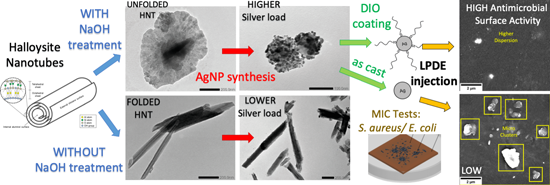
- + ions or growing up to the micrometer scale. Some routes stabilize Ag-NPs by nucleating silver into clay substrates [15][16], such as kaolinite [17][18][19], montmorillonite [18][19][20][21], and halloysite nanotubes [22][23][24]. The advantages are, for instance, preventing particle agglomeration
- aluminosilicate sheet that folds over itself in virtue of the internal stress inherent to the crystalline structure of the material, forming nanotubes [25]. As shown in Figure 1, it folds with a silicate phase facing outwards (Si-O), and an aluminol phase facing inwards (Al-OH). Since the internal and external
- induced major structural changes in the HNT substrates. As the treatment progressed, HNT nanotubes slowly unfolded into nanosheets, starting with the enlargement of the central lumen of HNT, as shown in the HNT-4 TEM image (Figure 4c). By day 8, most HNT nanotubes had already turned into nanosheets, as




Recent progress in actuation technologies of micro/nanorobots
Beilstein J. Nanotechnol. 2021, 12, 756–765, doi:10.3762/bjnano.12.59
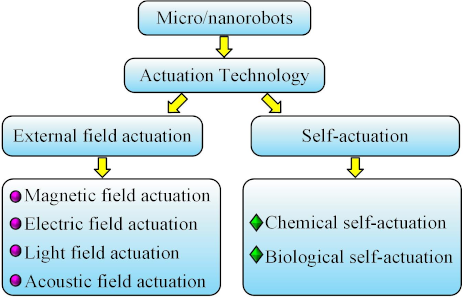
- -actuation. Magdanz et al. [46] proposed to use spermatozoa containing flagella as an actuation force for the preparation of micro/nanorobots. When combining sperm cells with nanotubes, the swing of the sperm flagella interacts with the microtubes to actuate the movement of the robot. Due to the high


Nanogenerator-based self-powered sensors for data collection
Beilstein J. Nanotechnol. 2021, 12, 680–693, doi:10.3762/bjnano.12.54
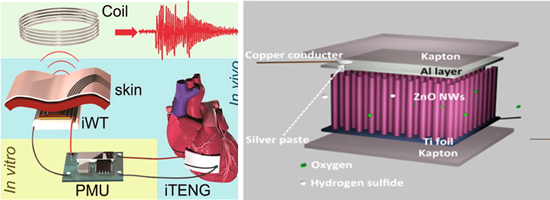
- . Lee et al. proposed a based Hg2+ ion sensor based on ZnO nanowires and carbon nanotubes for detecting toxic pollutants [17]. The ZnO nanowire (NW) array acted as power source. When Hg2+ ions were detected, the system powered a light-emitting diode (LED). Li et al. designed a self-powered heavy metal




A review of defect engineering, ion implantation, and nanofabrication using the helium ion microscope
Beilstein J. Nanotechnol. 2021, 12, 633–664, doi:10.3762/bjnano.12.52
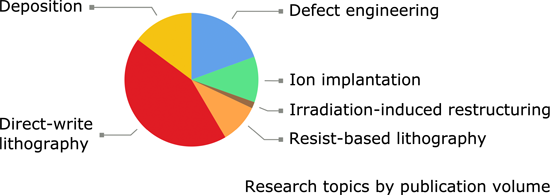
- electronic thermal conductivity of this material [72]. Additional defect engineering studies Defect formation in supported and free-standing multiwalled carbon nanotubes upon irradiation with both 25 keV helium and neon ions has also been investigated, since ion (and electron) irradiation can be used to


High-yield synthesis of silver nanowires for transparent conducting PET films
Beilstein J. Nanotechnol. 2021, 12, 624–632, doi:10.3762/bjnano.12.51
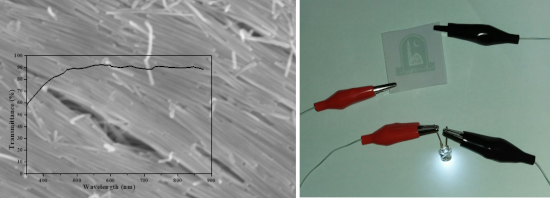
- , carbon nanotubes (CNT), conductive polymers, and metallic nanowires, have been tested commercially as alternative to ITO films for flexible optoelectronic devices [6][7][8][9]. Amongst them, graphene and carbon materials, particularly CNTs, display low optical transparency and high sheet resistance owing


Solution combustion synthesis of a nanometer-scale Co3O4 anode material for Li-ion batteries
Beilstein J. Nanotechnol. 2021, 12, 424–431, doi:10.3762/bjnano.12.34
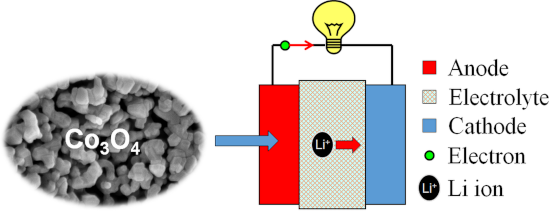
- the formation of composite materials consisting of Co3O4 and different materials, including carbon-based materials, such as graphene [7][8], carbon nanotubes [9], carbon coatings [10], dictyophora indusiata-derived carbon [11], or other transition metal oxides [12]. This approach usually leads to a


A review on the biological effects of nanomaterials on silkworm (Bombyx mori)
Beilstein J. Nanotechnol. 2021, 12, 190–202, doi:10.3762/bjnano.12.15
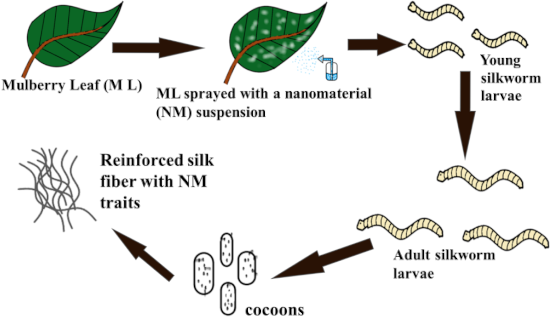
- observed [32]. TiO2 NPs have also been documented to increase the germination of lettuce seeds [33]. Recent reports indicate that multi-walled carbon nanotubes (MWCNTs) also increased the germination of tomato seeds by increasing the seed water uptake [34]. These reports of nanomaterials improving the
- al. [41] reported that the dietary uptake of carbon-based nanomaterials (fullerene C60, carbon black, single-walled nanotubes, multi-walled nanotubes) had no toxic effect on the growth and development of Drosophila melanogaster (fruit fly) from the egg stage to the adult form. However, the dietary
- uptake of carbon black and single-walled nanotubes caused impairment in the locomotor function of these flies. Demir et al. [42] reported that Ag NPs (0.1, 1, 5, and 10 mM) induced genotoxicity in the wing spot assay of fruit flies via somatic recombination. Carmona et al. [43] reported cytotoxic effects


Paper-based triboelectric nanogenerators and their applications: a review
Beilstein J. Nanotechnol. 2021, 12, 151–171, doi:10.3762/bjnano.12.12
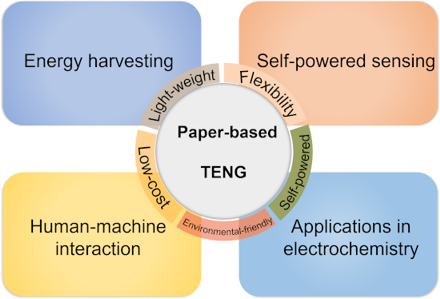
- changing the concentration of the conductive precursors (e.g., AgNWs, carbon nanotubes, and reduced graphene oxide). A special nanoscale paper composed of nanocellulose, which is easy to be synthesized/chemically modified/doped, has attracted great attention in recent years. Generally, cellulose-based






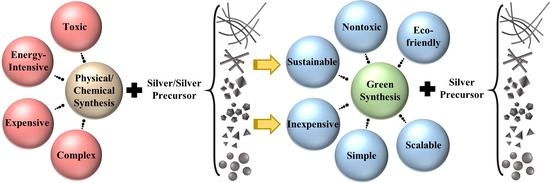
A review on the green and sustainable synthesis of silver nanoparticles and one-dimensional silver nanostructures
Beilstein J. Nanotechnol. 2021, 12, 102–136, doi:10.3762/bjnano.12.9


ZnO and MXenes as electrode materials for supercapacitor devices
Beilstein J. Nanotechnol. 2021, 12, 49–57, doi:10.3762/bjnano.12.4
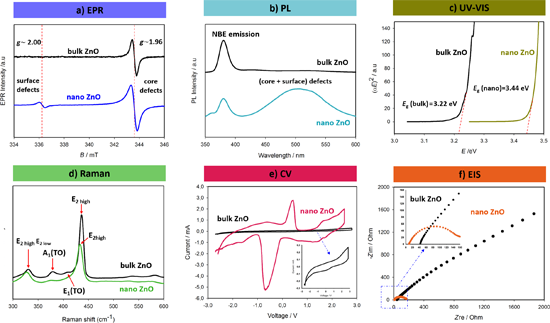
- used, for example, in water purification, as electrochemical actuators, as transparent conductive electrodes, and as biosensors [21][22][28]. To enhance the performance of MXene supercapacitors, a variety of materials, such as graphene and carbon nanotubes (CNTs), tin(IV) oxide (SnO2), and iron(III
Free and partially encapsulated manganese ferrite nanoparticles in multiwall carbon nanotubes
Beilstein J. Nanotechnol. 2020, 11, 1891–1904, doi:10.3762/bjnano.11.170
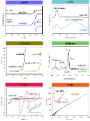
- manganese ferrite nanoparticles inside the tubes is observed as a shift in the X-ray diffraction peaks and as an increase in stress, hyperfine field, and coercivity when compared to free manganese ferrite nanoparticles. On the other hand, a strong charge transfer from the multiwall carbon nanotubes is
- ferrite nanoparticles in comparison to free manganese ferrite nanoparticles, which leads to an enhancement of the metallic properties. Keywords: carbon nanotubes; charge transfer; manganese ferrite; metallic nanoparticles; partial encapsulation; stress; surface; Introduction Since the discovery of
- carbon nanotubes (CNTs), researchers have been interested in functionalizing, inserting, and encapsulating materials inside their inner cavities. Processes related to functionalizing and inserting nanomaterials (i.e., directly implanting as-synthesized nanomaterials into CNTs) have been widely reported




Kondo effects in small-bandgap carbon nanotube quantum dots
Beilstein J. Nanotechnol. 2020, 11, 1873–1890, doi:10.3762/bjnano.11.169
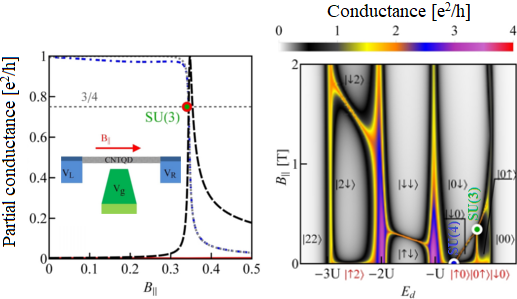
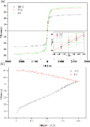
- close to perpendicular. When the field approaches a transverse orientation a crossover from SU(2) or SU(3) symmetry into SU(4) is observed. Keywords: carbon nanotubes; Kondo effect; mesoscopic transport; quantum dots; valleytronics; Introduction Due to their remarkable electronic, transport
- , mechanical, and magnetic properties carbon nanotubes (CNTs) are of great interest in molecular electronics and spintronics with potential applications, for example, as field-effect transistors, nanoelectromechanical devices, logic gates, spin valves, spin diodes, and spin batteries [1][2][3][4][5][6][7][8][9
- ][10][11]. CNTs are also interesting for fundamental science. Their study allows for the examination of many basic properties in ranges often not reachable in other systems. Many of the fundamental transport properties were observed in nanotubes, including Coulomb blockade [12][13], Fabry–Perot

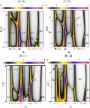
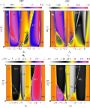


![[Graphic 37]](/bjnano/content/inline/2190-4286-11-169-i52.svg?max-width=637&scale=1.18182) as a functio...
as a functio...


Towards 3D self-assembled rolled multiwall carbon nanotube structures by spontaneous peel off
Beilstein J. Nanotechnol. 2020, 11, 1865–1872, doi:10.3762/bjnano.11.168
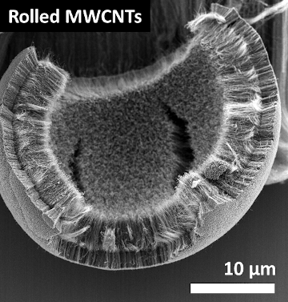
- ; multiwall carbon nanotubes; nitrogen doping; peel off; rolled carbon nanotubes; Introduction Carbon nanotubes (CNTs) are popular materials used in various applications [1]. These tubular hollow carbon nanomaterials have proven to be useful in multiple scientific fields [2][3][4][5][6]. Complex structures



Nanomechanics of few-layer materials: do individual layers slide upon folding?
Beilstein J. Nanotechnol. 2020, 11, 1801–1808, doi:10.3762/bjnano.11.162
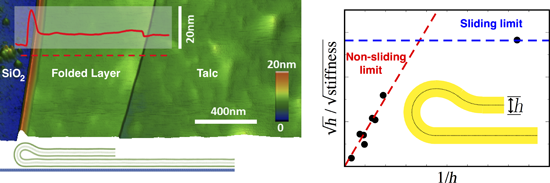
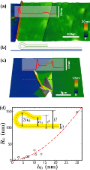
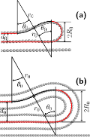
- carbon nanotubes [13][14]. The interlayer slip is also intimately related to the dependence of κ on the thickness or the number of layers of a 2D material, which, in the case of very thin 2D materials, may be very different from that obtained from classical theories [12]. The quantification and

![[Graphic 5]](/bjnano/content/inline/2190-4286-11-162-i8.svg?max-width=637&scale=1.18182) =
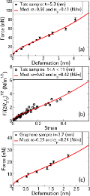
= ![[Graphic 6]](/bjnano/content/inline/2190-4286-11-162-i9.svg?max-width=637&scale=1.18182) as a function of 1/h for the nine measured talc samples. h is a directly measured ...
as a function of 1/h for the nine measured talc samples. h is a directly measured ...
PEG/PEI-functionalized single-walled carbon nanotubes as delivery carriers for doxorubicin: synthesis, characterization, and in vitro evaluation
Beilstein J. Nanotechnol. 2020, 11, 1728–1741, doi:10.3762/bjnano.11.155
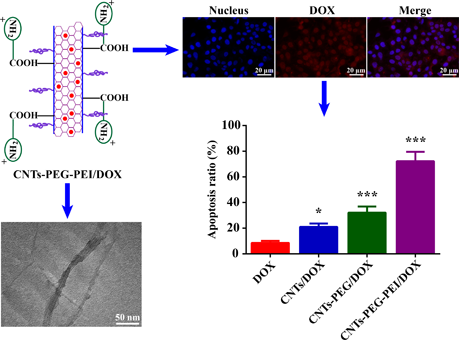
- of Chemistry and Molecular Engineering, Zhengzhou University, Zhengzhou, P. R. China 10.3762/bjnano.11.155 Abstract Single-walled carbon nanotubes (SWCNTs) have attracted great interest regarding drug-delivery applications. However, their application has been limited by some inherent disadvantages
- drugs. Keywords: antitumor activity; cellular uptake; PEG functionalization; PEI functionalization; poly(ethylene glycol) (PEG); polyethylenimine (PEI); single-walled carbon nanotubes; Introduction To date, chemotherapy is the most common therapy for cancer treatment. However, the inability of
- the distribution in normal tissues, and to improve the biological half-lives [3][4][5][6]. Carbon nanotubes (CNTs) have attracted great interest for biomedical applications, including the delivery of bioactive molecules such as drugs, the targeted cancer therapy, and biological imaging, because of




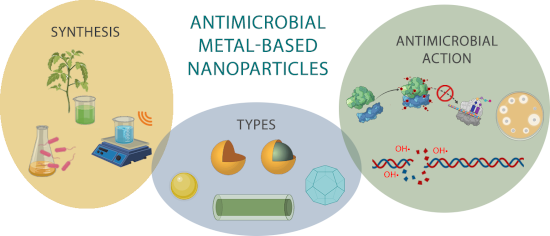
Antimicrobial metal-based nanoparticles: a review on their synthesis, types and antimicrobial action
Beilstein J. Nanotechnol. 2020, 11, 1450–1469, doi:10.3762/bjnano.11.129
- , Lopez de Dicastillo et al. (2018, 2019) have recently developed hollow titanium dioxide nanotubes and nanospheres through the deposition of tetrakis(dimethylamide) titanium and water, as precursors, on polymeric structures obtained via electrospinning. The resulting hollow nanotubes and nanospheres had
- thickness values of approximately 20 and 17 nm, respectively [38][39]. ALD has been recognized as a key technique used to deposit thin films on structures with complex geometries, allowing for the synthesis of nanostructures without shadowing effects and with a high aspect ratio, such as nanotubes with
- NPs has been directed towards water disinfection, food packaging in addition to their known use as a UV filter to prevent skin cancer [114]. Lopez de Dicastillo et al. (2019) developed hollow TiO2 nanotubes and nanospheres with high antimicrobial activity through the combination of electrospinning and


Structure and electrochemical performance of electrospun-ordered porous carbon/graphene composite nanofibers
Beilstein J. Nanotechnol. 2020, 11, 1280–1290, doi:10.3762/bjnano.11.112
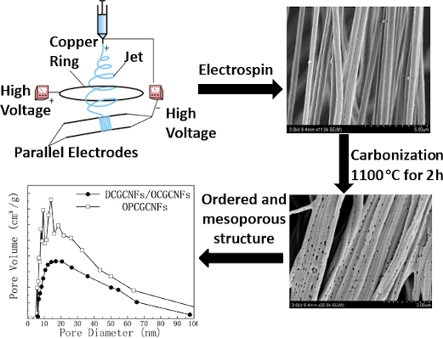
- devices [1][2], are one of the most needed energy storage devices. Their main characteristics include high energy density, high power density, and fast charging speed [3][4][5]. These instruments have electrodes that are composed of either carbonaceous materials (carbon nanotubes, graphene, carbon


Ultrasensitive detection of cadmium ions using a microcantilever-based piezoresistive sensor for groundwater
Beilstein J. Nanotechnol. 2020, 11, 1242–1253, doi:10.3762/bjnano.11.108
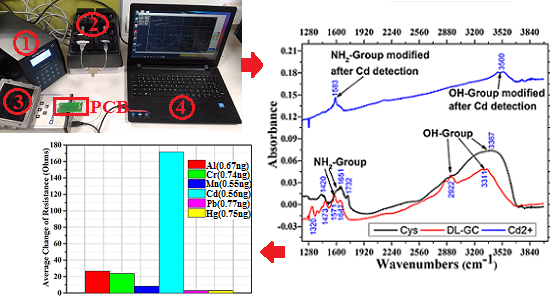
- based on nanotubes, nanorods, nanoneedles, or nanoplates are also used to detect HMIs selectively down to the nanomolar range [8][9][10][11]. Many authors used adsorption methods to extract heavy metal ions from groundwater [12][13][14][15][16]. However, this is only useful when a pollution source has




3D superconducting hollow nanowires with tailored diameters grown by focused He+ beam direct writing
Beilstein J. Nanotechnol. 2020, 11, 1198–1206, doi:10.3762/bjnano.11.104
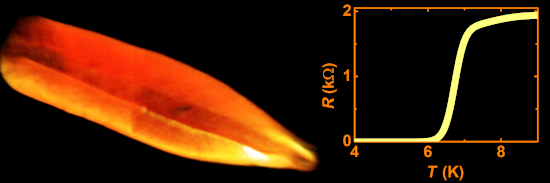
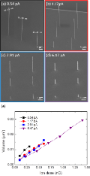
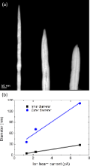
- nanotubes as small as 32 nm in diameter [17] and nanohelices with controllable geometries, including the smallest and most densely packed nanohelix to date with a diameter of 100 nm [19]. In this work, we present the direct writing of 3D WC crystalline superconducting hollow NWs with tailored diameters
- penetration depth, λ, [38][39] ranges from 720 to 874 nm. Additionally, Jc (0.6 K, 0 T) is approx. 0.15 MA/cm2. Summarizing, the estimated superconducting parameters (Tc, µ0Hc2, Jc, ξ, λ) for these NWs (Table 2) are mostly compatible with those reported for He+ FIBID out-of-plane WC nanotubes [17



Photothermally active nanoparticles as a promising tool for eliminating bacteria and biofilms
Beilstein J. Nanotechnol. 2020, 11, 1134–1146, doi:10.3762/bjnano.11.98
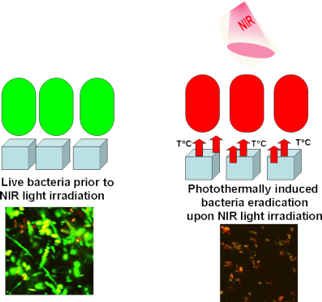
- photothermal effect under NIR laser irradiation. Carbon nanotubes are another valuable class of nanomaterials. They have high photothermal efficiency under NIR irradiation which excites the longitudinal phonon resonance along the nanotube. The resonance peaks can be tuned by changing the tube length [86
- ]. Therefore, carbon nanotubes also have potential to be used in the NIR-triggered photothermal bacterial treatment. It was shown that multiwall carbon nanotubes functionalized with antibodies against the group A Streptococcus bacteria were capable of photothermally ablating the planktonic and biofilm-residing
- bacteria upon 800 nm laser exposure (1.3 W/cm2) for 10–120 s [87]. The authors also found that, upon NIR irradiation, the antibody-labelled nanotubes displayed an enhanced antibacterial action on both planktonic cells and biofilms when compared to carboxylated multiwall carbon nanotubes. The use of carbon


Vibration analysis and pull-in instability behavior in a multiwalled piezoelectric nanosensor with fluid flow conveyance
Beilstein J. Nanotechnol. 2020, 11, 1072–1081, doi:10.3762/bjnano.11.92
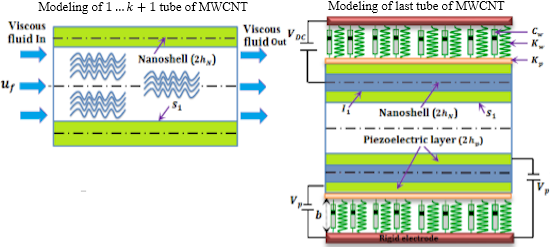
- result, MWNS materials are preferred in many applications such as nanoresonators. Many studies have been carried out on the vibration and stability analysis of nanostructures with some reviews given as follows. Strozzi and Pellicano investigated the vibration analysis of triple-walled carbon nanotubes
- (TWNTs) subjected to the interlayer van der Waals (vdW) force in the framework of the Sanders–Koiter shell theory [12]. Also, based on nonlocal cylindrical shell theory, Ghorbanpour Arani et al. studied nonlinear vibration and instability of double-walled boron nitride nanotubes [13]. Malihi et al
- stress theory to investigate the effects of various fluid parameters on the pull-in voltage of carbon nanotubes conveying viscous fluid [15]. Also, the vibration analysis of viscoelastic double-walled carbon nanotubes (DWCNTs) combined with ZnO layers and subjected to magnetic and electric fields were


![[Graphic 46]](/bjnano/content/inline/2190-4286-11-92-i46.svg?max-width=637&scale=1.18182) on DNF of FC-MWPENS.
on DNF of FC-MWPENS.


![[Graphic 50]](/bjnano/content/inline/2190-4286-11-92-i50.svg?max-width=637&scale=1.18182) on DNF of SS FC-MWPENS.
on DNF of SS FC-MWPENS.


![[Graphic 54]](/bjnano/content/inline/2190-4286-11-92-i54.svg?max-width=637&scale=1.18182) on DNF of SS FC-MWPENS.
on DNF of SS FC-MWPENS.


![[Graphic 59]](/bjnano/content/inline/2190-4286-11-92-i59.svg?max-width=637&scale=1.18182) for fluid velocity
for fluid velocity ![[Graphic 60]](/bjnano/content/inline/2190-4286-11-92-i60.svg?max-width=637&scale=1.18182) on DNF of SS FC-MWPENS.
on DNF of SS FC-MWPENS.

![[Graphic 61]](/bjnano/content/inline/2190-4286-11-92-i61.svg?max-width=637&scale=1.18182) for pull-in voltage on DNF of SS FC-MWPENS.
for pull-in voltage on DNF of SS FC-MWPENS.

![[Graphic 67]](/bjnano/content/inline/2190-4286-11-92-i67.svg?max-width=637&scale=1.18182) for fluid velocity
for fluid velocity ![[Graphic 68]](/bjnano/content/inline/2190-4286-11-92-i68.svg?max-width=637&scale=1.18182) on DNF of SS FC-MWPENS.
on DNF of SS FC-MWPENS.

![[Graphic 69]](/bjnano/content/inline/2190-4286-11-92-i69.svg?max-width=637&scale=1.18182) for pull-in voltage on DNF of SS FC-MWPENS.
for pull-in voltage on DNF of SS FC-MWPENS.

![[Graphic 73]](/bjnano/content/inline/2190-4286-11-92-i73.svg?max-width=637&scale=1.18182) on DNF of SS FC-MWPENS.
on DNF of SS FC-MWPENS.


![[Graphic 75]](/bjnano/content/inline/2190-4286-11-92-i75.svg?max-width=637&scale=1.18182) on DNF of SS FC-MWPENS.
on DNF of SS FC-MWPENS.

Microwave-induced electric discharges on metal particles for the synthesis of inorganic nanomaterials under solvent-free conditions
Beilstein J. Nanotechnol. 2020, 11, 1019–1025, doi:10.3762/bjnano.11.86
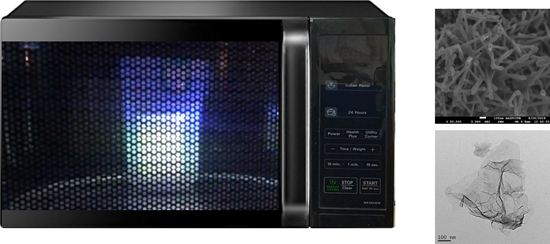
- . The average diameter of the nanorods is 100 nm and the length ranges from 2 to 3 µm. The formation of external amorphous fluorinated carbon nanotubes helps as a template in the formation of ZnF2 nanorods. It is well established that sulfur acts as a growth promoter for carbon nanotubes and carbon
- mixture along with g-C3N4, sulfur helps to produce carbon nanotubes instead of carbon nanospheres. The reactivity of sulfur with the end caps of nanotubes does not allow the carbon nanotubes to close. These amorphous carbon nanotubes help as a template to intercalate metal fluorides/metal sulfides. As the
- local temperatures are very high, metal fluorides and sulfides melt and fill the nanotubes via capillary forces. The liquids solidify as one-dimensional nanorods inside the nanotubes. The usage of g-C3N4, instead of graphite, was found to be beneficial, especially for obtaining high yields of nanorods





