Search results
Search for "one-step" in Full Text gives 152 result(s) in Beilstein Journal of Nanotechnology.
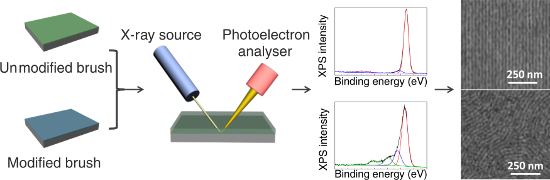
Identifying the nature of surface chemical modification for directed self-assembly of block copolymers
Beilstein J. Nanotechnol. 2017, 8, 1972–1981, doi:10.3762/bjnano.8.198
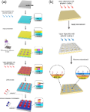
- other processes are based on direct writing (one-step) methods, thus avoiding the use of a resist. The selected methods are EBL (middle in Figure 1) and parallel oxidation nanolithography [18] (PON) (bottom of the Figure), respectively. The PON method is performed by contacting a conductive mold with


Application of visible-light photosensitization to form alkyl-radical-derived thin films on gold
Beilstein J. Nanotechnol. 2017, 8, 1863–1877, doi:10.3762/bjnano.8.187
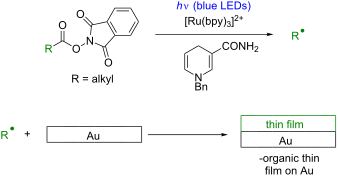
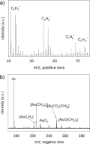
- ), species that are synthesized in one step from carboxylic acids [33][34][35][36][37][38][39][40] and which have been used to address a number of difficult problems in organic synthesis [36][37][38][39][40]. Therefore (Scheme 1), visible-light irradiation (e.g., with blue LEDs) of the photosensitizer [Ru



Micro- and nano-surface structures based on vapor-deposited polymers
Beilstein J. Nanotechnol. 2017, 8, 1366–1374, doi:10.3762/bjnano.8.138
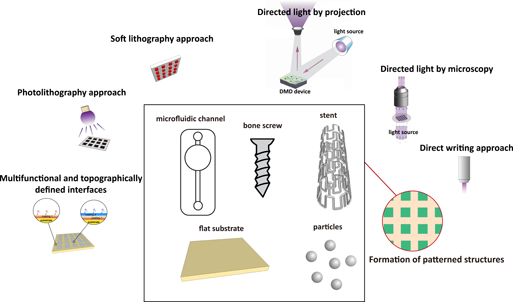
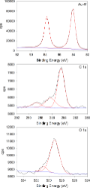
- depositions of different functional polymer films; the hierarchical structure of the outer layer and exposed underneath layers forms the multifunctional interface (Figure 4). Vapor-based multicomponent copolymers can be synthesized through CVD in one step by introducing independent monomers into the


Oxidative chemical vapor deposition of polyaniline thin films
Beilstein J. Nanotechnol. 2017, 8, 1266–1276, doi:10.3762/bjnano.8.128
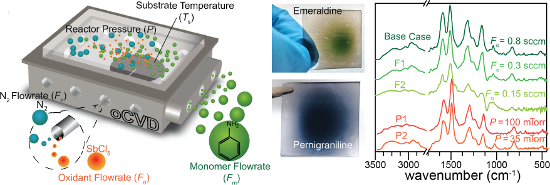
- washing and could be related to less stable oligomer units. Conclusions The oCVD process provides a viable approach for a one-step synthesis and deposition of PANI thin films using aniline monomer and antimony pentachloride oxidant. By carefully adjusting oCVD processing parameters, emeraldine PANI with




Optical response of heterogeneous polymer layers containing silver nanostructures
Beilstein J. Nanotechnol. 2017, 8, 1065–1072, doi:10.3762/bjnano.8.108
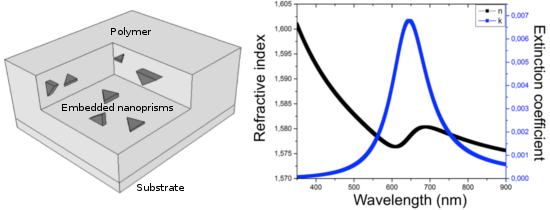
- our structures, through AFM or TEM studies, may improve our optical models in the future. Experimental Synthesis of nanoparticles The NPs were synthesized by the reduction of silver ions by sodium borohydride at room temperature in water. The nanospheres were synthesized in a one-step method [17]. The


The integration of graphene into microelectronic devices
Beilstein J. Nanotechnol. 2017, 8, 1056–1064, doi:10.3762/bjnano.8.107
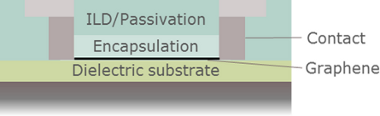
- contamination of graphene by following lithography steps. One method utilizes a one-step plasma-etch process with low selectivity to the underlying dielectric substrate to etch the encapsulation/hardmask layer and the underlying graphene simultaneously. An alternative approach applies two consecutive steps to
- permission from [58], copyright 2013 AAAS. (a) Schematic of the final side-contact hole cross-section after a one-step non-selective etch process and a two-step selective etch process. (b) General schematic of the integrated device comprising side contacts. Acknowledgements This work was financially


Synthesis of graphene–transition metal oxide hybrid nanoparticles and their application in various fields
Beilstein J. Nanotechnol. 2017, 8, 688–714, doi:10.3762/bjnano.8.74
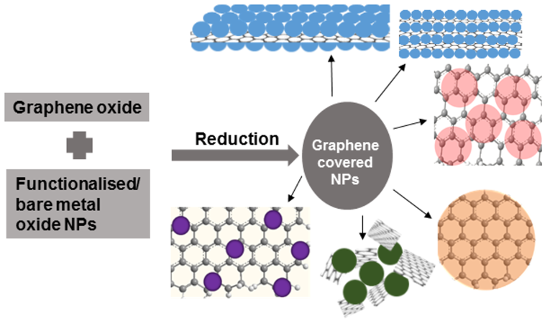
- , solid and hollow spheres. Graphene-wrapped Cu2O nanocubes exhibit higher electrocatalytic performance towards electro-oxidation of glucose with lower detection time, and this hybrid has improved electrochemical stability [211]. Ding et al. have prepared Cu2O microspheres on rGO by a one-step synthesis
- prepared by a one-step chemical method [225]. For the formation of graphene-wrapped ZnO NPs, some other routes have been used, like chemical functionalisation of the ZnO surface. In this process there are three steps: surface modification of NPs mainly by amine groups, coating the NPs with a GO shell, and






α-((4-Cyanobenzoyl)oxy)-ω-methyl poly(ethylene glycol): a new stabilizer for silver nanoparticles
Beilstein J. Nanotechnol. 2017, 8, 627–635, doi:10.3762/bjnano.8.67
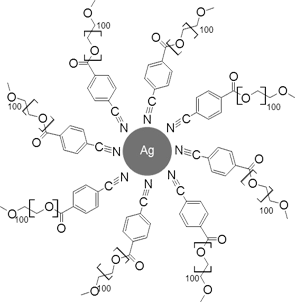
- -cyanobenzoyl)oxy)-ω-methyl poly(ethylene glycol) (CBAmPEG) exploiting the cyano group as an anchor. CBAmPEG is (i) accessible in good yield via a simple one-step synthesis and (ii) provides an efficient stabilization of SNPs in a pH range between 3 and 9. The latter point is important because degradation of


Role of oxygen in wetting of copper nanoparticles on silicon surfaces at elevated temperature
Beilstein J. Nanotechnol. 2017, 8, 425–433, doi:10.3762/bjnano.8.45
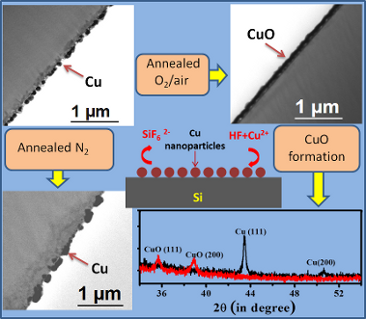
- oxidation of Cu nanoparticles deposited by the galvanic displacement reaction on silicon surfaces at various ambient conditions. Experimental Copper nanoparticles have been deposited on Si(100) substrates by an easy, one-step galvanic displacement reaction. 5 mL of 10 mM CuSO4 (Merck, >99%) solution was


Tailoring bifunctional hybrid organic–inorganic nanoadsorbents by the choice of functional layer composition probed by adsorption of Cu2+ ions
Beilstein J. Nanotechnol. 2017, 8, 334–347, doi:10.3762/bjnano.8.36
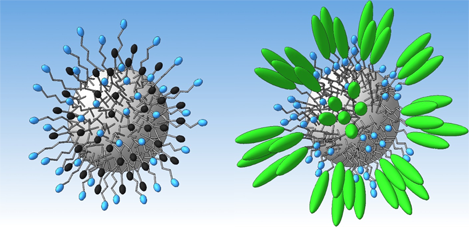
- (CH2)3NH2/≡SiCH3, ≡Si(CH2)3NH2/≡Si(CH2)2(CF2)5CF3) surface layers were produced by a one-step approach using a modified Stöber method in three-component alkoxysilane systems, resulting in greatly increased contents of functional components. The content of functional groups and thermal stability of the
- of functionalized silica nano- and sub-microspheres is achieved usually via two commonly used techniques. The first is based on the surface modification of Stöber silica spheres using trialkoxy silanes, (RO)3SiR'. The second technique applies a one-step synthesis, where the network-forming agent
- useful in further grafting of new functions via organic condensation reactions [30]. In the studies examining one-step preparations of nanoparticles bearing 3-aminopropyl groups it was shown that heating a suspension in DMF at 100 °C for 24 h did not increase the content of surface amino groups, but


Nanoscale isoindigo-carriers: self-assembly and tunable properties
Beilstein J. Nanotechnol. 2017, 8, 313–324, doi:10.3762/bjnano.8.34
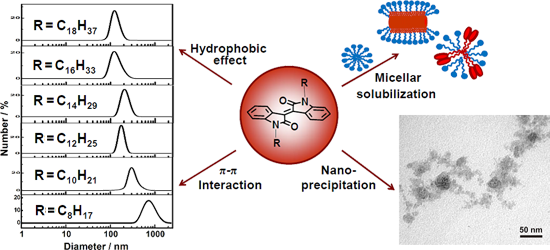
- cancer cells [59]. The factors controlling the formation of nanoparticles have been determined [42][57]. Nanoprecipitation is ideal, when the compound must dissolve in one component (the solvent), but must not in the second one (the non-solvent). This one-step manufacturing process commonly available to

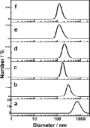


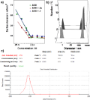

Functionalized TiO2 nanoparticles by single-step hydrothermal synthesis: the role of the silane coupling agents
Beilstein J. Nanotechnol. 2017, 8, 304–312, doi:10.3762/bjnano.8.33
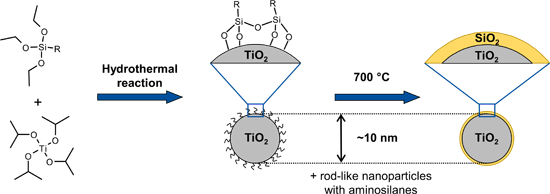
- . The one-step aqueous synthesis reported here reduces time, the number of steps needed, and the complexity of production of surface-functionalized TiO2 nanoparticles. Despite the hydrothermal conditions, the synthesis is simple, robust, and reproducible. The numerous varieties of silane coupling agents


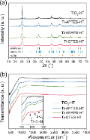

Sensitive detection of hydrocarbon gases using electrochemically Pd-modified ZnO chemiresistors
Beilstein J. Nanotechnol. 2017, 8, 82–90, doi:10.3762/bjnano.8.9
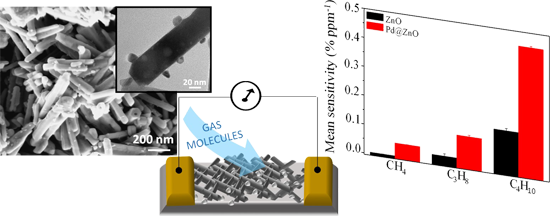
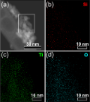
- clustering with the subsequent worsening of their catalytic activity [10]. Therefore, various new synthetic procedures have been proposed to overcome these limits [42][43]. In this study, we propose a one-step strategy based on sacrificial anode electrolysis (SAE) to synthesize stabilized Pd NPs [44


From iron coordination compounds to metal oxide nanoparticles
Beilstein J. Nanotechnol. 2016, 7, 2074–2087, doi:10.3762/bjnano.7.198
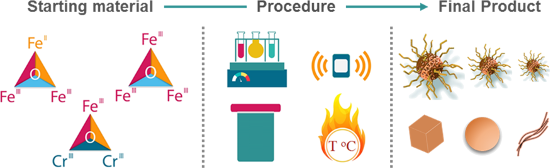
- -valence trinuclear acetate cluster to obtain ultra-small iron oxide nanoparticles. These have been prepared by one-step procedure consisting of the thermal decomposition of the reaction mixture that contains mixed-valence iron acetate (FeAc1) as the oxide precursor, dodecylamine (DA) and sunflower oil (SO


Antitumor magnetic hyperthermia induced by RGD-functionalized Fe3O4 nanoparticles, in an experimental model of colorectal liver metastases
Beilstein J. Nanotechnol. 2016, 7, 1532–1542, doi:10.3762/bjnano.7.147
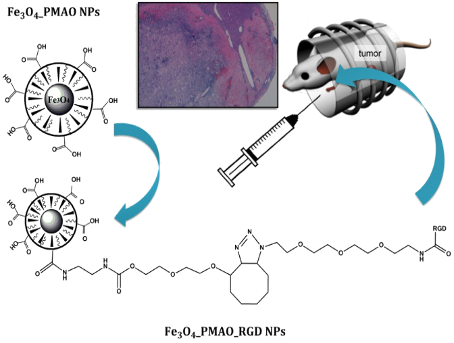
- nanoparticles (Fe3O4@PMAO). Carboxylic groups of PMAO were anchored with an amino-modified linker to add an alkyne group, which are the alkyne-modified NPs coupled by the azide-modified RGD peptide (RGD-N3) in water in a one-step procedure by a click reaction (Fe3O4@PMAO_RGD). Details of the preparation process
- , the azide-modified RGD peptide (Arg-Gly-Asp) (RGD-N3) in water in a one-step procedure by a click reaction (see Supporting Information File 1). These “clicked” MNPs (Fe3O4@PMAO_RGD) were thoroughly washed with distilled water and MNP fluids with concentrations around 1–1.5 mg Fe/mL in a PBS/H2O (1:10


Effect of triple junctions on deformation twinning in a nanostructured Cu–Zn alloy: A statistical study using transmission Kikuchi diffraction
Beilstein J. Nanotechnol. 2016, 7, 1501–1506, doi:10.3762/bjnano.7.143
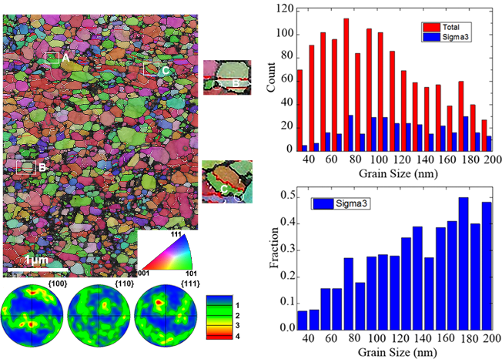
- boundary. But when the twin is extremely small and thinner than one step size (6 nm), it cannot be detected by TKD in our study. Therefore, when the twin domain thickness is around or slightly larger than the step size, as in the case of Figure 3a, TKD is able to detect the twin, but unable to resolve the


An efficient recyclable magnetic material for the selective removal of organic pollutants
Beilstein J. Nanotechnol. 2016, 7, 1447–1453, doi:10.3762/bjnano.7.136
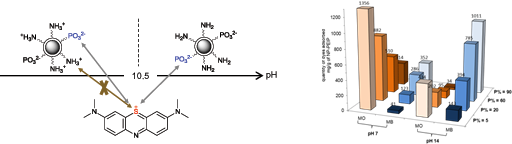
- magnetic core. Polyethylenimine is phosphonated at different percentages by a one-step process and used to coat maghemite nanoparticles. It selectively extracts high amounts of cationic and anionic contaminants over a wide range of pH values, depending on the adjustable number of phosphonate groups


Three-gradient regular solution model for simple liquids wetting complex surface topologies
Beilstein J. Nanotechnol. 2016, 7, 1377–1396, doi:10.3762/bjnano.7.129



![[Graphic 10]](/bjnano/content/inline/2190-4286-7-129-i31.png?max-width=637&scale=1.18182) and standard deviation as a function of the cavity diameter d (in...
and standard deviation as a function of the cavity diameter d (in...

![[Graphic 20]](/bjnano/content/inline/2190-4286-7-129-i41.png?max-width=637&scale=1.18182) and the corresponding fluctuations (measured along the x-direction) indica...
and the corresponding fluctuations (measured along the x-direction) indica...

![[Graphic 28]](/bjnano/content/inline/2190-4286-7-129-i49.png?max-width=637&scale=1.18182) and the corresponding standard deviation as measure of variation in the ...
and the corresponding standard deviation as measure of variation in the ...

![[Graphic 39]](/bjnano/content/inline/2190-4286-7-129-i60.png?max-width=637&scale=1.18182) and standard deviation as function of cut-off fraction c for fixed ...
and standard deviation as function of cut-off fraction c for fixed ...
On the pathway of cellular uptake: new insight into the interaction between the cell membrane and very small nanoparticles
Beilstein J. Nanotechnol. 2016, 7, 1296–1311, doi:10.3762/bjnano.7.121
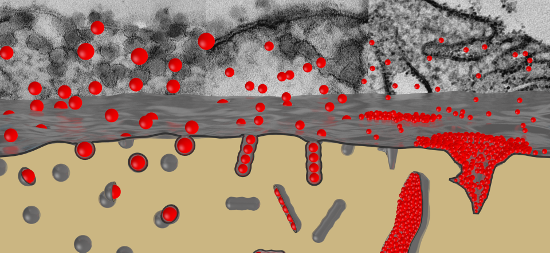
- have been reported in humans, general risk assessment and thereby the investigation of possible interactions of SiNPs with human cells and tissues is of crucial importance. A deeper understanding of SiNP uptake modes into cells may lead us one step further in grasping nanoparticle cytotoxicity and in




Fast diffusion of silver in TiO2 nanotube arrays
Beilstein J. Nanotechnol. 2016, 7, 1129–1140, doi:10.3762/bjnano.7.105
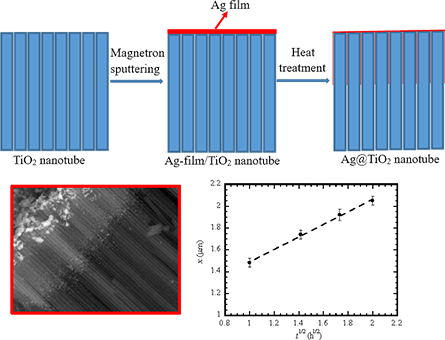
- of about 6.5 μm. The outmost surface of the pure TiO2 nanotubes prepared by the two-step anodization process is relatively clean and smooth, as shown in Figure 2b. For comparison, typical SEM images of the pure TiO2 nanotube arrays prepared by a one-step anodization process are shown in Figure S1c in
- Supporting Information File 1. The outmost surface of the pure TiO2 nanotubes prepared by the two-step anodization process is much cleaner and smoother than those prepared by the one-step anodization process. No “bamboo-like” structures are present on the outmost surface of the pure TiO2 nanotubes. Only the
- pure TiO2 nanotubes prepared by the two-step anodization process were used in this work. The inserted image in Figure 2b shows the topology of the Ti surface after the nanotubes formed by the one-step anodization were ultrasonically removed. There are no TiO2 nanotubes observable, and well-ordered


Facile synthesis of water-soluble carbon nano-onions under alkaline conditions
Beilstein J. Nanotechnol. 2016, 7, 758–766, doi:10.3762/bjnano.7.67
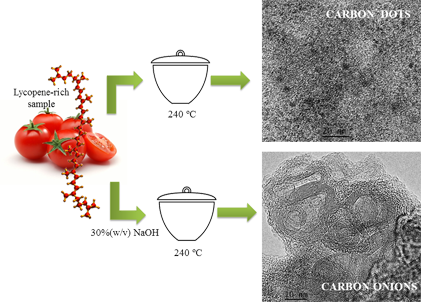
- C-NPs produced by the one-step thermal carbonization of tomatoes. For C-dots, a featureless reflection band centered at 2θ = 21.68° corresponds to the diffraction of graphite [002] crystal planes and a weak broad peak at about 2θ = 43° corresponds to the {100/101} set of crystal planes [24] of


Magnetic switching of nanoscale antidot lattices
Beilstein J. Nanotechnol. 2016, 7, 733–750, doi:10.3762/bjnano.7.65
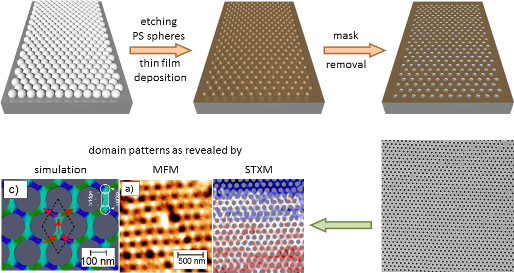
- vertices [15]. Neighbouring vortices are interacting via the thinner connecting bridges leading eventually to vortex-antivortex magnetic configurations where the antivortex is located at the bridge. Even one step further, an artificial skyrmionic lattice has been prepared using a heterostructure of a Py



Evaluation of gas-sensing properties of ZnO nanostructures electrochemically doped with Au nanophases
Beilstein J. Nanotechnol. 2016, 7, 22–31, doi:10.3762/bjnano.7.3
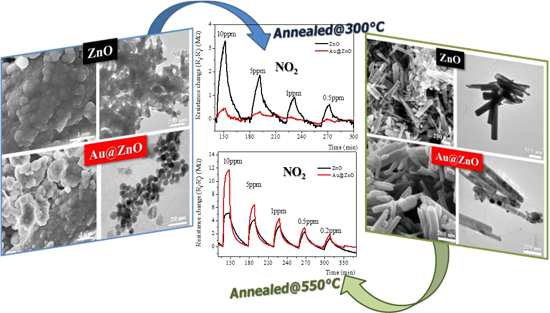
- Technologies, Energy and Sustainable Economic Development (ENEA), Technical Unit for Materials Technologies - Brindisi Research Center, Mesagne (BR), Italy CNR-IFN Bari, Bari, Italy 10.3762/bjnano.7.3 Abstract A one-step electrochemical method based on sacrificial anode electrolysis (SAE) was used to deposit




Sonochemical co-deposition of antibacterial nanoparticles and dyes on textiles
Beilstein J. Nanotechnol. 2016, 7, 1–8, doi:10.3762/bjnano.7.1
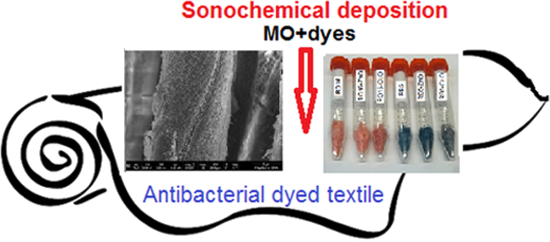
- wide range of applications. Here, we report for the first time on the simultaneous sonochemical dyeing and coating of textiles with antibacterial metal oxide (MO) nanoparticles. In this one-step process the antibacterial nanoparticles are synthesized in situ and deposited together with dye
- , however, find only one report in which sonochemistry was used for the co-deposition of AgNPs and AgCl on TiO2 NPs to form Ag@TiO2 and Ag/AgCl@TiO2 [18]. The synthetic process revealed that in fact it was a one-step process combining Ag+, TiO2 NPs, and NaCl in ethylene glycol solution. The sonochemical
- impart two functions in a one-step process that led to stabilization of the dye on the surface while exposed to the solution. Conclusion This is the first time that the sonochemical coating technique was applied for co-deposition of two functional materials. The simultaneous coating of the antibacterial




Possibilities and limitations of advanced transmission electron microscopy for carbon-based nanomaterials
Beilstein J. Nanotechnol. 2015, 6, 1541–1557, doi:10.3762/bjnano.6.158
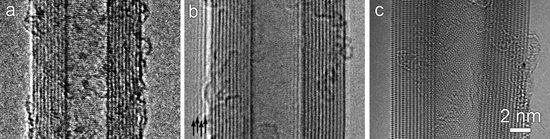
- diamond is also shown here [93] as an example of carbon nanostructure with predominantly sp3 hybridization (Figure 6e). A unique σ* feature starting at 290 eV is typical for diamond, in contrast to that of graphene, which starts at 292 eV. One step further, the doping of elements into carbon lattices can