Search results
Search for "spring constant" in Full Text gives 182 result(s) in Beilstein Journal of Nanotechnology.
Impact of surface wettability on S-layer recrystallization: a real-time characterization by QCM-D
Beilstein J. Nanotechnol. 2017, 8, 91–98, doi:10.3762/bjnano.8.10
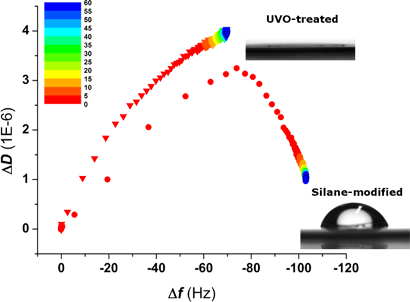
- (AFM): Recrystallized proteins were visualized using a multimode-AFM (Bruker AXS, Santa Barbara, USA) controlled by a Nanoscope V equipped with a J-scanner. Silicon-nitride probes (DNP-S, Bruker, USA) with a spring constant of about 0.3 N/m were used in the experiments, which were calibrated on SiO2


Surface roughness rather than surface chemistry essentially affects insect adhesion
Beilstein J. Nanotechnol. 2016, 7, 1471–1479, doi:10.3762/bjnano.7.139
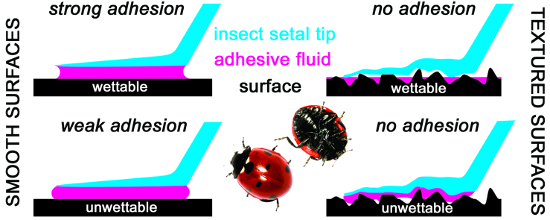
- (AFM, XE-100, Park Systems), with a Si probe (910M-NCHR; spring constant of 42 N/m and response frequency of 330 kHz, Park Systems). The surface roughness (root-mean square roughness, Rrms) were estimated using two separate techniques due to the huge disparity in the size of surface textures on smooth



Customized MFM probes with high lateral resolution
Beilstein J. Nanotechnol. 2016, 7, 1068–1074, doi:10.3762/bjnano.7.100
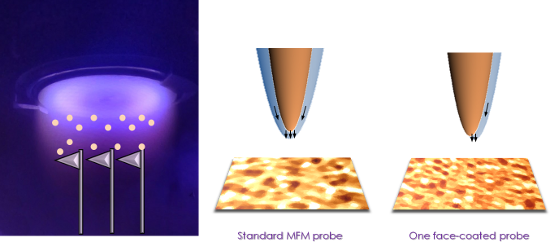
- ); AFM probes; high-resolution microscopy; magnetic force microscopy (MFM); magnetic materials; Introduction Conventional MFM probes consist of pyramidal Si or SiN tips with a ferromagnetic thin film coating (generally a CoCr alloy) mounted on a cantilever with resonance frequency and spring constant of
- also select the cantilever properties for each experiment, such as the spring constant, resonance frequency or the position of the tip on the lever. We have found neither in the literature nor in the market any MFM probe with cantilever characteristics far from the range of the aforementioned. Making
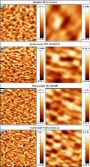
- present a comparison of the MFM images obtained with four different sorts of probes: three kinds of commercial tips [26][27] and the custom-made probes described here, all of them using cantilevers of similar properties (namely resonance frequency and spring constant of around 75 kHz and 3 N/m


Signal enhancement in cantilever magnetometry based on a co-resonantly coupled sensor
Beilstein J. Nanotechnol. 2016, 7, 1033–1043, doi:10.3762/bjnano.7.96
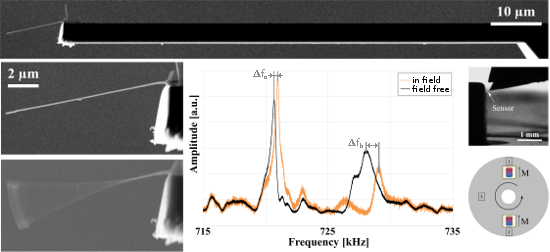
- usually achieved through geometric changes, making the cantilever itself very small and thin. An oscillating cantilever beam can be represented by a harmonic oscillator model for each flexural eigenmode of the beam [5]. Considering an external force gradient as an additional spring constant Δk, the
- eigenfrequency of the cantilever as a harmonic oscillator is given by: with the spring constant k and effective mass meff of the cantilever. Please note that the eigenfrequency f0 and the resonance frequency of a harmonic oscillator should in principle be distinguished. They are connected by the relation
- frequency of the cantilever. The magnetic interaction between sample and external magnetic field acts as the additional spring constant Δk, altering the resonance frequency of the cantilever. The frequency shift Δf induced by these interactions can be derived from Equation 1 as: In the case of cantilever


![[Graphic 11]](/bjnano/content/inline/2190-4286-7-96-i21.png?max-width=637&scale=1.18182) on the interaction spring constant k3. Th...
on the interaction spring constant k3. Th...
Understanding interferometry for micro-cantilever displacement detection
Beilstein J. Nanotechnol. 2016, 7, 841–851, doi:10.3762/bjnano.7.76
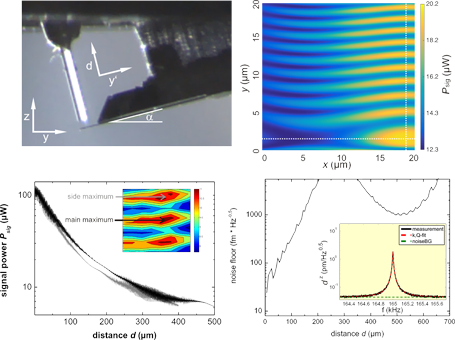
- deflection. To further optimize the signal, we introduce a method for positioning the fiber precisely in the optimal lateral position and examine the importance of this positioning. Finally, we investigate the impact of the interferometric signal on the effective modal spring constant and the modal Q-factor
- parameters are compiled in Table 1. The fringe-dependent effective cantilever stiffness k± is determined by a method relating the intrinsic stiffness to the optical spring constant as described in detail in [8]. In a series of measurements, we determine the noise floor by measuring the displacement noise




![[Graphic 27]](/bjnano/content/inline/2190-4286-7-76-i36.png?max-width=637&scale=1.18182) of the noise floor of the interferometer signal as a function of the...
of the noise floor of the interferometer signal as a function of the...
In situ observation of deformation processes in nanocrystalline face-centered cubic metals
Beilstein J. Nanotechnol. 2016, 7, 572–580, doi:10.3762/bjnano.7.50
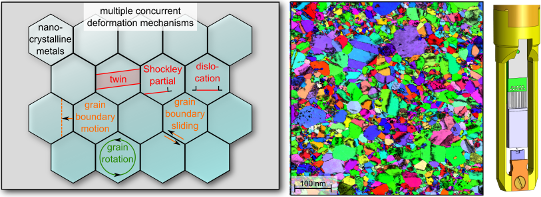
- were acquired as reference for determining the strain (all strain values in this paper are giving relative to the initial dog bone length) and the spring constant of the PTP device was measured with the film ruptured to subtract the PTP device related forces from the measured stress–strain curve


Contact-free experimental determination of the static flexural spring constant of cantilever sensors using a microfluidic force tool
Beilstein J. Nanotechnol. 2016, 7, 492–500, doi:10.3762/bjnano.7.43
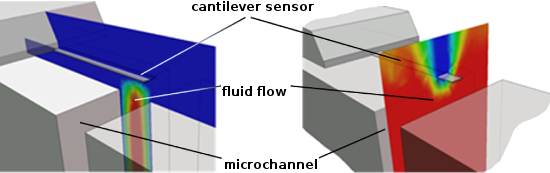
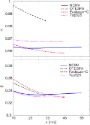
- sensing elements. They enable nanomechanical measurements, are essential for the characterization of nanomaterials, and form an integral part of many nanoscale devices. Despite the fact that numerous methods described in the literature can be applied to determine the static flexural spring constant of
- and demonstrate that this, in combination with a thermal noise spectrum, can provide the static flexural spring constant for cantilever sensors of different geometric shapes over a wide range of spring constant values (≈0.8–160 N/m). Keywords: AFM; cantilever sensors; microfluidic force tool; spring
- employed as freestanding sensors [8][9][10][11][12][13]. In many applications where a cantilever-type sensor is involved, the calibration of the sensor stiffness (spring constant, k) is a prerequisite for obtaining quantitative data. Several methods describing how the static flexural spring constant can be




![[Graphic 28]](/bjnano/content/inline/2190-4286-7-43-i34.png?max-width=637&scale=1.18182) value for cantilever NCHV. The dashed line indicates the mean
value for cantilever NCHV. The dashed line indicates the mean ![[Graphic 29]](/bjnano/content/inline/2190-4286-7-43-i35.png?max-width=637&scale=1.18182) value for ...
value for ...
Efficiency improvement in the cantilever photothermal excitation method using a photothermal conversion layer
Beilstein J. Nanotechnol. 2016, 7, 409–417, doi:10.3762/bjnano.7.36
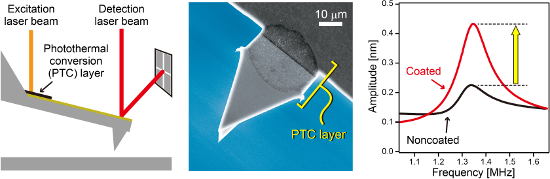
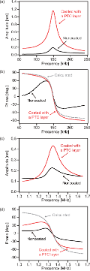
- improving the photothermal excitation efficiency by coating cantilever backside surface near its fixed end with colloidal graphite as a photothermal conversion (PTC) layer. The excitation efficiency for a standard cantilever of PPP-NCHAuD with a spring constant of ≈40 N/m and a relatively stiff cantilever
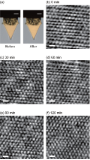
- of AC55 with a spring constant of ≈140 N/m were improved by 6.1 times and 2.5 times, respectively, by coating with a PTC layer. We experimentally demonstrate high stability of the PTC layer in liquid by AFM imaging of a mica surface with atomic resolution in phosphate buffer saline solution for more
- low excitation efficiency, the cantilever oscillation with a desired vibrational amplitude is often difficult to achieve with a moderate laser power (on the order of milliwatts). In particular, a cantilever with a large spring constant requires a large laser power modulation. To overcome this



Molecular machines operating on the nanoscale: from classical to quantum
Beilstein J. Nanotechnol. 2016, 7, 328–350, doi:10.3762/bjnano.7.31
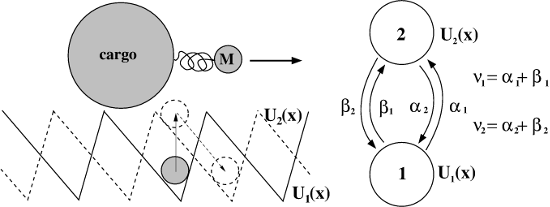

![[Graphic 40]](/bjnano/content/inline/2190-4286-7-31-i86.png?max-width=637&scale=1.18182) with depth ε. Bias Δμ < 0 per one rotation tur...
with depth ε. Bias Δμ < 0 per one rotation tur...

![[Graphic 48]](/bjnano/content/inline/2190-4286-7-31-i94.png?max-width=637&scale=1.18182) , for the most asymmetric sawtooth mod...
, for the most asymmetric sawtooth mod...


Determination of Young’s modulus of Sb2S3 nanowires by in situ resonance and bending methods
Beilstein J. Nanotechnol. 2016, 7, 278–283, doi:10.3762/bjnano.7.25
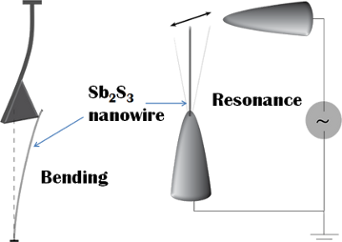
- , mechanical oscillation of the NW can be easily monitored directly in SEM images. For static bending experiments, soft silicon nitride AFM cantilevers with spring constants of 0.002–0.02 N/m (Olympus BL-RC-150VB) were used. The spring constant of the cantilever was calibrated in AFM (Asylum Research MFP-3D
- cantilever displacement, ∆x, and the cantilever spring constant, k, as F = k·Δx. For static bending the load was applied at different vertical positions along the vertical axis of the NW. The measurements showed that the examined NWs exhibited uniform elastic properties along their length. The inset in
- solving Eresonance(L) = Ebending(L) for L, the calculated value was compared with experimentally obtained results, giving a mean relative error of 31%. Measurement errors due to cantilever spring constant calibration were taken into account. Figure 3 suggests that a size effect exists for the investigated


Mismatch detection in DNA monolayers by atomic force microscopy and electrochemical impedance spectroscopy
Beilstein J. Nanotechnol. 2016, 7, 220–227, doi:10.3762/bjnano.7.20
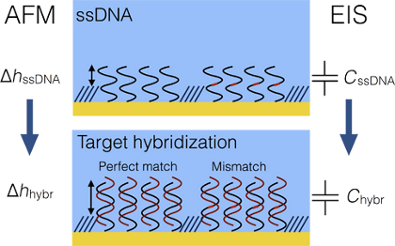
- remove loosely bound molecules and placed in a customised liquid cell for the AFM experiments. All AFM experiments were carried out on a XE-100 Park Instruments with a customised liquid cell. Si cantilevers (NSC36B Mikromasch, spring constant: 0.6 N/m) were used for the nanografting experiments. Briefly
- cantilevers (CSC38 Mikromasch, spring constant: 0.06 N/m) at 1 Hz scan rate, applying a force of 0.1 nN. Hybridization was monitored after the addition of the required target solutions (1 μM target in TE buffer 1 M NaCl) into the AFM liquid cell for 1 h. All DNA sequences used in the present work are listed


Kelvin probe force microscopy for local characterisation of active nanoelectronic devices
Beilstein J. Nanotechnol. 2015, 6, 2193–2206, doi:10.3762/bjnano.6.225
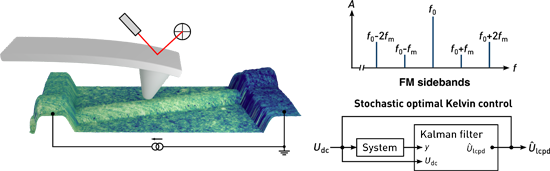
- perturbed by the tip–sample interaction force , where z(t) is the cantilever deflection, ω0 the eigenfrequency, k the spring constant, and Q the quality factor of the cantilever. For an oscillation with amplitude A and drive frequency ωd ≈ ω0, the interaction force can be approximated to where z0 is the


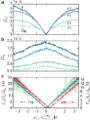
![[Graphic 33]](/bjnano/content/inline/2190-4286-6-225-i48.png?max-width=637&scale=1.18182) for different modulation amplitu...
for different modulation amplitu...




Development of a novel nanoindentation technique by utilizing a dual-probe AFM system
Beilstein J. Nanotechnol. 2015, 6, 2015–2027, doi:10.3762/bjnano.6.205
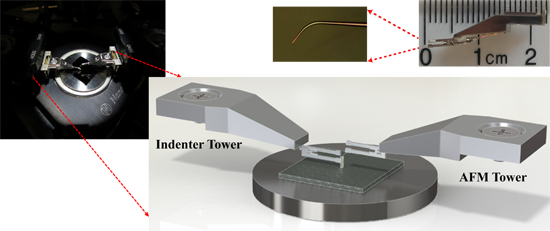
- using beam-bounce technology, this technique incorporates a second probe system with an ultra-high resolution for depth sensing. The additional second probe measures only the vertical movement of the straight indenter attached to a tuning-fork probe with a high spring constant and it can also be used
- optical lever method. With this methodology, a laser beam is reflected off the back end of the cantilever and directed towards a quadrant photodiode detector that monitors both vertical and lateral motion [9]. Force–distance (FD) curves can be generated based on displacement data and the spring constant
- . This gives ultra-sensitive and high resolution capability in terms of true depth sensing during nanoindentation. With this approach, only the Z axis motion of the straight indenter is monitored, independent of any possible tuning fork bending that may occur in spite of the very large spring constant of


A simple method for the determination of qPlus sensor spring constants
Beilstein J. Nanotechnol. 2015, 6, 1733–1742, doi:10.3762/bjnano.6.177
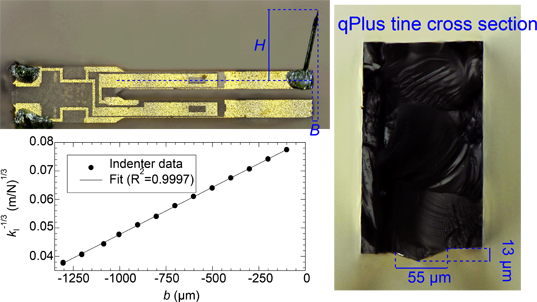
- of the spring constant of the sensor and complications from finite tip heights. Here we combine a numerical investigation of the force reconstruction with an experimental characterization of the flexural mechanics of the qPlus sensor. Numerical studies reveal significant errors in reconstructed force
- agreement with theoretical predictions for the geometry and material properties of the sensor once a peaked ridge in the beam cross section is included. We further develop a correction necessary to adjust the spring constant for the size and placement of the tip. Keywords: atomic force microscopy
- traditional silicon microcantilevers for ncAFM. The stiff spring constant of the tuning fork enables precise control over the tip–sample separation at short stand-off distances despite relatively large van der Waals interactions. Moreover, the mass production of tuning forks for timing applications has




![[Graphic 9]](/bjnano/content/inline/2190-4286-6-177-i28.png?max-width=637&scale=1.18182) vs b is plotted where kI is the spring constan...
vs b is plotted where kI is the spring constan...
Atomic force microscopy as analytical tool to study physico-mechanical properties of intestinal cells
Beilstein J. Nanotechnol. 2015, 6, 1457–1466, doi:10.3762/bjnano.6.151
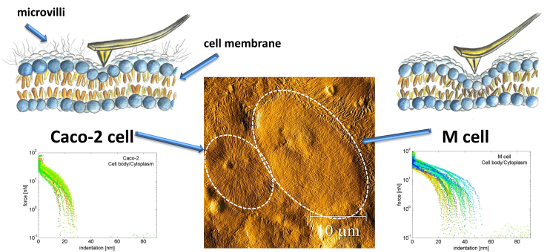
- determined. For all calculations a cantilever spring constant of 0.1 N/m was assumed (specified by the manufactures). A matlab program based on Butt et al. [65] was used for data handling and plotting. SEM analyses of the Caco-2 monolayer (A, B) and the Caco-2/M cell co-culture (C, D). The most prominent


Improved atomic force microscopy cantilever performance by partial reflective coating
Beilstein J. Nanotechnol. 2015, 6, 1450–1456, doi:10.3762/bjnano.6.150
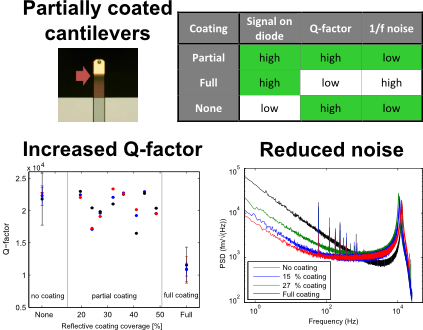
- ) systems, a large variety of commercial cantilevers exist. For each measurement mode, e.g., tapping, contact, non-contact, etc. optimized cantilevers are offered. These cantilevers differ in parameters like dimension, spring constant, resonance frequency and tip size. Most cantilever models are available
- were chosen for this study. First, a soft (≈0.01 N/m) cantilever mainly used for contact mode and force–distance measurements, where a low spring constant and low 1/f noise are the most important parameters. Second, a stiff (≈29 N/m) cantilever typically used in high resolution UHV AFM applications
- was calculated. The spring constant of the cantilevers and optical-lever sensitivities were measured by fitting the thermal vibration peak of the fundamental flexural mode acquired in air. The obtained optical-lever sensitivities are used to convert the noise density spectra to be expressed in fm


Scalable, high performance, enzymatic cathodes based on nanoimprint lithography
Beilstein J. Nanotechnol. 2015, 6, 1377–1384, doi:10.3762/bjnano.6.142
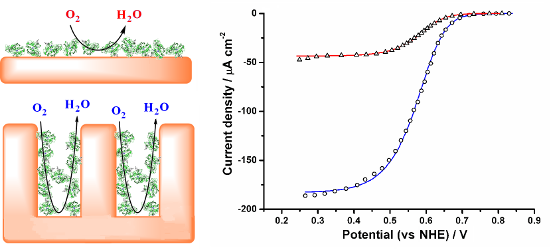
- SPM with a Nanoscope V control unit from Bruker AXS (Santa Barbara, CA, USA). The AFM was operated in the ScanAsyst mode. All images were obtained in air and at room temperature. Triangular silicon nitride cantilevers with a nominal spring constant of 0.4 N·m−1 (ScanAsyst Air probes, Bruker AXS) were


Nanomechanical humidity detection through porous alumina cantilevers
Beilstein J. Nanotechnol. 2015, 6, 1332–1337, doi:10.3762/bjnano.6.137
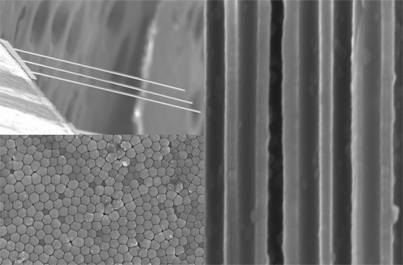
- frequency in dynamic vibration mode. The loading mass can be calculated from the change of resonance frequencies after (ƒ1) and before (ƒ0) adsorption as follows [9][10]: Here, the spring constant k is given by k = (E·w·t3)/(4·l3), where w, t and l are the width, thickness and length of the cantilever and E



Tattoo ink nanoparticles in skin tissue and fibroblasts
Beilstein J. Nanotechnol. 2015, 6, 1183–1191, doi:10.3762/bjnano.6.120
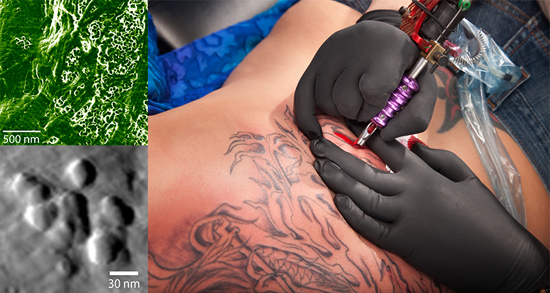
- fibril networks without particle matter, but were of lower quality (Figure 5). AFM fluid imaging has to use a cantilever spring constant that is about two orders of magnitude lower, which makes scanning trickier. Also, the tissue surface becomes softer. Tattoos inevitably fade over time with a


Probing fibronectin–antibody interactions using AFM force spectroscopy and lateral force microscopy
Beilstein J. Nanotechnol. 2015, 6, 1164–1175, doi:10.3762/bjnano.6.118
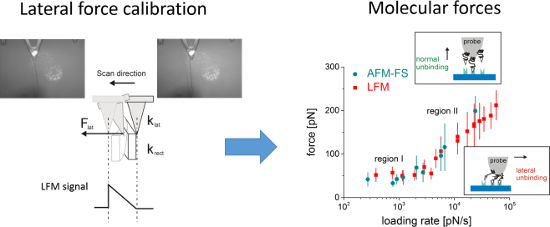
- (AFM-FS or LFM), the calibration proceeds through similar steps: (1) determination of the photodiode sensitivity converting the measured signal (in V) into a displacement of the cantilever (in nm) and (2) estimation of the cantilever spring constant used to deliver force (in nN). The calibration of
- deflection measurements carried out during the lateral scanning over a rectangular, reference cantilever with a known normal spring constant. Our method is relatively simple to use, fast, and it does not require any special equipment. In order to verify the extent to which the LFM is suitable for probing
- knowledge of the normal cantilever spring constant and normal photodetector sensitivity. The nominal, normal spring constant was controlled by monitoring the resonant frequency of a thermally excited cantilever [17], carried out before functionalization with an antibody. Since the resonance frequency of the



Stiffness of sphere–plate contacts at MHz frequencies: dependence on normal load, oscillation amplitude, and ambient medium
Beilstein J. Nanotechnol. 2015, 6, 845–856, doi:10.3762/bjnano.6.87
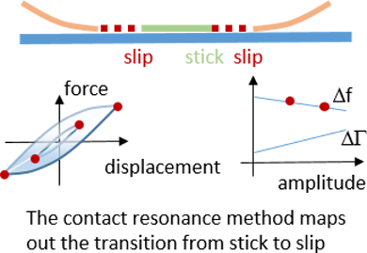
- displacement is evaluated in the undeformed regions far outside the contact zone. The ratio of force and displacement is the contact stiffness. As we show in the modeling section, the spring constant and the dashpot’s drag coefficient can be easily determined from the shifts of frequency and bandwidth. The
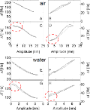
- often for the small spheres (diameters <500 µm) examined in [10]. Further discussion is outside the scope of this work. Large spheres were chosen here in order to achieve a linear dependence of Δf and ΔΓ on u0. If linear behavior is observed, the complex spring constant in the low-amplitude limit is




Capillary and van der Waals interactions on CaF2 crystals from amplitude modulation AFM force reconstruction profiles under ambient conditions
Beilstein J. Nanotechnol. 2015, 6, 809–819, doi:10.3762/bjnano.6.84
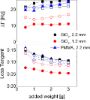
- resonance frequency f0 ≈ 300 kHz, spring constant k ≈ 45 N/m and nominal tip radius R0 ≈ 10 nm were employed (Nanosensors PPP-NCHR), for which avoiding discontinuity requires a free amplitude A0 ≈ 23 nm. The conversion of the amplitude in volts to amplitude in nm was determined by adjusting the tilt of dmin
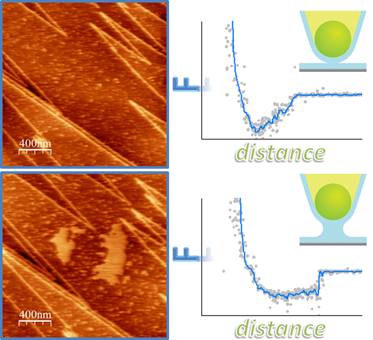
- vs zc curves in the repulsive region till a flat plateau was obtained [34]. The resonance frequency, spring constant and quality factor (Q ≈ 400) of the cantilever were calibrated in situ at a distance smaller than 200 nm from the surface. The resonance frequency was found to decrease approximately
- tip radius was estimated to be R = R0 · (A0(R)/A0)1.1, according to the experimental observations reported for the case of the critical amplitude Ac [49]. When force curves were collected in contact mode, cantilevers with resonance frequencies f0 ≈ 15 kHz, spring constant k ≈ 0.2 N/m and R ≈ 10 nm


Mapping of elasticity and damping in an α + β titanium alloy through atomic force acoustic microscopy
Beilstein J. Nanotechnol. 2015, 6, 767–776, doi:10.3762/bjnano.6.79
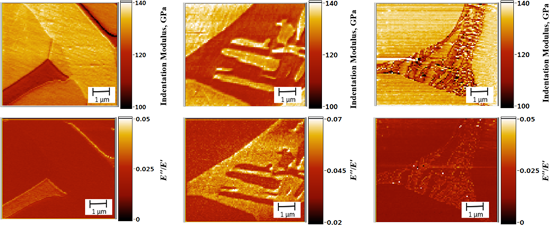
- , Russia was used in the study. A stiff cantilever with a spring constant, kc, of about 30 N/m and the first free resonance frequency f0 of about 171 kHz was used in the study. The surface topography of the specimens was obtained in tapping mode to select an area with sufficient flatness for acquiring the


Entropy effects in the collective dynamic behavior of alkyl monolayers tethered to Si(111)
Beilstein J. Nanotechnol. 2015, 6, 583–594, doi:10.3762/bjnano.6.60
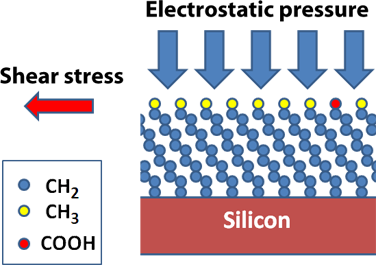
- depend on the spring constant k = (P/E·I)1/2 where I is the moment of inertia of the rod, E its Young modulus, and P the normal compression load. In the context of a molecular layer submitted to compression, conformational changes of the molecules must be taken into account (Figure 1). A gauche defect




Influence of spurious resonances on the interaction force in dynamic AFM
Beilstein J. Nanotechnol. 2015, 6, 420–427, doi:10.3762/bjnano.6.42
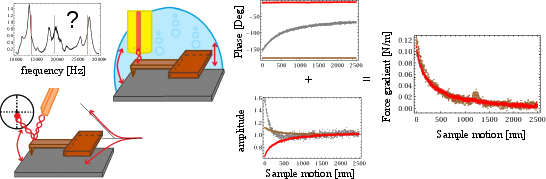
- constants a and cannot be evaluated from a simple analysis of the spectrum. This does not mean, however, that Equation 6 is incorrect. An important note is that even if the resonance curve is calibrated close to the sample, we assume that k is the spring constant of the cantilever, so that a resonance
- frequency different from the natural frequency is accounted for only through a rescaling of the effective mass and quality factor. Whereas, if a and are calibrated, the cantilever spring constant is not fixed to any value. The reasoning above assumes that the measurement corresponds to the position of the
- cannot fulfill this requirement, then the cantilever spring constant can not be used for any quantitative evaluation of the interaction, because in this case the cantilever deflection is not directly proportional to the inverse of its spring constant. Therefore the above condition/simplification must