


Search results
Search for "surface structure" in Full Text gives 142 result(s) in Beilstein Journal of Nanotechnology.
Ionic liquid-assisted formation of cellulose/calcium phosphate hybrid materials
Beilstein J. Nanotechnol. 2014, 5, 1553–1568, doi:10.3762/bjnano.5.167
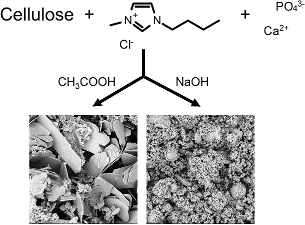
- starch led to a nanoscale hybrid material, the mineralization of cellulose led to cellulose fibers with a high degree of surface mineralization. In spite of this, the cellulose fibers appeared to “imprint” some features of their surface structure on the mineral layers. Venkataramanan et al. synthesized


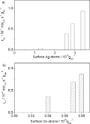
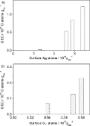
Probing the electronic transport on the reconstructed Au/Ge(001) surface
Beilstein J. Nanotechnol. 2014, 5, 1463–1471, doi:10.3762/bjnano.5.159
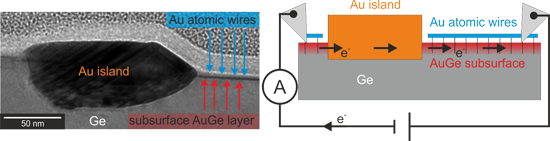
- atomic scale leads to contact, e.g., small atomic structures or molecules. The anisotropic transport properties of this surface structure have triggered controversial discussions within the scientific community [7][8][9]. However, to access the anisotropic transport properties, a significant electron
- annealing to 770 K for about 10 min the Au-induced wire-like Ge(001)-c(8 × 2)-Au structure emerges [1][3]. The excess amount of Au aggregates into Au clusters. We intentionally deposited this excess amount of Au since the Au clusters may serve as metallic leads to contact the surface structure by STM tips
- for both cases are shown in Figure 6c. Conclusion In conclusion, we find that the electronic transport properties of the system Au/Ge(001) are not only given by the atomic wire-like surface structure exhibiting a Tomonaga–Luttinger behavior, but also by a 2D conductive layer underneath the surface




Restructuring of an Ir(210) electrode surface by potential cycling
Beilstein J. Nanotechnol. 2014, 5, 1349–1356, doi:10.3762/bjnano.5.148
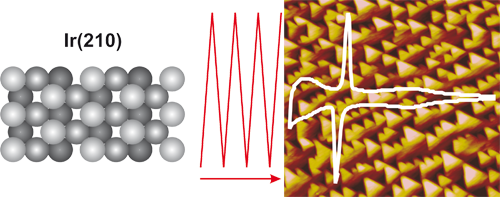
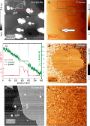
- cycling; scanning tunnelling microscopy; surface restructuring; Introduction The surface structure of metal electrodes is a decisive factor for kinetics of many electrochemical processes and electrocatalytical reactions [1][2][3]. Since the behaviour of polycrystalline material is often quite complex
- , relations between the surface structure of an electrode and its activity for a given reaction are typically investigated in experiments by using clean and well-defined model systems, such as single crystal surfaces [4][5][6], epitaxially grown monolayers [7][8] or preferentially-shaped nanoparticles [9]. In
- all cases, detailed protocols have been established for the reproducible preparation of these model electrodes, which have been extensively characterized in recent years. The development of so-called electrochemical surface science has shown that the geometric surface structure of metals is often


Observation and analysis of structural changes in fused silica by continuous irradiation with femtosecond laser light having an energy density below the laser-induced damage threshold
Beilstein J. Nanotechnol. 2014, 5, 1334–1340, doi:10.3762/bjnano.5.146
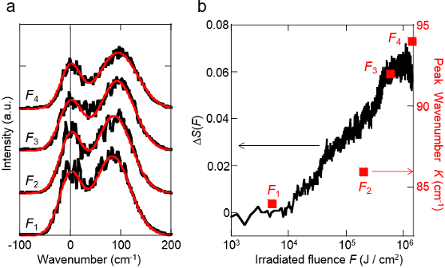
- polished by CMP. Thus, it is effective in reducing the drop in LIDT caused by electric field enhancement induced by the surface structure [5][6]. It has been reported that a dielectric multilayer mirror fabricated by using a silica substrate planarized by this technique exhibited an LIDT that was increased
- threshold for sample B is 1.4-times higher than that for sample A. As described above, sample B was a substrate prepared by selectively removing only the ultrafine surface structure from the substrate of sample A, and the LIDT of a mirror using a substrate identical to this was improved by a factor of 1.7
- indentations or protrusions. Also, the constants P which define the rate of increase of gA(F) and gB(F) are PA = 0.062 and PB = 0.016, differing by a factor of 3.9, which shows that laser-induced degradation originating from the surface structure proceeds more rapidly. 1.2 In situ evaluation of spectral change


Dry friction of microstructured polymer surfaces inspired by snake skin
Beilstein J. Nanotechnol. 2014, 5, 1091–1103, doi:10.3762/bjnano.5.122

- influence friction: (1) molecular interaction depending on real contact area and (2) the mechanical interlocking of both contacting surfaces. The strongest reduction of the frictional coefficient, compared to the smooth reference surface, was observed at a medium range of surface structure dimensions
- surface structure is not dominated by the elevation of the caudal tips of the denticulations as previously found on Boa constrictor skin [11], but rather by depressions located cranially between the denticulations [10]. The dimension of the microstructure on the SIMPS is quite similar to those of the


Double layer effects in a model of proton discharge on charged electrodes
Beilstein J. Nanotechnol. 2014, 5, 973–982, doi:10.3762/bjnano.5.111
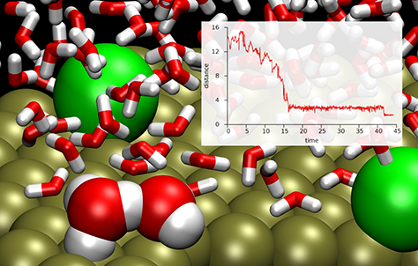
- the most fundamental electrochemical reactions is proton discharge from an aqueous solution to a charged electrode, which is the first step of the hydrogen evolution reaction. This basic electrocatalytic reaction and its dependence on the nature and the surface structure of the electrode, on


Measuring air layer volumes retained by submerged floating-ferns Salvinia and biomimetic superhydrophobic surfaces
Beilstein J. Nanotechnol. 2014, 5, 812–821, doi:10.3762/bjnano.5.93
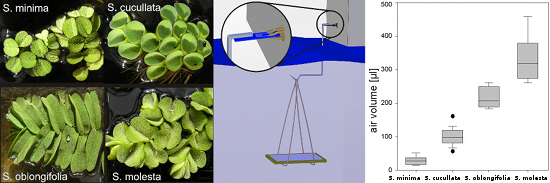
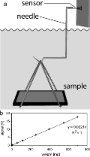
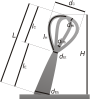
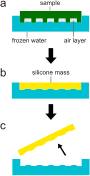
- be approximated. Table 1 displays the measured surface structure dimensions and parameters for the four investigated Salvinia species needed for this calculation. To estimate the volume occupied by the trichomes, we idealized them as assemblies of truncated cones for the emergence and the hairs. The


Shape-selected nanocrystals for in situ spectro-electrochemistry studies on structurally well defined surfaces under controlled electrolyte transport: A combined in situ ATR-FTIR/online DEMS investigation of CO electrooxidation on Pt
Beilstein J. Nanotechnol. 2014, 5, 735–746, doi:10.3762/bjnano.5.86
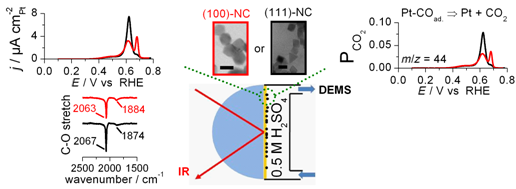
- , IR spectro-electrochemistry [3] was successfully employed to investigate the relations between electrode surface structure and the binding modes of adsorbed species [4][5][6][7][8][9][10], to identify poisoning species and adsorbed intermediates formed during electrocatalytic reactions [2][11][12][13
- hydrogen sorption peaks are convincing indicators for both a well ordered Pt nanocrystal surface structure and the cleanness of the experimental setup and procedures. The hydrogen-region voltammograms obtained for such samples are approximated as weighted sum of the respective features of extended low
- investigated, independently of the Pt nanocrystal surface structure (see Table 2). This allows us to determine the Epztc [27][28][29] for each of the working electrodes prepared from one of the three different batches of nanocrystals (see section ‘Preparation and characterization of the Pt nanocrystals’). The




The role of surface corrugation and tip oscillation in single-molecule manipulation with a non-contact atomic force microscope
Beilstein J. Nanotechnol. 2014, 5, 202–209, doi:10.3762/bjnano.5.22
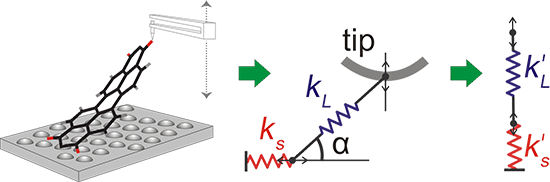
- corresponding to the Au(111) surface structure and a corrugation amplitude Vc(z) ≈ (2.6/z)7 that decays rapidly with increasing distance to the surface. Since here we aim at a qualitative description, the precise functional form of the corrugation potential is not relevant and we also can assume that the

Constant-distance mode SECM as a tool to visualize local electrocatalytic activity of oxygen reduction catalysts
Beilstein J. Nanotechnol. 2014, 5, 141–151, doi:10.3762/bjnano.5.14
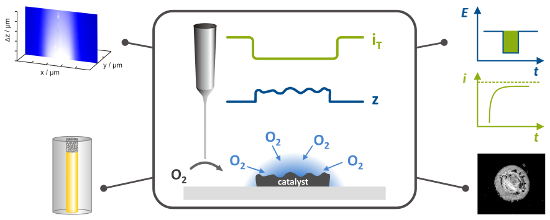
- retraction of the tip with simultaneous data acquisition at each pre-defined tip-to-sample separation is performed. Diffusion profiles exceed far the geometric dimensions of the investigated surface structure. The collection of electrochemical data in z-direction requires therefore comparable large distances




Design criteria for stable Pt/C fuel cell catalysts
Beilstein J. Nanotechnol. 2014, 5, 44–67, doi:10.3762/bjnano.5.5





Exploring the retention properties of CaF2 nanoparticles as possible additives for dental care application with tapping-mode atomic force microscope in liquid
Beilstein J. Nanotechnol. 2014, 5, 36–43, doi:10.3762/bjnano.5.4
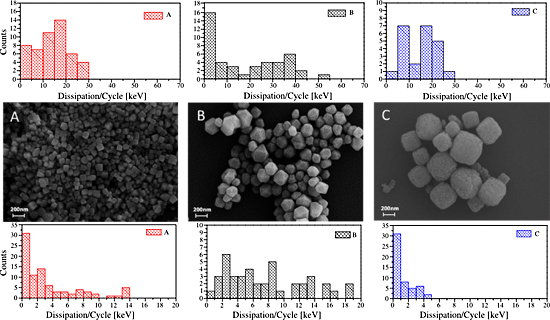
- and on tooth enamel in liquid. From the phase-lag of the forced cantilever oscillation the local energy dissipation at the detachment point of the nanoparticle was determined. This enabled us to compare different as-synthesized CaF2 nanoparticles that vary in shape, size and surface structure. CaF2
- spherical surface structure of these particles. Compared to the smaller particles (A) and (B), which have plane and smooth faceting, the high surface roughness leads to a smaller contact area on the substrate. The fact that the lowest energy dissipation was observed for specimen (C) is consistent with the
- . Remarkably, the energy dissipation for each of the particles is found to be much higher on enamel than on mica. For particles (C) the power dissipation is found to be up to 10-times higher on tooth enamel. The specimens (A) and (B), which are similar in size and surface structure show an increase in the


Surface assembly and nanofabrication of 1,1,1-tris(mercaptomethyl)heptadecane on Au(111) studied with time-lapse atomic force microscopy
Beilstein J. Nanotechnol. 2014, 5, 26–35, doi:10.3762/bjnano.5.3
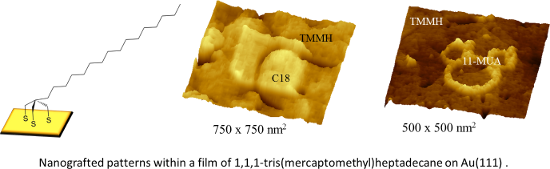
- liquid environment, studies of surface reactions can be accomplished using time-lapse atomic force microscopy (AFM). To understand more completely the surface structure and self-assembly process for multidentate thiols, we chose a tridentate molecule, 1,1,1-tris(mercaptomethyl)heptadecane (TMMH) for in


Some reflections on the understanding of the oxygen reduction reaction at Pt(111)
Beilstein J. Nanotechnol. 2013, 4, 956–967, doi:10.3762/bjnano.4.108
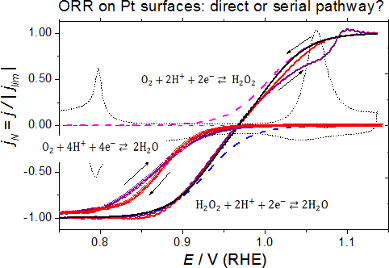
- step (RDS) on Pt, which would be an essential step toward an optimized design of new ORR electrocatalysts [15]. Results and Discussion Ideally, the surface structure and composition of a catalyst remain unchanged over the whole potential range in which a probe reaction is scrutinized. However, as can
- peak contribution at high potentials increases at higher Eup (Figure 8). As the upper potential limit is not too high, this observation is compatible with the preservation of the Pt(111) surface structure. It should be remarked that the product, PtO, could be formed through a chemical process that
- general points of agreement and disagreement highlighted. It has been shown that despite the ORR shows a dependence on the surface structure, experimental and theoretical results disagree in acidic media while they seem to agree in alkaline solutions. The reasons behind this fact are not clearly known


AFM as an analysis tool for high-capacity sulfur cathodes for Li–S batteries
Beilstein J. Nanotechnol. 2013, 4, 611–624, doi:10.3762/bjnano.4.68
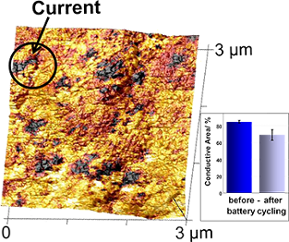
- was found with the magnitude of current values measured by AFM. High current values correspond to highly conductive, most likely carbon-rich, areas that are not sufficient for a good battery. The surface structure changed differently for the studied samples, e.g., the sample with PVDF lost only the



Mapping of plasmonic resonances in nanotriangles
Beilstein J. Nanotechnol. 2013, 4, 588–602, doi:10.3762/bjnano.4.66
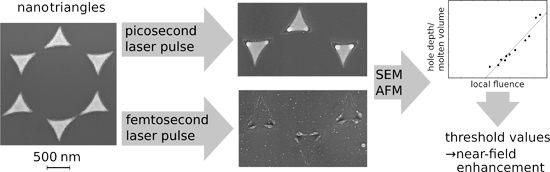
- near-field enhancement have not been altered. Additionally, the surface texture of the triangles in the modified region has changed. While the unmodified regions have a roughness comparable to the deposited gold film, the surface structure in the regions, which show a change due to the laser radiation


Digging gold: keV He+ ion interaction with Au
Beilstein J. Nanotechnol. 2013, 4, 453–460, doi:10.3762/bjnano.4.53
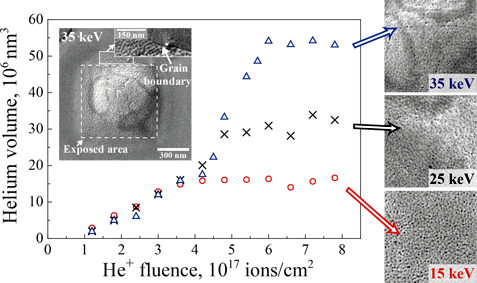
- in the imaged area. This is a common problem in conventional non-UHV HIM and scanning electron microscopes (SEM) [15][17][19]. The absence of the carbon layer that is normally present, allows us to obtain detailed information on the surface structure and how it evolves during repeated imaging of the


Porous polymer coatings as substrates for the formation of high-fidelity micropatterns by quill-like pens
Beilstein J. Nanotechnol. 2013, 4, 377–384, doi:10.3762/bjnano.4.44
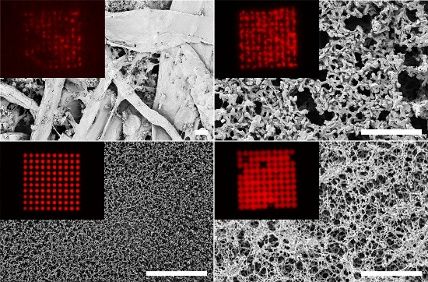
- prevented the SPT from touching the surface in some places) and because of inhomogeneous wetting behaviour due to the fibrous structure of the paper, as seen by sometimes brighter and sometimes fainter features. Overall the rough surface structure prevents clear homogenous patterning of phloxine B, and


Influence of the solvent on the stability of bis(terpyridine) structures on graphite
Beilstein J. Nanotechnol. 2013, 4, 269–277, doi:10.3762/bjnano.4.29
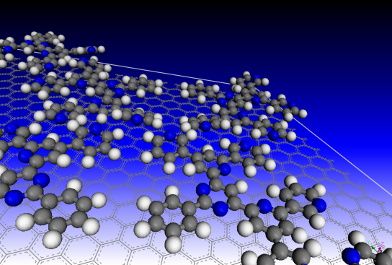
- adsorbed ordered surface structure in the presence of the solvent and another trajectory run for the BTP molecules in solution, as illustrated in Figure 2 using the same unit cell, were performed. Ideally, no interaction between a BTP molecule and the surface or another BTP molecule should occur in the


Catalytic activity of nanostructured Au: Scale effects versus bimetallic/bifunctional effects in low-temperature CO oxidation on nanoporous Au
Beilstein J. Nanotechnol. 2013, 4, 111–128, doi:10.3762/bjnano.4.13
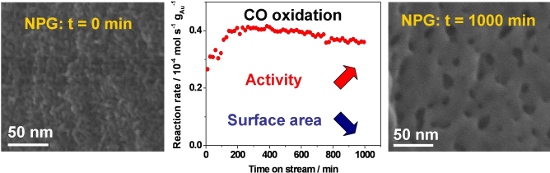
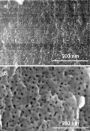
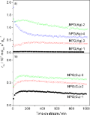
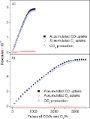
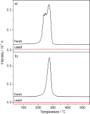
- characterized again. A representative SEM image taken from the NPG(Ag)-4 sample after reaction showed a distinct coarsening of the porous surface structure (see Figure 1b). This is confirmed also by the XRD patterns (see Figure 2a), where exposure to the reaction gas mixture caused a considerable sharpening of


Growth behaviour and mechanical properties of PLL/HA multilayer films studied by AFM
Beilstein J. Nanotechnol. 2012, 3, 778–788, doi:10.3762/bjnano.3.87
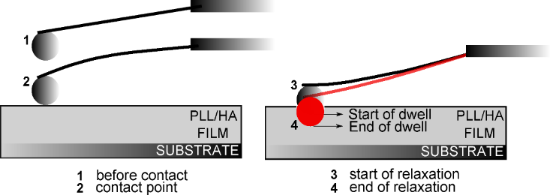
- the film bilayer number n. This result contradicts the results of Richert et al. [4], who reported a decrease in E from 90 kPa for n = 20 to 40 kPa for n = 60. The authors suggested a possibility of film softening due to greater hydration of the upper layers rather than due to a change in surface
- structure, heterogeneity or roughness. The film thickness range reported in the mentioned study [4] is nearly threefold larger than ours, which may result in significant structural differences. Despite some fluctuations, E in our study ranges between 10 and 40 kPa, being in the same order of magnitude with


Macromolecular shape and interactions in layer-by-layer assemblies within cylindrical nanopores
Beilstein J. Nanotechnol. 2012, 3, 475–484, doi:10.3762/bjnano.3.54
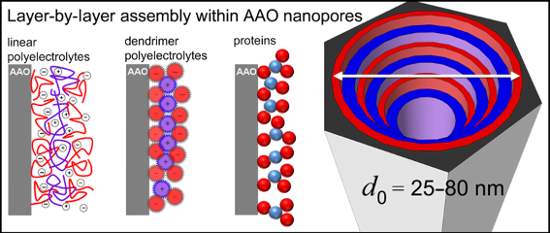
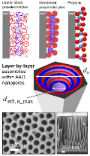
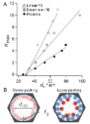
- adsorbing components, to generate multilayered structures. Different functional materials can be stepwise incorporated by LbL, within a single surface structure by electrostatic self-assembly [3][4], molecular-recognition pairs [5][6][7], or covalent-bond formation [8]. Homogeneous and heterogeneous layered




Repulsive bimodal atomic force microscopy on polymers
Beilstein J. Nanotechnol. 2012, 3, 456–463, doi:10.3762/bjnano.3.52
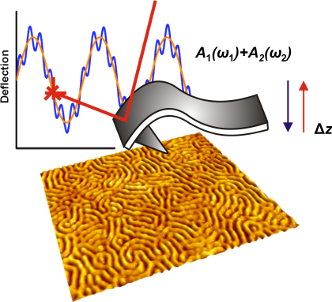
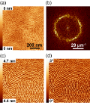
- between both types of polymers, which differ considerably in stiffness. However, if the amplitude of the additional oscillation becomes too large, the bimodal technique may become destructive to the surface structure, counteracting a good phase contrast. Figure 5 shows an SB sample measured in the



The morphology of silver nanoparticles prepared by enzyme-induced reduction
Beilstein J. Nanotechnol. 2012, 3, 404–414, doi:10.3762/bjnano.3.47
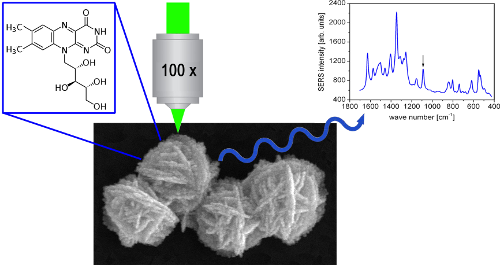
- silver nanoparticles consist of single-crystalline plates of pure silver. The surface-enhanced Raman spectroscopic (SERS) activity of the EGNP structures is promising due to the exceptionally rough surface structure of the silver nanoparticles. SERS measurements of the vitamin riboflavin incubated on the


Modeling noncontact atomic force microscopy resolution on corrugated surfaces
Beilstein J. Nanotechnol. 2012, 3, 230–237, doi:10.3762/bjnano.3.26
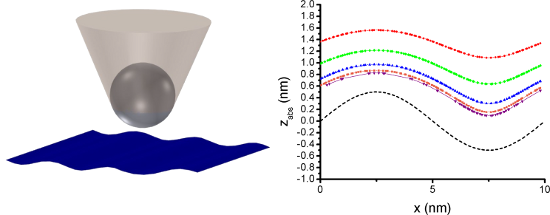
- -supported graphene, due to apparent differences in surface structure between the carefully UHV-prepared quartz in that study and the SiO2 substrates used for graphene. As with the barium silicate measurements, for high-resolution measurements of SiO2, special conditions were necessary [18]. In order to





