Search results
Search for "Anchoring" in Full Text gives 141 result(s) in Beilstein Journal of Nanotechnology.
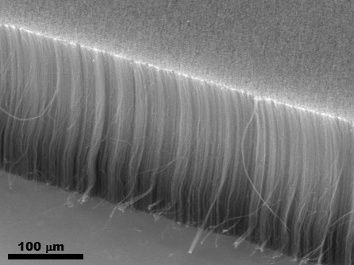
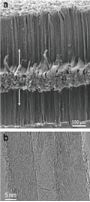
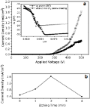
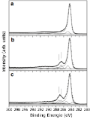
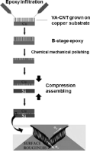
Functionalization of vertically aligned carbon nanotubes
Beilstein J. Nanotechnol. 2013, 4, 129–152, doi:10.3762/bjnano.4.14








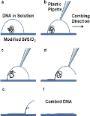
Controlled deposition and combing of DNA across lithographically defined patterns on silicon
Beilstein J. Nanotechnol. 2013, 4, 72–76, doi:10.3762/bjnano.4.8
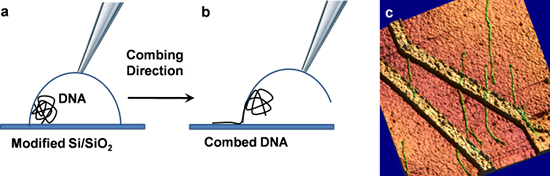
- stretched on a solid surface [4]. The alignment occurs in two major steps: first, a random-coiled dsDNA floating in solution is partially melted at the ends. The ends with the exposed hydrophobic core are then readily adsorbed to the hydrophobic surface, hence anchoring the DNA molecules. Second, the


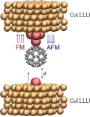
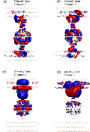
Strong spin-filtering and spin-valve effects in a molecular V–C60–V contact
Beilstein J. Nanotechnol. 2012, 3, 589–596, doi:10.3762/bjnano.3.69
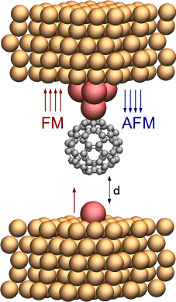
- ]. The C60 molecule is considered as an attractive anchoring group for molecular electronics due to its mechanical robustness [8]. Moreover, the lowest unoccupied molecular orbital (LUMO) of C60 is close to the Fermi level of ferromagnetic elements which makes spin injection relatively easy [9], and



A facile approach to nanoarchitectured three-dimensional graphene-based Li–Mn–O composite as high-power cathodes for Li-ion batteries
Beilstein J. Nanotechnol. 2012, 3, 513–523, doi:10.3762/bjnano.3.59
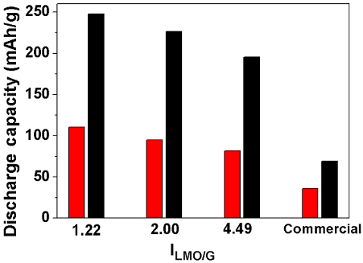
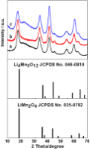
- adsorption layer of anchoring Mn2+ cations and thereby enhance the cyclability of the electrodes. Conclusion In conclusion, a novel and facile approach was developed to synthesize a nanoarchitectured LMO/G hybrid as a positive electrode material for lithium-ion batteries. The process combines the deposition




Distribution of functional groups in periodic mesoporous organosilica materials studied by small-angle neutron scattering with in situ adsorption of nitrogen
Beilstein J. Nanotechnol. 2012, 3, 428–437, doi:10.3762/bjnano.3.49
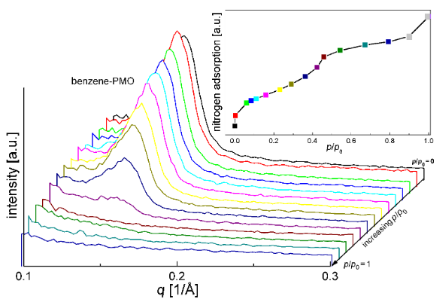
- adsorption (p/p0 > 0.9) for all the samples does not result from structural mesoporosity, but is caused by a condensation of nitrogen in the interstitial space between particles (void spaces) and cracks inside the particles. Due to the partial filling of the structural mesochannels by anchoring propyl-SO3H
- specific surface area of 487.96 m2·g−1 and a pore volume of 0.452 cm3·g−1. Due to the partial pore filling by anchoring of the functional groups, the high uniformity of the benzene-PMO pores is lost; in particular, from the sulfonation at the benzene rings an irregular distribution of pore sizes exhibiting
- proves undoubtedly the crystal-like structure of the pore walls of porous PMO materials, and underlines the results found by WAXS measurements [5][7][18]. Figure 4 shows neutron scattering curves of functionalized mesoporous benzene-PMO-(0.81 mmol SO3H·g−1) synthesized by anchoring SO3H groups via propyl


Dipole-driven self-organization of zwitterionic molecules on alkali halide surfaces
Beilstein J. Nanotechnol. 2012, 3, 285–293, doi:10.3762/bjnano.3.32
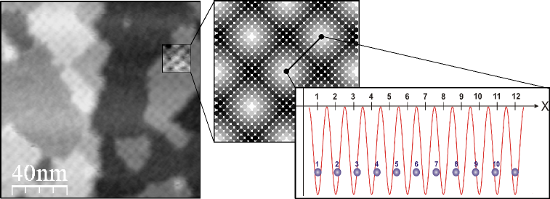
- potential of the substrate, i.e., a sinusoidal potential, and we position the molecules according to the two coincidences (Figure 5a and Figure 5d). Along the short molecular axes, each molecular protrusion corresponds to an anchoring site (i.e., the dipolar end with the pyridine ring and its positive
- charge N+ adsorbed on an anion Cl−). The case for the long molecular axes, in which only every second molecular protrusion corresponds to an anchoring point, will be discussed below. Second, we calculate the lateral force that would act on a molecule within that potential (i.e., the derivative −∂Eads/∂x
- dislocations, such that only small areas with a more or less uniform height can be observed (not shown). Along the long molecular axes (i.e., the direction), only every second molecular protrusion could act as an anchoring point. As depicted in Figure 5c for KBr, this does not change the shape, with a single


Forming nanoparticles of water-soluble ionic molecules and embedding them into polymer and glass substrates
Beilstein J. Nanotechnol. 2012, 3, 267–276, doi:10.3762/bjnano.3.30
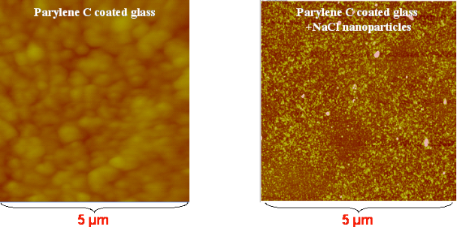
- strength of anchoring of the NPs to the substrate, some control experiments on the release of the ionic compounds into the surrounding environment were conducted. Namely, we placed the coated glass slides in the doubly distilled water at room temperature for different periods of time (from 2 to 96 h) under




An NC-AFM and KPFM study of the adsorption of a triphenylene derivative on KBr(001)
Beilstein J. Nanotechnol. 2012, 3, 221–229, doi:10.3762/bjnano.3.25
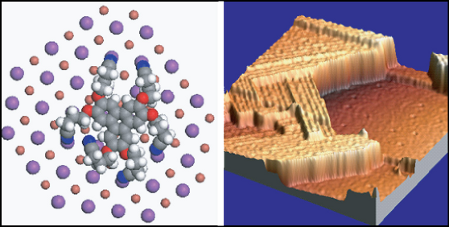
- equipped with six flexible propyl chains ending with dipolar CN groups. These groups were proven recently to behave as strong anchoring entities for a truxene derivative adsorbed on KBr(001) [10][11] due to their efficient electrostatic interaction with the K+ ions of the surface. Results Low coverage
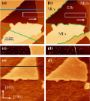
- adjacent K+ sites on nonpolar steps, as shown for truxene molecules [11]. The origin of the molecular aggregates observed in Figure 2 and Figure 3 is less clear. As indicated previously a single molecule diffuses at room temperature despite its six CN anchoring groups. A lower estimate of the distance that




Analysis of fluid flow around a beating artificial cilium
Beilstein J. Nanotechnol. 2012, 3, 163–171, doi:10.3762/bjnano.3.16
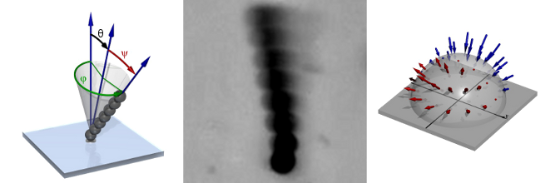
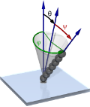
- only the vortical pattern is observed, centred at the anchoring point of the cilium. By averaging the measured velocities, one observes no net pumping and the position-averaged velocities in both the x and y directions are 0 μm/s within the experimental error. Keeping the semicone angle constant at ψ
- that the velocity field around the model cilium can be expanded in powers of the distance from the cilium anchoring point (r) and that the leading terms follow a 1/r2 dependence. The time-averaged flow velocity around a model cilium positioned at (0,0) for fluid pumping in the −y direction is where S
- diameter 55 nm [24]) in water. To prevent aggregation of the beads, we coated them with BSA (bovine serum albumin), 10 mg/mL, for 4 h in an ultrasonic bath. One end of the assembled chain was attached to the surface through prefabricated ferromagnetic-nickel anchoring sites. The nickel dots were



Surface functionalization of aluminosilicate nanotubes with organic molecules
Beilstein J. Nanotechnol. 2012, 3, 82–100, doi:10.3762/bjnano.3.10
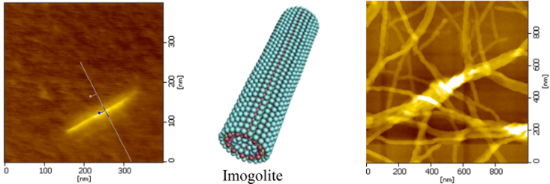
- has been reported by our group [32]. More recently, we developed an approach for anchoring alkyl chains on an imogolite surface from aqueous solution [33]. The adsorption of molecules on the inorganic surface from aqueous solution is particularly necessary for imogolite, because imogolite nanotubes
- component adsorption, abundance of empty surface sites for covalent binding of acidic anchoring groups, and high stability under ambient conditions. A more promising approach to render aluminosilicate nanotubes semiconducting is by functionalization with conjugated molecules, such as terthiophene with alkyl


Self-assembled monolayers and titanium dioxide: From surface patterning to potential applications
Beilstein J. Nanotechnol. 2011, 2, 845–861, doi:10.3762/bjnano.2.94
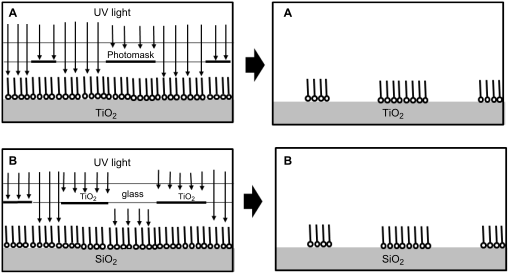
- two oxides to form SAMs and the structure and stability of the formed SAMs. Chlorosilanes and alkoxysilanes SAMs are characterized by hydrolysis–condensation reactions leading to the formation of M–O–Si bonds where M is in this context is Si or Ti. The chemical anchoring of the alkylsilanes to TiO2 is
- forms of anchoring prevented calculation of the relative role of each type of anchoring. At any case, the chemical shift of the P–O–Ti sites was found to be consistent with bridging modes, negating the possibility of anchoring through chelating modes. A slightly different view of the binding between n



Towards quantitative accuracy in first-principles transport calculations: The GW method applied to alkane/gold junctions
Beilstein J. Nanotechnol. 2011, 2, 746–754, doi:10.3762/bjnano.2.82
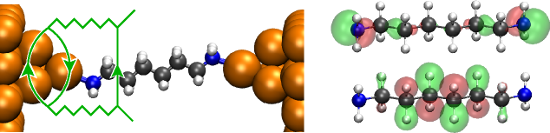
- structure of the molecule as well as the detailed atomic structure of the metal–molecule contact. Variations in the contact geometry beyond experimental control lead to an undesired spread in the measured conductance properties. For the most commonly used anchoring group, –thiol, these effects are rather
- can be bound directly to gold electrodes without the use of anchoring groups [51]. The transport mechanism in (short) saturated molecular wires is coherent tunneling through molecular orbitals with energy far from the Fermi energy. The trend of conductance versus chain length (n) thus follows an



Charge transport in a zinc–porphyrin single-molecule junction
Beilstein J. Nanotechnol. 2011, 2, 714–719, doi:10.3762/bjnano.2.77
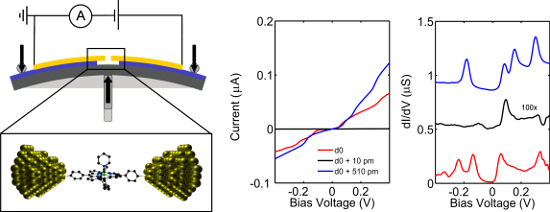
- displacement. Such low-bias transport measurements have been extensively used to study the dependence of the molecular conductance on the length [1][2], conformation [3][4] and anchoring groups [5][6] of rod-like molecules. However, as the bias range is very limited, the main contribution to the current is off
- molecule are used as anchoring groups. After deposition, the junctions are broken in vacuum at room temperature. The aforementioned stability of the electrodes allows us to characterize charge transport through ZnTPPdT–Pyr by performing two types of experiments. First, we measure at room temperature the


An MCBJ case study: The influence of π-conjugation on the single-molecule conductance at a solid/liquid interface
Beilstein J. Nanotechnol. 2011, 2, 699–713, doi:10.3762/bjnano.2.76
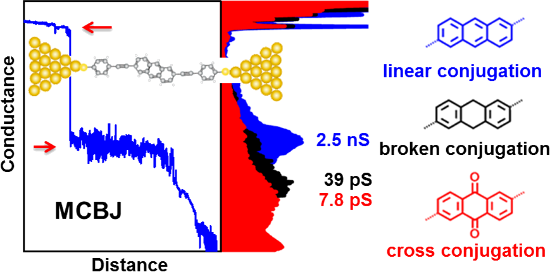
- molecular conformation [13][16] and as well as of the anchoring group and of the contacting leads [17][18] was studied to develop correlations between charge-transport characteristics and molecular structure. Furthermore, π-conjugation plays an essential role in charge transport through single molecular




Novel acridone-modified MCM-41 type silica: Synthesis, characterization and fluorescence tuning
Beilstein J. Nanotechnol. 2011, 2, 284–292, doi:10.3762/bjnano.2.33
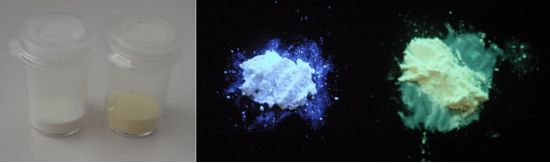
- can be ascribed to the RalkylSi(OMe)(OSi)2 unit resulting from the partially incomplete incorporation of the precursor’s anchoring group into the framework [20]. When studying the fluorescence properties of the materials obtained before and after the post-sol–gel modification, an instantaneous shift


Ultrafine metallic Fe nanoparticles: synthesis, structure and magnetism
Beilstein J. Nanotechnol. 2010, 1, 108–118, doi:10.3762/bjnano.1.13
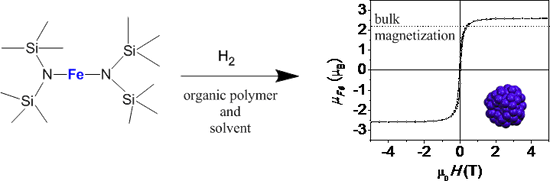
- than 300 atoms (≤2 nm) [2]. This confirms that the synthesis using metal–organic precursors and an organic polymer as a matrix allows the growth of clusters with narrow size distributions and magnetic properties similar to those of free clusters, since the number of anchoring sites of the polymer on