


Search results
Search for "X-ray spectroscopy" in Full Text gives 211 result(s) in Beilstein Journal of Nanotechnology. Showing first 200.
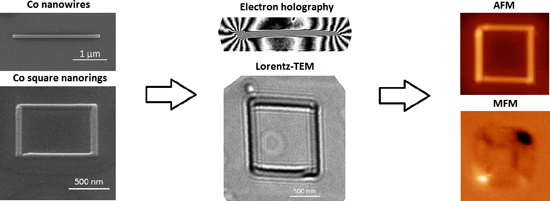
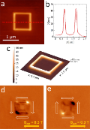
Magnetic characterization of cobalt nanowires and square nanorings fabricated by focused electron beam induced deposition
Beilstein J. Nanotechnol. 2018, 9, 1040–1049, doi:10.3762/bjnano.9.97
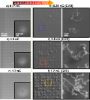
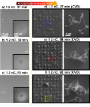
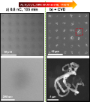
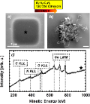
- secondary electron generation by the primary beam interacting with the Si substrate, which is thicker and denser than the C substrate. Energy-dispersive X-ray spectroscopy (EDX) provided measured compositions that depended on the substrate and deposition energy. A spectrum recorded from the bare substrate
Enzymatically promoted release of organic molecules linked to magnetic nanoparticles
Beilstein J. Nanotechnol. 2018, 9, 986–999, doi:10.3762/bjnano.9.92
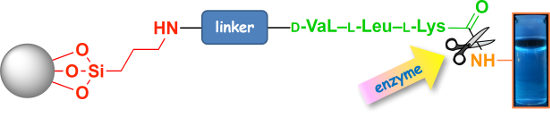
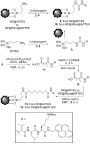
- . They are here identified as NP@silica@APTES. The morphology and chemical composition of these nanoparticles was studied using field emission scanning electron microscopy (FE-SEM) in combination with energy dispersive X-ray spectroscopy (EDXS) in addition to dynamic light scattering (DLS). In Figure 1A




Towards the third dimension in direct electron beam writing of silver
Beilstein J. Nanotechnol. 2018, 9, 842–849, doi:10.3762/bjnano.9.78
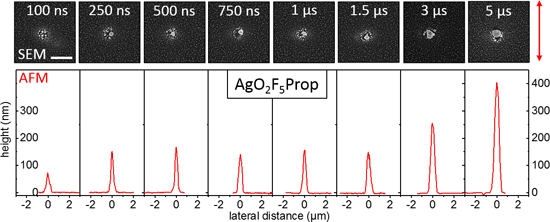
- whole deposition series. High-resolution scanning electron microscopy (SEM) imaging and energy-dispersive X-ray spectroscopy (EDX) was performed using a Hitachi S 4800 equipped with an EDAX silicon drift detector (SSD). EDX data acquisition was performed for acceleration voltages of 8 and 12 kV using a


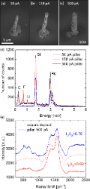
Surface-plasmon-enhanced ultraviolet emission of Au-decorated ZnO structures for gas sensing and photocatalytic devices
Beilstein J. Nanotechnol. 2018, 9, 771–779, doi:10.3762/bjnano.9.70
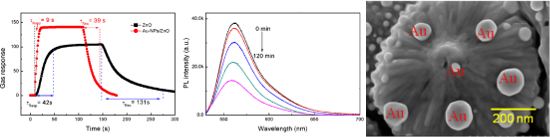
- simple chemical bath deposition and photoreduction methods. The analysis of scanning electron microscopy (SEM) and transmission electron microscopy (TEM) images, energy-dispersive X-ray spectroscopy (EDS), UV–vis absorption, and photoluminescence (PL) spectra results were used to verify the incorporation
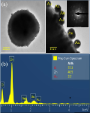
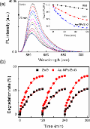
- the range of 20–50 nm. It can be assumed that Au nanoparticles were decorated on the ZnO sub-micrometer spheres due to the strong electrostatic attraction. The presence of a gold element in the ZnO matrix was confirmed by elemental analysis from energy-dispersive X-ray spectroscopy (EDS), as shown in




A review of carbon-based and non-carbon-based catalyst supports for the selective catalytic reduction of nitric oxide
Beilstein J. Nanotechnol. 2018, 9, 740–761, doi:10.3762/bjnano.9.68

- [32][33]. Jeong et al. [34] applied the impregnation technique to study the characteristics of graphene-supported tungsten (WO3) catalyst in a selective catalytic reduction system. The transmission electron microscopy energy-dispersive X-ray spectroscopy (TEM-EDS) measurements in their study showed
Cyclodextrin-assisted synthesis of tailored mesoporous silica nanoparticles
Beilstein J. Nanotechnol. 2018, 9, 693–703, doi:10.3762/bjnano.9.64
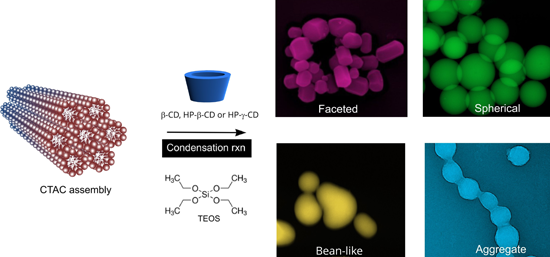
- . 100 particles from SEM images using ImageJ software (NIH, Bethesda, MD, USA). Energy-dispersive X-ray spectroscopy (EDX) was used to determine the elemental composition of the MSN samples at 30 kV and 4.5 mA. Transmission electron microscopy (TEM, FEI Tecnai G2F30) analysis was performed on the


Optimisation of purification techniques for the preparation of large-volume aqueous solar nanoparticle inks for organic photovoltaics
Beilstein J. Nanotechnol. 2018, 9, 649–659, doi:10.3762/bjnano.9.60
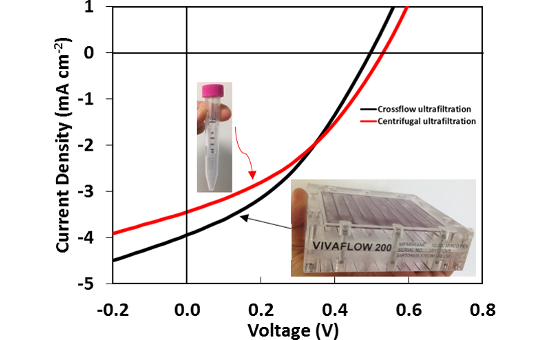
- ultrafiltration, the ASNP films with dilution factors of 1.6 × 10⁴, 9.8 × 10⁶ and 6.1 × 10⁹ all show aggregates on their surfaces (Figure 4A–C). These aggregates were analysed by energy dispersion X-ray spectroscopy (EDX, Supporting Information File 1, Figure S4). It is evident that the aggregates on the surfaces
- accelerating voltage of 2 kV and magnification ranges of 10,000–100,000×), with concurrent energy dispersive X-ray spectroscopy (EDX) measurements. For SEM, NP films were coated on conductive silicon substrates by spin coating, where 2.5 µL of NP ink was diluted in 12.5 µL of water and spun at 3000 rpm speed


Sensing behavior of flower-shaped MoS2 nanoflakes: case study with methanol and xylene
Beilstein J. Nanotechnol. 2018, 9, 608–615, doi:10.3762/bjnano.9.57

- using X-ray diffraction, Brunauer–Emmett–Teller surface area measurements, elemental analysis using energy dispersive X-ray spectroscopy, and field-emission scanning electron microscopy. The gas sensing characteristics were evaluated under exposure to various concentrations of xylene and methanol vapors


Sugarcane juice derived carbon dot–graphitic carbon nitride composites for bisphenol A degradation under sunlight irradiation
Beilstein J. Nanotechnol. 2018, 9, 353–363, doi:10.3762/bjnano.9.35
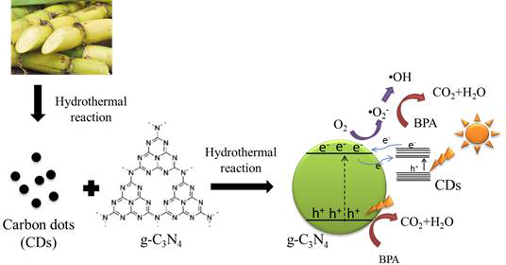
- detection of elemental C and N (inset of Figure 1b) using energy-dispersive X-ray spectroscopy (EDS) was attributed to the presence of pristine g-C3N4 and CDs [44]. A small peak of elemental O inevitably appeared due to reaction under ambient conditions. Figure 1e and Figure S2 (Supporting Information File
- ) HRTEM image of CD/g-C3N4(0.5). The insets of (b) and (e) show the energy-dispersive X-ray spectroscopy (EDS) results and particle size distribution of CDs, respectively. (a) XRD patterns and (b) FTIR spectra of g-C3N4, CD/g-C3N4(0.1), CD/g-C3N4(0.2), and CD/g-C3N4(0.5). (a) The absorption spectrum of


BN/Ag hybrid nanomaterials with petal-like surfaces as catalysts and antibacterial agents
Beilstein J. Nanotechnol. 2018, 9, 250–261, doi:10.3762/bjnano.9.27
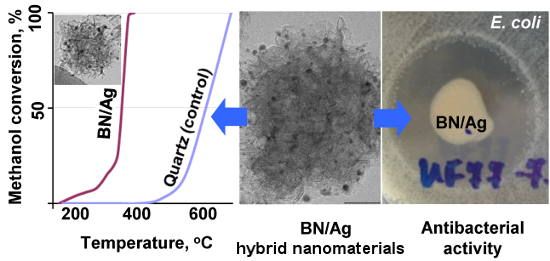
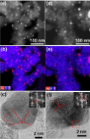
- means of high-resolution transmission electron microscopy (HRTEM), high-angular dark field scanning TEM (HADF-STEM) imaging and energy-dispersive X-ray spectroscopy (EDX) mapping using a JEM-2100 microscope (JEOL) equipped with an energy-dispersive X-ray spectrometer (Oxford Instruments) and a STEM





Gas-assisted silver deposition with a focused electron beam
Beilstein J. Nanotechnol. 2018, 9, 224–232, doi:10.3762/bjnano.9.24
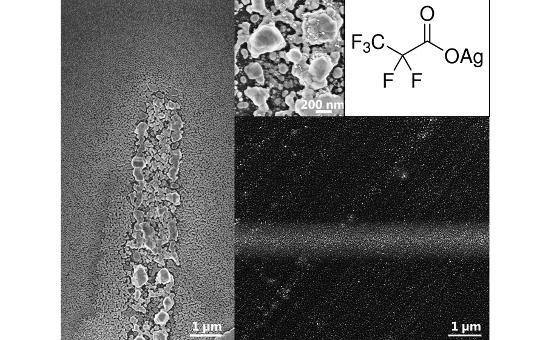
- diameter was chosen. For precise positioning, the GIS was fixed inside the chamber on a three-axis stage. The GIS was positioned at 200 µm lateral distance to the deposit and approximately 2 mm above the substrate. High resolution scanning electron microscopy and energy-dispersive X-ray spectroscopy (EDX


Bombyx mori silk/titania/gold hybrid materials for photocatalytic water splitting: combining renewable raw materials with clean fuels
Beilstein J. Nanotechnol. 2018, 9, 187–204, doi:10.3762/bjnano.9.21
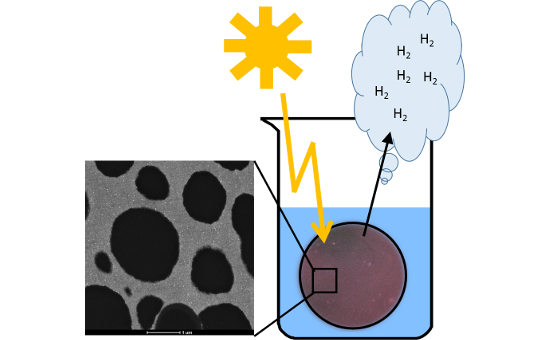
- electron microscopy (SEM) and energy dispersive X-ray spectroscopy (EDXS) were performed on a JEOL JSM-6510 with a W filament operated at 15 kV and equipped with an Oxford Instruments INCAx-act detector. Dry samples were either ground and deposited as powders on a carbon glue pad followed by sputtering
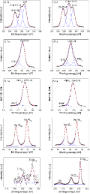
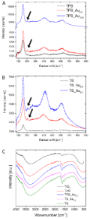
- electron microscopy (SEM) and energy dispersive X-ray spectroscopy (EDXS) data obtained from the hybrid materials. TPS has a rough and rather dense surface with large holes up to 16 µm in diameter and some smaller aggregates on the surface. Higher magnification images show smaller holes with diameters




Comparative study of post-growth annealing of Cu(hfac)2, Co2(CO)8 and Me2Au(acac) metal precursors deposited by FEBID
Beilstein J. Nanotechnol. 2018, 9, 91–101, doi:10.3762/bjnano.9.11
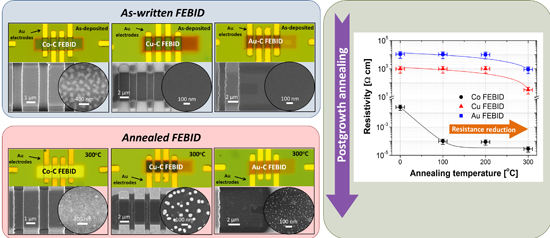
- pure Au agglomerates inside and on top of the carbonaceous matrix. Chemical characterisation EDX analysis The atomic percentages of the constituent elements of the Co–C–O, Cu–C–F–O and Au–C–O FEBID materials were determined using energy-dispersive X-ray spectroscopy (EDX), performed using a Hitachi S


The rational design of a Au(I) precursor for focused electron beam induced deposition
Beilstein J. Nanotechnol. 2017, 8, 2753–2765, doi:10.3762/bjnano.8.274
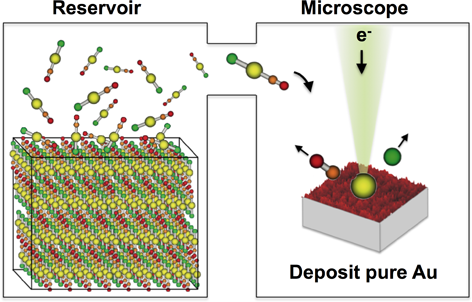
- same behavior was observed for ClAuPEt3 crystals (not shown). MeAuPMe3 was found to sublime within about 20 min in vacuum. The composition of the crystals was analyzed using energy-dispersive X-ray spectroscopy (EDS). It has to be noted that, with an anisotropic material distribution of relatively
- EDAX detector for energy-dispersive X-ray spectroscopy (EDX). The samples were inserted free of oxygen and water. The composition and morphology were characterized directly after inserting, and after 12 h in high vacuum. X-ray diffraction High-quality single crystals of MeAuPMe3 were grown by


Enhanced photoelectrochemical water splitting performance using morphology-controlled BiVO4 with W doping
Beilstein J. Nanotechnol. 2017, 8, 2640–2647, doi:10.3762/bjnano.8.264
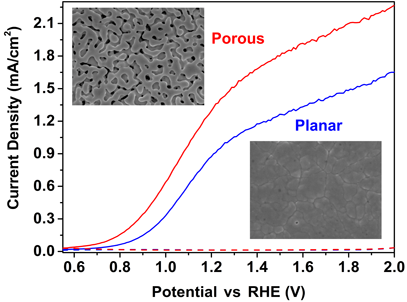
- °. Elemental analysis was conducted by energy-dispersive X-ray spectroscopy (EDX) equipped on a field-emission scanning electron microscopy (FESEM, JEOL JSM-7600F). Light absorption was measured using a UV–visible spectrophotometer by measuring the reflectance and transmittance with an integrating sphere


Localized growth of carbon nanotubes via lithographic fabrication of metallic deposits
Beilstein J. Nanotechnol. 2017, 8, 2592–2605, doi:10.3762/bjnano.8.260
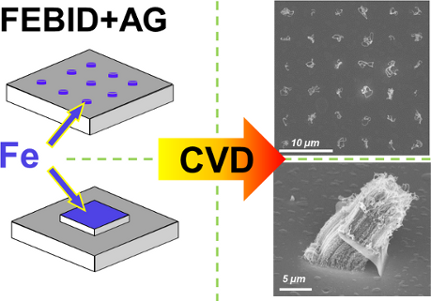
- ) CNT growth after a CVD experiment at 1133 K. (c) CNT growth after the CVD experiment at 1073 K. Energy dispersive X-ray spectroscopy (EDX) spectra were recorded at the indicated positions (1, 2 and 3) in (b) and details can be found in Supporting Information File 1. Lifted-up carbon nanotube (CNT
- ) forest structures produced on various Fe nanostructures. (a), (b) and (c) Bending forests grown on EBID Fe nanostructures with different shapes. (d) SEM micrographs at high magnification at the position indicated in (c). (e) Energy dispersive X-ray spectroscopy (EDX) spectrum at the position by the blue




Synthesis of metal-fluoride nanoparticles supported on thermally reduced graphite oxide
Beilstein J. Nanotechnol. 2017, 8, 2474–2483, doi:10.3762/bjnano.8.247
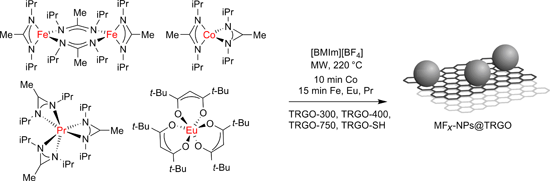
- identified by powder X-ray diffraction (PXRD) to be MF2 for M = Fe, Co and MF3 for M = Eu, Pr. The diameters and size distributions of MFx@TRGO were from (6 ± 2) to (102 ± 41) nm. Energy-dispersive X-ray spectroscopy (EDX) and X-ray photoelectron spectroscopy (XPS) were used for further characterization of


Comparing postdeposition reactions of electrons and radicals with Pt nanostructures created by focused electron beam induced deposition
Beilstein J. Nanotechnol. 2017, 8, 2410–2424, doi:10.3762/bjnano.8.240
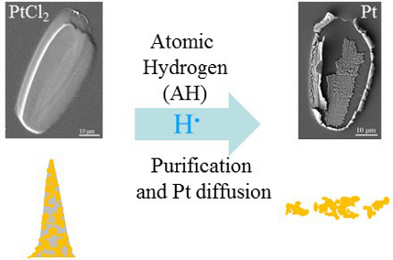
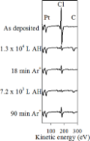
- from PtCl2 deposits created from cis-Pt(CO)2Cl2 by focused electron beam induced deposition (FEBID) is evaluated. Auger electron spectroscopy (AES) and energy-dispersive X-ray spectroscopy (EDS) measurements as well as thermodynamics calculations support the idea that electrons can remove chlorine from




Hydrothermal synthesis of ZnO quantum dot/KNb3O8 nanosheet photocatalysts for reducing carbon dioxide to methanol
Beilstein J. Nanotechnol. 2017, 8, 2264–2270, doi:10.3762/bjnano.8.226
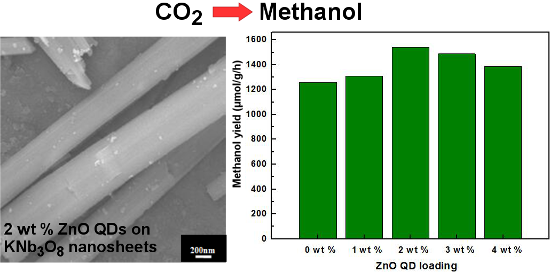
- . The as-prepared photocatalysts were characterized by X-ray diffraction (XRD), energy dispersive X-ray spectroscopy (EDS), scanning electron microscopy (SEM), high-resolution transmission electron microscopy (HRTEM) and UV–vis absorption spectroscopy (UV–vis). The photocatalytic activity of the
- were characterized with a powder X-ray diffraction instrument (XRD, D/Max–2500, Rigaku). The morphology and microstructure were examined by scanning electron microscopy (FE-SEM, JEOL–JSM 700F). The chemical composition was characterized using energy dispersive X-ray spectroscopy (EDS). TEM and HRTEM
- KNb3O8 nanosheets: (a) 0 wt %; (b) 1 wt %; (c) 2 wt %; (d) 3 wt %; (e) 4 wt %. TEM image of the 2 wt % ZnO quantum dot/KNb3O8 nanosheet composite photocatalyst. HRTEM image of the 2 wt % ZnO quantum dot/KNb3O8 nanosheet composite photocatalyst. Energy dispersive X-ray spectroscopy pattern of the 2 wt




Magnetic properties of optimized cobalt nanospheres grown by focused electron beam induced deposition (FEBID) on cantilever tips
Beilstein J. Nanotechnol. 2017, 8, 2106–2115, doi:10.3762/bjnano.8.210
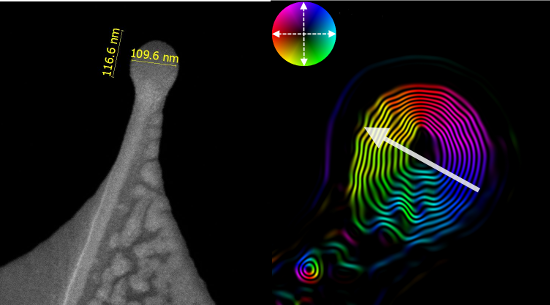
- studied the cobalt content of the nanospheres grown by FEBID at the apex of cantilevers by energy dispersive X-ray spectroscopy (EDS) to check the evolution of the metal content with nanosphere diameter, as it changes the surface-to-volume ratio of the nanosphere. First, we have grown nanospheres of 400


Synthesis and catalytic application of magnetic Co–Cu nanowires
Beilstein J. Nanotechnol. 2017, 8, 1769–1773, doi:10.3762/bjnano.8.178
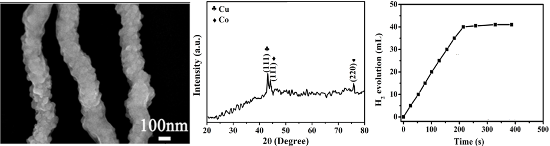
- °/min). The composition and amount of the sample was characterized by energy-dispersive X-ray spectroscopy (EDS, Oxford Instruments, X-Max 51-XMX0019). The magnetic performance of the sample was studied by a vibrating sample magnetometer (VSM, Lake Shore Cryotronics Inc., 7400). Figure 1 compares the


Near-infrared-responsive, superparamagnetic Au@Co nanochains
Beilstein J. Nanotechnol. 2017, 8, 1680–1687, doi:10.3762/bjnano.8.168
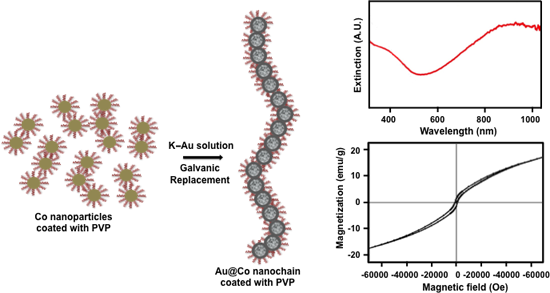
- electron diffraction (SAED) shown in the inset is also consistent with a single-phase fcc structure [36]. The chemical composition of the bimetallic nanochains was evaluated by energy dispersive X-ray spectroscopy (EDX) and X-ray photoelectron spectroscopy (XPS). Figure 4 shows the EDX spectrum with peaks


Group-13 and group-15 doping of germanane
Beilstein J. Nanotechnol. 2017, 8, 1642–1648, doi:10.3762/bjnano.8.164
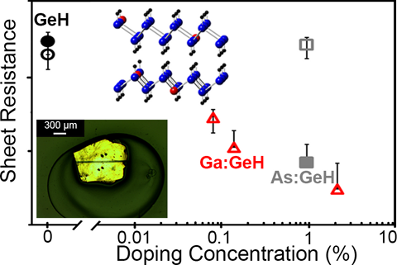
- % in GeH indicating that this is the maximum amount of As that can be substituted in CaGe2. The lack of any other distinguishing phase in the XRD suggests that Ga and As are part of the germanane lattice. Scanning electron microscopy (SEM) with energy-dispersive X-ray spectroscopy (EDX) provided


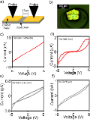

Enhanced catalytic activity without the use of an external light source using microwave-synthesized CuO nanopetals
Beilstein J. Nanotechnol. 2017, 8, 1167–1173, doi:10.3762/bjnano.8.118
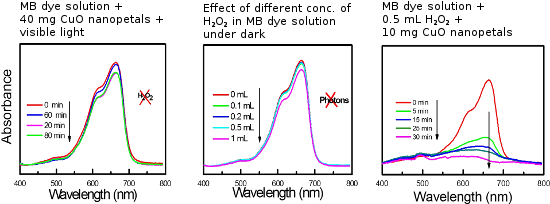
- %), and rhodamine B (RhB) were obtained from Sigma–Aldrich, Merck and SD Fine. CuO nanostructures were characterized by X-ray diffraction by a PANalytical high-resolution X-ray diffractometer (PW 3040/60) operated at 40 kV and 30 mA using Cu Kα X-rays (1.54 Å), energy dispersive X-ray spectroscopy using


Preparation of thick silica coatings on carbon fibers with fine-structured silica nanotubes induced by a self-assembly process
Beilstein J. Nanotechnol. 2017, 8, 1145–1155, doi:10.3762/bjnano.8.116
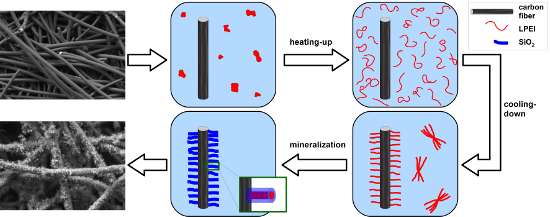
- /silica hybrid particles) and 150 °C (calcined silica nanotubes), respectively. Energy-dispersive X-ray spectroscopy (EDX) was performed with a XL30 FEG ESEM (environmental scanning electron microscope, FEI/Philips) equipped with an EDAX SiLi detector. The ESEM was used for electron micrographs in low





