


Search results
Search for "defect" in Full Text gives 402 result(s) in Beilstein Journal of Nanotechnology. Showing first 200.
Multilayer capsules made of weak polyelectrolytes: a review on the preparation, functionalization and applications in drug delivery
Beilstein J. Nanotechnol. 2020, 11, 508–532, doi:10.3762/bjnano.11.41
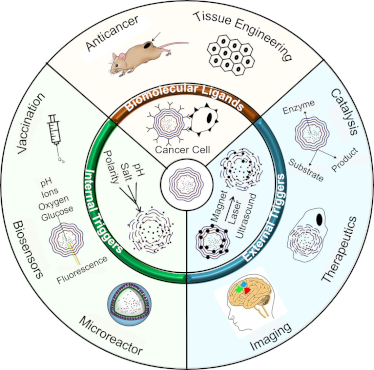
- CNTs ruptured upon laser light irradiation [115]. The introduction of graphene oxide (GO) nanosheets with PDDA as multilayers caused the migration and rearrangement of chains compared to PDDA/PAA multilayers [116]. The PDDA/GO multilayers showed improved resistance to damage and maintained a defect



Atomic-resolution imaging of rutile TiO2(110)-(1 × 2) reconstructed surface by non-contact atomic force microscopy
Beilstein J. Nanotechnol. 2020, 11, 443–449, doi:10.3762/bjnano.11.35
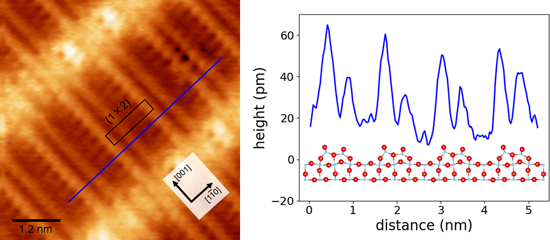
- -AFM and tunneling current for STM), the surface structure sometimes results in different contrasts in both images. In Figure 3, white squares and circles indicate line defects and protrusions, which are considered to be adsorbates or contamination. A line defect was imaged as a likely vacancy by STM
- defect is the same. Previous studies have reported STM imaging visualizing Ti2O3 rows with a bright contrast [22][24][26][28]. Based on these earlier results, the periodic lines with bright contrast in the NC-AFM image can be identified as Ti2O3 rows. STM and NC-AFM provided different geometry
- information on the line defect. The line defects could be due to be sub-surface defects because of the geometry of the reflected top surface obtained in NC-AFM imaging using the interaction between the tip and the sample surface as a feedback signal. To identify the line defects, it is necessary to combine


Electrochemically derived functionalized graphene for bulk production of hydrogen peroxide
Beilstein J. Nanotechnol. 2020, 11, 432–442, doi:10.3762/bjnano.11.34
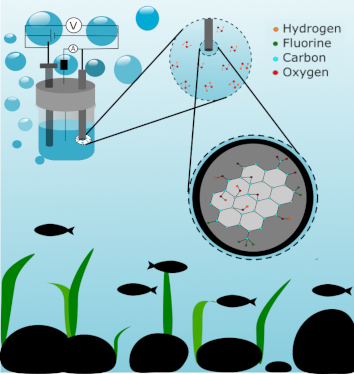
- their long-run alkaline ORR process where the extended stability in electrochemical processes is one of the crucial issues with Pt/C [36]. In all of these doped systems, carbon atoms near to the defect centers are found as catalytically active centers [37]. Recently, an ultra-small amount of selenium


DFT calculations of the structure and stability of copper clusters on MoS2
Beilstein J. Nanotechnol. 2020, 11, 391–406, doi:10.3762/bjnano.11.30
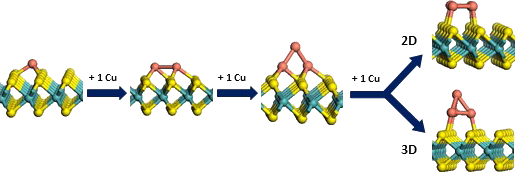
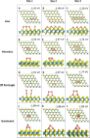
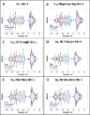
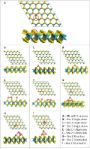
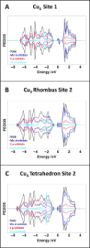
- particular when the monolayer is defect-rich. MoS2 is known to be naturally high in defects [21][32], in particular S vacancies. It has been predicted that S vacancies in a MoS2 monolayer are most stable when they occur in a row, with a decrease in the vacancy formation energy as the number of vacancies
- slightly shorter than the distances in bulk copper. As for the pristine surface, there is no clear correlation between the geometry and the strength of binding. The presence of a defect did not cause any notable geometry distortions in the monolayer. This is supported by Mo–S distances at the copper
Formation of nanoripples on ZnO flat substrates and nanorods by gas cluster ion bombardment
Beilstein J. Nanotechnol. 2020, 11, 383–390, doi:10.3762/bjnano.11.29
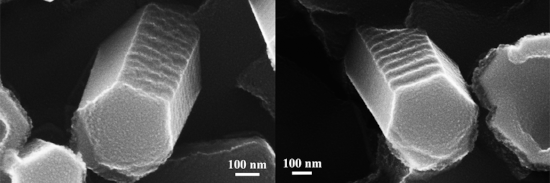
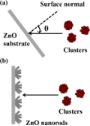
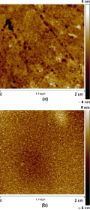
- “defect” are shown in Figure 6a and the lower inset of Figure 6a, respectively. Whereas, on the nanorod surfaces well-ordered and almost defectless ripples are formed (Figure 6b and Figure 5c,e,f). Similar to the “guiding” effect mentioned above, an ordering effect (at an appropriate fluence) is also
- al. predicting a remarkably defect-free ripple formation on the plane surface by ion bombardment of a binary material should also be noted [10]. In this theory, the composition change of the surface layer by the ion bombardment is discussed and a defect-free ripple formation of an elemental material
- becomes impossible from this point of view. In our experiment we also use binary materials and a defect-free ripple formation is observed, but only for nanorods. However, here, the scenario described in [10] seems unlikely due to a very low energy per atom in the cluster (a few electronvolts) and a



Nonequilibrium Kondo effect in a graphene-coupled quantum dot in the presence of a magnetic field
Beilstein J. Nanotechnol. 2020, 11, 225–239, doi:10.3762/bjnano.11.17
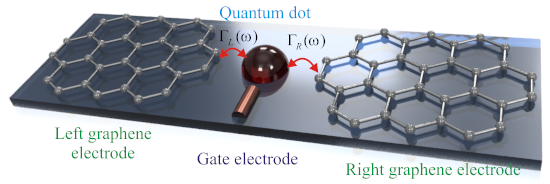
- ]. It was found that the Kondo resonance is not observed when the Fermi energy is near the Dirac points. The Kondo effect induced by a point defect or a magnetic impurity in graphene has been extensively studied for finite on-site Coulomb interaction within the NRG framework [72][73]. May et al. studied


Size effects of graphene nanoplatelets on the properties of high-density polyethylene nanocomposites: morphological, thermal, electrical, and mechanical characterization
Beilstein J. Nanotechnol. 2020, 11, 167–179, doi:10.3762/bjnano.11.14
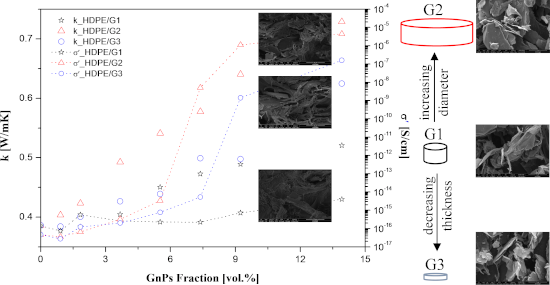
- graphene or its derivatives have shown that the properties of nanocomposites depend on several factors, such as the polymer type, morphology, intrinsic properties, size and defect level of the filler material, production method, interface between filler and polymer, and others [10][11][12]. Although the


Molecular architectonics of DNA for functional nanoarchitectures
Beilstein J. Nanotechnol. 2020, 11, 124–140, doi:10.3762/bjnano.11.11
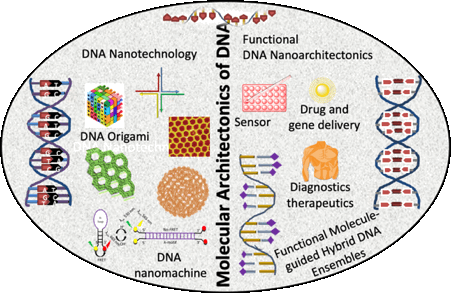
- compared to ssDNA. The selection of the correct base pairing sequence and order enabled the assembly of DNA with balanced rigidity and flexibility within the nanomaterial systems. The maintenance of an exact stoichiometry and long annealing period were the major criteria to achieve defect-free


Recent progress in perovskite solar cells: the perovskite layer
Beilstein J. Nanotechnol. 2020, 11, 51–60, doi:10.3762/bjnano.11.5

- can effectively improve the charge transport efficiency by eliminating the defect and trap density in the perovskite film. The resulting planar PSCs doped with 5 mol % FAAc achieved a PCE of 18.90%, which corresponds to an enhancement of the PCE of over 20% compared to those fabricated by doping with
- because of the unique morphology, which resulted in long carrier lifetime and low defect density. Of course, this precursor solution can be used for slot-die coating to fabricate high-quality PCSs at a high throughput rate. The combination of this special coating solution and the slot-die-coating


Influence of the epitaxial composition on N-face GaN KOH etch kinetics determined by ICP-OES
Beilstein J. Nanotechnol. 2020, 11, 41–50, doi:10.3762/bjnano.11.4
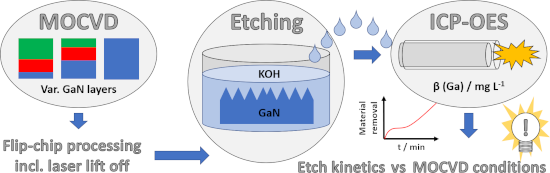
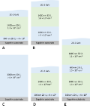
- and Al2O3 leads to a high dislocation density, if no strategy for defect reduction is applied. This spans the entire epitaxial layer. The most common strategy to bridge the structural mismatch is the application of AlN and GaN nucleation layers in between the sapphire substrate and bulk GaN [5][6
- ]. Nucleation layers have the second but very important effect of controlling crystal orientation, which is commonly Ga-polar (0001) [7]. Other than nucleation layers, there are several more strategies for defect reduction. These all require the insertion of additional layers or layer transitions into the


Synthesis of amorphous and graphitized porous nitrogen-doped carbon spheres as oxygen reduction reaction catalysts
Beilstein J. Nanotechnol. 2020, 11, 1–15, doi:10.3762/bjnano.11.1
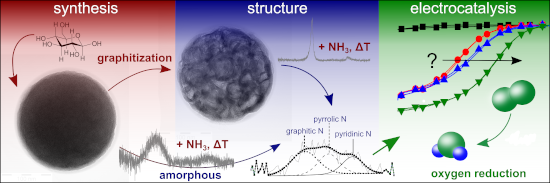
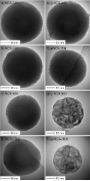
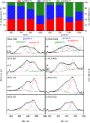
- interplanar distance in carbon with a turbostratic structure, and 0.3354 nm for the interplanar distance in a defect-free single crystal of graphite [41][42]. For g-NCS-850 and g-NCS-1000, g values of 0.43 and 0.59 were calculated, respectively. The reflections at 41.2° and 43.6° are associated to the (100
- the number of micropores, and thus of ORR active defect sites. Finally, considering the selectivity for the 4-electron reaction pathway to H2O, which is highly important for technical applications (Figure 8), we find that at potentials below 0.6 V the NCS-1000 catalyst, the best ORR catalyst in this
- directly to one of the N sites, but strongly depends on the amount of defect sites and thus on the microporosity/graphitization of the carbon surface, in combination with a low N-doping. These correlations between structure and ORR activity can be used to further improve the catalytic activity of N-doped




Abrupt elastic-to-plastic transition in pentagonal nanowires under bending
Beilstein J. Nanotechnol. 2019, 10, 2468–2476, doi:10.3762/bjnano.10.237
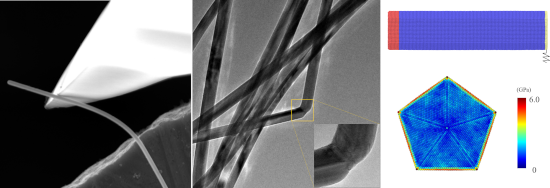
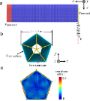
- at the twin boundaries leads to the brittle fracture-like onset of plastic deformation. The free surface of the NW facilitates the nucleation of defects, such as dislocations in an otherwise practically defect-free pentagonal NW structure. Additional preliminary experiments with alumina-coated Ag NWs



Multiple Fano resonances with flexible tunablity based on symmetry-breaking resonators
Beilstein J. Nanotechnol. 2019, 10, 2459–2467, doi:10.3762/bjnano.10.236
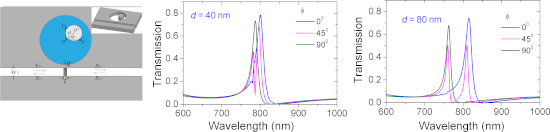
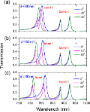
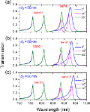
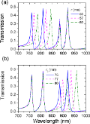
- stuctures are investigated at different platforms aiming for Fano resonance. Fano-type transmission phenomenona were observed in photonic crystal (PhC) waveguide–cavity systems [17][18]. The PhC waveguide is a line defect formed by removing a row of rods or air holes. The cavity is a point defect formed by




Mobility of charge carriers in self-assembled monolayers
Beilstein J. Nanotechnol. 2019, 10, 2449–2458, doi:10.3762/bjnano.10.235
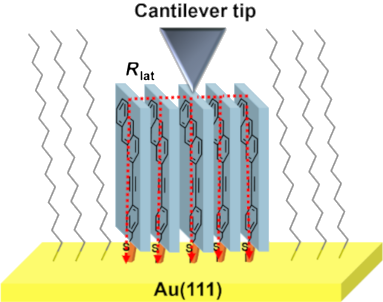
- ]. Domain boundaries, contaminations and defects have a pronounced, negative effect on charge carrier mobility. This fact calls for measurements on low-defect density samples, preferentially macroscopic single crystals, to determine the intrinsic mobilities. This approach, however, is difficult due to the
- challenge of production and procurement of highly ordered, very pure crystals of macroscopic dimensions with very low defect density, and accordingly only few measurements of such type were reported [5][6][7][8]. Here, we obtain information on intrinsic mobilities, the main figure of merit of OSC materials
- nanometers were formed. This process is expected to lead to rather small 2D domains. Also the exchange of the decanethiolate moieties by HBC may be incomplete, which would also lead to a larger defect density. We speculate that the asymptotic behavior of conductivity increase with island size results from a


pH-Controlled fluorescence switching in water-dispersed polymer brushes grafted to modified boron nitride nanotubes for cellular imaging
Beilstein J. Nanotechnol. 2019, 10, 2428–2439, doi:10.3762/bjnano.10.233
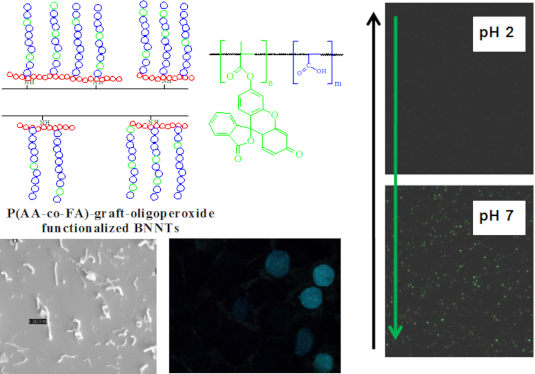
- functionalization strategies can be classified into three groups: (1) noncovalent, (2) covalent grafting to the surface, and (3) formation of amino and/or hydroxyl groups at the ends and defect sites [11][25][26][27]. Up to now, the most prospective procedure for BNNT functionalization is covalent grafting of



Deterministic placement of ultra-bright near-infrared color centers in arrays of silicon carbide micropillars
Beilstein J. Nanotechnol. 2019, 10, 2383–2395, doi:10.3762/bjnano.10.229
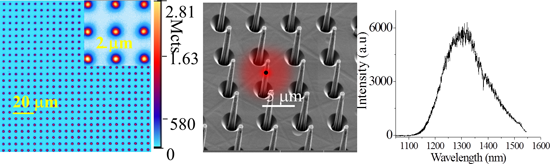
- field. Unpaired electrons interact to give two or more energy states [25]. ODMR is a technique to optically pump the electron spin state of a crystal defect for spin initialization and readout [26]. There are over 200 polymorphs of SiC, and the most relevant are cubic SiC (3C) and hexagonal (4H and 6H
- 4H-SiC. The intensity of the largest PL from a single defect at saturation is 10 kcts/s [8] without a solid immersion lens using an a-Si detector with 20–30% quantum efficiency and 40 kcts/s with a solid immersion lens [4]. The DWF is 40%, the ZFS is 70 MHz for V2 and 4 MHz for V1 at the ground state
- permitted to achieve coherent coupling to single nuclear spins with ca. 1 kHz resolution [27]. The divacancy in 4H-SiC is a neutral charge state defect with spin S = 1 with 4 ZPLs PL1–PL4, in the range of 1078–1132 nm [34]. The largest PL intensity is 27 kcps [5] at low temperature using a superconducting


Polyvinylpyrrolidone as additive for perovskite solar cells with water and isopropanol as solvents
Beilstein J. Nanotechnol. 2019, 10, 2374–2382, doi:10.3762/bjnano.10.228
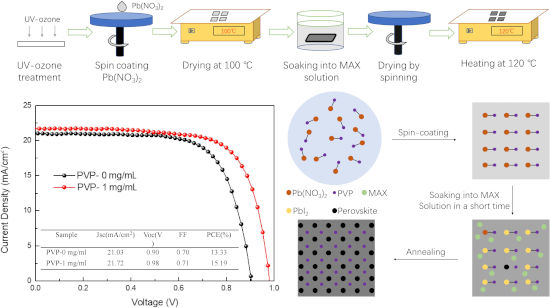
- -Fermi level in the contacted perovskite and electron transfer material, but also by the defect-induced recombination in the electron transport channels [33]. It is clear that perovskite solar cells using a PVP-containing aqueous lead nitrate precursor solution will lead to an increase in Voc. The Voc of




Design and facile synthesis of defect-rich C-MoS2/rGO nanosheets for enhanced lithium–sulfur battery performance
Beilstein J. Nanotechnol. 2019, 10, 2251–2260, doi:10.3762/bjnano.10.217
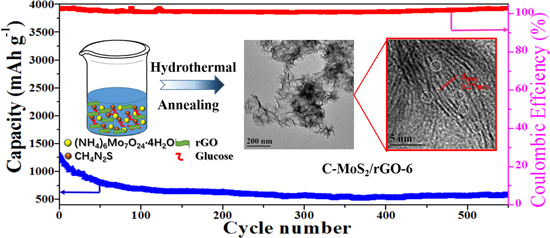
- composite with both large surface area and high porosity for the use as advanced electrode material in lithium–sulfur batteries. Double modified defect-rich MoS2 nanosheets are successfully prepared by introducing reduced graphene oxide (rGO) and amorphous carbon. The conductibility of the cathodes can be
- catalyzing the formation of sulfur species [21][22], indicating a potential application for Li–S batteries. Previous simulation results show that the binding energy of the edge active sites of defect-rich MoS2 and Li2S is much greater than the binding energy of the base plane, which is very helpful for the
- adsorption of polysulfides [23][24]. However, the low conductivity of MoS2 often results in incomplete conversion of polysulfides. Thus, MoS2 is usually combined with carbon materials and annealing treatment is also considered [25][26]. Hence, double modification of defect-rich MoS2 nanosheets with amorphous


Nitrogen-vacancy centers in diamond for nanoscale magnetic resonance imaging applications
Beilstein J. Nanotechnol. 2019, 10, 2128–2151, doi:10.3762/bjnano.10.207
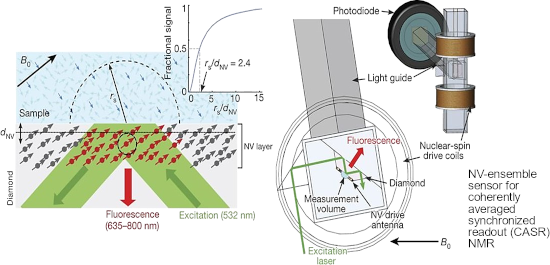
- and Technology, University of Wales, Wrexham, United Kingdom Department of Computer Science, University of Western Cape, Cape Town, South Africa School of Engineering, RMIT University, Bundoora, Victoria, Australia 10.3762/bjnano.10.207 Abstract The nitrogen-vacancy (NV) center is a point defect in
- illumination [7]. The characterization of single NV centers became popular at the end of the 1990s. It was demonstrated that the fluorescence of single NV centers can be detected by room-temperature fluorescence microscopy and that the defect shows perfect photostability [8]. Room-temperature optically
- associated with NV center sensors for magnetic imaging applications. An NV center is an atomic size point defect in diamond. Standard optical techniques are capable of resolving the photoluminescence signal of a single NV center, the detection of which is facilitated particularly in the negative charge state


Ion mobility and material transport on KBr in air as a function of the relative humidity
Beilstein J. Nanotechnol. 2019, 10, 2084–2093, doi:10.3762/bjnano.10.203
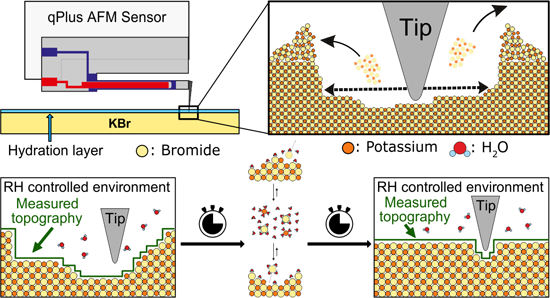
- removed material accumulated around the defect and to a small extent attached to the tip. Most of the material accumulates at the turnaround points of the tip. The scratching technique creates larger and more reproducible holes than the poking of single points, since the shape of the tip becomes less
- . The depth of the defects is defined by the height difference between the lowest point of the defect and the surrounding terrace. The removed material aggregates around the artificial defect. The accumulations do not attach symmetrically but irregularly around the holes. This can be explained by the
- model as described in Ref. [29]. If we were to start with a defect that has the first layer removed in a circle with radius R1 and a second (deeper) layer removed in a circle with radius r1< R1, this would yield an energy term for the edge E1 ∝ 2πR1 + 2πr1. The defect now evolves, maintaining the total


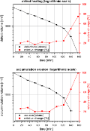
Green and scalable synthesis of nanocrystalline kuramite
Beilstein J. Nanotechnol. 2019, 10, 2073–2083, doi:10.3762/bjnano.10.202
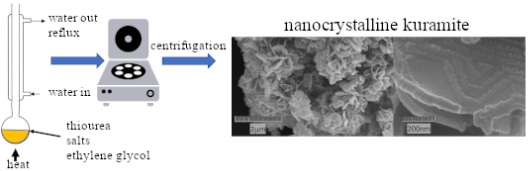
- covellite in the final product, a relevant factor is the molar defect of Cu precursor in the EG. The crystal chemical analysis (by Raman, XRD and EXAFS) revealed a random distribution of antisite defects, SnCu and CuSn, in the tetragonal structure while still maintaining the I−42m symmetry. These chemical


Improvement of the thermoelectric properties of a MoO3 monolayer through oxygen vacancies
Beilstein J. Nanotechnol. 2019, 10, 2031–2038, doi:10.3762/bjnano.10.199
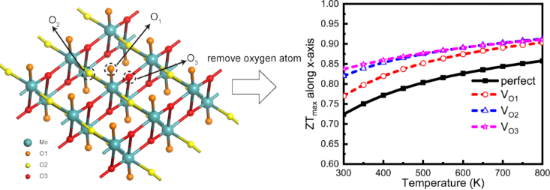
- supercell (72 atoms) to construct a neutral defect, such that the stoichiometric proportion is MoO2.94. Since there are three types of O atoms in the primitive cell, we named the three defective structures VO1, VO2 and VO3. Further details of the defect structures are presented in Supporting Information
- File 1. The formation energy, Ef, of a neutral defect is defined as: Ef = Etot(defect) − Etot(supercell) + ½ Etot(O2), where Etot(defect) is the total energy of the supercell containing the defect, Etot(supercell) is the total energy of the perfect supercell and Etot(O2) is the total energy of the
- oxygen molecules. Then we calculate the formation energies and band gaps of these defect structures. The absolute Ef values are 2.074 eV (VO1), 2.076 eV (VO2) and 4.108 eV (VO3) while the band gaps are 0.837 eV (VO1), 0.797 eV (VO2) and 0.831 eV (VO3). In contrast to the bulk MoO3, the three defective


The influence of porosity on nanoparticle formation in hierarchical aluminophosphates
Beilstein J. Nanotechnol. 2019, 10, 1952–1957, doi:10.3762/bjnano.10.191
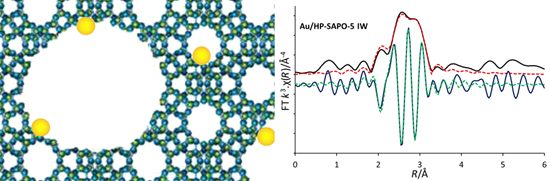
- (Figure S4 and Figure S5, Supporting Information File 1), the decrease in porosity suggests that the 1D channels are blocked, restricting access to the internal micropores. As pore mouths are known to produce high-energy defect sites [18], they are more likely to encourage nanoparticle deposition, thus
First principles modeling of pure black phosphorus devices under pressure
Beilstein J. Nanotechnol. 2019, 10, 1943–1951, doi:10.3762/bjnano.10.190
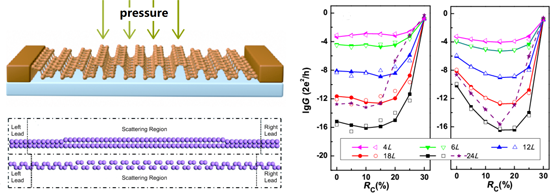
- to 40%, which indicates the stability of monolayer BP under zero pressure. The smooth variation of Etot means that monolayer BP can maintain its structure even at large pressure, and does not form any structural defect or bonding twist. The stress Ps can be calculated by Ps = −∂Etot/∂d·1/S with d the




Fabrication and characterization of Si1−xGex nanocrystals in as-grown and annealed structures: a comparative study
Beilstein J. Nanotechnol. 2019, 10, 1873–1882, doi:10.3762/bjnano.10.182
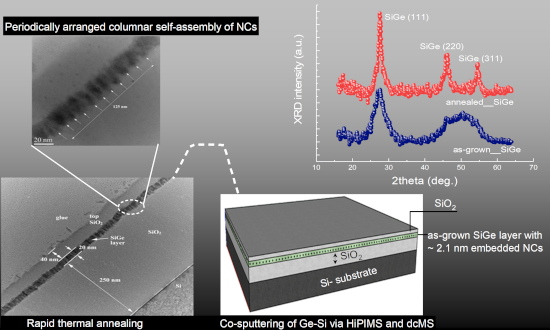
- the SiGe NCs); these defects do not appear because other relaxation processes take place as shown earlier. Since these shearing defects are near or in the (111) stacking planes of the SiGe structure, the NC size along the direction that is parallel to the defect plane remains large and the two others





