Search results
Search for "morphology" in Full Text gives 1296 result(s) in Beilstein Journal of Nanotechnology. Showing first 200.
Enhancing mechanical properties of chitosan/PVA electrospun nanofibers: a comprehensive review
Beilstein J. Nanotechnol. 2025, 16, 286–307, doi:10.3762/bjnano.16.22

- viscoelastic deformation and sliding. Morphological properties and structure Mechanical properties can often be correlated with the morphology and structure of the nanofibers [143]. The use of optical microscopes in obtaining nanofiber images is quite rare because of the relatively low resolution, but it is
- electron microscopy (SEM) and field-emission scanning electron microscopy (FESEM) are more commonly used to analyze the fiber diameter, distribution, and overall surface morphology [144]. Microscopic images obtained from these techniques help to identify defects such as beading or non-uniformity in fibers
- microscopy has been used to investigate morphology as well as the nanomechanical properties of individual fibers, including magnetization, friction, and mechanical strength [147]. These imaging techniques are critical for linking the mechanical behavior to the microstructure of the fibers. Based on fiber


Emerging strategies in the sustainable removal of antibiotics using semiconductor-based photocatalysts
Beilstein J. Nanotechnol. 2025, 16, 264–285, doi:10.3762/bjnano.16.21
- without modification with suitable dopants. Chen and his colleagues [86] synthesized nanoscale Bi2O3 and observed little degradation of TC. Modification of Bi2O3 with MnO2, changed the morphology from nanorods to nanosheets. This nanosheet structure showed a higher TC removal efficiency than pure Bi2O3
- morphology and textural structure of g-C3N4, which improved its solar absorption and charge-carrier transportation. The photocatalytic TC decomposition rate was 3.32 times higher in pyridazine-doped g-C3N4 than in the unmodified form [103]. Several studies have shown that heterojunctions formed by combining


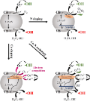

Radiosensitizing properties of dual-functionalized carbon nanostructures loaded with temozolomide
Beilstein J. Nanotechnol. 2025, 16, 229–251, doi:10.3762/bjnano.16.18
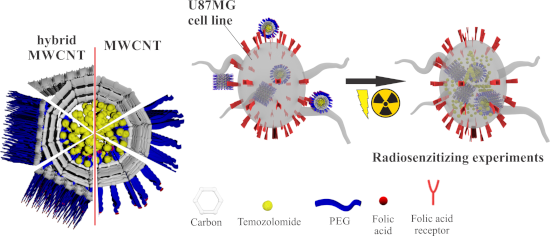
- [48][49][50][51][52][53]. Morphology In the SEM images of the MWCNTs-COOH (presented in our previous study [43]), a dense structure of randomly aggregated, convoluted, and highly tangled tubes was observed. The image of MWCNTs-G shows a hybrid structure of multiwalled nanotubes dispersed within the
- structures attached to the graphene sheets, attributed dominantly to PEG6000. No clear distinction regarding the morphology of single- and dual-functionalized CNs and structures with and without TMZ could be made with the used imaging technique. Also, no morphological differences were observed between the




Synthesis and the impact of hydroxyapatite nanoparticles on the viability and activity of rhizobacteria
Beilstein J. Nanotechnol. 2025, 16, 216–228, doi:10.3762/bjnano.16.17
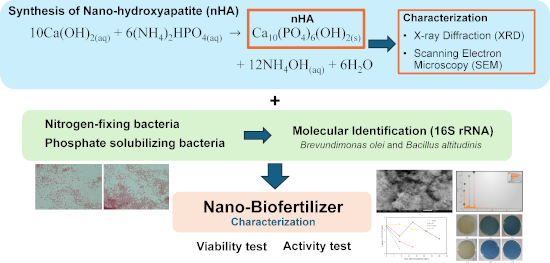
- using 16S rRNA gene sequencing, followed by analysis to construct a phylogenetic tree. nHA was found to meet the required quality criteria, exhibiting a spherical morphology with an average particle size of 68 nm and a porosity of 54.78%. The nHA carrier demonstrated favorable physical attributes to
- . The morphology of the analyzed sample, observed through scanning electron microscopy (SEM) at magnifications of 15,000× and 50,000× are depicted in Figure 3. Figure 3 provides a clear view of the sample demonstrating spherical shapes with a consistent particle size distribution. The SEM analysis
- (Tb) are gram-positive rhizobacteria with rod-like morphology, as illustrated in Figure 10. Conclusion Nanohydroxyapatite (nHA) was synthesized successfully using a hydrothermal method, and XRD analysis confirmed its alignment with the ICSD standard #154781. The measured crystal size of nHA was 34.27


Recent advances in photothermal nanomaterials for ophthalmic applications
Beilstein J. Nanotechnol. 2025, 16, 195–215, doi:10.3762/bjnano.16.16
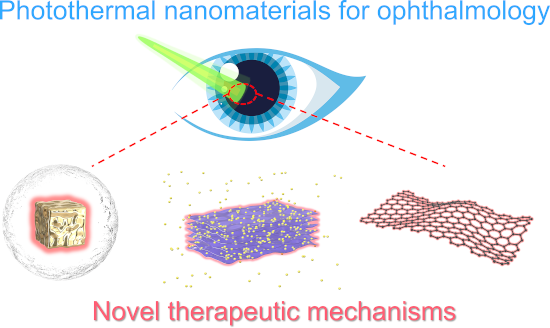
- ], and overcoming barriers in drug delivery [53]. Furthermore, the precise adjustment of the morphology and particle size of LSPR metals allows for the fine-tuning of their characteristic absorption within the range of 650 to 1350 nm. This range falls outside the absorption spectrum of the eye’s aqueous
- therapeutic effects in humans [213]. The safety profile of photothermal nanomaterials is influenced by various factors, including their morphology, structure, concentration, photothermal stability, mechanical strength, and surface chemistry [214]. Enhancements in biocompatibility and stability can be achieved
- development cycles and high cost. The rapid advancement in AI and machine learning is revolutionizing material design and screening processes [219]. Machine learning has achieved significant success in predicting various material properties, including morphology, toxicity, photothermal characteristics


Probing the potential of rare earth elements in the development of new anticancer drugs: single molecule studies
Beilstein J. Nanotechnol. 2025, 16, 187–194, doi:10.3762/bjnano.16.15

- from our AFM assays. Without any rare earth in the sample, the deposited DNA molecules exhibit the usual 2D worm-like chain morphology [23]. The concentration of rare earths used in each case was 1 μM, which is sufficiently high to able DNA compaction in the present cases (if such compaction actually
- experiments performed here was to confirm the ability of neodymium and erbium to condense DNA at high concentrations (>0.5 μM for neodymium and >0.05 μM for erbium). Furthermore, these assays allowed us to estimate the typical shape and size of these condensates. They present a globular morphology with


A review of metal-organic frameworks and polymers in mixed matrix membranes for CO2 capture
Beilstein J. Nanotechnol. 2025, 16, 155–186, doi:10.3762/bjnano.16.14
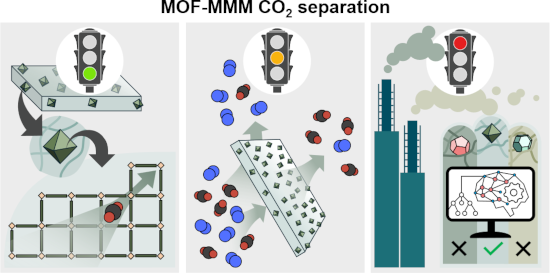
- functionalization of MOFs before MMM preparation can enhance MOF–polymer compatibility by enabling the formation of hydrogen bonds between the MOF and the hydrogen bond donors in the polymer matrix [33]. 3.5 Importance of interfacial morphology An optimal MOF–polymer matrix interface, schematically illustrated in
- Figure 6a, is crucial for the gas separation performance of MOF-based MMMs, as it helps overcome defect formation and control interface morphology. There are five types of common defects for MOF-based MMMs, namely (1) voids around the MOF, Figure 6b, (2) rigidified polymer around the MOF, Figure 6c, (3




TiO2 immobilized on 2D mordenite: effect of hydrolysis conditions on structural, textural, and optical characteristics of the nanocomposites
Beilstein J. Nanotechnol. 2025, 16, 128–140, doi:10.3762/bjnano.16.12
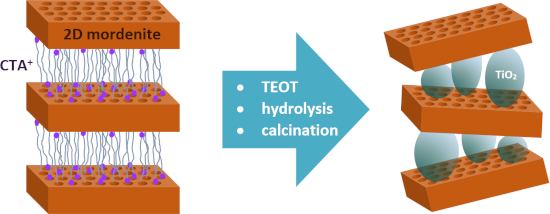
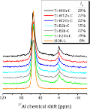
- treatment in air is eliminated in the process of crystallization at 400–550 °C; thus, titanium dioxide nanoparticles are obtained [29]. In this study we investigate in detail the influence of the hydrolysis medium and the duration of the hydrolytic process on composition, local structure, morphology
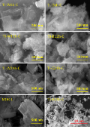
- calcination, all composites have a similar morphology. Thin plates of about 0.5 μm in size covered with nanoparticles of about 10 nm in size. The samples obtained by hydrolysis in 70% ethanol solution exhibit a more foam-like shape. Moreover, hydrolysis in 70% ethanol solution for 24 h results in the
- regulate the growth of nanoparticles in the interlayer space (e.g., the temperature of hydrolysis) and their morphology, as well as to investigate the influence of synthesis conditions on the target properties. Nevertheless, the successful application of zeolite pillaring using an oxide material other than



Characterization of ZnO nanoparticles synthesized using probiotic Lactiplantibacillus plantarum GP258
Beilstein J. Nanotechnol. 2025, 16, 78–89, doi:10.3762/bjnano.16.8
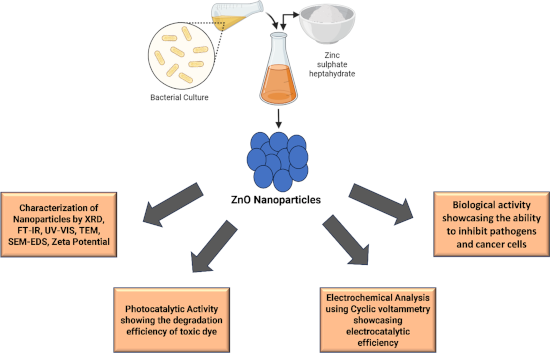
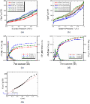
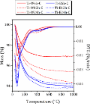
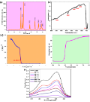
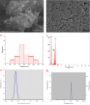
- measurements were employed to analyze the morphology, dimensions, and elemental composition of the generated nanoparticles. The experimental outcomes confirmed the presence of hexagonal wurtzite-structured ZnO NPs with an average size of 10 nm. The colloidal system demonstrated excellent stability with a zeta
- ZnO NPs confirms the XRD results, that is, the hexagonal wurtzite structure (Figure 3). SEM and EDX analysis SEM was used to analyze the surface morphology of a modified nanocomposite film, and the image displays a consistent coverage of a web-like structure. Close-up views revealed a crumpled and
- . Later, bacterial colonies were screened, and pure cultures were maintained at 4 °C. A comprehensive analytical scheme was adopted to identify the most promising bacterial isolates, that is, Gram’s reaction, morphology, catalase activity, endospore staining, and carbohydrate fermentation profiling using



Instance maps as an organising concept for complex experimental workflows as demonstrated for (nano)material safety research
Beilstein J. Nanotechnol. 2025, 16, 57–77, doi:10.3762/bjnano.16.7

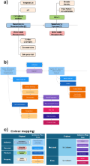
- of the material’s morphology, as well as the nature of the bonds between the surface and core. This level of detail can only be gained by understanding how the nanomaterial is synthesised, which is where instance maps will be a critical tool. Example 2: Monitoring nanomaterial transformation in


Bioinspired nanofilament coatings for scale reduction on steel
Beilstein J. Nanotechnol. 2025, 16, 25–34, doi:10.3762/bjnano.16.3

- – we can conclude that nanofilaments can be deposited on steel surfaces and that the grown structures render the steel surface super-hydrophobic [24]. The morphology and function of the SNF steel coatings remain intact during the shear stress test. The SEM image of the SNF coating after shear exposure
- silicone nanofilaments on steel surfaces, a novel application that has not been previously reported. The results indicate that SNF coatings can effectively render steel surfaces super-hydrophobic, as evidenced by high contact angles, high droplet mobility, and stable morphology under shear stress and


Attempts to preserve and visualize protein corona on the surface of biological nanoparticles in blood serum using photomodification
Beilstein J. Nanotechnol. 2024, 15, 1654–1666, doi:10.3762/bjnano.15.130

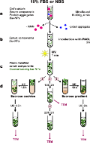
- data regarding their size and morphology [31][32][33][34]. The experiments on isolating bio-NPs from photomodified FBS and NBS did not achieve the goal to isolate protein corona-bearing bio-NPs. However, we revealed a few interesting facts regarding the interaction of bio-NPs with sucrose, as well as



Fabrication of hafnium-based nanoparticles and nanostructures using picosecond laser ablation
Beilstein J. Nanotechnol. 2024, 15, 1639–1653, doi:10.3762/bjnano.15.129
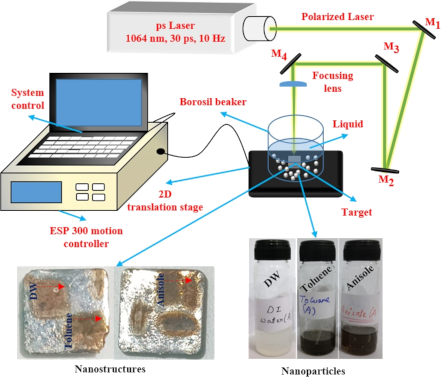
- size and morphology [1]. Recently, interest has risen regarding synthesis and study of Hf-based NPs. Depending on the morphology, chemical composition, and quantum confinement effects, NPs can exhibit novel properties, making them applicable for large-spectrum usage [12][13]. Thus, synthesizing the
- desired morphology is essential for a given application. Generally, practical techniques for obtaining nanomaterials are sol–gel method, chemical and physical vapour deposition, hydrothermal method, ball milling, grinding, lithography, etching, and laser ablation [14][15][16][17][18]. The morphology
- target, from a single pure medium to a mixture of liquid media, with a range of target types such as powder, pellets, and well-defined structures and shapes [16][20]. The choice of the liquid medium can significantly affect morphology and chemical composition of the obtained NPs. The high energy of the




Natural nanofibers embedded in the seed mucilage envelope: composite hydrogels with specific adhesive and frictional properties
Beilstein J. Nanotechnol. 2024, 15, 1603–1618, doi:10.3762/bjnano.15.126
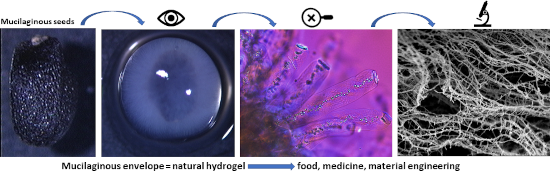
- Agnieszka Kreitschitz Stanislav N. Gorb University of Wrocław, Department of Plant Developmental Biology, ul. Kanonia 6/8, 50-328 Wrocław, Poland Kiel University, Department of Functional Morphology and Biomechanics, Am Botanischen Garten 9, D-24098 Kiel, Germany 10.3762/bjnano.15.126 Abstract


Liver-targeting iron oxide nanoparticles and their complexes with plant extracts for biocompatibility
Beilstein J. Nanotechnol. 2024, 15, 1593–1602, doi:10.3762/bjnano.15.125
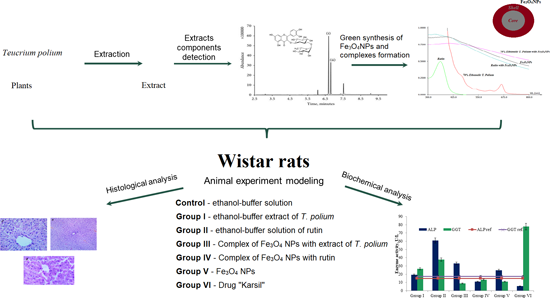
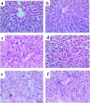
- correlates with literature data on the peroxidase-like enzymatic properties exhibited by Fe3O4 NPs, which is reflected in the preservation of liver tissue morphology, but accompanied by changes in liver function biochemical markers (Figures 1–3, Table 1 and Table 2). Considering the duration of exposure and
- Sonic-150W, MRC, Israel) at 80% power with an on/off cycle of 5/4 s. During the synthesis of the nanoparticles, a black precipitate with paramagnetic properties formed. Nature and morphology of this precipitate were determined using electron diffraction and transmission electron microscopy (TEM, LEO-912


Facile synthesis of size-tunable L-carnosine-capped silver nanoparticles and their role in metal ion sensing and catalytic degradation of p-nitrophenol
Beilstein J. Nanotechnol. 2024, 15, 1576–1592, doi:10.3762/bjnano.15.124
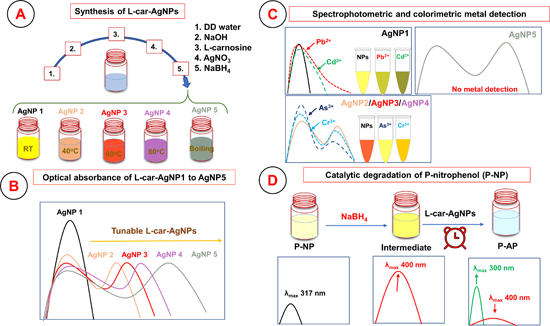
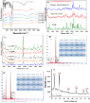
- , Netherlands) for a detailed examination of size and morphology. The crystalline structure of ʟ-car-AgNP1 was determined using X-ray diffraction (XRD, Rigaku Smartlab, Japan) within a 2θ range of 35° to 80°. Nanoparticle solutions were air-dried, and the obtained nanopowders (20 mg) were used for measurements
- pristine silver nanospheres upon interaction. The appearance of the redshifted peak might be due to charge transfer or aggregation [7]. An increased nanoparticle size leads to a further redshift of the plasmonic peak [26]. Hydrodynamic size, zeta potential, and morphology of the ʟ-car-AgNPs are shown in
- towards the positively charged surfaces of silver. The morphology and size of silver nanoparticles capped with ʟ-carnosine were measured using TEM (Figure 3b–f). The TEM micrograph of ʟ-car-AgNP1 (Figure 3b) indicates the formation of spherical particles with high monodispersity and is consistent with the




Green synthesis of silver nanoparticles derived from algae and their larvicidal properties to control Aedes aegypti
Beilstein J. Nanotechnol. 2024, 15, 1566–1575, doi:10.3762/bjnano.15.123
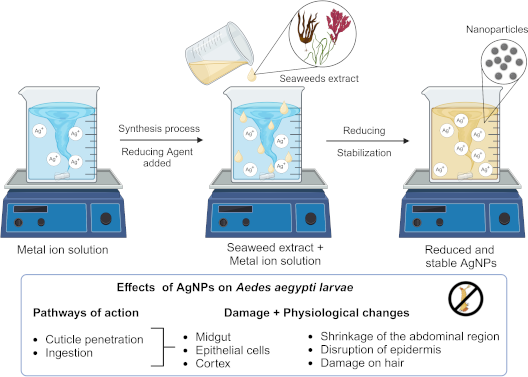
- ][43][44][45][46]. These bioactive compounds associated with metallic nanoparticles increase the specific delivery of drugs to the target and, thus, reduce the required amount of active compounds [47]. In addition, the control of particle size and morphology is essential for applications in


Ultrablack color in velvet ant cuticle
Beilstein J. Nanotechnol. 2024, 15, 1554–1565, doi:10.3762/bjnano.15.122

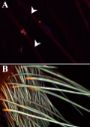
- Vinicius Marques Lopez Wencke Krings Juliana Reis Machado Stanislav Gorb Rhainer Guillermo-Ferreira Lestes Lab, Federal University of Triângulo Mineiro, Uberaba, Minas Gerais, Brazil Department of Functional Morphology and Biomechanics, Kiel University, Am Botanischen Garten 1–9, 24098 Kiel
- spectroscopy, we conducted a comprehensive analysis of the cuticle to elucidate its unique optical properties. SEM imaging provided a detailed surface morphology, while TEM provided insights into the internal structure. CLSM showed that the cuticle exhibits no autofluorescence. Our findings reveal a highly
- different magnifications, starting at 15,000× and adjusted as needed. Transmission electron microscopy (TEM) TEM was utilized to examine the internal cuticle morphology at high resolution at a nanometer scale. The apparatus was configured to operate at 50 kV with a minimum vacuum column pressure of 5.10



The round-robin approach applied to nanoinformatics: consensus prediction of nanomaterials zeta potential
Beilstein J. Nanotechnol. 2024, 15, 1536–1553, doi:10.3762/bjnano.15.121
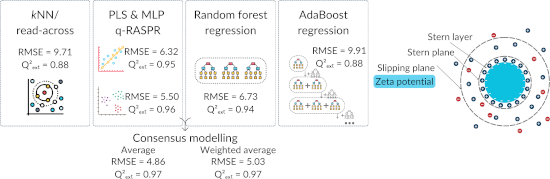
- [36], the following four were included in this study because of the completeness of the data (absence of data gaps): the NMs’ core chemistry, coating, morphology, and hydrodynamic diameter measured using dynamic light scattering (DLS). The ZP of the NMs was measured in water (pH 6.5–8.5). To enrich


Electrochemical nanostructured CuBTC/FeBTC MOF composite sensor for enrofloxacin detection
Beilstein J. Nanotechnol. 2024, 15, 1522–1535, doi:10.3762/bjnano.15.120
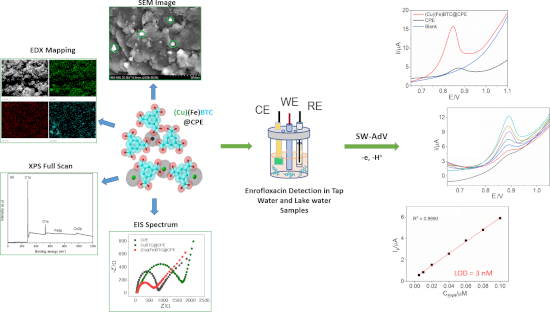
- mixture of CuBTC and FeBTC to modify carbon paste electrodes for the determination of enrofloxacin. The characterization and properties of the fabricated electrode, including molecular structure, morphology, and electrochemical characteristics, were thoroughly investigated using various analytical
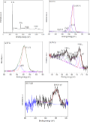
- 2e), the binding energy peak of Cu 2p3/2 (934.9 eV) can be attributed to Cu2+. Characterization of (Cu)(Fe)BTC@CPE Morphology The TEM image of the (Cu)(Fe)BTC sample shows unevenly distributed particles with different particle sizes fluctuating in the range of 40 to 100 nm (Figure 3). After mixing





Integrating high-performance computing, machine learning, data management workflows, and infrastructures for multiscale simulations and nanomaterials technologies
Beilstein J. Nanotechnol. 2024, 15, 1498–1521, doi:10.3762/bjnano.15.119

- materials research by extracting valuable patterns and correlations from vast amounts of experimental and computational data [6][7][8][9]. These approaches enable researchers to uncover hidden relationships between composition, structure, morphology, processing, and properties, accelerating the discovery of
- of a broad range of advanced digital technologies (Figure 1). One significant area where these technologies can have a profound impact is in the design and development of advanced nanomaterials [15][16], where the relationship between structure and morphology at different scales, processing, and


Effect of radiation-induced vacancy saturation on the first-order phase transformation in nanoparticles: insights from a model
Beilstein J. Nanotechnol. 2024, 15, 1453–1472, doi:10.3762/bjnano.15.117

- essential to consider nucleation and the nucleation barrier. To describe nucleation, it is necessary to consider the geometrical morphology of the transforming system and the possible transformation modes (Figure 3). In experiments, nucleation through a cap-type two-phase configuration has been observed
- avoid the complexity of formula expressions accounting for nucleation morphology, we refrain from presenting the mathematical apparatus and detailed geometry descriptions. Similar analyses can be found in our previous work [45]. The energy of point defects, ΔGpd(β+α), can be expressed as follows: Let us
- energy criterion In order to describe nucleation, it is essential to consider the geometrical morphology of the transforming system and the potential transformation modes (Figure 7). Let us now visualize the dependence of ΔGncl ≡ ΔG(Nα) on Nα. The results of the computations are depicted in Figure 8 for


Various CVD-grown ZnO nanostructures for nanodevices and interdisciplinary applications
Beilstein J. Nanotechnol. 2024, 15, 1390–1399, doi:10.3762/bjnano.15.112
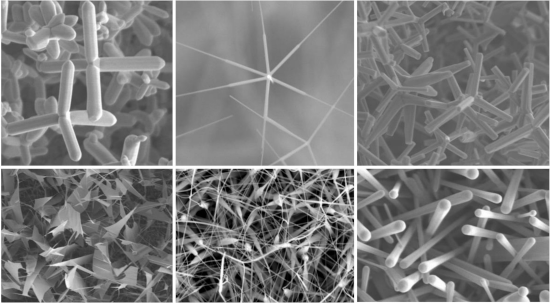
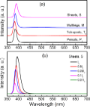
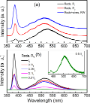
- . Depending on the morphology and crystal quality, their photoluminescence spectra have only a strong UV emission associated with the exciton radiative recombination, or both UV and defect-related visible emissions with their relative intensity ratio varying with the excitation power density. The obtained
- . They converge at the origin with a size of ≈100 nm. For the second morphology, named T2 in Figure 3b, the tetrapods have long arms of 8–10 μm, where arms are nanorods with diameters of 200–500 nm. Another tetrapod type shown in Figure 3c, named T3, has a morphology similar to that of T2 but with



A biomimetic approach towards a universal slippery liquid infused surface coating
Beilstein J. Nanotechnol. 2024, 15, 1376–1389, doi:10.3762/bjnano.15.111
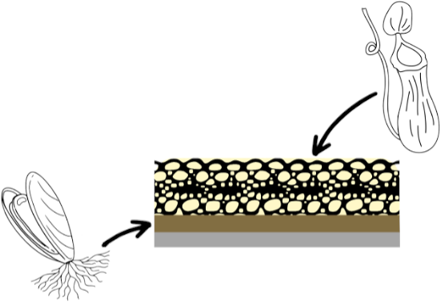
- spectroscopy. Finally, ordering of specific chemical groups within our PDA SLIPS layer was determined via sum frequency generation spectroscopy. The hemocompatibility of our new PDA-based SLIPS coating was then evaluated by tracking FXII activation, fibrin generation time, clot morphology, and platelet
- baseline absorbance value. 5% is a sufficient threshold to overcome the noise floor of the data [33]. Clot morphology Wells of interest of a non-treated 96-well polystyrene were blocked with 300 μL 1% BSA in Milli-Q water for 2 h at 37 °C. After 2 h, wells were rinsed three times with Milli-Q water. Plates
- pathway dominates [47]. Thus, in this investigation we took one of our newly created PDA SLIPS samples (PDA–FDT–PFD on COC) and characterized it in terms of FXII activation, fibrin generation time, clot morphology, and platelet adhesion and activation. Previously, Badv et al. hypothesized that the




Green synthesis of carbon dot structures from Rheum Ribes and Schottky diode fabrication
Beilstein J. Nanotechnol. 2024, 15, 1369–1375, doi:10.3762/bjnano.15.110
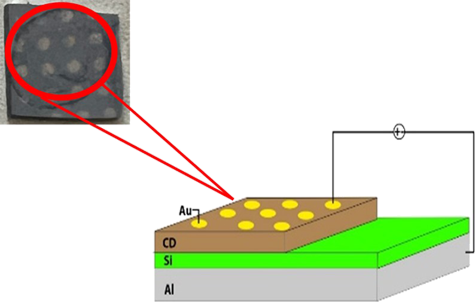
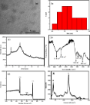
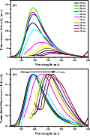
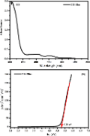
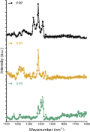
- synthesis, which is commonly used in the literature. TEM and zeta potential measurements were used to determine morphology and sizes of the CDs, and XRD, XPS, and FTIR and micro-Raman spectroscopy were used for structural characterization. Optical characterization of the CDs was done by absorption and
- study, Rheum ribes, which grows wild in the Eastern Anatolia region of Turkey, was used as a carbon source for the first time, and fluorescent carbon dot structures (CDs) were successfully synthesized in a single step by the hydrothermal synthesis method. Morphology, size, and surface charge of these