


Search results
Search for "UV–vis absorption" in Full Text gives 155 result(s) in Beilstein Journal of Nanotechnology.
Variations in the structure and reactivity of thioester functionalized self-assembled monolayers and their use for controlled surface modification
Beilstein J. Nanotechnol. 2012, 3, 213–220, doi:10.3762/bjnano.3.24
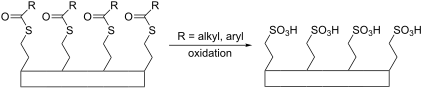
- wavelengths. This was compared to irradiations done with a broad-spectrum, longer-wavelength UV lamp (UV-A, 320–400 nm). Since the UV–vis absorption spectra of all compounds 1 were the same, only 1a was used in the comparisons to the photo-oxidation behavior of compounds 2–4 at longer wavelength. The SAMs


Surface functionalization of aluminosilicate nanotubes with organic molecules
Beilstein J. Nanotechnol. 2012, 3, 82–100, doi:10.3762/bjnano.3.10
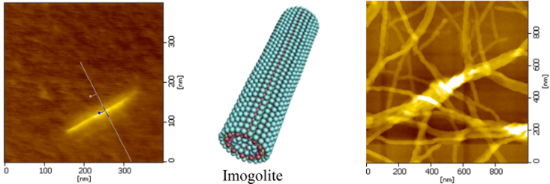
- P3HT/HT3P-imogolite nanofiber hybrid. Reprinted with permission from W. O. Yah et al., J. Phys.: Conf. Ser. 2011, 272, 012021 [86]. © IOP Publishing 2011. UV–vis absorption spectra of P3HT (a) and P3HT/HT3P-imogolite hybrid (b) in anisole (0.0005%) during cooling. Reprinted with permission from W. O


Novel acridone-modified MCM-41 type silica: Synthesis, characterization and fluorescence tuning
Beilstein J. Nanotechnol. 2011, 2, 284–292, doi:10.3762/bjnano.2.33
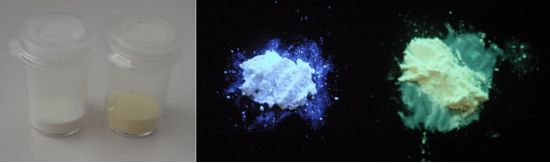
- absorption emerges at 1613 cm−1. The redshift of the absorption frequency is conclusive with respect to the weakened C=O double bond caused by the electron donation from the carbonyl unit to the scandium(III) cation, which is also evident in the UV–vis absorption of MCM-ACR (see below in Figure 9). According
- 0.17 nm point resolution. The UV–vis absorption and fluorescence of the precursor were measured using a Perkin–Elmer Lambda 900 and a Horiba Jobin–Yvon Fluorolog 3-22 τ in steps of 0.1 nm and 1.0 nm, respectively, the SiO2-cuvettes used had a width of 1.0 cm. Solid state UV–vis measurements were
- ). Overlay of the solid state UV-vis (top) and fluorescence (bottom) spectra of MCM-ACR, MCM-ACR + Sc(OTf)3 and pure Sc(OTf)3 (fluorescence excitation wavelength λex. = 400 nm). UV–vis-absorption intensities are not normalized to a given value; fluorescence has been normalized to an intensity of 1.0. Sc(OTf


Twofold role of calcined hydrotalcites in the degradation of methyl parathion pesticide
Beilstein J. Nanotechnol. 2011, 2, 99–103, doi:10.3762/bjnano.2.11
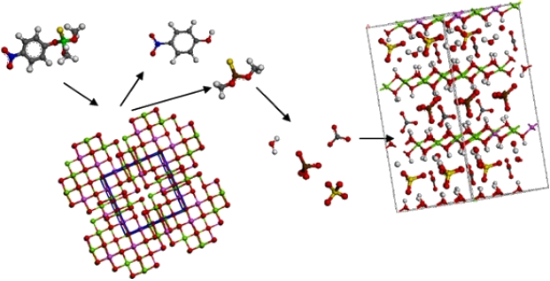
- the ability to regenerate the layered structures of HTs by the “memory effect” in the presence of anions released during MP degradation. Degradation of MP: Figure 1 shows the UV–vis absorption spectra of the solution after stirring MP with the Mg–Al, Zn–Al and Ni–Al mixed oxides (see Supporting


Enhanced visible light photocatalysis through fast crystallization of zinc oxide nanorods
Beilstein J. Nanotechnol. 2010, 1, 14–20, doi:10.3762/bjnano.1.3
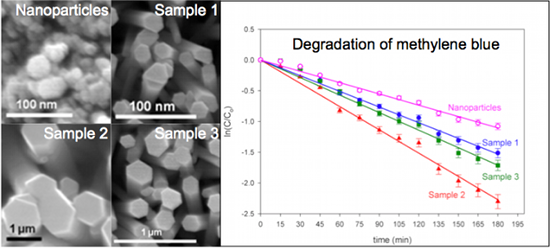
- polar face. Degradation of methylene blue as a function of ln(C/C0) versus the time of exposure to light in the presence of ZnO nanorods synthesized by the conventional method (Sample 2 with surface area ≈ 47.54 cm2) and the fast crystallization method (surface area ≈ 33.74 cm2). Inset: UV–vis
- absorption spectra of ZnO nanorods grown by the conventional hydrothermal method and by microwave irradiation of comparable exposed surface area. Estimated effective area of ZnO nanorod surfaces on substrates of size 1 × 3 cm, grown at different reactant concentrations during the hydrothermal growth process


Other Beilstein-Institut Open Science Activities



