


Search results
Search for "ambient conditions" in Full Text gives 320 result(s) in Beilstein Journal of Nanotechnology. Showing first 200.
Intercalation of Si between MoS2 layers
Beilstein J. Nanotechnol. 2017, 8, 1952–1960, doi:10.3762/bjnano.8.196
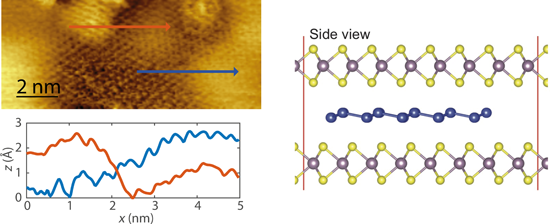
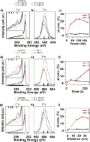
- samples were exfoliated before Si deposition. In a separate UHV chamber, Si was deposited on the MoS2 sample via resistive heating of a small piece of a silicon wafer and then the MoS2 sample was quickly transferred to the XPS chamber. During this transfer the sample was exposed to ambient conditions. The
- , measured at 103 eV, can be attributed to oxidized silicon [48]. The oxidation of Si occurs during the transfer of the sample from the growth chamber to the XPS chamber. During this transfer the sample was exposed to ambient conditions. A more detailed analysis reveals that only 5% of the Si is pristine


Carbon nano-onions as fluorescent on/off modulated nanoprobes for diagnostics
Beilstein J. Nanotechnol. 2017, 8, 1878–1888, doi:10.3762/bjnano.8.188
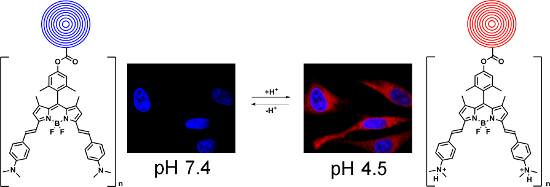
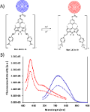
- . Experimental Materials All solvents and reagents were purchased from Sigma-Aldrich in high purity grade. All reactions and measurements were carried out under ambient conditions, unless otherwise stated. Instrumentation Thermogravimetric analysis (TGA) TGA was conducted on a TA Q500 analyzer, using a platinum




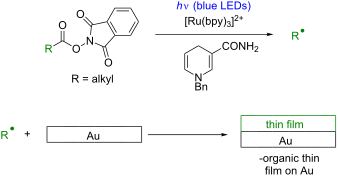
Application of visible-light photosensitization to form alkyl-radical-derived thin films on gold
Beilstein J. Nanotechnol. 2017, 8, 1863–1877, doi:10.3762/bjnano.8.187
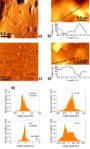
- mode in ambient conditions. The sites of nanopores of uncovered gold substrate that were protected by the mesosphere mask appear as dark circles (Figure 1a). The characteristic features of a gold surface such as triangular terrace steps and flat domains are apparent in the topography image. The
- sample in ambient conditions for six months, using tapping mode AFM (Figure 5). The arrangement and locations of nanopores can still be resolved with AFM topographs (Figure 5a). The surface coverage of the Au–NHBoc film measured 83%, which is consistent with the value measured from the freshly prepared
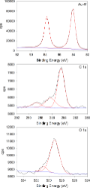
- –NHBoc film after storage in ambient conditions for six months. (a) Topography image; (b) zoom-in view; (c) cursor profile for the line in (b); (d) corresponding phase image of (b). IRRAS Spectrum of Au–Me. IRRAS Spectrum of Au–NHBoc. Au 4f, C 1s and O 1s photoelectron spectra of the deposited Au–Me



Evaluation of preparation methods for suspended nano-objects on substrates for dimensional measurements by atomic force microscopy
Beilstein J. Nanotechnol. 2017, 8, 1774–1785, doi:10.3762/bjnano.8.179
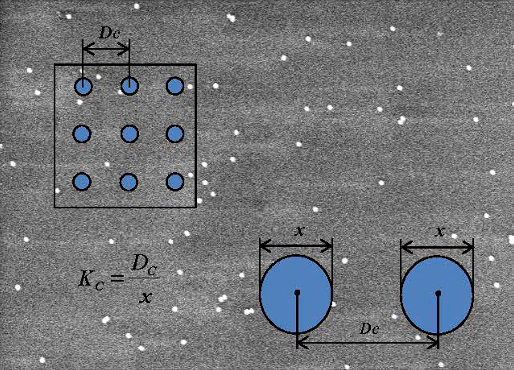
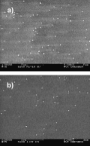
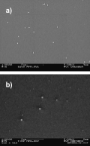
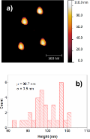
- specimen holder. Drying methods: Conventional drop-drying was realized by supplying one droplet of the conditioned suspension (approx. 5–10 µL) on the conditioned substrate using a micropipette (Model L-200XLS+, Mettler Toledo, Gießen, Germany). The drying procedure was performed under ambient conditions


Fluorination of vertically aligned carbon nanotubes: from CF4 plasma chemistry to surface functionalization
Beilstein J. Nanotechnol. 2017, 8, 1723–1733, doi:10.3762/bjnano.8.173
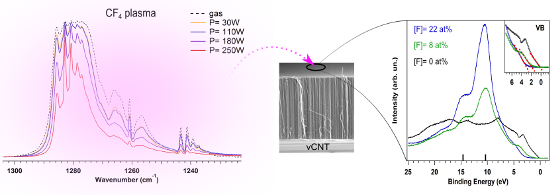
- investigate the evolution of the electronic properties as a function of the fluorine content at the vCNT surface. The samples suffer a limited ageing effect, with a small loss of fluorine functionalities after two weeks in ambient conditions. Keywords: carbon nanotubes; CF4 plasma; fluorination; plasma
- electronic properties of fluorinated vCNT is discussed as a function of the fluorine content and ageing effects are verified after storing the samples for two weeks under ambient conditions. Results and Discussion In the present work, we combine the study of the CF4 plasma chemistry with the analysis of the
- . In Figure 6, we show the evolution of the F (green) and O (blue) concentrations from the as-functionalized vCNT (dark shades) to the samples after being stored two weeks in ambient conditions (light shades). The loss of fluorine is limited to few percent in all samples except for the highly




Air–water interface of submerged superhydrophobic surfaces imaged by atomic force microscopy
Beilstein J. Nanotechnol. 2017, 8, 1671–1679, doi:10.3762/bjnano.8.167
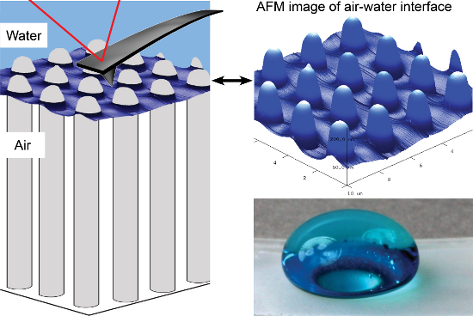
- showing long-term stable air retention, we were able to image the air–water interface by AFM. In Figure 5, the data measured from the ideal sample in ambient conditions and in water are compared. The image of Figure 5a was taken in ambient conditions in tapping mode. It shows a row of pillars validating
- . Characterization by atomic force microscopy (AFM) AFM images were made with a commercial AFM system (Dimension ICON, Bruker) operated by a Nanoscope V controller (Bruker). Imaging under ambient conditions was conducted in tapping mode with NSC 15 cantilevers (MikroMasch) with a nominal force constant of 40 N/m and
- , the interfaces separating the wetted areas from the air-retaining areas followed exactly the alignment of the micro-pillars. AFM images (a, c) and the corresponding cross-sections (red lines in b, d) of the sample. The image in a) was taken in ambient conditions in tapping mode and confirms the pillar



Process-specific mechanisms of vertically oriented graphene growth in plasmas
Beilstein J. Nanotechnol. 2017, 8, 1658–1670, doi:10.3762/bjnano.8.166
- the help of a CCD camera (Apex Instrument Co. Pvt. Ltd., India). The volume of the droplet was about 1 µL and all measurements were carried out under ambient conditions. The value of contact angle was evaluated by half angle fitting method prescribed by Apex instrument. Ag paste was used to make four


Group-13 and group-15 doping of germanane
Beilstein J. Nanotechnol. 2017, 8, 1642–1648, doi:10.3762/bjnano.8.164
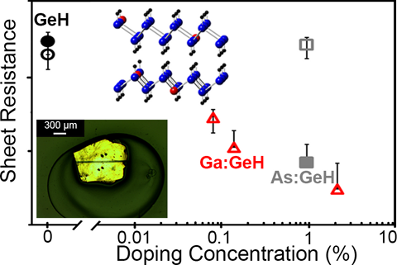
- + oxidation state. For comparison, a Ge(111) wafer having surface oxide contains Ge 2p3/2 peaks at 1216.3 for Ge0, and peaks of oxidized Ge2+ to Ge4+, which range from 1218.2 to 1220.6 eV. Figure 4b shows the Ga 3d5/2 and Ge 3d5/2 XPS spectra for the 2.3% Ga:GeH crystals after exposure to ambient conditions
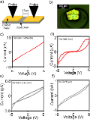
- . Undoped GeH exhibited sheet resistances approaching the noise limit of the instrumentation of the order of ca. 1015 Ω/sq in both vacuum and under ambient conditions, similar to previous studies [29]. Figure 5c,d shows a representative I–V plot for 2.3% Ga:GeH in vacuum and air, respectively. The I–V plot
- again at the actual noise limit of our instrumentation. However, in air, there is an increase in conductivity of at least three orders of magnitude. Figure 5f shows a representative I–V plot of As:GeH in ambient conditions. In contrast to Ga:GeH, the I–V plot is linear, with minimal hysteresis. The I–V



Parylene C as a versatile dielectric material for organic field-effect transistors
Beilstein J. Nanotechnol. 2017, 8, 1532–1545, doi:10.3762/bjnano.8.155
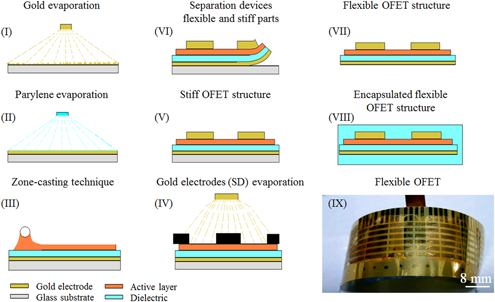
- dielectric, OFETs of adequate transport characteristics are operated under ambient conditions with no need of any extra shielding. After an initial period of a decrease of charge-carrier mobility, the long-term performance stabilizes at a satisfactory operational level. It has to be stressed, however, that
- discussed above were obtained for active materials that were not sensitive to ambient conditions. However, most n-type organic semiconductors do not show such stability. One example of an unstable material (characterized by considerable charge trapping) is the previously described fullerene C60. The
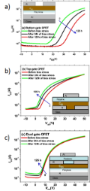
- transistor characteristics of unprotected and Parylene C protected fullerene based devices are presented in Figure 13. Transfer characteristics, monitored under ambient conditions, of non-protected OFETs are shown in Figure 13a. As seen in the figure, the source–drain current (IDS) of a non-encapsulated OFET




Light-induced magnetoresistance in solution-processed planar hybrid devices measured under ambient conditions
Beilstein J. Nanotechnol. 2017, 8, 1502–1507, doi:10.3762/bjnano.8.150
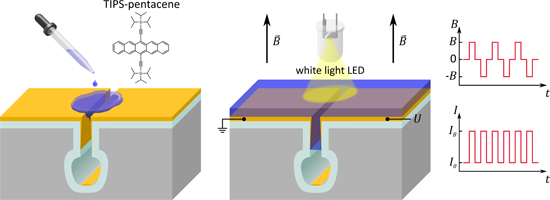
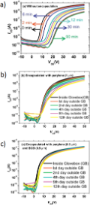
- photocurrent. The magnetoresistance effect was found to diminish over time under ambient conditions compared to a freshly prepared sample. We propose that the much faster degradation of the magnetoresistance effect as compared to the photocurrent was due to the incorporation of water molecules in the TIPS
- reported for other materials such as Alq3 [3]. The observed magnetoresistance effect was found to diminish approximately after two days of sample preparation in case of the HED-TIE devices kept under ambient conditions, while the photocurrent decreased from 120% to only 65%. The photoresponse time, however


Deposition of exchange-coupled dinickel complexes on gold substrates utilizing ambidentate mercapto-carboxylato ligands
Beilstein J. Nanotechnol. 2017, 8, 1375–1387, doi:10.3762/bjnano.8.139
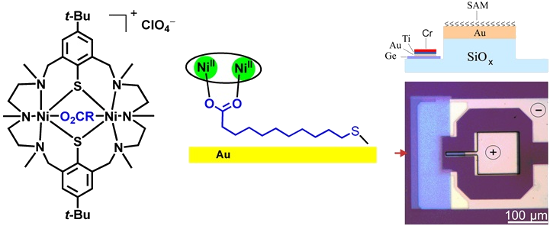
- . Atomic force microscopy An Agilent 5600LS AFM system was used to collect topography data under Ar and ambient conditions in order to keep the integrity of the organic system. Measurements were performed in tapping mode in order to minimize the contact between the AFM probe and the sample surface and
- were recorded under ambient conditions in a spectral range from 0.7 eV to 5 eV at light incidence angles of 65°, 70°, and 75°. The samples were immediately measured after preparation. Gold substrates were cleaned, immersed in a 1 × 10⁻³ M solution of the complexes in CH2Cl2 for at least 12 h, rinsed


Comprehensive Raman study of epitaxial silicene-related phases on Ag(111)
Beilstein J. Nanotechnol. 2017, 8, 1357–1365, doi:10.3762/bjnano.8.137
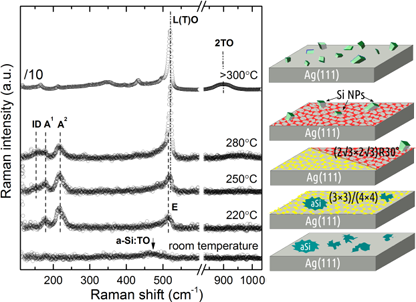
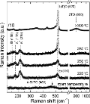
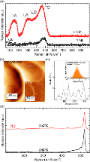
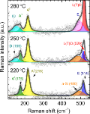
- detected. Ex situ AFM images of this sample recorded under ambient conditions, i.e., after oxidation in air, are displayed in Figure 3b. Raman spectra obtained before and after air exposure are identical confirming that the oxidation process in air does not cause the appearance of those new features



Bright fluorescent silica-nanoparticle probes for high-resolution STED and confocal microscopy
Beilstein J. Nanotechnol. 2017, 8, 1283–1296, doi:10.3762/bjnano.8.130
- under ambient conditions. The UV–vis spectra of diluted and undiluted solutions were recorded with a Cary 5000 spectrophotometer (Varian Inc., Darmstadt, Germany) in the range from 300 to 800 nm. Fluorescence spectra were obtained with a spectrofluorometer Spex FluoroMax-3 from HORIBA Jobin Yvon


Metal oxide nanostructures: preparation, characterization and functional applications as chemical sensors
Beilstein J. Nanotechnol. 2017, 8, 1205–1217, doi:10.3762/bjnano.8.122
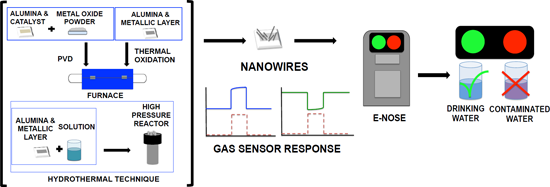
- in a test chamber of 1 L volume enclosed in a custom-made climatic chamber, set at 20 °C, to remove any influence from external ambient conditions. A fixed voltage of 1 V was applied to the sensing element of each sensor, while the current flowing was measured by picoamperemeters (Keithley). The


Preparation of thick silica coatings on carbon fibers with fine-structured silica nanotubes induced by a self-assembly process
Beilstein J. Nanotechnol. 2017, 8, 1145–1155, doi:10.3762/bjnano.8.116
- methanol, dried under ambient conditions and subsequently dissolved in water by neutralizing with 25 wt % aqueous ammonia solution. The clear polymer solution was transferred into dialysis tubing (Aldrich, cellulose membrane, typical molecular weight cut-off: 3500 kDa) and the dialysis was carried out
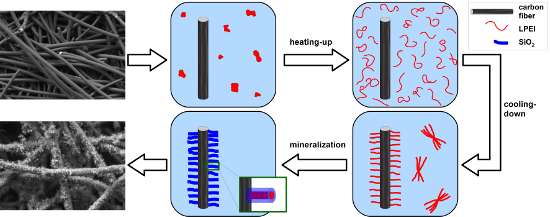
- centrifugation, washed with water and ethanol and dried at ambient conditions leading to white silica powders. Calcination of the LPEI/silica hybrid material was performed in air atmosphere with a heating rate of 1.5 K/min up to a maximum temperature of 475 °C at which the sample was kept for 90 min. In the case


Growth, structure and stability of sputter-deposited MoS2 thin films
Beilstein J. Nanotechnol. 2017, 8, 1115–1126, doi:10.3762/bjnano.8.113
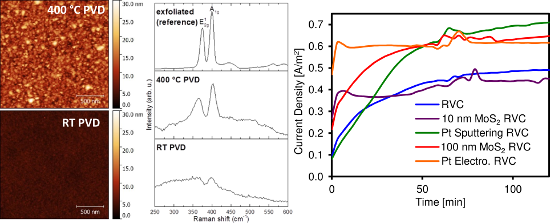
- , electron beam and light scattering, scanning and spectroscopic methods as well as electrical device characterization. We find that room-temperature-deposited MoS2 films are amorphous, of smooth surface morphology and easily degraded upon moderate laser-induced annealing in ambient conditions. In contrast
- annealing conditions. Our in situ laser annealing experiments therefore show that the amorphous MoS2 films deposited at RT are very unstable and easily oxidized upon increased energy input in ambient air whereas nanocrystalline films deposited at 400 °C remain comparatively stable in ambient conditions when


ZnO nanoparticles sensitized by CuInZnxS2+x quantum dots as highly efficient solar light driven photocatalysts
Beilstein J. Nanotechnol. 2017, 8, 1080–1093, doi:10.3762/bjnano.8.110
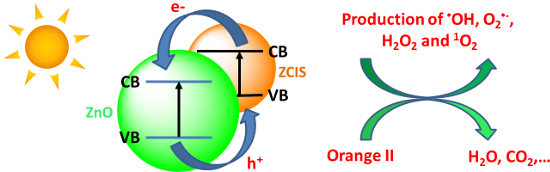
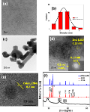
- the ZnO/ZCIS nanoparticles was determined using a Malvern Zetasizer Nano ZS instrument. All the optical measurements were conducted at room temperature (20 ± 1 °C) under ambient conditions. The absorption spectra of liquid samples were recorded on a Thermo Scientific Evolution 220 UV–visible




The integration of graphene into microelectronic devices
Beilstein J. Nanotechnol. 2017, 8, 1056–1064, doi:10.3762/bjnano.8.107
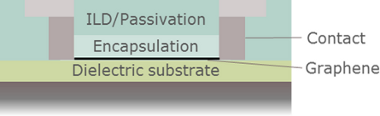
- passivated (Figure 4) and was stable for a longer period of time under ambient conditions [50]. The main problem of growing Al2O3 by ALD is to obtain a continuous nucleation layer on graphene to start the deposition. To solve this problem several approaches are proposed. One solution is the deposition of a


Structural properties and thermal stability of cobalt- and chromium-doped α-MnO2 nanorods
Beilstein J. Nanotechnol. 2017, 8, 1032–1042, doi:10.3762/bjnano.8.104
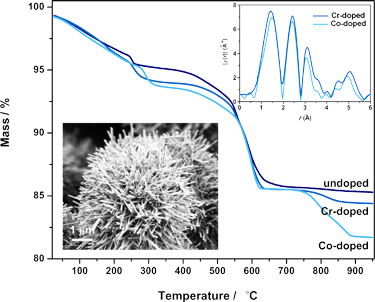
- birnessite-type MnO2 nanoparticles, synthesized under ambient conditions from KMnO4 and ethylene glycol, doping with Co prevented agglomeration and increased the specific surface area. The prepared materials possess a very high specific capacity and are potential candidates for supercapacitors [23]. Co-doped


Study of the correlation between sensing performance and surface morphology of inkjet-printed aqueous graphene-based chemiresistors for NO2 detection
Beilstein J. Nanotechnol. 2017, 8, 1023–1031, doi:10.3762/bjnano.8.103
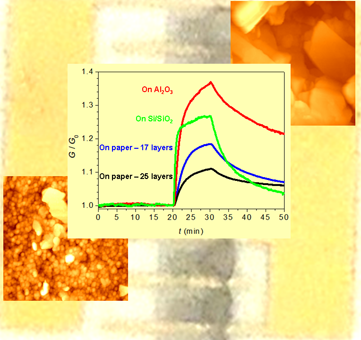
- surface tension of the prepared dispersion has been evaluated by using the contact angle equipment OCA20-Dataphysics in pendant drop configuration. The measurements have been performed under ambient conditions (21 °C, RH 50%) and the estimated value has been the result of measurements repeated five times
- temperature and under ambient conditions. Sensor-device fabrication Different substrates, paper (Epson, premium glossy photo paper), alumina (purity 96%, Rockwell hardness = 82, resistivity > 1014 Ω·cm, roughness = 12–20 microinches) and Si/SiO2 (thermal oxide 300 nm, Silicon Valley), with gold electrodes


High photocatalytic activity of Fe2O3/TiO2 nanocomposites prepared by photodeposition for degradation of 2,4-dichlorophenoxyacetic acid
Beilstein J. Nanotechnol. 2017, 8, 915–926, doi:10.3762/bjnano.8.93
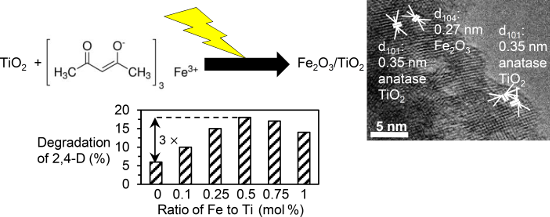
- out at ambient conditions [14]. Even though high activity was obtained, evidence of the formation of good contact between Fe2O3 and TiO2 nanoparticles was not provided. Recently, the photodeposition method has been proposed as a suitable method to directly investigate the role of added copper or
- /TiO2 catalysts without heat treatment at ambient conditions. Using iron(III) nitrate nonahydrate as the precursor, active and stable Fe2O3/TiO2 was successfully prepared via photodeposition [15]. However, the actual amount of iron precursor in the prepared Fe2O3/TiO2 was much lower than that added. In


Bio-inspired micro-to-nanoporous polymers with tunable stiffness
Beilstein J. Nanotechnol. 2017, 8, 906–914, doi:10.3762/bjnano.8.92
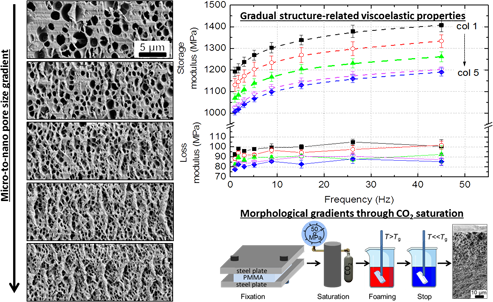
- overall damping capability of the material. All tests were conducted at room temperature (25.5 °C) under ambient conditions. The measurements were performed at 20 different positions arranged in an array of 5 by 4 (see below in Figure 2b). Results and Discussion Porous PMMA films were produced via a


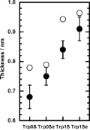
Triptycene-terminated thiolate and selenolate monolayers on Au(111)
Beilstein J. Nanotechnol. 2017, 8, 892–905, doi:10.3762/bjnano.8.91
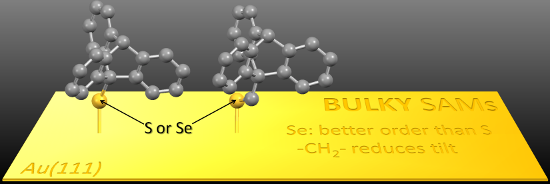
- could be achieved by reacting 9-triptycylmethylselenocyanate with sodium borohydride and subsequent oxidation of the product under ambient conditions (compare Supporting Information File 1). The diselenide obtained this way was reduced with elemental sodium using benzophenone as a catalyst, and reacted




Functional dependence of resonant harmonics on nanomechanical parameters in dynamic mode atomic force microscopy
Beilstein J. Nanotechnol. 2017, 8, 883–891, doi:10.3762/bjnano.8.90
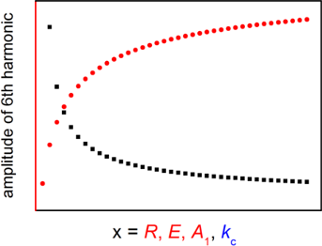
- ambient conditions. The time evolution is expressed in terms of sequentially acquired images. The free oscillation amplitude was set to 30 nm and setpoint to Asp = 27 nm, respectively. The missing points 3, 4 and 5 correspond to approach curves taken for amplitude calibration. The continuous blue lines


Hybrid nanomaterials: from the laboratory to the market
Beilstein J. Nanotechnol. 2017, 8, 861–862, doi:10.3762/bjnano.8.87

- have specifically adapted micro- and macroscopic properties and emergent phenomena. Materials from the natural world offer extraordinary features, such as self-healing, miniaturization, reconfigurability, and defect tolerance. Moreover, their synthesis typically takes place at roughly ambient
- conditions – often presenting a challenge to chemists, biologists, physicists, and engineers in its full complexity. In spite of these challenges, we nowadays have a basic understanding of how (desired) material properties are related to material composition and structure. One of the key observations in this



